
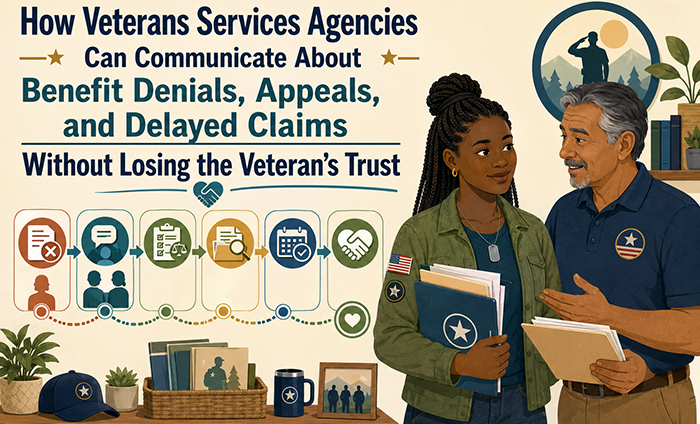
How Veterans Services Agencies Can Communicate About Benefit Denials, Appeals, and Delayed Claims Without Losing the Veteran’s Trust
There is a specific moment in the benefit access process that determines more than any other whether a veteran will persist through the complexity of the system or walk away from benefits they are legally entitled to receive. It is not the moment of initial application, when motivation is highest and the future feels open. It is not the moment of the Compensation and Pension exam, when anxiety is high but the process is still in motion. It is the moment when a denial letter arrives, or when months have passed without any status update, or when a rating decision comes back at a level the veteran believes is wrong. In that moment, the veteran faces a choice: stay in the process and fight for what they believe they are owed, or conclude that the system is not going to work for them and disengage.
What the veteran decides in that moment is shaped in significant part by how they have been communicated with up to that point and how they are communicated with at that point. A veteran who has been kept informed throughout the process, who understands what is happening and why, who has a CVSO representative they trust and can reach, and who receives the denial or delay with a clear explanation of what it means and what options are available, is a veteran who has the informational and relational foundation to make an informed decision about whether to appeal or re-engage. A veteran who has been in the dark throughout the process, who receives a dense regulatory denial letter without translation or context, who cannot reach the CVSO because no clear communication channel has been established, and who concludes from the system’s behavior that it was never going to help them anyway, is a veteran who has been failed by the communication environment before the denial or delay has even been fully processed.
The communication challenge of denial, delay, and appeals is one of the most demanding in the veterans services landscape because it requires maintaining trust with a veteran who has just received bad news, explaining complex regulatory determinations in plain language without either minimizing their significance or making them feel final and irreversible, presenting appeal options in ways that are honest about what appeal involves and what outcomes are realistic without either discouraging legitimate appeals or raising unrealistic expectations, and sustaining a helping relationship through a difficult and potentially extended bureaucratic process that may include multiple rounds of frustration and disappointment before it produces a favorable outcome.
This article provides a comprehensive framework for communication at the denial, delay, and appeals stages of the veterans benefit access process, covering the specific communication principles that maintain trust through difficult bureaucratic moments, the plain-language design of denial communications, the explanation of appeal rights in terms that are actionable rather than overwhelming, the relational practices that sustain the helping relationship through extended and difficult processes, the specific communication needs of veterans who have received denials after prior denial experiences, and the organizational practices that ensure consistent and high-quality communication at these critical junctures. The goal throughout is communication that serves the veteran’s actual interests at the most difficult moment in the benefit access process rather than communication that serves the agency’s administrative convenience or the system’s self-presentation.
The context for this communication work includes the recognition that denial and delay are not exceptional events in the veterans benefit process. They are predictable and common features of a system that is genuinely complex, that requires specific types of evidence that veterans do not always have available, and that processes large volumes of claims with the result that individual claims sometimes fall through gaps or are processed with errors. Veterans who are prepared for the possibility of denial or delay, and who have the information and the support they need to navigate these outcomes when they occur, are in a fundamentally better position than veterans who encounter denial or delay as a surprise without the communication support needed to respond effectively.
The Psychology of Denial and How Communication Must Respond
 Understanding the psychological experience of receiving a benefits denial is essential for designing communication that responds to that experience rather than to the administrative fact of the denial itself. A denial letter is not simply a piece of information about the outcome of an administrative process. It is an event that activates specific psychological responses in the veteran who receives it, responses that are shaped by the veteran’s prior experiences with institutional systems, by what the denial represents for their financial and healthcare situation, by how much emotional investment they made in the claim, and by whether the denial confirms or contradicts expectations they had formed about how the system would treat them.
For many veterans, particularly those from communities with historical reasons to distrust government institutions, a denial confirms an expectation they may have held throughout the claims process: that the system was not going to recognize what they experienced and what they deserve. This confirmation of prior distrust is among the most psychologically powerful effects of a denial, and it is also the effect most resistant to communication correction. A veteran who receives a denial as confirmation of their prior belief that the VA was never going to help them is not simply receiving disappointing news. They are having a deeply held belief validated by institutional behavior, and that validation makes them less likely to engage further with the system regardless of how clearly they are told that appeal is possible and that their case may be reconsidered.
For veterans who had higher expectations of a favorable outcome, a denial produces a different but equally significant psychological response: a sense of betrayal or injustice that is often experienced as more personal than bureaucratic. A veteran who believed their service-connected condition was clearly documented and clearly qualifying may experience a denial not as an administrative determination but as a statement about whether the system believes and values their experience of service and its consequences. This experience of denial-as-disbelief is particularly common and particularly damaging among veterans who have already told their story multiple times across the claims process, and who interpret the denial as a final verdict on the legitimacy of that story.
Communication at the denial point must respond to both of these psychological realities simultaneously: it must meet the veteran where they are emotionally, acknowledge the difficulty and the significance of what they have just received, and provide a specific and actionable pathway forward that does not minimize the challenge ahead but also does not confirm the belief that the situation is hopeless. This is a communication task of genuine difficulty, one that requires both emotional intelligence and informational precision in the same interaction, and that cannot be accomplished through a standard denial communication letter alone regardless of how well that letter is written.
The CVSO’s Role as a Human Buffer Against Bureaucratic Communication Failure
The VA’s denial letters, even when they have been improved in quality and accessibility, remain documents that were designed for administrative purposes and that carry the weight of regulatory language, legal citation, and institutional framing that is alien and often alienating to the veterans who receive them. No degree of plain-language revision will make a denial letter a document that a veteran receives easily or that fully communicates what they need to know about their options and next steps. The letter is an administrative communication. What the veteran needs at the moment of denial is human communication, and that human communication is the CVSO’s role.
A CVSO that has established a genuine relationship with the veteran throughout the claims process, that has communicated regularly and proactively, and that has established clear channels for the veteran to reach out and to be reached, is positioned to provide the human communication that the denial letter cannot. The CVSO representative who calls the veteran before or immediately after the denial letter arrives, who can translate what the letter says into plain human terms, who can acknowledge the veteran’s disappointment before launching into the options available, and who can convey through the quality of the communication that the CVSO’s commitment to helping the veteran has not been changed by the denial, is providing the relational and informational support that determines whether the veteran stays in the process.
The timing of the CVSO’s outreach at the denial point is critical. A call that comes before the veteran has opened the denial letter can prepare them for what is coming and ensure that they open it with the context they need to interpret it accurately. A call that comes immediately after the denial letter is likely to have arrived allows the CVSO to address the letter’s specific content directly and to be present in the moment of the veteran’s first response to the news. A call that comes weeks after the denial letter has arrived is communicating through its tardiness that the CVSO’s response to the veteran’s difficult moment was not urgent, which is itself a damaging message in a moment when the veteran is most susceptible to the belief that the system is not on their side.
Serving Those Who Served: Communication Strategies for Veterans Agencies
This article is part of our series on strategic communication for Veterans Services Agencies, County Veterans Services Offices, State Departments of Veterans Affairs, and community-based veteran support organizations. To learn more and to see the parent article, which links to other content just like this, click the button below.
Plain-Language Denial Communication
The plain-language principles described throughout this series apply with particular force to denial communications, because the combination of technical regulatory language and emotionally difficult content that characterizes denial letters creates comprehension barriers that are more significant than those associated with standard program descriptions. A veteran who does not fully understand what a denial letter says cannot make informed decisions about whether to appeal, what grounds to appeal on, or what additional evidence might support a successful supplemental claim. The comprehension failure is therefore not only a communication failure but an access failure: it prevents the veteran from exercising the appeal rights the law provides.
The most fundamental plain-language principle for denial communication is to lead with what the veteran most needs to know, which is not the regulatory basis for the denial but the practical meaning of the denial for their situation and the options that remain available to them. A denial letter that opens with an explanation of what was denied, why it was denied in plain terms, what the veteran can do about it, and how much time they have to take each available action, provides the veteran with the orienting information they need before engaging with the regulatory detail of the denial rationale. This sequence inverts the typical administrative letter structure, which leads with formal regulatory citation before reaching the practical implications, but it is far more useful to the veteran who is reading the letter under conditions of emotional stress and cognitive load.
The reason for the denial must be communicated in specific and plain terms rather than in the generic regulatory language that denial letters typically use. A denial that says ‘service connection not established due to insufficient evidence of nexus’ is technically accurate but practically useless to a veteran who does not know what nexus means, what evidence would have established it, or what they would need to do to establish it in an appeal or supplemental claim. A denial communication that says ‘Your claim was denied because the evidence did not show a clear connection between your current condition and an event, injury, or illness that occurred during your military service. To have a chance at a different outcome, you would need additional evidence that makes this connection clear, such as a doctor’s letter that specifically addresses how your current condition is related to your service’ is providing the specific actionable information that allows the veteran to understand what happened and what they need to do about it.
The timeline information in denial communications is among the most important and most frequently unclear information the communication must convey. Veterans have specific and sometimes short windows within which they can file appeals or supplemental claims with specific strategic advantages, and missing these windows can affect their rights in ways that are difficult or impossible to reverse. The plain-language communication of these timelines must be specific about the starting date of the window, which is the date of the decision letter, not the date the veteran receives it or reads it; the length of the window; and what happens to the veteran’s options after the window closes. This information should be prominently highlighted rather than embedded in the middle of a paragraph with other denial rationale information.
Translating Rating Decision Language
For denials that are partial rather than complete, including rating decisions that grant service connection at a lower disability percentage than the veteran believes is appropriate, the communication challenge extends beyond explaining why service connection was denied to explaining how the rating was determined, why the veteran might believe it is too low, and what the options are for seeking a higher rating. The combined rating formula, described in earlier articles in this series, is a source of significant confusion for veterans who receive a combined rating that seems mathematically impossible, and denial communication at the rating stage must address this confusion directly.
A plain-language explanation of how the rating was calculated, using the specific percentages assigned to each of the veteran’s conditions and walking through the whole-person calculation that produces the combined rating, is an essential component of the rating decision communication for veterans who receive a combined rating that surprises them. This explanation should be accompanied by an explicit acknowledgment that the combined rating formula produces results that seem counterintuitive to most veterans who encounter it for the first time, which validates the veteran’s confusion without confirming that the calculation is wrong. The goal is to help the veteran understand what the rating means and what options they have for seeking a different determination, not to persuade them that the rating is correct.
The specific appeal options available for rating decisions that the veteran believes are too low include the Higher-Level Review lane, in which a more senior VA adjudicator reviews the same evidence for error; the Supplemental Claim lane, in which the veteran submits new and relevant evidence for a fresh adjudication; and the Board of Veterans Appeals lane, in which the veteran may request a hearing before a Veterans Law Judge. Each of these lanes has different requirements, different timelines, and different strategic implications that should be communicated in plain language specific enough to allow the veteran to make an informed choice among them rather than presenting all options with equal emphasis as though they are interchangeable.
Explaining Appeal Rights Without Creating Overwhelm
The explanation of appeal rights following a denial or an unsatisfactory rating decision is one of the most information-dense communication tasks in the veterans services context, and the density of the information creates a real risk of overwhelming the veteran rather than empowering them. A veteran who receives a comprehensive explanation of all available appeal options, with all relevant timelines, requirements, and strategic considerations presented with equal emphasis and equal complexity, may feel more paralyzed after the explanation than before it, because the sheer volume of information has increased cognitive load without providing the specific direction they need to take the next step.
The antidote to information overwhelm in appeal rights communication is specificity rather than comprehensiveness. A CVSO representative who, after reviewing the denial with a veteran, says ‘Based on what I know about your case, I think the Supplemental Claim lane is probably the right approach for you, because the primary reason your claim was denied is a nexus issue that an independent medical opinion would address, and the Supplemental Claim lane allows you to submit that opinion as new evidence,’ is providing the specific directional guidance that converts the general information about appeal options into an actionable specific recommendation. The veteran does not need to understand all three appeal lanes equally. They need to understand the one that is most likely to serve their specific situation.
The conversational explanation of appeal rights, whether delivered in person, over the phone, or through a written communication that adopts a conversational register, should explicitly acknowledge the emotional weight of the appeal decision the veteran faces. Telling a veteran that they have appeal options without acknowledging that pursuing an appeal requires them to invest more time, more energy, and more emotional exposure in a process that has just disappointed them, is communicating in a way that ignores the real cost of what the appeal recommendation implies. An honest acknowledgment of that cost, combined with a specific and credible assessment of the veteran’s prospects in an appeal, allows the veteran to make a genuinely informed decision about whether to proceed rather than a decision made without full awareness of what they are committing to.
The specific timeframes for each appeal option must be communicated with precision and emphasis, because missing an appeal deadline is one of the most consequential and least recoverable mistakes a veteran can make in the benefit access process. The communication should be explicit about which day the clock started, how many days remain, what the veteran needs to do before the deadline passes, and what help the CVSO can provide in meeting the deadline. For veterans who are close to a deadline when they contact the CVSO, the urgency of the timeline should be communicated with appropriate directness rather than buried in a comprehensive explanation of all appeal options that the veteran does not have time to fully evaluate.
Written Appeal Rights Summaries
In addition to verbal explanation of appeal rights, veterans should receive a written summary of the specific appeal options available in their specific situation, the relevant timelines, the evidence or documentation that would support each option, and the specific next steps for pursuing the recommended option. This written summary serves as a reference that the veteran can consult after the initial conversation, when the emotional intensity of the denial moment has receded and they can engage more fully with the practical planning of their appeal strategy.
The written appeal rights summary should be personalized to the specific denial rather than a generic description of VA appeal options. A summary that references the specific conditions denied, the specific reasons cited for the denial, and the specific evidence that would address those reasons in each available appeal lane, is substantially more useful than a generic appeal rights summary that the veteran must mentally translate to their specific situation. Personalization of this summary requires more staff time than providing a standard document, but the investment is justified by the significantly higher likelihood that a personalized summary will be read, understood, and acted upon by the veteran receiving it.
The written summary should also include the CVSO representative’s direct contact information and an explicit invitation to call with questions, to follow up on any aspect of the appeal options that needs further explanation, and to schedule an appointment for appeal filing assistance when the veteran is ready to proceed. This explicit invitation, combined with clear contact information, maintains the helping relationship through the period between the denial communication and the veteran’s decision about whether and how to appeal, ensuring that the CVSO remains accessible to the veteran during the period when they most need accessible support.
Communicating About Delayed Claims
 Claim delays are a different communication challenge from denials because they do not convey a decision about the veteran’s claim but a status situation that the veteran may be tempted to interpret as a decision in disguise. Veterans who have been waiting for a claim to be processed for many months without any update frequently develop the belief that the silence indicates a denial that is coming or has already been made without notification. This interpretation of silence as bad news is psychologically understandable, particularly for veterans from communities whose prior experiences with government institutions have given them reason to expect the worst, but it is often inaccurate and it produces the same disengagement behavior that actual denials produce.
The communication antidote to the delay interpretation problem is exactly what has been described throughout this series: proactive, regular status communication that explicitly tells the veteran what is happening with their claim and that specifically addresses the anxiety about silence. A CVSO representative who contacts a veteran whose claim has been pending for six months and says ‘I am reaching out because I know this wait is difficult. Your claim is still in process at the regional office and we have not received a decision. This does not mean anything is wrong; processing times are currently running in this range for claims like yours. I will contact you again in 60 days or earlier if anything changes,’ is providing a communication that replaces the silence that breeds anxiety with a specific update that validates the veteran’s impatience, provides accurate status information, and maintains the relationship through a waiting period that could otherwise become a disengagement period.
Status communication during claims delays should include not only the current status of the claim but specific information about the factors that affect processing time and what is likely to happen next. A veteran who understands that their claim includes a request for a Compensation and Pension exam, that the exam has been scheduled but not yet completed, and that the processing of the claim will accelerate once the exam results are received, has a specific picture of the claims process that reduces the ambiguity of the waiting period and reduces the tendency to interpret absence of resolution as absence of progress. The more specific and accurate the status information, the more effectively it counters the silence-as-bad-news interpretation that drives claim abandonment during processing delays.
For claims that have been delayed beyond the typical processing timeframe for similar claims, the CVSO should communicate proactively about options for accelerating the claim, including expedited processing requests for veterans facing financial hardship, for claims involving terminal illness, and for veterans with homelessness or imminent housing instability. These expedited processing options exist specifically for situations where the standard processing timeline creates serious harm, and veterans who qualify for them should be informed of the option proactively rather than discovering it through their own research or not discovering it at all.
The Communication of Suspense Dates and Processing Milestones
Veterans who understand the specific milestones in their claims processing, including the completion of specific review stages, the scheduling and completion of C&P exams, the request for and receipt of records from various sources, and the entry of their claim into the decision queue, have a more concrete and less anxiety-producing experience of the waiting period than veterans who are simply told their claim is in process without further specification. The communication of these milestones, when they occur and when they are expected to occur, converts the claims process from an opaque bureaucratic experience into a transparent process that the veteran can follow and understand even when the outcome is uncertain.
The VA’s online claims tracking system, which allows veterans to check the status of their claims through a digital interface, is a valuable tool for milestone transparency, but it is not sufficient on its own for veterans who need the human context that converts status information into meaningful understanding. A veteran who sees that their claim has moved to a specific processing stage but who does not know what that stage means, how long it typically takes, or what will happen next, has received information without comprehension. The CVSO’s communication role is to provide the human context that converts the system’s status information into meaningful understanding of what is happening and what to expect.
Maintaining the Helping Relationship Through Difficult Processes
The most consequential communication achievement at the denial and delay stages of the benefit access process is not the specific information conveyed about denial reasons or appeal options. It is the maintenance of the helping relationship between the CVSO and the veteran through a period that could easily damage or sever that relationship. A veteran who, at the end of a denial or delay communication, feels that the CVSO is genuinely on their side, that the CVSO’s commitment to helping them has not been diminished by the bad news they have just received, and that the CVSO will continue to be available and engaged as they navigate whatever comes next, is a veteran who is significantly more likely to persist in the process than a veteran who does not have this sense of continued relational support.
Maintaining the helping relationship through difficult moments requires specific communication practices that go beyond the informational content of the communication. It requires that the CVSO acknowledge the difficulty of the news before providing information about options, because a veteran who does not feel heard is less receptive to the information that follows the acknowledgment than one who does. It requires that the CVSO be honest about the challenges of the path ahead without either minimizing those challenges or suggesting that they are insurmountable. It requires that the CVSO be specific about what they will do to help rather than vague about their continued availability. And it requires that the CVSO follow through on the specific commitments made during the difficult moment, because a CVSO who promises to research a specific appeal option and then does not follow up has communicated through their behavior that the commitment was not genuine.
The specific language of maintaining the helping relationship at the denial point includes explicit statements of continued commitment: ‘I am still in your corner on this,’ ‘This is not the end of the road for your claim, and I am going to help you figure out what to do next,’ and ‘I want you to know that my job here is to help you get what you are entitled to, and a denial does not change that.’ These statements are not empty reassurances: they are specific communications about the nature of the CVSO’s role and commitment that correct the veteran’s potential interpretation that the denial has somehow changed what the CVSO is able or willing to do for them.
The CVSO’s own emotional tone during denial and delay communications is a communication factor that is often underappreciated but that veterans register clearly. A representative who communicates with genuine empathy, who seems to personally care about the veteran’s situation and to be genuinely committed to helping them find the best available path forward, is providing a qualitatively different communication experience than a representative who delivers the same informational content in a procedural tone that signals professional competence without personal investment. The emotional tone is not a substitute for information quality, but it is an essential dimension of the communication that determines whether the veteran experiences the interaction as genuinely supportive or as efficiently processed.
Supporting Veterans Who Have Multiple Prior Denials
Veterans who are filing claims for the second, third, or fourth time, having been denied in prior attempts, present a specific communication challenge because they have experienced the system’s failure to recognize their claims in the past and may carry significant distrust, cynicism, and emotional exhaustion from those prior experiences into their current engagement. Communication with this population requires specific acknowledgment of their prior experience before any other content is introduced, because a communication that proceeds as though the veteran’s history with the system does not exist will be received as either ignorant of that history or dismissive of it, either of which compounds rather than addresses the trust deficit that prior denials have produced.
The acknowledgment of prior denial experience in CVSO communication with this population should be genuine and specific rather than generic and formulaic. ‘I know you have been through this before and that it has been frustrating’ is a minimal acknowledgement that some veterans will receive as pro forma rather than genuine. ‘I see from your records that you filed in 2019 and were denied, and I want to acknowledge that that is a hard experience to have gone through. I also want to tell you that what has changed since then, in terms of both the law and the evidence approach we are going to take, gives me genuine reason to believe this claim has a different chance than the last one did’ is a specific acknowledgment that is informed by the veteran’s actual history and that is connected to a specific basis for the current claim’s improved prospects.
Veterans with multiple prior denials may need more time and more relationship investment at the outset of their current engagement than veterans without that history, specifically because the prior experience has built a trust deficit that takes time to address and that cannot be addressed solely through informational communication. A CVSO who invests in understanding the veteran’s prior experience in some detail, who can speak specifically to what went wrong in prior claims and what is different about the current approach, and who is transparent about the realistic prospects for the current claim without either raising or dismissing false hope, is building the trust relationship that makes productive engagement with the current claims process possible.
Communicating With Veterans Who Disengage After Denial
Some veterans who receive denials do not respond to the CVSO’s follow-up communication and effectively disengage from the process. These veterans represent a specific outreach challenge that is described more fully in the PACT Act re-engagement article earlier in this series. For the specific context of post-denial disengagement, the communication approach must address the denial experience directly rather than initiating re-engagement as though the denial had not occurred.
Re-engagement outreach to veterans who have disengaged after a denial should be timed with awareness that immediate outreach following a denial may catch the veteran at a moment of peak emotional activation when they are least receptive to a recommendation to persist in the process. Outreach that comes two to four weeks after the denial, when the immediate emotional intensity has moderated, may produce better reception than outreach that comes immediately after the denial letter arrives. This is not a universal rule, and veterans in time-sensitive appeal situations may need immediate outreach regardless of where they are emotionally, but it is a general consideration that should inform outreach timing for veterans who have not responded to the initial denial-point communication.
The specific content of re-engagement communication after post-denial disengagement should acknowledge the denial directly, validate the veteran’s response to it without encouraging sustained disengagement, and provide a specific and compelling reason for considering a different option going forward. If the denial was for lack of nexus evidence and a compelling independent medical opinion is available that addresses the nexus issue, the re-engagement communication should lead with that specific change in the evidentiary landscape rather than with a general invitation to try again. The more specific and credible the reason for renewed engagement, the more likely the communication is to break through the disengagement that the denial produced.
Organizational Practices for Consistent Denial Communication Quality
The quality of denial and delay communication in a CVSO office should not depend on the individual communication style, emotional intelligence, or personal commitment of the specific representative handling each case. It should be produced by organizational practices that establish consistent standards for how denial and delay communications are conducted, what information must be communicated in what sequence, what follow-up must occur within what timeframe, and how the success of the communication in maintaining veteran engagement will be tracked.
Standard operating procedures for denial communication should specify the outreach timing relative to the denial date, the content elements that must be included in both the verbal and written components of the denial communication, the specific timeframes within which appeal options must be communicated before approaching deadlines, the follow-up schedule for veterans who do not respond to initial denial outreach, and the escalation path for veterans who have disengaged and who are approaching appeal deadlines without having indicated whether they intend to pursue appeal. These procedures ensure that the quality of denial communication is organizationally produced rather than individually variable.
Staff training for denial communication, as described in earlier articles in this series, should address both the informational content requirements and the interpersonal communication skills that the denial context requires. Role-playing exercises that simulate denial communications with veterans who have different emotional responses to the news, different levels of prior experience with the system, and different cultural backgrounds that affect how they receive institutional communications, develop the specific communication skills needed for this demanding context in ways that reading a procedure manual cannot.
Tracking of veteran engagement following denial communications provides the organizational data needed to assess whether the denial communication protocols are maintaining veteran engagement as intended or whether specific aspects of the protocols are not producing the expected engagement outcomes. If tracking data shows that veterans who receive denials for specific types of claims are disengaging at higher rates than veterans who receive other types of denials, the agency has specific evidence about where the denial communication protocols need strengthening.
Strategic Communication Support for Veterans Services Agencies
 Communicating with veterans about benefit denials, delays, or appeals requires more than delivering accurate information. These conversations often occur at the most stressful point in the benefits process, when veterans may feel frustrated, uncertain, or discouraged about what happens next. Effective communication helps veterans understand the reason for a decision, the options available to them, and the steps they can take to continue pursuing the benefits and services they may be entitled to receive.
Successful denial and delay communication systems are built through plain-language writing, empathetic messaging, consistent communication standards, staff training, clear appeal guidance, and ongoing evaluation. Veterans facing delays or denials need communication that reduces confusion, explains complex decisions in understandable terms, and provides practical guidance without creating additional barriers. Building trust during these interactions requires communication systems that combine accuracy with compassion and consistency across every point of contact.
Developing this type of communication system requires specialized expertise in plain-language communication, message development, service communication, staff training, content governance, and communication evaluation. Many veterans services agencies choose to partner with external communication specialists such as Stegmeier Consulting Group (SCG) because these capabilities complement the agency’s expertise in veterans benefits while providing the strategic communication knowledge needed to design systems that improve veteran understanding, strengthen trust, and encourage continued engagement throughout the benefits process.
Working alongside veterans services agencies, SCG develops communication strategies that improve how agencies communicate denials, delays, and appeal rights. Support may include developing plain-language decision summaries, creating communication frameworks for appeals and next steps, designing staff training programs that strengthen empathetic communication skills, establishing communication standards for high-stakes interactions, implementing tracking systems that monitor communication quality, and developing measurement frameworks that evaluate communication effectiveness throughout the benefits journey.
As policies, programs, and veteran expectations continue to evolve, communication systems must remain clear, consistent, and responsive. SCG helps agencies establish repeatable communication processes, governance practices, and performance measurement frameworks that enable denial and delay communication to remain accurate, compassionate, and effective while supporting consistent communication across departments, programs, and service channels.
The objective is to create a communication environment in which veterans understand benefit decisions, know what actions they can take next, and remain engaged with the process instead of abandoning potential benefits because of confusion or frustration. By strengthening denial and delay communication systems, agencies are better positioned to improve veteran confidence, support informed decision-making, and help more veterans successfully navigate the path toward the benefits and services they have earned.
Future Trends in Denial and Appeals Communication
The VA’s ongoing modernization of its appeals system, following the implementation of the Appeals Modernization Act, has significantly changed the appeal pathway landscape that CVSO communication must describe and navigate for veterans. The three-lane system, Higher-Level Review, Supplemental Claim, and Board of Veterans Appeals, has been operational long enough to produce emerging evidence about which lanes are most effective for different types of claims and which are producing the most favorable outcomes for different veteran populations. This evidence base is growing, and CVSO communication about appeal options should be updated regularly to reflect the most current evidence about strategic lane selection for different claim types.
Digital tools for appeal tracking and management are evolving in ways that may reduce some of the communication burden currently carried by CVSO staff. Online appeal status tracking, digital notification of processing milestones, and electronic communication of adjudication decisions are all developments that can improve the timeliness and transparency of information reaching veterans during the delay and appeal phases. However, these digital tools supplement rather than substitute for the human communication that is the most important factor in maintaining veteran engagement through difficult bureaucratic processes, and agencies should resist the temptation to substitute digital notification for human relational support at the moments when human support is most essential.
The growing evidence base for the communication practices that are most effective at maintaining veteran engagement through denial and delay experiences will continue to develop as more agencies track engagement outcomes and analyze the relationship between communication practices and engagement behavior. Agencies that participate in this evidence building, through systematic tracking of their own denial communication outcomes and participation in professional networks that share this evidence, will be better positioned to improve their communication practices as the evidence evolves.
Conclusion
The veteran who receives a denial after months of waiting, who is disappointed and perhaps angry, who has a right to appeal but does not know it, and who has no one to explain what the denial means or what to do about it, is a veteran who is at the highest risk of leaving the process permanently at exactly the moment when the process still has the most to offer them. The communication investment required to prevent that outcome, a proactive call, a plain-language explanation, a specific appeal recommendation, a written summary with clear timelines, and a genuine expression of continued commitment to helping the veteran get what they are entitled to, is modest in time and resources relative to the benefit it produces.
Veterans who stay in the process through difficult moments do so, most often, not because they are particularly resilient or particularly informed, but because someone reached out to them at the right moment with the right communication and made them feel that the effort of continuing was worth making. Building the organizational infrastructure that ensures that reach-out happens consistently, at the right time, with the right content, and in the right tone, is the communication investment that makes the difference between a veteran who gives up and a veteran who gets what they earned.
SCG’s Strategic Approach to Communication Systems
Stegmeier Consulting Group’s work in denial and appeals communication reflects the foundational insight that the moments of greatest difficulty in the benefit access process are the moments when communication quality matters most and where communication failure causes the most consequential harm. The veterans who most need the support of an effective communication system at these moments are precisely the veterans who have most invested in the process and who stand to lose the most if that process ends in abandonment rather than resolution. SCG helps agencies build the communication systems that serve veterans at these critical moments: the plain-language materials, the relational communication skills, the organizational protocols, and the tracking systems that ensure consistent, high-quality communication at the points in the benefit access process where that communication most directly determines whether veterans receive what they have earned.
Use the form below to connect with our team and explore how strategic denial and delay communication can help your agency improve veteran understanding, strengthen trust, and support continued engagement throughout the benefits process.