
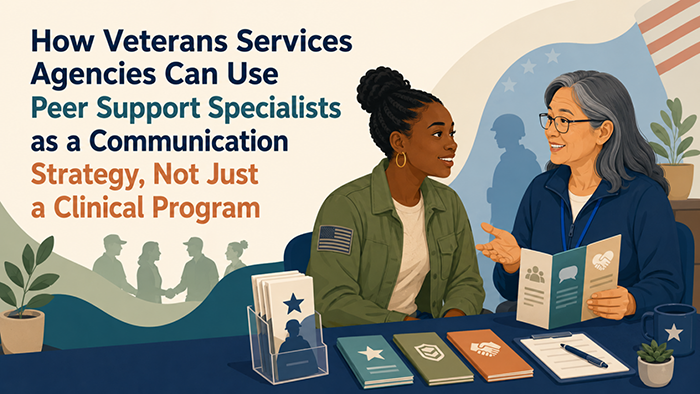
How Veterans Services Agencies Can Use Peer Support Specialists as a Communication Strategy, Not Just a Clinical Program
The conventional model for peer support in veterans services is a clinical model. Peer support specialists are employed within behavioral health departments, receive their referrals through clinical pathways, carry caseloads assigned by clinical supervisors, and are evaluated against clinical outcome metrics. Their work is understood as a therapeutic modality, a form of service delivery that adds the ingredient of shared lived experience to the professional clinical ecosystem. Within this model, peer support specialists are clinical program staff, and their contribution is measured in the clinical currency of sessions completed, referrals made, and client outcomes tracked. The model has genuine merit, and the evidence base for peer support as a clinical tool in veteran behavioral health is well established and growing.
But this model captures only a fraction of what peer support specialists are capable of contributing, and confining them to it leaves substantial communication capacity untapped. Peer support specialists are not simply clinicians with a shared experience credential. They are, by virtue of who they are and what they have navigated, the most credible communicators a veterans services agency can deploy across a wide range of contexts and purposes. Their credibility is not institutional. It is not credential-based. It is rooted in the authenticity of shared experience, in cultural fluency that cannot be trained into someone who has not lived it, and in the trust that veteran communities extend to their own members in ways they do not extend to institutional representatives, however well-intentioned.
The argument this article makes is not that peer support specialists should stop doing clinical work. Clinical work is important and the demand for it consistently exceeds supply in most veterans services systems. The argument is that clinical program participation represents only one dimension of the value peer support specialists create, and that agencies which confine them to that dimension are leaving their most credible communication asset underutilized across a broad range of communication functions where their impact would be significant and often irreplaceable. From social media content to community outreach events, from partner briefings to printed materials, from VSO post meetings to employer presentations, there are communication contexts across the veterans services landscape where a peer support specialist’s authentic voice and lived experience produce communication outcomes that institutional staff cannot replicate.
Recognizing this communication potential and building the organizational infrastructure to realize it requires a strategic repositioning of how peer support specialists are understood, resourced, and deployed. It requires agencies to think of peer support not only as a service delivery function but as a communication function, and to design roles, training, and support systems that enable peer support specialists to serve both functions sustainably and effectively. This article provides the framework for that repositioning, with specific attention to the communication contexts where peer voice delivers maximum impact, the organizational structures that make peer voice communication sustainable, and the measurement approaches that demonstrate peer voice communication value in terms that inform strategic investment.
The investment in peer support specialist communication capacity is not a luxury for well-resourced agencies. It is a communication efficiency decision that any agency can make, because the cost of deploying peer support specialists in communication roles is modest relative to the communication impact they produce, and because the alternative, relying on institutional communication to do work that only peer voice can do effectively, is a strategy of consistent underperformance in the communication contexts that matter most for veteran access and engagement.
What Peer Support Specialists Communicate That Others Cannot
 The starting point for understanding peer support specialist communication value is recognizing that there are specific communication functions that peer voice performs effectively and that institutional communication cannot perform regardless of how well it is designed. These are not simply functions where peer voice is better than institutional communication in degree. They are functions where peer voice is qualitatively different from institutional communication in kind, where the gap between what peer voice produces and what institutional voice produces is not a gap in quality but a gap in what kind of communication is actually happening.
The first of these functions is the transmission of authentic credibility. Authentic credibility is the quality a message has when it comes from someone whose identity, experience, and personal stake make the message undeniably genuine. It cannot be manufactured by institutional communication, because institutional communication by definition comes from an entity rather than a person, and entities cannot possess the personal experience that authenticates a message about lived difficulty. When a peer support specialist says ‘I know what it feels like to think the VA isn’t going to help you, because I spent years thinking the same thing,’ that statement carries authentic credibility that no institutional message can carry, because no institution can have spent years thinking anything.
The second function unique to peer voice is cultural translation. Military culture has specific codes, specific language patterns, specific ways of communicating indirectly about things that are difficult to communicate directly, and specific signals that indicate to insiders whether a communicator understands the culture from inside it or from outside it. A peer support specialist who served understands these codes in ways that non-veteran staff cannot fully replicate through training and good intentions. They know what a veteran means when they say they are ‘fine’ in a context where fine clearly means something else. They know the specific language that opens conversations that would otherwise remain closed. They know the cultural references that signal insider understanding and the institutional language patterns that signal outsider observation. This cultural translation capacity makes peer support specialists effective communicators in veteran contexts where institutional communicators are systematically less effective.
The third function is what might be called the demonstration of the possible. Veterans who are struggling psychologically, who have disengaged from services, or who are skeptical that any form of support will be useful for someone like them, are operating partly on an implicit assumption that the pathway through their current situation is not accessible to people with their history and their identity. A peer support specialist who is demonstrably on the other side of a comparable journey demonstrates something that no institutional communication can demonstrate: that the pathway exists, that it is accessible to veterans with backgrounds and identities like theirs, and that traversing it did not require them to abandon the self-concept that defines who they are. This demonstration is a form of communication that operates at the level of identity possibility rather than informational content, and it is often more influential than any amount of accurate information about available resources.
The Authenticity Dimension of Peer Communication
Authenticity is simultaneously one of the most powerful qualities in communication and one of the most difficult to analyze, because it operates partly below the threshold of conscious awareness. Audiences do not always know exactly why they find one communicator more credible than another, but they respond differently to authentic communication than to communication that lacks it, and the response difference has behavioral consequences. In veteran audiences specifically, the ability to detect inauthenticity is highly developed, because military culture creates extensive training in reading people and situations for genuine versus performed quality.
What makes peer support specialist communication authentic in the specific sense that matters for veteran audiences is not simply that the peer has had difficult experiences. Many people have difficult experiences. What makes it authentic is the combination of the specific nature of those experiences, the cultural context in which they occurred, and the peer’s willingness to speak from within that experience rather than about it. A peer support specialist who says ‘There was a period after I got back where I was doing everything right on the outside and feeling completely hollow on the inside, and I had no idea how to talk about that’ is speaking from within an experience that many veterans recognize from their own interior life. The recognition is the communication event.
This recognition effect, the moment when a veteran hears a peer describe something they have experienced but not articulated and thinks ‘that is exactly what it is like,’ is among the most powerful communication events available in the prevention and outreach context. It breaks through the self-exclusionary logic that prevents many veterans from identifying with available resources, because it positions the peer’s situation as recognizably similar to the veteran’s own. A veteran who has recognized themselves in a peer’s description cannot easily maintain the position that the resources the peer accessed are for a different kind of person.
Developing and maintaining the authenticity of peer support specialist communication over time requires organizational practices that protect the peer’s genuine relationship with their own experience rather than scripting or over-polishing their public communications. Agencies that treat peer testimonials as marketing content to be professionally produced will find that the production process removes the very quality that makes the content effective. The editorial hand in peer voice content should focus on accuracy and safety, not on professional polish, and the peer’s own language should be preserved even when it is informal, imperfect, or not what an institutional communication would look like.
The Cultural Fluency Dimension
Cultural fluency in the context of veteran peer support specialist communication refers to the specific competency of operating within military culture as an insider rather than engaging with it as a knowledgeable outsider. The distinction between insider and knowledgeable outsider is not merely academic. It shapes every dimension of a communication interaction with a veteran audience, from the language choices that signal cultural belonging to the implicit understandings about what can remain unsaid to the specific ways of raising difficult topics that respect the community’s norms while still creating the space for honest communication.
A peer support specialist who served in the same service era as the veterans they are working with shares not only a general cultural framework but a specific set of reference points, experiences, and understandings that create immediate common ground. They know the specific operational contexts, the specific institutional pressures, and the specific cultural shifts of the service period in ways that create a level of specific recognition that neither training nor even extensive interaction with veterans can fully replicate. This specific cultural fluency operates as a credibility signal that veterans read before any substantive content is assessed.
Peer support specialists who serve communities that include veterans from diverse service eras, branches, and occupational backgrounds face the challenge of operating across multiple cultural contexts within the veteran community. The Marines have a distinct cultural identity from the Army. Vietnam-era veterans have a distinct cultural experience from post-9/11 veterans. Veteran women have a distinct cultural experience from veteran men. Peer support specialists whose background matches that of specific veteran populations they are serving will have maximum cultural fluency with those populations, and agencies should think carefully about how to match peer support specialist backgrounds with the communication needs of specific veteran community segments.
Where perfect cultural match is not possible, training in the specific cultural contexts of the veteran populations the peer will serve, combined with the peer’s own genuine curiosity and respect for the cultural differences they are navigating, produces the kind of cultural competence that allows effective communication even without perfect background alignment. The key is genuine respect for the cultural specificity of different veteran experiences, rather than the assumption that one set of veteran experiences provides adequate understanding of all veteran experiences.
Serving Those Who Served: Communication Strategies for Veterans Agencies
This article is part of our series on strategic communication for Veterans Services Agencies, County Veterans Services Offices, State Departments of Veterans Affairs, and community-based veteran support organizations. To learn more and to see the parent article, which links to other content just like this, click the button below.
Communication Contexts Where Peer Support Specialists Deliver Maximum Impact
Identifying the specific communication contexts where peer support specialist presence and voice produce the greatest impact relative to institutional communication is a strategic question that shapes where agencies should invest in peer voice deployment. Not every communication context is equally amenable to peer voice enhancement, and not every context where peer voice could help is a context where the organizational and personal costs of peer deployment are justified by the communication gain. Strategic deployment means identifying the contexts where peer voice is most irreplaceable and concentrating deployment there before expanding to contexts where the incremental gain over institutional communication is smaller.
The communication contexts where peer support specialist voice is most irreplaceable share several common features. They are contexts where authenticity and cultural fluency are the primary determinants of communication effectiveness. They are contexts where the audience’s default orientation is skeptical or resistant, such that institutional communication triggers defensive filtering while peer communication passes through because it carries recognizable inside-the-culture authority. They are contexts where the communication objective is to shift an attitude or a behavioral intention rather than simply to transmit information, because attitude and intention change is far more responsive to peer influence than to institutional messaging. And they are contexts where the communication happens in real time, in direct human interaction, where the peer’s ability to read and respond to the specific person in front of them provides communication agility that printed or produced institutional content cannot match.
Community Outreach and Veteran-Facing Events
Community outreach events represent among the highest-value contexts for peer support specialist communication deployment, and not primarily because they are efficient ways to reach many veterans at once, though they can be. Their highest value lies in the quality of the communication encounter they enable. When a peer support specialist is present at a veteran resource fair, a VSO post meeting, a community service event, or any other gathering where veterans are present in community mode rather than client mode, they are positioned to have exactly the kind of informal, direct, authentic conversation that is most effective at reaching veterans who would not respond to formal agency outreach.
The veteran who is reluctant to approach an agency information table but who will stop and talk to someone who is clearly a fellow veteran, who opens with a natural reference to shared experience, and who mentions the agency’s services in the course of an otherwise normal conversation, is being reached through a communication channel that the agency’s own institutional presence cannot create. The peer support specialist’s informal presence at community events is itself a communication act, one that signals the agency’s commitment to genuine community connection rather than institutional processing, and one that creates access to veterans who have explicitly or implicitly opted out of formal institutional engagement.
Preparing peer support specialists for community outreach events involves specific attention to the informal communication skills that make spontaneous peer-to-peer conversation effective in these contexts. This is different from preparing for a formal presentation or a clinical interaction. It includes the ability to start a natural conversation with a stranger in a community setting, to weave references to available resources naturally into a conversation without triggering the defensive filtering that comes from feeling like you are receiving a sales pitch, and to identify when a conversation has reached a point where offering a specific resource connection would be genuinely welcomed rather than intrusively promotional. These are learnable skills, but they require practice in realistic scenarios rather than only conceptual training.
Post-event follow-up is a dimension of peer support specialist community outreach communication that is often overlooked. Peer support specialists who have had conversations with veterans at community events and who follow up with those veterans in the days following the event are demonstrating a continuity of concern that amplifies the impact of the initial community encounter. The follow-up can be as simple as a brief personal message checking in on how the veteran is doing and offering to answer any questions that have come up since the event. The simplicity of the follow-up belies its impact: it converts a single community encounter into an ongoing relationship, which is the communication foundation that makes sustained engagement with agency services possible.
Social Media Content and Digital Community Presence
Social media has become one of the primary information environments for veterans in the post-9/11 generation, and it is an environment with specific characteristics that make peer voice particularly valuable and institutional voice particularly ineffective. Social media platforms reward authenticity, personal voice, and content that generates genuine emotional recognition in audiences. They penalize institutional tone, promotional framing, and content that reads as generated by an organization rather than a person. The algorithmic and social dynamics of major social media platforms effectively disadvantage institutional communication and advantage peer communication in ways that make peer support specialist social media presence an exceptional communication asset.
Peer support specialists who contribute to agency social media through personal posts, video content, or responses to veteran comments in agency social media feeds are providing a form of digital presence that transforms the character of the agency’s online communication. An agency social media feed that includes a mix of institutional program information and genuine peer voice content is a substantially different communication environment from one that includes only institutional content. The peer voice content draws engagement, generates shares within veteran networks, and creates the sense of genuine human presence that makes audiences feel they are encountering an organization staffed by real people with real experience rather than a communications department managing a content calendar.
The content that peer support specialists produce for social media does not need to be polished or elaborately produced to be effective. In fact, over-production of peer voice content for social media typically reduces its effectiveness by removing the authenticity markers that make it valuable. A peer support specialist who posts a brief video from their car or their kitchen, speaking directly to camera about something they have been thinking about related to veteran wellbeing, creates more engagement and more trust than the same peer reading from a script in front of a professionally designed backdrop. The informal setting signals that the communication is genuine rather than produced, and that signal is itself a communication asset.
Social media peer voice programs require organizational infrastructure that supports peer support specialists in navigating the specific challenges of public digital communication. These challenges include managing difficult or distressing interactions with veterans who respond to peer content in crisis, maintaining appropriate professional boundaries while communicating in an informal medium, and protecting the peer’s own wellbeing against the emotional demands of sustained public engagement with difficult topics. Agencies that develop clear social media guidelines for peer contributors, provide specific training on social media communication for peer support specialists, and build regular check-in processes for peers in social media roles are building the support infrastructure that makes sustained peer voice digital presence possible.
Printed Materials and Formal Agency Communications
The inclusion of genuine peer support specialist voice in the agency’s printed materials and formal communications produces consistent improvements in how those materials are received by veteran audiences. A benefits guide that includes a sidebar in which a peer support specialist describes their experience navigating a specific process in their own words is more engaging, more credible, and more likely to be read and retained than a guide presenting only institutional information. A program brochure that opens with a brief peer testimonial provides social proof of program value that institutional program descriptions cannot provide regardless of how well they are written.
The development of peer voice content for printed materials requires a collaborative process that is distinct from both standard institutional content development and the individual peer’s natural communication style. The peer’s authentic experience and genuine language are the raw material. The agency’s communication function provides structure, accuracy review, and appropriateness assessment. The collaboration between these two inputs produces printed material that is both authentic and appropriate, personal and accurate, engaging and professional. This collaborative development process requires more time than simply writing institutional content, and agencies should budget for that additional time rather than treating peer voice content in printed materials as a quick addition to the production process.
One specific application of peer voice in printed materials deserves particular attention: the use of peer narratives in outreach materials designed to recruit veterans who have disengaged from services. Veterans who have had unsatisfying experiences with the agency in the past are among the most resistant audiences for institutional outreach communications. A direct mail piece or a community-distributed brochure that leads with a peer support specialist’s account of their own initial frustration with the agency and subsequent positive experience with specific services provides the kind of honest, relatable entry point that can penetrate the resistance that direct institutional outreach cannot. The peer’s willingness to name the frustration, rather than denying it, establishes the credibility that makes the subsequent positive account believable.
Partner Briefings and Stakeholder Presentations
When veterans services agencies present to community partners, elected officials, healthcare providers, employer organizations, or other stakeholders, the inclusion of a peer support specialist in the presenting team transforms the character and effectiveness of the presentation in ways that have lasting relationship consequences. A partner organization that receives a briefing from agency staff alone is learning about the agency’s programs from the agency’s perspective. A partner organization that receives a briefing that includes a peer support specialist’s first-person account of what those programs meant to them is learning about the agency’s programs from the perspective of someone who represents the population the programs serve.
The peer support specialist’s contribution to a partner briefing is not primarily informational. The information about programs and eligibility can be delivered by agency staff. The peer’s contribution is the evidence of impact, delivered in first-person terms that no summary statistic or client outcome report can replicate. When a peer says to a room of healthcare providers ‘I had been avoiding the VA for years because of a bad experience I had early on, and it was only because my primary care doctor mentioned a specific program that I finally gave it another chance, and that referral changed my life,’ they are making the case for partner engagement with veteran-specific communication that no agency presentation can make as effectively.
Preparing peer support specialists for partner briefing participation requires attention to both the content of their contribution and the context in which they are operating. Partner briefings often involve professional audiences with different communication norms than the veteran community settings where peer support specialists typically operate. The peer’s natural communication style remains the most valuable element of their contribution, but they benefit from preparation that helps them understand the specific goals of the briefing, the specific interests and concerns of the audience, and the appropriate scope of what they are being asked to share. This preparation should be collaborative and should respect the peer’s professional judgment about what they are comfortable disclosing in a professional context.
Building the Organizational Infrastructure for Peer Voice Communication
 The strategic repositioning of peer support specialists as communication assets requires organizational changes that go beyond simply asking peer support specialists to do additional work. Without the appropriate organizational infrastructure, peer voice communication deployment will be unsustainable, inconsistent, and ultimately counterproductive as peer support specialists burn out from underprepared and unsupported communication demands layered on top of their clinical responsibilities. Building the infrastructure means addressing role definition, training, supervision, recognition, and wellbeing support as interconnected elements of a coherent system rather than as separate administrative tasks.
The most fundamental organizational change required is the formal recognition of peer support specialist communication functions within their official roles, job descriptions, and performance evaluation frameworks. If the official job description of a peer support specialist describes only clinical functions, and their performance evaluation measures only clinical activities, the message communicated to peer support specialists about what the agency values from them is unambiguous: their communication contributions are extra work, not recognized professional contribution. This signal undermines motivation for communication engagement, creates tension between clinical and communication responsibilities, and removes the organizational legitimacy that peer support specialists need to allocate time to communication functions without feeling that they are neglecting their real work.
Formal role recognition means explicitly including communication functions in peer support specialist job descriptions, allocating specific time within their workweek for communication activities, and including communication contribution as a component of performance evaluation. This does not require creating a separate communication role or splitting peer support specialists between clinical and communication functions. It requires integrating communication functions into the existing role in a way that is planned, resourced, and evaluated rather than improvised, uncompensated, and invisible.
Role Definition and Boundary Setting
Clear role definition for peer support specialists performing communication functions is essential for preventing the boundary confusion and role conflict that are among the primary sources of peer support specialist burnout and attrition. The communication role and the clinical role have different characteristics, different demands, and different professional boundaries, and peer support specialists who are expected to move between them without clear guidance on what each role involves and where each role’s boundaries lie are set up for the kind of confusion that degrades both role performance and personal wellbeing.
The clinical role of a peer support specialist involves direct supportive engagement with veterans who are on the peer’s caseload, emotional and practical support within the scope of the peer’s training, connection to clinical and community resources, documentation in clinical systems, and the specific professional boundaries that govern therapeutic relationships. The communication role involves representing the agency’s services and values in public and community contexts, contributing peer voice content to agency communication outputs, engaging with veterans at community events in informational and relational rather than clinical ways, and participating in partner briefings and stakeholder presentations.
The distinction between these roles is especially important in community event settings, where a peer support specialist may transition from a communication function to a support function within a single conversation when a veteran they are speaking with discloses acute distress. Peer support specialists need clear guidance on how to manage these transitions, including when to shift from communication mode to support mode, what resources are available in community event settings for veterans who need immediate support, and how to document and follow up on community event encounters that involve significant distress disclosure. This guidance should be developed proactively and rehearsed rather than improvised in the moment.
Training for Communication Functions
Standard peer support specialist training curricula, which are regulated and standardized in most states, are designed primarily to prepare peers for clinical program participation. They cover the principles of peer support, recovery-oriented communication, motivational approaches, crisis recognition and response, and professional boundaries in service delivery contexts. This training provides the foundation for clinical work but does not fully prepare peer support specialists for the communication functions described in this article, which have different conventions, different challenges, and different skill requirements.
Supplemental training for peer support specialists in communication roles should address the specific communication contexts they will be entering and the specific skills those contexts require. For community outreach, this means training in how to initiate natural conversation with strangers in community settings, how to weave resource information into informal conversation without creating the impression of a sales pitch, and how to manage difficult situations that arise in informal community contexts. For social media communication, this means training in the conventions of the specific platforms being used, the management of difficult online interactions, and the professional judgment about what to share publicly versus keep private.
For partner briefings and stakeholder presentations, training should address the norms of professional presentation contexts and how they differ from the community contexts where peer support specialists typically operate, the preparation process for partner presentations, and the management of questions and audience responses in professional settings. For printed materials, training should address the collaborative content development process and the distinction between authentic peer voice and institutional voice styled to resemble it. Each communication context has enough specific requirements that treating them all as variations on a single communication skill will leave peer support specialists underprepared for the specific demands of each.
Supporting Peer Support Specialist Wellbeing in Communication Roles
The wellbeing dimension of peer support specialist communication deployment is not a supplementary concern to be addressed after the strategic and organizational questions are resolved. It is a foundational condition for the sustainability of peer voice communication programs. Peer support specialists who are asked to perform communication functions without adequate wellbeing support will experience the cumulative emotional demands of repeated public disclosure, exposure to veterans in various states of distress, and navigation of public and media environments in ways that accelerate burnout and attrition. When a peer support specialist burns out or leaves the role, the communication program loses not only a staff member but an irreplaceable communication asset whose authenticity and cultural fluency cannot be recruited and replaced the way a program manager position can.
The emotional demands specific to communication roles deserve explicit attention. Public testimonial about personal struggle and help-seeking requires a form of ongoing self-exposure that is emotionally demanding in ways that differ from the demands of clinical work. In clinical work, the peer’s disclosure is managed within a professional therapeutic relationship with defined boundaries and professional supervision. In public communication, the peer’s disclosure is made to unknown audiences in contexts where the reactions and uses of the disclosure cannot be controlled. The peer support specialist who shares their story at a VSO post meeting does not know whether someone in the audience will recognize them, how their story will be discussed after they leave, or what personal consequences will follow from a public account of their mental health history.
Agencies must build robust support structures that address these specific emotional demands of communication roles. Supervision conversations should explicitly address communication experiences alongside clinical caseload, creating space for peer support specialists to process the emotional impact of public testimony and community event engagement. Debriefing processes following high-demand communication events, such as presentations to large audiences or interactions with veterans in significant distress at community events, should be standard rather than exceptional. And peer support specialists should have access to their own peer support connections, whether through formal peer support programs or through informal relationships with others in similar roles, that allow them to process the experience of being a helper in public without the isolation of doing that processing alone.
The formal recognition of communication functions in performance evaluation frameworks, discussed in the previous section, also has wellbeing implications. When peer support specialists know that their communication contributions are visible to and valued by the agency, they are less likely to experience those contributions as invisible burdens layered on top of their recognized responsibilities. Visibility and recognition are protective factors against the sense of exploitation that, when present, accelerates burnout and attrition in peer support roles.
Integrating Peer Voice Into Agency Communication Planning
Treating peer support specialists as strategic communication assets requires integrating them into the agency’s communication planning process at the beginning of the planning cycle rather than deploying them reactively in response to specific events or communication opportunities as they arise. A communication plan that identifies in advance the contexts where peer voice will be deployed, the specific communication objectives peer voice is intended to serve, and the preparation and support that will be provided to peers who participate in each communication activity, is a plan that uses peer support capacity strategically rather than opportunistically. The difference between strategic and opportunistic deployment is the difference between a sustained communication function and an episodic communication experiment.
The integration of peer voice into communication planning begins with an honest inventory of the agency’s existing communication activities. Every communication activity, from the benefits newsletter to the community outreach schedule to the social media content calendar to the partner briefing schedule, should be assessed for peer voice potential: Would peer voice inclusion in this communication activity improve its effectiveness with the target audience. Is the communication objective one that peer voice serves better than institutional voice. Is there a peer support specialist available whose background and communication comfort level make them appropriate for this context. Are the support and preparation structures in place to make peer participation sustainable.
The answers to these questions will reveal that peer voice is currently underutilized across most of the agency’s communication activities, concentrated in a small number of mental health specific contexts while absent from the large majority of the agency’s communication ecosystem. The planning goal is to develop a systematic approach to expanding peer voice presence across the communication activities where it produces the greatest impact, while building the organizational support infrastructure that makes the expansion sustainable over time.
Communication planning for peer voice should also address the question of how to develop and maintain the peer support specialist communication capacity required to execute the plan. If the plan calls for peer voice presence at six community outreach events per month, two social media posts per week, and monthly partner briefings, the agency needs to ensure that there are enough peer support specialists with the appropriate training and the appropriate role capacity to fulfill those commitments without overwhelming any individual peer. Building the peer voice communication capacity required by the plan is as much a part of the planning process as identifying the communication activities where peer voice will be deployed.
Measuring Peer Voice Communication Impact
Demonstrating the value of peer support specialist communication functions in terms that justify continued and expanded organizational investment requires measurement approaches that capture the specific kinds of impact peer voice communication produces. Standard communication metrics, such as reach, impressions, and click-through rates, capture the scale of communication activity but not the quality of its impact. The specific value that peer voice adds, the shift in audience attitude, the increased willingness to engage with available resources, the deepening of community trust in the agency, is not captured by scale metrics alone and requires additional measurement approaches.
Engagement quality metrics for social media peer voice content provide evidence of the qualitative difference between peer-generated content and institutional content. Comments on peer voice posts tend to be longer, more personal, and more substantive than comments on institutional posts. They are more likely to include personal disclosure, questions about specific resources, and expressions of connection and recognition. Tracking and analyzing this comment quality, alongside standard engagement rate metrics, provides a richer picture of what peer voice content is producing in the audience than engagement rates alone.
Event-level measures for community outreach with peer support specialist presence include post-event survey data from veterans who attended, assessing the extent to which the presence of a peer support specialist influenced their perception of the agency and their intention to engage with specific services. Comparison of these measures across events with and without peer support specialist presence provides direct evidence of the communication value that peer presence adds. Agencies that consistently collect this data across community events build an evidence base that demonstrates peer voice communication impact in terms that are meaningful for strategic investment decisions.
Longitudinal tracking of veterans who first engaged with the agency through a peer support specialist community encounter, compared to veterans who first engaged through other channels, provides evidence of the relationship between peer voice as a first contact mechanism and sustained engagement with agency services over time. If veterans who enter the agency through a peer support specialist community connection show higher sustained engagement rates than veterans who enter through institutional channels, this provides direct evidence that peer voice communication is not only attracting initial engagement but building the kind of relationship quality that sustains engagement over time.
Strategic Communication Support for Veterans Services Agencies
 Peer support specialists contribute far more than lived experience alone. Their ability to build trust, reduce hesitation, and communicate through shared understanding makes them one of the most valuable communication assets available to veterans services agencies. Realizing that potential, however, requires more than assigning additional responsibilities. It depends on intentionally designing roles, training, support systems, and evaluation practices that allow peer support specialists to communicate effectively while remaining supported in their own work.
Turning peer voice into a sustainable organizational capability requires agencies to understand where peer communication has the greatest impact, how peer support specialists should be integrated into communication efforts, and what resources are needed to maintain those programs over time. It also requires thoughtful planning to ensure communication responsibilities enhance, rather than compete with, the primary purpose of peer support. Without a coordinated approach, agencies risk underutilizing one of their most trusted connections with veterans.
Many veterans services agencies choose to partner with external communication specialists such as Stegmeier Consulting Group (SCG) because developing peer voice communication programs requires specialized expertise in communication strategy, program design, workforce support, and performance evaluation. By combining those communication capabilities with the agency’s expertise in peer support and veterans services, agencies can build communication systems that are both sustainable for staff and meaningful for veterans.
Rather than treating peer communication as a collection of individual activities, SCG helps agencies design integrated peer voice communication programs from the outset. Support may include assessing how peer support specialists are currently engaged, identifying opportunities to expand communication impact, developing role definitions and communication protocols, designing training and wellbeing support structures, and establishing evaluation frameworks that measure communication outcomes alongside broader organizational goals.
The value of this approach extends beyond improving communication. SCG helps agencies create systems in which peer support specialists are equipped, supported, and recognized as an essential part of the agency’s communication strategy. By embedding peer voice into communication planning, governance, and ongoing program evaluation, agencies are better positioned to sustain trusted veteran-to-veteran communication as programs, staffing, and community needs evolve.
The goal is to create a communication environment where veterans encounter trusted voices that reflect shared experience, encourage meaningful engagement, and strengthen confidence in the services available to them. When peer voice is supported as a strategic communication capability rather than an informal resource, agencies are better equipped to reach veterans who may be least likely to respond to traditional institutional communication.
Future Trends in Peer Voice and Communication Integration
Several trends in the veterans services landscape are reshaping both the opportunity and the necessity for peer support specialist communication function integration in coming years. The most consequential of these is the rapid expansion of the peer support specialist workforce itself, driven by growing state and federal investment in peer support as an evidence-based service delivery modality and by the growing recognition across behavioral health systems that peer support is not a supplement to professional services but a distinct and irreplaceable form of care. As the peer support specialist workforce grows, the aggregate communication capacity available to veterans services agencies through peer voice programs grows proportionally. Agencies that have built the infrastructure for peer voice communication will be positioned to scale that function in step with workforce growth.
The maturation of digital communication platforms is creating new peer voice distribution possibilities that extend beyond the geographic boundaries of any individual agency’s community. A peer support specialist whose video content is distributed through the agency’s social media platforms reaches veterans in communities across the state and potentially across the country, creating awareness and trust-building impacts that far exceed what the same peer could produce through in-person community engagement alone. Agencies that develop the organizational capacity to create, review, and distribute digital peer voice content are multiplying the geographic reach of their peer communication function through digital distribution in ways that represent a substantial communication leverage.
The formalization of peer support specialist roles within state credentialing and workforce development systems is producing clearer professional standards for peer support practice that will, over time, increasingly include guidance on the communication functions appropriate to peer roles. Agencies that are developing peer voice communication programs now are building the experience base that will inform those emerging professional standards, and they are positioned to shape how the field understands the legitimate and valuable scope of peer support communication across the veterans services ecosystem.
Conclusion
Peer support specialists are the veterans services agency’s most credible communicators. Their credibility is not institutional, not credential-based, and not manufactured by communication strategy. It is rooted in the authenticity of shared experience, in the cultural fluency of insider understanding, and in the demonstrated possibility that the pathway through difficulty is real and accessible for people with backgrounds like the ones they serve. Confining them to clinical program roles while institutional communication struggles to reach the veterans who most need to be reached is a strategic misalignment that costs agencies communication effectiveness they cannot afford to lose and that costs veterans access to the support they have earned.
The path to realizing peer support specialist communication value fully is not technically complex. It requires organizational will, thoughtful role design, adequate training and support, and the measurement infrastructure to demonstrate impact. Agencies that make these investments are not simply expanding a program. They are transforming the communication capacity of the entire veterans services function by putting the most credible voice in the veterans services ecosystem to work across every communication context where that voice can make a difference.
SCG’s Strategic Approach to Communication Systems
Stegmeier Consulting Group’s approach to communication system development for veterans services agencies is grounded in the principle that effective communication leverages every available asset and that the most powerful communication assets are often the ones that are already present within the organization, underutilized and unrecognized as the strategic resources they are. Peer support specialists are the clearest example of this principle in the veterans services context, and SCG’s work with agencies on peer voice communication reflects the same commitment to strategic leverage that characterizes all of SCG’s communication systems work.
The structured process SCG uses for peer voice communication program development begins with an honest assessment of current peer support specialist deployment and the communication gap it leaves, moves through the design of integrated peer voice frameworks that align role definitions, training programs, support structures, and measurement systems into a coherent whole, and results in organizational change that produces sustained communication impact rather than episodic communication events. Agencies that engage SCG for this work build peer voice communication capacity that serves them and their veteran communities for years, not for a single program cycle.
Use the form below to connect with our team and explore how strategic peer voice communication can help your agency strengthen veteran engagement, build trust, and improve connections to benefits and support services.