
Site Readiness Communication for Economic Development Organizations: What Site Selectors Need to See First
By the time an economic development organization learns that its community was considered for a project, the decision has often already been made, and the community was eliminated by someone the organization never met, in a screening process it never knew was happening, based on information it did or did not make available online. This is the quiet reality of modern site selection. The early stages of a location search are conducted at a distance, on compressed timelines, by consultants and corporate real estate teams working through long lists of candidate locations, and the primary instrument of that early screening is not the familiarization tour or the incentive proposal. It is the community’s own published information, evaluated in minutes, against a checklist the community never sees.
In this environment, site readiness communication is not a marketing function layered on top of economic development work. It is the front door of the entire business attraction enterprise, and for a substantial share of opportunities, it is the only door that matters, because communities that fail the initial information screen never receive the request for proposals, the inquiry call, or the chance to make their fuller case. A region can possess genuinely competitive sites, workforce, and infrastructure and still lose systematically, not on its merits but on the discoverability, specificity, currency, and credibility of the information it presents about those merits.
What makes this a solvable problem is that the site selection audience is unusually knowledgeable. Site selectors are professionals who perform a repeatable process, evaluate consistent categories of information, operate under well-understood time pressures, and are refreshingly explicit, in industry surveys, conference sessions, and direct feedback, about what they need, what impresses them, and what causes them to quietly remove a community from consideration. An economic development organization does not need to guess what this audience wants to see first. It needs to take seriously what this audience has repeatedly said, and to organize its property and site communication accordingly, which is a discipline problem far more than a resource problem.
This article examines how economic development organizations should present sites and industrial properties, online and in outreach materials, so that site selectors can find current, specific, and credible information at the speed their process demands. It addresses the information hierarchy that early screening actually uses, the currency and credibility practices that separate trusted communities from ignored ones, the digital presentation standards that have become table stakes, and the responsiveness infrastructure that determines what happens in the critical hours after a site selector decides a community merits a closer look.
Understanding the Screening Process You Are Being Judged By
 Effective site readiness communication begins with an accurate mental model of how the early stages of site selection actually work, because organizations that misunderstand the process consistently produce the wrong materials. The early screen is an elimination exercise, not a selection exercise. A consultant working from an initial universe of dozens or hundreds of candidate locations is not looking for reasons to include a community; they are looking for efficient reasons to exclude one, because their task is to reduce a long list to a short list defensibly and quickly. Every gap in a community’s published information is, in this context, a potential exclusion reason, because a missing answer is operationally identical to a disqualifying answer when the evaluator has neither the time nor the obligation to chase it down.
This elimination logic inverts the instinct that drives much economic development marketing. Promotional narrative, quality-of-life photography, and broad claims about business climate are essentially inert in the early screen, because they answer no checklist question. What is being checked is specific and largely uniform across projects of a given type: available sites and buildings meeting the project’s physical parameters, utility capacity in specific quantities at specific locations, transportation access measured in distances and capacities, workforce availability in relevant occupations and volumes, environmental and geotechnical status, ownership and control status, and price or lease parameters. A community whose materials answer these questions specifically survives screens; a community whose materials answer them vaguely, or answer different questions entirely, does not, regardless of how attractive its narrative is.
The compressed timeline of modern site selection intensifies all of this. Project schedules that once allowed months for location analysis now frequently allow weeks, and the information-gathering phase within those schedules is measured in days. A site selector who cannot find a community’s site data quickly does not schedule a call to request it, except for the largest and most site-constrained projects; they proceed with the communities whose data was findable. Speed of information access is therefore not a courtesy. It is a competitive variable, and it is one of the few competitive variables entirely within the economic development organization’s control.
The Anonymity Problem and What It Means for Communication
Early-stage site searches are typically conducted anonymously, with consultants shielding client identity behind project code names or conducting entirely silent desktop screening with no community contact at all. This anonymity has a decisive communication implication: the organization cannot rely on conversation to convey what its materials omit, because for the silent screens, no conversation will ever occur. Everything essential must be discoverable without human contact. Organizations that hold back key information as a device to force inquiries, publishing teaser descriptions while requiring a call for details such as pricing, utility specifics, or environmental status, are optimizing for a behavior pattern that no longer describes how the early process works. The gated information strategy does not generate the call; it generates the elimination.
Growing Places: Communication Strategies for Economic Development and Public Finance Agencies
This article is part of our series on strategic communication for Economic Development organizations, including state and local economic development agencies, regional partnerships, and business attraction initiatives. To learn more and to see the parent article, which links to other content just like this, click the button below.
The Information Hierarchy of a Site Listing That Works
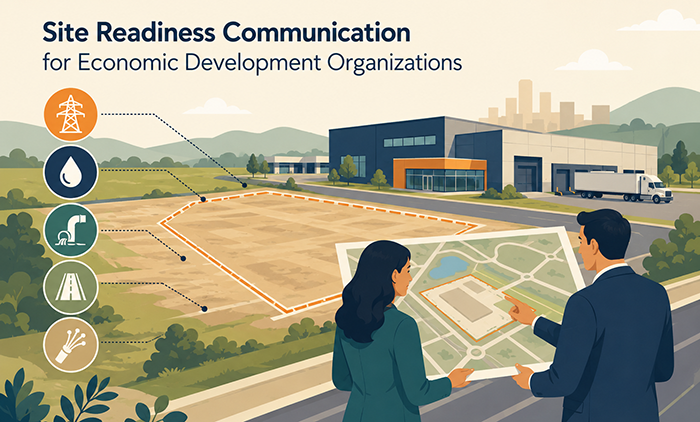
Every published site or building listing should be constructed around the questions the screening process asks, presented in the order of their eliminating power, with specificity treated as the core quality standard. The difference between a listing that survives screens and one that does not is rarely design polish; it is whether the numbers are there.
Physical fundamentals come first: total acreage and, critically, developable acreage after accounting for wetlands, floodplain, easements, and topography, because the gap between gross and usable acreage is one of the most common sources of wasted evaluation effort and downstream credibility damage. For buildings, the fundamentals include clear height, column spacing, dock and drive-in door counts, floor thickness and condition, expansion capability, and current condition, stated as facts rather than adjectives. A listing that says the property offers ample space serves no one; a listing that states the specific figures lets an evaluator reach a conclusion in seconds, which is the entire function of the document.
Utility information must be stated in capacities and distances, not in assurances. Electric service should be described by the serving provider, the voltage and capacity available at or near the site, the distance to the serving substation, and where relevant for energy-intensive projects, the realistic timeline and process for securing large loads. Water and sewer should be described by line sizes, distances to the site, and available capacity in measurable terms. Natural gas and telecommunications follow the same standard. The phrase all utilities available, which still appears on an extraordinary share of published listings, communicates nothing an engineer can use and, to experienced evaluators, functions as a signal that the community has not done its homework.
Transportation access should be quantified: distance and drive time to the relevant interstate interchange, rail service status stated precisely, including which railroad, whether the site is rail-served today or rail-adjacent with a feasible connection, distance and service profile of relevant airports and ports where applicable. Site selectors distinguish sharply between rail-served and near rail, and listings that blur this distinction spend credibility the community will need later.
Ownership, control, and price complete the screening core. A site whose ownership is fragmented, whose availability is speculative, or whose price expectations are unstated introduces exactly the kind of execution risk and friction that elimination-stage evaluation is designed to screen out. Listings should state who controls the property, the nature of that control, whether the community or its partners hold options or ownership, the asking price or a defensible price range, and any known conditions attached to a transaction. Where pricing genuinely cannot be published, the listing should say what can be said and explain the path to a fast answer, because silence on price is read as either disorganization or a problem.
Environmental and due diligence status is the layer that separates genuinely ready sites from merely available land, and it should be communicated with documentary specificity: whether Phase I environmental assessment has been completed and when, whether geotechnical investigation exists, wetlands delineation status, floodplain status, zoning and any entitlement progress, and where the state operates a site certification program, the certification status and what it covered. The strongest practice is to make the underlying documents themselves available, directly or through a simple request mechanism, because the willingness to show the documents is itself a credibility signal that summaries cannot replicate.
Workforce Data That Answers the Actual Question
Workforce information attached to site communication commonly fails by answering a general question, how many people live around here, when the evaluator is asking a specific one: can this project staff this facility with these occupations at this scale in this labor market. Site-linked workforce communication should therefore emphasize labor shed data rather than municipal population, occupational employment in the categories relevant to the community’s target sectors, relevant wage benchmarks, commuting patterns that define the realistic draw area, training infrastructure including community college and technical programs with capacity in relevant fields, and where available, evidence from recent expansions or hires that the market has actually produced workforce at scale. Communities that maintain this data in current, citable form, and connect it directly to their site materials, answer the question the project is actually asking.
Currency and Credibility as the Deciding Variables
 Among communities whose published information is comparably specific, the differentiators become currency and credibility, and these are where economic development organizations most often quietly fail. A listing containing a property that sold last year, a capacity figure from a utility study two rate cases ago, or a certification badge whose underlying documents have expired does damage that extends far beyond the individual listing, because site selectors generalize: a community whose information is wrong once is a community whose information must be independently verified always, and independent verification is precisely the burden the evaluator has no time to carry.
Currency is a process problem, and it yields to process solutions. Every published listing should carry a visible last-verified date, which simultaneously disciplines the organization and reassures the evaluator. The organization should operate a standing verification cycle, quarterly at minimum for active listings, confirming availability, control, pricing, and any changed conditions with owners and utility partners. And the organization should establish a removal discipline at least as strong as its addition discipline, because the instinct to keep the inventory looking full by retaining stale or marginal listings trades short-term appearance for the long-term trust on which everything else depends.
Credibility is also built through sourcing transparency. Data points attributed to their sources, utility figures confirmed by the provider, workforce figures drawn from named datasets, environmental conclusions tied to dated reports by named firms, carry categorically more weight than unattributed claims, and they permit the evaluator to move quickly precisely because verification paths are visible. Organizations should treat every significant claim in their site materials as a claim that will eventually be checked by someone whose confidence the community needs, because for every project that advances, that is exactly what happens.
Digital Presentation Standards That Have Become Table Stakes
The digital presentation layer of site readiness has consolidated around a set of practices that sophisticated evaluators now simply expect, and communities materially below this standard are communicating their competitive position whether they intend to or not. A searchable, filterable property inventory, allowing filtering by size, type, and key attributes, is the baseline; inventories published as static documents or scattered project pages impose navigation costs the evaluator will not pay. GIS-based interactive mapping, showing parcel boundaries, utility corridors, transportation assets, and flood and wetland layers, has moved from differentiator to expectation for communities competing seriously for industrial projects. Downloadable content matters more than agencies assume, because site selectors assemble internal comparison documents and need site data, maps, and diligence reports in usable formats; a listing whose entire substance is locked in a web page produces friction at precisely the moment the community wants none.
Visual documentation should be treated as evidence rather than decoration: current aerial imagery, drone photography and video that honestly convey the site, its surroundings, and its access, and where available, conceptual layouts demonstrating how representative facilities could fit the parcel. Every visual asset should be dated, because imagery that quietly predates the new interchange, or the neighboring development, misleads in both directions. Mobile performance and load speed are not cosmetic considerations; evaluators work from wherever they are, and a property database that fails on a tablet in a conference room fails at a moment that matters. And the pathway from any listing to a knowledgeable human, a named contact with direct phone and email rather than a generic form, should be immediate and prominent, because when the silent screen ends and the evaluator chooses contact, the community’s responsiveness clock starts.
The Response System Behind the Materials
Published information wins the community a conversation; the response system determines what the conversation concludes. Site selectors consistently report that responsiveness, in both speed and quality, functions for them as a proxy for how the community will perform during a project’s execution, on permits, on utility coordination, on problem-solving under schedule pressure. A community that takes a week to answer an information request is understood to be a community that will take a month to resolve a permitting question, and it is evaluated accordingly.
Economic development organizations should therefore operate against explicit internal response standards: acknowledgment of an inquiry within hours, substantive response within one to two business days, and honest interim communication when a full answer requires utility or owner input that takes longer. Meeting these standards requires preparation rather than heroics, and the core preparation is the maintained readiness of a response package for each priority site: the current data sheet, maps, diligence documents, utility confirmations, and workforce materials, assembled and refreshed in advance so that responding to a request is an act of retrieval rather than a scramble of assembly. Organizations that must build their response from scratch each time will miss the standard whenever the request arrives, as it always does, at an inconvenient moment.
The response system also depends on pre-built relationships with the partners whose information the organization does not control: utility economic development staff who can confirm capacity and timelines quickly, property owners and brokers reachable on short notice, county and municipal officials who can speak to permitting pathways, and workforce partners who can substantiate labor claims. These relationships are communication infrastructure in the fullest sense, and the time to construct them is before the request for proposals arrives, not during its seventy-two-hour response window.
Strategic Communication Support for Economic Development Organizations
 Site readiness communication sits at the intersection of disciplines that rarely live in the same office: real estate data management, utility coordination, GIS and digital publishing, workforce analytics, and rapid-response project management. Most economic development organizations, particularly those serving smaller communities and regions, are staffed thinly across these functions, and their site communication reflects accumulation rather than design: listings added over years by different hands, in different formats, at different levels of specificity, with no verification cycle, no consistent information hierarchy, and no tested response system behind them. In a screening environment that eliminates on gaps, this accumulated approach loses opportunities the community never learns existed.
A structured assessment of an organization’s site readiness communication typically identifies a consistent pattern: listings strong on narrative and weak on the specific data the screen requires, utility information stated in assurances rather than capacities, missing developable-acreage and control clarity, stale entries undermining the credibility of current ones, digital presentation below the filterable, mappable, downloadable standard the audience now assumes, and no maintained response packages or explicit response-time standards behind the public materials. Each of these is a design and discipline problem with a known solution.
Stegmeier Consulting Group (SCG) helps economic development organizations build site readiness communication that survives the screen and converts the inquiry. That support may include site and building listing audits against site-selector information standards, information hierarchy and data specification frameworks, verification cycle and currency process design, digital property inventory and presentation strategy, workforce data communication tied to site materials, response package development for priority sites, and inquiry response system design with explicit standards and partner coordination structures.
The goal of this work is a community whose published information does the first round of selling entirely on its own, at whatever hour the anonymous screen occurs, and whose response system then confirms, at conversation speed, everything the materials promised.
Future Trends in Site Readiness Communication
The practices described in this article represent the current standard, and the standard is moving. Several developments will shape what site selectors expect to see first in the years ahead.
Data-driven screening is deepening, with site selection teams increasingly using analytics platforms that aggregate property, labor, utility, and risk data across thousands of locations before any community-published material is consulted. This raises the importance of the data pipelines behind community listings, because communities whose information flows accurately into the platforms the profession uses are being evaluated continuously, while communities absent from or misrepresented in those datasets are losing screens they never see. Managing the community’s presence in third-party data ecosystems is becoming part of site readiness communication itself.
Power availability has moved to the center of a growing share of location decisions, driven by manufacturing electrification and energy-intensive facility types, and the communication standard for electric capacity is rising accordingly: from provider names and general assurances toward specific megawatt availability, interconnection timelines, and documented utility engagement. Communities able to communicate credible, specific power stories, jointly with their utilities, will hold a widening advantage for the projects where energy is the controlling variable.
Speed-to-operation framing is increasingly displacing raw site attributes in competitive positioning, with projects evaluating locations by the total time from selection to production. This shifts communication weight toward permitting pathways, entitlement status, pre-completed diligence, and documented examples of recent project timelines, the evidence that a community can convert a decision into an operating facility faster than its competitors.
Risk and resilience disclosure is becoming a standard screening layer, with flood exposure, water availability, grid reliability, and climate-related operational risk entering evaluation frameworks for a growing range of facility types. Communities that communicate proactively and honestly about risk profile and mitigation, rather than leaving evaluators to assemble the picture from external datasets alone, will control their own narrative on a dimension whose importance is only increasing.
Conclusion
The early stages of site selection are a test a community takes without knowing it is being tested, administered by evaluators it never meets, graded against a checklist it never sees, with elimination as the default outcome for every unanswered question. In that environment, the community’s published site information is not supporting material for its economic development strategy. It is the strategy’s first and most frequently decisive act.
The disciplines that pass this test are unglamorous and entirely achievable: specificity where the field’s habit is vagueness, currency maintained by process rather than intention, credibility built through sourcing and document transparency, digital presentation that matches how the audience actually works, and a response system prepared before the inquiry rather than assembled after it. Economic development organizations that adopt these disciplines stop losing silently, and communities with genuinely competitive assets finally get evaluated on those assets rather than on the gaps in how they were presented. What site selectors need to see first is, in the end, exactly what they have always said they need: the facts, current and verifiable, at the speed of their process. The organizations that provide them are the ones that stay on the list.
SCG’s Strategic Approach to Communication Systems
Align your agency’s messaging, processes, and public engagement strategies.
Economic development organizations need site readiness communication built for the way location screening actually works: specific data organized in the hierarchy evaluators use, utility and workforce information stated in capacities and quantities rather than assurances, visible currency through verification dates and standing update cycles, digital presentation that is searchable, mappable, and downloadable, and a prepared response system with explicit speed standards and maintained response packages behind every priority site.
SCG helps economic development organizations build site and property communication that survives anonymous screens, earns evaluator trust, and converts inquiries into advancing projects. Whether your organization needs a listing audit, data specification frameworks, verification process design, digital inventory strategy, or inquiry response system development, SCG can help you build the communication infrastructure that keeps your community on the list.
Use the form below to connect with our team and explore how strategic site readiness communication can help your organization compete for the projects your community deserves to be considered for.