
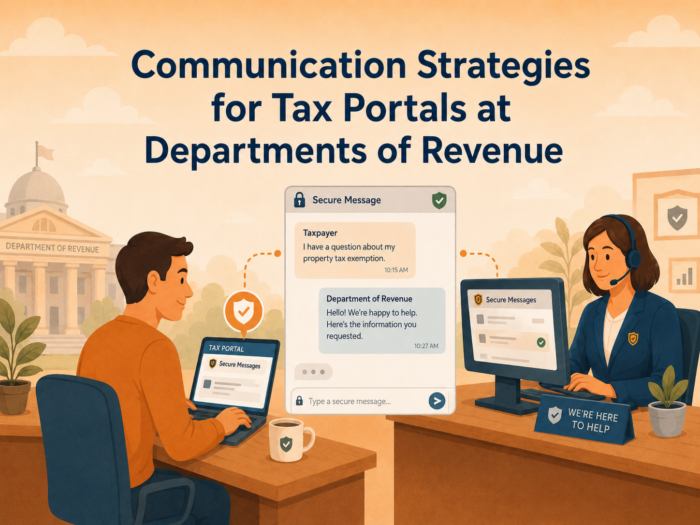
Secure Messaging That Builds Trust: Communication Strategies for Tax Portals at Departments of Revenue
When a taxpayer has a question about their account, a notice they received, a payment they submitted, or an obligation they do not fully understand, they have historically had one primary path to the agency: the phone. They call, they wait, they explain their situation to a representative who may or may not have all the information needed to answer the question in a single call, and they hang up having either resolved the issue or added a follow-up call to their list of tasks. For many taxpayers, this call is a source of genuine anxiety. It requires setting aside time during business hours, navigating automated phone systems, and trusting that the information they receive over the phone is accurate and complete.
Secure messaging through a taxpayer portal represents a meaningful alternative to this dynamic. A taxpayer who can send a message through their authenticated account, attach a relevant document, describe their situation at their own pace and in their own time, and receive a written response that they can save and reference later has a qualitatively different relationship with the agency than one who depends entirely on phone calls. Secure messaging does not replace every type of taxpayer-agency interaction, but it serves a wide range of common inquiry types, including questions about notices, account status, payment confirmation, document submission, and general filing guidance, in a way that can be more accurate, more accessible, and more satisfying than phone communication alone.
The challenge for state and local departments of revenue is not primarily a technical one. Most modern taxpayer portals include a secure messaging function. The challenge is communicational. Taxpayers who do not know the secure messaging feature exists will not use it. Taxpayers who do not understand what kinds of questions it can answer will not know when to use it versus when to call. Taxpayers who submit a message and receive no response within a reasonable time, or receive a response that does not address their question, will not use it again. And taxpayers who are uncertain whether a message response is official agency communication will not trust the answers they receive.
This article examines how state and local departments of revenue can build the communication strategy around secure portal messaging that makes it a genuinely useful, trusted, and appropriately used channel. It addresses how to promote secure messaging, how to set expectations about its scope and response times, how to design responses that build rather than erode trust, and how to maintain message quality as volume grows.
The Communication Gap Around Secure Messaging Features
 Most taxpayers who use a state or local revenue agency’s online portal are aware that the portal exists and may know how to log in, check their balance, or make a payment. Fewer are aware that the same portal typically includes a secure messaging channel through which they can send questions directly to agency staff and receive written responses. This awareness gap is not primarily a function of taxpayer disinterest. It is a function of how revenue agencies communicate about their portal services, which tends to emphasize the transactional functions such as filing and payment and underemphasize the communication functions such as messaging and document submission.
A taxpayer who does not know secure messaging is available will default to their familiar channel when they have a question: the phone. From the agency’s operational perspective, this means the call center absorbs inquiry volume that could have been handled more efficiently through asynchronous messaging. From the taxpayer’s perspective, it means a less convenient, more time-constrained interaction that may not produce a written record they can save. Both parties would benefit from a communication strategy that makes secure messaging a visible, well-understood option at the moments when taxpayers are most likely to have questions.
Those moments are predictable. A taxpayer who receives a balance due notice is likely to have questions about the notice. A taxpayer who submits a document upload is likely to want confirmation that it was received. A taxpayer who makes a payment is likely to want to know when it will be posted to their account. A taxpayer who is preparing to file for the first time in a new tax type is likely to have procedural questions. Each of these moments is a natural prompt for a secure message, and agencies that include a reference to secure messaging in the communications that accompany these moments, including notices, portal confirmation screens, and filing instructions, can drive meaningful adoption without requiring a separate marketing campaign.
Why Taxpayers Do Not Trust New Communication Channels
Even when taxpayers become aware that a secure messaging channel is available, adoption can be slow because of a fundamental trust question: is this channel real, official, and reliable enough to use for something that matters. A taxpayer who has an important question about a notice affecting their tax balance is not looking for a channel that might produce a helpful response eventually. They want confidence that their message will reach the right person, that the response will be official and accurate, and that using the messaging channel will not delay their resolution compared to calling.
Revenue agencies can address this trust barrier by being specific about what secure messaging is, who responds to messages, what the typical response time is, and what the status of a written message response is from an official standpoint. A messaging channel that is clearly identified as a direct line to agency staff, that provides a specific response time commitment, and that explicitly states that written responses through the portal are official agency communications gives taxpayers the confidence they need to trust the channel with questions that matter. Vague descriptions of a contact us feature without these specifics leave taxpayers uncertain whether to rely on it.
Clearer Taxpayer Communication: Strategies for State and Local Assessors, Treasurers, Revenue Departments, and Finance Offices
This article is part of our series on strategic communication for State and Local Assessors, Treasurers, Revenue Departments, and Finance Offices. Clear, timely, and accessible taxpayer communication helps government agencies improve compliance, reduce confusion, strengthen public trust, and enhance the citizen experience. To learn more and to see the parent article, which links to additional resources and best practices for taxpayer outreach and engagement, click the button below.
Setting Clear Expectations About Scope and Response Time
Secure messaging is a powerful channel for the right types of taxpayer questions. It is not appropriate for every type of taxpayer-agency interaction, and communication about secure messaging should be honest about its scope. Questions that require immediate resolution, that involve a rapidly approaching deadline, or that require the taxpayer to take action within hours are generally better served by phone. Questions that are informational, that involve documentation submission, that require a written record, or that can be addressed within a few business days are well suited to secure messaging. Communicating this distinction clearly gives taxpayers the ability to choose the right channel for their situation rather than using secure messaging for urgent matters and being frustrated by the response time.
Response time commitments are among the most important elements of secure messaging communication. A messaging channel that does not tell taxpayers how long to expect before receiving a response creates uncertainty that undermines adoption. A taxpayer who sends a message and hears nothing for a week may assume the message was not received, may call the agency in the interim, or may resolve never to use the messaging channel again. A taxpayer who is told at the point of submission that responses are typically provided within three to five business days and who receives an acknowledgment that the message was received can wait appropriately and plan their next steps accordingly.
Agencies that commit to specific response time standards for secure messages must build the operational capacity to meet those standards consistently before they communicate them publicly. A response time commitment that is frequently missed is worse for taxpayer trust than no commitment at all, because it creates a specific expectation that is then visibly not met. The appropriate response time standard depends on the agency’s staffing and workflow capacity, the complexity of the messages it receives, and the urgency of the typical message type. For many agencies, a three to five business day standard for general inquiries is both achievable and satisfying to taxpayers, provided it is consistently met and prominently communicated.
Message Routing and the Accuracy Problem
One of the operational challenges that shapes the quality of secure messaging as a communication channel is ensuring that messages reach the staff members who can answer them accurately and promptly. A revenue agency that receives secure messages into a general inbox and routes them manually to the appropriate unit may see significant delays and variability in response quality. A message about a sales tax audit that is initially routed to the individual income tax unit, transferred to the business tax unit, and then transferred again to the audit division before reaching someone who can answer it may take days longer than necessary and may produce an inconsistent response if each unit provides a partial answer along the way.
Message routing that is designed to get the right questions to the right people efficiently is a prerequisite for a secure messaging channel that meets its response time commitments and produces accurate responses. This may involve structured message intake forms that capture the tax type, the nature of the inquiry, and the relevant account information at the point of submission, enabling automatic or guided routing to the appropriate unit. It may involve training front-line messaging staff to handle a broader range of common inquiry types without referral. Or it may involve dedicated messaging response teams that have broad enough knowledge of the agency’s programs to answer most common questions directly. The specific approach depends on the agency’s size and organizational structure, but the goal is the same: a routing process that is fast, accurate, and invisible to the taxpayer.
Designing Secure Message Responses That Build Trust
The quality of a secure message response determines whether the taxpayer’s experience with the channel was worth having. A response that is accurate, clear, specific, and addressed to the taxpayer’s actual question builds confidence in the channel and increases the likelihood that the taxpayer will use it again. A response that is generic, that restates the question without answering it, that refers the taxpayer to call the agency for information they could have received in the message, or that is difficult to understand because of technical or legal language does the opposite.
Secure message responses should be written in plain language, addressed directly to the taxpayer’s specific question, and organized so the answer is clear before any supporting explanation is provided. If the taxpayer asked whether their payment was received and applied to their account, the first line of the response should answer that question directly: yes, the payment of a specific amount received on a specific date has been applied to your account for a specific tax year. The supporting detail about where the payment was applied, the updated balance, and any remaining obligations can follow. A response that begins with a paragraph explaining agency payment processing timelines before confirming whether the specific payment was received fails the taxpayer at the moment the response was their reason for writing.
Responses should also be signed or attributed in a way that identifies them as official agency communications. A response that comes from a generic account name or department label without a staff identifier provides less assurance of official status than one that identifies the responding unit and includes a name or reference number for the interaction. The response should also include information about what the taxpayer should do if they have a follow-up question, whether they can reply to the same message thread, and what to do if their situation requires immediate attention before a follow-up response can be provided.
Avoiding Responses That Redirect Taxpayers Back to the Phone
One of the most frustrating experiences a taxpayer can have with a secure messaging channel is sending a question, waiting several days for a response, and receiving a reply that says please call our office to discuss your account. This response pattern defeats the purpose of the messaging channel, wastes the taxpayer’s time, and signals that the messaging channel is not a genuine service option but a call deflection filter that routes some questions back to the phone anyway.
Agencies should review their secure message response practices to identify how frequently responses redirect taxpayers to the phone and why. Some redirects are genuinely necessary: questions that require real-time negotiation, situations that involve active audit or enforcement proceedings, or inquiries that require access to information the messaging staff cannot retrieve in the messaging environment. But many redirects are habitual rather than necessary, representing cases where messaging staff default to a call referral because it is easier than drafting a complete written response. Reducing unnecessary redirects requires both the operational capacity for messaging staff to provide complete written answers and a clear policy about which inquiry types can and should be resolved through the messaging channel.
Promoting Secure Messaging at the Right Moments
 The most effective promotion for secure messaging is not a general campaign explaining that the feature exists. It is contextual promotion that introduces the messaging option at the specific moment when a taxpayer is likely to have a question. The right moments for secure messaging promotion are the moments immediately after taxpayers complete a portal action, receive a notice, or encounter a situation that commonly generates questions.
A confirmation screen after a document upload that says if you have questions about this document submission, you can message agency staff through your account is more effective than a general introduction to the messaging feature on the portal’s homepage. A notice that includes a line saying you can send questions about this notice through your secure online account is more effective than a separate email about portal communication options. A payment confirmation that says if you do not see this payment reflected in your account balance within three business days, you can message us through your portal account giving the taxpayer a specific, relevant use case for the channel at the moment when that use case is most likely to apply.
Agencies should map the taxpayer journey through the portal and identify the five to ten moments where questions most commonly arise. Each of those moments is an opportunity to introduce secure messaging as the recommended path for questions of that type, with language that makes it clear what kind of answer the taxpayer can expect and within what timeframe. This contextual promotion approach builds adoption organically by connecting the messaging feature to the situations where it is genuinely useful, rather than asking taxpayers to remember the feature and think to use it independently.
Integrating Secure Messaging Into Notice Communication
Tax notices are one of the highest-anxiety communication touchpoints in the taxpayer-agency relationship, and they are also one of the situations most likely to generate taxpayer questions. A notice that assesses a penalty, proposes an adjustment, or requests documentation will prompt many recipients to want clarification before they respond. Those taxpayers currently have three options: call the agency, visit an office, or attempt to respond to the notice without fully understanding it. Secure messaging should be a clearly offered fourth option.
Notices that include a specific reference to secure messaging as a path for questions, with language that identifies the type of questions the channel can answer and a realistic response time, give taxpayers a lower-stakes, more convenient path to clarification than a phone call. A notice that says if you have questions about this notice, you can send a secure message through your online account and expect a response within three to five business days converts a taxpayer who might otherwise call immediately, wait on hold, and potentially receive a rushed answer into one who can send a thoughtful message when they have time and receive a considered written response. For both the taxpayer and the agency, that is a better interaction.
Managing Message Volume and Maintaining Quality
As secure messaging adoption grows, managing message volume while maintaining response quality becomes a significant operational challenge. Agencies that promote secure messaging successfully may see a rapid increase in message volume that overwhelms the staffing resources initially allocated to the channel. Without adequate capacity, response times lengthen, quality declines, and the trust that the channel took time to build erodes quickly. Planning for volume growth is therefore part of the communication strategy for secure messaging, not just an operational concern.
Agencies can manage message volume more effectively by investing in several practices that reduce the number of messages that require individual staff response. Frequently asked question libraries that are accessible from within the messaging interface, before the taxpayer submits their question, can deflect a portion of common questions to self-service without requiring taxpayers to abandon the messaging channel entirely. Automated acknowledgment messages that confirm receipt and provide a specific response time help reduce follow-up messages from taxpayers checking whether their original message was received. Message templates for the most common response types allow staff to provide accurate, complete answers more quickly than drafting each response from scratch.
Quality assurance for secure message responses requires a systematic review process that evaluates accuracy, clarity, completeness, and tone. A response that is technically accurate but difficult to understand, or one that is friendly in tone but leaves the taxpayer’s specific question unanswered, represents a quality failure even if it meets the response time standard. Agencies should build response quality review into their messaging operations, using a sample-based approach to identify response patterns that need improvement and providing staff with feedback and examples of strong responses to guide their writing.
Multilingual Secure Messaging
Secure messaging serves the goal of equitable taxpayer communication only if it is accessible to taxpayers who communicate in languages other than English. An agency that offers secure messaging in English only is effectively limiting the benefit of the channel to the portion of the taxpayer population that is comfortable corresponding in English. Taxpayers who prefer to write in another language, who use a family member or community resource to help draft their message in English, or who may misunderstand responses because of language limitations are less well served by a messaging channel that does not accommodate their language needs.
Agencies serving multilingual populations should assess the feasibility of accepting and responding to messages in the most common non-English languages present in their taxpayer base. This does not require hiring dedicated bilingual messaging staff for every language. It may involve using translation resources to respond to non-English messages, working with the agency’s existing bilingual staff to handle messages in the languages they speak, or providing clear guidance in non-English languages about how to request language assistance through the messaging channel. The key is ensuring that a taxpayer who writes in Spanish, Vietnamese, Mandarin, or another language does not receive a response that fails to address their question because of a language mismatch between their message and the agency’s response capacity.
Strategic Communication Support for Revenue and Tax Administration Agencies
 Building a secure messaging channel that taxpayers trust and use effectively requires more than deploying the technical feature in the portal. It requires a communication strategy that introduces the channel at the right moments, sets honest expectations about scope and response time, designs responses that answer questions completely in plain language, manages volume without sacrificing quality, and extends the channel’s benefits to the full range of the taxpayer population. These are communication design challenges that most revenue agency portal teams were not specifically structured to address when the messaging feature was added to the portal.
Structured communication support for secure messaging programs typically begins with an assessment of how the messaging channel is currently being promoted, how taxpayers are using it, what the response time and quality patterns look like, and where the gap is between the channel’s potential and its current performance. That assessment produces a clear picture of the specific communication improvements that would most increase taxpayer adoption, trust, and satisfaction with the messaging channel, and distinguishes between communication gaps that can be closed through better messaging design and operational challenges that require staffing or process changes.
Stegmeier Consulting Group (SCG) helps state and local departments of revenue build secure messaging communication strategies that make the channel a trusted, well-understood, and appropriately used alternative to phone contact. That support may include secure messaging promotion strategy development, notice and portal confirmation language revisions that introduce messaging at the right moments, response template development, response quality frameworks, staff training on plain-language written response practices, multilingual messaging accessibility assessment, and measurement frameworks for messaging adoption and quality.
A secure messaging channel that taxpayers trust and use is one of the most cost-effective ways to reduce call volume, improve taxpayer experience, and extend the agency’s service capacity beyond the constraints of a phone-based model. Realizing that potential requires the same communication discipline that governs every other element of taxpayer-facing outreach.
Future Trends in Secure Messaging for Tax Portals
The role of secure messaging in taxpayer-agency communication is expanding as both taxpayer expectations and agency capabilities evolve. Several developments will shape how secure messaging functions in state and local revenue portals over the next several years.
Artificial intelligence-assisted response drafting is beginning to enter government service contexts, including tax administration. AI tools that can draft a first-pass response to common taxpayer messages, drawing on a library of accurate agency information, may allow messaging staff to provide more consistent, faster responses by reviewing and refining AI-drafted text rather than drafting every response from scratch. The communication design of these AI-assisted responses, including how they handle nuance, account-specific information, and unusual situations, will determine whether they improve or undermine response quality. Agencies that implement AI-assisted messaging will need to invest in response quality review processes to ensure that AI-drafted responses meet the accuracy and clarity standards that taxpayer trust requires.
Proactive messaging from the agency to the taxpayer is an emerging capability that inverts the typical secure messaging dynamic. Rather than waiting for taxpayers to initiate contact when they have a question, some agencies are beginning to use the authenticated messaging channel to send taxpayer-specific alerts, reminders, and status updates directly to the taxpayer’s portal inbox. A proactive message notifying a taxpayer that their quarterly payment is due in ten days, that a document they uploaded has been reviewed and accepted, or that their refund has been processed is a higher-value communication than a generic email or text because it is delivered through an authenticated channel that the taxpayer associates with their official account. Designing these proactive messages to be clear, specific, and action-oriented requires the same plain-language discipline that governs response quality.
Integration between secure messaging and case management systems is becoming more common in modernized tax administration platforms. When a taxpayer’s message can be automatically linked to their account record, previous messages in the same thread, and relevant case activity, the messaging staff member who responds has more context and can provide a more accurate, complete response without manual research. This integration also supports quality assurance by creating a record of the full message exchange in the agency’s case management system, allowing supervisors to review exchanges and identify patterns in both taxpayer questions and staff responses.
Conclusion
Secure messaging in a taxpayer portal is not simply a convenience feature. It is a service channel that, when well-designed and well-communicated, can meaningfully improve the quality of the taxpayer-agency relationship. It gives taxpayers a written record of their communications with the agency. It allows them to ask questions at their own pace and in their own time. It creates a channel for accurate, considered responses that telephone interactions under time pressure do not always provide. And it extends the agency’s service capacity beyond the constraints of a call center model that is expensive to staff, difficult to scale, and inherently limited to business hours.
Realizing those benefits requires a communication strategy that goes well beyond announcing that the messaging feature exists. It requires contextual promotion at the moments when taxpayers are most likely to have questions. It requires honest expectation-setting about scope and response time. It requires response practices that provide complete, plain-language answers to specific taxpayer questions. It requires operational capacity that can meet the response time commitments made publicly. And it requires accessibility across language and accessibility dimensions so that the benefits of the channel are available to the full taxpayer population, not only those who are most comfortable with digital communication in English.
The taxpayer who sends a message through the portal and receives a clear, accurate, timely response has experienced government communication at its most useful. Building the conditions for that experience is the communication work that makes secure messaging deliver on its promise.
SCG’s Strategic Approach to Communication Systems
Align your agency’s messaging, processes, and public engagement strategies.
State and local departments of revenue need secure messaging communication strategies that make the channel visible at the right moments, set honest expectations about scope and response time, produce responses that build rather than erode taxpayer trust, and extend the channel’s benefits to the full range of the taxpayer population. That means contextual promotion in notices and portal confirmation screens, response quality frameworks that ensure plain-language and complete answers, multilingual accessibility planning, and measurement systems that track adoption and quality over time.
SCG helps revenue departments build secure messaging communication strategies that turn a technical portal feature into a trusted service channel. Whether your agency needs promotion strategy development, notice and portal language revisions, response template and quality frameworks, staff training, multilingual accessibility assessment, or measurement design, SCG can help you build the communication strategy that makes secure messaging deliver its full value.
Use the form below to connect with our team and explore how a strategic approach to secure messaging communication can help your department reduce call volume, improve taxpayer experience, and build a more trusted and accessible communication channel for taxpayers across your jurisdiction.