
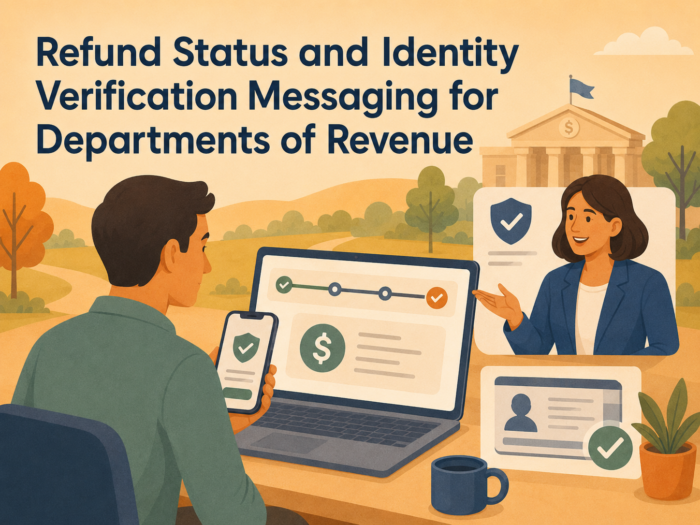
Refund Status and Identity Verification Messaging for Departments of Revenue
Few interactions between a taxpayer and a revenue agency carry more emotional weight than the refund. For many filers, a tax refund represents the largest single payment they will receive in any given year. It is money they have been anticipating, planning around, and in some cases depending on to meet financial obligations. When that refund is delayed, adjusted, reduced, or placed on hold because of a verification request, the taxpayer’s experience of the agency shifts from routine to urgent in a way that no other tax communication produces.
State and local departments of revenue face a persistent communication challenge around refunds and identity verification that is more complex than it might appear. Refund delays and verification holds are legitimate administrative functions. Agencies have a legal obligation to ensure that refunds are issued to the correct person, that the return information is accurate, and that the refund is not the product of fraudulent filing. But the taxpayer who is waiting for their refund and suddenly receives a notice asking them to verify their identity may not know whether that notice is legitimate. They may not understand what the verification requires. They may not know how long the process will take or whether their refund will be processed once verification is complete.
At the same time, the same channels that legitimate agencies use to communicate refund status and request identity verification have been systematically exploited by fraudulent actors who impersonate revenue agencies to steal personal information. A taxpayer who receives an email claiming to be from the state department of revenue asking them to verify their identity by clicking a link cannot always tell whether that communication is legitimate or a phishing attempt. The visual and linguistic overlap between genuine agency communication and sophisticated fraud schemes has created a verification environment in which taxpayer confusion is not irrational. It is the predictable result of a communication landscape that agencies have not yet fully designed for the threat.
This article examines how state and local departments of revenue can design refund status and identity verification communication that is clear about what is happening, specific about what is required, honest about timing, and designed to help taxpayers distinguish legitimate agency requests from fraudulent ones. It addresses the structural, language, and channel decisions that determine whether these high-stakes communications build trust or create the kind of uncertainty that drives taxpayers toward fraudulent sources for reassurance.
Why Refund Communication Fails at Critical Moments
 Refund communication from state and local revenue agencies fails most often not in normal processing situations but at the specific moments when something in the processing chain changes. When a refund is delayed because of a high-volume processing period, the taxpayer may receive no communication at all and instead be directed to check the agency’s online refund status tool, which may provide a generic status message without a useful timeline. When a refund is held because of a mathematical error on the return, the taxpayer may receive a notice that explains the adjustment without clearly distinguishing between the adjusted refund amount and the original expected amount. When a refund is held because of an identity verification requirement, the taxpayer may receive a notice whose purpose is clear to the agency but ambiguous to the taxpayer.
Each of these failure modes has the same underlying cause: the agency’s communication is organized around its own administrative process rather than around the taxpayer’s experience of that process. The agency knows that a return is in identity verification hold status. The taxpayer knows only that their expected refund has not arrived and that they have received an unusual notice. Bridging that gap, helping the taxpayer understand what is happening in terms that connect to their experience rather than the agency’s workflow, is the core communication challenge in refund and verification messaging.
The consequences of communication failure in these situations are disproportionate to what might seem like a routine administrative matter. A taxpayer who does not understand a refund delay notice may call repeatedly, generating avoidable call volume. A taxpayer who does not understand an identity verification request may ignore it, causing the refund to remain on hold indefinitely. A taxpayer who cannot tell whether a verification request is legitimate may click on a fraudulent link attempting to answer what they believe to be a government request, exposing their personal information to theft. The stakes of clear refund and verification communication are not administrative. They are financial and in some cases security-related.
The Specific Anxiety of Refund Delays
A delayed refund creates a specific kind of taxpayer anxiety that differs from the anxiety produced by a balance due notice. A balance due notice tells the taxpayer they owe something. The taxpayer may disagree, but the situation has a clear structure: owe, respond, resolve. A refund delay creates uncertainty without a clear structure. The taxpayer was expecting something, that something has not arrived, they do not know why, they do not know when it will arrive, and they are unsure whether inquiring will accelerate the situation or trigger scrutiny that makes it worse.
Agencies can reduce this anxiety significantly through proactive status communication that reaches the taxpayer before they begin calling. A message that says a return has been received and is being processed, that standard processing takes a specific number of weeks, and that the taxpayer will be contacted if additional information is needed eliminates the most basic source of refund anxiety: the uncertainty about whether the return was even received. Adding a specific, realistic timeline and a clear statement of what happens next reduces the remaining uncertainty in a way that a generic check the status tool message cannot match.
Clearer Taxpayer Communication: Strategies for State and Local Assessors, Treasurers, Revenue Departments, and Finance Offices
This article is part of our series on strategic communication for State and Local Assessors, Treasurers, Revenue Departments, and Finance Offices. Clear, timely, and accessible taxpayer communication helps government agencies improve compliance, reduce confusion, strengthen public trust, and enhance the citizen experience. To learn more and to see the parent article, which links to additional resources and best practices for taxpayer outreach and engagement, click the button below.
What Refund Status Communication Must Tell Taxpayers
Effective refund status communication answers a sequence of questions that taxpayers have as they move through the refund waiting period. The first is whether the return was received. The second is where it is in the processing sequence. The third is when to expect the refund. The fourth is whether anything has changed from what the taxpayer expected. The fifth is what to do if something unexpected has occurred. Agencies that design their refund status communication to address these questions in sequence, in plain language, and through channels the taxpayer actually uses will generate less call volume, fewer avoidable inquiries, and higher levels of taxpayer trust than agencies that provide minimal status information and direct taxpayers to a generic online tool.
The received confirmation is the most important first communication in the refund sequence because it eliminates the most basic anxiety point. A confirmation that arrives after a return is processed into the system, stating that the return has been received and is being reviewed, provides the taxpayer with immediate reassurance that the filing reached the agency. This confirmation should include the tax year the return covers, the filing date, a realistic processing timeline, and information about how the taxpayer will be notified if additional information is needed. It should be sent through whatever channel the taxpayer used to file: electronically delivered for e-filers and mailed for paper filers.
Processing timeline communication is the second critical element. Taxpayers have a general expectation that a refund will arrive within a certain number of weeks based on prior experience, information from their tax preparer, or guidance from the agency. When processing is taking longer than expected, which happens regularly during high-volume periods, agencies that proactively communicate the reason and the updated timeline preserve taxpayer trust more effectively than agencies that leave taxpayers to discover the delay on their own. A brief update that explains a high filing volume has extended standard processing by an additional two weeks and provides a revised expected date is significantly more useful than the same generic status message the taxpayer has been checking repeatedly.
Adjustment Notices and the Confusion They Create
One of the most confusing refund communications a taxpayer can receive is a notice that their refund amount has been adjusted. The adjustment may be entirely legitimate, reflecting a math correction, an offset for a prior balance, a change to a credit claimed on the return, or a difference between the income reported and the income the agency has on file from third-party sources. But the taxpayer who was expecting a specific refund amount and receives a notice that the amount has changed needs to understand what changed, why it changed, and whether the adjustment is final or subject to dispute.
Adjustment notices that explain the change in plain language, show the original expected refund amount, the adjustment and its basis, and the adjusted refund amount give the taxpayer the information they need to evaluate whether the adjustment is correct. A notice that simply states an adjusted refund amount without explaining the basis for the adjustment creates doubt, generates calls, and produces disputes that a clear explanation would have prevented. The additional communication investment in a clear adjustment explanation is far smaller than the call volume and case management cost that vague adjustment notices generate.
Identity Verification Communication Requires a Different Standard
Identity verification requests occupy a special category in refund communication because they combine the urgency of a delayed refund with the sensitivity of a request for personal information. A taxpayer who receives an identity verification request from the agency is being asked to provide information that confirms they are the person who filed the return. That request is legitimate, necessary, and important for fraud prevention. But it is also the type of request that fraudulent actors systematically mimic, which means the communication design of a legitimate identity verification request must work harder than any other agency communication to establish its own credibility.
An identity verification notice from a legitimate revenue agency should immediately and clearly identify itself as official government correspondence. It should reference specific information that only the agency and the taxpayer would know, such as the tax year, the filing date, and a portion of the return information, in a way that does not itself constitute a security risk. It should explain exactly why the verification is being requested in plain language that connects to the taxpayer’s return rather than generic fraud prevention language. And it should provide a specific, verifiable set of options for completing the verification that direct the taxpayer to official agency channels, not to external links or phone numbers that are not clearly connected to the agency.
The verification process itself should be designed to minimize friction while maintaining security. A taxpayer who is asked to verify their identity through a process that requires multiple steps, the creation of a new online account, or the submission of documents they may not have readily available will experience that process as a barrier rather than a path to their refund. Clear, step-by-step instructions, a realistic timeline for what happens after verification is submitted, and an accessible alternative for taxpayers who cannot complete the digital process are all elements of verification communication design that determine whether the legitimate request achieves its purpose.
The Verification Timeline Gap
One of the most common sources of taxpayer frustration after completing an identity verification request is the absence of communication about what happens next. A taxpayer who submits identity documents, completes an online verification process, or responds to a verification notice expects to receive some form of confirmation that their submission was received and some indication of when their refund will be released. When that confirmation does not arrive, or arrives only in the form of a generic acknowledgment without a timeline, the taxpayer is left in a state of uncertainty that frequently leads to repeat calls and escalating frustration.
Agencies should treat post-verification communication as a required element of the verification process, not an optional follow-up. A confirmation that verification materials were received, an explanation of how long the review will take, and a notification when the review is complete and the refund has been released are the minimum communication elements a taxpayer needs to feel that the verification process is functioning as intended. These communications do not require complex systems. They require a deliberate decision to include post-verification notification in the design of the verification workflow rather than treating the taxpayer’s submission as the end of the communication sequence.
Helping Taxpayers Distinguish Legitimate Requests From Fraud
 The responsibility of a revenue agency to help taxpayers identify legitimate communications does not exist in isolation from its responsibility to communicate clearly about refunds and verifications. These two functions are deeply connected. A taxpayer who cannot tell whether a verification request is genuine may not complete it, which delays their refund and creates an unnecessary administrative burden for both parties. A taxpayer who cannot identify a fraudulent verification request as such may comply with it, which exposes their personal information and may produce a fraudulent refund claim that the agency then has to investigate.
Building verification confidence into the design of legitimate agency communications is one of the most important communication investments a revenue department can make. This means designing letters, emails, and other verification requests in ways that include specific, verifiable signals of authenticity. The agency’s official letterhead and correct return address on mailed correspondence. A specific, searchable agency phone number on any notice requesting a callback. A website URL that uses the official government domain on any digital communication. A reference to specific return information that the taxpayer can verify matches their own filing. And explicit language telling the taxpayer how to confirm that the request is genuine before they respond.
This last element is particularly important. A legitimate verification notice should tell the taxpayer that they can verify its authenticity by calling the agency’s publicly listed main number, by logging into their online account to check whether a verification flag appears, or by visiting the agency’s official website to confirm that the verification process described in the notice matches what the agency’s public resources describe. Giving taxpayers these verification pathways empowers them to confirm the legitimacy of a request before responding, which protects them from fraud and increases their confidence in legitimate requests.
What Legitimate Agency Verification Will Never Ask For
One of the most effective ways to help taxpayers identify fraudulent verification requests is to tell them explicitly what a legitimate agency verification will never include. This kind of negative definition, stating clearly what the agency does not do, gives taxpayers a reliable filter for evaluating suspicious communications. A notice or communication that asks a taxpayer to verify their identity by providing a full Social Security number via email, by clicking a link to enter banking information, by calling a number not listed on the agency’s public website, or by paying a fee to release a held refund is not a legitimate agency communication.
Revenue agencies should publish and communicate this list of things the agency will not ask for through proactive public education efforts, on the refund status pages of the agency website, in the body of legitimate verification notices, and through any community partner or practitioner channels that regularly communicate agency guidance. Making this negative definition widely known gives taxpayers a tool that works regardless of how sophisticated the fraudulent communication is. A taxpayer who knows that the revenue department will never ask for banking information by email does not need to evaluate the quality of the fraudulent email’s letterhead to know it is not legitimate.
Channel Design for Refund and Verification Communication
The channel choices an agency makes for refund and verification communication affect both the effectiveness of the communication and its vulnerability to impersonation by fraudulent actors. Channels that have high open rates and immediate delivery, such as email and text, are efficient for refund status updates and verification notifications. They are also the channels most commonly used in tax fraud schemes. Agencies that communicate primarily through these channels without providing taxpayers with clear verification tools are increasing both their communication reach and their taxpayers’ exposure to credible-looking fraud.
A balanced channel strategy for refund and verification communication uses direct mail as the foundation for formal verification requests because mailed letters from a government return address are harder to convincingly fabricate and are more widely recognized as legitimate official correspondence. Digital channels including email and text can supplement mailed communication for refund status updates and general processing notifications where the information being communicated is status-based rather than action-requiring. When a digital communication requires action from the taxpayer, particularly action that involves providing personal information, the communication should direct the taxpayer to an authenticated government portal or the agency’s official public website rather than embedding a link that must be clicked without verification.
The agency website should serve as the definitive reference for refund status and verification information. A clearly maintained, current page that explains the verification process, describes what taxpayers can expect at each stage, provides a realistic timeline, and tells taxpayers explicitly what legitimate agency communications will and will not include gives every other channel a reliable source to reference. A mailed notice that says for more information about this verification process, visit the agency’s official website at the specific address can direct taxpayers to verification guidance without requiring the notice itself to contain every piece of relevant information.
The Refund Status Tool as a Communication Asset
Most state and local revenue agencies provide an online refund status tool that taxpayers can use to check the current status of their return. These tools are valuable but are often designed as information retrieval systems rather than communication tools. A taxpayer who enters their information and receives a status of processing in progress without a timeline, a description of what that status means, or guidance about when to follow up has not received useful communication. They have received a data point that they must interpret without context.
A well-designed refund status tool communicates more than status. It explains what each status means in plain language, provides a realistic estimate of when the status will change, tells the taxpayer what to do if the status has not changed after a specific period, and identifies whether any action is required from the taxpayer before processing can continue. A status tool that provides this level of communication reduces calls from taxpayers trying to understand what their status means, reduces repeat checks from taxpayers who are uncertain when they should be concerned, and produces a more useful taxpayer experience than a tool that simply reflects database values without communicating their significance.
Communicating Refund Offsets and Third-Party Holds
A refund that is offset to satisfy a debt to another government agency is one of the most jarring refund outcomes a taxpayer can experience, particularly when they were not expecting it. An offset may apply when the taxpayer owes a debt to a state agency, a court, a child support program, or another government creditor. The revenue agency may be legally required to apply the offset regardless of whether the taxpayer was notified in advance by the creditor agency. The taxpayer may receive a refund that is smaller than expected, or no refund at all, without understanding why.
Offset communication should explain clearly that a portion of the refund was applied to a specific type of debt, identify the agency or program to which the offset was applied, and provide contact information for that agency or program so the taxpayer can follow up about the underlying debt. An offset notice that simply states the refund was reduced without identifying the reason or the creditor leaves the taxpayer without a path to understand or address the situation. This kind of communication gap generates calls to the revenue agency that the revenue agency often cannot resolve because the underlying debt is managed by a different entity.
Some taxpayers receiving offset notices will also have questions about whether the offset was correct, whether they have any rights to dispute it, and whether the remaining refund, if any, will be issued on the standard timeline. A well-designed offset communication anticipates these questions and provides brief, clear answers to each one, along with specific contact information for the creditor agency and the revenue agency’s own refund processing team. This proactive communication reduces calls, reduces confusion, and helps taxpayers navigate a situation that is genuinely complex without professional assistance.
Strategic Communication Support
 Refund status and identity verification communication sits at the intersection of taxpayer service, fraud prevention, and public trust in ways that make it one of the most strategically significant areas of a revenue department’s communication portfolio. Getting it wrong does not just produce avoidable calls and frustrated taxpayers. It creates situations where taxpayers cannot tell whether official government correspondence is genuine, where legitimate verification requests go unaddressed because taxpayers feared they were scams, and where actual fraud succeeds because taxpayers could not identify it as such. The communication design stakes in this area are higher than in almost any other area of tax administration correspondence.
Structured communication support in this area typically begins with an audit of the current refund and verification communication sequence. That audit examines the notices and status communications taxpayers receive at each stage of the refund process, evaluates whether the language and structure of those communications answers the questions taxpayers most commonly have, assesses whether verification requests contain the elements that establish their legitimacy, and identifies whether the communication provides taxpayers with the tools they need to distinguish official agency contact from fraud.
Stegmeier Consulting Group (SCG) helps state and local departments of revenue design refund status and identity verification communication systems that build trust, reduce avoidable calls, protect taxpayers from fraud, and produce timely responses to legitimate verification requests. That support may include communication audits of the refund processing sequence, redesign of verification notices and refund status communications, development of plain-language verification guidance for taxpayers and partners, refund status tool content review, anti-fraud public education messaging, and channel strategy development for refund and verification outreach.
The goal is a communication system in which taxpayers understand what is happening with their refund at every stage, know exactly what is required of them when verification is requested, can reliably identify legitimate agency communications, and have a clear path to help when their situation involves an offset, an adjustment, or an extended hold. That level of communication clarity is not a luxury feature of a well-designed tax administration system. It is a core function that supports taxpayer compliance, agency efficiency, and the public trust that makes voluntary tax administration possible.
Future Trends in Refund and Verification Communication
The trajectory of refund and identity verification communication for state and local revenue departments is being shaped by parallel developments in fraud sophistication and communication technology that are pushing agencies toward more robust, multi-layered communication design.
Identity verification technology is advancing rapidly, and the communication around that technology must keep pace. Agencies that implement knowledge-based authentication, document upload verification, biometric verification, or multi-factor authentication for refund processing need to communicate those processes clearly to taxpayers who may have no prior experience with them. The communication burden of explaining a new verification method is significant and should be treated as part of the implementation planning for any new verification system, not as an afterthought.
Artificial intelligence is increasingly being used in tax fraud detection, which means that more returns will be flagged for verification based on algorithmic risk signals rather than straightforward anomalies. This creates new communication challenges because the reason a return was flagged may not be describable in simple terms. Agencies will need to develop communication that explains that a return has been selected for verification without implying wrongdoing, without revealing fraud detection methods that could be exploited, and without leaving the taxpayer more confused than the original notice would have made them.
Real-time processing status communication is becoming more common in state and local tax systems. As agencies modernize their processing platforms, some are developing capabilities that allow taxpayers to receive live or near-live updates on the status of their return through authenticated online accounts. The design of these real-time communication experiences will determine whether they reduce taxpayer anxiety or amplify it by surfacing intermediate processing states that are technically accurate but meaningless or alarming to a general-audience taxpayer. Designing status language for real-time systems requires the same plain-language discipline that all refund communication requires, applied to a more granular and dynamic set of status values.
Finally, the intersection of refund communication and fraud education will become increasingly important as fraud schemes become more sophisticated. Agencies will need to invest in ongoing, proactive public education about how to verify the legitimacy of agency communications, not just as a one-time awareness campaign but as a sustained communication discipline that is built into the regular rhythm of refund season outreach. The agencies that help their taxpayer populations become more sophisticated consumers of government communications will have fewer fraud victims, fewer refund fraud claims, and a stronger foundation of public trust in the legitimacy of their own outreach.
Conclusion
Refund status and identity verification communication represents one of the highest-stakes areas of taxpayer-facing correspondence in state and local tax administration. The taxpayers who receive these communications are in situations that are financially consequential, emotionally charged, and in some cases actively targeted by sophisticated fraudulent actors who are trying to exploit their uncertainty. The communication these taxpayers receive from the agency determines whether they can navigate their situation effectively, complete required verification, protect themselves from fraud, and maintain their trust in the agency.
Agencies that invest in clear, specific, trustworthy refund and verification communication protect their taxpayers, reduce their own operational burden, and build the kind of confidence in official government correspondence that the fraud environment makes increasingly necessary. The investment required is not primarily technological. It is communicative. Clear language about what is happening. Specific timelines about what comes next. Explicit guidance about how to verify that a communication is genuine. These are communication design decisions, and they are available to any agency willing to make them deliberately.
The taxpayer waiting for their refund and uncertain whether a verification notice is real or a scam is not asking for a perfect government system. They are asking for clear, honest, specific communication that helps them understand their situation and take the right next step. Providing that communication is both an administrative responsibility and a public trust obligation that revenue departments can meet with thoughtful, deliberate communication design.
SCG’s Strategic Approach to Communication Systems
Align your agency’s messaging, processes, and public engagement strategies.
State and local departments of revenue need refund status and identity verification communication systems that reach taxpayers with clear, trustworthy information at every stage of the refund process. That means receiving confirmations that reduce initial anxiety, processing status communications that provide realistic timelines, verification notices that establish their own legitimacy through specific and verifiable signals, and post-verification communications that close the loop for taxpayers who have completed the process and are waiting for their refund.
SCG helps revenue departments design refund and verification communication that builds taxpayer trust, reduces avoidable call volume, and protects taxpayers from fraud by making legitimate agency communications clearly distinguishable from fraudulent ones. Whether your department needs a communication audit of the refund sequence, redesign of verification notices, anti-fraud public education messaging, refund status tool content review, or channel strategy development, SCG can help you build a system that communicates clearly at the moments that matter most.
Use the form below to connect with our team and explore how a strategic approach to refund and verification communication can help your department improve taxpayer experience, reduce fraud exposure, and build public confidence in your agency’s correspondence.