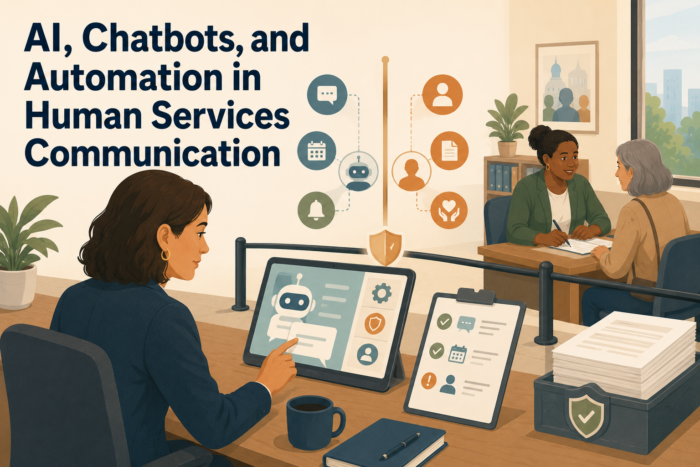
AI, Chatbots, and Automation in Human Services Communication: Where Public Benefits Agencies Need Guardrails
Artificial intelligence, chatbots, automated reminders, virtual assistants, predictive routing, and other digital tools are becoming more common in public-facing service environments. For human services agencies, public benefits agencies, county social services departments, and state benefits offices, these tools can appear attractive for practical reasons. They may help residents find information after hours, answer common questions, route people to the right page, remind households about renewals, reduce repetitive calls, support document submission, or help staff manage high-volume communication. In systems that often operate under staffing pressure and rising resident demand, automation can seem like a necessary extension of service capacity.
But human services communication is not the same as ordinary customer service communication. A resident asking about SNAP, Medicaid, cash assistance, child care assistance, EBT issues, renewals, verification requests, case closures, appeal rights, disaster benefits, or document deadlines may be dealing with high-stakes consequences. A wrong answer, vague instruction, misleading status explanation, or poorly timed automated message can affect whether the resident acts in time, submits the right document, understands a notice, or knows where to get help. In this context, automation is not just a convenience tool. It becomes part of the benefits access pathway.
That is why agencies need guardrails before they expand AI, chatbots, or automated communication. The question is not whether technology can be useful. It can be. The stronger question is where automation is appropriate, where human review is required, how information is verified, how residents are protected from misleading guidance, and how the agency preserves trust when digital tools are used in high-consequence processes. Without clear guardrails, automation can create the appearance of access while leaving residents with answers that are incomplete, outdated, too generic, or not appropriate for their case.
The risk is especially serious when automation blurs the line between general information and case-specific guidance. A chatbot may be able to explain where to apply for benefits, how to upload documents, or where to find office hours. But residents may ask questions that require individual eligibility review, interpretation of a notice, confirmation of case status, explanation of appeal options, or advice about a deadline. If the tool responds as though it can answer those questions definitively, residents may rely on information that should have been handled through an official notice, staff review, portal status, call center process, or formal case action.
Public benefits agencies also need to consider the emotional context of automated communication. Residents may interact with AI or chatbots while anxious, frustrated, confused, or worried that benefits will stop. They may not know whether they are speaking with a person, whether the answer is official, whether the tool has access to their case, or whether the guidance is current. A poorly designed automated experience can feel evasive or dismissive, especially when the resident needs reassurance that their situation has been understood. Guardrails help agencies use technology without weakening the human trust that public benefits communication depends on.
The goal is not to reject AI, chatbots, or automation. The goal is to use them responsibly. Human services agencies can benefit from well-designed digital assistance when it is limited to appropriate tasks, connected to maintained source-of-truth content, transparent about what it can and cannot answer, accessible to residents with different needs, and supported by clear escalation to human staff. Automation should reduce confusion, not conceal it. It should help residents reach the right next step, not create another layer of interpretation between the resident and the agency.
Automation Should Serve the Resident’s Task, Not the Agency’s Technology Agenda
 Human services agencies should begin any automation discussion with the resident task, not the tool. A chatbot, AI assistant, automated text, or self-service workflow should be evaluated by whether it helps residents complete a specific action more clearly and safely. That action might include finding office hours, locating a form, understanding how to submit documents, checking where to report a change, learning how to request language assistance, or finding the correct phone number for case-specific help. The value of automation depends on whether it improves the resident’s ability to move through the process.
When agencies begin with the technology itself, the communication strategy can drift toward promotion rather than usefulness. Residents may be encouraged to “use the chatbot,” “ask the virtual assistant,” or “try the automated service” without being told what the tool can reliably do. That creates a familiar problem in public benefits communication: the tool name becomes a substitute for instruction. Residents need to know what the tool is for, what kinds of questions it can answer, what it cannot answer, and where to go when their situation requires case-specific assistance.
A task-first approach also helps agencies avoid overextending automation. Some resident needs are well suited for automated guidance because they involve general information, stable instructions, or clear routing. Other needs require human judgment, privacy protection, eligibility expertise, or formal decision-making. The agency should define those boundaries before the tool is released publicly. Automation should support the service model, not quietly redefine it around what the tool can handle.
This matters because residents may interpret the availability of an automated tool as a signal that the agency expects them to use it. If the tool cannot answer their real question or route them clearly to a person, the resident may feel trapped in a digital loop. A responsible strategy makes automation one entry point into the communication system, not a replacement for the system itself.
More Than Just Applications: Human Services and Public Benefits Communication Strategies for State and Local Agencies
This article is part of our series on strategic communication for Human Services Agencies, Public Benefits Agencies, and Health and Human Services departments. To learn more and to see the parent article, which links to other content just like this, click the button below.
Guardrails Should Define What the Tool Can and Cannot Say
A public benefits chatbot or AI tool should have clear limits on the kinds of answers it can provide. It may be appropriate for the tool to explain general program information, office locations, document submission options, application pathways, website navigation, common terminology, or where to find official notices. It may not be appropriate for the tool to interpret a resident’s eligibility, predict whether benefits will continue, advise on a case-specific deadline, assess whether a document will be accepted, or explain appeal strategy. Those boundaries should be defined before residents interact with the tool.
The distinction between general information and case-specific guidance should be visible to residents. If the tool does not have access to case records, it should say so. If it can provide only general guidance, that limitation should be clear. If the resident needs an official case decision, staff review, hearing process, or account-specific status, the tool should direct them to the correct channel. A resident should never have to infer whether the answer they received is general guidance or an official determination.
Guardrails should also control tone and certainty. An automated tool should avoid sounding more confident than the agency can responsibly be. It should not say that a resident is eligible, that a document is sufficient, that a case will remain open, or that benefits will not be interrupted unless the agency has a verified process for making that statement. Even small wording choices can create expectations. A safer tool explains the next step, directs residents to official sources, and avoids making case-specific promises.
These limits protect both residents and agencies. Residents are less likely to rely on inaccurate or incomplete guidance. Staff are less likely to spend time correcting automated misinformation. Agencies are less likely to damage trust by offering a tool that appears helpful but gives answers beyond its authority. Responsible automation begins with knowing where the tool should stop.
Source-of-Truth Content Must Come Before AI or Chatbot Deployment
AI and chatbot tools are only as reliable as the information environment behind them. If an agency’s website pages are outdated, notices use inconsistent terms, portal instructions are unclear, or policy guidance is scattered across PDFs and internal documents, automation may simply reproduce that confusion at scale. A chatbot cannot compensate for a weak source-of-truth system. It may actually make the weakness more visible by giving residents fast access to unclear or inconsistent answers.
Before deploying automated communication tools, agencies should identify and maintain the official content the tool will rely on. This includes plain-language pages for applying, renewing, submitting documents, reporting changes, checking case status, finding help, understanding notices, accessing language assistance, and contacting the agency. It also includes clear definitions for common terms, current instructions for digital tools, and boundaries for when residents need case-specific help. The source content should be accurate, resident-facing, and actively maintained.
This source-of-truth discipline is especially important when rules, deadlines, disaster benefit processes, office operations, or digital systems change. If the underlying guidance changes but the chatbot or automation logic does not, residents may receive outdated instructions with the agency’s apparent authority behind them. Agencies need a process for updating the source content, reviewing automated responses, and retiring old language that no longer applies. Automation should not be allowed to operate from stale guidance.
A strong source-of-truth foundation also makes automation more useful. When the agency has clear public explanations, the tool can route residents to the right page, summarize stable guidance, and reinforce consistent terminology. The technology then becomes a channel for delivering trusted information, not an independent source of interpretation.
Residents Should Always Know When They Are Interacting With Automation
Transparency begins with making clear whether the resident is interacting with a person or an automated tool. Residents should not have to guess whether a chatbot, AI assistant, automated text, or virtual service agent is human. In public benefits communication, that distinction matters because residents may share sensitive details, ask case-specific questions, or assume the response carries the same weight as a staff explanation. Agencies should be direct about the nature of the interaction.
The tool should introduce itself in plain language and explain its role. It can say that it provides general information, helps residents find the right page, or directs residents to official support channels. It should also explain that it cannot make eligibility decisions, review individual cases, or replace official notices. This kind of disclosure does not weaken the tool. It makes the tool more trustworthy because residents understand what kind of help they are receiving.
Transparency should also extend to automated messages. If a text reminder, email alert, or portal notification is generated automatically, the message should still be clear, accurate, and connected to the resident’s action path. Residents do not need a technical explanation of automation rules, but they do need to know what the message means and where to verify details. Automated communication should never feel like an anonymous command from a system that cannot be questioned.
When residents understand that automation has limits, they can use it more appropriately. They may rely on it for directions, general information, and next-step routing while seeking human help for case-specific issues. That is the balance agencies should want. Transparency turns automation into a guided support channel rather than an opaque authority.
Automation Should Create a Clear Path to Human Help
One of the most important guardrails for AI, chatbots, and automation is escalation. Residents should have a clear path to human help when the tool cannot answer the question, when the issue is case-specific, when the resident is confused, when the situation is urgent, or when accessibility and language needs require additional support. A chatbot that keeps residents cycling through scripted answers without a human pathway can increase frustration and deepen distrust.
Escalation should be designed around resident needs, not only around agency capacity. If the resident is asking about a deadline, case closure, missing document, appeal right, benefit interruption, EBT issue, disaster benefit change, or unclear notice, the tool should recognize that the issue may require more than general information. It should direct the resident to the appropriate channel and explain what information to have ready. If human support is not immediately available, the tool should explain when and how to seek help rather than leaving the resident with a dead end.
This is especially important for residents with language access needs, disabilities, low digital literacy, unstable housing, limited phone access, or urgent household circumstances. Automation may help some residents move faster, but it may create barriers for others if it becomes the only visible route to service. Human services agencies should make clear that automated tools are part of the support system, not a replacement for accessible service.
A strong escalation pathway also protects frontline staff. When automation routes residents appropriately, staff receive questions that are more likely to require human judgment instead of basic navigation. When automation fails to escalate, staff may later receive residents who are more frustrated because they have already tried the digital path and felt stuck. Guardrails should ensure that automation reduces unnecessary workload without withholding human help from residents who need it.
Guardrails Should Begin With the Difference Between General Guidance and Case-Specific Advice
The most important guardrail for AI, chatbots, and automation in human services communication is the distinction between general guidance and case-specific advice. A tool may be able to explain how to apply for benefits, where to upload documents, how to find office hours, or what a renewal generally means. That is different from telling a resident whether their own case will be approved, whether a document will be accepted, whether benefits will continue, or whether a deadline can still be met. Public benefits communication becomes risky when that boundary is unclear.
Residents do not always know which questions require case review. A person may ask a chatbot why their SNAP benefits changed, whether Medicaid will continue, whether a missing document was received, whether an appeal is worth filing, or whether a closure notice still gives them time to act. Those questions may sound simple from the resident’s point of view, but they often depend on case records, program rules, notices, deadlines, verification, and formal eligibility decisions. An automated tool should not answer with confidence when the correct response requires an official case-specific source.
Agencies should define this boundary in advance and build it into every automated communication channel. The tool should be able to say that it can provide general information, but that the resident must check an official notice, online account, call center, local office, caseworker, or formal process for case-specific guidance. This protects residents from relying on generic answers for personal decisions. It also protects agency credibility by preventing automation from speaking beyond its authority.
General Information Should Be Useful but Clearly Limited
General information can still be valuable. A chatbot can explain what a renewal is, list common ways to submit documents, explain how to request language assistance, or direct residents to the correct benefits page. These are helpful functions when the underlying content is accurate, maintained, and written in plain language.
The limitation should be visible. Residents should understand that general information does not replace their official notice, account status, eligibility decision, or conversation with authorized staff. The tool should make this clear without sounding dismissive. Its role is to guide residents toward the right path, not to create the impression that it has reviewed their case.
Case-Specific Questions Should Trigger Escalation
When residents ask questions about their own benefits, deadlines, documents, notices, appeal options, or case status, the automated tool should move toward escalation. Escalation does not always mean immediate live staff assistance. It may mean directing the resident to the official portal, the case status page, a phone number, an office, a hearing request process, or the instructions in the resident’s notice.
The important point is that the tool should not improvise a case-specific answer. It should recognize when the question is beyond its role and route the resident to a verified source. This is especially important when the resident may be making decisions that affect food assistance, health coverage, cash support, child care, housing stability, or disaster-related benefits.
Automated Tools Should Be Built From Approved Resident-Facing Language
AI and chatbot tools should not be allowed to create public benefits explanations from scattered internal documents, outdated PDFs, informal staff notes, or unreviewed policy summaries. Human services agencies need approved resident-facing language before automation is deployed. The tool should draw from maintained content that has already been reviewed for accuracy, plain language, accessibility, and consistency with notices, portals, call center scripts, and partner materials.
This matters because automation can scale confusion very quickly. If a website page is unclear, a limited number of residents may struggle with it. If a chatbot pulls from unclear or inconsistent content, the same confusion can be repeated across thousands of interactions. A tool that answers quickly is not necessarily helping if it is answering from weak source material. Speed does not create clarity.
Approved language also helps agencies preserve message discipline. Residents should hear the same explanation whether they read a notice, visit a website, receive a text, use a chatbot, call the agency, or ask a community partner for help. If the automated tool uses different terms from the rest of the agency, residents may believe they are receiving new or conflicting instructions. Guardrails should ensure that automation reinforces the agency’s communication system rather than creating a separate voice.
Source Content Should Be Maintained Before It Is Automated
Before launching a chatbot or automated guidance tool, agencies should identify the official pages, definitions, scripts, and instructions the tool will use. Those sources should be current, plain, and organized around resident tasks such as applying, renewing, sending documents, reporting changes, checking status, understanding notices, and getting help.
If the source content is outdated or fragmented, the automation will inherit those weaknesses. A responsible automation strategy starts by improving the content foundation. The tool should make trusted information easier to access, not compensate for a source-of-truth system that has not yet been built.
Automated Responses Should Match Notices and Portals
A resident who receives a notice saying “renew your benefits” should not receive a chatbot response that refers only to “redetermination” unless the tool explains the connection. A resident who sees “documents needed” in a portal should not be told by an automated assistant to look for “verification intake” without a plain-language bridge.
Consistency across channels reduces uncertainty. Automated tools should be trained or configured to use the same resident-facing terms that appear in public notices, portal screens, text reminders, staff scripts, and partner guidance. When technical terms must appear, they should be translated immediately into practical action.
Agencies Should Decide Which Topics Are Not Appropriate for Automation
Not every resident question belongs in an automated channel. Some topics require human judgment, formal notice language, supervisor review, legal process, fraud investigation, disability accommodation, language assistance, or emotional support. Agencies should identify these topics before automation is expanded. Without clear exclusions, a chatbot or automated assistant may appear to answer questions that should never have been handled through a general tool.
High-risk topics may include appeals, hearings, benefit termination, suspected fraud, domestic violence or safety concerns, immigration-related questions, disability accommodations, medical coverage continuity, disaster benefit eligibility, replacement of stolen benefits, and questions about whether a specific document or action will preserve eligibility. These topics may not all require the same escalation pathway, but they do require more careful handling than a generic response. The guardrail should be based on potential harm, not only on technical complexity.
A strong automation policy defines what the tool can answer, what it must avoid, and where residents should be routed when the topic is sensitive or case-specific. This helps residents receive more appropriate support and helps staff understand how automated tools fit into the service model. It also reduces the risk that residents will treat a chatbot response as an official decision when the agency has not made one.
High-Consequence Questions Need Human Review Pathways
When a resident asks about a benefit stopping, a missed deadline, an appeal right, a disaster benefit change, an EBT issue, or a case closure notice, the tool should not treat the question as ordinary website navigation. These are high-consequence situations where a wrong or incomplete answer can cause real harm.
The automated response should acknowledge the seriousness of the topic and direct the resident to the official next step. That may be a notice, account, phone line, office, hearing request process, or specialist unit. The tool should not over-explain beyond the approved guidance or make assumptions about the resident’s case.
Sensitive Situations Require Careful Language
Some residents may disclose information related to safety, disability, language access, homelessness, medical needs, family conflict, or urgent hardship. Automated tools should not respond to these situations with generic text that feels impersonal or misdirected. Agencies should decide how these situations are identified and routed.
The response should be calm, respectful, and clear about how to reach appropriate support. The tool should avoid asking residents to share unnecessary personal details and should avoid creating the impression that the automated channel can resolve issues that require human assistance.
Automation Should Not Hide Accountability
When an agency uses AI, chatbots, or automated messages, residents should still know who is responsible for the information. A tool may generate the interaction, but the agency remains responsible for the communication environment it creates. Residents should not be left with a vague system response that cannot be explained, corrected, reviewed, or challenged. Public benefits communication must preserve accountability even when the delivery channel is automated.
This means agencies need review processes for automated content. They should be able to examine common responses, identify inaccurate or confusing answers, correct outdated language, and document how the tool is being maintained. If residents report that a chatbot gave unclear or wrong guidance, the agency should have a process for reviewing the issue and improving the response. Automation should not become a closed box that staff cannot evaluate or explain.
Accountability also includes public clarity. Residents should know whether the automated tool provides general information, whether it has access to case data, whether it can submit requests, whether it can connect to staff, and where official decisions will appear. The agency should not allow automation to blur the status of an answer. A chatbot response is not the same as an eligibility decision unless the agency has explicitly designed and authorized that function through appropriate processes.
Residents Need a Way to Verify Automated Guidance
Automated guidance should point residents back to official sources they can verify. This may include the agency website, online benefits account, mailed notice, call center, local office, or official case communication. A resident should not have to rely on a chatbot answer alone when the issue affects benefits.
Verification pathways are especially important when residents are unsure whether a message is legitimate. Automation should reinforce safe behavior by directing people to known agency channels and by avoiding requests for sensitive information through unverified paths.
Agencies Need a Process for Correcting Bad Answers
Even carefully designed tools may produce confusing or incomplete responses. Agencies should plan for correction before launch. Staff and residents should have a way to report problems, and the agency should have an internal process for reviewing and updating the tool’s responses.
Correction is part of responsible governance. A tool that cannot be improved when it fails should not be used for high-consequence communication. Residents need the agency to maintain the quality of automated guidance just as it maintains notices, websites, scripts, and public alerts.
Automation Should Support Staff, Not Replace the Need for Staff Communication
 AI, chatbots, and automated reminders can reduce repetitive questions when they are used well. They can help residents find common information, route basic inquiries, and complete simple tasks. But they cannot replace the need for trained staff who can explain complex rules, respond to emotional situations, identify case-specific issues, and help residents navigate high-stakes decisions. Automation should support staff capacity, not create a service model where residents are pushed away from human help when they need it.
This distinction is important for staff trust as well. Frontline workers may be concerned that automation will give residents incomplete information and leave staff to repair the confusion. They may also worry that residents will arrive more frustrated after failing to get help from a digital tool. Agencies should include staff in automation planning because staff understand the questions residents ask, the language residents use, and the points where automated guidance is most likely to break down.
A well-designed automation strategy can make staff communication stronger. It can route basic questions to maintain content, reduce repetitive navigation calls, and give residents clearer information before they contact staff. But that only works when staff know what the tool says, how it routes residents, what its limits are, and how to correct or escalate issues. Automation should become part of the agency’s communication system, not a separate system that staff have to work around.
Automated Communication Should Be Tested With Real Resident Scenarios
AI, chatbots, and automated communication tools should be tested against the situations residents actually bring to human services agencies. It is not enough for a tool to answer simple questions in a controlled demonstration. Residents may ask questions in incomplete, emotional, informal, multilingual, or confusing ways. They may describe a notice without using the official term. They may ask whether benefits will stop when the real issue is a missing document. They may say they already sent proof when the agency has received it but not reviewed it. A responsible test should reflect these realities.
Testing should include common and high-risk scenarios. Agencies should examine how the tool responds when residents ask about renewals, verification, case status, missing documents, EBT issues, benefit changes, portal problems, office access, disaster benefits, and appeal rights. The test should look not only at whether the response is technically accurate, but whether it is understandable, appropriately limited, connected to the right source of truth, and clear about when human help is needed. A correct answer that residents cannot interpret is still a communication failure.
Testing should also include staff, community partners, and residents with lived experience when appropriate. Frontline staff know where residents get stuck. Partners know the language residents use outside the agency. Residents can show whether the tool’s answer feels clear, trustworthy, and usable. This review helps agencies identify where the tool sounds too confident, too vague, too technical, or too disconnected from the resident’s actual next step. Automation should be evaluated as a public communication channel, not only as a technology function.
Chatbots Should Not Become Dead Ends for Residents With Urgent Needs
A chatbot can help residents find routine information, but it becomes harmful when it keeps people inside a loop after the question has become urgent or case-specific. Residents may ask about benefits that stopped, documents due today, a missed interview, a closure notice, a pending renewal, a disaster-related need, or a situation where they cannot buy food or access coverage. If the tool continues offering general guidance after the resident has signaled urgency, the agency may appear unreachable at the exact moment when human help or a formal pathway is needed.
Human services agencies should design chatbot flows with clear exit points. The tool should recognize when a resident needs to be directed to a call center, local office, online account, emergency resource, hearing process, language assistance, accommodation pathway, or other verified support channel. The tool does not need to resolve every issue directly. It needs to identify when it has reached the edge of its usefulness and guide the resident to the next responsible step.
This is especially important for residents who are already frustrated by previous attempts to get help. A resident who tried the portal, waited on hold, received a confusing notice, and then reached a chatbot may experience another generic answer as dismissal. A clear escalation path communicates that the agency understands the limits of automation and has not designed the tool to block access to staff. The chatbot should reduce friction, not become another barrier residents must overcome.
Automated Reminders Should Be Aligned With Actual Case Status
Automated texts, emails, robocalls, and portal alerts can be useful when they remind residents to renew benefits, submit documents, attend interviews, report changes, or check notices. But automated reminders can also create confusion when they do not reflect the resident’s current status. A resident who already submitted documents may receive a reminder that sounds as if nothing was received. A resident whose renewal is under review may receive a generic message that implies action is still required. A resident whose case requires one specific missing item may receive a broad alert that does not identify what remains unfinished.
Agencies should design automated reminders around status accuracy and message clarity. The reminder should distinguish between not started, submitted, received, under review, missing information, completed, and no action needed when the agency has the ability to do so. When case-specific detail cannot be included, the reminder should direct residents to the official notice, account, or verified support channel where the current status can be confirmed. The message should not create urgency without helping residents understand what action is actually needed.
Alignment also requires suppressing or changing messages after residents act. If someone has already completed the required step, the next automated message should not continue to sound like a warning. If a document has been received but not reviewed, the message should explain that distinction. If no further action is needed, the resident should not keep receiving alerts that imply a deadline is still unresolved. Automation builds trust only when it appears responsive to the resident’s actual situation.
AI Should Not Be Used to Hide Weak Notice, Portal, or Website Design
Automation can be tempting when residents are confused by existing communication. Agencies may hope a chatbot or AI assistant will help people navigate unclear notices, complex portal screens, dense website pages, or inconsistent program terminology. But if the underlying communication system is weak, automation may only create another layer of interpretation. A chatbot that explains a confusing notice does not solve the notice problem. A virtual assistant that helps residents find a buried page does not solve the website structure problem. An automated reminder that points to a difficult portal does not solve the portal usability problem.
Human services agencies should be careful not to use AI as a workaround for communication problems that should be fixed at the source. Notices should still lead with the required action. Portal screens should still use plain-language task labels. Website pages should still be organized around resident needs. Staff scripts should still match public guidance. Automation should reinforce these improvements, not compensate for their absence.
This distinction matters for equity. Residents with limited literacy, limited English proficiency, disabilities, limited digital access, or high stress should not be expected to rely on a chatbot to decode an already confusing system. A strong communication strategy improves the core materials first, then uses automation to help residents access and navigate them more efficiently. The goal is not to make residents better at interpreting agency complexity. The goal is to reduce unnecessary complexity wherever possible.
Agencies Need Human Oversight of Automated Content
Automated tools should not be allowed to operate without ongoing human oversight. Public benefits rules, office procedures, portal workflows, deadlines, document requirements, disaster guidance, and contact channels can change. If automated content is not regularly reviewed, residents may receive outdated guidance that still appears official. Human oversight is necessary to ensure that automated messages remain accurate, current, and aligned with the agency’s public communication standards.
Oversight should include both content review and performance review. Agencies should review common chatbot responses, failed conversations, resident complaints, escalation patterns, and topics that generate confusion. They should examine whether automated reminders are reducing completion barriers or creating unnecessary calls. They should check whether the tool is using approved language and whether it is routing sensitive issues appropriately. Automation should be monitored the same way agencies monitor notices, websites, call center scripts, and public alerts.
Human oversight also supports accountability. When residents receive unclear or inaccurate automated guidance, the agency should be able to identify the source, correct the message, and prevent the same issue from recurring. A responsible automation program includes ownership, review schedules, escalation rules, content approval, accessibility checks, and a process for responding when the tool fails. Without that governance, automation can become a public-facing risk disguised as a service improvement.
Staff Should Understand How Automation Fits Into Their Role
Frontline staff need to know what automated tools are telling residents. If residents arrive at a lobby, call a caseworker, or contact a call center after using a chatbot, staff should not be surprised by the language the resident heard. Staff need to understand what the tool can answer, what it cannot answer, how it routes residents, and what residents may misunderstand after using it. Otherwise, staff may spend time correcting confusion created by a tool they were not prepared to support.
Agencies should include frontline staff in automation planning and training. Staff can help identify which questions are appropriate for automation, which topics require human review, which phrases residents understand, and which automated responses may create risk. They can also provide feedback after launch about where residents are still confused. Staff experience should shape automation design because staff see the practical consequences when digital guidance does not work.
When staff understand the automation strategy, the tool can support rather than undermine their work. Routine questions may be routed to maintain guidance. Residents may arrive better prepared for conversations. Staff may spend less time answering basic navigation questions and more time helping with case-specific or high-consequence issues. That benefit depends on alignment. Automation should be part of the same communication system staff use every day, not a separate channel operating outside their awareness.
Automation Should Be Evaluated for Equity and Access
AI, chatbots, and automated communication tools can improve access for some residents while creating barriers for others. A resident with reliable internet, strong English proficiency, digital confidence, and a straightforward question may find an automated tool helpful. Another resident may be using a shared phone, navigating the process in a second language, relying on assistive technology, managing low literacy, experiencing unstable housing, or trying to resolve an urgent benefit issue under stress. The same tool can feel efficient to one person and inaccessible to another.
Human services agencies should evaluate automation through an equity lens before expanding it. The question is not only whether the tool works technically. The question is whether residents with different access needs can understand it, use it safely, and reach appropriate help when the automated channel is not enough. If the tool is available only in limited languages, relies heavily on typing, uses complex menu options, requires strong digital literacy, or does not provide accessible alternatives, it may deepen the very barriers the agency is trying to reduce.
Equity review should also include the risk of uneven service quality. If some residents receive clear human explanation while others are routed mainly through automation, the agency may create different communication experiences for different populations. Automation should not become a lower-quality pathway for residents who are harder to serve. It should be designed to expand access while preserving clear routes to human support, language assistance, accommodations, and case-specific guidance.
Language Access Must Be Built Into Automated Communication
Automated tools should not treat language access as an afterthought. Residents who need public benefits communication in languages other than English may also need help with renewals, notices, documents, eligibility questions, case status, and urgent benefit issues. If a chatbot or automated alert is available only in English, or if translated content is incomplete, residents may receive less useful guidance than the agency provides through other channels. That weakens access and increases the likelihood of missed steps.
A strong automation strategy begins with plain source content that can be translated accurately and maintained consistently. If the English content is dense, inconsistent, or filled with internal terminology, automated translation or multilingual chatbot responses may carry the same confusion into other languages. Agencies should create clear resident-facing language first, then ensure that translated responses, language selection tools, and interpreter pathways reinforce the same guidance.
Language access also requires escalation. A resident who cannot understand an automated response should be able to reach language assistance without navigating several confusing prompts. The tool should make the language support path visible early, especially for high-consequence topics such as renewals, missing documents, benefit changes, case closures, appeals, disaster benefits, and EBT issues. Automation should help residents reach language support more easily, not delay access to it.
Privacy and Data Protection Should Shape the Design From the Beginning
AI, chatbots, and automation can introduce privacy risks when residents are invited to enter personal details, case information, household circumstances, income, immigration-related concerns, disability-related needs, medical coverage questions, or other sensitive information into a digital tool. Even if the agency does not intend to collect sensitive data through the tool, residents may provide it because they are trying to explain their situation. Agencies should design automated communication with the assumption that residents may disclose more than the tool needs.
A responsible tool should limit the personal information it requests and make clear when residents should not enter sensitive details. If the tool cannot securely access or review case records, it should not encourage residents to provide case-specific information as though it can make a determination. If the tool routes residents to a secure portal or official account, that transition should be clear. Residents should understand when they are in a general information environment and when they are entering a protected case-specific channel.
Privacy review should also include vendors, data retention, audit logs, transcript storage, staff access, training data, and whether resident conversations may be used to improve the tool. Agencies need clear policies for how automated interactions are stored, reviewed, protected, and deleted. Residents do not need a technical privacy lecture in every interaction, but the agency does need a governance structure that protects sensitive information and supports public trust.
Automated Decisions and Automated Communication Should Not Be Confused
Agencies should distinguish between automated communication and automated decision-making. A chatbot that answers general questions is different from a system that determines eligibility, prioritizes cases, flags risk, sends notices, or triggers case actions. Residents may not understand that difference, especially when both functions appear through digital systems. Agencies should be careful not to let communication tools imply decision authority they do not have, or allow decision systems to communicate outcomes without clear explanation and due process.
This distinction matters because residents deserve to know when a formal decision has been made, where that decision appears, and what rights or next steps are available. A chatbot response should not be treated as a notice. An automated reminder should not be mistaken for a final eligibility action. A portal message should not create confusion about whether the agency has actually reviewed a case. Clear communication should preserve the difference between general guidance, automated prompts, staff review, formal notices, and official decisions.
Human services agencies should also ensure that any automated communication connected to a formal process is reviewed carefully for accuracy, accessibility, and fairness. If an automated message tells residents that information is missing, the agency should be confident that the message reflects the current case status. If a system triggers a closure warning, the message should clearly explain the required action, deadline, and available help. Automation should never make formal processes harder to understand.
Agencies Should Monitor for Harm, Not Just Efficiency
Automation is often justified by efficiency. Agencies may track reduced call volume, faster response times, increased self-service use, fewer routine questions, or higher digital engagement. Those metrics matter, but they are not enough. A tool can reduce calls while still leaving some residents confused. It can increase chatbot use while failing to resolve high-consequence questions. It can deflect contacts from staff while increasing frustration for residents who need human assistance. Efficiency should not be the only measure of success.
Human services agencies should monitor for harm signals as well. These may include repeated failed chatbot interactions, residents asking the same question several times, high abandonment rates, complaints about unclear answers, increased escalations after automation use, wrong document submissions, missed deadlines, duplicate applications, or staff reports that residents are arriving with misinformation from the tool. These signals can show whether automation is improving access or simply moving confusion to another channel.
Monitoring should lead to action. If a tool gives unclear answers, the source content should be revised. If residents repeatedly ask case-specific questions, the escalation pathway should be improved. If automated reminders are inaccurate, the triggering logic should be reviewed. If certain populations have lower completion rates after automation is introduced, the agency should examine access barriers. Responsible automation requires ongoing attention to resident outcomes, not only system performance.
Public Trust Depends on Human Accountability
AI, chatbots, and automation can support human services communication, but they cannot carry public trust on their own. Residents need to know that the agency remains accountable for the information provided, the systems it deploys, and the processes residents are asked to use. When a tool gives confusing guidance or fails to route someone properly, the response should not be that the system made an error and nothing can be done. The agency must be able to review, correct, and improve the communication.
Human accountability should be visible in the service design. Residents should know how to reach a person when the tool cannot help. Staff should know how to respond when residents cite an automated answer. Supervisors should know how to escalate patterns of tool failure. Communications, program, legal, technology, language access, accessibility, and frontline teams should have roles in maintaining the tool. Automation should be governed as an agency communication channel, not treated as a separate technical feature.
This accountability is especially important because public benefits agencies serve residents in vulnerable moments. A person seeking help with food, health coverage, income support, child care, disaster recovery, or benefit continuity should not be left trying to negotiate with an automated system that cannot understand the stakes. Technology can assist, route, remind, and explain. Trust depends on the agency’s willingness to remain present, responsible, and reachable when automation reaches its limits.
Strategic Communication Support for Human Services and Public Benefits Agencies
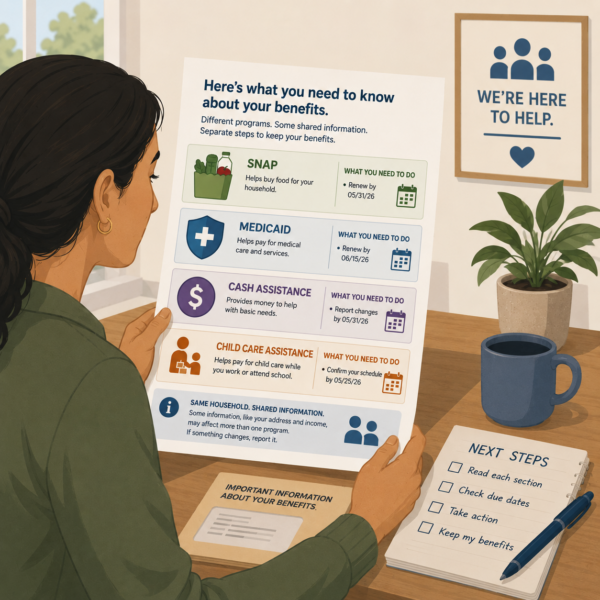 AI, chatbots, and automation can help human services agencies expand access to information, reduce repetitive inquiries, and guide residents toward common tasks. But these tools also introduce communication risks when they are used without clear boundaries. In public benefits programs, residents may rely on automated guidance while making decisions about renewals, documents, deadlines, case status, appeal rights, EBT issues, disaster benefits, or benefit continuity. That means automation must be governed as part of the agency’s public communication system, not treated as a separate technology feature.
Because automated communication sits at the intersection of policy, eligibility workflows, digital tools, privacy, accessibility, language access, staff support, and resident trust, many agencies benefit from structured communication support before and after implementation. Internal teams may understand the tool, the policy environment, and the operational goals, but residents need communication that clearly explains what the tool can do, what it cannot do, when human help is needed, and where official guidance can be verified. Without that structure, automation can unintentionally create confusion at scale.
Stegmeier Consulting Group (SCG) helps human services and public benefits agencies develop communication frameworks that support responsible use of AI, chatbots, automated reminders, and digital service tools. That support may include guardrail development, chatbot content review, plain-language source-of-truth planning, staff and partner guidance, automated message frameworks, escalation language, resident journey mapping, accessibility review, and alignment across notices, portals, websites, call centers, text alerts, and community-facing materials. The goal is not to make agencies avoid innovation. The goal is to make sure innovation supports clarity, access, and trust.
This kind of support is especially valuable when agencies are launching new digital assistants, expanding automated reminders, redesigning portals, using AI-supported content tools, or trying to reduce call volume without weakening resident support. Responsible automation should make it easier for residents to find the right next step, easier for staff to reinforce accurate guidance, and easier for agencies to maintain consistency across channels. Technology should strengthen the communication system, not become another place where residents have to interpret unclear rules on their own.
Future Trends in AI and Automation for Human Services Communication
Human services agencies are likely to continue exploring AI, chatbots, and automation as demand for faster, more accessible service grows. Residents increasingly expect digital tools that can answer basic questions, route them to the right page, remind them about deadlines, and help them understand where to start. Agencies facing staffing constraints and high call volume may also look to automation as a way to support routine inquiries and improve service availability outside traditional office hours.
At the same time, public benefits agencies will need stronger governance around automated communication. As tools become more capable, the difference between general information, case-specific guidance, and formal decision-making will become even more important. Agencies will need clear policies for what automated tools can answer, what they must avoid, how they escalate sensitive issues, how they use approved source content, and how staff review and correct automated responses. The more powerful the tool, the more important the guardrails become.
Another likely trend is greater integration between automated tools and existing communication channels. Chatbots, text alerts, portal notifications, call center scripts, website pages, and staff guidance will need to use the same language and point to the same source of truth. Residents should not receive one explanation from a chatbot, another from a notice, and another from a caseworker. Automation will be most effective when it reinforces a coordinated communication system rather than operating as a separate voice.
Agencies may also place more emphasis on equity, accessibility, privacy, and harm monitoring as automation expands. Success will not be measured only by deflected calls, faster responses, or higher self-service use. Agencies will need to understand whether residents are completing the right steps, whether vulnerable populations are being served fairly, whether automated messages are accurate, and whether residents can still reach human help when they need it. Responsible automation will depend on resident outcomes, not only technology performance.
Conclusion
AI, chatbots, and automation can support human services communication when they are used with discipline, transparency, and clear boundaries. They can help residents find general information, navigate digital tools, receive reminders, and reach the right next step. They can also create risk when they answer beyond their authority, rely on outdated content, obscure the difference between general guidance and case-specific advice, or make it harder for residents to reach a person.
Public benefits agencies need guardrails that define what automated tools can say, when they must escalate, how source content is maintained, how privacy is protected, how language access and accessibility are supported, and how inaccurate or confusing responses are corrected. These guardrails are not barriers to innovation. They are the conditions that make innovation safe enough for high-consequence public service environments.
In the end, automation should help residents navigate the benefits system with greater clarity, not leave them alone with a tool that cannot understand their full situation. Human services agencies strengthen trust when technology supports clear communication, preserves human accountability, and keeps residents connected to verified guidance and appropriate help. AI and automation can have a role in public benefits communication, but that role must be carefully designed around access, accuracy, dignity, and public responsibility.
SCG’s Strategic Approach to Communication Systems
Align your agency’s messaging, processes, and public engagement strategies.
Human services and public benefits agencies need communication systems that can support innovation without sacrificing clarity, trust, or resident protection. AI, chatbots, and automation require plain-language source content, clear escalation pathways, staff alignment, privacy safeguards, accessibility, language access, and strong governance so residents receive accurate guidance and know when human help is needed.
SCG helps agencies create communication frameworks that make digital tools safer, clearer, and more resident-centered. Whether your agency is developing chatbot guardrails, reviewing automated message language, aligning AI-supported tools with notices and portals, training staff on automation boundaries, or building source-of-truth content for digital service channels, SCG can help you communicate with consistency and care.
Use the form below to connect with our team and explore how a strategic communication system can help your agency use AI, chatbots, and automation responsibly while protecting resident access and public trust.