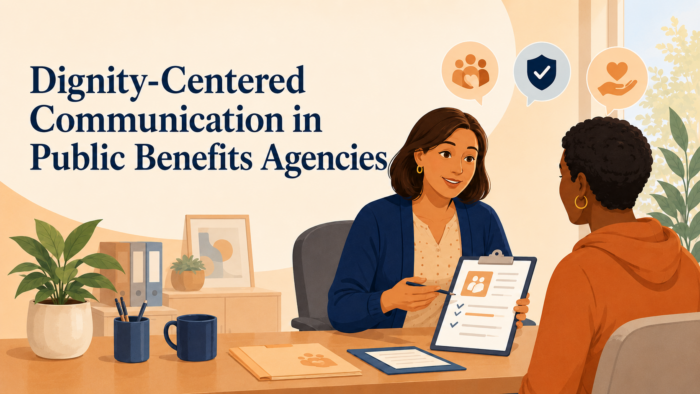
Dignity-Centered Communication in Public Benefits Agencies: Why Tone Affects Compliance and Trust
Public benefits communication often focuses on accuracy, deadlines, eligibility rules, required documents, and procedural notices. Those elements matter. Human services agencies, public benefits agencies, county social services departments, and state benefits offices have to explain complex requirements clearly and consistently. They have to preserve due process, support program integrity, document decisions, and communicate consequences when residents do not complete required steps. But accuracy alone is not enough. The tone of the communication also shapes whether residents understand the message, trust the agency, and take the action needed to protect their benefits.
Dignity-centered communication recognizes that residents often interact with public benefits agencies during moments of pressure. A household may be trying to maintain SNAP, renew Medicaid, provide proof for cash assistance, preserve child care support, respond to an EBT issue, understand a case closure, or complete a renewal before a deadline. The message may be technically correct, but if it sounds accusatory, dismissive, punitive, or indifferent, residents may become defensive, confused, embarrassed, or less willing to engage. The tone of the message can either make the process feel navigable or make it feel like another barrier.
This does not mean agencies should soften every message or avoid difficult information. Residents need to understand deadlines, documentation requirements, possible benefit changes, appeal options, and consequences for nonresponse. Dignity-centered communication is not about hiding rules or making promises the agency cannot keep. It is about explaining requirements in a way that respects the resident’s circumstances and preserves the resident’s ability to act. A notice can be direct without sounding threatening. A script can explain a closure without implying blame. A reminder can convey urgency without creating panic. A front desk interaction can enforce a process while still treating the resident as someone who deserves clarity and respect.
Tone affects compliance because residents are more likely to act when they understand the agency’s request and believe the process is still open to them. A message that says “you failed to provide verification” may be technically familiar inside the agency, but it can sound final or blaming to the resident. A message that says “we still need proof of income to complete your review” communicates the same operational issue in a way that points toward action. The distinction is not cosmetic. It changes how the resident interprets the agency’s intent and whether they see a path forward.
Tone also affects trust. Residents who believe the agency is trying to help them understand the process are more likely to open notices, answer calls, respond to reminders, ask questions, and seek help before a deadline passes. Residents who experience the agency as confusing, punitive, or unreachable may delay, avoid contact, rely on informal advice, or disengage until the problem becomes more serious. In public benefits administration, trust is not an abstract reputation issue. It influences whether residents participate in the process well enough for agencies to make timely and accurate decisions.
For agencies, dignity-centered communication should be treated as a practical operating discipline. It belongs in notices, websites, portals, text alerts, lobby signs, front desk scripts, call center language, eligibility worker explanations, supervisor coaching, partner materials, and leadership messaging. When tone is consistent across these channels, the agency communicates that residents are expected to comply with rules, but also deserve information that is understandable, respectful, and usable. That balance supports access, program integrity, staff effectiveness, and public confidence.
Dignity-Centered Communication Is Not Softer Communication
 Dignity-centered communication is sometimes misunderstood as making public benefits messages less firm or less precise. That is not the goal. Agencies still need to explain requirements, deadlines, missing documents, eligibility decisions, benefit changes, appeal rights, and consequences. They still need to protect program integrity and apply rules consistently. Dignity-centered communication does not remove the agency’s responsibility to be clear about what must happen. It strengthens that responsibility by making the message easier to understand and less likely to trigger unnecessary resistance.
A dignity-centered message is direct about the requirement while careful about the resident’s experience. It explains what the agency needs, why the information matters, what date applies, what may happen if the step is not completed, and where the resident can get help. It avoids language that assumes bad intent when the issue may be confusion, missing mail, portal difficulty, language barriers, unstable housing, disability, caregiving responsibilities, or a document the resident did not know how to obtain. The agency can still communicate consequences without framing the resident as the problem.
This distinction is especially important in high-consequence communication. A renewal notice, verification request, closure warning, text reminder, or front desk explanation may determine whether a resident understands that action is still possible. If the tone makes the message feel like a final judgment, the resident may give up too soon. If the tone is respectful and action-oriented, the resident is more likely to see what can still be done. Dignity-centered communication therefore supports compliance because it keeps the focus on the next step rather than on blame.
More Than Just Applications: Human Services and Public Benefits Communication Strategies for State and Local Agencies
This article is part of our series on strategic communication for Human Services Agencies, Public Benefits Agencies, and Health and Human Services departments. To learn more and to see the parent article, which links to other content just like this, click the button below.
Tone Shapes How Residents Interpret Agency Intent
Residents do not interpret public benefits communication only by reading the words. They also interpret what the tone suggests about the agency’s intent. A notice that sounds accusatory may lead the resident to believe the agency has already decided against them. A script that sounds dismissive may make a resident feel that asking questions is unwelcome. A sign that sounds harsh may make the lobby feel hostile before the person reaches the front desk. In each case, the tone influences whether the resident experiences the agency as a guide, a gatekeeper, or an obstacle.
This matters because residents often lack full context for agency decisions. They may not know why a document is being requested again, why one benefit changed while another did not, why a portal status says pending, or why an interview is required. If the communication does not explain the reason clearly and respectfully, residents may fill the gap with their own interpretation. They may assume the agency lost paperwork, ignored a submission, made a mistake, or is trying to make the process harder. Tone can either reduce that suspicion or intensify it.
A dignity-centered tone helps residents understand that the agency is applying rules while still providing a path to action. It signals that the resident’s situation is being handled through a process, not through arbitrary judgment. This does not eliminate frustration, especially when the message is difficult. But it can keep the communication grounded, credible, and more likely to produce the resident response the agency needs.
Compliance Improves When Communication Points Toward Action
Public benefits agencies often depend on residents completing required steps accurately and on time. Residents may need to renew eligibility, submit proof, report changes, attend interviews, update contact information, respond to notices, or correct missing information. Compliance is not only a matter of willingness. It is also a matter of comprehension, timing, confidence, and the resident’s belief that action will make a difference.
Tone plays a role in that belief. A message that focuses mainly on what the resident did wrong can leave the person feeling accused or defeated. A message that focuses on what the agency still needs can help the person understand how to move forward. For example, “we still need your recent pay stubs to finish your renewal” is more action-oriented than “you failed to provide income verification.” Both may describe the same case condition, but the first version is more likely to help the resident identify what to do.
Action-oriented tone is particularly important when residents are under stress. A person who is worried about losing benefits may not absorb dense explanations. They need the agency to make the required step visible and achievable. Dignity-centered communication does that by combining clarity with respect. It states the requirement plainly, connects it to the benefit process, and avoids unnecessary shame. That combination makes it easier for residents to respond before the issue becomes a crisis.
Trust Is Built Through Repeated Respectful Interactions
Trust in a public benefits agency is not built through one message. It is built through repeated interactions across notices, phone calls, office visits, websites, portals, text alerts, and community partner guidance. Residents notice whether the agency’s communication is consistent, understandable, current, and respectful. They notice whether staff explain the next step or simply restate the rule. They notice whether the website helps them act or sends them into a maze of program pages. They notice whether reminders clarify what is missing or create more anxiety.
Dignity-centered communication helps agencies build trust because it creates a more predictable and respectful experience across channels. A resident who receives a clear notice, sees similar language on the website, hears the same explanation from staff, and receives a text reminder that points to the same action is more likely to believe the agency is organized and credible. A resident who receives conflicting or harsh messages may keep searching for a different answer or disengage from the process altogether.
This trust has operational value. Residents who trust the agency’s communication are more likely to use official channels, respond earlier, provide more complete information, and seek help before deadlines pass. Staff benefit because they spend less time repairing confusion or responding to frustration created by unclear messages. Community partners benefit because they can reinforce official guidance with more confidence. Dignity-centered communication therefore supports the practical work of benefits administration, not just the tone of the resident experience.
Tone Should Be Designed, Not Left to Individual Style
In many agencies, tone varies by template, program, channel, unit, and individual staff member. One notice may sound formal and punitive. Another may sound helpful and clear. One staff member may explain a missing document in plain language. Another may rely on internal terminology. One website page may be resident-centered. Another may read like a policy manual. This inconsistency is not usually intentional. It often reflects the absence of a shared tone standard.
Agencies should define tone as part of their communication system. A dignity-centered tone standard can help writers, program staff, eligibility workers, call centers, supervisors, translators, web teams, and community partner liaisons communicate with a consistent voice. The standard should not make every message sound identical. A closure notice, renewal reminder, fraud alert, lobby sign, and staff script each require different levels of urgency and detail. But they should all reflect the same basic commitments: clarity, respect, accuracy, action orientation, and avoidance of unnecessary blame.
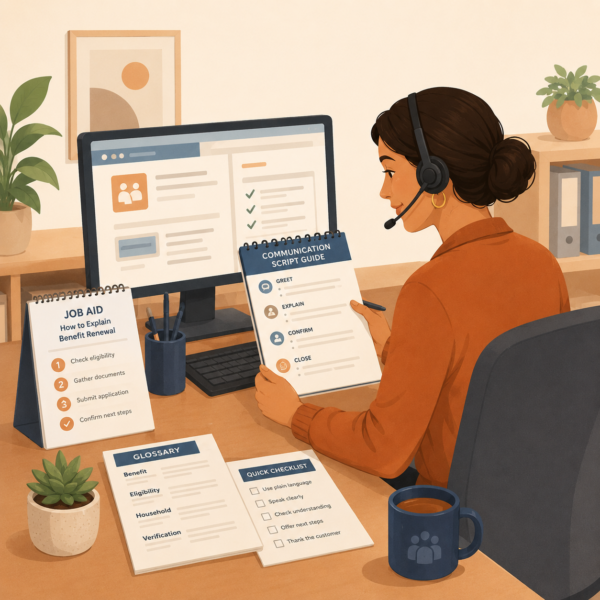
Designing tone also helps staff. Frontline workers should not have to invent respectful language under pressure for every difficult conversation. They need scripts, examples, job aids, and coaching that show how to explain consequences, missing information, deadlines, and limits without escalating tension. When tone is supported at the system level, dignity-centered communication becomes an agency practice rather than an individual preference.
Dignity-Centered Tone Begins With Assumptions About the Resident
The tone of public benefits communication often reveals what the agency is assuming about the resident. A message can imply that the resident is careless, noncompliant, or withholding information, even when the agency does not intend that meaning. In many cases, the resident may be trying to comply but struggling with a confusing notice, unstable mail, limited technology access, work schedules, caregiving responsibilities, language barriers, disability-related needs, or difficulty getting documents from someone else. A dignity-centered tone begins from the assumption that many residents want to do the right thing and need the process explained clearly enough to act.
This assumption changes the language agencies use. Instead of leading with blame, the communication leads with what is needed. Instead of emphasizing failure, it identifies the remaining step. Instead of making the resident feel that the process is closed, it explains whether there is still a path forward. This does not mean the agency ignores missed deadlines or incomplete information. It means the agency communicates those issues in a way that preserves the resident’s ability to respond.
For human services agencies, this is not only a matter of kindness. It is a matter of effectiveness. Residents are more likely to provide usable information when the agency’s message makes the next step visible and achievable. Staff are more likely to have productive conversations when the communication framework reduces defensiveness. Agencies are more likely to reduce avoidable churn when residents understand that a missing step can still be corrected before benefits are interrupted.
Replace Blame Language With Process Language
Blame language focuses on what the resident did wrong. Process language focuses on what the agency needs to complete the next step. “You failed to provide verification” may be familiar inside an agency, but it can sound accusatory to residents. “We still need proof of income to finish your review” gives the resident a clearer path without minimizing the requirement.
This shift matters because residents often respond to tone before they absorb detail. A blaming phrase can make the resident feel judged or defeated. A process-focused phrase helps the resident understand what remains unresolved and what action may still matter. The agency remains accurate, but the communication becomes more usable.
Acknowledge Effort Without Promising an Outcome
Residents may have already tried to comply before contacting the agency. They may have mailed documents, uploaded files, left messages, attended an interview, or brought paperwork to an office. A dignity-centered response can acknowledge that effort while still explaining what remains under review or what is still missing.
This is especially important when staff cannot promise a result. A clear statement such as “I can see that you submitted documents, and they still need to be reviewed” respects the resident’s effort without implying that eligibility has been confirmed. This kind of language helps maintain trust because it separates acknowledgement from approval.
Consequences Should Be Clear Without Sounding Threatening
Public benefits agencies must explain consequences. Residents need to know when benefits may stop, when a case may close, when documents are due, when an interview is required, and when a change may affect eligibility. Avoiding these consequences would not be respectful because it would leave residents without the information needed to protect their benefits. The challenge is to communicate consequences in a way that is direct, calm, and connected to action.
A dignity-centered consequence statement pairs the possible outcome with the step that can prevent or address it. Instead of presenting the consequence as a punishment, the message explains the relationship between the required action and the agency’s next decision. For example, a renewal reminder can say that benefits may stop if the renewal is not completed by the deadline, while also making the renewal path easy to find. A verification request can explain that the agency needs a specific document to finish the review, and that benefits may be delayed or closed if the document is not received.
Tone is especially important when the resident still has time to act. If the message sounds final before the process is final, residents may give up too soon. If the message sounds vague, residents may not understand urgency. The strongest communication preserves both truths: the consequence is real, and the resident still has a clear next step. That balance supports compliance because it turns risk into action instead of fear.
Urgency Should Not Depend on Fear
Agencies sometimes rely on severe language to make residents take deadlines seriously. But fear-based communication can backfire. Residents who feel overwhelmed may avoid the notice, delay calling, or assume the case is already lost. Urgency is more effective when it is tied to a specific action and a clear timeline.
A stronger message states the deadline plainly, explains what may happen if the step is missed, and tells the resident where to act. The tone should be serious, not punitive. Residents need to understand that the deadline matters, but they also need to believe the process is still navigable.
Difficult Decisions Still Require Respectful Explanation
Some messages will be difficult no matter how carefully they are written. A resident may receive a notice that benefits are changing, an application is denied, or a case has closed. Dignity-centered communication does not remove the difficulty of the decision, but it can make the explanation more understandable and less alienating.
A respectful decision notice explains what changed, the reason for the decision, the effective timing, any available next steps, and where the resident can get help understanding the notice. It avoids language that sounds dismissive or unnecessarily harsh. Even when the outcome is negative, the resident should not be left feeling that the agency’s message was careless, confusing, or degrading.
Dignity-Centered Communication Requires Plain Language and Emotional Precision
Plain language is often discussed as a readability issue, but it is also a dignity issue. Residents should not have to decode technical vocabulary to understand whether they need to act. Terms such as verification, redetermination, adverse action, discontinuance, household composition, overpayment, recertification, or pending review may have precise administrative meanings, but they can create distance between the agency and the resident if they are not explained. Dignity-centered communication translates those terms into practical meaning.
Emotional precision matters as much as word choice. A message can be plain but still sound cold. It can be respectful but too vague. It can be empathetic but not specific enough to guide action. The strongest public benefit communication combines plain language with a tone that matches the situation. A missed document needs calm clarity. A closure notice needs seriousness and procedural transparency. A reminder needs urgency without alarm. A staff script needs empathy without overpromising.
This level of precision helps agencies avoid two common extremes. One extreme is bureaucratic language that is technically accurate but difficult for residents to use. The other is overly soft language that obscures the requirement. Dignity-centered communication sits between them. It is accurate, direct, and action-oriented, but it treats the resident as a person navigating a consequential process, not as a case problem to be corrected.
Plain Language Should Make the Requirement Easier to Follow
Plain language should do more than make a sentence sound simpler. It should help residents act. A document request should name the document. A renewal notice should explain the renewal step. A status update should clarify whether the resident needs to act or wait. A lobby sign should tell people where to go and what to have ready.
This is where tone and usability overlap. Residents experience dignity when the agency does not make them work unnecessarily hard to understand a basic requirement. Clear language communicates respect because it recognizes the resident’s time, stress, and need for practical direction.
Empathy Should Not Replace Instruction
Empathy is important, but it cannot substitute for a clear next step. A message that sounds compassionate but does not explain what the resident should do may still leave the person stuck. Staff may express concern, but the resident still needs to know what document is missing, what deadline applies, or what process comes next.
A dignity-centered approach combines empathy with instruction. It acknowledges the concern briefly, then moves to the action path. This is especially important in call centers, lobbies, and eligibility conversations where residents may be upset and staff need to guide the interaction toward resolution.
Tone Standards Should Be Shared Across Channels
Dignity-centered tone should not depend on which notice template, staff member, program unit, or communication channel the resident encounters. A resident may receive a mailed notice, read a website page, get a text alert, check a portal, call the agency, visit a lobby, and ask a community partner for help during the same process. If one channel sounds respectful and another sounds punitive, the resident’s trust can still weaken. Inconsistent tone can make the agency feel unpredictable.
Agencies should create shared tone standards that apply across notices, scripts, portal messages, text alerts, websites, lobby signs, and partner materials. These standards should define what the agency’s communication should consistently do: explain the action, avoid unnecessary blame, state consequences clearly, use plain language, acknowledge resident effort where appropriate, and direct people to help. A tone standard should also identify language that should be avoided because it escalates frustration or obscures the next step.
Shared standards help staff and content owners make better decisions. Program teams can preserve required language while improving resident-facing clarity. Communications staff can revise templates without weakening accuracy. Call center leaders can coach staff using examples that match written materials. Community partners can reinforce the agency’s guidance with the same respectful framing. Tone becomes part of the agency’s operating system rather than an individual writing preference.
Notices, Scripts, and Signs Should Sound Like the Same Agency
Residents should not feel that every channel comes from a different institution. A notice should not sound punitive while a website sounds supportive. A lobby sign should not use internal terminology while a call center script uses plain language. A text alert should not create anxiety while the source-of-truth page explains the process calmly.
Consistency across channels helps residents trust that they are receiving one coherent message. It also helps staff reinforce the written guidance residents bring with them. When the tone is aligned, the agency becomes easier to understand and easier to believe.
Staff Need Examples, Not Just Principles
A tone standard is most useful when staff can see how it applies. Agencies should provide examples of common phrases to avoid and stronger alternatives to use. This is especially helpful for difficult situations involving missing documents, case closures, missed deadlines, benefit changes, and resident frustration.
Examples make dignity-centered communication practical. Staff can learn how to say the same accurate thing in a way that points toward action rather than blame. Over time, those examples become part of the agency’s shared communication culture.
Dignity-Centered Communication Should Be Built Into Notices Before They Are Sent
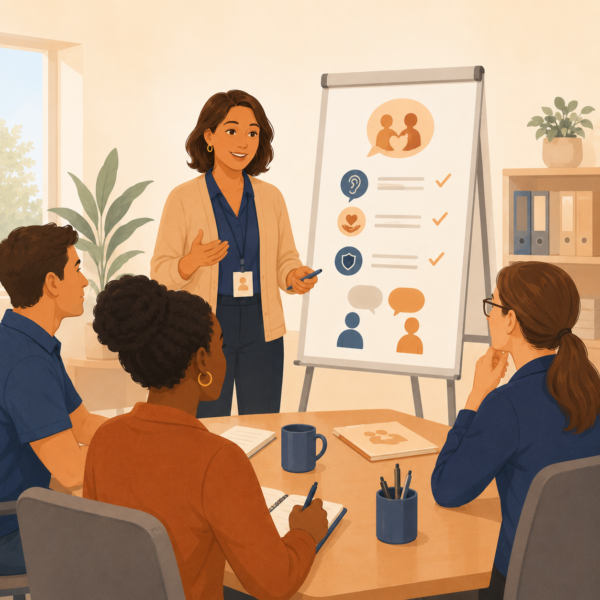 Notices are often the first place residents encounter the agency’s tone. A renewal notice, verification request, appointment notice, case closure warning, benefit change notice, or denial letter can shape how residents interpret the entire process. If the notice sounds accusatory or hard to follow, staff may spend the next several days repairing confusion and frustration. If the notice is clear, direct, and respectful, residents are more likely to understand what is happening and what action may still be available.
Human services agencies should review notice templates not only for required content, but for tone and usability. A notice may include the correct legal language and still sound unnecessarily harsh. It may explain the consequence but fail to show the resident the path forward. It may use formal terms that satisfy internal requirements but leave residents uncertain about what the agency needs. Dignity-centered review asks whether the notice communicates the requirement in a way that residents can understand without feeling blamed or dismissed.
This does not require removing formal sections or weakening due process. It requires better hierarchy and framing. The notice should explain the core action first, identify the deadline clearly, state the consequence without exaggeration, and direct the resident to help. Required rights and technical details should remain, but they should not obscure the resident’s practical next step. A notice that preserves accuracy and improves tone can reduce both resident stress and agency workload.
Staff Scripts Should Reinforce Dignity Under Pressure
Frontline staff often have to deliver difficult explanations in real time. Residents may call or visit after receiving a confusing notice, missing a deadline, losing benefits, struggling with a portal, or submitting a document that did not resolve the case. In those moments, tone can determine whether the conversation moves toward action or escalation. Staff need language that helps them remain clear, respectful, and grounded even when the resident is upset.
A dignity-centered script should not make staff sound robotic. It should give them a reliable structure for common high-stress situations. Staff can acknowledge the concern, state what the agency can see, explain what is still needed or under review, clarify the next step, and avoid making promises outside their role. This structure helps staff keep the conversation focused without ignoring the resident’s frustration.
Scripts are especially useful for phrases that can easily sound punitive. Instead of saying that a resident failed to respond, staff can explain that the agency does not show the needed information as received. Instead of saying there is nothing the agency can do, staff can explain the available process or the appropriate escalation path. Instead of simply stating that the case is closed, staff can explain what led to the closure, whether any next step exists, and where the resident can get help understanding their options. The words do not change the rule, but they can change whether the resident can hear and act on it.
Digital Channels Need the Same Tone Discipline as Human Conversations
Residents increasingly encounter public benefits agencies through portals, text alerts, email reminders, automated calls, chat tools, and website pages. These digital channels often feel impersonal, so tone discipline becomes even more important. A terse portal message, vague text alert, or overly technical status label can make residents feel that the agency is unavailable or indifferent. Digital communication should not rely on brevity or automation as an excuse for unclear or harsh language.
A dignity-centered digital message should still be concise, but it should give residents enough context to understand what is happening. A text alert should identify the action and point to an official source of truth. A portal status should explain whether the resident needs to act or wait. A document upload confirmation should distinguish between received and reviewed. A website page should explain the task in resident-facing language rather than directing people through agency divisions. Digital tone is not about warmth alone. It is about making automated communication usable and trustworthy.
Consistency across digital and human channels is also essential. If a portal says one thing and a call center representative explains it differently, residents may not know which source to believe. If a text alert sounds urgent but the website does not explain the action clearly, the reminder may increase anxiety without improving completion. Agencies should align digital tone with staff scripts and notices so residents experience one coherent communication system, not a set of disconnected messages.
Dignity-Centered Communication Supports Staff Safety and Confidence
Respectful tone is often discussed as a benefit to residents, but it also supports staff. Frontline workers are more likely to face frustration when residents arrive confused, frightened, or feeling blamed by agency communication. A harsh notice, unclear portal message, or inconsistent instruction can create tension that staff then have to manage. When written and digital communication are clearer and more respectful, staff are less often placed in the position of defending a message that residents experienced as unfair or confusing.
Staff also benefit from having agency-approved language for difficult situations. Without scripts, examples, and tone standards, workers may have to improvise in high-pressure conversations. Some may over-explain, some may use internal terminology, some may sound overly blunt, and some may avoid giving a direct answer because they are worried about saying the wrong thing. Dignity-centered communication tools give staff a safer path through these interactions.
This support is important for consistency and morale. Staff should not be expected to carry the entire burden of respectful communication through individual personality or experience. The agency should provide the framework. When notices, scripts, websites, and job aids use the same tone principles, staff can focus more on helping residents understand the next step and less on repairing avoidable communication damage.
Tone Should Be Tested Against Real Resident Interpretation
Agencies should not assume that a message feels respectful because it was written with good intent. Residents may interpret tone differently depending on their experience with government systems, language access needs, literacy level, disability, cultural context, past benefit disruptions, or current stress. A phrase that seems neutral internally may sound harsh or final to a resident. A notice that seems clear to program staff may feel overwhelming to someone reading it after a long workday or while worried about losing support.
Testing tone does not require a large research project for every message. Agencies can review high-consequence notices with frontline staff, community partners, residents with lived experience, interpreters, and call center teams. They can ask whether the message makes the required action clear, whether the consequence is understandable, whether the language sounds blaming, and whether the resident would know where to get help. These practical reviews often reveal problems that internal approval processes miss.
Resident interpretation should also be tracked after communication goes out. Repeated calls, partner questions, complaints, wrong-document submissions, missed deadlines, and lobby frustration can all signal that a message did not land as intended. Tone is not only a writing quality. It is an operational variable that affects whether residents can move through the process with enough clarity and trust to act.
Dignity Requires Consistency Across Difficult and Routine Messages
Agencies sometimes apply more care to public-facing campaigns than to routine administrative messages. But residents often experience the agency most directly through routine notices, reminder texts, lobby signs, portal statuses, and staff explanations. A strategic communication system should apply a dignity-centered tone to both high-visibility materials and everyday transactional communication. The routine message may be the one that determines whether a resident submits documents, attends an interview, or understands why benefits changed.
This consistency is especially important when the message is difficult. Dignity should not disappear when the agency is communicating a denial, closure, overpayment, missed deadline, or unfavorable decision. In those moments, residents need clarity and respect most. A difficult decision can still be explained with plain language, procedural transparency, and a clear statement of available next steps. The agency can communicate limits without sounding indifferent.
Routine consistency also builds institutional trust over time. Residents who repeatedly encounter clear, respectful communication are more likely to understand that the agency’s tone is not situational or performative. It is part of how the agency operates. That trust can help residents remain engaged even when a message is disappointing or requires action under pressure.
Dignity-Centered Communication Should Be Part of Staff Training
Dignity-centered communication cannot depend only on individual instinct. Some staff naturally explain difficult rules with warmth and clarity, while others may rely more heavily on policy language, system labels, or phrases they have heard over time. In a high-volume human services environment, tone can vary widely unless the agency gives staff a shared framework. Residents should not receive respectful, clear communication only when they happen to reach a particular worker or office. The standard should be built into training, scripts, coaching, and daily operations.
Training should help staff understand how tone affects resident behavior. A resident who feels blamed may become defensive, delay action, or avoid contacting the agency again. A resident who understands the requirement and hears a clear path forward is more likely to respond. Staff should learn how to explain missing documents, renewals, closures, deadlines, benefit changes, and appeal pathways in language that is direct without sounding punitive. This type of training supports both resident access and staff confidence.
The training should also give staff practical language they can use immediately. General reminders to “be respectful” are not enough. Staff need examples of stronger phrasing for common situations, including how to explain that information has not been received, a document is still under review, a case has closed, an action is still required, or a resident must follow a formal process. These examples help staff maintain professionalism under pressure without losing clarity.
Supervisors Should Reinforce Tone Through Coaching and Quality Review
Tone standards become stronger when supervisors reinforce them consistently. A one-time training session may introduce dignity-centered communication, but daily coaching is what helps staff apply it during difficult calls, lobby interactions, interviews, and case discussions. Supervisors can listen for whether staff are explaining the next step clearly, avoiding unnecessary blame, using plain language, and maintaining respectful boundaries. They can also identify where staff need better scripts, clearer job aids, or updated explanations for recurring issues.
Quality review should include communication quality, not only procedural accuracy. A call may be technically correct but still leave the resident confused about what to do next. A lobby interaction may follow policy but sound dismissive. A case note may document the action but not reveal whether the resident understood the requirement. Agencies that review communication as part of service quality are better able to identify where tone, clarity, and consistency need improvement.
This kind of review should be supportive rather than punitive. Staff often communicate under pressure, with limited time, complex rules, and residents who may be upset or afraid. If tone problems appear, the agency should ask whether staff have the tools they need. The solution may be a clearer script, a better notice, a revised portal status message, or a short refresher on how to explain a difficult rule. Coaching should help staff improve while also revealing where the communication system needs support.
Dignity-Centered Communication Should Inform Lobby and Front Desk Language
The lobby is one of the places where tone becomes visible quickly. A resident may arrive after receiving a confusing notice, missing a deadline, losing benefits, or failing to resolve an issue online. The signs they see and the words they hear at the front desk can either calm the situation or increase stress. A sign that focuses mainly on restrictions may make the office feel unwelcoming. A front desk response that begins with what the resident did wrong may make the interaction harder than it needs to be.
Lobby communication should set expectations clearly while preserving respect. Residents need to know where to check in, where to drop off documents, how to request language assistance, what to have ready, and what happens after they wait. Those instructions can be firm and still sound helpful. A dignity-centered lobby does not avoid rules. It explains them in a way that helps residents move through the office with less confusion.
Front desk scripts are especially important because staff often have to redirect residents. A resident may be in the wrong line, missing paperwork, late for an appointment, or asking a question that cannot be answered at the front desk. The script should pair the limitation with the next step. Instead of leaving the resident with a refusal, staff can explain where to go, what to bring, who can help, or how the resident can continue the process. That language reduces stress because it keeps the interaction oriented toward resolution.
Partner Communication Should Reflect the Same Respectful Tone
Community partners often help residents interpret agency communication. Food banks, clinics, schools, libraries, legal aid organizations, housing providers, child care resource organizations, faith-based groups, and other community organizations may explain notices, help gather documents, share reminders, or guide residents toward agency services. If partner materials use a different tone from agency notices and scripts, residents may receive mixed signals about what the agency expects and how the process works.
Agencies should provide partners with guidance that reflects the same dignity-centered tone used in public-facing materials. Partner materials should explain common resident actions in plain language, identify official pathways, and clarify where case-specific questions must return to the agency. They should avoid language that frames residents as noncompliant when the issue may be confusion, missing information, or a process barrier. The more partners can reinforce the agency’s respectful action language, the more coherent the resident experience becomes.
This alignment also protects trust. Residents may trust a community partner more than the agency at first, especially if they have had frustrating experiences with public systems. When the partner’s explanation matches the agency’s guidance in both meaning and tone, residents are more likely to believe the official process is understandable and worth engaging. Partner communication should extend the agency’s clarity, not replace it with a separate interpretation.
Dignity-Centered Communication Should Be Measured Through Resident Response
Agencies can evaluate tone by looking at how residents respond to communication. If a notice generates repeated calls asking whether action is still possible, the tone or structure may be making the message feel final. If residents submit duplicate documents after receiving confirmation, the status language may not clearly distinguish receipt from review. If lobby interactions frequently escalate around the same issue, the signs or scripts may be creating more frustration than clarity. Resident behavior often reveals where tone and usability are not working together.
Measurement should include both quantitative and qualitative signals. Call volume, appeal patterns, procedural closures, missed deadlines, document errors, duplicate submissions, website search terms, complaint themes, and partner feedback can all show where communication is failing to support action. Staff observations are also essential because frontline workers hear how residents interpret agency language in real time. These signals should be treated as evidence for improvement, not just as workload data.
The goal is not to make every resident satisfied with every outcome. Some decisions will remain difficult, and some residents will disagree with the agency. The stronger measure is whether communication helps residents understand the decision, the requirement, the deadline, and the available next step. Dignity-centered communication is successful when it makes the process clearer, reduces unnecessary shame or defensiveness, and supports meaningful participation even when the message is hard.
Tone Should Be Maintained as Programs and Systems Change
Public benefits communication changes over time. Agencies revise notices, launch portals, update text reminders, modify service models, change lobby processes, introduce new forms, and respond to policy or operational shifts. Each change creates a risk that the tone will drift. A new portal may use technical labels that do not match plain-language notices. A revised form may reintroduce harsh language. A new reminder campaign may sound more urgent than helpful. A change in workflow may leave staff without updated scripts.
Dignity-centered communication needs maintenance. Agencies should review tone whenever resident-facing materials change. They should ask whether the new language is clear, respectful, action-oriented, and aligned with existing standards. They should update scripts, job aids, partner materials, and source-of-truth pages when processes change. Tone should not be considered complete after one rewrite or training session. It should be part of the agency’s ongoing communication governance.
This maintenance is especially important during high-volume or high-stakes periods. Renewals, document deadlines, benefit transitions, EBT issues, technology changes, and service disruptions can place residents and staff under pressure. During these moments, agencies may be tempted to communicate quickly without reviewing tone carefully. The better approach is to prepare dignity-centered templates and message frameworks in advance so urgent communication can still remain clear, respectful, and credible.
Strategic Communication Support for Human Services and Public Benefits Agencies
 Dignity-centered communication is not a soft layer added after the technical work is complete. It is part of how human services and public benefits agencies help residents understand requirements, comply with rules, ask for help, and remain engaged in processes that can affect essential support. For residents navigating SNAP, Medicaid, cash assistance, child care assistance, EBT issues, renewals, verification requests, benefit changes, or case closures, tone shapes whether agency communication feels understandable, fair, and worth responding to.
Because tone appears across notices, websites, portals, text alerts, call center scripts, lobby signs, staff conversations, partner materials, and leadership messaging, many agencies benefit from structured communication support. Internal teams may know the rules, forms, and workflows deeply, but that familiarity can make it harder to see how residents experience the message. A phrase that sounds routine inside the agency may sound accusatory to a resident. A notice that seems complete may still leave someone unsure whether action is possible. A script that follows policy may still escalate tension if it does not explain the next step clearly.
Stegmeier Consulting Group (SCG) helps human services and public benefits agencies build communication systems that preserve accuracy while improving clarity, respect, and trust. That support may include tone audits, notice revisions, plain-language message frameworks, staff scripts, lobby communication guidance, source-of-truth page development, partner materials, frontline communication training, and alignment across resident-facing channels. The goal is not to make difficult decisions sound easy. The goal is to communicate requirements, consequences, and next steps in a way that residents can understand and act on without unnecessary shame, confusion, or distrust.
This type of support is especially valuable when agencies are trying to reduce procedural benefit loss, improve renewal completion, strengthen resident trust, lower avoidable call volume, or prepare staff for difficult conversations. Dignity-centered communication gives residents a clearer path through complex requirements and gives staff a stronger framework for explaining those requirements consistently. It supports compliance by making the process more understandable and supports trust by treating residents as people navigating consequential decisions, not as problems to be managed.
Future Trends in Dignity-Centered Public Benefits Communication
Human services agencies are likely to place greater emphasis on tone as part of service quality, access, and program integrity. As residents interact with agencies through more channels, including portals, text alerts, websites, call centers, lobby visits, mailed notices, and community partners, tone consistency will become increasingly important. A respectful website cannot fully offset a punitive notice. A supportive call center script cannot fully repair a confusing portal message. Agencies will need communication standards that carry across the full resident journey.
Another likely trend is stronger integration between plain language and dignity-centered tone. Agencies will continue to simplify complex rules, but the strongest communication will go beyond readability. It will help residents understand the requirement, the reason for the requirement, the consequence of missing it, and the available next step. Messages will need to be direct enough to support compliance and respectful enough to keep residents engaged.
Agencies may also use resident behavior and frontline feedback more intentionally to identify tone problems. Repeated calls, complaints, partner questions, missed deadlines, duplicate submissions, and escalation patterns can all reveal where messages feel unclear, final, accusatory, or incomplete. These signals can help agencies revise notices, scripts, portal statuses, text alerts, and lobby materials before confusion becomes a larger operational issue.
Finally, dignity-centered communication will likely become more closely tied to staff training and communication governance. Staff need practical examples, scripts, and coaching that help them explain difficult rules without overpromising or sounding punitive. Content owners need standards that keep resident-facing materials aligned as programs, systems, and service models change. Agencies that treat tone as a managed communication discipline will be better positioned to protect trust during both routine and difficult interactions.
Conclusion
Dignity-centered communication helps public benefits agencies explain complex rules in a way that supports understanding, compliance, and trust. Residents still need accurate information about deadlines, documents, eligibility reviews, benefit changes, appeal rights, and consequences. The difference is that those messages should be written and spoken in a way that points toward action rather than blame.
Tone matters because residents interpret agency communication through the pressure of their own circumstances. A message that sounds punitive can make the process feel closed or hostile. A message that is clear, direct, and respectful can help residents understand what is happening and what step remains available. This distinction affects whether residents respond, whether staff can guide conversations productively, and whether the agency is experienced as credible and fair.
In the end, dignity-centered communication is a practical standard for public benefits administration. It supports resident access, staff confidence, program integrity, and public trust. When agencies design tone with the same care they give to rules and processes, they create communication that is not only accurate, but usable, respectful, and more effective.
SCG’s Strategic Approach to Communication Systems
Align your agency’s messaging, processes, and public engagement strategies.
Human services and public benefits agencies need communication systems that explain complex rules clearly while preserving resident dignity. Notices, portals, text alerts, call center scripts, lobby signs, staff explanations, and partner materials should reinforce the same respectful action path so residents understand what is happening, what is required, and where to get help.
SCG helps agencies create communication frameworks that support clarity, consistency, compliance, and trust. Whether your agency is revising benefit notices, improving staff scripts, strengthening tone standards, aligning digital messages, training frontline staff, or developing partner-ready materials, SCG can help build a communication system that treats residents with respect while helping them complete required steps. Use the form below to connect with our team and explore how a strategic communication system can help your agency strengthen dignity-centered communication and improve the resident experience.