Frontline Staff as Communicators: How Human Services Agencies Can Train Eligibility Workers and Caseworkers to Explain Complex Rules Clearly
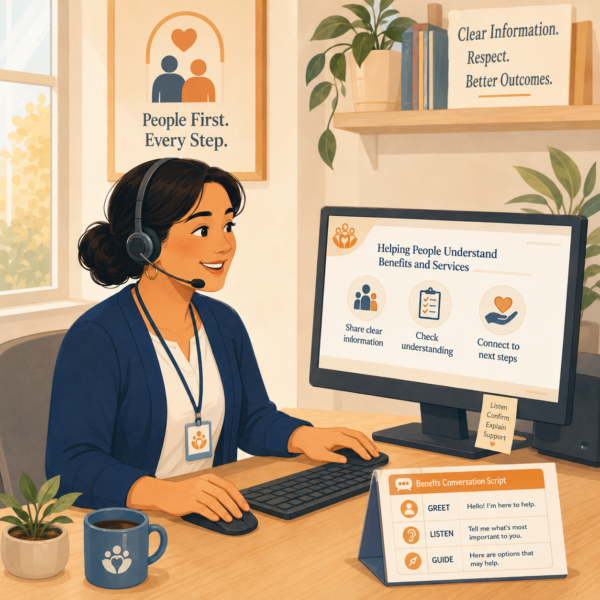 Eligibility workers, caseworkers, call center representatives, reception staff, navigators, and other frontline staff are often the people residents rely on when public benefits rules become difficult to understand. A notice may explain that information is missing. A portal may show that a renewal is pending. A text alert may say that action is required. A website may describe eligibility in general terms. But when residents are confused, worried, or facing a deadline, they often look to a person to explain what the rule means for their situation and what they should do next.
For human services agencies, county social services departments, public benefits agencies, and state benefits offices, this makes frontline staff central to the communication system. Staff are not only processing cases or answering questions. They are translating complex policies into resident-facing meaning every day. They explain SNAP, Medicaid, cash assistance, child care assistance, verification requests, renewals, reported changes, case closures, appeal rights, document requirements, interviews, portal steps, and benefit changes in conversations that may be brief, emotional, and high stakes.
This work requires more than program knowledge. A worker can understand the rule and still struggle to explain it clearly under pressure. A caseworker may know why a document is needed, but not have plain-language wording for a resident who believes the agency already has it. A call center representative may know that a case is pending review, but not know how to explain the difference between received, reviewed, accepted, and completed. A front desk staff member may know that a resident is in the wrong line, but not have the language to redirect the person without sounding dismissive. Communication training helps close the gap between knowing the rule and explaining the rule.
That gap matters because residents often experience public benefits through explanation. A resident who understands why action is needed is more likely to complete the right step. A resident who receives inconsistent or technical explanations may call again, submit duplicate documents, miss a deadline, or leave the office feeling that the agency is impossible to navigate. The issue is not only whether staff are courteous. It is whether staff have a shared communication framework that helps them explain complex rules accurately, consistently, and respectfully.
Training frontline staff as communicators does not mean asking them to become marketers or public relations representatives. It means recognizing that every resident-facing explanation can either reduce confusion or add to it. Strong communication training gives staff plain-language tools, message structures, escalation guidance, role boundaries, and practice with the situations they encounter most often. It helps staff explain rules without overpromising, show empathy without changing policy, and guide residents toward the correct next step without making the process feel arbitrary.
For agencies, this is a strategic issue. Complex benefits rules will not become simple just because staff are trained. But residents can be given clearer explanations, more consistent guidance, and a better understanding of what action is required. When agencies invest in frontline communication skills, they strengthen access, reduce avoidable rework, support staff confidence, and build trust in the benefits system.
Frontline Staff Are the Human Interface of Complex Benefits Systems
Public benefits systems are built from rules, eligibility factors, technology platforms, documents, deadlines, notices, verification standards, and case-processing workflows. Residents usually do not see that full structure. They see the moments when the system asks them to do something or tells them that something has changed. A caseworker, eligibility worker, or call center representative often becomes the person who makes that system understandable. The staff member’s explanation can determine whether the resident leaves with clarity or with more uncertainty.
This role is especially important because residents often seek help when something has already become stressful. They may have received a notice they do not understand, discovered that benefits changed, missed a deadline, uploaded a document without confirmation, lost access to a portal, or been told that more information is needed. In these moments, residents are not asking for a lecture on program administration. They are asking for a usable explanation of what is happening, what matters now, and how to move forward.
Agencies should therefore treat frontline communication as a core service function. Staff need more than access to policy manuals and system screens. They need shared language for explaining common situations, clear boundaries for what they can and cannot say, and practical tools for translating technical rules into resident-facing next steps. When the human interface of the system is consistent and understandable, the entire benefits experience becomes easier to navigate.
More Than Just Applications: Human Services and Public Benefits Communication Strategies for State and Local Agencies
This article is part of our series on strategic communication for Human Services Agencies, Public Benefits Agencies, and Health and Human Services departments. To learn more and to see the parent article, which links to other content just like this, click the button below.
Policy Knowledge Alone Does Not Create Clear Explanation
Human services agencies often train staff extensively on eligibility rules, systems, workflows, documentation requirements, and compliance responsibilities. That training is necessary. Staff need to understand the rules they are applying and the boundaries of their role. But policy knowledge does not automatically produce clear public explanations. Knowing the correct rule is different from explaining the rule in a way a resident can understand and act on.
This distinction becomes visible in everyday interactions. A worker may say that a case is closed for failure to verify, but the resident may not understand which document was missing or whether the case can still be corrected. A staff member may say that a renewal is pending, but the resident may not know whether action is needed. A notice may refer to a household composition issue, but the resident may not understand whose information the agency is asking about. The explanation may be accurate from an internal perspective and still incomplete from the resident’s perspective.
Communication training should help staff move from internal labels to practical meaning. Instead of relying only on terms such as verification, redetermination, adverse action, or pending review, staff need language that explains the action, deadline, consequence, and next step. The goal is not to remove all formal terminology. Some terms may be required or useful. The goal is to make sure that formal terms are translated into plain language before they become barriers to understanding.
Consistency Matters Because Residents Often Ask the Same Question More Than Once
Residents frequently move across channels before they understand a benefits issue. They may read a notice, check a portal, call the agency, visit a lobby, speak with a caseworker, ask a community partner, and then call again. If each person explains the same issue differently, residents may believe they have received conflicting instructions. Even when the underlying answer is the same, variation in language can create doubt.
This is particularly common when staff improvise explanations for recurring issues. One worker may describe a renewal as a redetermination. Another may call it a review. Another may say recertification. One person may say the agency received the document. Another may say the document is still pending. Another may say verification is incomplete. Without shared definitions and resident-facing language, the agency may unintentionally create the impression that the case status or required action is changing from one conversation to the next.
A consistent communication framework helps prevent this problem. Staff do not need to sound identical, but they should explain common situations with the same core meaning. Residents should hear the same basic explanation of what is needed, what the deadline means, what has been received, what is under review, what action belongs to the resident, and where to verify current information. Consistency reduces repeated contacts because residents are less likely to keep searching for a clearer answer.
Clear Explanations Protect Both Access and Program Integrity
Plain-language communication is sometimes treated as a resident service improvement, but it also supports program integrity. Residents are more likely to provide accurate and usable information when they understand what the agency needs and why it matters. A vague explanation can lead to wrong documents, incomplete forms, missed interviews, duplicate submissions, or nonresponse. A clear explanation gives residents a better opportunity to comply with the rules the agency is responsible for applying.
This is especially important in situations involving verification, renewals, reported changes, eligibility reviews, and case closures. These processes depend on residents understanding what information is required and what happens if the agency does not receive it. If the explanation is too technical or too general, the resident may not know how to complete the step correctly. The result can be a procedural problem that looks like noncompliance but began as a communication failure.
Training staff to explain rules clearly helps agencies apply policy more effectively. It does not weaken eligibility standards or ask staff to make exceptions outside their role. It helps staff communicate the requirements in a way residents can follow. That improves the quality of submissions, reduces avoidable rework, and supports fairer access to the process.
Staff Need Communication Tools That Work Under Pressure
Frontline staff often explain complex rules in difficult conditions. Calls may be short. Lobby lines may be long. Residents may be frustrated, frightened, or upset. Staff may be balancing system notes, policy requirements, time limits, privacy concerns, and safety considerations while trying to give a clear answer. In that environment, communication cannot depend on staff inventing the right explanation every time.
Agencies can support staff by giving them practical tools for common communication moments. These may include plain-language explanations of frequent rules, short scripts for common scenarios, examples of how to explain deadlines, guidance on what not to promise, and language for redirecting residents respectfully. Staff also need practice applying these tools to real conversations, not just reading them in a manual. The goal is to make clear explanation easier when pressure is high.
This support also matters for staff morale. Workers who lack clear language may feel caught between policy and resident frustration. They may know the rule but struggle to explain it in a way that reduces conflict. A strong communication framework gives staff more confidence and helps them maintain consistency without sounding cold or scripted. It turns communication from an individual burden into an agency-supported skill.
Training Should Start With the Situations Staff Explain Most Often
Communication training for eligibility workers and caseworkers should begin with the situations residents ask about repeatedly. In human services agencies, those situations often include renewals, verification requests, missing documents, benefit changes, case closures, interview requirements, portal problems, reported changes, appointment confusion, EBT concerns, and questions about why one program changed while another continued. These are the moments when residents are most likely to need a plain-language explanation, and they are also the moments when inconsistent answers can create the most confusion.
Starting with common situations makes training practical. Staff do not need abstract communication advice disconnected from their daily work. They need usable language for the conversations they are already having. A worker should be able to explain why income proof is needed, what happens after a document is submitted, why a renewal is still under review, or what a resident should do after receiving a closure notice. The training should help staff move from internal process language to resident-facing action.
This approach also helps agencies identify where communication problems are creating operational pressure. Repeated calls, duplicate submissions, missed interviews, wrong-document uploads, lobby confusion, and partner questions often show where residents are not understanding the process. Training staff around those recurring moments allows the agency to reduce confusion at the points where it most often becomes workload.
Use Real Resident Questions as Training Material
The strongest training examples come from the questions residents actually ask. Instead of building training only around policy categories, agencies can use common resident questions from call centers, lobby interactions, case notes, partner feedback, and complaint themes. These examples help staff practice translating rules into the language residents are already using.
A training scenario might begin with a resident saying, “I already sent that document,” “Why did my benefits stop?” “What does pending mean?” or “I got a text, but I do not know what to do.” These questions create more realistic practice than generic policy summaries. They help staff learn how to respond to the resident’s concern first, then explain the rule and next step clearly.
Prioritize High-Consequence Communication Moments
Not every explanation carries the same risk. Agencies should prioritize the moments where unclear communication can lead to benefit interruption, resident harm, or avoidable escalation. Renewals, verification deadlines, case closures, interview requirements, appeal rights, and reported changes deserve special attention because misunderstanding them can affect whether support continues.
Training should give staff clear language for these high-consequence moments. Workers need to explain what action is required, what deadline applies, what may happen if the step is missed, and where the resident can get help. The explanation should be accurate without sounding punitive, and direct without sounding cold.
Staff Need a Shared Plain-Language Vocabulary
Human services agencies often use several terms for the same or similar actions. Staff may say renewal, recertification, redetermination, eligibility review, case review, or continuation depending on the program, system, or worker. A resident may hear these terms as separate requirements, even when they are related. That kind of variation can make an already complex process feel unstable.
A shared plain-language vocabulary helps staff explain common concepts consistently. The agency can decide how to describe renewals, document requests, status updates, reported changes, interviews, approvals, denials, closures, and appeals in resident-facing language. Formal terms can still be used when required, but they should be paired with plain explanations. The purpose is not to erase program terminology. The purpose is to make sure residents understand what the term means for their next step.
This shared vocabulary should appear across staff training, notices, scripts, websites, portals, text reminders, lobby signs, and partner materials. When residents hear the same action language in multiple places, they are more likely to trust that they understand what the agency is asking. Staff also benefit because they are not left to invent their own translations of complex terms during high-pressure interactions.
Define Common Status Words Before Staff Use Them
Case status words can create confusion when staff use them without explanation. Pending, incomplete, received, approved, denied, closed, under review, and verification needed may all have meaning inside the agency, but residents need to know what each status means for them. The most important distinction is often whether the resident needs to act or wait.
Training should give staff plain-language definitions for common status terms. For example, staff may need language to explain that receiving means the agency has the document, but still may need to review it. Under review may mean the agency is working on the case and no action is needed right now. Incomplete may mean the agency still needs a specific item by a deadline. These distinctions help residents avoid duplicate submissions and unnecessary calls.
Translate Formal Terms Into Resident Action
Formal program terms should be connected to action. If a staff member uses the term verification, the explanation should quickly clarify what document is needed. If they use redetermination, the explanation should clarify that the resident needs to renew benefits. If they use adverse action, the explanation should clarify what is changing, when it may happen, and what options the resident has.
This translation should become a habit. Staff should not have to choose between accuracy and clarity. A strong communication framework allows them to use required terms when needed while still giving residents the practical meaning that supports action.
Scripts Should Support Judgment, Not Replace It
Frontline communication scripts can be valuable, but only when they are designed as support tools rather than rigid performance language. Eligibility workers and caseworkers need room to respond to individual circumstances, resident emotion, case complexity, language access needs, and safety concerns. A script that is too stiff can make staff sound impersonal. A script that is too vague does not solve the consistency problem. The strongest scripts provide a structure for explanation while preserving professional judgment.
A useful script helps staff organize the conversation. It may begin by acknowledging the resident’s concern, then explain what the agency knows, what action is needed, what deadline applies, and where the resident can verify or complete the step. This structure is especially helpful when residents are upset because it keeps the conversation grounded in the next practical action. Staff can adapt the words, but the core explanation remains consistent.
Scripts should also include boundaries. Staff need clear language for what they cannot promise, what requires case review, what must be handled through a formal process, and when a resident should be escalated to another unit. Without that guidance, staff may over-explain, overpromise, or avoid giving a clear answer because they are worried about saying the wrong thing. Good scripts help staff communicate with confidence while staying within policy.
Scripts Should Explain the Reason and the Next Step
Residents often need both context and action. If staff only state the rule, the resident may not understand why the agency is asking for something. If staff only express empathy, the resident may still not know what to do. A good script connects the two. It explains why the rule matters and what the resident should do next.
For example, a document request explanation can state that the agency needs current income proof to complete the review, then identify the acceptable document and deadline. A case closure explanation can state what information was not received, whether there is still a path to correct the issue, and where the resident should start. This structure keeps the conversation practical and respectful.
Scripts Should Include What Not to Say
Communication training should include language to avoid. Staff should be careful with phrases that sound blaming, final, or dismissive when a resident may still have options. Phrases such as “you failed to respond,” “there is nothing we can do,” or “that is not our problem” can escalate frustration and damage trust, even when staff are trying to explain a real limitation.
A better training approach gives staff replacement language. Instead of “you failed to send proof,” staff can say, “Our records do not show that we received the income proof needed to complete the review.” Instead of “nothing can be done,” staff can explain the available next step or, if no action is available through that channel, direct the resident to the formal process. This helps staff stay accurate without sounding punitive.
Training Should Help Staff Explain Rules Without Overpromising
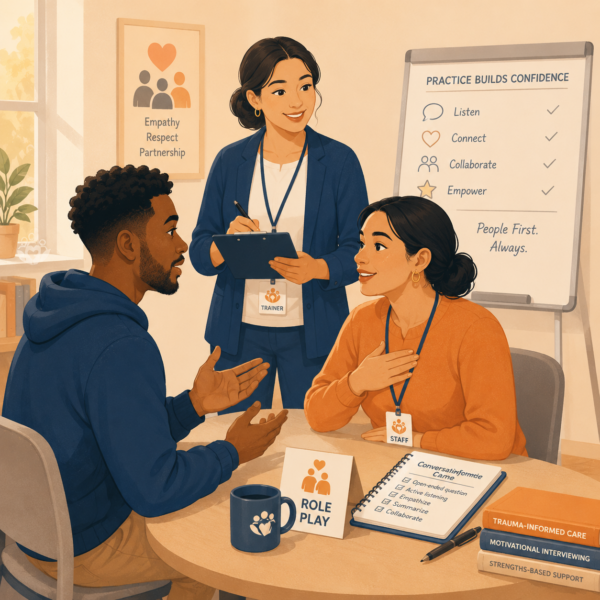 One of the hardest parts of frontline communication is helping residents understand what may happen without promising an outcome before the case has been reviewed. Eligibility workers and caseworkers often speak with residents who want certainty. They may want to know whether benefits will continue, whether a document will be accepted, whether a case can be reopened, whether an appeal will succeed, or whether a deadline can still be met. Staff need language that is clear and helpful while still protecting the integrity of the decision-making process.
Training should help staff distinguish between what is known, what is still under review, and what the resident can do next. For example, a worker may be able to say that the agency received a document, but not that the document has been accepted. A caseworker may be able to explain that a renewal was submitted, but not that benefits will continue until eligibility has been determined. A call center representative may be able to tell a resident that a case is under review, but not predict the final decision. These distinctions are essential because residents often interpret informal reassurance as a promise.
Clear communication does not require staff to sound evasive. It requires them to explain the process honestly. A strong response might say that the agency has received the information, staff still need to review it, and the resident will be contacted if anything else is needed. That kind of statement gives the resident useful information without creating false certainty. Training should help staff use this kind of language consistently so residents understand where the case stands and what remains unresolved.
Staff Need Practice Explaining Consequences Without Sounding Punitive
Human services staff often have to explain difficult consequences. Benefits may stop if a renewal is not completed. A case may close if required documents are not received. A child care authorization may change if work schedule information is missing. Cash assistance may be affected by participation requirements. Residents need to understand these consequences clearly, but the way consequences are explained can either support action or increase defensiveness.
Training should help staff frame consequences around the action that can prevent or address them. Instead of leading with penalty language, staff can explain what the agency needs and why the timing matters. A resident is more likely to act when they hear, “We need this income proof by the date in your notice so we can finish the review,” than when they hear only that the case will close for failure to verify. The rule is still being communicated, but the explanation is oriented toward completion.
This matters because many residents who miss steps are not refusing to comply. They may not understand the notice, may have sent the wrong document, may have trouble using the portal, may be waiting on an employer or landlord, or may not know where to ask for help. Staff communication should preserve urgency without assuming intent. When staff are trained to explain consequences clearly and respectfully, residents are more likely to hear the next step instead of only hearing blame.
Communication Training Should Include Emotional De-Escalation
Residents often contact human services agencies when they are afraid, frustrated, or overwhelmed. A resident may have lost benefits, received a confusing notice, been unable to reach someone by phone, struggled with a portal, or arrived at an office after several unsuccessful attempts to resolve an issue. Even when the agency’s action is correct, the resident may experience the interaction as urgent and personal. Staff need communication tools that help them manage emotion without losing the substance of the explanation.
De-escalation training should not be separated from benefits communication. Staff do not only need general customer service techniques. They need practice explaining complex rules in moments when residents are upset. That includes acknowledging the concern, lowering the amount of technical language, identifying the immediate issue, and giving the resident a clear next step. A calm tone matters, but tone alone is not enough. Residents also need to understand what is happening.
A useful de-escalation structure can help staff move the conversation from emotion to action. Staff can acknowledge the concern, state what they can see or verify, explain what is still needed or under review, and identify the next step. This keeps the interaction grounded in the resident’s practical needs. It also helps staff avoid defensive explanations that may be accurate but not useful at the moment.
Supervisors Should Reinforce Communication Standards in Daily Work
One-time training is not enough to change frontline communication. Staff may learn plain-language techniques in a workshop and then return to high caseloads, complex systems, inconsistent notices, and difficult resident conversations. Without reinforcement, staff often fall back into internal terminology or individual habits. Supervisors play an important role in making clear communication part of daily practice rather than a one-time training topic.
Supervisors can reinforce communication standards through coaching, team huddles, call reviews, lobby observations, case examples, and short refreshers on common resident questions. They can help staff identify where explanations are creating confusion and where a different phrase might be clearer. They can also surface patterns from resident interactions, such as repeated confusion about pending status, missing documents, renewal deadlines, or portal confirmations. Those patterns should inform both staff coaching and broader communication improvements.
This supervisory role should be supportive rather than punitive. Staff are often communicating under difficult conditions, and unclear explanations may reflect weak tools, inconsistent templates, or system language rather than individual performance alone. Supervisors can help staff improve while also identifying where the agency needs better scripts, clearer notices, stronger portal language, or more consistent policy-to-resident translation. Communication quality is both a staff skill and an agency responsibility.
Training Should Connect Staff Communication to Notices, Portals, and Text Alerts
Frontline staff should not be expected to explain rules in isolation from the agency’s written and digital communication. Residents often contact staff because a notice, portal status, text alert, or website page was unclear. If staff use different language from those channels, the conversation may create additional uncertainty. Training should therefore connect staff explanations directly to the language residents see in official communication.
For example, if a text alert tells residents to upload documents, staff should know which portal screen uses that language and how to explain what happens after upload. If a notice says benefits may stop if a renewal is not completed, staff should know how to explain the renewal deadline and what completion means. If the portal says a case is pending, staff should know how the agency wants that status translated for residents. This alignment helps residents feel that every channel is part of one coherent system.
Training can also reveal where agency materials need improvement. If staff repeatedly have to translate a notice into plain language, the notice may need revision. If staff repeatedly explain that “received” does not mean “accepted,” the portal confirmation language may need to be clearer. If text alerts cause residents to call because they do not know which document is missing, the reminder language may need adjustment. Frontline staff are not just users of communication materials. They are a critical feedback source for improving them.
Role Boundaries Should Be Clear So Staff Can Communicate With Confidence
Eligibility workers and caseworkers need to know not only what to explain, but also where their explanation should stop. Residents may ask questions that require legal advice, supervisory review, appeal guidance, fraud investigation, program specialist input, technical support, or case-specific decisions outside the staff member’s role. If role boundaries are unclear, staff may either overstep and create risk or become too cautious and provide little useful guidance.
Training should give staff language for staying within their role while still being helpful. A worker can explain the process for submitting documents without guaranteeing approval. A call center representative can explain how to request a hearing without advising the resident on the merits of the appeal. A front desk staff member can direct a resident to the right service point without interpreting complex eligibility rules. These boundaries protect staff, residents, and the agency.
Clear role boundaries also improve the resident experience. Residents are less frustrated when staff explain why a question needs to be handled through a specific process and what the resident should do next. The key is not to say only that the staff member cannot help. The key is to explain the appropriate path. Strong communication training helps staff stay accurate, respectful, and useful even when they cannot resolve the issue directly.
Communication Training Should Be Scenario-Based, Not Only Policy-Based
Frontline staff need policy knowledge, but they also need practice applying that knowledge in the kinds of conversations they actually have with residents. A training module that explains renewal rules, verification standards, or case closure procedures may be necessary, but it is not enough if staff are not also asked to explain those rules out loud in resident-facing language. The challenge is not only knowing the rule. It is knowing how to translate the rule clearly when the resident is worried, confused, upset, or working under a deadline.
Scenario-based training gives staff a safer place to practice difficult explanations before they happen in a call, lobby, interview, or case discussion. Staff can work through examples involving missing documents, late renewals, unclear portal status, case closure notices, benefit changes, reported income, household composition questions, interview requirements, and residents who believe they already complied. These scenarios should reflect the actual questions staff hear, not simplified examples that avoid the hardest communication moments.
This kind of training also helps agencies identify where staff need better tools. If multiple staff members struggle to explain the same issue plainly, the problem may not be individual skill. The agency may need a clearer script, a better notice, a stronger website explanation, or a more consistent case status definition. Scenario practice can therefore improve both staff capability and the agency’s broader communication system.
Training Should Help Staff Communicate Across Programs Without Creating Confusion
Many residents receive more than one benefit or ask questions that cross program boundaries. A household may be dealing with SNAP, Medicaid, cash assistance, child care assistance, EBT issues, and a renewal deadline at the same time. Staff may work primarily in one program area, but residents often experience the agency as one system. If staff explain only one program without clarifying how it relates to the others, residents may misunderstand which actions are complete and which still require attention.
Training should help staff explain both connection and difference. Staff need language for saying that one document may support more than one review, but that some program-specific steps may still be required. They need language for explaining that one benefit may be active while another is pending, changed, or waiting for information. They need language for clarifying that reporting a change may affect several benefits, but not always in the same way. This prevents residents from assuming that one action resolves everything or that every program is disconnected from the others.
Cross-program communication is especially important for call centers, lobby staff, navigators, and caseworkers who serve as general points of entry. These staff do not need to become experts in every program rule, but they do need a reliable framework for orienting residents. They should be able to explain when they can provide general guidance, when the resident needs program-specific review, and where the resident should go for the correct next step. That kind of clarity reduces confusion without asking staff to exceed their role.
Communication Standards Should Be Reinforced Through Quality Review
Training has more impact when it is connected to ongoing quality review. Agencies often review case accuracy, timeliness, documentation, and compliance, but frontline communication quality also deserves structured attention. Residents may receive correct information in a technically accurate way that still leaves them confused. Quality review should therefore look not only at whether staff followed policy, but whether the explanation helped the resident understand what happened and what to do next.
This review can be built into call monitoring, supervisor coaching, case conference discussions, lobby observations, peer review, or sample interaction analysis. Supervisors can listen for whether staff used plain language, identified the next step, explained deadlines clearly, avoided overpromising, and checked for understanding. They can also identify whether staff are relying too heavily on internal terms or giving different explanations for the same common issue. The goal is not to punish staff for imperfect wording. The goal is to make clear communication a supported and observable part of service quality.
Quality review should also feed back into training and materials. If residents repeatedly misunderstand the same explanation, the agency may need better language. If staff frequently struggle to explain a particular status or rule, the agency may need a new script or job aid. If one team has developed especially clear wording for a difficult issue, that language can be shared more broadly. Communication quality should improve over time because the agency is learning from real interactions.
Job Aids Should Make Clear Explanation Easier in the Moment
Frontline staff need tools they can use while they are serving residents, not only training materials they saw weeks earlier. A job aid can help staff quickly explain common statuses, document requests, renewal steps, deadlines, appeal pathways, portal actions, and cross-program questions. The best job aids are short, practical, and written in the same plain language residents should hear. They should help staff find the right explanation quickly without forcing them to search through long policy manuals during a live conversation.
A strong job aid might include plain-language definitions, “say this instead” examples, common resident questions, escalation points, role boundaries, and reminders about what not to promise. It can also include distinctions that often create confusion, such as received versus reviewed, submitted versus accepted, pending versus missing information, renewal submitted versus renewal approved, and closure notice versus final case status. These distinctions help staff communicate more accurately and help residents understand where they stand.
Job aids should be maintained with the same discipline as public-facing materials. If policy changes, portal language changes, notice wording changes, or program terminology changes, staff tools need to be updated as well. Outdated job aids can create inconsistent explanations that undermine the agency’s public communication. A well-maintained job aid gives staff confidence and helps residents receive the same core message across channels.
Staff Feedback Should Shape Agency Communication Improvements
Frontline staff are often the first to know when residents are confused. They hear which notices generate calls, which portal terms residents do not understand, which deadlines are missed, which signs are ignored, which text alerts create questions, and which document requests lead to wrong submissions. Their experience is a valuable source of communication intelligence. Agencies should treat staff feedback as a formal input into communication improvement, not as informal complaint or anecdote.
A simple feedback loop can help agencies identify recurring issues before they become larger operational burdens. Staff can flag common questions, confusing notice language, frequent misinterpretations, or phrases that residents respond to well. Supervisors can compile patterns and share them with communications, policy, training, and technology teams. This allows the agency to improve notices, scripts, portal labels, text alerts, website pages, and training materials based on the real places where residents are getting stuck.
This feedback loop also supports staff morale. When frontline workers see that their observations lead to better materials and clearer processes, communication improvement feels like shared agency work rather than another expectation placed on individual staff. Staff are more likely to use scripts and standards when they help identify the need for them and when they see those tools reducing confusion in daily interactions.
Communication Training Should Be Part of Onboarding and Continuing Development
Clear explanations should not be treated as a one-time training topic. New staff need communication guidance as part of onboarding, and experienced staff need refreshers as programs, systems, notices, and resident needs change. Human services work is too complex and too dynamic for communication standards to remain static. Staff may learn one set of phrases during initial training, then encounter new portal language, revised renewal procedures, changed document processes, or different call center expectations later.
Onboarding should introduce staff to the agency’s resident-facing communication principles early. New employees should learn not only what the programs require, but how the agency expects those requirements to be explained. They should understand the importance of plain language, consistency, role boundaries, empathy, and next-step clarity. They should also see how their explanations connect to notices, websites, portals, text alerts, lobby signage, and partner materials. This helps new staff understand that communication is part of their role from the beginning.
Continuing development should reinforce and update those skills. Short refreshers, team discussions, scenario practice, revised job aids, and supervisor coaching can help staff keep pace with changing resident questions and agency processes. The strongest agencies treat frontline communication as an ongoing professional skill. They do not assume that staff will automatically translate complex rules clearly without practice, support, and current tools.
Strategic Communication Support for Human Services and Public Benefits Agencies
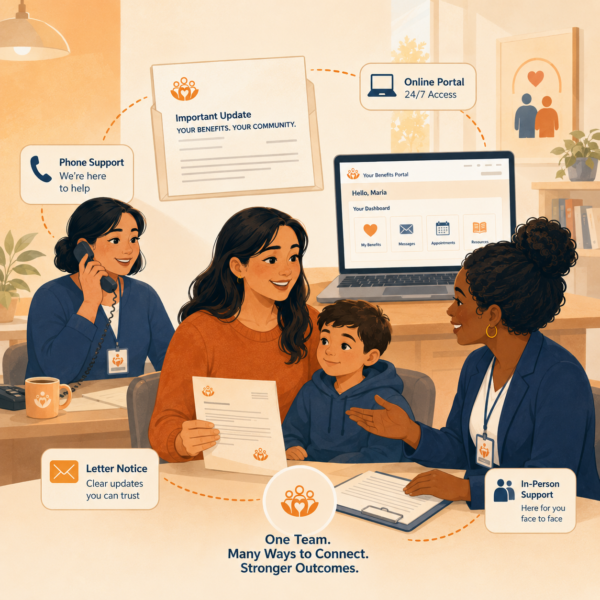 Frontline staff communication is one of the most important parts of the resident experience in human services and public benefits programs. Eligibility workers, caseworkers, call center representatives, reception staff, and navigators are often the people residents turn to when notices, portals, text alerts, and program rules become difficult to understand. Their explanations can determine whether a resident understands a renewal deadline, submits the correct document, attends the right interview, reports a change appropriately, or knows what to do after benefits are changed or closed.
Because frontline communication sits at the intersection of policy, operations, staff training, resident experience, call center workflows, lobby service, digital tools, notices, and partner support, many agencies benefit from structured communication support. Internal teams may understand program rules deeply, but that expertise does not always translate into resident-facing clarity. Staff need practical language, shared definitions, scenario-based training, and job aids that help them explain complex rules accurately without sounding overly technical, punitive, or uncertain.
Stegmeier Consulting Group (SCG) helps human services and public benefits agencies strengthen the communication systems that support frontline staff. That support may include plain-language message frameworks, staff scripts, scenario-based training materials, supervisor coaching tools, resident journey mapping, notice and portal language alignment, partner guidance, job aid development, and communication standards for high-consequence interactions. The goal is not to script every conversation or reduce professional judgment. The goal is to give staff a consistent foundation for explaining complex processes clearly and respectfully.
This kind of support is especially valuable when agencies are managing high call volume, renewal pressure, procedural benefit loss, inconsistent explanations, cross-program confusion, or major changes to notices, portals, service models, and eligibility workflows. Clear frontline communication helps residents understand what is happening, helps staff respond with confidence, and helps agencies reduce avoidable confusion before it becomes repeat contact, missed action, or distrust.
Future Trends in Frontline Communication for Human Services Agencies
Human services agencies are likely to place greater emphasis on frontline communication as a core operational skill rather than a secondary customer service function. Eligibility workers and caseworkers will continue to manage complex rules, system changes, digital tools, notices, and resident questions across multiple programs. Agencies that invest in staff communication training will be better positioned to reduce confusion, support resident compliance, and improve the quality of service interactions.
Another likely trend is stronger alignment between staff scripts and other communication channels. Residents increasingly move between notices, portals, text alerts, websites, call centers, lobby desks, and community partners during the same benefits process. If staff language does not match those channels, residents may lose confidence in the guidance they receive. Agencies will need shared vocabulary, plain-language status definitions, and common explanations for renewals, verification, case closures, document submission, and reported changes.
Agencies may also use frontline feedback more intentionally to improve broader communication systems. Staff hear where residents get stuck, which terms cause confusion, which notices generate repeat calls, and which portal screens create avoidable questions. That knowledge can inform notice revisions, website updates, text alert language, lobby signage, and staff training materials. Frontline communication will increasingly become both a service function and a source of insight for agencywide improvement.
Finally, communication training will likely become more embedded in onboarding, supervision, and quality review. Agencies will need to reinforce clear explanations over time rather than treating it as a one-time training event. Scenario practice, coaching, job aids, and call or interaction reviews can help staff maintain clarity under pressure. This will be especially important as benefit programs continue to evolve and residents rely on staff to translate complex rules into practical next steps.
Conclusion
Frontline staff are not only processors of information. They are interpreters of complex public benefits systems. When residents do not understand a notice, portal status, document request, renewal deadline, case closure, or program rule, they often rely on staff to translate the issue into practical meaning. The quality of that explanation can affect whether the resident completes the right step, submits usable information, avoids unnecessary repeat contact, and maintains trust in the agency.
Training eligibility workers and caseworkers to explain complex rules clearly requires more than general courtesy expectations. Staff need shared plain-language vocabulary, scenario-based practice, consistent scripts, role boundaries, job aids, supervisor reinforcement, and connection to the agency’s notices, portals, text alerts, websites, lobby materials, and partner guidance. Clear communication should be treated as part of service quality, program integrity, and resident access.
In the end, human services agencies strengthen the entire benefits experience when they support frontline staff as communicators. Residents receive clearer explanations. Staff gain confidence in difficult conversations. Supervisors have a stronger basis for coaching. Agencies reduce avoidable confusion and rework. A complex rule may remain complex, but the resident’s next step should not be harder to understand than it needs to be.
SCG’s Strategic Approach to Communication Systems
Align your agency’s messaging, processes, and public engagement strategies.
Human services and public benefits agencies need communication systems that help staff explain complex rules clearly, consistently, and respectfully across every resident-facing channel. Frontline communication training should connect eligibility policy, notices, portals, call center scripts, lobby interactions, partner guidance, and source-of-truth materials so residents hear one coherent explanation of what is happening and what action is required.
SCG helps agencies create communication frameworks that support staff, residents, and agency operations at the same time. Whether your agency is training eligibility workers, improving caseworker scripts, aligning call center language, developing job aids, revising notices, or preparing staff for major program or system changes, SCG can help build a communication system that supports clarity, access, consistency, and trust. Use the form below to connect with our team and explore how a strategic communication system can help your agency strengthen frontline communication and improve the resident experience.