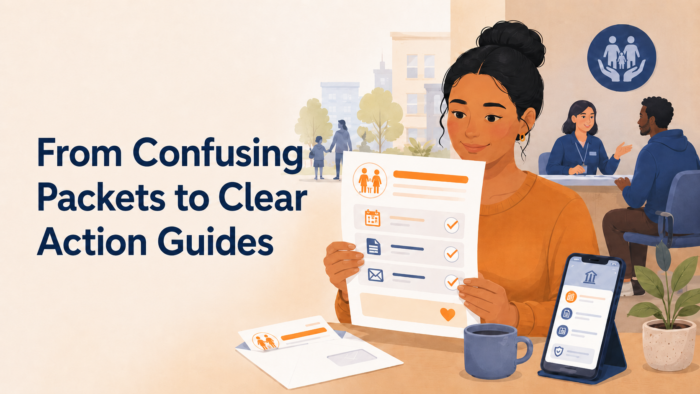
From Confusing Packets to Clear Action Guides: How Public Benefits Agencies Can Redesign Notices for Real Residents
Public benefits notices are often built around what agencies are required to communicate. For human services agencies, public benefits agencies, county social services departments, and state benefits offices, that requirement matters. Notices need to document decisions, explain rights, outline deadlines, request information, and preserve due process. But residents do not experience those notices as compliance documents. They experience them as instructions that may determine whether their household keeps health coverage, food assistance, cash support, child care assistance, housing-related help, energy assistance, or another essential benefit. When a notice arrives in the mail or appears in an online account, the resident is usually asking a much simpler question than the agency is answering: What does this mean for me, and what do I need to do now?
That gap between agency purpose and resident experience is where many notice problems begin. A packet may contain every required paragraph and still fail to guide the person through the next step. It may include a deadline, but not make that deadline easy to recognize. It may explain rights, but not make clear whether benefits are ending, changing, pending, or still available if the resident responds. It may list documents, but not distinguish between what is required, what is optional, and what the agency may already have. It may use accurate program language that staff understand, while leaving residents unsure whether a “redetermination,” “verification request,” “recertification,” “adverse action,” or “case review” requires immediate action.
For residents, confusing notices create more than inconvenience. They create risk. A person who misunderstands a notice may miss a deadline, submit the wrong document, call too late, abandon an online portal, fail to complete an interview, or assume benefits have already ended when there is still time to act. In many cases, the person may remain eligible but lose access because the communication did not successfully move them from notice to completion. That is why notice redesign should not be treated as a cosmetic project. It is a practical strategy for reducing avoidable benefit interruptions, improving resident access, lowering call center confusion, and strengthening trust in public benefits systems.
A stronger notice is not simply shorter. It is clearer, better sequenced, and more useful at the moment of decision. It functions less like a dense packet and more like an action guide. That does not mean removing required language, weakening legal protections, or oversimplifying complex program rules. It means organizing the notice around how real residents read, decide, and act under pressure. The goal is to help people understand what is happening, what action is required, what date matters most, what information is needed, how to complete the step, and where to get help before the issue becomes a crisis.
Why Traditional Benefits Packets Often Fail Real Residents
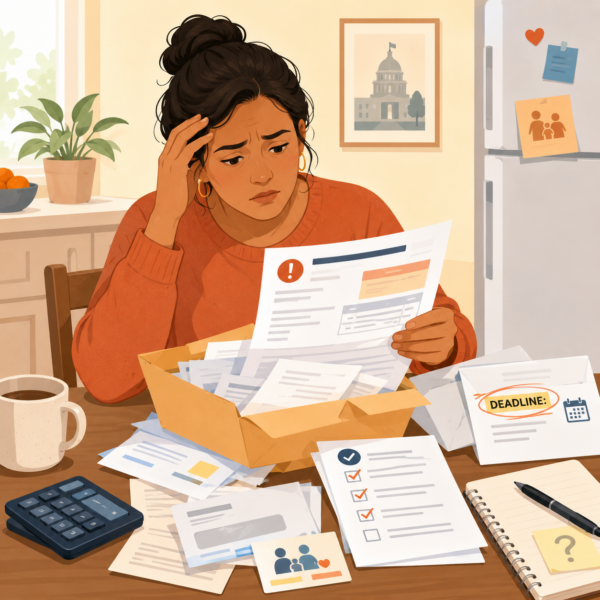
 Traditional benefits packets often reflect the internal structure of the agency more than the lived experience of the resident. They may be assembled from system-generated language, legal templates, program rules, eligibility codes, rights language, and standard paragraphs that have accumulated over time. Each piece may have a reason for being there, but the combined result can feel overwhelming. A resident may open a multi-page packet and encounter several headings, repeated references to the same program, multiple dates, dense paragraphs, and unfamiliar terms before finding the action they need to take. For agency staff, the packet may look complete. For the resident, it may feel like a test.
This is especially challenging because many residents are not reading notices in ideal conditions. They may be working variable hours, managing child care, helping an older family member, moving between addresses, experiencing stress about income or health coverage, using a phone instead of a computer, or trying to understand the notice in a second language. They may also be receiving several pieces of government mail at once. A packet that expects careful, uninterrupted reading from beginning to end does not match how many people actually interact with public benefits communication. Real residents scan, compare, worry, set the notice aside, ask someone else for help, call the agency, or look for the one sentence that tells them what to do next.
The problem is not that agencies include too much important information. The problem is that important information is often not prioritized according to resident need. A packet may treat the reason for the notice, the resident’s required action, legal rights, background rules, document requirements, appeal language, and contact information as if they all deserve the same immediate attention. But residents need hierarchy. They need to know whether something is happening now, whether they must act, what the consequence is, and how to complete the step. Without that hierarchy, the resident has to interpret the agency’s priorities on their own. That interpretation burden can lead directly to missed action.
Redesigning notices for real residents begins by acknowledging that comprehension is part of access. If the resident cannot understand the packet well enough to act, the agency has not fully communicated, even if the required language is present. A notice should not assume that the resident understands agency vocabulary, knows which date matters, or can infer the difference between a request, a warning, a decision, and a rights explanation. The notice should do that work for them. It should guide attention, reduce uncertainty, and make the next step visible.
A Clear Notice Starts With the Resident’s Decision Point
Every public benefits notice arrives at a decision point. The resident may need to submit information, confirm eligibility, report a change, attend an interview, provide verification, appeal a decision, update contact information, or take no action because the notice is only informational. The first job of the notice is to make that decision point clear. Before the resident reads background information, program rules, or formal rights language, they should understand what kind of moment they are in. Is this a request? Is this a warning? Is this a change? Is this a closure? Is this a reminder? Is this an explanation of a decision that has already been made?
This matters because residents often misread notices when the decision point is not obvious. A warning may sound like a final closure. A request may sound like a general update. An eligibility review may sound optional. A right explanation may be mistaken for the main action. If the notice does not clearly label the moment, residents may respond in the wrong way or not respond at all. Public benefits agencies can reduce that risk by designing the notice around a direct action statement near the beginning. The first page should tell the resident what is happening, what action is required, and what deadline applies. Supporting information can still follow, but it should not block the action path.
A resident-centered notice also avoids making the person assemble meaning from scattered clues. For example, one paragraph should not describe the review, another paragraph list possible consequences, a third paragraph mention documents, and a later paragraph provide the deadline without clearly connecting them. The notice should bring those pieces together in a sequence that mirrors the resident’s thought process. What is this about? What do I need to do? When is it due? How do I send it? What happens if I do not? Who can help me? When the notice answers those questions in that order, it becomes easier to follow because it respects the way people make decisions under pressure.
This decision-point approach also helps staff and partners. Call center representatives, eligibility workers, reception teams, navigators, legal aid organizations, clinics, schools, libraries, food banks, and community-based organizations often help residents interpret notices. If the notice clearly identifies the resident’s action step, everyone supporting the resident can reinforce the same message. If the notice is unclear, each helper may interpret the packet differently. That creates inconsistent guidance and more confusion for the person who needs help most.
More Than Just Applications: Human Services and Public Benefits Communication Strategies for State and Local Agencies
This article is part of our series on strategic communication for Human Services Agencies, Public Benefits Agencies, and Health and Human Services departments. To learn more and to see the parent article, which links to other content just like this, click the button below.
From Packet Mindset to Action Guide Mindset
The packet mindset assumes that communication is successful when all required information is included. The action guide mindset asks whether the resident can use the information to complete the right step. This is a critical distinction for human services and public benefits agencies because many benefit interruptions are not caused by a lack of information in the technical sense. They are caused by information being hard to find, hard to understand, hard to prioritize, or hard to translate into action. A packet may tell residents everything, but an action guide helps them do what matters.
An action guide does not remove complexity. It organizes complexity around use. It may include a short opening summary, a visible deadline, a clear list of required steps, plain-language explanations of key terms, specific document instructions, completion options, and help pathways. It may still include legal language, appeal rights, and program rules, but those sections are placed where they support the resident’s understanding rather than overwhelm the first page. The notice becomes easier to scan without becoming less serious. It becomes more practical without becoming less compliant.
This shift also changes how agencies think about layout, tone, and sequencing. Instead of asking only whether the notice contains required content, the agency asks whether the most important content appears where residents are most likely to look. Instead of using headings based mainly on internal categories, the agency uses headings that match resident questions. Instead of presenting all dates in the same way, the agency makes the primary action deadline unmistakable. Instead of offering a general contact line at the end, the agency explains where to get help before the deadline becomes urgent. These are not decorative changes. They are design choices that affect whether residents can complete the process.
For public benefits agencies, moving from packet mindset to action guide mindset can also improve internal operations. Clearer notices can reduce basic clarification calls, duplicate submissions, incomplete forms, repeated mailings, partner confusion, and avoidable rework. Staff still need to support complex cases, but they spend less time explaining what the notice should have made clear in the first place. In that sense, better notice design supports both resident access and agency efficiency.
Notice Redesign Is a Trust Strategy
Residents often judge public benefits agencies through the communication they receive at stressful moments. A notice may be the only direct contact a person has with the agency during a renewal, eligibility review, change, warning, or closure. If that notice is confusing, the resident may interpret the agency as indifferent or punitive, even when staff are trying to follow rules and protect due process. If the notice is clear, the resident is more likely to experience the agency as understandable and reachable, even when the message is difficult.
This is why notice redesign is also a trust strategy. Trust does not come only from reassuring language. It comes from communication that helps people understand their situation and act before harm occurs. A notice that says “we need this information by this date so your benefits do not stop” is more useful than a notice that relies mainly on formal warnings. A notice that clearly explains how to get help feels different from one that lists a phone number without context. A notice that separates required steps from rights information helps residents see both the action path and the protections available to them.
For agencies, this trust dimension matters because public benefits systems depend on resident engagement. People need to open mail, update contact information, respond to requests, keep appointments, submit documents, and ask for help when something is unclear. Confusing notices weaken that engagement by making the process feel unpredictable. Clear notices strengthen it by showing that the agency is not lowering standards, but making the process possible to follow.
The strongest redesigned notices send a practical signal: this process may matter, but you can understand what is being asked of you. That signal is especially important for residents who have had negative experiences with government systems, residents with limited literacy, residents who speak languages other than English, residents with disabilities, and residents managing unstable life circumstances. A notice that respects real conditions can help preserve access, reduce fear, and make the agency’s expectations more credible.
Redesign Begins With a Better Information Hierarchy
A confusing notice is often not confusing because the agency has nothing useful to say. It is confusing because the information is not arranged in the order residents need it. Public benefits notices often include the reason for the notice, the program involved, the household information being reviewed, the action required, the deadline, the consequence, the rights language, and the help information. All of that may matter, but it does not all matter in the same way at the same moment. Residents first need to know whether they must act. Then they need to know what action is required, by when, and how to complete it. Only after that can supporting explanation, technical detail, and formal language do their job without overwhelming the reader.
For human services agencies and public benefits agencies, better hierarchy means designing the notice around the resident’s first few decisions. A clear opening section should make the core message visible without forcing the resident to scan several pages. If the notice is requesting information, that request should appear plainly. If benefits may stop, that consequence should be stated clearly and tied directly to the action that can prevent it. If no action is required, the notice should say so early. This kind of hierarchy does not weaken the notice. It strengthens it because it helps the resident understand the most important information before the packet becomes dense.
Put the Resident’s Next Step Before the Agency’s Explanation
Many notices begin with the agency’s reason for sending the notice. That can be useful, but it is not usually the first thing residents need. A resident opening a benefits packet is not first trying to understand the agency’s workflow. They are trying to understand whether they need to do something. A notice that begins with “We are reviewing your eligibility” may be accurate, but it does not provide enough direction. A notice that begins with “Send us your completed renewal form by June 15 so your benefits do not stop” gives the resident a clearer path.
The agency’s explanation still belongs in the notice. Residents deserve to know why information is being requested and what rules apply. But the explanation should support the action, not bury it. When the next step comes first, the resident can read the rest of the notice with a clearer understanding of why the information matters.
Make the Most Important Date Stand Out
Public benefits notices often contain several dates, and each date may serve a different purpose. There may be a mailing date, a response deadline, a document due date, a benefit change date, a hearing request deadline, an appeal deadline, and an appointment date. When those dates are presented without clear hierarchy, residents may not know which date controls their immediate action. This can lead to missed deadlines even when the notice technically included the correct information.
A redesigned notice should make the primary action deadline unmistakable. That date should appear near the beginning, be stated in plain language, and be connected to the consequence. The notice can still include other dates, but it should explain their purpose so residents do not have to guess. A resident should be able to glance at the first page and know the date by which they must act to protect their benefits.
The Best Notices Reduce Cognitive Load
Residents often read public benefits notices while under pressure. They may be worried about losing coverage, food assistance, child care help, housing stability, or income support. They may be trying to understand the notice between work shifts, during caregiving responsibilities, while using a phone, or with help from someone else. In that context, every unclear sentence adds cognitive load. Every unfamiliar term, repeated paragraph, unexplained date, and competing instruction makes the resident work harder before they can act. A notice may feel manageable to staff who understand the program, but exhausting to residents who are trying to decode it from the outside.
Reducing cognitive load means making the notice easier to process without removing the substance. Agencies can do that by using direct language, grouping related information together, avoiding unnecessary repetition, and using headings that match resident questions. The notice should not make people hold too much information in their heads at once. It should guide them through the process one step at a time. This is especially important when the resident must gather documents, complete a form, attend an interview, or use an online portal. The notice should help the resident move from reading to action, not force them to build their own checklist from scattered paragraphs.
Plain Language Must Be Paired With Plain Structure
Plain language is necessary, but it is not enough on its own. A notice can use simpler words and still be hard to follow if the structure is confusing. Public benefits agencies sometimes revise individual sentences without changing the order of the notice, the placement of the deadline, the visibility of required steps, or the relationship between the mailed packet and the online process. That kind of editing can help, but it does not fully solve the resident’s problem. Residents need plain language and plain structure working together.
Plain structure means the notice follows a recognizable path. The opening should state what is happening and whether action is required. The next section should explain the required step. The deadline should be visible. The document list should be easy to find. Completion options should be grouped together. Help information should appear before the end of the packet. Rights and legal information should remain clear and complete, but should not interrupt the resident’s ability to understand the action path. When plain language and plain structure are combined, the notice becomes more than readable. It becomes usable.
Redesign Should Preserve Rights While Improving Access
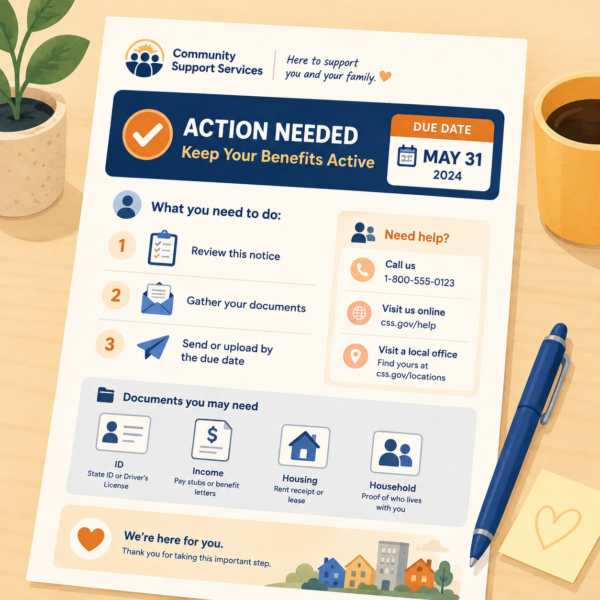 One concern agencies may have about notice redesign is that clearer, more action-oriented notices could weaken required rights language or omit important legal information. That should not happen. A resident-centered notice still needs to explain appeal rights, hearing rights, continuation of benefits when applicable, reporting responsibilities, program rules, and the basis for agency decisions. The goal is not to reduce due process protections. The goal is to make those protections easier to find and understand while also making the immediate action path clear.
In practice, this means separating rights information from action instructions without treating either as secondary. Residents should know what they can do to keep benefits from stopping, and they should also know what they can do if they disagree with the agency’s decision. Those are different questions, and notices should not make residents untangle them from the same dense block of text. A better notice can clearly explain both the practical next step and the resident’s rights, so people are not forced to choose between understanding the process and understanding their protections.
Notice Design Should Reflect Real Resident Behavior
Many notices appear to assume that residents read every page in order, understand every term, compare every date carefully, and keep the packet organized until the process is complete. In reality, residents often scan first. They look for bold text, dates, dollar amounts, program names, warnings, phone numbers, and anything that sounds like a consequence. They may read only the first page before deciding whether to call, wait, ask someone for help, or set the packet aside. They may separate forms from instructions, misplace attachments, or rely on a partner organization to explain the notice later. Redesign should account for these behaviors rather than assuming ideal reading conditions.
This means the notice should be scannable, self-orienting, and clear even when read out of order. The first page should not depend on information buried later. The document checklist should make sense without requiring the resident to reread the full packet. The phone number, portal link, mailing address, and office options should be easy to locate. If attachments are included, the notice should explain what they are and which ones must be returned. A notice designed for real behavior helps residents recover from normal moments of confusion before those moments turn into missed action.
A Good Notice Tells Residents What Is Needed, Not Just What Is Missing
One of the most frustrating parts of public benefits communication is the difference between telling residents that something is missing and helping them understand how to fix it. A notice may say that verification is needed, income information is incomplete, identity must be confirmed, household composition needs review, or documents have not been received. Those statements may be accurate, but they often leave residents unsure what the agency actually wants from them. A person may not know whether to send a pay stub, an employer letter, a tax document, a lease, a utility bill, a school record, a child care statement, a bank record, or something else. They may also be unsure whether a copy is acceptable, whether a photo upload will work, or whether the agency already has the document from a previous interaction.
A redesigned notice should move from deficiency language to completion language. Instead of simply identifying what is missing, it should explain what the resident can provide, how to provide it, and what happens after it is received. This is especially important for residents who may be trying to complete the process through a phone camera, a public computer, a mail drop, a lobby visit, or help from a community organization. The clearer the document request, the less likely residents are to send the wrong item, submit incomplete information, or delay because they are afraid of doing it incorrectly. A good action guide does not merely tell people that the case cannot move forward. It shows them what would allow the case to move forward.
Completion Options Should Be Specific Enough to Use
Many public benefits notices list several ways to respond: online, by mail, by phone, in person, by fax, or through a drop box. Providing options is important, but options alone do not always create usability. If the notice gives a website link without explaining where to go after logging in, residents may get stuck. If it lists a phone number without saying whether the renewal can be completed by phone, residents may call expecting one kind of help and receive another. If it provides a mailing address without clarifying whether originals or copies are needed, residents may hesitate. If it names an office location but does not explain what to bring, residents may make a trip and still leave without resolving the issue.
A strong action guide makes each completion option practical. It explains what residents can do through each channel and what they should have ready before they begin. If online completion is available, the notice should connect the resident directly to the correct portal task and use the same terminology the portal uses. If documents can be uploaded, the notice should explain acceptable formats in plain language. If residents can call for help, the notice should clarify whether the call can complete the step, schedule an interview, answer questions, or confirm receipt. This level of specificity reduces frustration because residents are not just being given channels. They are being shown how to use the channels successfully.
Notices Should Confirm What Happens After the Resident Responds
Residents often complete a step and still feel uncertain. They may mail documents and wonder whether they arrived. They may upload a file and not know whether it was accepted. They may complete an online form and not know whether anything else is needed. They may speak with a staff member and later receive another notice that seems to say the issue is unresolved. This uncertainty can lead residents to submit duplicate documents, call repeatedly, miss follow-up steps, or assume that the agency has ignored their response. A confusing post-submission experience can weaken trust even when the original notice was clear.
Notice redesign should account for what happens after the resident acts. The notice should explain what the agency will do next, how the resident may be contacted, how they can check status, and whether they should keep proof of submission. When possible, agencies should align notices with confirmation messages, portal status language, text reminders, and call center scripts so residents can recognize where they are in the process. A notice that says “after you send your documents, we will review them and contact you if anything else is needed” may seem simple, but it helps residents understand that response is part of a continuing process, not a one-way submission into an unknown system.
Reminder Messages Should Strengthen the Action Guide
Reminder messages are valuable only when they help residents act. A reminder that repeats the same vague language as the original notice may increase anxiety without increasing completion. If the resident did not understand the first packet, another message saying “your renewal is due” may not solve the problem. The reminder should clarify what still needs to happen, restate the primary deadline, and point residents back to the same completion options described in the notice. If the agency can personalize the reminder based on case status, it should name the missing step as clearly as possible. If personalization is limited, the reminder should still reinforce the action path rather than introduce new terms.
This matters because residents often respond to reminders more quickly than to the original packet. A text, phone call, email, or second mailing may be the prompt that finally moves someone to action. That means the reminder should be designed as part of the notice system, not as a separate communication written in a different style. The language should match the original notice, the portal, staff scripts, and partner guidance. If the action guide says “complete your renewal,” the reminder should not switch to “submit your redetermination” unless that distinction is carefully explained. Consistency reduces doubt, especially for residents who are already worried that they may misunderstand the process.
Staff and Partners Need the Same Action Guide Language
Public benefits notices are often interpreted by people other than the resident. Call center staff, eligibility workers, reception teams, supervisors, navigators, legal aid staff, clinic workers, school liaisons, libraries, food banks, housing providers, and other community partners may all help residents understand what a notice means. If those helpers use different explanations from the notice, the resident may become more confused even when everyone is trying to help. A notice redesign effort should therefore include the people who will be asked to explain the notice after it is sent.
Agencies can strengthen redesigned notices by creating short companion guidance for staff and partners. That guidance should mirror the same action statement, deadline language, document explanations, completion options, and help pathways used in the notice. It should also identify the most likely questions residents will ask and provide plain-language answers. This does not need to become a large training program for every notice. It can be a simple alignment tool that helps everyone reinforce the same meaning. When notices, staff, and partners all point residents in the same direction, the notice becomes part of a communication system rather than a packet residents have to decode alone.
Redesign Should Be Tested Before It Becomes the Official Template
A notice may look clear to agency staff because staff already understand the program, the system language, the eligibility rules, and the consequences behind each paragraph. Residents do not have that same context. They are reading from the outside, often while worried about losing benefits or unsure whether the notice is asking for action. That is why public benefits agencies should test redesigned notices before making them the standard template. A notice review should ask practical questions: Can a resident tell what the notice is about within the first few lines? Can they identify whether action is required? Can they find the deadline? Can they tell what documents are needed? Can they understand how to respond? Can they find help before the issue becomes urgent?
Testing does not need to be overly complicated to be valuable. Agencies can review draft notices with frontline staff, call center representatives, eligibility workers, community partners, navigators, and residents with lived experience using benefits programs. The goal is not to make the notice perfect or remove all complexity. The goal is to find the points where people hesitate, misread the instruction, overlook a deadline, misunderstand a term, or confuse one action with another. If multiple reviewers cannot quickly explain what the resident needs to do, the notice needs more work before it reaches thousands of households.
Accessibility and Language Access Should Be Built Into the Notice, Not Added Later
Public benefits agencies serve residents with different literacy levels, language needs, disabilities, technology access, household circumstances, and levels of familiarity with government programs. A redesigned notice should account for those realities from the start. Accessibility is not limited to whether a notice meets a technical requirement. It also includes whether the notice can be scanned, read aloud, translated accurately, understood by someone using assistive technology, explained by a helper, or followed by someone who has limited time and high stress. A notice that depends on dense paragraphs, inconsistent headings, small text, unclear dates, or unexplained program terms can exclude residents even when the agency has technically sent the required information.
Language access works the same way. Translation is important, but translation alone may not solve a confusing structure. If the English notice is poorly organized, the translated version may carry the same confusion into another language. Agencies should first create a clear source version with plain action language, consistent terms, visible deadlines, and organized sections. Then translated versions, interpreter scripts, multilingual inserts, website explanations, and partner materials can reinforce the same action path. This helps residents understand the notice more reliably and helps staff and community partners explain it with less risk of conflicting guidance.
Digital Channels Should Support the Notice, Not Contradict It
Many residents now move between mailed notices, online portals, text reminders, automated calls, email alerts, document upload tools, and phone support during the same benefits process. That creates opportunity, but it also creates risk. If the mailed notice says “complete your renewal,” the portal says “submit your redetermination,” the text says “verification due,” and the call center says “recertification packet,” residents may not know whether these are the same step or different steps. A redesigned notice cannot succeed on its own if the surrounding channels use different terms, different deadlines, or different instructions.
For this reason, notice redesign should include a channel alignment check. The language on the first page of the notice should match the portal task, reminder message, call center script, website explanation, and partner handout as much as possible. Completion instructions should also match the real process. If residents can upload documents online, the notice should guide them to the correct place. If they need to call for an interview, the notice should say that clearly. If they can mail copies but should not mail originals, that should be stated plainly. Digital tools should reduce uncertainty by reinforcing the same action guide, not create a second version of the process that residents have to interpret.
Notice Redesign Should Use Data From Resident Confusion
Agencies do not have to guess where notices are failing. Resident behavior often shows where the communication system is unclear. Repeated call center questions, incomplete forms, duplicate document submissions, wrong-document submissions, missed interviews, portal abandonment, returned mail, appeal themes, office lobby questions, partner feedback, and procedural closure patterns can all point to notice problems. If many residents call to ask whether they need to respond, the action statement may not be clear. If many residents submit the wrong document, the document request may be too vague. If residents miss the deadline after receiving reminders, the deadline language or reminder sequence may not be strong enough.
This type of feedback should be treated as a communication improvement tool, not just an operational burden. Human services agencies can use these signals to revise notice language, strengthen first-page hierarchy, clarify document lists, improve reminder wording, align staff scripts, and adjust partner materials. Over time, this creates a stronger loop between what residents actually experience and how the agency communicates. The best notice redesign efforts are not one-time formatting projects. They are part of an ongoing system for reducing confusion, preserving access, and helping eligible residents complete the steps required to maintain benefits.
Clearer Notices Can Reduce Workload as Well as Resident Harm
Notice redesign is often discussed as a resident access improvement, and it is. But it is also an operational improvement. When residents understand what they need to do, they are more likely to send the right information, use the correct channel, meet the deadline, and ask more specific questions when help is needed. That can reduce unnecessary call volume, repeated mailings, duplicate uploads, incomplete submissions, avoidable appeals, reinstatement work, and staff time spent explaining basic instructions. A clearer notice does not eliminate complex cases, but it can reduce preventable confusion before it becomes extra work across the agency.
This matters because public benefits agencies are often managing high caseloads, staffing constraints, system limitations, policy changes, and urgent resident needs at the same time. A confusing notice pushes more burden into every part of that system. Residents call because they do not understand. Staff explain what the letter should have made clear. Partners spend time decoding packets. Cases close or stall because a step was missed. A clear action guide helps distribute the work more effectively because the notice itself does more of the basic guidance. That makes the process more humane for residents and more manageable for the agency.
Strategic Communication Support for Human Services and Public Benefits Agencies
 Notice redesign is not simply a writing exercise. It is a communication systems project that connects eligibility policy, legal requirements, resident behavior, staff workflows, technology platforms, community partner support, and public trust. For human services agencies, public benefits agencies, county social services departments, and state benefits offices, notices often carry some of the most consequential messages residents receive. They may explain whether food assistance continues, whether health coverage is renewed, whether child care support is at risk, whether income support is changing, or whether a household needs to provide information before a deadline. When those notices are confusing, the effects ripple across the system. Residents may miss action steps, staff may spend more time clarifying basic instructions, partners may struggle to interpret packets, and eligible people may experience avoidable benefit interruptions.
Because notices sit at the intersection of so many operational and public-facing concerns, many agencies benefit from outside communication support when redesigning them. Internal teams often know the programs deeply, but that familiarity can make it difficult to see where residents are likely to hesitate, misread, or become overwhelmed. An external partner can help review notices from the resident’s point of view, identify where action hierarchy breaks down, translate internal terminology into practical language, align notices with reminder messages and staff scripts, and create a clearer structure that still preserves required information. This kind of support is especially useful when agencies are managing large caseloads, policy changes, system constraints, call volume, renewal pressure, or equity concerns tied to procedural benefit loss.
Stegmeier Consulting Group (SCG) helps human services and public benefits agencies redesign communication materials so residents can better understand what is happening, what action is required, and where to get help. That support may include notice audits, plain-language message frameworks, resident journey mapping, source-of-truth page development, staff and partner talking points, renewal communication strategies, and alignment across letters, portals, reminders, websites, call center scripts, and community-facing materials. The goal is not to make complex programs seem simple when they are not. The goal is to make the next step easier to find, easier to understand, and easier to complete.
Strong notice redesign also helps agencies move beyond one document at a time. A redesigned notice should become part of a broader communication system that residents, staff, and partners can recognize. When the same action language appears in the notice, portal, reminder text, phone script, lobby handout, and partner guidance, residents are less likely to wonder whether they are being asked to do several different things. That consistency is one of the most important ways agencies can reduce confusion and support continuity of benefits for residents who remain eligible.
Future Trends in Public Benefits Notice Redesign
Public benefits agencies are likely to place greater emphasis on resident-centered notice design as they continue to manage renewals, eligibility reviews, document requests, program changes, and high-volume resident communication. Notices will increasingly be judged not only by whether required content is present, but by whether residents can realistically understand and act on the information. This shift matters because procedural benefit loss, repeated calls, incomplete submissions, and partner confusion often reveal a gap between technical communication and usable communication. Agencies that treat notices as action guides rather than dense packets will be better positioned to reduce avoidable hardship and improve program administration.
Another likely trend is stronger integration between paper notices and digital channels. Residents may receive a mailed packet, log into a portal, upload documents, receive a reminder text, call the agency, and ask a community partner for help during the same process. If each channel uses different labels, different deadlines, or different instructions, the redesigned notice will not be enough. Agencies will need shared message frameworks that connect printed letters, online workflows, text alerts, email reminders, automated calls, and staff explanations. The notice will remain a key document, but its effectiveness will depend on how well the full communication environment supports it.
Agencies may also make greater use of resident behavior data to improve notice design over time. Call center questions, returned mail, wrong-document submissions, appeal reasons, portal drop-off points, lobby questions, partner feedback, and procedural closure trends can all show where residents are getting stuck. Instead of treating those signals only as workload problems, agencies can use them to refine notice language, strengthen first-page hierarchy, improve document instructions, clarify deadlines, and adjust reminder timing. This kind of feedback loop will help agencies move from one-time notice redesign to ongoing communication improvement.
Conclusion
Public benefits notices are too important to function as confusing packets that residents have to decode under pressure. They should work as clear action guides that help people understand what is happening, what they need to do, when they need to do it, how to complete the step, and where to get help. For residents, that clarity can be the difference between maintaining essential support and experiencing avoidable disruption. For agencies, it can mean fewer basic clarification calls, fewer incomplete submissions, fewer duplicate contacts, and fewer preventable cases of benefit interruption.
Redesigning notices for real residents does not mean removing necessary legal language, ignoring program rules, or weakening eligibility requirements. It means organizing required information in a way that people can use. A strong notice leads with the decision point, makes the next step visible, highlights the deadline, explains what is needed, preserves rights, supports accessibility, aligns with digital channels, and gives staff and partners the same language residents see in the notice. That is how agencies can communicate clearly while still meeting administrative and legal responsibilities.
In the end, the strongest public benefits notices respect the reality that residents are often making important decisions under stress. They do not assume perfect attention, perfect literacy, perfect technology access, or perfect familiarity with agency language. They guide people through the process in a way that is accurate, practical, and humane. When agencies redesign notices with real residents in mind, they strengthen access, improve operations, and build a more trustworthy communication system.
SCG’s Strategic Approach to Communication Systems
Align your agency’s messaging, processes, and public engagement strategies.
Human services and public benefits agencies need communication systems that help residents understand complex processes before confusion leads to missed steps, avoidable benefit loss, or unnecessary frustration. Whether your agency is redesigning notices, improving renewal communication, aligning staff scripts, strengthening reminder messages, or creating clearer source-of-truth guidance for residents and partners, SCG can help you build a communication framework that supports clarity, access, consistency, and trust. Use the form below to connect with our team and explore how a strategic communication system can strengthen public benefits communication and improve the resident experience.