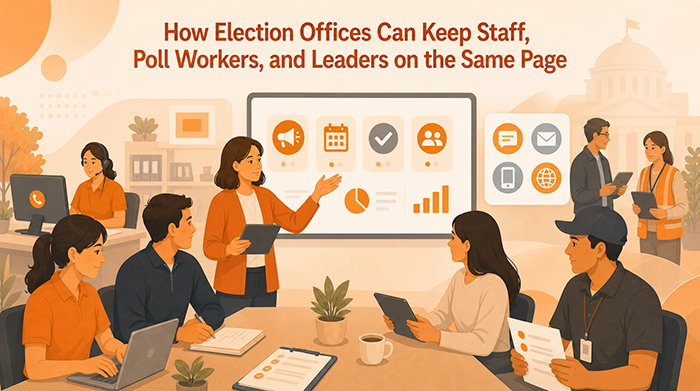
Internal Alignment Before Public Release: How Election Offices Can Keep Staff, Poll Workers, and Leaders on the Same Page
Election communication problems often appear in public first, but they usually begin internally. A website update goes live before poll workers have heard about the change. A leader gives an interview using language that does not match the official voter notice. Frontline staff answer questions with one explanation while the office’s social channels use another. None of these breakdowns require bad intentions or weak procedures. They usually happen because information moved outward before it was aligned inward. In elections, that sequence creates avoidable risk. The public does not experience those differences as minor internal timing issues. It experiences them as signs that the office may not be fully coordinated.
This is why internal alignment should be treated as part of election readiness, not as an administrative courtesy that happens if time allows. Before a message reaches voters, campaigns, observers, media, or community partners, the office has to decide whether the people representing the institution already share the same facts, labels, timing, and explanation of what the public needs to do next. If that work has not happened, even an accurate public release can create confusion. The office may appear inconsistent not because its process is unsound, but because its own people are speaking from different versions of the process.
That challenge becomes more significant in election environments because communication is not carried by one person alone. Election offices rely on leaders, communications staff, operations teams, call-center personnel, temporary workers, poll workers, site supervisors, and external-facing partners to reinforce the same public meaning under pressure. A message that sounds clear in a drafted statement may lose clarity quickly if the people answering questions, directing voters, or speaking to reporters have not been prepared to use the same language. Internal alignment is what keeps that drift from happening. It turns communication from a series of isolated outputs into a shared institutional voice.
Internal alignment also matters because election communication is often time-sensitive and public-facing at the same moment. A polling place update, weather adjustment, accessibility notice, deadline reminder, line management decision, or election-night reporting explanation may all require quick release. Under those conditions, offices can be tempted to prioritize speed over shared understanding. That temptation is understandable, but risky. A fast message that staff cannot reinforce consistently may create more confusion than a slightly slower release that reaches the public through one aligned explanation. In election communication, the office is not only publishing information. It is preparing people to carry that information reliably once public attention arrives.
Why Internal Alignment Breaks Down
 Internal alignment often breaks down because election offices are managing several types of work at once. Communications staff may be focused on publishing. Operations teams may be focused on implementation. Leaders may be focused on public accountability. Poll workers and temporary staff may be focused on what needs to happen at the site level. Each role is valid, but without a shared communication structure, each group may emphasize different parts of the same message. One team highlights timing. Another focuses on rules. Another speaks in practical shorthand. The result is not always a contradiction. More often, it is variation that seems manageable inside the office and confusing outside it.
Timing is one of the biggest causes. A message may be finalized and released before all relevant staff have been briefed. A change may be operationally decided before communication language has been standardized. A leader may be given key facts without the same phrasing that frontline staff are expected to use. Poll workers may receive process instructions without understanding how those instructions will be described publicly. In each case, the office has information, but not yet shared meaning. That distinction matters because shared meaning is what makes public communication sound coordinated.
Another reason alignment breaks down is that offices often assume internal audiences need only the facts, while external audiences need the explanation. In practice, staff also need the explanation. Poll workers, call-center staff, reception teams, and leaders do not just need to know what changed. They need to know how the office wants that change described, what terms should remain consistent, what question the public is most likely to ask first, and what next step should be emphasized. If staff are given facts without message logic, they will often fill in the gaps themselves. That is where drift begins.
Beyond the Ballot: Election Office Communication Strategies for County Clerks, Secretaries of State, and Boards of Election
This article is part of our series on strategic communication for Election Offices, Election Administration Agencies, and Boards of Elections. To learn more and to see the parent article, which links to other content just like this, click the button below.
One Institution, Many Voices
Election offices do not communicate through a single channel or a single spokesperson. They communicate through many voices. A voter may read the website, call the office, see a social post, speak to a poll worker, and hear a local official describe the same issue in public. If those voices do not sound connected, the office’s credibility weakens quickly. The public usually does not sort those differences by department or job title. It hears one institution that either appears coordinated or does not.
This is why internal alignment is not simply about briefing senior staff or distributing final language to communications personnel. It is about making sure the office’s wider communication network can reinforce the same meaning in different settings. A leader may need a high-level explanation for public remarks. A poll worker may need a short and practical version for in-person questions. A call-center staff member may need a slightly fuller answer for repeated confusion points. These versions do not have to be identical to remain aligned. What matters is that they reflect the same core process, the same key labels, and the same action the public should take.
When offices handle this well, public communication becomes more resilient. The website update, the interview quote, the help-desk answer, and the site-level explanation all reinforce one another. When offices do not, even routine issues can begin to look like larger process problems. A voter may assume the rules changed. A reporter may suspect uncertainty. A leader may appear out of sync with staff. Internal alignment prevents those outcomes by making it easier for many voices to carry one message without flattening every interaction into the exact same script.
Building a Core Message Before Anything Goes Public
Internal alignment becomes much easier when election offices define the core message before they start adapting it for different internal audiences. That core message should answer a few basic questions. What changed? Who is affected? What should the public do next? What timing matters. Where should people go to confirm details? Once those elements are clear, the office can shape them for leaders, frontline staff, poll workers, and digital channels without changing the underlying meaning.
This step matters because many internal breakdowns begin when offices move directly from decision to distribution. A website draft is written. A supervisor note is sent. A leader is briefed verbally. A poll worker update is added to a training sheet. Each version may be reasonable, but without a shared message core, small differences in wording can quickly become different public interpretations. The office is not just deciding what information to release. It is deciding how the institution will sound once that information starts moving.
A strong core message also helps offices stay calm under pressure. If the office has already agreed on the central explanation, it becomes much easier to brief staff quickly, answer repeated questions consistently, and adapt the message for different formats without losing clarity. That is especially valuable in election settings where time is short and public attention can rise quickly.
Identifying the Non-Negotiable Elements of the Message
A core message becomes much easier to carry across the office when the non-negotiable elements are defined first. These are the parts that should not drift as the message moves from leadership to frontline staff, poll workers, website language, and public release. They usually include what changed, who is affected, what action people should take next, what timing matters, and where the official source of truth lives. When these elements are fixed early, the office can adapt the message for different roles without changing its meaning.
Separating the Core Message From Role-Specific Framing
Not every internal audience needs the same level of detail, but every audience does need the same underlying explanation. That is why election offices benefit from separating the core message from the role-specific framing that comes after it. The core message stays stable. Leaders may receive a short public frame, frontline staff may receive a practical answer for likely questions, and poll workers may receive a simple action-oriented version tied to site operations. This structure helps the office stay aligned while still giving each group the kind of guidance it actually needs.
What Leaders Need Before a Public Release
Leaders often receive information early, but early awareness is not the same as communication readiness. A director, board member, spokesperson, or senior official may know the operational facts of a situation and still be unprepared to explain it in the way the office wants the public to hear it. This is where election offices can run into trouble. A leader gives a public comment using different labels, different timing language, or a different emphasis than the official message. The facts may still be broadly accurate, but the inconsistency becomes visible immediately.
This is why leaders need more than a fact summary before a public release. They need a short message frame that explains how the office is describing the issue, what key terms should stay consistent, what question the public is most likely to ask, and what answer the office wants emphasized first. They also need to know what remains under review, what should not be speculated on, and where fuller details will be available publicly.
The goal is not to make every leader sound identical. It is to make sure public remarks reinforce the same institutional meaning. When leaders are aligned this way, they help stabilize the message. When they are not, even a well-prepared public release can lose force because the office sounds divided in its own explanation.
Core Elements Leaders Should Have Before Speaking Publicly
Before a public release goes live, leaders should have a short, clear briefing that prepares them to reinforce the office’s message with confidence and consistency. That briefing should include:
-
The core message the office wants the public to understand first
-
The exact terms and labels that should remain consistent across all channels
-
A plain-language explanation of what changed and why it matters
-
The specific action the public should take next
-
The timing details that are most important to emphasize
-
The source-of-truth page or official location where full details will appear
-
The most likely public or media questions leaders may hear first
-
The approved response frame for those likely questions
-
A clear understanding of what is confirmed, what is still under review, and what should not be speculated on
-
The point of contact or escalation path if additional clarification is needed before or after release
This kind of preparation helps leaders sound aligned with the office’s broader communication system rather than unintentionally creating a second version of the message.
What Frontline Staff and Poll Workers Need
 Frontline staff and poll workers need a different kind of preparation. They usually do not need long background explanations or broad strategic framing. They need practical message tools they can use in real interactions. What changed. What do I tell people first? What question am I most likely to hear? What should I direct them to do next? What should I do if the question goes beyond my role? Those are the points that keep public communication from unraveling once voters begin calling, arriving, or asking for clarification.
This is especially important because frontline staff often become the office’s most visible communicators at the moment confusion is highest. A voter may never read the full website explanation, but will remember what the poll worker said at the door or what the office staff member said on the phone. If those answers sound uncertain or inconsistent, the office may appear unprepared even when its public materials were strong.
That is why offices benefit from giving frontline teams short, stable language that reflects the same message the public has already received. These explanations should be clear, usable, and closely tied to the office’s source of truth. Staff should not have to improvise the office’s meaning under pressure. They should have enough guidance to sound calm, aligned, and practical from the start.
Internal Sequencing Before Public Release
Election offices often focus on the public release sequence but give less attention to the internal release sequence that should come first. That is where many alignment problems begin. If the website goes live before supervisors are briefed, or if a leadership statement is issued before frontline staff know how to answer the most likely questions, the office creates a window where public information is moving faster than internal understanding. In election communication, that gap can become visible quickly.
A stronger approach is to decide in advance who needs to know what first. The staff responsible for operational execution usually need early clarity on what is changing and when it takes effect. Leaders need the message frame they will use publicly. Frontline teams need the short explanation and next-step guidance they can use in direct interactions. Poll workers and temporary personnel need the practical version that matches what voters will see online and on site. When this sequencing is handled deliberately, the office is more likely to sound coordinated the moment the message leaves the building.
This does not require a complicated internal system for every update. It does require discipline around message order. The office should know when a release is large enough to require pre-briefing, which roles need the full explanation, which roles need the short version, and what must be in place before the public announcement is pushed outward. That internal structure often matters more than speed alone because it determines whether the public will meet one office voice or several incomplete ones.
Briefing Staff for the Questions They Will Actually Hear
Internal alignment improves when election offices brief staff around likely public questions rather than around internal process detail alone. Staff do need the facts, but they also need help understanding how those facts will surface in real interactions. A polling place change, a deadline update, an accessibility notice, or an election-night reporting shift will all produce predictable questions. Where do I go now? Does this affect me? What should I do next? Is anything else changing? If staff are not prepared for those questions, they may answer from memory, habit, or partial inference instead of from the office’s intended message.
This is why a good internal briefing usually includes more than one type of information. It should explain the change itself, the core public message, the question most people are likely to ask first, and the answer staff should lead with. It should also clarify when staff should escalate a question rather than extending the explanation beyond their role. That kind of preparation reduces improvisation and helps staff feel more confident when public attention arrives.
Briefings also work better when they are scaled to the role. A leader may need a broader explanation and likely media framing. A call-center staff member may need a short script and follow-up instructions. A poll worker may need a simple orientation line tied to signage and site flow. These are different forms of preparation, but they should all reflect the same underlying process and the same official action guidance.
Reducing Internal Drift During Fast-Moving Updates
Fast-moving election periods make internal drift more likely because updates can outpace normal communication habits. A small wording change may be made on the website but not reflected in the staff note. A supervisor may summarize the issue differently than the formal release. A poll worker lead may shorten instructions in ways that change the emphasis. None of these shifts may seem major in the moment, but together they can make the office sound less certain than it is.
The best way to reduce drift is to keep one central version of the message that everyone is working from. That version does not need to be long. It does need to hold the fixed terms, the official action step, the timing, and the source-of-truth reference. When updates happen, the office should revise that core first, then make sure related staff guidance reflects the change. This keeps the message stable even as the situation evolves.
It also helps to assign clear ownership. Someone should know when a change triggers a staff update, who is responsible for pushing revised language to frontline teams, and how old language will be retired. Internal drift usually grows when everyone assumes someone else has already updated the message. Clear ownership reduces that risk and makes it easier for the office to stay aligned under pressure.
Alignment as an Ongoing Process, Not a One-Time Briefing
Election offices sometimes treat internal alignment as a single step before public release. In reality, alignment often needs reinforcement after the first message goes out. Staff begin hearing repeated questions. New confusion points emerge. Leaders may get follow-up inquiries. Poll workers may discover that one phrase is not landing clearly with voters. If the office does not absorb and respond to those patterns, alignment can weaken even after a strong start.
This is why internal alignment should be treated as an ongoing loop. Release the message. Listen to where confusion appears. Clarify as needed. Update staff language if the public is asking a different question than expected. This does not mean changing the core message every hour. It means keeping the office’s shared explanation active enough to stay useful as real interactions unfold.
When offices work this way, internal alignment becomes more resilient. It is not dependent on one perfect pre-release moment. It is supported by continued coordination after release, which is often what keeps the office sounding prepared through the full life of an issue.
Leadership Communication During Pressure
Internal alignment becomes most visible when leaders speak under pressure. A director, board member, clerk, or spokesperson may be asked to explain a change, clarify a problem, or respond before the office has had much time to settle public interpretation. In those moments, leadership language carries unusual weight. If leaders sound calm, clear, and aligned with the office’s written and frontline guidance, the institution appears steady. If they sound uncertain, overly broad, or out of sync with staff, even a manageable issue can begin to look larger.
This is why leadership communication should be prepared around message discipline, not just fact awareness. Leaders need to know the core explanation, the key terms that should stay stable, the action the public should hear first, and the limits of what should not be expanded in the moment. They also need to know how the office is describing what remains under review so they do not fill gaps with phrasing that later has to be revised. Strong leadership communication does not require long scripts. It requires a short, repeatable frame that keeps public remarks aligned with the office’s broader message.
This matters especially because leaders often become the bridge between internal operations and public trust. Their role is not simply to speak first. It is to reinforce the same institutional logic the office is already using elsewhere. When leaders do that well, staff answers, website language, and public statements all sound connected. That connection is one of the strongest signals that the office is operating from one shared understanding.
Staff Confidence Is Part of Message Consistency
Election offices often think about internal alignment in terms of accuracy, but confidence matters too. Staff who know the right answer but do not feel prepared to explain it can still sound hesitant, overly cautious, or inconsistent. Poll workers and frontline personnel especially need communication support that helps them feel steady in real interactions, not just informed on paper.
This is why internal alignment works better when offices prepare staff for the feel of the interaction, not just the content of the update. Staff should know the first sentence to use, the most likely follow-up question, and the point at which the matter should be referred upward. That preparation lowers the chance that someone will overtalk, contradict the public message, or sound uncertain simply because they are trying to be careful. Confidence in this sense is not about improvised authority. It is about giving staff enough structure that they can guide the public calmly and consistently.
The office also benefits when staff believe the internal message will hold. If teams expect that leadership, supervisors, digital channels, and site guidance are all working from the same explanation, they are more likely to speak with clarity. If they suspect the message may shift without warning or that other parts of the office are saying something different, hesitation grows. Internal alignment is therefore not only informational. It is also relational. Staff confidence rises when the office shows that shared language will actually be shared.
Updating the Message Without Sounding Inconsistent
Some of the hardest communication moments occur when an office needs to update its message after the first public release. New facts may be confirmed. A timeline may narrow. A location detail may need refinement. An issue that first appeared limited may turn out to affect more people than expected. These updates are normal in active election environments, but if they are handled poorly, the office can appear to be changing its story rather than refining its explanation.
The strongest way to avoid that impression is to treat updates as continuity, not replacement. The office should anchor each update in what remains true, explain what new information has been confirmed, and show how that affects the public’s next step. This helps people hear movement within a stable process instead of hearing contradiction. It also helps staff understand that updating the message does not mean the original alignment failed. It means the office is continuing to communicate as facts become clearer.
This is where internal notification has to move quickly. Before or at the same time the public message changes, leaders, frontline staff, supervisors, and relevant teams should know what has been updated, what language is now fixed, and what older phrasing should be retired. If some parts of the office continue using the earlier explanation while others adopt the new one, the update itself becomes a source of confusion. Clear retirement of old language is just as important as distribution of new language.
A well-aligned office does not sound rigid when it updates. It sounds methodical. It communicates that the process is being followed, the facts are being clarified, and the public is being kept informed in a controlled way. That tone helps preserve trust because it shows that accuracy and consistency can coexist even when circumstances change.
Strategic Communication Support for Election Offices
 Internal alignment before public release is often treated as an internal management issue, but in practice it is also a public-trust issue. When leaders, staff, poll workers, and frontline teams are working from the same facts, labels, timing, and action guidance, the office is more likely to sound prepared and credible. When internal alignment is weak, even accurate public information can unravel once people begin answering questions, directing voters, or speaking under pressure.
Because of these stakes, many election offices find that internal communication alignment can stretch beyond internal capacity or specialized expertise. Teams are often managing operational changes, legal requirements, frontline preparation, digital updates, and public scrutiny at the same time. In that environment, agencies may choose to work with an external partner because they need focused communication planning, specialized expertise, an objective outside perspective, and support in a high-risk area where timing, consistency, and public confidence all matter.
Stegmeier Consulting Group (SCG) helps election offices approach internal alignment as part of a larger communication system. That includes clarifying the core message before release, aligning leadership and frontline explanations, strengthening staff briefing structures, and building repeatable processes for updating language without creating drift. This helps offices make sure public communication is supported by internal readiness, not undermined by internal variation.
This support is especially valuable because internal alignment has to do several things at once. It must help the office move quickly, keep messaging consistent, prepare different roles appropriately, and maintain confidence when questions intensify. In that sense, strong internal alignment is not separate from election readiness. It is one of the clearest ways readiness becomes visible once the public starts listening.
Future Trends in Internal Alignment for Election Offices
Election offices are likely to place greater emphasis on internal message discipline before public release rather than relying on informal staff awareness alone. As communication channels multiply and scrutiny rises faster, offices will need stronger internal sequencing, clearer role-based briefing models, and more repeatable ways to keep leadership, staff, and poll workers aligned.
Another likely trend is the increased use of role-specific message preparation built from one shared core explanation. Leaders will need short public frames, frontline teams will need practical guidance for likely voter questions, and poll workers will need stable language tied to on-site operations. Offices that build these layers in advance will be better positioned to stay coordinated under pressure.
Election offices may also invest more in update-management processes that help retire old language quickly when public messaging changes. That will matter because credibility increasingly depends not only on what the office says first, but on whether the full organization can keep saying the same thing as facts evolve.
Conclusion
Internal alignment before public release is one of the most important parts of effective election communication. When the office agrees internally before it speaks externally, leaders sound steadier, staff answer more consistently, poll workers feel more prepared, and the public is less likely to encounter mixed explanations at the moment clarity matters most.
This is why internal alignment should be treated as an operational communication priority rather than as a final administrative step. A public release does not stand on its own. It is only as strong as the people who have to carry it once questions begin. Offices that prepare those people well are more likely to sound coordinated, credible, and in control.
In the end, strong internal alignment helps election offices do something simple but essential. It helps one institution speak with one clear meaning across many voices. That is one of the strongest foundations public trust can have.
SCG’s Strategic Approach to Communication Systems
Align your agency’s messaging, processes, and public engagement strategies
Election offices need communication systems that stay aligned internally before they go public. Whether your office is refining pre-release briefing processes, improving leadership and frontline message coordination, strengthening poll worker guidance, or building clearer internal workflows for fast-moving updates, SCG can help you create a communication framework that supports consistency, clarity, and public trust. Use the form below to connect with our team and explore how a strategic communication system can strengthen election readiness and internal alignment.