
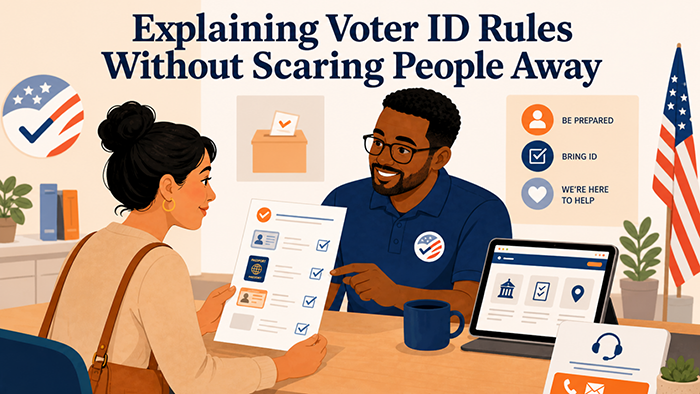
Explaining Voter ID Rules Without Scaring People Away: Communication Strategies for Election Offices
Voter ID communication fails most often before a voter ever reaches the polling place. The real risk is not only that someone arrives without the right document. It is when someone reads a rule, feels uncertain, and quietly decides voting will be too complicated, too risky, or too embarrassing to attempt. That kind of self-disqualification is a communication problem as much as an election administration problem.
This is why voter ID messaging has to do more than repeat the rule. It has to help people understand what the rule means in practice, what they can bring, what alternatives may exist under their jurisdiction’s procedures, and where to get help before Election Day. The U.S. Election Assistance Commission’s voter education toolkit specifically prompts election offices to explain voter ID requirements, list valid forms of ID, clarify whether documents must be current, and tell voters what to bring when voting in person. Its design guidance also emphasizes plain language and structuring information in digestible formats.
Election offices also need to recognize that voter ID rules create a different kind of confusion than many other election topics. A voter can misunderstand registration deadlines or polling place details and still correct the course with a quick lookup. ID rules feel more personal. They raise worries about being turned away, delaying the line, or making a mistake in public. When offices communicate those rules in a rigid or overly legalistic way, they can make even eligible voters feel as though the system is warning them away rather than helping them prepare.
This article provides an evergreen communication framework for election offices that need to explain voter ID rules clearly without creating unnecessary fear. It focuses on how to reduce hesitation, organize the message, use plain-language explanations, prepare voters for common questions, and build confidence that the office is there to help people vote successfully.
The Biggest Communication Risk Is Uncertainty, Not Resistance
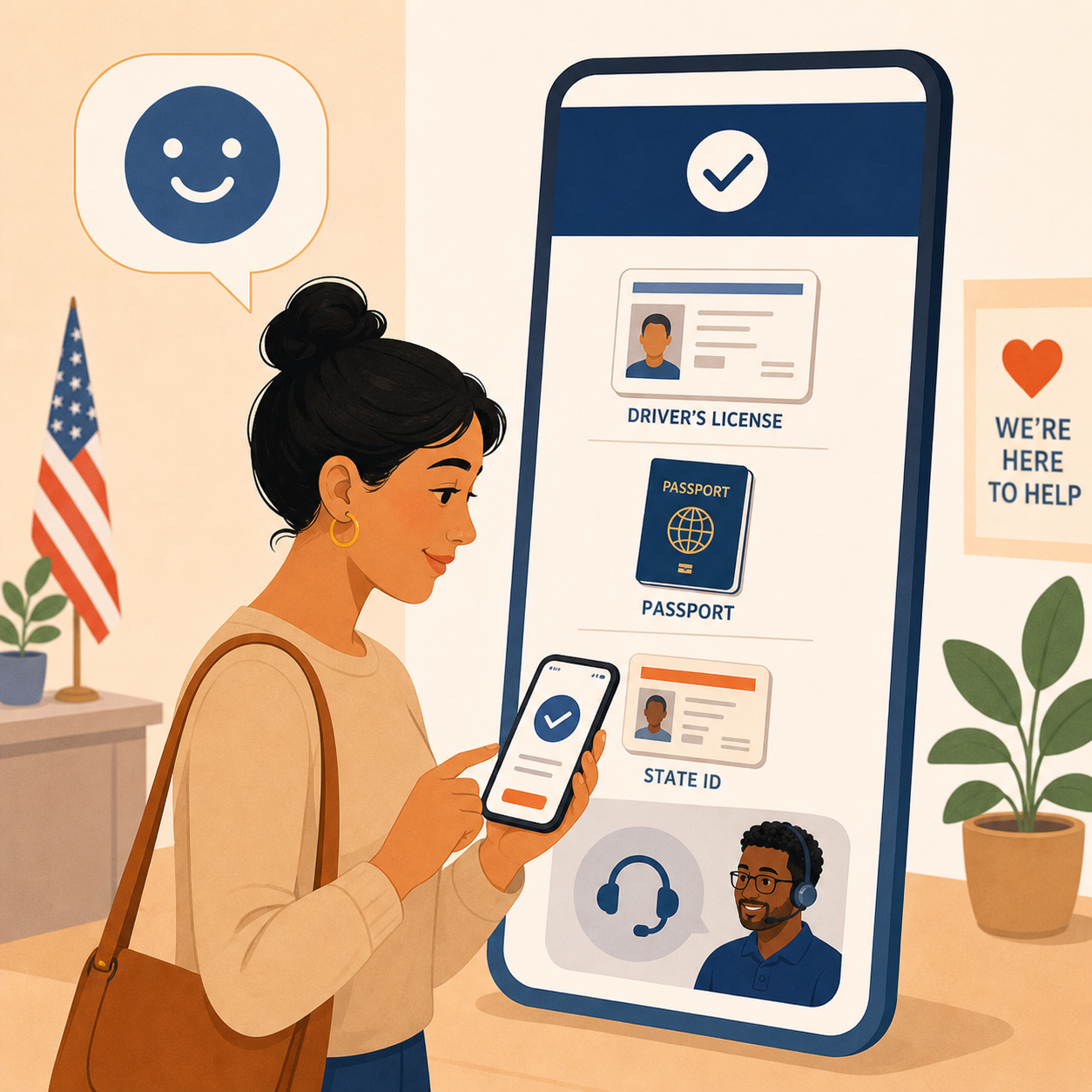 Election offices sometimes approach voter ID communication as though the main challenge is persuading skeptical audiences to accept the rule. In practice, a more common challenge is uncertainty among ordinary voters who are trying to do the right thing but are not sure what the rule requires. They may wonder whether an expired document counts, whether a name variation matters, whether an address must match exactly, whether first-time voters face different standards, or what happens if they arrive without the expected document. If those questions are not answered clearly, the voter may decide not to risk the trip.
That is why the tone of voter ID communication matters so much. A message can be technically correct and still discourage participation if it sounds punitive, overly formal, or incomplete. By contrast, a message that is clear, specific, and practical can lower anxiety without weakening the rule. The office is not trying to make the requirement disappear. It is trying to make the path to compliance understandable.
The U.S. Election Assistance Commission’s resources reflect this practical approach. Its best-practices FAQ document includes model language for jurisdictions that require identification and for jurisdictions that generally do not, and it specifically advises election offices to tell voters how to contact the office if they have lost their ID or cannot obtain an acceptable form for in-person voting. That kind of guidance recognizes an important public reality. Voters need more than the rule itself. They need to know the office has thought about the problems people actually face.
A second reason uncertainty matters is that voter ID rules often get filtered through hearsay. Voters may rely on family members, advocacy groups, candidates, or old assumptions from prior elections. They may hear a rule described too broadly, too narrowly, or incorrectly for their state. If the election office does not provide a simple and visible explanation, outside summaries can become the default source. Once that happens, confusion spreads quickly because people begin preparing based on secondhand versions of the rule instead of the office’s official guidance.
This makes voter ID communication a confidence issue as well as an information issue. Voters should not feel that they need to decode legal text to know whether they are ready to vote. They should be able to find one clear explanation from the election office, understand what applies to them, and know where to go with questions before arriving at the polls.
Beyond the Ballot: Election Office Communication Strategies for County Clerks, Secretaries of State, and Boards of Election
This article is part of our series on strategic communication for Election Offices, Election Administration Agencies, and Boards of Elections. To learn more and to see the parent article, which links to other content just like this, click the button below.
Define Voter ID Communication as Preparation, Reassurance, and Problem-Solving
Election offices should define voter ID communication in three ways. It should function as preparation, reassurance, and problem-solving. Preparation tells voters what to bring. Reassurance tells them that the office wants them to succeed and that clear help is available. Problem-solving tells them what to do if something does not go as expected. When those three functions are present together, ID communication becomes far more effective.
Preparation is the most obvious function, but it is often handled too narrowly. Offices may post a list of acceptable IDs and assume the work is done. In reality, many voters need more structure than a list alone provides. They need to know whether the document must be current, whether supporting information is required, where to verify their polling place, and whether the requirements differ depending on how or when they vote. The Election Assistance Commission’s editable voter education content explicitly prompts jurisdictions to customize these details, including what forms of ID are valid and what additional documentation or information voters may need.
Reassurance matters because voter ID rules can sound like warnings if they are not framed carefully. Election offices should communicate that the goal is to help eligible voters arrive prepared, not to create fear around making a mistake. This does not mean softening the rule into vagueness. It means presenting the rule in a way that feels navigable. The Election Assistance Commission’s design guidance stresses making voter education materials easy to understand through plain language and accessible presentation, which is especially important for requirements that voters may already perceive as high stakes.
Problem-solving is the piece many offices under-communicate. Voters need to know what to do if they realize close to Election Day that they do not have the expected ID, if they have lost it, or if they are unsure whether what they have is acceptable. EAC best-practice guidance specifically includes contact language for voters who have lost ID or cannot obtain an acceptable form in time, which shows that effective voter ID communication must anticipate obstacles instead of pretending they do not exist.
Lead With What the Voter Should Do, Not With Legal Framing
Many voter ID notices begin with formal wording about statutory requirements. That may be legally accurate, but it is not always the best public entry point. Most voters first need a simple practical answer. What should I bring? Where can I check the list? What should I do if I am unsure?
A stronger approach is to begin with the voter action and then provide the legal detail through a link or secondary explanation. This keeps the message usable while still preserving accuracy. The Election Assistance Commission’s voter education toolkit follows this logic by organizing topics around practical voter tasks such as what to bring, where to vote, and how to verify requirements.
Action-first communication also reduces the chance that the rule will feel more intimidating than it needs to be. When a voter sees a clear path forward before seeing the complexity behind it, the office appears helpful and organized rather than formal and distant.
Explain the Rule in Layers, Not in One Dense Block
Voter ID communication works better when it is layered. Some voters need a short summary. Others need the full list of acceptable documents. Others need special-case guidance. Trying to put every detail into one paragraph makes the message harder for everyone to use.
The Election Assistance Commission’s voter education materials recommend breaking information into different levels of detail and using plain language so voters can access what they need without getting lost in unnecessary complexity. That is especially useful for voter ID communication because it lets the office give quick reassurance up front while still providing full detail for people who need it.
A layered approach might begin with a short headline statement about whether ID is required, followed by a simple checklist of what to bring, then a link to a fuller explanation covering document types, edge cases, and how to get help. This structure helps voters find the answer they need more quickly and lowers the chance that they will abandon the page feeling more confused than when they arrived.
Turn the Acceptable ID List Into a Decision Aid, Not a Document Dump
Many voter ID pages fail because they present the rule as a dense inventory of documents rather than as a practical tool for voter preparation. A long list may be legally complete, but it is not always easy to use. Voters do not usually arrive at the page wanting to study categories. They arrive wanting to know, quickly, whether what they already have will work and what detail might matter under their jurisdiction’s rules.
Election offices should therefore organize acceptable ID information around voter decisions rather than around internal legal formatting. A stronger public-facing structure begins with the most common options people are likely to have, then moves to less common forms, and finally directs voters to a full official list for unusual circumstances. This makes the page more useful because it mirrors how people think. Most voters start with a driver’s license, state ID, passport, student ID, tribal ID, utility bill, bank statement, paycheck, or government document, depending on what their jurisdiction allows. The office should design the page so those voters can find their likely answer near the top instead of sorting through a long block of text.
This approach is consistent with federal voter education guidance. The U.S. Election Assistance Commission encourages election offices to explain voter ID requirements in plain language, list acceptable forms of identification, clarify whether documents must be current, and tell voters what to bring. Its design guidance also recommends structuring election materials so information is easy to scan and digest rather than packed into dense text.
A useful voter ID page should also separate the broad rule from the details that change whether a document qualifies. In many jurisdictions, the real confusion does not come from the type of document alone. It comes from the qualifiers. Voters may need to know whether the document must include a photo, whether the address must match the registration record, whether the document can be expired, whether a copy is acceptable, or whether a supporting document can substitute in certain circumstances. If those qualifiers are buried too far down the page, voters may stop reading once they see a familiar document type and miss the detail that actually matters.
Election offices should avoid assuming that a full legal list automatically produces clarity. It often does the opposite. A shorter, voter-centered presentation can still preserve accuracy while making the rule easier to follow. The office can lead with a practical summary, then provide a full official list below or on a linked page. That layered structure serves both the voter who wants a quick answer and the voter who needs detailed documentation.
Another important principle is consistency across channels. The website, printed materials, social reminders, poll worker scripts, and call center guidance should use the same public-facing terms for acceptable identification. If one channel says photo ID and another says government-issued photo identification, while another uses a narrower phrase, voters may assume the rule changed when the language simply drifted. Stable terminology helps prevent that kind of confusion.
Election offices should also remember that voter ID communication must be jurisdiction-specific. Election procedures and requirements vary primarily by state and local law, and the Election Assistance Commission’s general election administration materials note that federal resources are intended as broad guidance rather than a substitute for each jurisdiction’s actual rules and procedures. That means an effective voter ID page should not sound generic. It should make clear that the listed rules reflect the voter’s actual jurisdiction and that the office is the official source for those requirements.
A strong public-facing ID list usually works best when it helps the voter answer a short sequence of practical decisions. Do I need an ID for this kind of voting? Which common documents are accepted here. What details must match or remain current. Where do I go if I am still unsure. When the page answers those points in that order, the office reduces hesitation and makes the rule feel navigable rather than intimidating.
Group Documents the Way Voters Search for Them
Election offices often group documents by legal category, but voters usually search by familiarity. That is why the most useful public-facing lists begin with the documents people are most likely to reach for first. If a jurisdiction accepts a driver’s license or state ID, that information should be easy to find. If it accepts a broader group of non-driver documents, those should be grouped in a way that helps voters quickly compare what they have at home with what the office allows.
The goal is not to reduce legal precision. The goal is to reduce the work the voter has to do to interpret the rule. The Election Assistance Commission’s voter education materials reflect this practical orientation by prompting offices to tell voters what identification is required, what forms are acceptable, and what they should bring to vote.
Grouping by likely voter behavior also helps with multilingual materials, mobile viewing, and print pieces where space is limited. The clearer the grouping, the easier it is to adapt the message across formats without losing the central guidance.
Put the Qualifiers Near the Document List, Not in Fine Print
Many ID misunderstandings come from qualifiers that appear too late. A voter sees a familiar document on the list and assumes the answer is settled. Only later does the voter discover that the document must be current, that the name must substantially match, or that a secondary document may also be required under that jurisdiction’s rules. That kind of layout creates preventable disappointment because the office technically disclosed the requirement but did not present it where voters were most likely to notice it.
A stronger approach is to place the key qualifiers directly beside or immediately under the list of accepted documents. This makes the communication feel practical instead of legalistic. It also reflects the Election Assistance Commission’s emphasis on plain-language, accessible design for voter education materials.
Address Edge Cases Clearly Without Making Every Voter Feel Like a Special Case
 Voter ID communication becomes much more effective when election offices acknowledge common edge cases directly. Many voters are not confused about the existence of the rule. They are confused about whether a small variation in their situation will cause a problem. That uncertainty is what often drives anxiety. A voter who recently moved, changed a name, lost a wallet, or uses a less common form of ID may not need a legal memo. That voter needs a short, clear explanation of what to do next.
The challenge is to address those situations without making the entire process sound fragile or full of traps. Election offices should not design the page so that every voter walks away thinking there are endless ways to fail. The better approach is to identify the few scenarios that most often create uncertainty, explain them calmly, and provide a direct help path for anything more complex. This lets the office solve common problems without overwhelming people whose situation is straightforward.
Federal best-practice guidance supports this practical orientation. The Election Assistance Commission advises election offices to tell voters how to contact the office if they have lost their ID or cannot obtain an acceptable form in time for in-person voting, and its voter education content encourages jurisdictions to clarify exactly what is needed for local procedures.
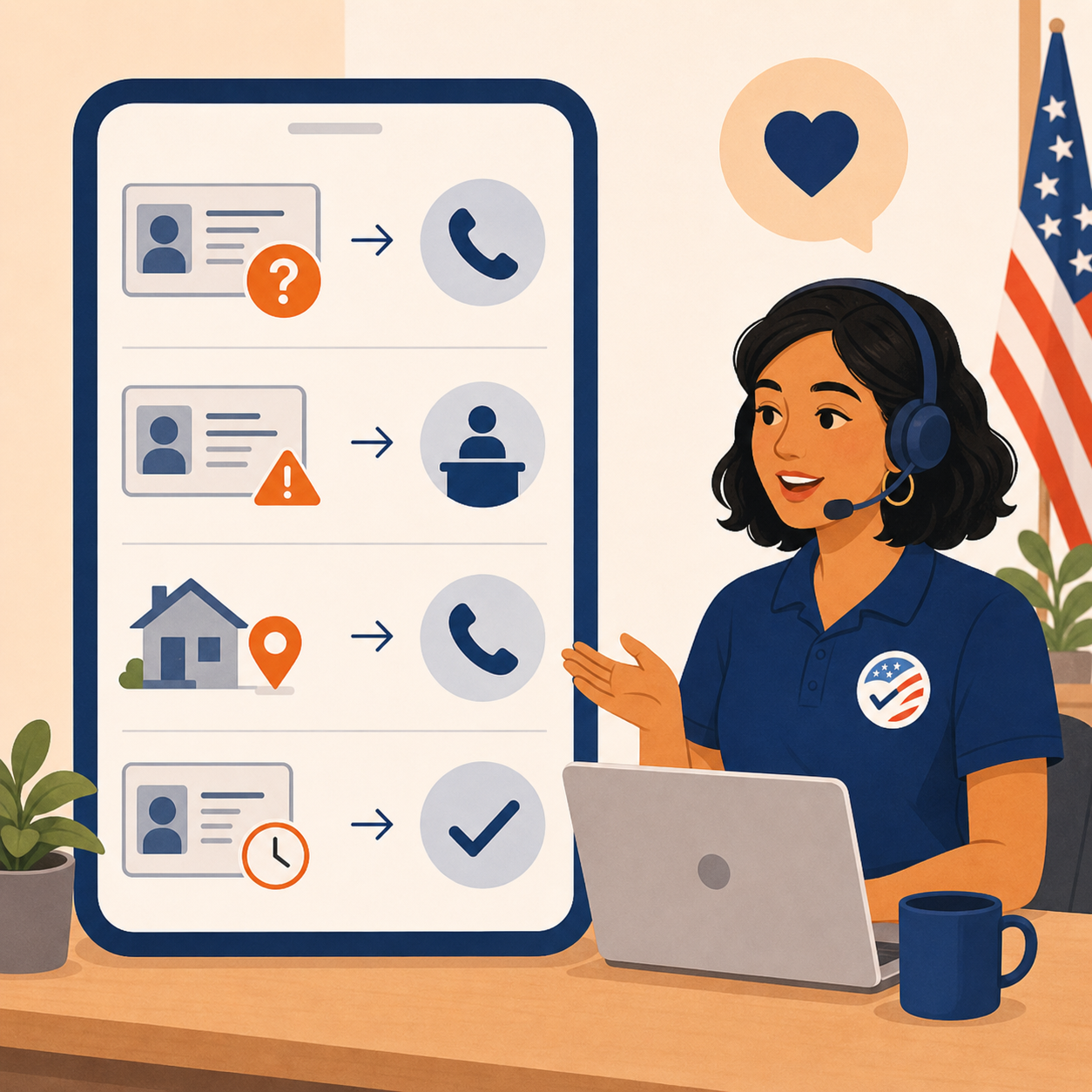
A useful edge-case section often works best when it focuses on the situations voters are most likely to recognize in themselves. For example:
-
I lost my ID and I am not sure what to do before voting.
-
My name is different on one document than it is on my registration.
-
I recently moved and I am unsure whether my address needs to match.
-
I am not sure whether my document is too old or otherwise unacceptable.
This kind of list helps voters locate the issue quickly without suggesting that every voter is facing a complicated compliance problem. It also gives the office a clear way to route uncertainty toward the correct next step instead of leaving the voter to guess.
Explain Common Problems With Calm, Action-Focused Language
The language used for edge cases should remain practical and calm. A voter who reads about lost identification or name mismatch should not feel as though the page is announcing a likely failure. The office should present the issue, explain the rule that applies, and direct the voter to the next action or contact point. This keeps the page helpful without sounding permissive or alarmist.
That tone matters because voter ID rules can already feel high stakes. The Election Assistance Commission’s design guidance emphasizes using plain language and accessible presentation to help voters understand what they need to do. A calm, action-focused explanation supports that goal far better than dense legal language or strongly worded warnings.
Always Pair Special Situations With a Direct Help Path
Edge cases are where many voters need the election office most. That means every edge-case explanation should end with a clear help path. A phone number, office location, website tool, or other official contact should appear close to the problem description so the voter can move directly from uncertainty to resolution.
This is one of the most important ways to keep voter ID communication from becoming discouraging. The message should not stop at describing the problem. It should show that the office has a practical route for helping the voter prepare correctly. That approach is directly reflected in Election Assistance Commission best-practice guidance that encourages offices to tell voters how to contact the election office if they have lost identification or cannot obtain an acceptable form before voting.
Make In-Person ID Messaging Feel Like Guidance, Not a Warning
Election offices often focus heavily on pre-election voter ID pages, but the in-person experience matters just as much. A voter may read the website, feel mostly prepared, and still become uneasy when approaching an early voting site or polling place if the surrounding messaging sounds harsh, overly legalistic, or incomplete. This is where communication design has to support confidence at the point of action, not just in advance.
The first principle is consistency. The same practical explanation of the ID rule should appear across the website, early voting information, polling place reminders, and any on-site signage. The U.S. Election Assistance Commission notes that election administration is highly decentralized and that the best source of practical voting information is the voter’s state or local elections office. That makes consistency from the local office especially important, because voters should not have to reconcile conflicting versions of the rule from secondary sources.
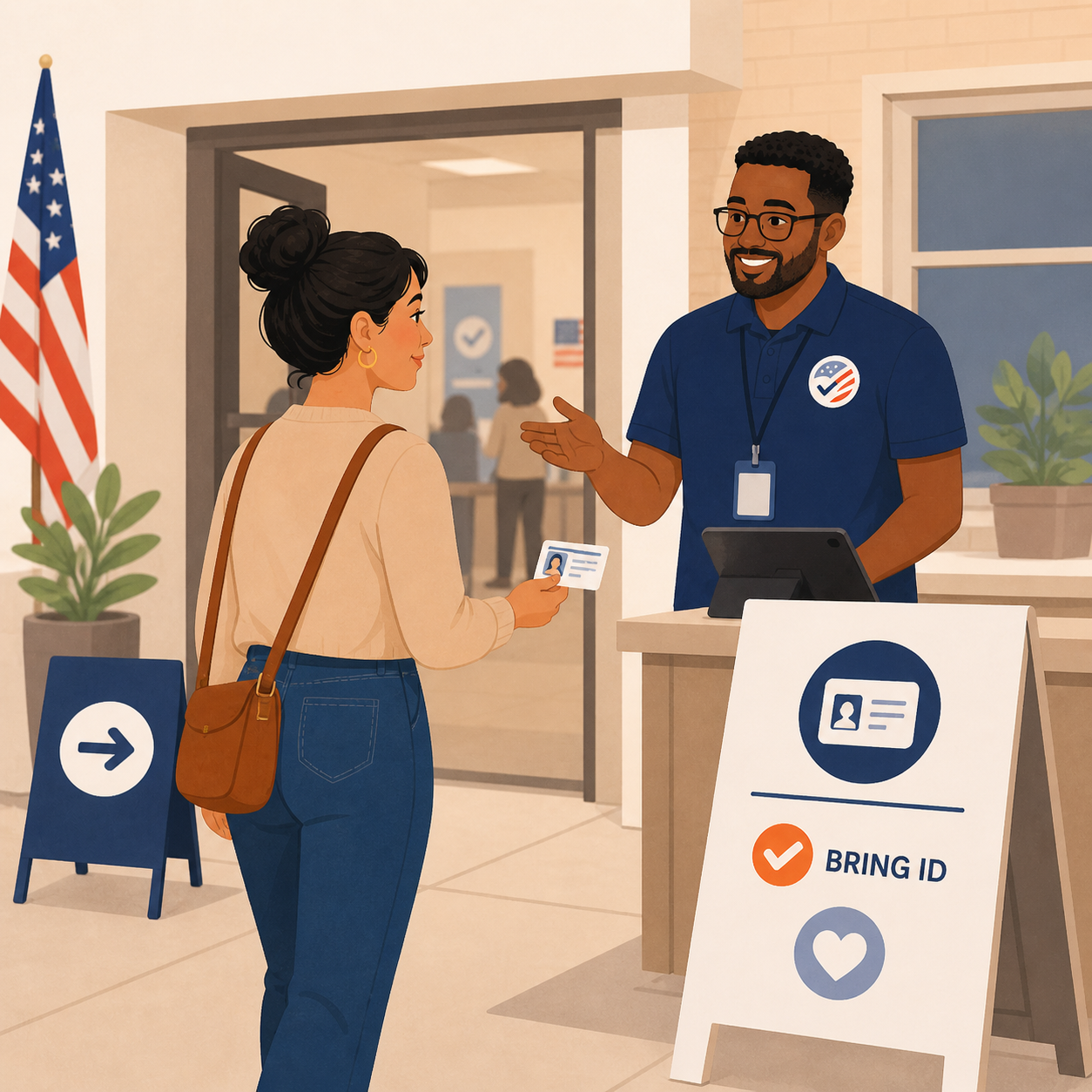
A second principle is placement. ID reminders should appear where they help voters prepare, not only where they heighten stress. A reminder sent before voting begins is useful because it gives the voter time to gather documents or contact the office. A reminder posted at the entrance can also be useful, but only if it is framed as a final preparation cue rather than as a barrier notice. Signage that simply announces identification required in large, formal language can make the rule feel more punitive than practical. A better approach is to pair the reminder with helpful language that points voters to assistance if they are unsure.
This is also where layering matters again. On-site communication should not attempt to reproduce every legal detail. It should provide the clearest possible instruction in short form and direct voters to staff if they need help. The Election Assistance Commission’s voter education guidance emphasizes plain language, digestible structure, and practical information about what voters need to bring. Those principles are especially valuable at the point of voting because anxious voters are less likely to process dense text effectively.
Election offices should also think carefully about the emotional tone of entry-point language. A sign, email, or text reminder can either lower uncertainty or heighten it. If the message sounds like a warning about what could go wrong, some voters will interpret it as evidence that they are likely to fail. If it sounds like a preparation aid, the voter is more likely to treat it as useful guidance. The rule itself stays the same, but the communication experience changes dramatically.
Another important factor is visibility of help. A voter who realizes at the last minute that an ID issue may exist should immediately know where to turn. That means the office should not bury assistance options in a long webpage or assume the voter will know to search for them. The Election Assistance Commission’s best-practices guidance specifically advises offices to tell voters how to contact the election office if they have lost their ID or cannot obtain an acceptable form in time. Bringing that help path closer to the in-person moment makes the rule feel more navigable and less intimidating.
This same principle applies to early voting communications. Early voting often provides the best opportunity to reduce fear because it gives voters more time to solve problems if uncertainty arises. Offices should use early voting reminders to frame ID rules as something voters can check and prepare for now, not as a last-minute obstacle they will face at the door. That approach helps shift the message from compliance anxiety to preparation confidence.
Finally, in-person messaging should reinforce that the office wants eligible voters to succeed. The public-facing tone should not be casual or permissive, but it should be plainly supportive. Voters should feel that the office is helping them arrive ready, not looking for reasons to turn them away. That distinction matters because people often decide how difficult a process feels before they ever interact with a staff member. Communication at the entrance, in reminders, and in voter guides shapes that expectation.
Train Poll Workers to Explain the Rule Calmly and Consistently
Poll workers are one of the most important communication channels in the voter ID experience. They are the people voters see when uncertainty turns into a real moment of decision. If poll workers explain the rule confidently, consistently, and respectfully, they can reduce anxiety quickly. If they sound uncertain, overly rigid, or inconsistent with the office’s public materials, they can make even a straightforward requirement feel unpredictable.
That makes poll worker preparation essential. The Election Assistance Commission describes poll workers as frontline workers who interact directly with voters to check them in and support the voting process. In practical terms, that means poll worker language is not a secondary communication issue. It is part of the voter education system itself.
A strong poll worker briefing should focus on a few core communication goals. Workers should understand the voter-facing version of the rule, know the office’s preferred plain-language explanation, and be ready to direct voters to the next step if a question falls outside the most common scenarios. This does not require workers to become legal interpreters. It requires them to speak with the same practical clarity the office uses in its public materials.
Give Poll Workers Approved Language for the Most Common Questions
One of the easiest ways to create confusion is to let each poll worker explain ID rules in a different way. Even when every worker means well, wording drift can make the rule sound inconsistent. A voter who hears one explanation from the website, another from a mailed reminder, and a third from a poll worker may assume that the office itself is unsure.
Election offices should therefore prepare approved language for the most common interactions. That language should be short, respectful, and action-focused. It should explain what document types or categories apply in that jurisdiction, what the voter should do next if there is uncertainty, and where the worker should escalate the issue if needed. This approach aligns with broader EAC guidance encouraging plain-language voter education and strong support structures for election workers.
Approved language also helps workers stay calm under pressure. A worker who knows the office’s preferred explanation is less likely to improvise, argue, or over-explain. That is especially important in high-volume periods when long lines or tense voters can make every interaction feel more urgent.
Train for Confidence, Courtesy, and Escalation
Poll worker training should not stop at the rule itself. It should also address tone and escalation. A technically correct answer delivered in a cold or rushed way can still damage confidence. Workers should know how to explain the rule without sounding accusatory and how to guide voters toward the next step without making them feel embarrassed.
This is particularly important because voter ID issues can feel personal. A voter may already be worried about holding up the line or making a mistake in public. Courtesy is therefore not just a service issue. It is part of whether the communication works. The office should prepare workers to respond with calm confidence, explain only what is necessary, and route more complex cases to the correct supervisor or help contact. Resources from the Election Assistance Commission on poll worker support and training reinforce the importance of preparing frontline workers for consistent, effective voter interaction.
Escalation paths should also be clear. If a voter presents a less common ID situation, the worker should know exactly where to send the question rather than trying to resolve it through guesswork. That protects both the voter and the office. It reduces inconsistency, supports better decision-making, and helps the interaction feel orderly rather than improvised.
When poll workers, signage, reminders, and web materials all reinforce the same practical message, the voter experiences one coherent system. That coherence matters because confidence is built through repetition. A voter who hears the same calm explanation at every touchpoint is far more likely to feel prepared and far less likely to abandon the process out of uncertainty.
Promoting Long-Term Election and Voter Confidence Through Clear Voter ID Communication
Clear voter ID communication does more than help one voter arrive with the right document on one election day. It shapes whether the public sees the election office as a source of practical help or as a source of hard-to-decipher rules. When offices explain ID requirements in plain language, organize information so people can scan it quickly, and place help options close to common problems, they reduce the chance that uncertainty will turn into avoidance. The U.S. Election Assistance Commission’s voter education resources emphasize plain-language design, digestible formats, and practical guidance about what voters need to bring, which supports exactly this kind of confidence-building approach.
This kind of communication also reduces recurring confusion across election cycles. Many voter ID misunderstandings are not new. They return because voters rely on old assumptions, hear incomplete summaries from unofficial sources, or remember a rule from a different state or a prior election. When the office publishes a clear, stable explanation each cycle and reinforces it through reminders, polling place materials, and staff scripts, voters are less likely to depend on secondhand interpretations. Federal election guidance likewise notes that election administration is largely governed by state law and that voters should rely on their state or local election office for the practical rules that apply to them.
Operationally, stronger voter ID communication lowers unnecessary friction for staff. Offices receive fewer preventable calls when acceptable documents are grouped in a usable way, fewer last-minute escalations when edge cases are explained clearly, and fewer tense polling place interactions when poll workers are prepared to use consistent language. Poll workers play a direct public-facing role in voter check-in and support, so communication quality at that point is a meaningful part of the voter experience rather than a separate administrative detail.
Equity improves as well when ID rules are explained clearly and accessibly. Voters with limited time, limited transportation, lower familiarity with election processes, or limited English proficiency are often affected most when requirements are presented in dense or highly legalistic language. The Election Assistance Commission highlights language access needs under federal law and provides accessibility resources for election officials, reinforcing the importance of making voting information understandable and usable for diverse voters.
Over time, this work also helps election offices reduce the rumor pressure that often surrounds voter ID. When the public can quickly find a jurisdiction-specific explanation of what is accepted, what qualifiers apply, and where to get help, there is less room for inaccurate summaries to define the conversation. The office does not need to make the rule feel casual in order to make it feel navigable. It needs to make the official explanation easier to find and easier to understand than the rumor or the hearsay version. That approach is consistent with the Election Assistance Commission’s emphasis on usable voter education materials and official election offices as the right source for practical voting information.
Strategic Communication Support for Election Offices and Voter-Facing Agencies
 Election offices often understand their voter ID rules thoroughly, but that does not always mean the public-facing explanation is easy to use. A list may be legally accurate and still leave voters unsure whether their own document qualifies. A sign may be technically correct and still sound like a warning. A poll worker script may convey the rule without reinforcing confidence. The communication challenge is not only to state the requirement. It is to organize the requirement so eligible voters can prepare successfully and know where to turn when they are unsure.
That is why agencies often choose to partner with an external resource like Stegmeier Consulting Group (SCG) to strengthen communication systems. Stegmeier Consulting Group supports election offices, boards of elections, clerks, and voter-facing public organizations by helping them build practical communication frameworks for voter ID pages, plain-language document guides, edge-case explanations, polling place reminders, poll worker scripts, and help-path messaging. That includes reorganizing complex requirement lists into more usable public formats, aligning website and field language, and creating message structures that lower anxiety without weakening the rule.
SCG can also help offices identify where voter hesitation is most likely to arise, design communications that support multilingual and accessible presentation, and connect pre-election guidance with the actual in-person experience so the voter encounters one coherent system rather than several disconnected messages. These practices help reduce confusion, ease frontline pressure, and improve the likelihood that eligible voters arrive prepared and confident.
Conclusion
Election offices communicate voter ID rules most effectively when they treat the topic as a preparation challenge rather than as a warning message. Voters need to know what to bring, how to tell whether a document qualifies, what to do if something is unclear, and where to get help before or during voting. Federal voter education guidance from the U.S. Election Assistance Commission consistently emphasizes plain language, practical voter-facing information, and materials that are easy to scan and understand.
Clear communication matters at every stage of the voter journey. A usable document list reduces guesswork before voting. Calm explanations of edge cases reduce fear for people whose situation feels uncertain. Consistent polling place language and prepared poll worker scripts help reinforce confidence in person, when small misunderstandings can feel much bigger than they are. The Election Assistance Commission also highlights the importance of poll worker support and language access resources, which reinforces the need for clear, accessible, and consistent communication around voting requirements.
The goal is not simply to restate the rule. The goal is to help eligible voters understand the rule well enough to act confidently. Election offices that do this well reduce hesitation, lower avoidable staff burden, and make the voting experience feel more navigable without weakening the requirement itself.
SCG’s Strategic Approach to Communication Systems
Align your agency’s messaging, processes, and public engagement strategies
Election offices build confidence when every public touchpoint reinforces the same practical guidance, the same acceptable-document language, and the same help path for voters who are unsure. SCG helps voter-facing organizations create coordinated communication systems by developing voter ID content frameworks, plain-language document guides, edge-case explanations, polling place reminders, poll worker scripts, and source-of-truth messaging that stay aligned from pre-election outreach through in-person voting.
SCG also supports governance and operational coordination so websites, mailers, FAQs, signs, staff scripts, and voter assistance channels work together as one coherent public information system. Use the form below to connect with our team and explore how a strategic communication framework can elevate your agency’s impact.