Why Are Results Taking So Long: A Public Communication Guide for Election Offices on Election Night, Canvassing, and Certification
Election offices face one of their most visible communication tests when the public begins asking why results are not final yet. On election night, people often expect a fast, simple answer. They want to know who is ahead, whether the numbers can still change, and why some jurisdictions report quickly while others continue updating for hours or days. When offices do not explain that process clearly, routine election administration can start to look confusing, secretive, or unreliable even when the system is functioning exactly as intended.
This is not only a reporting issue. It is a public confidence issue. Voters, candidates, media outlets, community groups, and elected officials all watch results through their own expectations and assumptions. Some focus only on election night totals. Others do not understand the difference between unofficial results, canvassing, and certification. Others see updates continue after election night and assume that something improper is happening. In many cases, the real problem is not the count itself. The real problem is that the process was never translated into clear public language before people started watching it unfold.
Election offices therefore need to treat result reporting as a communication system, not just a data release process. The public needs to understand what election night results can and cannot show, why additional ballot categories may be processed later, what canvassing actually does, and why certification exists as a formal step at the end. When those stages are explained early and repeatedly, slower finality feels understandable. When they are not, ordinary administrative work can be mistaken for delay, indecision, or worse.
This article provides an evergreen public communication framework for election offices explaining election night reporting, canvassing, and certification. It focuses on expectation-setting, message structure, timing language, public status explanations, staff alignment, and practical ways to help the public understand why complete and accurate results often take longer than people expect.
Slow Results Are Usually a Process Story, Not a Problem Story
 One of the biggest communication mistakes election offices make is allowing speed to become the public’s main measure of legitimacy. Speed matters, but accuracy, completeness, reconciliation, and legal compliance matter more. If the office does not say that clearly and often, the public may begin to judge election administration by the wrong standard. A result that arrives later than some people hoped can then appear suspicious even when the office is following the required steps carefully.
Election night creates this tension because the public sees visible movement before it sees the full process. Numbers appear on websites, television screens, and social media feeds almost immediately. That visibility creates the impression that the election is nearly finished when, in reality, the most visible stage may only be the first public snapshot of a much larger sequence. Ballots may still be arriving through lawful channels. Provisional ballots may still require review. Reconciliation steps may still be underway. Different categories of ballots may be reported on different timelines depending on state and local rules. None of that is unusual, but it feels unusual when the office has not prepared the public to expect it.
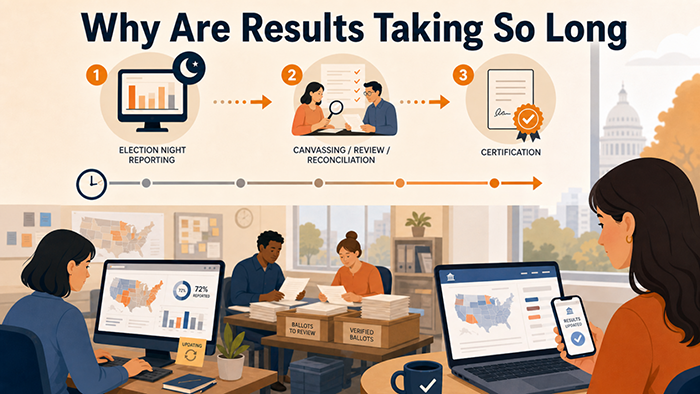
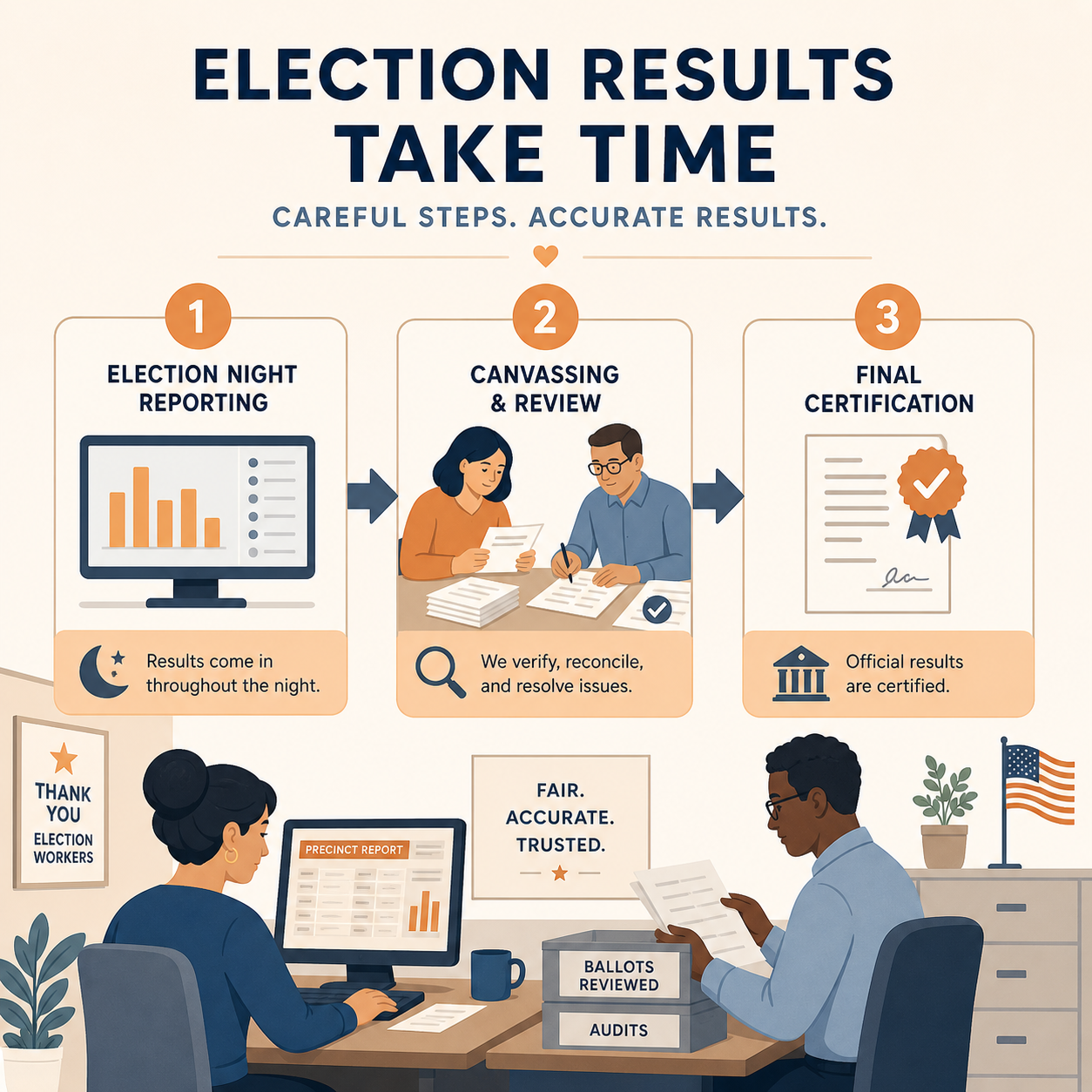
This is why election offices should explain results as a process story rather than as a race to a finish line. The public needs to understand that election night reporting, canvassing, and certification serve different purposes. Election night reporting gives an early public picture based on ballots counted and reported at that point. Canvassing verifies, reconciles, and confirms the accuracy and completeness of those returns according to the jurisdiction’s legal requirements. Certification is the formal step that closes the process after those checks are completed. When offices describe these stages as connected and legitimate parts of one system, later updates are less likely to be misread as signs of trouble.
A second reason this framing matters is that different audiences react to delay in different ways. Some voters become anxious because they think a missing update means something is wrong. Candidates and advocates may pressure staff for quicker answers. Media outlets may compress complicated procedural steps into short headlines that emphasize uncertainty rather than normal process. Social media users may fill the information gap with speculation. In every case, the office benefits when it has already established a simple public logic. Results are reported first, reviewed carefully, updated as required, and certified only after the necessary checks are complete.
This framing also helps protect staff credibility. When election workers are rushed by public demand for instant finality, they can be placed in the difficult position of defending routine procedures as though it were an exception. That is the wrong posture. The office should not sound apologetic for following lawful verification steps. It should sound prepared, transparent, and steady. Public communication should therefore normalize the fact that complete and certified results often take longer than election night headlines suggest.
The most effective message in this environment is often not a defensive one. It is a grounding one. The office should repeatedly reinforce that results take time because the system is designed to value accuracy, lawful review, and complete reconciliation over premature certainty. That message does not eliminate frustration, but it gives the public a more reliable framework for understanding why the timeline works the way it does.
Beyond the Ballot: Election Office Communication Strategies for County Clerks, Secretaries of State, and Boards of Election
This article is part of our series on strategic communication for Election Offices, Election Administration Agencies, and Boards of Elections. To learn more and to see the parent article, which links to other content just like this, click the button below.
Explain the Reporting Timeline Before the First Results Post
Election offices should not wait until the public becomes impatient to explain why results continue changing after polls close. By that point, many people have already formed assumptions. A better approach is to communicate the reporting timeline before the first results appear. This allows the office to frame what the public is about to see, what it should expect over the next several hours or days, and why later updates are part of the normal process.
Pre-election expectation setting is especially important because many misunderstandings begin with a false assumption that election night produces final results. In reality, election night usually produces unofficial results based on the ballots counted and reported by that stage of the process. Those numbers matter, but they do not usually represent the final certified result. If the office explains that distinction before polls close, the public is more likely to interpret later updates correctly.
A useful pre-reporting message should answer a few core questions in plain language. What will be posted on election night. What ballot categories may still be under review or still being processed after polls close. Why may some updates continue after election night? What is canvassing? What is certification? The goal is not to overload the public with legal detail. The goal is to make the timeline legible before the public starts reacting to partial information.
Distinguish Unofficial Results, Canvassing, and Certification in Plain Language
Many public misunderstandings happen because these three stages are never clearly separated in voter-facing language. Election offices may know exactly how each stage differs, but the public often hears all result-related activity as one blurred process. That makes it easier for ordinary updates to look inconsistent or suspicious.
Unofficial results should be explained as the preliminary public reporting of votes counted and reported at that point in time. Canvassing should be explained as the review and reconciliation process used to verify totals, resolve outstanding ballot categories according to law, and confirm that the reported numbers match the official records and procedures. Certification should be explained as the formal legal step that finalizes the results after canvassing is complete.
This distinction matters because each stage answers a different public question. Unofficial results answer what the numbers currently show. Canvassing answers whether those numbers are accurate and complete under the law. Certification answers whether the jurisdiction has formally finalized the election outcome. When those purposes are stated clearly, the office gives the public a much better way to interpret why time passes between election night and the final official outcome.
Show the Public Where Time Usually Goes
Many people assume that slow results mean ballots are simply sitting untouched somewhere. Election offices should replace that vague assumption with a clearer explanation of where time usually goes. The public does not need every technical detail, but it does need to understand that time is often spent on lawful review, verification, reconciliation, and processing steps rather than on unexplained delay.
That explanation should be concrete enough to feel real. Offices can explain that some ballot categories may require review before inclusion, that reconciliation processes must confirm totals and documentation, and that canvassing exists to catch and correct discrepancies before certification. This helps the public understand that additional time often reflects a controlled quality process rather than a failure to act.
Explain Why Reported Numbers Change After Election Night
One of the most important communication tasks for election offices is explaining that changes in reported numbers after election night are not automatically signs of a problem. To the public, a shift in totals can feel dramatic because many people assume that the first numbers posted should be close to final. In reality, reported numbers often change because additional ballot categories are processed, reviewed, reconciled, or added according to the jurisdiction’s lawful timeline. When the office does not explain that early and clearly, normal movement in the totals can be misread as instability.
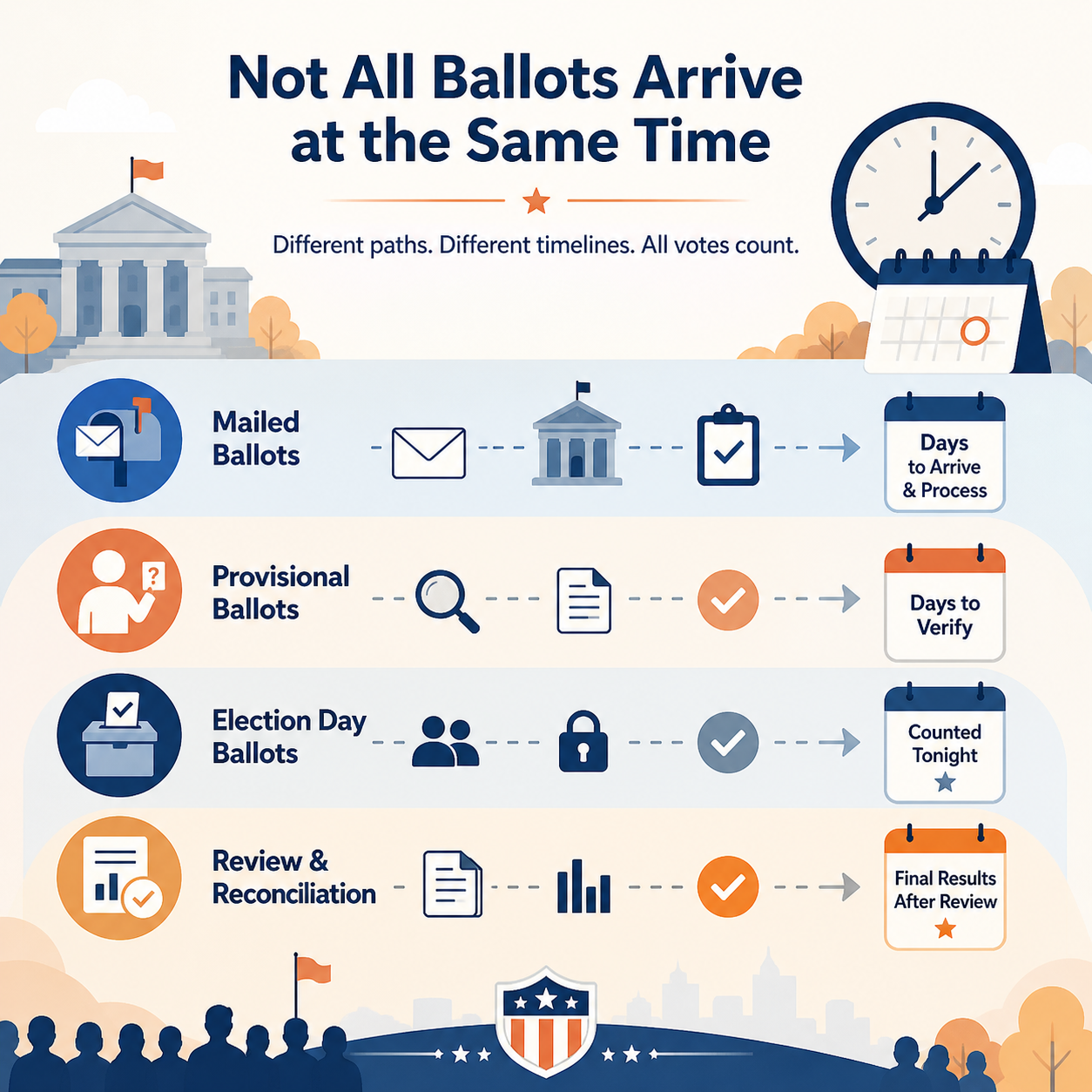
The public needs to understand that election night results are usually a snapshot of what has been counted and reported at that stage, not a guarantee that every eligible ballot has already been reflected. Some ballots may be processed later because they arrive through lawful channels after election night, because they require review before inclusion, or because reporting from different locations reaches the public-facing system in stages. None of this is unusual within election administration. What makes it seem unusual is the absence of explanation.
Election offices should therefore normalize change rather than treating every update like an exception that needs special defense. The public message should make clear that unofficial results may evolve as additional lawful ballots are processed and as reconciliation and canvassing steps continue. This framing helps voters understand that movement in the totals is often part of the process working as designed, not evidence that the process is breaking down.
It is also important to explain that not every update reflects a dramatic new development. Sometimes totals change because a batch of ballots that was expected later has now been added. Sometimes a reporting lag from a site or jurisdiction has been resolved. Sometimes a ballot category that required review is now complete enough for inclusion in the next update. These are ordinary administrative realities, but they can appear suspicious when the office allows the numbers to speak without context.
Tone matters here. Election offices should avoid language that sounds defensive or evasive. The public should not be left with the impression that the office is reluctantly admitting that numbers changed. Instead, the office should describe updates in steady, procedural language that reminds people what stage the results are in and why later additions are part of the normal reporting and canvassing process.
A strong public explanation should emphasize that updates are expected because the count is being completed accurately and lawfully. That explanation becomes even more important in close contests, high-turnout elections, or jurisdictions where the public and media are paying constant attention to each new release. When offices prepare voters for the fact that numbers can change, they reduce the chance that ordinary updates will be framed as extraordinary events.
Give the Public a Simple Explanation of Ballot Categories
Election offices do not need to overwhelm the public with every technical ballot category, but they do need to explain enough so that people understand why all ballots may not appear in the first reported totals. If the office avoids the topic entirely, the public may imagine that missing votes are unexplained. If it explains the categories too technically, the public may tune out or become more confused. The best approach is to use a small amount of plain language tied to the reporting timeline.
A useful explanation might state that some ballots are counted and reported quickly, while others may take longer because they require lawful review, verification, or later processing under the election calendar. The office can explain that these later categories are not unusual and that they are handled through established procedures before being added to updated unofficial results or included in canvassing. This kind of explanation gives the public enough structure to understand why the first posted numbers are not always the final picture.
The office should also be careful not to use ballot category language only when controversy arises. If the public first hears about provisional ballots, late-arriving eligible ballots, or review-based ballot categories only after impatience has already set in, those terms can sound like ad hoc explanations. They are much more credible when introduced early as normal parts of the reporting process.
Explain Batch Updates Without Making the Process Sound Mechanical or Mysterious
Many jurisdictions release results in waves, but the public does not always understand why. Some people imagine that batch updates mean ballots are being held back for unclear reasons. Others assume that every batch reflects a major change in direction. Election offices should explain that updates often occur in stages because counting, review, transmission, and reconciliation do not all finish at the same moment.
That explanation should stay practical. The office can say that unofficial results are updated as additional numbers are ready for release under the jurisdiction’s procedures, and that those updates may include different reporting units or ballot categories at different times. This helps the public see staged updates as an orderly reporting method rather than a sign of hidden activity.
At the same time, the office should avoid making the process sound so mechanical that voters lose sight of the human purpose behind it. Results are not delayed simply because a system is slow. They are updated in stages because the office is balancing public visibility with the need for lawful review, accuracy, and reconciliation. That is a much stronger public message than a purely technical explanation of data flow.
Avoid Language That Accidentally Fuels Suspicion
 Election offices often create avoidable confusion not because the process is unclear, but because the language used to describe the process unintentionally sounds uncertain, overly technical, or reactive. In a high-attention environment, wording that seems harmless internally can take on a very different meaning in public. That is why result-related communication should be reviewed not only for legal accuracy, but also for how an ordinary voter is likely to interpret it under pressure.
One common mistake is using vague reassurance instead of practical explanation. Statements that merely say the office is working hard or that people should be patient do not answer the public’s real concern. Voters want to know what stage the process is in, why more time is needed, and what kind of updates they should still expect. A message that offers only reassurance can sound dismissive, especially when the public is watching numbers move in real time.
Another mistake is using language that makes ordinary procedures sound exceptional. If the office announces that certain ballots are now being reviewed without ever previously explaining that such review is a routine and lawful part of the process, people may assume a new problem emerged. The same risk applies to terms like discrepancy, adjudication, reconciliation, and verification. These terms may be necessary in some contexts, but when they appear without plain-language framing, they can make normal procedure sound alarming.
Election offices should also avoid abrupt shifts in tone from one update to the next. If early updates sound highly confident and later ones sound guarded, the public may assume the office is responding to hidden trouble. A steadier approach works better. Every update should sound grounded in the same public logic: unofficial results are being reported in stages, remaining ballot categories and reconciliation steps are being completed according to law, and certification comes only after those checks are finished.
Precision helps. Instead of saying results are delayed, offices should explain that unofficial results are still being updated as additional lawful steps are completed. Instead of saying the count is not done, offices should explain what remains in broad, understandable terms. Instead of saying the office cannot comment, it is often better to explain what stage is currently underway and when the next public update is expected. The more the office can replace vague language with concrete process language, the less room there is for speculation to fill the gap.
Election offices should also avoid speaking as though speed and accuracy are competing values in a dramatic sense. The stronger message is that the office reports results as quickly as possible within the requirements for lawful review, reconciliation, and completeness. That framing avoids sounding defensive while still reinforcing that careful process is not the enemy of public confidence. It is part of what protects that confidence.
Finally, offices should remember that silence itself can function like suspicious language when the public expects explanation. If the office knows updates will slow, if a major ballot category remains outstanding, or if canvassing is now the more important stage, the public should hear that from the office directly. Waiting too long to explain what is happening gives other voices time to define the story first.
Explain Canvassing as a Verification and Reconciliation Process
Canvassing is one of the least understood stages of election administration, yet it is one of the most important to explain well. Many members of the public hear the word only after election night, often in moments when they are already impatient for final answers. If election offices do not define it clearly, canvassing can sound like an unusual extra step rather than a standard part of how results are confirmed. That misunderstanding creates avoidable suspicion because people may interpret continued activity after election night as a sign that the process is still unsettled in some improper way.
Election offices should explain canvassing in plain language as the stage where the office verifies, reconciles, and confirms the accuracy and completeness of the reported results under the law. This framing matters because it tells the public that canvassing is not separate from trustworthy election administration. It is one of the reasons trustworthy election administration is possible. The office is not reopening a finished process. It is completing the process through required checks that help ensure the reported numbers match the official records, ballots, and procedures.
This explanation should remain grounded in practical meaning. The public does not need a technical seminar on every canvassing task. It does need to understand that canvassing exists to confirm that results are accurate, that required reviews are complete, and that records reconcile before certification occurs. When that purpose is clear, a longer timeline becomes easier to understand because the public sees that time is being spent on confirmation, not on unexplained delay.
It also helps to explain that canvassing is not a sign that election night reporting was unreliable. Some people assume that if canvassing matters, then election night results must be weak or untrustworthy. That is the wrong interpretation. Election night reporting provides an early public picture based on the ballots counted and reported at that point. Canvassing then performs the formal review and reconciliation steps needed before results become official. These stages are different by design, not because one fixes a broken version of the other, but because each serves a different public and legal function.
Election offices should also normalize the fact that canvassing can continue even when public attention begins to fade. For office staff, this is expected. For the public, the continued work can look confusing if no explanation is provided. People may wonder why activity continues after the apparent outcome looks clear. The answer is that election administration does not stop when media interest drops or when a race appears decided. It continues until the required checks are complete and the jurisdiction reaches the point where results can be certified.
A strong canvassing message should also make clear that careful verification protects everyone, regardless of political preference or expected outcome. This keeps the office from sounding as though it is justifying extra time for one contest, one candidate, or one audience. Instead, the office can present canvassing as a standard, neutral safeguard that exists to confirm the integrity of the result before it is made official.
Canvassing communication works best when it answers a small set of public questions clearly. What is canvassing? Why does it happen after election night? What kinds of review and reconciliation occur during this stage. Why can unofficial results still change before certification. When the office answers those questions early and consistently, it reduces the temptation for others to describe canvassing as mysterious or discretionary.
Describe Reconciliation in Terms the Public Can Follow
Reconciliation is often one of the most important reasons results are not immediately final, but it is rarely explained well. The term itself can sound abstract or overly technical, which makes it easy for the public to misread. Election offices should therefore describe reconciliation in terms of what it accomplishes. It is the process of confirming that the numbers, records, and documentation align before results move toward certification.
That public explanation should stay straightforward. The office can say that reconciliation helps confirm that reported totals match the official records and that any discrepancies requiring review are identified and resolved through established procedures. This gives the public a usable understanding without pulling them into internal jargon or excessive procedural detail.
The value of this explanation is that it replaces a vague sense of delay with a visible purpose. The public is far more likely to accept additional time when it understands that the office is checking whether the numbers and records align, rather than simply waiting or repeating work without explanation.
Clarify That Canvassing Is Structured, Not Open-Ended
Another common public misunderstanding is the idea that canvassing is an undefined period during which anything might happen. Election offices should correct that perception by explaining that canvassing is a structured stage governed by established rules, deadlines, and procedures. It is not an open-ended extension of election night. It is a formal process with a defined role in moving from unofficial results to official results.
This matters because undefined processes invite speculation. If the public thinks canvassing is vague or discretionary, normal developments during that period can seem improvised. When the office explains that canvassing follows a set timeline and legal structure, the process becomes easier to interpret as disciplined and routine.
That explanation also helps media coverage. Reporters and community stakeholders are more likely to describe canvassing accurately when the office consistently frames it as a standard review and reconciliation stage with a clear purpose and endpoint.
Explain Certification as the Formal Close of the Process
Certification is the stage that many voters assume happened on election night. In reality, certification is usually the formal act that occurs after unofficial reporting and canvassing are complete. Because the word sounds legal and distant, election offices sometimes under-explain it. That can be a mistake. If the public does not understand what certification means, it may not understand why earlier result updates were always described as unofficial or why the office could not treat election night reporting as final.
Election offices should explain certification as the formal step that finalizes election results after the required canvassing and verification work has been completed. This is an important public distinction. Certification is not merely another update to the numbers. It is the point at which the jurisdiction confirms the result through its official legal process. That explanation gives the public a clear endpoint and helps distinguish between an evolving result picture and a finalized result.
This stage should also be explained in relation to the earlier phases. Election night reporting provides the first broad public picture. Canvassing verifies and reconciles the returns. Certification closes the process formally. When offices use this three-stage structure consistently, the public has a much easier time understanding why results can appear settled socially or politically before they are settled officially.
Election offices should avoid explaining certification in language that is so formal it becomes inaccessible. The office does not need to cite every statutory step in public-facing messaging. It needs to explain the practical meaning. Certification is the point where the office or governing authority completes the final required step to make the results official after the review process is done. That message is easier for the public to follow than a purely legal definition.
It is also important to explain that certification is not a signal that earlier stages were untrustworthy. Some people assume that if results are unofficial until certification, then nothing before certification can be trusted at all. That is too simplistic and often unhelpful. A better explanation is that unofficial results provide the public with timely visibility into the election, while certification provides the formal final confirmation after required checks are complete. These are complementary functions, not conflicting ones.
Certification should also be framed as a trust-building measure rather than just a procedural obligation. It shows that the office does not stop at public reporting. It completes the process through formal review and official closure. That reinforces the principle that the office is accountable not only for speed, but also for accuracy, completeness, and lawful finality.
Finally, election offices should be clear about when certification is expected and what the public should or should not expect between canvassing and certification. If the office knows certification is scheduled for a certain date or within a certain legal window, it should communicate that. When the public knows the endpoint, the space between election night and official finality becomes easier to understand.
Promoting Long-Term Election and Voter Confidence Through Clear Results Communication
Clear communication about election night reporting, canvassing, and certification does more than answer immediate questions during a high-attention period. It shapes how voters understand the professionalism and reliability of the election office over time. When the public hears a steady, understandable explanation of why unofficial results appear first, why additional updates may follow, and why certification comes later, the office reduces the gap between what it is doing and what the public thinks it is doing. That gap is where avoidable mistrust often grows.
A strong public communication framework also helps the office manage expectation before impatience turns into suspicion. Many result-related controversies are not caused by the count itself. They are caused by a vacuum of explanation at the exact moment the public begins watching numbers move. If people are told in advance that election night is the beginning of public reporting rather than the legal end of the process, later updates feel less surprising. If they are told clearly that canvassing exists to verify and reconcile the results, additional time feels more purposeful. If certification is explained as the formal close of the process, the public has a clearer sense of when unofficial reporting becomes official finality.
This communication discipline also improves operational performance. Election offices that explain the reporting timeline clearly tend to face fewer repetitive questions, fewer rumor-driven escalations, and fewer avoidable demands for answers that cannot exist yet. Staff can spend less time defending routine procedure and more time providing accurate, useful guidance. Media inquiries also become easier to handle when the office has already established a public framework that reporters can reference instead of compressing every development into a narrative of unexplained delay.
Equity matters here as well. Voters who are less familiar with election administration, less connected to local news, or more reliant on short public updates are often most affected by unclear result communication. If the office uses overly technical language, assumes background knowledge, or posts updates without context, those voters are left to interpret the process through rumor or partisan commentary. A clearer communication system creates a more even playing field. It allows more people to understand what is happening without needing insider knowledge of election law or administrative practice.
Over time, this work also strengthens the office’s credibility in future elections. Public understanding is cumulative. When voters repeatedly see that unofficial results are labeled clearly, that updates are explained in the same calm language, and that canvassing and certification are presented as normal parts of the same process, they become less vulnerable to confusion the next time a timeline extends beyond election night. The office does not have to rebuild trust from scratch each cycle. It benefits from a more informed public baseline.
Another long-term benefit is that clear results communication helps protect the legitimacy of careful work. Election offices should never feel pressured to apologize for reconciliation, review, or certification. Those are not obstacles to confidence. They are part of how confidence is earned. When the office communicates that principle effectively, the public is more likely to understand that timeliness matters, but timeliness without accuracy and lawful verification would be a much weaker standard.
In that sense, results communication is not just about managing public reaction during one election week. It is about teaching the public how election administration actually works. Offices that do that will reduce the likelihood that ordinary procedural steps will be cast as extraordinary events. They also create a more durable foundation for trust, transparency, and public patience in close races, high-turnout contests, and any election where finality takes longer than people hoped.
Strategic Communication Support for Election Offices and Voter-Facing Agencies
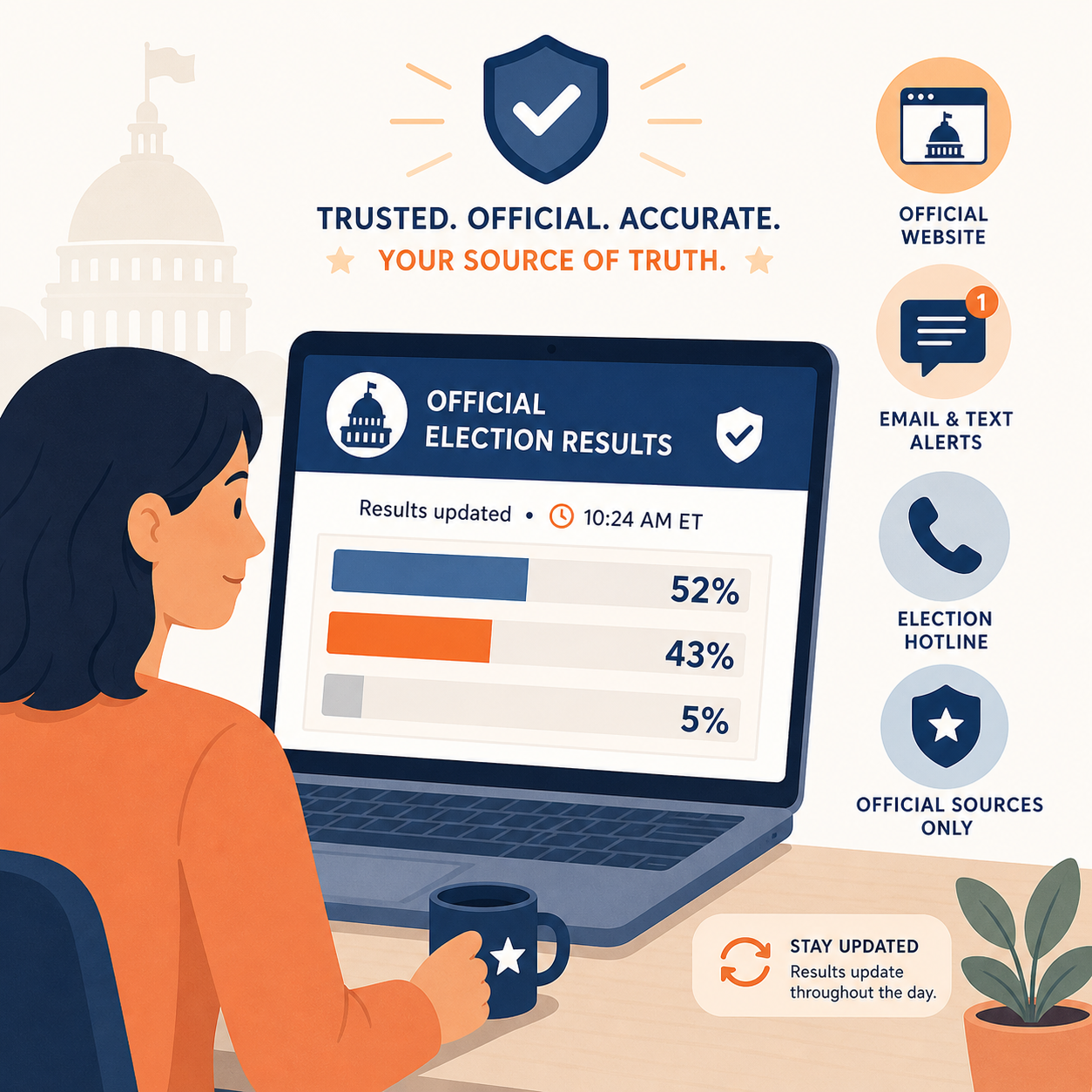 Election offices often have strong operational processes for reporting results, conducting canvassing, and completing certification, but they do not always have a public communication structure that translates those steps into language voters can understand quickly and trust easily. When election night updates appear without enough explanation, when canvassing is described too vaguely, or when certification is treated as a legal afterthought instead of a public milestone, routine processes can begin to look confusing or suspicious. A coordinated communication framework reduces that risk by making sure each public touchpoint reinforces the same timeline, the same terminology, and the same explanation of why results are not final yet.
That is why agencies often choose to partner with an external resource like Stegmeier Consulting Group (SCG) to strengthen communication systems. SCG supports election offices, boards of elections, clerks, and voter-facing public organizations by helping them build practical communication frameworks for election night updates, public dashboards, result disclaimers, canvassing explanations, certification messaging, media talking points, website content, social updates, and staff scripts. That includes expectation-setting language before polls close, clearer voter-facing definitions of unofficial results, canvassing, and certification, message structures for result updates, and governance approaches that help offices keep public explanations aligned across channels.
SCG can also help offices identify where public misunderstanding is most likely to emerge, simplify technical election administration language without sacrificing accuracy, and create communication tools that reduce speculation during periods of ongoing result updates. These practices help protect public confidence, reduce misinformation, and improve the way voters understand the path from election night reporting to final certified results.
Conclusion
Election offices build confidence when they explain results as a structured public process rather than as a race to immediate finality. Unofficial results, canvassing, and certification each serve a different purpose, and the public is far more likely to trust the timeline when those purposes are explained early, clearly, and consistently. When offices define what election night numbers do and do not represent, explain why later updates are normal, and show that certification is the formal close of the process, slower finality becomes easier to understand.
Clear communication matters at every stage. Pre-election expectation setting helps voters interpret election night reporting correctly. Plain-language explanations of ballot categories, reconciliation, and canvassing reduce the chance that normal updates will be mistaken for suspicious developments. Honest certification messaging gives the public a clear endpoint and reinforces that accuracy, completeness, and lawful review are part of how trustworthy results are produced.
The goal is not simply to defend why results take time. The goal is to help the public understand that time is often being used for visible, necessary, and legitimate work. Election offices that communicate with that level of discipline reduce confusion, lower rumor pressure, protect staff credibility, and strengthen public trust in the path from election night reporting to official final results.
SCG’s Strategic Approach to Communication Systems
Align your agency’s messaging, processes, and public engagement strategies
Election offices build confidence when every public touchpoint reinforces the same timeline, the same definitions, and the same explanation of why results are not final yet. Stegmeier Consulting Group helps voter-facing organizations create coordinated communication systems by developing expectation-setting language, public result-reporting frameworks, plain-language explanations of canvassing and certification, website and dashboard messaging, media talking points, social update structures, and staff scripts that remain aligned throughout the reporting process.
SCG also supports governance and operational coordination so election night updates, canvassing explanations, certification messages, FAQs, public notices, and frontline responses work together as one coherent public information system. Use the form below to connect with our team and explore how a strategic communication framework can elevate your agency’s impact.