
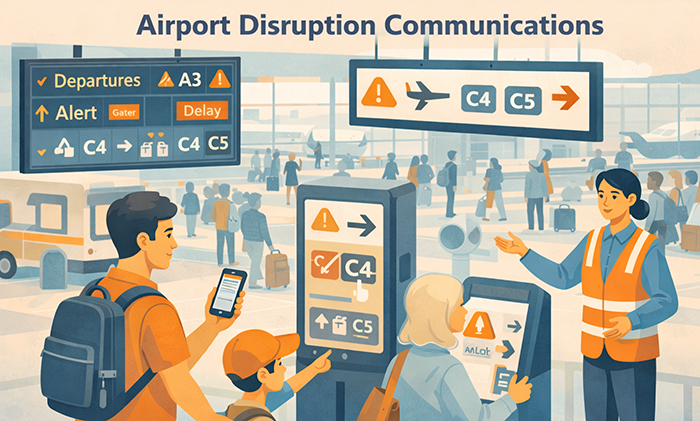
Airport Disruption Communications: Coordinating Passenger Updates Across Terminals, Apps, and Signage
Airports operate as moving systems. Gate changes, security lane shifts, baggage system issues, weather impacts, ground stops, terminal connector disruptions, and staffing constraints can change passenger flow in minutes. During these moments, passengers do not need more messages. They need consistent messages that tell them what to do next and where to verify what is current.
Disruption communication fails when terminals, apps, screens, signage, and staff scripts tell different stories. A passenger might see one instruction in an airline app, hear a different instruction in an announcement, and follow a sign that leads somewhere else. That mismatch creates crowding, missed connections, and unnecessary stress. It also increases the burden on frontline staff, who become the only reliable navigation tool when the information system is fragmented.
Coordinating passenger updates is therefore both a communication challenge and an operations challenge. Clear, aligned messaging helps manage crowd behavior, protect safety, and keep throughput moving. It also reduces misinformation. A single screenshot of a screen or a partial social post can spread quickly. A coordinated source of truth with predictable updates can limit rumor cycles and restore confidence.
This article provides an evergreen framework for airport disruption communications focused on coordination across terminals, apps, screens, announcements, and signage. It covers message spines, label consistency, update cadence, internal alignment, and practical tactics for managing passenger behavior during disruptions.
Why Airport Disruption Messaging Breaks Down
 Airport messaging breaks down because information is distributed across many owners. Airlines control some communications. Airport operations control others. Security agencies may issue separate guidance. Ground transportation partners have their own updates. When these inputs are not synchronized, passengers receive conflicting instructions.
Messaging also breaks down because labels are inconsistent. A terminal connector might be called by different names. A shuttle pickup location might be described by a door number in one channel and by a zone name in another. A baggage carousel might be referenced inconsistently. Passengers then hesitate, backtrack, and cluster at decision points.
Timing is another failure. During disruption, conditions can change faster than content can be updated. If screens and app updates lag, passengers assume the system is unreliable and turn to rumor. If updates arrive too frequently without clear “what changed,” passengers stop reading.
Finally, messaging breaks down when it emphasizes status rather than decisions. Passengers need to know what to do next. They need route guidance, alternative paths, and clear confirmation cues. Pure status reporting increases anxiety because it does not reduce uncertainty.
Passengers Experience One Airport, Not Many Departments
Passengers do not distinguish between the airport authority, airlines, security agencies, and vendors. They experience one environment. If that environment provides conflicting instructions, passengers blame the airport as a whole.
This reality makes coordination essential. Even when the airport does not control every channel, it can align the message spine and the labels and provide a clear source of truth. It can also provide copy-ready blocks and terminology guidance to partners, reducing drift.
Coordination also protects staff. When messages align, staff spend less time correcting confusion and more time supporting passengers with real needs.
Crowd Behavior Is a Communication Outcome
During disruption, passengers move in response to what they believe. If they believe a connector is closed, they will reroute and may create congestion elsewhere. If they believe security is faster in one terminal, they will surge. If they believe a baggage system is down, they may crowd claim areas and block flow.
Communication therefore shapes throughput and safety. Clear, consistent updates can prevent unnecessary surges, reduce bottlenecks, and keep corridors usable. Confusing updates do the opposite.
A communication strategy should be designed with crowd behavior in mind. It should prioritize decision points, provide confirmation cues, and route passengers to the safest, most efficient paths.
From Detours to Understanding: Effective Communication Strategies for Transportation Agencies to Improve Safety and Drive Behavioral Change
This article is part of our series on strategic communication for Transportation Agencies, Transit Authorities, and Public Works departments. To learn more and to see the parent article, which links to other content just like this, click the button below.
Define Disruption Communication as Decision Support and Routing Support
Airport disruption communication should function as decision support. It should tell passengers what is happening only to the extent that it helps them decide what to do next. It should also function as routing support, directing passengers to the correct path and confirming that they are moving toward the right place.
Decision support includes scope and location precision. Which terminal is affected. Which connector is closed. Which doors, checkpoints, or baggage areas are impacted. Vague statements cause passengers to assume the disruption affects everything.
Routing support includes clear alternatives. If a connector is down, direct passengers to the alternate connector or shuttle route with clear pickup cues. If a security checkpoint is congested, direct passengers to the appropriate alternative, but only when it is safe and operationally feasible. If gates change, ensure that the wayfinding cues match the new direction.
Both decision support and routing support require predictable updates. Time stamps, “what changed” lines, and a “next update by” time reduce anxiety and rumor cycles. Passengers need to know when information will be refreshed.
Build a Shared Disruption Message Spine for the Entire Airport System
Coordination begins with a shared message spine. The spine is the structure that keeps meaning consistent across terminals, screens, apps, announcements, and staff scripts. Without a spine, each channel will write its own version, and passengers will receive conflicting cues.
A practical airport disruption spine includes seven elements. The impact statement, the specific location and scope, the time stamp, the action step, the routing alternative, the verification path, and the next update timing. The first line should carry the core action because it will often be screenshot or heard in fragments.
The impact statement should be plain and specific. For example, stating that a connector is out of service, a checkpoint is temporarily closed, or baggage delivery is delayed in a specific terminal. The scope should name the terminal, the connector name, or the checkpoint label exactly as it appears on signs. The action step should tell passengers what to do now. The routing alternative should provide the next best path using stable labels and visible cues. The verification path should point to the airport’s source of truth, such as an airport status page or in-terminal information screens. The next update timing should set expectations.
The spine should be reused everywhere. Apps can use a short version that links to detail. Screens can display the action-first line and the alternative route. Announcements can use the same labels and the same sequence. Staff scripts can mirror the same structure, with calm language and consistent routing.
Use One Label Set for Terminals, Connectors, Checkpoints, and Zones
Label consistency is the fastest way to reduce confusion. If a connector is called “Terminal Link” on a sign and “Interterminal Shuttle” in the app, passengers hesitate. The airport should define a label set and require it across all channels.
Labels should be visible in the environment. If a sign uses “Checkpoint C,” the messaging should use “Checkpoint C,” not “the main checkpoint.” If a shuttle pickup uses door numbers, use those numbers consistently. If it uses zones, use those zones consistently.
A label set should also include short forms that are consistent. Not every channel has the same space. The short form should still match the sign language. This reduces drift and improves recognition.
Label consistency also improves translation and accessibility. Stable labels are easier to translate and easier for staff to communicate in audio announcements.
Put “Do This Now” Before Background Context
Passengers under stress want the next step. If the message begins with background context, passengers may miss the action. The spine should lead with what to do now, then provide the short reason if needed.
Action-first messaging also reduces panic. When passengers have a clear next step, uncertainty decreases. Context can be added in a second sentence, but it should remain short and factual.
This approach also improves shareability. When a message is screenshot or reposted, the action line remains visible and reduces misinterpretation.
Make the Source of Truth Non-Negotiable Across Apps and Screens
During disruption, passengers will check multiple sources. Airline apps, airport apps, flight information displays, third-party travel apps, and social channels will all circulate information. The airport cannot control every platform, but it can establish a clear source of truth and route all airport-controlled channels to it.
A source of truth should be time-stamped, mobile-friendly, and written in plain language. It should include the current status, the scope, the action step, and the alternate route. It should also include a “what changed” line for updates, because passengers will compare versions.
Every airport-controlled channel should route passengers back to the source of truth. Terminal screens can display the short action line and a prompt to check the airport status page. Announcements can reference the same source. Staff scripts can direct passengers there. Social posts can link to it rather than carrying full details that may change.
The source of truth should also support internal teams. Staff need to confirm what is current quickly. A single reference reduces improvisation and reduces conflicting directions at information desks.
Finally, the source of truth should include an updated rhythm. A “next update by” time reduces rumor cycles and stabilizes expectations during prolonged events.
Use Time Stamps and “What Changed” Lines to Prevent Outdated Sharing
Outdated messages create chaos. Passengers share screenshots. Media outlets quote posts. Group chats circulate partial information. Time stamps allow passengers to verify whether what they are seeing is current.
A “what changed” line helps passengers interpret updates. It can state that a connector reopened, that a shuttle route moved pickup locations, or that a checkpoint reopened. This reduces confusion and prevents passengers from rereading large blocks of text.
This practice also supports staff. Staff can tell quickly whether they are referencing the newest version and can avoid contradicting what passengers saw earlier.
Time stamps and change lines are credibility cues that reduce misinformation without requiring long explanations.
Keep the Source of Truth Focused and Scannable
A source of truth should not become a long narrative page. Passengers need scannable blocks with headings and clear actions. The page should be structured to answer the next decision quickly.
A practical structure includes current status, what to do now, alternate routes, and where to get help. Details can be included for those who want it, but the top section should remain simple.
Scannability is also important for mobile use and accessibility. Clear headings and concise language improve usability for everyone.
Coordinate Terminal Screens, Audio Announcements, and Signage as One Wayfinding System
In disruption, passengers rely heavily on what they see and hear in the terminal. Screens, announcements, and signs must reinforce the same meaning. If these elements contradict, passengers will stop trusting them and will cluster at information desks, airline counters, and corridor choke points.
Coordination begins by treating these channels as one wayfinding system. Screens should communicate the action step and the route alternative with stable labels. Announcements should use the same labels and mirror the same sequence. Temporary signage should match both and should be placed before decision points, not after passengers make mistakes.
Screen content should be concise. It should not attempt to explain every detail. It should direct passengers to the correct path and point them to the source of truth for updates. Audio announcements should be calm and repeated on a predictable cadence, especially when conditions are changing. Signage should be high-contrast, legible from a distance, and consistent with permanent sign language.
Temporary signage is especially important during connector disruptions and checkpoint changes. If passengers cannot find the shuttle pickup quickly, they will create crowding in corridors and may block accessible routes. Clear temporary signs, aligned with screen messaging, reduce this risk.
Finally, these channels must be updated together. A screen update without a signage update produces contradictions. A signage update without an announcement creates uncertainty. Coordination is a governance task, not an ad hoc decision.
Use Decision-Point Placement and Confirmation Cues to Reduce Backtracking
Passengers make choices at corridor splits, elevator and escalator banks, terminal connector entrances, checkpoint approaches, and gate concourse junctions. Guidance must appear before these points so passengers can commit to the correct path.
Decision-point placement should be paired with confirmation cues. After a passenger turns toward a shuttle pickup, a confirmation sign should reassure them they are still on the right path. This reduces hesitation and prevents people from stopping in high-flow corridors.
Confirmation cues also support accessibility. Passengers using mobility devices need clear routing without last-minute reroutes. Consistent confirmation reduces stress and improves flow.
This approach reduces staff burden because fewer passengers need to ask for basic directional help.
Make Temporary Signage Look Like Part of the System, Not a Patch
Temporary signs often look improvised. Passengers treat improvised signs as unreliable, especially when they conflict with permanent signage. Temporary signs should use the same label set and the same icon language as the permanent system.
A consistent look also improves compliance. Passengers are more likely to follow signage that appears official and aligned. This is important for safety routing and crowd management.
Temporary signage should include time stamps when practical, especially for printed posters placed near connectors or checkpoints. Even a simple “updated today” cue can reduce confusion when signage remains posted longer than expected.
Temporary signage should also be removed when no longer applicable. Old signs become long-term misinformation sources inside the terminal.
Align App Updates With On-Site Reality and Airline Communications
 Passengers will check apps during disruption, often while moving. If app instructions do not match on-site signs, passengers lose confidence and may ignore both. Alignment between apps and the terminal environment is therefore essential.
Airport-controlled apps and webpages should use the same label set as signage. They should show the same alternative routing and the same pickup location identifiers. If a shuttle pickup is at a specific door, the app should use that door number and match the sign at the door.
Airline communications can complicate alignment. Airlines may push gate change messages or boarding time updates that interact with airport disruptions. The airport cannot control airline messaging, but it can provide copy-ready language and stable routing guidance so airline messages do not conflict with airport instructions.
A practical approach includes a partner message pack during major disruptions. The pack provides a short action-first statement, stable labels, and routing instructions. Airlines and terminal partners can paste this language into their own channels. This reduces meaning drift and improves the passenger experience.
App updates should also be time-stamped and include “what changed” lines. Passengers often compare app notifications and assume contradictions when updates are not framed clearly.
Finally, app updates should include clear help routing. Passengers need to know where to get assistance, such as information desks, service ambassadors, or accessible support routes. Clear help routing reduces panic and reduces conflict at high-stress points.
Use Route-Based Instructions, Not Vague Alternative Suggestions
Vague alternatives create chaos. Instead of stating that passengers should use another checkpoint, provide a specific route instruction that references visible labels. For example, directing passengers to a specific checkpoint label and providing a clear path to reach it.
Route-based instructions also help manage crowd flow. If the airport wants to shift passengers to a different checkpoint, it must provide an organized routing plan, not a general suggestion. Otherwise, passengers will choose randomly and may overwhelm unintended areas.
Route-based instructions should also include constraints. If an alternative route is not accessible or is limited, the message should state that clearly and provide a separate accessible route when needed.
This specificity reduces repeated questions and improves compliance.
Sync App Language With Signage, Then Validate in the Field
Alignment must be tested on the ground. A message can be correct in theory and still fail in practice if signage is hard to find or if corridor barriers change the route.
Field validation should be part of the disruption workflow. Staff should confirm that signs match the app language, that the stated pickup point is correct, and that passengers can follow the route without hitting dead ends. If validation reveals an issue, the source of truth should be updated first, then screens and signage should be corrected.
Validation also protects credibility. Passengers are more likely to trust the system when digital and physical guidance match.
This practice also reduces misinformation because fewer passengers will post contradictory experiences online.
Maintain Credibility During Rapid Change With Update Rhythm and Version Control
Airport disruptions evolve quickly. Connector status can change. Checkpoint staffing can shift. Ground stops can end abruptly. Credibility depends on how updates are managed. Passengers will accept change when updates are consistent, time-stamped, and clearly explain what is new.
Update rhythm reduces anxiety and rumor cycles. A “next update by” time sets expectations and prevents passengers from interpreting silence as concealment. The rhythm should be realistic and should be met consistently. When nothing changes, an update that states “no change” is often better than silence.
Version control prevents contradictions. When messages update, the new version should include a “what changed” line. This helps passengers interpret new information without assuming prior information was false. It also helps staff maintain consistency at information desks and in terminal announcements.
Credibility also depends on keeping scope precise. Broad messages can cause overreaction. If a checkpoint is closed in one terminal, the message should name that terminal and that checkpoint. If a connector is down between specific terminals, the message should state that precisely. Precision reduces unnecessary rerouting and improves throughput.
Finally, credibility depends on coordination between public and internal updates. Staff should not learn about changes after passengers do. Internal message packs should be updated first or at least in parallel, so staff scripts remain aligned with what passengers are seeing.
Use “Next Update By” Commitments to Stabilize Passenger Expectations
A simple “next update by” time is a powerful tool. It tells passengers when to check again and reduces the urge to refresh multiple sources constantly.
The commitment should be conservative. Missing a promised update time reduces trust. When conditions change significantly, the airport can publish an earlier update, but it should still maintain the regular cadence.
This approach also supports internal coordination. Teams can align their checks and approvals around the update rhythm. That reduces random, uncoordinated posts that create contradictions.
Over time, passengers learn that the airport communicates on a reliable rhythm, which improves confidence even when disruptions are serious.
Use a Short Change Log During Prolonged Events
Prolonged disruptions benefit from a short change log. The log can list time-stamped updates with one-line change summaries, such as connector status changes, shuttle pickup relocations, checkpoint reopenings, or updated estimated resolution windows.
A change log helps passengers who arrive mid-event. They can understand what has changed without reading a long narrative. It also helps staff answer questions consistently.
The log should be tied to the source of truth and should be scannable. It should not replace the current action step, which should remain prominent at the top.
A change log also reduces misinformation because it provides a verifiable timeline of what was communicated.
Partner Coordination and Internal Alignment, Reduce Conflicting Messages
Airport disruption communication involves many partners. Airlines, security agencies, ground transportation operators, and concession teams can all issue messages that influence passenger behavior. Without coordination, passengers receive conflicting cues and trust collapses.
The airport can reduce conflicts by providing a partner message pack. The pack includes the shared message spine, the approved label set, the current action step, the alternate routes, and the source of truth link. It can also include short copy blocks for common channels, such as airline app notifications, gate agent announcements, and social captions.
Internal alignment is equally important. Terminal operations, communications, customer service, and service ambassadors should work from the same source of truth. A short internal brief should accompany each major update, including the time stamp and “what changed” line. Staff should know what to say and where to route passengers.
Decision rights should also be clear. Airport operations should own physical routing and access changes. Communications should own message structure and channel deployment. Partner agencies should own their operational decisions, but the airport should coordinate the passenger-facing meaning and the label consistency.
Finally, escalation routes should be defined. Some passengers will need accessible support, language support, or special assistance. Staff must know how to route these needs quickly. Clear escalation reduces conflict and improves passenger outcomes during high stress.
Provide Copy-Ready Blocks for Airlines and Terminal Partners
Airlines and partners move fast. They often do not have time to write custom language. Copy-ready blocks reduce drift because partners can paste consistent language that matches signage and screens.
Blocks should be short and action-first. They should reference the same labels and the same alternate routes. They should also include a time stamp and a source of truth link where possible.
Providing blocks also improves the passenger experience. Gate agents and airline apps will align with airport guidance, which reduces contradictory direction.
Copy-ready blocks should be updated when conditions change. A versioned approach helps partners keep pace and prevents old blocks from circulating.
Train Staff Scripts for High-Pressure Passenger Interactions
During disruption, staff become a key channel. Passengers will ask where to go, what to trust, and how to make a connection. Staff scripts should mirror the shared spine and use calm, clear language.
Scripts should include routing guidance. Staff should direct passengers to the source of truth and explain what to look for. Scripts should also include de-escalation language for frustrated passengers and clear escalation routes for those needing extra assistance.
Staff scripts should be updated in parallel with public updates. If staff language lags, passengers will hear conflicting guidance and trust will decline.
Practice helps as well. Short scenario drills can build muscle memory for consistent label use and consistent routing instructions.
Promoting Long-Term Transportation Outcomes Through Communication
Airport disruption communication improves long-term performance because it stabilizes passenger behavior during high-stress moments. When terminals, apps, screens, announcements, and signage reinforce the same action-first guidance, passengers move more predictably, crowding decreases at decision points, and throughput is easier to maintain. Clear routing also reduces missed connections and prevents unnecessary surges toward closed connectors, congested checkpoints, or incorrect shuttle pickup points.
Trust grows when updates are verifiable and consistent. Time stamps, “what changed” lines, and “next update by” commitments reduce rumor cycles and prevent outdated screenshots from dominating the narrative. Stable labels across terminals and zones help passengers match what they read to what they see. This consistency also protects frontline staff, who can focus on assistance rather than correcting conflicting information.
Equity improves when disruption messaging includes clear accessible alternatives and visible help routes. Passengers who rely on accessible paths, language support, or additional assistance are disproportionately harmed by inconsistent directions. Coordinated scripts and clear escalation routes reduce that harm and improve safety. Over time, a disciplined disruption communication system becomes a reliability signal in itself, because passengers learn that airport guidance can be trusted when conditions change.
Strategic Communication Support for Your Transportation Agency
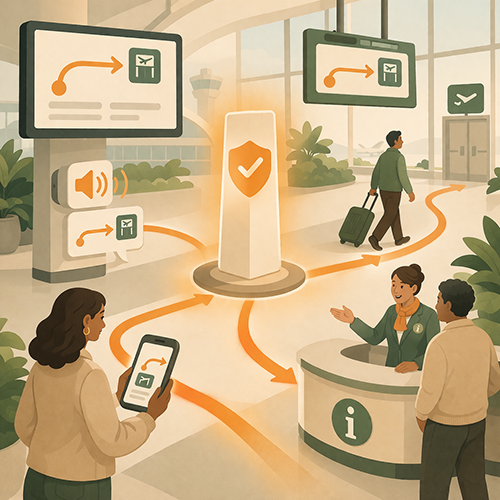 Airports and airport-connected transit systems often have the operational expertise to manage disruptions but struggle to keep passenger communications aligned across many owners and channels. When label sets drift, update rhythms are inconsistent, and routing guidance is vague, passenger confusion quickly becomes an operational problem. A coordinated communication system reduces that risk by ensuring every touchpoint reinforces the same action step, the same alternate route, and the same source of truth.
That is why agencies often choose to partner with an external resource like Stegmeier Consulting Group (SCG) to strengthen communication systems. SCG supports transportation organizations by building disruption communication frameworks that coordinate terminal messaging, digital updates, and on-site wayfinding. That includes developing shared message spines, stable label sets for terminals, connectors, checkpoints, and zones, copy-ready partner blocks for airlines and operators, time-stamped update templates with “what changed” lines, and governance workflows that keep screens, signage, announcements, and apps synchronized as conditions evolve.
SCG can also help agencies design passenger-facing source-of-truth pages that remain scannable on mobile, implement update cadence discipline with “next update by” commitments, and create staff scripts that reduce escalations and improve consistent routing in high-pressure interactions. These practices reduce misinformation, protect throughput, and strengthen passenger confidence during both routine disruptions and major incidents.
Conclusion
Airport disruption communications succeed when they function as decision support and routing support. A shared message spine, stable labels, and a clear source of truth allow terminals, apps, screens, announcements, and signage to tell one coherent story. Decision-point placement of temporary signage and confirmation cues reduces backtracking and crowding. Route-based instructions and field validation keep digital guidance aligned with on-site reality.
Credibility is preserved through predictable update rhythm, time stamps, “what changed” lines, and “next update by” commitments. Partner coordination reduces conflicting messages by providing copy-ready blocks and shared terminology, while internal alignment ensures staff scripts stay consistent with public updates. When these practices are embedded, passenger confusion decreases, throughput improves, and misinformation loses momentum.
SCG’s Strategic Approach to Communication Systems
Align your agency’s messaging, processes, and public engagement strategies
Airports build confidence during disruption when every channel reinforces the same action step, the same labels, and the same source of truth. SCG helps transportation agencies create coordinated disruption communication systems by developing shared message spines, stable terminal and zone label sets, time-stamped update templates with clear change cues, and mobile-friendly source-of-truth pages that passengers can scan quickly.
SCG also supports governance and operational alignment so updates stay synchronized across screens, signage, announcements, apps, and staff scripts, even during rapid change. Use the form below to connect with our team and explore how a strategic communication framework can elevate your agency’s impact.