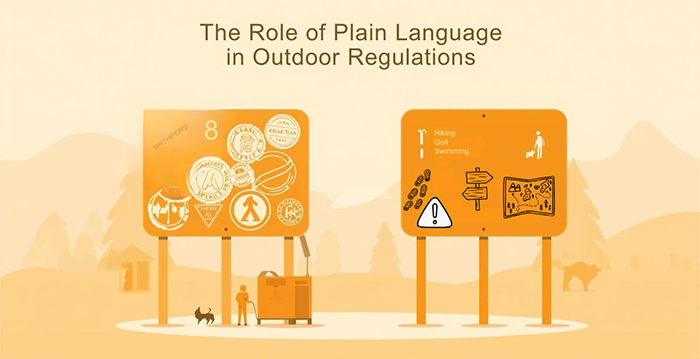
The Role of Plain Language in Outdoor Regulations
 Outdoor regulations exist to protect visitors, staff, wildlife, and natural environments. Yet the way these rules are written often determines whether visitors understand them, follow them, or unintentionally ignore them. Parks and recreation agencies, wildlife agencies, outdoor recreation departments, and park districts all rely on regulations to manage safety, conserve sensitive habitats, and support a positive visitor experience. When these rules are written in overly technical or bureaucratic language, visitors may feel confused or overwhelmed. When written in plain, clear language, regulations become practical guidance that visitors absorb quickly and confidently.
In today’s outdoor settings, where families, new hikers, multilingual visitors, and occasional recreation users share the same spaces, clarity is not optional. It is a communication responsibility. Visitors come from diverse backgrounds, with different levels of outdoor experience and different expectations about rule systems. Plain language bridges those differences. It helps visitors take in essential information while still enjoying the outdoor experience they came for.
The importance of plain language extends beyond readability. It influences trust, safety, accessibility, and compliance. Regulations written in a clear voice help visitors understand why a rule exists, what action is expected, and how their behavior contributes to the well being of the environment and community. By simplifying regulatory communication without diluting meaning, agencies create conditions where visitors are more likely to act responsibly, stay safe, and respect the land.
Why Plain Language Matters in Outdoor Settings
Outdoor conditions place natural limits on how much information visitors can process. Weather, distractions, group dynamics, fatigue, and emotional states all influence comprehension. Parks and recreation agencies often observe that visitors skim signs quickly, especially when arriving with children or preparing for activities. Wildlife agencies see that unclear safety rules can lead to risky behavior near sensitive habitats or wild animals. Outdoor recreation departments find that confusing trail or equipment regulations create hesitation or improper use of facilities. Park districts hear from families who simply misinterpreted instructions because signage or online descriptions were too dense.
Plain language solves this by reducing cognitive load. It helps visitors understand information at a glance rather than requiring them to pause, interpret, or guess. During peak visitation, when parking lots are busy or trails feel crowded, this simplicity prevents bottlenecks and reduces frustration. Plain language also increases fairness. Visitors who speak English as a second language or who prefer visual communication benefit from rules that are stated clearly and directly.
When regulations are presented with simplicity, visitors perceive the agency as approachable. They feel guided rather than lectured. They see rules as supportive rather than punitive. All of these emotional responses shape whether they comply willingly or resist unintentionally.
From Trails to Tweets: Effective Communication Strategies for Parks, Recreation, Outdoors, and Wildlife Agencies
This article is part of our series on strategic communication for Parks, Recreation, Outdoors, and Wildlife agencies. To learn more and to see the parent article, which links to other content just like this, click the button below.
How Visitors Interpret Rule Language in Outdoor Contexts
Visitors interpret rule language through a blend of logic and emotion. A rule is not only a directive. It is a message about tone, expectations, and trust. The same regulation stated in different languages can produce very different reactions. For example, wildlife agencies have long observed that rules written in stern or punitive language can trigger defensiveness, especially when visitors believe they already behave responsibly. Outdoor recreation departments sometimes find that highly formal or technical phrasing leads to confusion because visitors are unsure what action is truly required. Park districts notice that parents respond more cooperatively when regulations feel supportive rather than strict.
Rule interpretation is also influenced by context. A sign at a trail junction must communicate differently than text on a website. A rule posted at a campground must account for noise, distraction, and visitor fatigue. A wildlife advisory must balance urgency with reassurance. Regulations posted in poor weather must compete with limited visibility, which means clarity and simplicity become even more important.
Visitors rely on mental shortcuts when processing outdoor rules. They look for keywords, visual cues, and direct instructions. If language feels convoluted, they may make assumptions based on partial information. Plain language reduces the number of assumptions visitors must make. It increases the likelihood that they interpret the rule correctly the first time, even under pressure.
When agencies understand these interpretation patterns, they write regulations that work with human behavior rather than against it.
Designing Regulations Visitors Can Understand Quickly
The goal of regulatory communication is not to sound official. It is to be understood. Regulations must communicate the expected action, the reason behind the rule, and the outcome visitors can expect if they follow it. Parks and recreation agencies often begin this process by rewriting rules in shorter sentences. Wildlife agencies remove jargon and replace Latin species names or scientific terms with understandable language. Outdoor recreation departments focus on the verbs that guide visitor action, such as stay, keep, follow, or avoid. Park districts simplify family oriented rules by reducing multi step instructions into single clear behaviors.
Plain language is not about oversimplifying. It is about using the clearest possible path to meaning. A regulation becomes more effective when visitors can understand it without reading it twice. This efficiency reduces confusion during crowded periods, busy weekends, or seasons when visitor turnover is high.
Designing understandable regulations also requires predictability. When rules across signs, digital platforms, brochures, and staff communication use consistent phrasing, visitors internalize them more quickly. Consistency creates familiarity, and familiarity reduces hesitation.
Barriers That Complicate Regulatory Language
Despite the value of plain language, agencies face barriers when rewriting regulations. Many rules are inherited from legal documents, policy handbooks, or long standing templates that were not originally designed for public readability. Wildlife agencies often work with regulations written decades ago, when clarity for visitors was not a communication priority. Parks and recreation agencies may feel pressure to include technical terms to ensure legal accuracy. Outdoor recreation departments sometimes copy rules from partner organizations that use complex language. Park districts may inherit program policies that were crafted for administrative purposes rather than visitor communication.
Another barrier is the fear of oversimplification. Agencies must balance clarity with precision. Staff sometimes worry that simplifying rules may lead visitors to overlook important details. Yet plain language does not reduce meaning. It simply delivers meaning in a way that the public can understand more quickly and reliably.
Environmental complexity also contributes to communication difficulty. Outdoor regulations often include nuances about wildlife behavior, weather risk, trail difficulty, or seasonal variation. Translating these complexities into plain language requires careful thought and collaboration between subject matter experts and communication professionals.
Overcoming these barriers allows agencies to build communication systems that are both accurate and visitor friendly.
Principles of Plain Language for Outdoor Rulemaking
Plain language strengthens communication by making regulations easier to read, understand, and act on. Parks and recreation agencies, wildlife agencies, outdoor recreation departments, and park districts can apply plain language principles to ensure that visitors interpret rules correctly the first time. These principles are simple, but they require discipline. The goal is not to reduce rules to their shortest version. The goal is to make meaning clear without requiring visitors to slow down or translate complex phrasing.
Agencies often start by focusing on clarity. Sentences should express one idea at a time. Visitors should not be expected to decode multi clause statements, especially in outdoor settings where distractions are constant. Plain language also prioritizes everyday vocabulary. Words like “use,” “enter,” “stay,” and “follow” communicate more effectively than “utilize,” “commence,” or “proceed.” When agencies choose simpler terms, they reduce the cognitive effort visitors must exert.
Another key plain language principle is directness. Visitors need to know exactly what action is required. Ambiguous phrasing such as “Visitors should endeavor to remain on the designated path when possible” leaves too much room for interpretation. Direct phrasing such as “Stay on the trail” or “Do not leave the path” is clearer and more actionable.
Agencies also improve readability by placing the most important word first. This is known as front loading. When the required behavior appears at the beginning of the sentence, visitors absorb it faster. For example, “Keep your dog on a leash at all times” is far clearer than “Dog owners are reminded that leashes must be used in all designated areas.” Visitors should not need to search for the rule buried in the middle of a sentence.
These principles guide agencies in crafting rules that support comprehension even when visitors are navigating stressful, unfamiliar, or fast moving environments.
Techniques for Rewriting Complex Regulations
Translating a regulation from bureaucratic language into plain language requires careful attention to both meaning and flow. Many agencies start with a technique called “chunking,” which breaks long paragraphs into smaller pieces. Wildlife agencies often use this when rewriting safety advisories that originally resembled legal briefs. Parks and recreation agencies apply chunking to simplify trail rules that include multiple steps. Outdoor recreation departments use it to clarify equipment guidelines or rental procedures. Park districts use chunking to remove unnecessary detail from program expectations.
Another useful technique is identifying the core action within a regulation. Complex rules often contain one essential message surrounded by context, exceptions, or administrative language. By isolating the action first, agencies can build a rule around what visitors truly need to know. Context can still be included, but it becomes secondary rather than competing with the main message.
Agencies also benefit from testing their rewritten rules with real visitors. Plain language does not exist in a vacuum. A rule that seems clear to staff may still confuse members of the public. Wildlife agencies sometimes invite local community groups to review rewritten advisories. Parks and recreation agencies often ask frontline staff to observe how visitors react to new signs. Outdoor recreation departments use digital analytics to see whether visitors stay longer on certain pages of a website, which may signal unclear instructions. Park districts gather feedback from families to refine program descriptions.
Rewriting complex regulations is an iterative process. Each revision brings the rule closer to the level of clarity that visitors need.
Visual Design Elements That Support Plain Language
Plain language is not limited to words. Visual design plays a significant role in how regulations are understood. Outdoor conditions create challenges such as glare, fog, snow cover, low light, and visual clutter from natural surroundings. Parks and recreation agencies must ensure that signs remain readable under these conditions. Wildlife agencies often rely on high contrast color palettes so essential information remains visible at a distance. Outdoor recreation departments use bold headlines and intuitive icons to reduce comprehension time. Park districts design family friendly signs that use clear spacing and minimal text so parents can scan them quickly.
Typography also influences comprehension. Sans serif fonts with generous spacing improve readability outdoors. Excessive capital letters, tightly packed lines, or decorative fonts make signs harder to interpret. Agencies benefit from using consistent typography across all signs, digital platforms, and printed materials so visitors internalize the design language.
Visual hierarchy guides visitors toward what matters most. The main rule should appear first. Context should appear second. Icons should reinforce meaning rather than compete with text. When visual hierarchy is used effectively, visitors understand regulations even when they only glance at the sign.
Plain language and design are inseparable. The way information looks influences how well it is understood.
Plain Language for Multilingual and Multicultural Visitors
Visitors approach outdoor regulations with different expectations, cultural backgrounds, and language abilities. Wildlife agencies often host international visitors who interpret rules through their own cultural lenses. Parks and recreation agencies welcome multilingual families whose first impressions depend heavily on whether signs feel accessible. Outdoor recreation departments support visitors who may rely more on symbols than written text. Park districts frequently serve communities where plain language is essential for equitable access.
Plain language is the first step toward multilingual accessibility. Rules written in clear, simple English translate more accurately into other languages. When agencies avoid idioms, jargon, and complex phrasing, machine translation tools also perform more reliably. This is particularly important for visitors who rely on smartphones to interpret signs or website text in real time.
Cultural accessibility also plays a role. Some cultures expect direct statements of rules. Others respond more positively to messages framed around shared responsibility. Wildlife agencies sometimes tailor messaging for communities with deep cultural ties to land or wildlife, ensuring that rules feel respectful and rooted in partnership. Parks and recreation agencies may adjust tone to support newcomers who are unfamiliar with outdoor recreation norms.
Plain language helps all of these groups by offering clarity that transcends culture and language. When visitors understand the rule, they are more likely to follow it and appreciate the agency’s communication approach.
Strengthening Trust Through Consistent Messaging
Consistency builds trust. Visitors expect the same rule to appear in the same language across signs, digital platforms, brochures, and staff communication. When that consistency is missing, visitors become uncertain about which rule is correct. Parks and recreation agencies see this often when outdated signs remain in the field after a regulation has changed. Wildlife agencies encounter confusion when multiple platforms present slightly different versions of a safety protocol. Outdoor recreation departments sometimes struggle when temporary closures or seasonal advisories use language that deviates from established norms. Park districts occasionally find that program rules written by different teams compete in tone or complexity.
Plain language supports consistency by offering a unified framework for communication. When agencies use the same verbs, phrasing patterns, and tone across all materials, visitors internalize the message more easily. It also helps staff communicate more effectively because they are not relying on improvised or inconsistent wording.
Trust is earned not only through the accuracy of rules but through the reliability of their presentation. Plain language strengthens both.
Plain Language During Emergency or High-Stress Moments
 Emergencies change how people think and behave. Visitors who normally read signs carefully may only register a few words when they feel rushed, startled, or uncertain. This makes plain language essential for parks and recreation agencies, wildlife agencies, outdoor recreation departments, and park districts managing fast moving hazards. Clear, short phrasing helps visitors act quickly and confidently during moments when attention is limited.
Agencies that plan for these behavioral shifts reduce confusion, improve safety outcomes, and support better cooperation across diverse visitor groups.
How Stress Changes Visitor Understanding
High stress reduces a visitor’s ability to interpret long or technical instructions. People scan rather than read, rely on instinct, and often miss context. Wildlife agencies see this when visitors encounter large animals unexpectedly. Parks and recreation agencies observe similar patterns during sudden storms. Outdoor recreation departments see decision making decline when visibility drops or temperatures shift rapidly.
Plain language counteracts these tendencies because visitors can understand it with little cognitive effort. Short directives like “Move to shelter now” or “Avoid this trail due to flooding” remain clear even when stress is high.
Timing and Placement Matter
Even well written emergency messages fail if they appear too late or in hard to see places. Alerts must reach visitors before they commit to risky areas. Wildlife agencies often place advisories at trailheads where animals are active. Parks and recreation agencies position storm warnings near open fields or water access points. Outdoor recreation departments ensure hazard signs appear before steep drop offs or narrow passages.
Digital timing is equally important. When conditions shift quickly, brief mobile updates help visitors adapt in real time.
Preparing Visitors Ahead of Time
Plain language works best when visitors already understand the environment’s risks. Pre arrival information helps reduce panic during actual emergencies. Wildlife agencies may share simple animal encounter guidance online. Parks and recreation agencies outline shelter procedures before storm season. Outdoor recreation departments warn hikers how fast mountain or desert conditions can change. Park districts use supportive tone when explaining emergency procedures to families.
This preparation creates familiarity. When an alert appears, visitors are less startled and more willing to respond.
Consistency Builds Trust
Visitors follow emergency instructions more readily when they trust the agency delivering them. Consistent use of plain language across everyday signage, digital updates, and staff communication helps create that trust. Parks and recreation agencies that maintain the same tone across all platforms see fewer questions during crises. Wildlife agencies strengthen confidence by using predictable wording in both routine advisories and urgent alerts. Outdoor recreation departments benefit when hazard language matches the style used in trailhead information.
Consistency reassures visitors. Familiar patterns calm uncertainty and reduce panic.
Reaching Multigenerational Audiences
Emergency messages must work for everyone. Families, older adults, first time visitors, and multilingual audiences often process information differently. Plain language bridges these gaps by offering clear, memorable instructions. Wildlife agencies need simple guidance for animal encounters. Parks and recreation agencies require messages that parents can absorb quickly while managing children. Outdoor recreation departments design hazard statements that inexperienced hikers can understand without hesitation. Park districts must ensure facility alerts are readable for diverse community members.
Plain language ensures that essential safety directions remain accessible to all visitors when it matters most.
How Plain Language Reduces Visitor Conflict
Conflicts between visitors and staff often arise from misunderstanding rather than disagreement. When rules are unclear, visitors fill gaps with assumptions. Some assume they are exempt. Others assume the rule is arbitrary. When staff must intervene to clarify expectations, misunderstandings can escalate into tension, especially in crowded parks or during busy seasons.
Plain language reduces these conflicts by making expectations visible and unambiguous. Wildlife agencies observe fewer disputes at wildlife viewing areas when safety advisories are written in direct, supportive language. Parks and recreation agencies report fewer confrontations at trail intersections when signage spells out rules in a simple, predictable structure. Outdoor recreation departments experience less friction around equipment rental, access fees, or trail etiquette when instructions include clear verbs and concise phrasing. Park districts find that parents respond better to youth program guidelines when the rules feel transparent rather than overly formal.
Plain language prevents conflict by removing guesswork. When visitors understand a rule clearly, they interpret staff enforcement as consistent rather than subjective.
It is much easier for visitors to follow a rule they can understand.
Internal Processes for Maintaining Plain Language Systems
Even the clearest regulation can become ineffective if not maintained. Agencies must develop internal processes to ensure that plain language remains consistent across all platforms and is updated when conditions change. Parks and recreation agencies often assign communication leads or small teams to review existing rules periodically. Wildlife agencies schedule annual audits of safety advisories, habitat protection messages, and seasonal closures. Outdoor recreation departments review signage as part of trail inspections or facility updates. Park districts monitor program descriptions and visitor forms to ensure language remains accessible.
Maintaining plain language requires collaboration. Subject matter experts provide technical accuracy while communication staff refine tone and structure. Field staff offer insight into what visitors misunderstand or ignore. Digital teams ensure that rewritten rules appear consistently across websites, apps, and social media. When these groups work together, plain language becomes an organizational standard rather than a one time project.
Consistency is also supported by documentation. Agencies benefit from plain language style guides that outline preferred verbs, phrasing patterns, sentence lengths, and tone. These tools help create stable systems that honor both clarity and professional responsibility.
Internal processes protect the investment agencies make in improving how they communicate with the public.
The Relationship Between Plain Language and Visitor Safety
Clear rules prevent dangerous behavior. When visitors understand what is expected of them, they are far more likely to stay safe. Wildlife agencies see this when plain language helps visitors maintain appropriate viewing distances. Parks and recreation agencies observe safer trail use when rules about staying on marked paths or avoiding unstable cliffs are expressed directly. Outdoor recreation departments see fewer incidents when equipment instructions and hazard warnings use simple, familiar vocabulary. Park districts experience safer program environments when families understand drop off procedures, supervision expectations, and facility rules.
Plain language reduces hesitation, which is critical in environments where conditions can change quickly. When rules require interpretation, visitors lose time thinking, checking with others, or guessing the correct action. This delay can increase risk. When rules present the required behavior immediately, visitors respond faster.
Safety outcomes also improve because plain language encourages shared responsibility. When visitors can comprehend why a rule exists, they internalize it more deeply. Plain language provides access to understanding, which creates a more cooperative and engaged visitor community.
Outdoor safety is not only about infrastructure. It is also about communication clarity.
How Plain Language Enhances Environmental Stewardship
Environmental regulations are only effective when visitors understand and follow them. When habitat protections, trail restrictions, or wildlife viewing rules are written in technical or bureaucratic language, visitors may miss essential cues. Wildlife agencies find that plain language improves compliance with rules that protect nesting areas or migration routes. Parks and recreation agencies observe better stewardship behaviors when visitors understand how their actions affect erosion, vegetation, or water quality. Outdoor recreation departments see improved adherence to trail etiquette when the reasoning behind rules is clear and accessible. Park districts find that families are more willing to support conservation practices when instructions feel respectful and understandable.
Plain language fosters stewardship by aligning communication with the way visitors naturally process information. People want to help protect the places they enjoy. They only need clear direction. When regulations use recognizable language and explain their purpose, visitors respond with care rather than resistance.
Stewardship is strengthened when visitors understand their role in maintaining the environment. Plain language makes that understanding possible.
Plain Language Across Digital Platforms
Digital communication is one of the first places visitors encounter outdoor regulations. Park websites, reservation portals, mobile maps, and social media updates often shape visitor expectations long before they reach a trailhead. When these platforms use dense, complex language, confusion begins at home and carries into the field. Parks and recreation agencies frequently see this when visitors arrive at a site already misunderstanding access rules or seasonal closures. Wildlife agencies observe similar issues when visitors misinterpret species advisories because online guidance was too technical. Outdoor recreation departments note that unclear digital instructions lead to incorrect gear use or route selection. Park districts hear from families who struggled with registration or facility policies because directions were not stated plainly.
Plain language ensures digital platforms communicate effectively with users of all ages, reading levels, and backgrounds. Short sentences, direct instructions, and predictable phrasing reduce the mental effort required to understand a rule. This is especially important on mobile devices, where visitors skim quickly and may encounter distractions.
Digital plain language also helps maintain consistency across platforms. When agencies rewrite complex rules using a clear framework, those rules translate more smoothly into emails, SMS alerts, social posts, and app notifications. Visitors experience stability in how information is presented, which increases trust and reduces unnecessary inquiries or complaints.
When digital communication becomes a plain language environment, visitors arrive more prepared and more confident about what is expected of them.
Training Staff To Communicate in Plain Language
Plain language is most effective when staff use it consistently in both written and verbal communication. Visitors form impressions not only from signs and websites but from conversations with rangers, naturalists, visitor center staff, program instructors, and maintenance teams. Parks and recreation agencies often find that when staff use clear, simple phrasing, visitors respond with greater cooperation. Wildlife agencies see fewer misunderstandings at viewing areas or trailheads when staff avoid technical jargon. Outdoor recreation departments experience safer interactions when staff can explain risk in ways that new or inexperienced visitors understand. Park districts benefit when frontline staff use consistent, parent friendly wording during programs and facility interactions.
Training staff in plain language involves more than reviewing words. It involves teaching a communication mindset. Staff learn to identify the core message, reduce unnecessary detail, and adapt their tone to visitors who may feel stressed, rushed, or unfamiliar with the environment. They also learn how to use consistent phrases that align with agency wide communication standards.
Training can occur through workshops, scenario based exercises, or quick reference guides. Agencies sometimes provide staff with plain language scripts for common interactions, such as explaining why a trail is closed or how to behave around wildlife. These tools help staff feel confident and reduce improvisation that may unintentionally introduce complexity.
When staff speak plainly, visitors understand regulations more quickly and are more likely to follow them without confusion.
Using Plain Language With QR Code Feedback Systems
QR code systems allow agencies to gather real time visitor feedback about signage clarity, rule comprehension, trail conditions, or visitor needs. When these feedback tools use plain language, participation increases and responses become more accurate. Parks and recreation agencies often see higher engagement when prompts are phrased simply, such as “Tell us about your visit today” instead of “We invite you to participate in a visitor experience assessment.” Wildlife agencies find that clear questions generate more useful data about animal sightings or safety concerns. Outdoor recreation departments benefit from prompts that guide visitors toward specific topics like trail conditions or equipment needs. Park districts see more responses from families when QR code surveys are brief, direct, and written in friendly language.
Plain language also helps agencies interpret feedback more easily. When visitors respond to clear questions, their comments become more focused, which simplifies trend analysis. This improves the agency’s ability to identify gaps in communication, signage weakness, or areas where regulations are frequently misunderstood.
By combining QR code systems with plain language, agencies create a feedback loop that both informs and improves future regulations.
Plain Language for Seasonal or Temporary Rules
Outdoor regulations often change with the seasons. Wildlife migrations, winter hazards, summer overcrowding, and changing daylight patterns influence how visitors move through outdoor spaces. These shifting conditions require agencies to create temporary or seasonal rules that visitors can understand without confusion. Parks and recreation agencies must regularly communicate changes in operating hours, trail access, or fire restrictions. Wildlife agencies often update advisories related to breeding seasons, nesting periods, or migration corridors. Outdoor recreation departments adjust trail ratings or equipment recommendations based on moisture, heat, snowpack, or ice. Park districts modify program rules or facility policies during holidays, busy summer periods, or periods of extreme weather.
Plain language ensures these temporary rules remain accessible to first time visitors and returning users alike. Seasonal rules often introduce new behaviors visitors have not encountered before, which makes clarity even more important. When agencies eliminate jargon and avoid long explanations, visitors adapt more quickly. A clear statement such as “Trail closed for mud season to protect plants” is far more understandable than a complex policy description.
Seasonal or temporary rules must be particularly visible. Visitors who know an area well may assume conditions have not changed. Plain language messaging placed at entrances, digital platforms, and key decision points helps bridge this familiarity gap.
When seasonal rules are written plainly, compliance rises and conflict decreases.
Making Compliance Easier Through Predictable Language Patterns
Visitors absorb rules more easily when agencies use stable patterns of language. Predictability helps visitors process information quickly, especially in outdoor environments where they do not want to stop and read every word. Parks and recreation agencies often use consistent verbs across all regulations, such as stay, keep, leave, or follow. Wildlife agencies repeat the same sentence structures for safety advisories. Outdoor recreation departments use predictable patterns in trailhead signage so that visitors instantly know where to look for hazard information. Park districts apply consistent formats to program instructions so families can interpret expectations without effort.
Predictable patterns reduce cognitive load. Visitors no longer need to decode a new structure every time they encounter a rule. They begin to internalize the agency’s communication rhythm, which helps them recall rules even when signage or digital tools are not immediately visible.
Plain language is powerful not only because it simplifies words, but because it creates a communication system visitors can rely on.
Strategic Communication Support for Your Parks and Recreation Agency
 Plain language is not just a writing technique. It is a communication system that affects safety, visitor satisfaction, environmental protection, and operational efficiency. Stegmeier Consulting Group (SCG) helps parks and recreation agencies, wildlife agencies, outdoor recreation departments, and park districts develop plain language frameworks that improve how regulations are created, displayed, and communicated across teams. People at these agencies often choose to partner with an external resource like SCG when they want clearer rules, more consistent messaging, or a communication structure that reduces confusion for both visitors and staff.
SCG supports agencies in reviewing existing regulations, identifying unclear or overly technical language, and rewriting rules for clarity while preserving legal and operational accuracy. This includes aligning digital platforms, signage systems, staff communication, and visitor materials so that users encounter predictable and understandable messages at every touchpoint. SCG also helps agencies build internal processes that sustain plain language over time, ensuring updates remain consistent even as conditions change.
The goal is not merely to simplify wording. It is to create a unified communication approach that strengthens trust, reduces visitor conflict, and supports safer behavior across outdoor spaces. Agencies that adopt plain language as a strategic practice gain stronger relationships with the communities they serve and clearer pathways for public engagement.
Conclusion
Clear communication is foundational to outdoor stewardship, and plain language is a powerful tool for achieving it. Parks and recreation agencies, wildlife agencies, outdoor recreation departments, and park districts depend on regulations to guide safe and responsible behavior. When these rules are written in accessible, direct language, the public understands what is expected and why it matters. When the language becomes overly technical or bureaucratic, confusion rises and compliance drops.
Plain language reduces misunderstandings, improves safety outcomes, and strengthens visitor trust. It helps multilingual and multicultural communities feel welcome. It simplifies emergency communication during high stress moments. It supports staff by giving them consistent messages to use in the field. It even improves environmental protection by making stewardship expectations clearer.
Agencies that prioritize plain language create outdoor experiences that feel more accessible, more predictable, and more cooperative. Visitors are not left guessing. They feel guided. They feel informed. They feel connected to the purpose behind the rules.
Plain language makes outdoor regulations work better for everyone, from first time visitors to experienced recreation users, and from staff on the ground to the organizations that steward public lands.
SCG’s Strategic Approach to Communication Systems
Align your agency’s messaging, processes, and public engagement strategies
Agencies that communicate effectively build stronger trust with staff, stakeholders, and the public. Whether you are implementing QR code systems, improving internal communication workflows, or strengthening agency wide alignment, SCG can help you develop a communication system that supports consistent decision making and long term organizational success. Use the form below to connect with our team and explore how a strategic communication framework can elevate your agency’s impact.