

Powering Preparedness: How Snohomish County, Washington Public Utility District Builds Trust and Safety Through Communication

Across the Pacific Northwest, the realities of climate change are felt in new and unsettling ways. Longer wildfire seasons, hotter summers, and increasingly erratic storm patterns create risks not only to landscapes but also to communities and critical infrastructure. In Snohomish County, Washington, these risks converge in a population of nearly 385,000 electric utility customers who depend on reliable service from the Snohomish County Public Utility District (PUD).
Rather than waiting for emergencies to define the terms of engagement, Snohomish Public Utility District has taken a proactive approach. It has invested in a layered communication strategy designed to prepare residents before disaster strikes, keep them informed during outages or Public Safety Power Shutoffs (PSPS), and build trust long after power is restored. This case study examines how Snohomish Public Utility District’s communication strategies—spanning narrative framing, multi-channel execution, targeted outreach, visual consistency, and community engagement—offer a replicable model for county-level utilities navigating an age of growing risk.
Communication Strategy
Narrative Framing and Message Development
Snohomish Public Utility District’s communication begins with a simple premise: preparedness is a partnership. By emphasizing the utility’s own role in prevention—trimming more than 500 miles of vegetation annually, adopting alternative equipment settings in high fire-risk zones, and modernizing infrastructure through its SnoSMART grid initiative—the Public Utility District demonstrates that safety is not left to chance. Customers are not left out of this equation. They are urged to participate by preparing emergency kits, registering for MySnoPUD alerts, and making contingency plans for medical equipment or heating needs during extended outages.
This approach moves communication away from the traditional utility posture of issuing warnings only in moments of crisis. Instead, it builds a continuous narrative that encourages customers to see every season as an opportunity to prepare. Seasonal campaigns tie the story together: wildfire season in the summer emphasizes defensible space and PSPS education, while winter storm season underscores outage safety, generator use, and downed line protocols.
Why It Worked: By framing emergencies as shared challenges, the Snohomish Public Utility District fosters a sense of empowerment rather than helplessness. Residents see visible investments—crews trimming trees, new equipment installed—and connect these activities to the preparedness stories told online, in brochures, and at community meetings. This alignment between visible action and verbal narrative builds trust. Customers are more willing to believe in the utility’s commitment when they see it manifested in their own neighborhoods.
Multi-Channel Communication Execution
The backbone of Snohomish Public Utility District’s strategy is a multi-channel communication system that ensures messages reach residents wherever they are. At the center lies the Outage Center, a comprehensive digital hub that provides real-time outage maps, estimated times of restoration, and safety guidance. Customers can personalize their information flow through MySnoPUD alerts, choosing to receive updates by text, email, or both. Social media platforms amplify these alerts, providing quick posts that link back to the official site.
During major events, local television and radio stations carry updates directly from the Public Utility District’s media team, ensuring that even residents without digital access receive timely information. Traditional mailers play a role too, particularly in wildfire-prone communities where advance notice of PSPS criteria is critical.
Why It Worked: This layered approach ensures redundancy. In a storm that knocks out power and internet service, text alerts still reach phones. In a wildfire event where families may be evacuating, local broadcasters reinforce official instructions. The system’s design makes communication resilient in the same way that utility infrastructure is hardened: no single point of failure disrupts the entire chain. By combining immediacy with breadth, Snohomish Public Utility District reduces the likelihood that anyone is left uninformed at a critical moment.
Audience Segmentation and Targeting
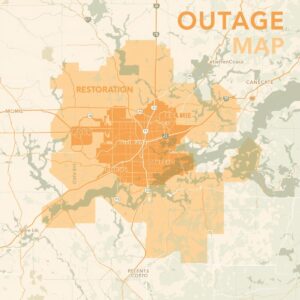
Snohomish County is not monolithic, and neither are its risks. The Public Utility District has tailored its communication strategies to address the needs of distinct audiences. Residents in wildfire-prone areas such as Darrington, Gold Bar, and Index receive targeted outreach that explains PSPS protocols and mitigation efforts specific to their terrain. Medically vulnerable customers—those dependent on electricity for life-supporting equipment—are prioritized with specialized communication about backup power and outage preparation. The general population is addressed with broader safety messages about storm readiness, generator precautions, and safe digging practices. Schools and community centers serve as key intermediaries, receiving customized preparedness materials that spark family discussions and community-wide engagement.
Why It Worked: By refusing to treat its customer base as a single audience, Snohomish Public Utility District ensures that each group receives messages that feel directly relevant to their circumstances. A household in Everett may only need reminders about winter outages, while a family in Gold Bar must understand how PSPS could impact them during wildfire season. Vulnerable populations receive additional reassurance that their needs are not overlooked. This nuanced approach builds equity into communication, ensuring no community feels ignored or underserved.
Visual Identity and Brand Integration
In crisis communication, recognition saves time. Snohomish Public Utility District has cultivated a visual identity that makes its alerts and materials instantly identifiable. Outage maps use standardized color codes to distinguish the severity of outages, while wildfire safety graphics employ clear hazard colors to signify urgency. Printed brochures, website banners, and social media posts all share consistent fonts, imagery, and tone, reinforcing the Public Utility District’s brand as a reliable authority.
Why It Worked: When residents encounter a message during a stressful event, they should not need to question its authenticity. Snohomish Public Utility District’s visual consistency eliminates this hesitation. A family that sees a red warning banner online knows immediately that the message is official. A resident glancing at a color-coded map can quickly interpret severity without parsing paragraphs of text. In moments where seconds matter, this visual shorthand is as valuable as the information itself.
Community Engagement Tactics
Perhaps the most distinctive aspect of Snohomish Public Utility District’s approach is its investment in in-person engagement. Each wildfire season, the utility hosts forums in high-risk towns where residents can hear directly from leaders about vegetation management, grid modernization, and PSPS criteria. These forums are not one-way lectures; they create space for questions, concerns, and dialogue. Partnerships with Snohomish County Emergency Management integrate the utility’s messaging into county-wide preparedness campaigns, while schools extend the conversation into households through age-appropriate materials. Social campaigns on topics like generator safety and “Call 811 before you dig” broaden awareness throughout the year.
Why It Worked: Trust is not established in the moment an alert appears on a phone. It is built in advance, through consistent presence and authentic dialogue. By showing up in schools, town halls, and markets, Snohomish Public Utility District positions itself as a partner in community resilience rather than a distant authority. This visibility ensures that when the utility sends an urgent alert, residents already trust the source. Community engagement transforms communication from a transactional process into a relationship.
Impact and Replication
The results of Snohomish Public Utility District’s strategy are measurable. Enrollment in MySnoPUD alerts has steadily increased as residents recognize the reliability of the system. In wildfire-prone areas, public understanding of PSPS has improved, reducing confusion and frustration when preventive shutoffs are discussed. Vegetation management, once perceived as routine maintenance, is now widely understood as a wildfire prevention measure tied directly to community safety.
Other county-level utilities can replicate this model by first making their mitigation strategies public, translating fieldwork into communication narratives, and investing in layered channels that reach both digitally connected and underserved communities. The lesson is not that technology alone solves the problem but that technology paired with trust, education, and visibility builds resilience.
 Communication Lessons from Snohomish Public Utility District
The case of Snohomish Public Utility District offers several lessons for public agencies and utilities navigating risk communication. First, localization matters. By naming towns and regions in its messaging, the Public Utility District ensures that residents understand precisely when and how they are affected. Vague statements breed uncertainty, but hyper-local communication drives action.
Second, technology must be blended with human connection. Alerts and maps are vital, but without prior education through forums and mailers, they can be confusing or ignored. The Public Utility District’s commitment to engaging residents before emergencies ensures that messages delivered during crises are understood and trusted.
Third, trust is a form of infrastructure. Just as poles and wires carry electricity, relationships carry communication. Snohomish Public Utility District invests in building those relationships with community leaders, schools, and emergency partners so that when alerts are issued, they travel along existing lines of credibility.
Fourth, visual consistency accelerates response. Branded graphics and color-coded maps reduce the mental burden of decision-making under stress. Recognition is built through repetition, making every emergency message feel both familiar and authoritative.
Finally, communication must empower, not just instruct. Snohomish Public Utility District encourages residents to see themselves as partners in preparedness—equipping them with knowledge and roles rather than relegating them to passive recipients of warnings. This empowerment fosters resilience that extends beyond the utility’s boundaries into neighborhoods and households.
Conclusion
Snohomish County Public Utility District demonstrates that communication is as critical to safety as transformers, substations, and transmission lines. By weaving together narrative framing, layered channels, targeted outreach, visual identity, and community engagement, the utility has built a model that protects lives and strengthens trust. Its message is clear: communication is not a supplement to infrastructure—it is infrastructure. In an era where every second counts, Snohomish Public Utility District shows how county-level utilities can harness communication as a tool for resilience, safety, and public confidence.
Ready to Elevate Your Agency’s Public Communication?
We understand the unique challenges state and local government agencies face—from complex issues to diverse community needs. Our comprehensive approach can help you transform the way you connect with constituents, improve transparency, and highlight the valuable work your agency does every day.
Interested in learning more? Reach out to us today for a consultation. We’d love to discuss how our services can support your goals and help you build lasting trust with the communities you serve.