
From Tragedy to Testimony: Webb County, Texas’ Communication Strategy for Click It or Ticket
 Seat belts are among the simplest and most effective tools for preventing injury and death in motor vehicle accidents, yet consistent seat belt use remains uneven, especially in regions with high rates of traffic fatalities. Recognizing this challenge, the Texas Department of Transportation (TxDOT) has long supported statewide enforcement and awareness through its annual Click It or Ticket campaign. But in Webb County, Texas—a border community where public trust in law enforcement can be fragile and where roadway fatalities hit close to home—the campaign evolved into something deeper than a compliance initiative. It became a model for emotionally grounded, community-centered communication.
This case study explores how Webb County’s campaign set a new standard for combining enforcement with public education, storytelling, and strategic communication. Through a closer look at the initiative’s structure, partnerships, narrative approach, and long-term impact, the following sections examine what made the campaign resonate—and why its lessons matter far beyond South Texas.
Program Structure and Oversight
The Click It or Ticket initiative in Webb County was part of a larger statewide campaign coordinated by the Texas Department of Transportation (TxDOT) to enforce seat belt laws and reduce crash-related fatalities. While the state provided funding and baseline requirements, Webb County’s implementation—led by Constable Precinct 3, in close collaboration with the Laredo Police Department and the Webb County Sheriff’s Office—evolved into something far more comprehensive than simple citation enforcement.
Backed by TxDOT grant support and governed by state safety statutes, the campaign included strategic enforcement periods, road patrol checkpoints, and data tracking on seat belt violations. Deputies from Precinct 3 and Laredo PD participated in coordinated roadside operations, focusing on both adult compliance and child restraint use. Texas DPS and the TxDOT Laredo District provided public safety guidance, crash data, and logistical coordination, ensuring alignment with statewide messaging standards.
Communication Strategy
1. Narrative Framing: Moving Beyond Tickets to Tell Human Stories
Rather than lead with punishment or statistics, Webb County’s campaign reframed the Click It or Ticket message around personal loss and survival. Law enforcement and public officials emphasized that citations were not the campaign’s main goal. The real consequence, as they repeatedly stated in media interviews and press events, was death or lifelong injury. This message was echoed in every medium—TV, radio, social media, and at live events—with the recurring phrase: “It’s not about a ticket. It’s about your life.”
A powerful element of this reframing was the inclusion of real-life stories that hit close to home. Most notable was the story of Issac Schwartz, a local man paralyzed in a crash. His emotional testimony—delivered in-person and through media interviews—helped audiences visualize the stakes. Similarly, when the death of a 7-year-old unbuckled child made headlines, the campaign was able to reference this tragic case as further validation of its long-standing warnings.
Why It Worked: The communication succeeded because it made the stakes feel personal and immediate. By shifting the narrative from punitive to protective, the campaign reached audiences who may have otherwise tuned out standard enforcement messaging. Real-life testimony grounded the issue in lived experience, not abstract risk. Emotion, not regulation, became the vehicle for behavior change, creating a sense of urgency that data alone could not deliver. This human-centric framing also earned the campaign broader buy-in across demographics that might distrust law enforcement-centric messages, positioning the effort as genuinely concerned with public well-being.
2. Survivor Testimony as Central Messaging
Issac Schwartz, a Webb County resident who became paralyzed after a car crash, emerged as a key spokesperson for the campaign. His presence transformed the messaging from abstract warning to visceral reality. In interviews and public events, he described how his injuries could have been prevented by a seat belt—and how that split-second decision changed the course of his life. Media coverage of his story became a focal point of the campaign, generating significant community attention.
Unlike a celebrity PSA or distant case study, Schwartz’s testimony came from someone local—someone neighbors might know or recognize. His vulnerability and openness invited empathy, not resistance, and reinforced the idea that tragic outcomes can happen to anyone, anywhere.
Why It Worked: Issac’s story worked because it collapsed the distance between the audience and the message. He wasn’t a symbol or a statistic—he was a community member whose suffering was avoidable. His wheelchair, his words, and his raw emotion cut through the noise of traditional PSAs. Research in health and safety communication shows that first-person narratives increase message retention and emotional impact, especially when paired with visual cues. The authenticity of his story created a kind of social proof: if it happened to him, it could happen to anyone.
3. Multi-Channel, Multi-Layered Media Strategy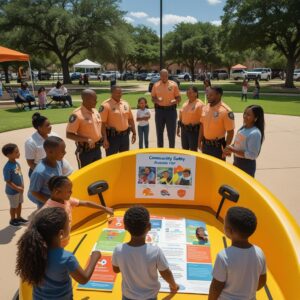
Webb County’s communication team, in partnership with TxDOT and local media, implemented a robust cross-platform media strategy. Campaign materials ran across television (KGNS-TV), local news websites (LMTonline), and social media channels operated by the Laredo Police Department and TxDOT Laredo. Interviews with officials and survivors were strategically timed to coincide with the enforcement window, with earned media amplifying both the operational details and emotional stakes of the campaign.
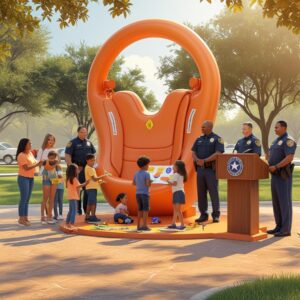
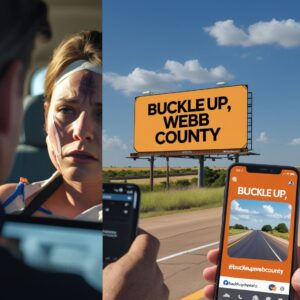
Importantly, the campaign also deployed radio PSAs, billboards across high-traffic areas, and a strong visual identity—including a giant seat belt prop used at public events. This symbolic installation became a focal point for both media coverage and in-person engagement, reinforcing the campaign’s central theme with a powerful image.
Why It Worked: The multi-channel approach worked because it respected the diversity of the audience’s media habits. Some residents engaged with local news broadcasts; others followed police and county updates on Facebook; still others saw the physical props during daily commutes or public gatherings. By embedding consistent messaging across platforms, the campaign generated the kind of repetition that builds recall. Additionally, using emotional narratives across all media made the message cohesive regardless of the format. The physical seat belt prop also played a crucial visual role—it wasn’t just a metaphor but a literal “belt around the community,” signaling unity and care.
4. Integration with Public Events and Local Leadership
Public engagement was not left to media alone. The campaign hosted in-person press conferences at Doctors Hospital and law enforcement headquarters, where speakers included County Judge Tano Tijerina, TxDOT representatives, and law enforcement leaders. These events were designed to do more than deliver citations—they humanized the campaign through shared grief and community reflection. Officials spoke not from a place of authority but from a place of responsibility and heartbreak.
This approach was intentional. Judge Tijerina’s widely quoted remark—“A ticket is the least thing… it’s the death, it’s the paralysis”—set the tone for the entire effort. These events became moments of community mourning and collective resolve, linking civic leadership with citizen safety.
Why It Worked: Bringing elected officials into the communication effort helped legitimize and elevate the campaign. It signaled that this was not just a law enforcement initiative—it was a community-wide call to action. Research shows that when authority figures model vulnerability and compassion (rather than mere authority), public trust increases. These leaders used their platform not just to issue warnings but to express care, loss, and determination. That tone built moral urgency and softened potential backlash from communities wary of over-policing.
5. Visual Symbolism and Public Installations
Perhaps the most striking communication tactic was the use of a massive, mock-up seat belt installation displayed at community events. This oversized prop didn’t just decorate—it communicated. It became the emotional centerpiece of the campaign, a physical reminder that “buckling up” is not abstract. It made the concept visible, photogenic, and accessible—especially for younger attendees and families.
This tactic was supported by on-site handouts, staff talking points, and interactive Q&A moments at campaign events, which helped residents connect the visual metaphor to their real-life choices.
Why It Worked: The seat belt installation succeeded because it created a visceral, Instagram-worthy image that media and attendees alike could amplify. Visual metaphors are powerful communication tools because they transcend language and reinforce ideas at a glance. The sheer size and placement of the prop also suggested gravity: this wasn’t a small issue. This wasn’t just for drivers. It symbolized collective responsibility, a protective gesture wrapping around the community. Paired with first-person stories, the prop served as both reminder and monument.
 Impact and Outcomes
The campaign’s integration of emotional storytelling, local leadership, public symbolism, and cross-platform consistency positioned it as one of Webb County’s most resonant public safety efforts. The groundwork laid initially allowed for an agile, sensitive resurgence following the tragic crash involving a 7-year-old child a few years later. That incident—while devastating—was met with a campaign infrastructure ready to respond: familiar messaging, trusted voices, and a community already primed for dialogue.
While specific citation statistics and seat belt compliance metrics are pending, anecdotal feedback, media coverage, and community response indicated heightened awareness, increased press engagement, and a more unified public discourse around seat belt use.
Ready to Elevate Your Agency’s Public Communication?
We understand the unique challenges state and local government agencies face—from complex issues to diverse community needs. Our comprehensive approach can help you transform the way you connect with constituents, improve transparency, and highlight the valuable work your agency does every day.
Interested in learning more? Reach out to us today for a consultation. We’d love to discuss how our services can support your goals and help you build lasting trust with the communities you serve.