
From Sparks to Safety: How Travis County, Texas Mobilized a Wildfire Preparedness Campaign for a Growing Region at Risk
 When most Americans think of wildfires, their minds go west—to California’s scorched forests and dramatic evacuations. But in recent years, the risk map has shifted. Central Texas, with its rapid population growth, suburban sprawl, and increasingly hot, dry seasons, has become one of the most wildfire-vulnerable regions in the country. In fact, Travis County ranks among the highest-risk wildfire zones outside of California—and the risk isn’t limited to rural areas. Today, the threat often sits just beyond the back fence of suburban cul-de-sacs and hillside homes.
Recognizing the urgent need to prepare its growing population, Travis County Emergency Services and the County Fire Marshal’s Office led a multi-year, multi-agency public safety campaign to help residents get wildfire-ready. Through free home assessments, digital resources, bilingual outreach, and public education events, the county activated a clear, actionable strategy rooted in the national “Ready, Set, Go!” framework.
This case study examines how Travis County’s wildfire readiness campaign transformed risk communication into community empowerment—building awareness, prompting preventive action, and fostering collaboration between fire agencies and residents across one of Texas’s fastest-growing metro areas.
The Initiative: Wildfire Readiness in a Changing Landscape
As population density increased in formerly wildland-adjacent neighborhoods, Travis County officials recognized the need for a proactive wildfire communication strategy that reached beyond traditional rural audiences. Starting in the mid-2010s and intensifying into the 2020s, the Travis County Fire Marshal’s Office, working alongside Emergency Services Districts (ESDs) like ESD 11, launched a region-wide preparedness initiative focused on household-level risk reduction and early evacuation readiness.
Oversight was coordinated by the Austin–Travis County Wildfire Coalition, a multi-jurisdictional alliance of city and county fire agencies that collaborated on public education, policy guidance, and community outreach. The coalition adopted and adapted the national “Ready, Set, Go!” program as its communication backbone—an easy-to-understand, three-step framework that helped residents assess risk and make decisions before, during, and after fire season.
Key services included:
- Free wildfire risk assessments by trained firefighters, evaluating defensible space, vegetation management, and home ignition zones
- Multilingual outreach materials and guides distributed at events and online
- Evacuation planning education, including checklists and go-kit templates
- Promotion of the regional WarnCentralTexas alert system
Importantly, the campaign emphasized personal preparedness over government rescue—empowering residents to take ownership of their safety while reinforcing agency support.
Communication Strategy
1. Translating Risk into Readiness: The “Ready, Set, Go!” Framework
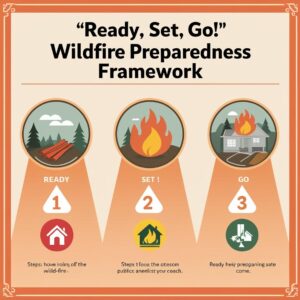
At the core of Travis County’s wildfire communications strategy was the adaptation of the national “Ready, Set, Go!” model—a three-step framework that transformed abstract wildfire risk into a series of clear, actionable phases. This structure helped residents organize their thinking and behavior around the escalating nature of wildfire danger.
- Ready emphasized mitigation: creating defensible space around the home, cleaning gutters, trimming trees, and ensuring fire-resistant landscaping.
- Set focused on monitoring red flag warnings, preparing go-bags, creating communication plans with family members, and knowing two evacuation routes.
- Go! communicated urgency: when local officials advise or mandate evacuation, residents should not wait—leave early to avoid being trapped by fast-moving fire.
To make the framework accessible and memorable, Travis County issued infographics, checklists, and short animated videos across multiple platforms. All core materials were provided in both English and Spanish, increasing their usability across the county’s diverse linguistic and cultural populations. Officials also integrated the messaging into seasonal social media campaigns, media briefings, and press conferences—ensuring that “Ready, Set, Go!” became a familiar civic mantra, especially during peak wildfire months.
Why It Worked: The three-phase model provided clarity during a highly stressful and time-sensitive situation. By teaching residents to assess their status—am I “Ready”? Do I need to “Set”? Is it time to “Go”?—the campaign gave people a way to mentally rehearse their responses. The repetition of this framework across channels (digital, in-person, and print) ensured message saturation and recall, while the use of bilingual materials promoted equity in understanding across the county.
2. Face-to-Face Assessments that Built Relationships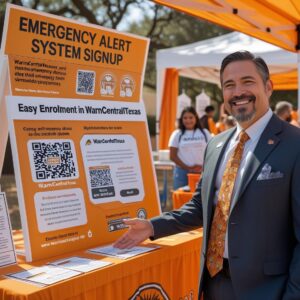
One of the most direct and high-impact components of the strategy was the county’s offer of free wildfire risk assessments—personalized home visits conducted by trained firefighters or Emergency Services District (ESD) staff. These visits evaluated factors like brush clearance, firewood storage, mulch placement, attic vent screens, and the proximity of flammable objects to home exteriors.
Homeowners received immediate feedback and tailored action steps, along with printed preparedness guides and follow-up resources. These interactions weren’t inspections—they were framed as risk reviews, emphasizing collaboration rather than compliance. Importantly, assessors weren’t limited to rural homes. Many visits took place in suburban subdivisions near wildland-urban interface zones, where risk is often misunderstood or downplayed.
Why It Worked: These in-person engagements helped demystify wildfire preparation and made safety feel achievable. Residents didn’t have to guess what steps to take or navigate technical websites. They got personalized guidance and face time with trusted professionals. The strategy also helped agencies build credibility and rapport with residents who might be wary of government outreach or unclear on jurisdictional boundaries (city vs. county vs. ESD). These relationships, built pre-incident, are especially valuable when trust and compliance are critical during evacuations.
3. Pop-Ups and Preparedness Symposia as Touchpoints for Trust
In addition to one-on-one assessments, Travis County brought wildfire readiness messaging into the public sphere through a series of preparedness pop-ups, community fairs, school outreach events, and symposiums. These events were often co-hosted with neighborhood associations, public libraries, or school districts and tailored to seasonal moments such as Fire Prevention Week or peak drought months.
Each pop-up featured:
- Live demonstrations of home hardening techniques (e.g., ember-resistant vents)
- Printed materials and sign-up booths for WarnCentralTexas alerts
- Fire extinguisher demonstrations
- Pet safety plans and senior mobility resources
- Children’s activities like coloring books about fire safety
The preparedness symposiums brought together multiple jurisdictions—county officials, fire marshals, and disaster response partners—to present educational workshops, answer questions, and foster collaboration between residents and agencies.
Why It Worked: These public events transformed preparedness from a solitary task into a shared community experience. By engaging with residents in familiar, non-emergency contexts, the county normalized conversation about evacuation, mitigation, and self-rescue. It also made fire professionals more approachable, reinforcing the idea that readiness is a team effort, not an individual burden. Symposia in particular positioned Travis County as a thought leader and convener on wildfire issues, elevating the profile of the entire campaign.
4. Digital Presence and Alert Integration to Close the Loop
A critical layer of the strategy was Travis County’s robust use of digital channels, including the Emergency Services website, official social media platforms, and the WarnCentralTexas emergency alert system. Each played a unique role:
- The website housed detailed preparedness resources, neighborhood-specific risk maps, video tutorials, and toolkits for HOAs.
- The @TravisCountyES Twitter and Facebook pages provided real-time updates, red flag warnings, event announcements, and digestible graphics explaining the “Ready, Set, Go!” framework.
- WarnCentralTexas served as the call-to-action in every campaign asset, encouraging residents to register for localized alerts via text, email, or voice call.
To ensure adoption, alert registration was promoted at every touchpoint—flyers, booth signage, QR codes on assessment handouts, and direct encouragement during pop-ups and school events.
Why It Worked: The integration of digital tools created a seamless loop from education to action. Residents who engaged with the county’s digital content were funneled toward alert enrollment, while those who received in-person services were reminded to stay connected online. The consistent visual branding and message alignment across platforms built trust and familiarity, while the real-time nature of the social media posts increased urgency and reach during active fire conditions.
 Outcomes and Impact
Between 2019 and 2023, the wildfire preparedness campaign contributed to meaningful improvements in both public awareness and resident action:
- Thousands of residents enrolled in WarnCentralTexas, increasing alert reach during red flag days
- More than 1,500 wildfire home risk assessments were completed by local fire personnel
- Over 10,000 preparedness guides (English and Spanish) were distributed at events, schools, and libraries
- ESDs reported greater resident compliance with defensible space recommendations, particularly in HOA communities
- No loss-of-life wildfire evacuations occurred in Travis County during this campaign period, even during multiple fire-weather events
Perhaps most notably, the “Ready, Set, Go!” model became familiar shorthand across the region—used by schools, neighborhoods, and local media to explain fire-season preparation. The language and tools were normalized, accessible, and widely recognized, which helped build a cultural shift toward proactive planning and early evacuation.
Takeaway and Conclusion
Wildfire season is no longer a western-only issue, and Travis County, Texas has shown how local governments can rise to meet a rising threat. With the Ready, Set, Go! framework, public-facing partnerships, and a willingness to meet residents both online and on their front lawns, Travis County transformed wildfire preparedness from a niche concern into a community norm.
The campaign succeeded because it made readiness relatable—grounded in homes, neighborhoods, and daily habits. It didn’t ask residents to become experts overnight. Instead, it gave them manageable steps, clear tools, and trustworthy partners. And in doing so, it empowered people to protect their homes long before a siren ever sounded.
As other fast-growing, fire-prone counties across the Sun Belt face similar risks, Travis County’s playbook offers a powerful, scalable model. Prepare with clarity. Communicate with compassion. And act before the flames arrive.
Ready to Elevate Your Agency’s Public Communication?
We understand the unique challenges state and local government agencies face—from complex issues to diverse community needs. Our comprehensive approach can help you transform the way you connect with constituents, improve transparency, and highlight the valuable work your agency does every day.
Interested in learning more? Reach out to us today for a consultation. We’d love to discuss how our services can support your goals and help you build lasting trust with the communities you serve.