
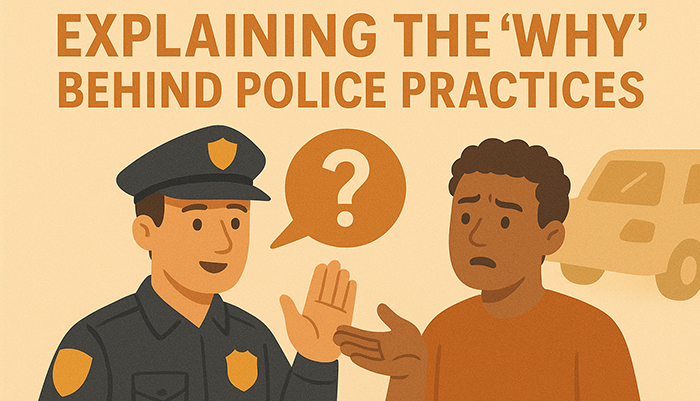
Explaining the “Why” Behind Police Practices: Turning Potentially Controversial Practices Into Understandable, Contextualized Narratives
When a police officer asks a driver to step out of their vehicle during what seems like a routine traffic stop, the driver often wonders: Why? I just have a broken taillight. When a police department releases its annual use-of-force statistics showing that officers used physical control techniques in hundreds of encounters, community members ask: Why so often? When a sheriff’s office conducts probation compliance checks early in the morning, residents question: Why so early, and why so aggressively?
These aren’t just questions, they’re opportunities. Every “why” represents a gap between what law enforcement does and what communities understand. In that gap, mistrust grows, misinformation spreads, and relationships between officers and the people they serve deteriorate.
The challenge facing modern law enforcement agencies, municipal police departments, county sheriff’s offices, and specialized task forces alike is not only about following proper procedures. It’s about explaining those procedures in ways that make sense to everyday people. The ability to translate policy, law, and safety protocols into clear and relatable terms can determine whether a community perceives an action as legitimate or as excessive.
This effort is not about justifying misconduct or defending controversial behavior. On the contrary, it’s about helping communities recognize and understand good policing, so they can more easily identify when something isn’t right and hold agencies accountable for improvement.
The Communication Crisis in American Policing
American law enforcement faces a profound crisis of understanding. Practices that officers consider routine and necessary often appear arbitrary, unfair, or even threatening to civilians. This disconnect rarely stems from officers acting improperly; it often arises because agencies fail to explain the “why” behind their actions.
Common Scenarios That Create Confusion
The Traffic Stop That Seems to Last Forever. An officer pulls someone over for a minor violation but spends fifteen minutes checking licenses, calling dispatch, and observing vehicle behavior. To the driver, it feels like harassment. To the officer, this process ensures that the driver is not wanted for a crime, that the vehicle isn’t stolen, and that the encounter is conducted safely. Studies by the Bureau of Justice Statistics confirm that traffic stops remain one of the most dangerous and unpredictable moments for officers, accounting for a significant share of assaults and ambushes nationwide.
The Use of Force That Appears Excessive. Body-camera footage circulates online showing several officers restraining a suspect who shouts, “I can’t breathe.” Without context, viewers see brutality. In some cases, officers are following training intended to control an individual experiencing excited delirium or drug-induced agitation, a condition that can cause self-harm or sudden collapse. Explaining this distinction, while also acknowledging national debates over the medical legitimacy of “excited delirium,” helps agencies convey both transparency and empathy. The National Institute of Justice notes that accurate communication after force incidents can reduce misinformation and reinforce procedural justice.
The Knock-and-Talk That Feels Like Intimidation. When detectives canvass a neighborhood asking for information, residents sometimes perceive it as targeting or harassment. Yet, such outreach is a standard investigative technique known as a “knock and talk.” When done respectfully and transparently—officers identifying themselves, explaining the purpose, and confirming the voluntary nature of participation—it can build trust rather than fear. The Department of Justice’s Community Policing Defined framework recommends that agencies proactively explain investigative methods in community forums to reduce confusion and complaints.
In each of these situations, officers may be operating squarely within law, policy, and training, but without explanation, their actions appear arbitrary at best and malicious at worst.
Why “Just Trust Us” No Longer Works
For much of the 20th century, American policing operated under an implicit social contract: police enforce the law, and the public trusts that those actions are fair. That contract has eroded, and it will not return simply through better performance.
Several forces drive this shift:
- Ubiquitous Video. Nearly every police encounter is now recorded from multiple angles—body-worn cameras, dash cameras, smartphones, and doorbell devices. Public expectations for transparency have risen accordingly. Departments such as the Las Vegas Metropolitan Police Department and Washington D.C.’s Metropolitan Police Department now publish edited critical-incident footage within days to maintain credibility.
- High-Profile Incidents. Tragic events in Ferguson, Minneapolis, and Louisville reshaped national awareness of use-of-force policies and accountability. These incidents spurred a generational demand for clearer explanations of police actions and disciplinary outcomes.
- Generational Change. Younger Americans, regardless of political affiliation, expect participatory governance. They don’t automatically defer to authority; they seek rationale. Research by the Pew Research Center shows that transparency and procedural fairness are now stronger predictors of public confidence in police than overall crime rates.
- Social Media Echo Chambers. Misinformation spreads faster than official statements. Agencies that delay communication risk losing control of their own narratives.
- Historical Context. Communities of color, in particular, carry legitimate skepticism based on historical misuse of police power. Effective communication must acknowledge, not dismiss, these realities.
Forward-leaning departments have learned that trust now depends on communication, not assumption. Transparency and explanation are no longer optional; they are essential tools of modern policing legitimacy.
The Foundation: Starting With Legitimacy 
Before any agency can explain a specific practice, it must first establish foundational legitimacy—the belief that its motives are transparent, its authority lawful, and its actions consistent with community values. Without this foundation, even well-intentioned explanations risk sounding defensive or self-serving.
Acknowledge the History
Acknowledging harm builds credibility faster than statistics ever can. The U.S. Department of Justice’s Office of Community Oriented Policing Services (COPS Office) emphasizes that “acknowledging historic misuses of authority is essential to rebuilding trust between police and citizens.”
For example, the Tampa Police Department has addressed community concerns about disproportionate traffic stops by opening public presentations with an acknowledgment of past misuse:
“We recognize that, in some jurisdictions, traffic stops have been used inappropriately, for profiling or pretextual enforcement. We want to show you how our current policy prohibits those practices.”
By proactively naming public concerns, Tampa Police and similar agencies demonstrate that transparency begins with self-awareness, not self-defense. This type of acknowledgment does not undermine authority; it strengthens it by validating lived experiences.
Explain the Legal Framework
Many practices that appear arbitrary to civilians exist because courts have defined the boundaries of lawful police conduct. Explaining these rulings helps communities understand that many actions are not discretionary choices but responses to legal precedent.
For example, the U.S. Supreme Court ruled in Pennsylvania v. Mimms (1977) that an officer may order a driver out of a vehicle during a lawful traffic stop for safety reasons. Later, in Maryland v. Wilson, the Court extended this authority to passengers. By referencing these cases in community materials or during public forums, agencies can clarify that such practices are grounded in constitutional law, not arbitrary authority.
When agencies explain these rulings in plain language, describing both rights and limitations, they help citizens direct concerns appropriately, focusing reform efforts on policy and law, rather than on the individual officers who are required to follow them.
Distinguish Between Policy and Practice
Not every authorized action is a required one. Communicating the difference between policy (what officers may do) and practice (what officers typically do) helps dispel misconceptions. For example, a department might clarify: “Our policy allows officers to conduct vehicle searches under defined conditions, such as probable cause or consent, but the vast majority of traffic stops involve no search at all. Officers are trained to use the least intrusive method necessary.” This distinction underscores that officer discretion is guided by training and oversight, not unchecked authority.
Be Honest About Trade-Offs
Every policing decision involves balancing public safety, individual rights, and community expectations. Agencies that openly discuss these trade-offs demonstrate respect for the public’s intelligence and willingness to participate in nuanced conversations. Other departments have hosted policy forums where residents explore the pros and cons of specific enforcement tactics. These dialogues communicate that transparency includes not only explaining what is done but also why certain methods are chosen over others.
When police and community members share the reasoning behind operational choices, the conversation shifts from “why did you do that?” to “how can we improve this together?”—the foundation of durable legitimacy.
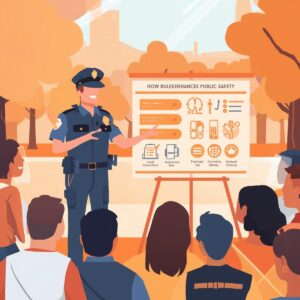
 Explaining Traffic Stops: From Suspicion to Safety
Why Officers Approach Vehicles Carefully
The explanation: Traffic stops are one of the most dangerous situations in policing. From 2012–2022, more than 500 officers were killed or seriously injured during traffic stops nationwide, according to the National Law Enforcement Officers Memorial Fund. Officers take a moment to observe driver behavior, check license plates for stolen-vehicle hits, and assess the environment before walking up. Approaching from the passenger side minimizes exposure to traffic and potential blind spots.
Why Stops Take Longer Than Expected
What communities see: A driver waits 15–20 minutes while the officer sits in the patrol car, apparently doing nothing.
The explanation: That time is used for safety and verification. Officers run several state and national checks, including license status, outstanding warrants, vehicle registration, and stolen-vehicle databases, each requiring confirmation through state or federal systems. A delay often means one of the checks produced an alert requiring supervisor review.
Why Officers Ask, “Where Are You Coming From?”
What communities see: Questions that appear unrelated to the original reason for the stop.
The explanation: Conversational questions are part of officer observation, not interrogation. They help gauge whether behavior or visible items in the car align with a person’s statements. The U.S. Supreme Court has held that casual conversation during a lawful stop does not violate the Fourth Amendment, as long as questioning does not unreasonably extend the stop.
The Seattle Police Department, for instance, trains officers under SPD Manual 6.220 – Voluntary Contacts, Terry Stops & Detentions to clarify the voluntary nature of non-investigative questions, reinforcing a balance between officer awareness and civil liberty.
Why Multiple Officers Sometimes Respond
What communities see: A single traffic stop suddenly involves two or three police vehicles, which can feel intimidating.
The explanation: Backup officers often respond based on availability, perceived risk level, or radio calls indicating uncertainty. More officers can actually reduce risk for both parties: one handles communication while others ensure situational safety. Studies from the Police Executive Research Forum show that team-based stops can de-escalate faster because officers can divide tasks safely.
Why Officers Ask About Weapons
What communities see: An officer asks, “Do you have any weapons in the vehicle?” during a simple equipment stop, which feels accusatory.
The explanation: In states where firearm carry is legal, many law-abiding drivers may have weapons in their vehicles. Officers ask this to ensure safety and avoid surprises, not as an accusation. If a firearm is present, standard practice is to request that the driver keep their hands visible and avoid reaching toward it.
In North Carolina, for example, drivers with concealed carry permits are legally required to disclose this information to officers under state statute §14-415.11(c2).
Explaining Use of Force: The Complexity Behind Split-Second Decisions 
Use of force remains one of the most emotionally charged and misunderstood aspects of policing. Explaining it effectively requires candor about the complexity of real-time decision-making, the legal framework that governs officer behavior, and the human factors that influence perception under stress.
The Legal Standard: Objectively Reasonable
What communities see: Videos of force incidents often appear brutal or excessive.
The explanation: Courts do not evaluate use-of-force incidents by public perception or by hindsight; they apply the standard of what a “reasonable officer on the scene” would have done, given the same information and split-second pressures. This principle originates from the U.S. Supreme Court decision Graham v. Connor (1989), which established that reasonableness must account for rapidly evolving circumstances and imperfect information.
Agencies that clearly explain this standard, which publishes plain-language summaries following officer-involved shootings, help the public understand how investigations determine whether force was justified under law rather than public opinion.
The Force Continuum Isn’t a Ladder
What communities see: A belief that officers must “start at the bottom,” verbal commands, then pepper spray, then baton, and so on.
The explanation: Most modern training replaces the outdated “force continuum ladder” with a flexible “force options” model. Officers may use any objectively reasonable option, depending on the immediacy and severity of the threat. The Police Executive Research Forum’s Guiding Principles on Use of Force (2016) encourages agencies to train officers to move fluidly between communication, control, and tactical repositioning rather than viewing force as an escalatory checklist.
Some police departments publicly share graphics explaining these options, showing that communication and de-escalation appear throughout the model, not only at its start.
Why Multiple Officers Restrain One Person
What communities see: Three or four officers holding down one person, which can look like “piling on.”
The explanation: Research shows that using multiple officers can actually reduce injuries to both suspects and officers. When force is distributed among several people, each officer can apply less physical pressure individually, ending resistance more quickly and safely. The National Institute of Justice notes that team-based restraint techniques lead to fewer injuries and less likelihood of uncontrolled escalation.
The “Hands Behind Your Back” Command
What communities see: Officers shouting repetitive commands at someone who appears to be complying.
The explanation: Under high stress, officers experience physiological effects such as tunnel vision, auditory exclusion, and distorted time perception, well-documented by police-psychology research. When multiple officers shout commands simultaneously, they may not realize compliance has already occurred. Modern training emphasizes designating a single “contact officer” to give clear, singular commands to reduce confusion.
Departments now include stress-response education in their annual training to help officers recognize and mitigate these perceptual distortions.
Explaining “Excited Delirium” and “Positional Asphyxia”
What communities see: Individuals restrained on the ground who say, “I can’t breathe,” and officers not immediately releasing them.
The explanation: Agencies are moving away from ambiguous terms like “excited delirium,” which lacked medical consensus. Following guidance from the American College of Emergency Physicians and the DOJ’s 2023 update to in-custody death investigations, most departments now describe these incidents as acute behavioral disturbances and train officers to transition restrained individuals into recovery positions immediately once control is achieved.
For example, Louisville Metro Police Department, following the death of Breonna Taylor, updated its policy to require immediate medical response whenever a subject complains of breathing difficulty. Officers must move restrained persons to a side or seated position and request emergency medical services without delay.
Why Officers Don’t “Shoot to Wound”
What communities see: An officer fires multiple rounds instead of “just shooting the suspect in the leg.”
The explanation: Officers are trained to use deadly force only when a person poses an imminent threat of death or serious injury, and to aim at center mass to stop the threat. The notion of “shooting to wound” is a Hollywood myth. In high-stress conditions, accuracy drops dramatically; striking a leg or arm is nearly impossible and could endanger bystanders. Moreover, the femoral artery in the leg can cause fatal bleeding. Both the International Association of Chiefs of Police and the FBI Firearms Training Unit reaffirm that deadly-force encounters are about stopping threats, not targeting extremities.
Agencies such as the Phoenix Police Department use virtual-reality simulators in citizen academies to demonstrate this reality, allowing community members to experience how quickly such decisions must be made.
 Explaining Investigative Practices: When Police Presence Feels Intrusive
Knock-and-Talk Investigations
What communities see: Detectives knock on doors asking questions, sometimes requesting to “look around,” which can feel like harassment.
The explanation: A “knock-and-talk” is a consensual encounter, officers may approach a residence, knock, and attempt to speak with occupants just like any member of the public could. People are free not to answer or to decline consent to search. Courts have long recognized this technique, while also stressing that consent must be voluntary and not obtained by claiming false authority (e.g., saying “we have a warrant” when none exists). Importantly, bringing a drug-sniffing dog to the home’s front door is considered a search that generally requires a warrant.
How to explain it: “Cooperation is voluntary. If you prefer, you may decline to answer questions or request we return with a warrant.”
Surveillance and Presence in High-Crime Areas
What communities see: Marked units repeatedly driving through certain neighborhoods or parking nearby, which can feel like targeting.
The explanation: Visible presence and directed patrols are often deployed in hot spots, small places where data show a disproportionate share of crime and victimization. Research finds that well-designed hot-spots policing can reduce crime without displacing it, especially when paired with problem-solving and community engagement. Courts also allow officers to weigh the context of a high-crime area among other factors when assessing reasonable suspicion, but location alone does not justify a stop.
How to explain it: “We deploy based on where residents are most at risk. We’ll also work with you on non-enforcement solutions, lighting, environment design, and community outreach.”
Why Officers Ask for ID When You’re “Not Doing Anything”
What communities see: An officer asks for identification while someone is standing in a park or outside a store.
The explanation: There are three common tiers of encounters:
- Consensual: You’re free to leave and don’t have to provide ID.
- Investigatory detention (Terry stop): If an officer has reasonable suspicion you’re involved in criminal activity, a brief detention is allowed; in many states, “stop-and-identify” laws permit requiring your name.
- Arrest: Probable cause is required; identity may be compelled.
The Supreme Court has said officers cannot demand ID without reasonable suspicion (Brown v. Texas), but states may require you to state your name during a lawful Terry stop (Hiibel). The key is whether you’re free to go, and you may ask that question.
How to explain it: “This is a voluntary conversation, you’re free to go,” or, if detained: “You’re being detained based on reasonable suspicion; please provide your name as required by state law.”
Probation and Parole Compliance Checks
What communities see: Early-morning home checks, searches, and questions to family members.
The explanation: People on probation or parole accept conditions that reduce their privacy expectations. The Supreme Court has upheld warrantless compliance searches of parolees and probationers within constitutional limits. Parolees may be searched without suspicion when a valid condition exists; probationers may be searched with reasonable suspicion when search conditions apply.
How to explain it: “These checks are a condition of supervision intended to support compliance and public safety. We’ll be as brief and respectful as possible, and we document each visit.”
Undercover Operations and Confidential Informants
What communities see: Later learning that a person was an undercover officer or informant can feel deceptive.
The explanation: Undercover operations and informants are governed by strict legal standards and DOJ guidelines. Officers may not entrap someone, meaning they cannot induce a person not predisposed to commit a crime to do so. The DOJ’s Attorney General’s Guidelines require careful vetting, supervision, and corroboration of informant information. Courts have thrown out prosecutions where the government’s conduct created the crime rather than detected it.
How to explain it: “We follow federal guidelines that tightly regulate informants and undercover work. We corroborate information, avoid entrapment, and maintain supervisory review.”
Explaining Enforcement Priorities: Why Some Laws More Than Others 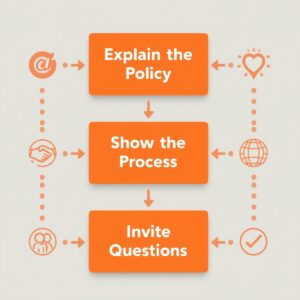
Communities often question why police seem to focus on certain violations while others appear to be ignored. Explaining how priorities are set, grounded in data, safety outcomes, and community input, helps residents understand that enforcement is not arbitrary, but strategic and resource-based.
Traffic Enforcement Focus Areas
What communities see: Heavy enforcement of speeding or red-light violations in some areas while other infractions seem overlooked.
The explanation: Modern traffic enforcement is data-driven. Agencies analyze crash reports, speed studies, and call-for-service data to identify where serious and fatal crashes occur most often. These “high-injury networks” are the basis for targeted enforcement, especially near schools, senior housing, or pedestrian corridors.
How to explain it: “We can’t enforce every violation everywhere. We prioritize based on the behaviors that most often lead to severe crashes and community complaints.”
Quality-of-Life vs. Serious Crime
What communities see: Officers responding to noise complaints, public intoxication, or homeless encampments while more serious crimes, like theft or burglary, remain unresolved.
The explanation: Calls for service are triaged by threat level and resource availability. A robbery in progress gets immediate response; noise complaints or loitering are handled as resources allow. Still, “quality-of-life” issues matter—unchecked disorder can reduce residents’ sense of safety and, over time, attract more serious crime.
Agencies that adopt problem-oriented policing (POP) approaches work with community groups, code enforcement, and public health partners to address underlying causes rather than relying solely on citations or arrests.
How to explain it: “When you see officers addressing a noise complaint, it doesn’t mean we’re ignoring violent crime. It means we’re managing multiple priorities that all affect neighborhood safety.”
Why Some Warrants Get Served Immediately and Others Don’t
What communities see: People learning that someone with an outstanding warrant remains free while others are arrested right away.
The explanation: Most jurisdictions carry thousands of open warrants, far exceeding the staff available to serve them all. Departments prioritize based on severity and risk; violent offenses, sex crimes, and domestic-violence warrants take precedence. Lesser offenses (e.g., failure to appear for minor infractions) may be served only when the individual is encountered during other enforcement activity.
How to explain it: “We prioritize warrants based on threat to public safety and available resources. Serious offenders are handled first, but all warrants remain active until resolved.”
 Explaining Specialized Units: Why They Exist and How They Operate
Specialized police units, gang task forces, SWAT teams, and K-9 programs often attract public curiosity or concern. Transparency about their mission, training, and deployment helps communities distinguish specialized readiness from routine over-policing.
Gang Units and Gang Databases
What communities see: Young people, often from marginalized groups, are labeled as “gang members,” sometimes based on vague criteria.
The explanation: Gang-related enforcement exists to target organized violence, not communities. However, misuse of gang databases has raised legitimate civil-rights concerns. In 2020, the California Department of Justice audited the Los Angeles Police Department’s CalGang system after evidence of inaccurate and racially biased entries. The result: new statewide standards now require multiple independent criteria, mandatory documentation, annual reviews, and an appeal process for removal.
Explaining these safeguards is critical. Agencies such as the Los Angeles Police Department and Chicago Police Department now publish gang-documentation criteria and annual oversight reports.
How to explain it: “Gang designations require multiple verifiable indicators, not race, clothing, or neighborhood. You can request a review or removal if you believe you’ve been misidentified.”
SWAT and Tactical Teams
What communities see: Heavily armed officers in military-style gear serving warrants or responding to neighborhood incidents.
The explanation: SWAT (Special Weapons and Tactics) teams are used only for high-risk situations, such as armed barricades, hostages, or active-shooter calls. Their equipment is protective, not offensive—ballistic helmets, shields, and armored vehicles designed to reduce casualties.
A 2017 Bureau of Justice Statistics survey found that about 70 percent of U.S. law-enforcement agencies maintain a tactical or regional SWAT capability, but that deployments for violent incidents far exceed those for warrant service.
How to explain it: “SWAT is reserved for situations with exceptional danger. When you see armored gear, it’s for protection, not intimidation.”
K-9 Units: Detection and Apprehension
What communities see: Police dogs searching vehicles or biting suspects, raising concerns about force and fairness.
The explanation: K-9s serve several distinct functions: detecting narcotics, explosives, and missing persons; tracking suspects; and, in limited cases, controlled apprehension. DOJ-funded research shows detection dogs can locate hidden substances at rates exceeding human capability when properly trained and certified.
However, recent civil-rights investigations highlight disparities in K-9 bite incidents, leading agencies to impose new restrictions. The International Association of Chiefs of Police (IACP) recommends that agencies separate detection and apprehension dogs whenever possible and mandate medical evaluation for all bite subjects.
How to explain it: “K-9s detect drugs, explosives, and missing people, but their deployment is tightly regulated and reviewed. Every bite is investigated.”
Building Trust Through Education: Proactive Explanation Strategies 
Citizens Police Academies
What communities see: Residents unsure how policing decisions are made or how officers are trained.
The explanation: Citizens academies invite community members to participate in multi-week learning programs that demystify operations. Participants observe traffic-stop procedures, practice de-escalation in simulators, and learn about investigative processes. Evaluations of these academies show measurable improvements in trust and perceived transparency.
Programs typically include:
- Ride-alongs for firsthand observation.
- Scenario-based training illustrating split-second judgment.
- Meet-and-greets with specialized units (K-9, traffic, forensics).
- Graduation discussions where participants provide feedback.
Graduates often become informal ambassadors who help explain police work within their own neighborhoods.
Youth Education and Mentorship Programs
What communities see: Young people who view police mainly through media coverage or enforcement encounters.
The explanation: Engaging youth early creates a long-term foundation of understanding. The Boston Police Department’s Youth Police Academy, for example, brings high-school students into structured summer sessions focused on leadership, physical fitness, and civic responsibility. A 2022 city report found that 90 percent of participants reported greater confidence engaging with police after completion.
How to explain it: “Our youth programs aren’t recruitment pipelines; they’re education partnerships that teach communication, responsibility, and teamwork.”
Community Forums on Specific Topics
What communities see: One-size-fits-all town halls that rarely address the real questions people have.
The explanation: Focused forums work better. Agencies like the Tucson Police Department hold quarterly sessions each centered on a single issue: Understanding Traffic Stops, Use of Force Explained, or How Investigations Work. Limiting each meeting to one topic allows deeper discussion, hands-on demonstrations, and myth-busting.
This targeted format also lets staff prepare visual aids, videos, and policy handouts, increasing both clarity and retention.
Social Media Explanations
What communities see: Quick video clips of incidents are circulating without context.
The explanation: Agencies now use social platforms to explain rather than react. The U.S. DOJ’s COPS Office identifies social media as a “frontline transparency tool,” urging departments to use plain language and two-way communication rather than formal press statements.
Transparency Reports and Open Data
What communities see: Public records that are difficult to interpret or access.
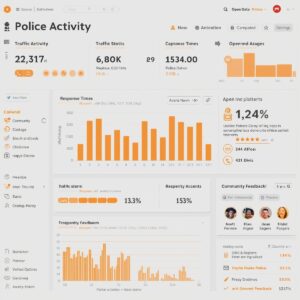
The explanation: Publishing annual transparency reports and open-data dashboards turns raw numbers into accountability tools. Some police departments post detailed annual reports showing use-of-force incidents, traffic-stop demographics, and complaint outcomes, each with explanations and trend comparisons.
Agencies that contextualize these numbers, showing not only “what happened” but also “why it matters,” move beyond compliance to true openness.
How to explain it: “We share our data and explain what it means so residents can track progress alongside us.”
 When Explanation Isn’t Enough: Acknowledging the Need for Change
The Example of No-Knock Warrants
Few issues illustrate the balance between officer safety, investigative urgency, and public risk more sharply than no-knock search warrants. Historically justified as a means to preserve evidence or surprise violent suspects, these operations have produced tragic outcomes for both residents and officers.
Following national attention to incidents involving forced entry and mistaken addresses, many agencies have voluntarily restricted or eliminated the use of no-knock warrants. For example, Louisville Metro Council passed “Breonna’s Law” in 2020, banning no-knock warrants and mandating body-worn cameras during all warrant-service operations. The U.S. Department of Justice has since directed federal law enforcement components, including the FBI and DEA, to limit such warrants to exceptional circumstances where announcing presence would pose imminent danger.
These policy shifts reflect a larger truth: effective communication isn’t about defending outdated practices—it’s about recognizing when those practices must change.
How to explain it: “We review every practice that carries safety risks. When evidence shows a better way, we adjust policies to protect both officers and the public.”
Acknowledging Disparate Impact
Trust cannot exist where inequity goes unacknowledged. Data transparency has revealed that many enforcement outcomes—traffic stops, use-of-force incidents, and arrests—disproportionately affect communities of color. The challenge is not merely statistical but moral: explaining disparity is not enough; agencies must act on it.
The U.S. Department of Justice’s Advancing Policing Through Data Transparency Initiative (2022) encourages agencies to publish demographic data on stops, searches, and arrests while pairing it with narrative context, analysis, and community dialogue. Some jurisdictions, such as the City of Minneapolis, have gone further by incorporating disparity-reduction goals into consent decrees and public reporting frameworks, acknowledging that causes are complex and solutions must be multi-layered.
Effective communication of disparity starts with honesty:
“Our data show gaps. We are analyzing the factors, listening to community input, and changing practices within our control.”
That kind of message builds more legitimacy than any defensive press release ever could.
Balancing Explanation and Evolution
Public trust depends on more than procedural accuracy; it requires responsiveness. When the public’s lived experience suggests a disconnect between policy and fairness, agencies must treat that perception as real data, worthy of response.
The Police Executive Research Forum (PERF) emphasizes that modern legitimacy comes not from perfection but from “demonstrated learning.” Agencies that publicly acknowledge mistakes, publish reforms, and report outcomes over time show that accountability is not an event—it’s a habit.
How to explain it: “Transparency is not the end goal. It’s the tool we use to understand ourselves, evolve, and serve better.”
Training Officers to Be Explainers 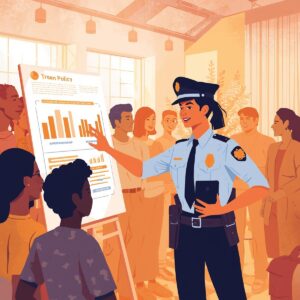
Officers cannot clearly articulate practices they do not fully understand themselves. Effective explanation begins long before an interaction; it begins in training, where the “why” behind each action is taught alongside the “how.”
Teaching the ‘Why’ in the Academy
Traditional academy training focused on tactics, law, and physical conditioning. Modern curricula are evolving to emphasize context, communication, and community impact. The U.S. Department of Justice’s Office of Community Oriented Policing Services (COPS Office) encourages agencies to include “procedural justice” and “community legitimacy” modules in basic training, ensuring recruits understand not only what is legal but what builds trust.
Research from the Police Executive Research Forum (PERF) shows that when recruits learn the rationale for each tactic, why positioning matters, why commands are phrased a certain way, and why tone affects compliance, they are far more likely to apply those practices consistently in the field.
How to explain it: “Our academy doesn’t just teach what to do, it teaches why it matters for community trust, safety, and fairness.”
Building Communication Competence
Once on the job, officers benefit from ongoing communication and de-escalation training. National best practices emphasize integrating communication skills into all tactical instruction rather than treating them as separate subjects. The National De-escalation Training Center, for instance, advises embedding dialogue and empathy exercises into defensive tactics and vehicle-stop drills rather than scheduling them as isolated workshops.
Officers who can narrate their decisions aloud, explaining their reasoning as they act, are better prepared to debrief with supervisors, respond to civilian questions, and manage community interactions under stress.
Reinforcing Community Context
Understanding a community’s demographics, history, and social climate is as important as mastering policy. The DOJ’s Community Policing Defined framework notes that officers who appreciate local history and lived experiences are better able to explain the reasoning behind enforcement actions without escalating tension.
Some academies now include modules on local government operations, cultural competency, and neighborhood engagement so new officers can see how their decisions fit within broader civic systems. Training that connects policing to its social environment produces officers who can explain with empathy, not defensiveness.
Recognizing and Rewarding Explanation
Communication must be measured and valued. Performance reviews, commendations, and promotional systems increasingly include “ability to explain decisions and policy to the public” as a leadership competency. The International Association of Chiefs of Police (IACP) recommends formal recognition of officers who excel at community communication, noting that it directly correlates with public trust and complaint reduction.
How to explain it: “We promote not only tactical skill but clarity, empathy, and understanding, because every officer is also a community educator.”
The Special Challenge of Explaining in Crisis 
The most difficult time to communicate effectively is during a crisis, especially in the hours after a critical incident such as an officer-involved shooting or high-profile arrest. Yet this is when the need for explanation is greatest. The goal is not public relations; it is maintaining legitimacy through timely, factual, and disciplined communication.
Timely but Accurate
In the digital era, silence is quickly filled by speculation. Agencies must balance the need for speed with the responsibility for accuracy. The Police Executive Research Forum (PERF) advises that agencies issue an initial public statement within hours of a major incident, focusing on verified facts only: the time, location, and nature of the event, the current safety status, and confirmation that an investigation is underway.
The statement should avoid speculation about motive, outcomes, or officer intent until verified evidence is available. Law Enforcement Best Practices for Critical Incident Communication notes that emphasizing the process (“what happens next”) can reassure the public even when few details are known.
How to explain it: “Here’s what we know, what we’re doing to verify it, and what to expect next.”
Avoiding Premature Justification
A common mistake after controversial incidents is responding defensively. Public trust erodes when agencies appear to justify before they investigate. Communication professionals should focus initial messaging on procedure rather than defense—for instance, clarifying that officers involved are placed on administrative leave pending standard review, or that an external agency will handle the investigation.
This approach aligns with the National Association for Civilian Oversight of Law Enforcement (NACOLE) principles of transparency and procedural fairness: communicate the process, not conclusions. Clear process language demonstrates accountability without pre-judging the facts.
How to explain it: “We follow a consistent process for reviewing serious incidents. The same rules apply here, and we’ll share updates as they’re verified.”
Explaining the Investigation Process
Public frustration often stems not from what happened, but from not understanding why information takes time to release. Agencies that proactively explain investigative timelines, evidence processing, witness interviews, body-camera review, and external oversight help reduce suspicion.
Best practice guides from the International Association of Chiefs of Police (IACP) recommend publishing a visual outline or short explainer video describing each step of a critical-incident investigation. This allows residents to see that the delay is due to procedure, not secrecy.
Transparency in process also sets realistic expectations: some evidence (such as autopsy results or forensic analysis) may take weeks to complete and must be reviewed by independent entities before release.
How to explain it: “Investigations take time because evidence must be complete and verified. We’ll release updates in stages so accuracy comes first.”
Maintaining Human Empathy
Crises affect not only the community but also victims, families, and officers themselves. Communication that recognizes emotional reality—offering sympathy without assigning blame—shows humanity and helps maintain calm. Research from the Harvard Kennedy School’s Program in Criminal Justice Policy and Management highlights that messages expressing empathy and shared loss can reduce polarization and increase public cooperation following critical events.
How to explain it: “This is a difficult time for everyone affected. Our responsibility is to find the truth, support those impacted, and ensure accountability.”
Measuring Success: Are Your Explanations Working? 
Effective communication in policing is measurable. Agencies can evaluate whether their explanations are bridging understanding—or if they’re falling short—by tracking objective and perceptual indicators.
Surveying Community Understanding
Regular community surveys and focus groups help assess comprehension and trust. Instead of simply asking, “Do you trust the police?”, the U.S. Department of Justice recommends measuring understanding—for example, “Do you feel you understand why police use certain tactics?” This approach distinguishes distrust rooted in misunderstanding from distrust based on legitimate experience, giving agencies better insight into where communication should improve.
Monitoring Complaint Patterns
Trends in complaints reveal communication breakdowns. If multiple reports cite confusion about officer conduct rather than misconduct itself, the issue may lie in explanation failure, not performance. Many agencies now categorize complaints into procedural, behavioral, and communication-related groups to guide training priorities.
Analyzing Public Dialogue
Public sentiment on social and traditional media reflects how well official explanations are reaching audiences. Monitoring themes, rather than chasing approval, helps identify persistent misconceptions. According to the Police Executive Research Forum, analyzing online engagement patterns provides early warning of emerging legitimacy challenges.
Engaging Civilian and Advisory Boards
Community advisory boards provide structured, qualitative feedback on the clarity of agency messaging. The U.S. DOJ’s Collaborative Reform Initiative encourages law enforcement to partner with these boards to review public statements, dashboards, and training materials for accessibility and tone.
Turning Metrics into Practice
Collecting data is only the first step; acting on it demonstrates genuine accountability. Agencies that publish follow-up actions, such as adding FAQs after survey results show confusion, signal that communication is an ongoing partnership, not a one-way broadcast.
Conclusion: Transparency as the Foundation of Legitimacy
Transparency is not a public-relations tactic; it is a pillar of democratic legitimacy. Explaining the “why” behind procedures helps residents see not only what police do, but how those actions fit within the rule of law, professional ethics, and shared safety.
Agencies that communicate openly, acknowledging complexity, admitting uncertainty when it exists, and changing course when evidence demands it, strengthen their most valuable resource: public trust. As the DOJ’s COPS Office summarizes, “Community confidence in policing grows when explanations precede enforcement.”
In the end, legitimacy is not earned through perfection, but through clarity, humility, and accountability. When law enforcement explains the “why,” it transforms policy into understanding—and understanding into trust.
Ready to Elevate Your Agency’s Public Communication?
We understand the unique challenges state and local government agencies face—from complex issues to diverse community needs. Our comprehensive approach can help you transform the way you connect with constituents, improve transparency, and highlight the valuable work your agency does every day.
Interested in learning more? Reach out to us today for a consultation. We’d love to discuss how our services can support your goals and help you build lasting trust with the communities you serve.