
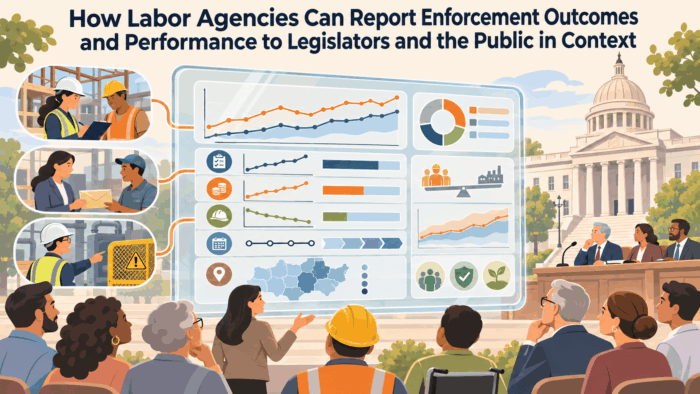
How Labor Agencies Can Report Enforcement Outcomes and Performance to Legislators and the Public in Context
Labor standards, workplace safety, employment relations, and related enforcement agencies are expected to demonstrate that public authority is producing meaningful results. Legislators want to know whether appropriated resources are being used effectively. Workers and employers want evidence that laws are being enforced fairly. Agency leaders need performance information to identify operational problems and defend program priorities. Journalists, advocacy organizations, industry groups, unions, and members of the public may use the same numbers to reach very different conclusions about whether an enforcement program is succeeding or failing.
That makes enforcement reporting more complicated than publishing annual totals. A labor agency can report the number of investigations completed, violations identified, penalties assessed, wages recovered, hazards corrected, cases closed, or workers affected and still leave audiences with an incomplete understanding of performance. A higher number of violations can indicate stronger enforcement, worsening compliance, better targeting, expanded jurisdiction, or some combination of those factors. A decline in investigations can reflect weaker capacity, more complex cases, changes in complaint volume, or a deliberate shift toward cases with greater potential impact. Numbers that appear straightforward often require operational context before they can be interpreted responsibly.
The communication challenge becomes particularly significant when performance information enters legislative oversight, budget discussions, public debate, or media coverage. A single metric can become a shorthand judgment about an entire program even when the metric captures only one stage of enforcement. Agencies can make the problem worse when they publish large collections of statistics without explaining what each measure represents, how measures relate to one another, what changed during the reporting period, and which conclusions the data can and cannot support. Transparency requires access to information, but meaningful transparency also requires enough context for audiences to interpret that information accurately.
Labor agencies therefore need a reporting framework that connects enforcement activity, outcomes, workload, timeliness, compliance effects, organizational capacity, and public value. The objective should not be to make performance appear stronger than it is. Agencies should communicate achievements, limitations, backlogs, changing conditions, and unresolved challenges with the same discipline. When performance reporting explains what happened, why it matters, what influenced the results, and what the agency is doing next, legislators and the public receive a more accurate picture of how enforcement systems are functioning.
Define What Enforcement Performance Actually Means Before Selecting Metrics
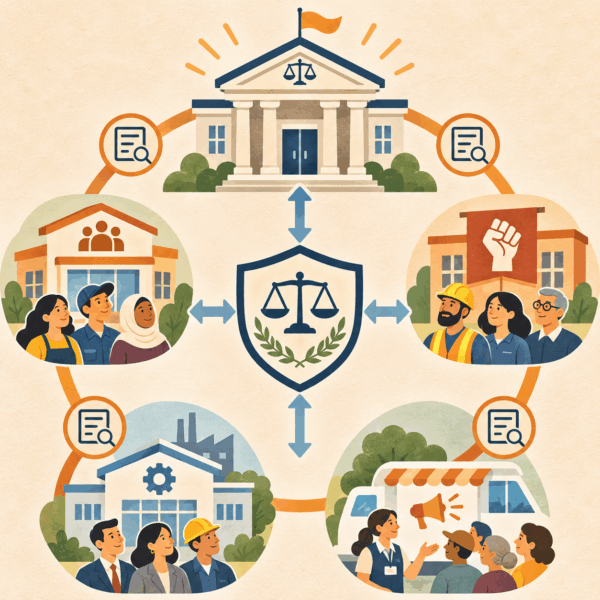 Labor agencies should begin performance reporting by defining the outcomes their enforcement programs are intended to produce. Enforcement activity is relatively easy to count, but activity is not necessarily the same as performance. An agency may conduct inspections, investigate complaints, issue citations, hold hearings, assess penalties, collect unpaid wages, require corrective action, or close cases. Each measure describes something the agency did, but no single activity automatically demonstrates whether workers were protected, employers came into compliance, or enforcement resources were used effectively.
A useful performance framework should distinguish inputs, workload, activities, outputs, outcomes, and longer-term effects. Staffing and funding are inputs. Complaints and referrals represent workload. Investigations and inspections are activities. Citations, determinations, settlements, or orders are outputs. Recovered wages, corrected hazards, completed abatement, resolved disputes, and restored compliance may represent more substantive outcomes. Longer-term effects can include improved compliance patterns, reduced recurrence, or stronger understanding of workplace requirements, although those effects can be more difficult to attribute directly to agency action.
Making these distinctions visible helps prevent legislators and the public from treating every number as interchangeable. An increase in inspections may demonstrate expanded activity but does not by itself show whether the inspections were well targeted. A larger penalty total may indicate significant enforcement activity but could also be influenced by a small number of unusually large cases. A decline in complaints could reflect improved compliance, reduced awareness of reporting channels, fear of retaliation, changing economic conditions, or other factors. Metrics become more meaningful when the agency explains what category of performance each one represents.
The definition of performance should also reflect the agency’s statutory responsibilities rather than an abstract expectation that every program maximize the same numbers. Wage enforcement, occupational safety, public employment relations, personnel administration, and other labor functions may have fundamentally different objectives and processes. A strong reporting system establishes what success means for each program while still allowing agency leadership and legislative audiences to understand the overall contribution of the organization.
Build a Performance Story Around Outcomes Rather Than Enforcement Volume Alone
Enforcement reports often emphasize numbers that are easiest to collect, such as inspections conducted, cases opened, citations issued, or penalties assessed. Those measures are useful, but they primarily describe enforcement volume. Labor agencies should place activity measures within a larger performance story that explains what happened because the agency took action. This shifts reporting from a tally of administrative work toward a clearer explanation of public value.
For wage enforcement programs, outcomes may include wages recovered, workers receiving payments, cases resolved, employer compliance achieved, or repeat problems addressed. Workplace safety programs may report hazards corrected, workers affected by abatement, serious conditions addressed, or corrective actions verified. Labor relations agencies may examine cases resolved, elections administered, disputes processed, agreements reached through mediation, or procedural timeliness. The appropriate outcomes depend on the program, but the underlying communication principle remains consistent: audiences should be able to connect agency activity to a meaningful result.
Outcome reporting should remain careful about attribution. An agency should not imply that every improvement in workplace conditions resulted exclusively from enforcement activity when broader economic, organizational, or regulatory factors may also be involved. Similarly, the absence of a measurable long-term outcome does not necessarily mean an enforcement action lacked value. Some effects are difficult to quantify, and others emerge only after the reporting period. Agencies should explain those limitations rather than stretching available data beyond what it can reasonably demonstrate.
A balanced performance story can combine activity and outcome measures. The activity data shows the scale of the agency’s work, while the outcome data shows what that work produced. Together, they give legislators and the public a more useful basis for evaluating whether enforcement resources are reaching significant problems and producing results consistent with the agency’s responsibilities.
Clear Rules, Fair Process: Communication Strategies for Labor Standards, Workplace Safety, and Employment Relations Agencies
This article is part of our series on strategic communication for Labor Standards, Workplace Safety, and Employment Relations Agencies. To learn more and to see the parent article, which links to other content just like this, click the button below.
Explain Why More Violations Do Not Automatically Mean Worse Performance
One of the most important contextual challenges in labor enforcement reporting is explaining that higher violation numbers can have several meanings. If an occupational safety program identifies more serious hazards or a wage enforcement program finds more violations, audiences may interpret the increase as evidence that workplace compliance is deteriorating. That may be true in some circumstances, but the same increase can also result from improved targeting, additional inspectors, expanded outreach, stronger complaint intake, new legal requirements, or more effective identification of complex violations.
Labor agencies should therefore avoid presenting violation totals without information about the enforcement environment in which those violations were identified. Reports can explain changes in inspection volume, complaint patterns, staffing, enforcement priorities, targeted initiatives, industry conditions, or jurisdictional responsibilities that materially affected the results. The objective is not to explain away unfavorable numbers. It is to ensure that audiences understand the factors necessary to interpret them.
Trend reporting is particularly important. A one-year increase can look dramatic when separated from several years of data. Conversely, a relatively stable annual number may conceal a significant long-term change. Agencies should provide appropriate historical comparisons and explain material breaks in methodology, data systems, program scope, or legal authority that make direct comparisons difficult. A trend line is useful only when the underlying measures remain sufficiently comparable.
The same discipline should apply when violation numbers decline. Agencies should not automatically describe fewer violations as evidence of improved compliance unless the data supports that conclusion. Reduced enforcement activity, staffing shortages, changes in case mix, fewer complaints, or different targeting practices can also produce lower totals. Credible reporting requires the agency to apply the same interpretive caution to numbers that appear favorable and numbers that appear unfavorable.
Put Penalties in Context Rather Than Treating Dollar Amounts as the Primary Measure of Success
Penalty totals attract attention because they provide a simple financial measure that can be compared from year to year. Legislators, media organizations, advocacy groups, and the public may interpret higher penalties as stronger enforcement and lower penalties as weaker enforcement. Labor agencies should resist making penalty dollars the central measure of program effectiveness because the amount assessed can be influenced by the severity and number of individual cases, statutory penalty structures, settlements, appeals, employer size, and other factors that do not necessarily reflect overall enforcement performance.
Reports should distinguish among penalties proposed, assessed, adjusted, collected, or finalized where those stages apply. Combining these amounts can create a misleading picture of what actually occurred. An initial enforcement action may involve a proposed amount that changes through settlement, administrative review, or adjudication. Agencies should use terminology consistently and explain which stage a reported number represents.
Penalty information should also be connected to the underlying enforcement outcome. A large financial assessment may be significant, but audiences should also understand what violation occurred, what corrective action was required, whether workers received restitution where applicable, and whether the employer completed required compliance measures. Financial consequences are one component of enforcement rather than the complete result.
This contextual approach can strengthen credibility with audiences that have different views about enforcement. Agencies do not need to characterize penalties as either evidence of toughness or evidence of employer wrongdoing beyond what the formal action establishes. They can report the amount accurately, explain what it represents, and connect it to the broader objective of achieving compliance with workplace requirements.
Distinguish Wages Assessed, Wages Recovered, and Money Actually Delivered to Workers
Wage enforcement agencies often report monetary recoveries as one of their most visible measures of impact. These figures can demonstrate substantial public value, but they can also become confusing when reports use terms such as wages owed, wages assessed, restitution ordered, wages recovered, and payments distributed without explaining the differences. Legislators and workers may reasonably assume that every dollar announced by the agency has already reached an affected employee when that is not necessarily the case.
Agencies should establish consistent definitions for each financial stage. An investigation may determine that wages are owed. An administrative order or settlement may establish an amount the employer is required to pay. Collection activity may recover some or all of that amount. The agency may then distribute funds to workers, or another process may govern payment. Reporting should make these stages visible where they are relevant to the program.
The distinction is especially important when collection is difficult. An agency may issue a substantial wage determination but face challenges collecting from an employer that has closed, lacks assets, contests the action, or uses organizational structures that complicate recovery. Reporting only the amount ordered can overstate the immediate financial benefit to workers, while reporting only collected dollars can obscure significant enforcement work and unresolved employer obligations.
A stronger presentation can show both the enforcement determination and the ultimate recovery outcome. This gives legislators a clearer view of where the system is working and where additional collection tools, staffing, statutory authority, interagency coordination, or process improvements may be needed. It also gives workers and the public a more accurate understanding of what announced monetary outcomes actually mean.
Report Timeliness Without Reducing Complex Cases to a Single Average
Case processing time is a legitimate concern for legislators, workers, employers, and agency leadership. Delayed wage claims, safety investigations, employment disputes, hearings, or enforcement decisions can create real consequences for the people involved. Labor agencies should report timeliness openly, but they should avoid relying on a single average that conceals substantial differences in case complexity and service experience.
An average processing time can be distorted by a relatively small number of very old or very fast cases. Median processing time, percentile measures, age distributions, or the percentage of cases completed within defined service benchmarks can provide additional context. Agencies can also distinguish among case types when the underlying processes differ significantly. A straightforward complaint and a complex multi-employer investigation should not necessarily be expected to follow the same timeline.
Reports should explain what the measurement period covers. Time from complaint submission to initial review is different from time from investigation opening to determination, and both differ from the complete period through appeal, collection, or final closure. Without clear definitions, audiences may compare numbers that represent different stages of the process.
Timeliness reporting should ultimately help audiences understand both performance and operational constraints. If cases are taking longer, the agency should explain the relevant factors and what it is doing in response. If processing improves, the agency should identify the changes that contributed to that improvement when the evidence supports the connection. The goal is to make timeliness a management and accountability measure rather than a number presented without explanation.
Show Backlogs as Workload Conditions That Require Explanation and Management
Backlogs are among the most politically sensitive performance measures for enforcement agencies because they can be interpreted as evidence that government is failing to provide timely service. Labor agencies should not hide or redefine backlogs to make performance appear stronger. They should establish a consistent definition, report the scale and age of pending work, and explain the operational conditions affecting the inventory.
A pending case inventory and a backlog are not necessarily the same thing. Every enforcement program will have cases actively moving through investigation, review, hearing, or collection. Agencies should define when a case becomes backlogged based on an appropriate operational or service standard rather than treating all open matters as overdue. That distinction helps legislators understand the difference between normal workload and accumulated delay.
Context should include incoming workload as well as completed work. An agency can increase case closures substantially and still end the year with a larger backlog if incoming complaints rise even faster. Reporting only the year-end inventory could make performance appear to have deteriorated despite increased productivity. Conversely, a declining backlog may reflect fewer incoming cases rather than improved processing. Showing inflow, outflow, and pending inventory together provides a more complete picture.
Agencies should also explain the composition of the backlog. Older cases, complex cases, cases awaiting external information, matters in formal review, and cases requiring collection may create different management challenges. Breaking the inventory into meaningful categories helps legislators and the public understand where delays occur and gives the agency a stronger basis for explaining the actions being taken to address them.
Connect Staffing and Resources to Workload Without Making Every Performance Problem a Budget Argument
Legislators need to understand how staffing and resources affect enforcement capacity, particularly when they are making appropriation and oversight decisions. Labor agencies should provide enough information to show the relationship among workload, staffing, case complexity, and performance. At the same time, reports lose credibility when every unfavorable outcome is attributed automatically to insufficient funding.
A useful resource discussion can show authorized positions, filled positions, vacancies, turnover, training requirements, caseloads, specialized staffing needs, and other factors that materially influence program capacity. An agency with the same number of authorized positions may have substantially different operational capacity if vacancies are high or experienced investigators have been replaced by staff who require extensive training. Headcount alone may not explain the actual resources available to perform enforcement work.
Agencies should also identify process, technology, policy, or management issues that influence performance independently of staffing. A growing backlog may involve insufficient personnel, but it can also reflect inefficient intake, duplicative review, outdated case systems, unclear case prioritization, or procedures that no longer fit the volume and complexity of work. Reporting those factors demonstrates that the agency is evaluating its own operations rather than treating appropriations as the only solution.
When additional resources are requested, the performance framework can make the rationale more concrete. Instead of stating only that more staff are needed, the agency can explain what workload is growing, which stage is constrained, what capacity the requested resources would add, and what performance improvement the agency expects to pursue. That creates a more useful connection between budget decisions and public outcomes.
Use Multi-Year Trends to Prevent One Reporting Period From Becoming the Entire Story
Annual reports naturally emphasize the most recent fiscal or calendar year, but enforcement performance rarely fits neatly within a single reporting period. Investigations may span multiple years, economic conditions can change complaint patterns, new laws can alter agency responsibilities, and staffing initiatives may take time to affect outcomes. Labor agencies should use multi-year trends to help legislators and the public distinguish sustained changes from short-term variation.
Trend reporting should use consistent measures whenever possible. If a metric definition changes, the agency should disclose the change and explain whether prior years were recalculated or are no longer directly comparable. A visually continuous trend can be misleading when the underlying methodology changed halfway through the period. Transparency about those breaks strengthens rather than weakens the usefulness of the report.
Multi-year reporting can also reveal relationships that are difficult to see in annual totals. Complaint volume, staffing, inspections, case closures, recovery amounts, and pending inventories can be shown together so audiences can understand how changes in one area may relate to another. The agency should avoid claiming causation unless the evidence supports it, but it can identify operational patterns that help explain performance.
Historical context is especially valuable during periods of unusual change. New statutory responsibilities, major economic disruptions, new reporting systems, large hiring initiatives, or shifts in enforcement strategy can affect several years of data. Explaining those conditions allows legislators and the public to evaluate the agency against the environment in which it was operating rather than treating every annual difference as a standalone measure of success or failure.
Separate Complaint Volume From the Prevalence of Workplace Violations
Complaint volume is an important measure of public interaction with a labor agency, but it should not be presented as a direct measure of how frequently workplace violations occur. Workers may file more complaints because violations are increasing, but complaint volume can also rise because awareness improves, outreach expands, filing becomes easier, economic conditions change, or a highly visible enforcement initiative encourages workers to come forward. The same caution applies when complaints decline.
Labor agencies should explain the factors that influence whether workers report suspected violations. Fear of retaliation, limited English proficiency, uncertainty about jurisdiction, lack of awareness, difficulty using an intake system, immigration concerns, or assumptions that the agency cannot help can suppress reporting. A low complaint rate therefore does not necessarily demonstrate widespread compliance, particularly in industries or worker populations where barriers to reporting are significant.
Reports can provide greater context by showing complaint trends alongside outreach activity, intake changes, referral patterns, enforcement findings, and other relevant indicators. If the agency introduced an online complaint form, expanded multilingual access, partnered with community organizations, or conducted targeted education during the reporting period, those changes may help explain why complaint volume moved. The agency should identify these relationships carefully without claiming that one factor caused the change unless the evidence supports that conclusion.
Legislators and the public ultimately need to understand that complaints are signals entering an enforcement system rather than a comprehensive census of workplace conditions. Reporting complaint volume transparently while explaining its limitations allows the agency to demonstrate responsiveness without encouraging audiences to treat fluctuations in reporting as definitive evidence that compliance is improving or deteriorating.
Explain How Enforcement Targeting Changes the Meaning of Inspection and Investigation Results
Labor agencies increasingly have to make strategic decisions about where limited enforcement resources will have the greatest impact. Complaint severity, industry risk, worker vulnerability, prior violations, emerging patterns, referrals, geographic concentrations, and other factors may influence which workplaces or cases receive attention. When agencies improve targeting, the resulting enforcement statistics can change even if underlying compliance conditions remain relatively stable.
A targeted inspection program may identify violations at a higher rate than a broadly distributed inspection program because the agency intentionally directs resources toward workplaces where available information suggests greater risk. Reporting a higher violation rate without explaining that targeting strategy can create the impression that compliance deteriorated. Conversely, presenting the higher rate as proof that targeting succeeded may overstate what the data can establish unless the agency has an appropriate basis for comparison.
Agencies should explain how cases enter different enforcement pathways without disclosing information that would undermine investigations, reveal protected information, or allow regulated entities to avoid scrutiny. Legislators do not necessarily need every operational detail to understand that enforcement activity is risk-informed rather than random. A concise explanation of prioritization criteria can make the resulting performance data considerably more meaningful.
Targeting information can also help explain why raw enforcement volume may decrease while case impact increases. An agency that devotes more resources to complex investigations involving multiple workers or systemic practices may complete fewer cases while addressing larger or more consequential problems. Performance reporting should make that tradeoff visible rather than allowing case counts alone to define productivity.
Report Case Complexity Alongside Case Counts
Not every labor enforcement case requires the same amount of work. A straightforward wage complaint involving one worker and a limited set of records may be resolved relatively quickly, while an investigation involving numerous workers, multiple worksites, subcontracting relationships, disputed classifications, extensive payroll records, or coordinated business entities may require substantially more investigative and legal effort. Reporting each matter simply as one case can obscure major differences in workload.
Labor agencies should develop practical ways to communicate case complexity without creating a reporting system so complicated that it becomes difficult to maintain. Cases might be grouped by type, scope, number of affected workers, investigative intensity, procedural stage, or another meaningful characteristic. The purpose is not to assign a perfect complexity score to every matter but to help audiences understand why raw case totals cannot fully describe workload.
Complexity information becomes particularly important when annual case closures decline. Legislators may reasonably ask why fewer matters were completed despite stable staffing. If the agency handled a larger share of resource-intensive investigations, the report should provide evidence of that shift rather than relying on a general statement that cases became more complicated. Relevant measures can make the explanation more credible.
The same principle applies when productivity increases. A higher number of completed cases can represent genuine process improvement, but it can also reflect a different case mix. Agencies should apply contextual reporting consistently regardless of whether the numbers appear favorable. That discipline demonstrates that the purpose of performance reporting is accurate interpretation rather than selective presentation.
Create a Small Set of Case-Mix Indicators
Labor agencies do not need dozens of complexity measures to improve performance reporting. A limited set of case-mix indicators can show whether the agency’s workload is changing in ways that affect processing time, staffing demands, or enforcement outcomes.
Useful indicators may include the share of cases involving multiple workers, the number of complex or priority investigations, the percentage requiring formal hearings or extensive legal review, or another measure appropriate to the program. The agency should select indicators that can be defined consistently and maintained over time.
Case-mix measures should supplement rather than replace basic workload reporting. Their value comes from helping legislators and the public interpret changes in case volume, timeliness, and outcomes with a clearer understanding of the work behind those numbers.
Show the Difference Between Cases Opened, Cases Closed, and Cases Resolved
Labor agency reports often use case terminology that appears straightforward internally but can be confusing externally. A case may be opened after intake, administratively closed without a substantive finding, resolved through settlement, completed after investigation, transferred to another process, appealed, or remain active for collection or compliance monitoring. If reports use “closed” and “resolved” interchangeably, audiences may misunderstand what the agency actually accomplished.
Agencies should define the major stages used in their performance reports and apply those definitions consistently. Cases opened can demonstrate incoming workload. Cases completed can show processing activity. Cases resolved with a substantive outcome may provide a different measure of enforcement impact. Administrative closures, withdrawals, referrals, duplicate complaints, and jurisdictional dismissals may need to be reported separately when they represent a meaningful share of the workload.
The distinction matters because a high closure count can appear to demonstrate strong productivity even when many closures did not involve a substantive enforcement determination. That does not make administrative closures illegitimate. Screening out matters outside the agency’s authority can be an important operational function. The report should simply explain what the number represents so audiences do not assign it a meaning the data cannot support.
Clear case-stage terminology also improves year-to-year comparison. If legislators understand how cases move through intake, investigation, determination, collection, review, and closure, they can evaluate where workload is accumulating and where process improvements are occurring. Performance reporting becomes a representation of the enforcement system rather than a collection of disconnected totals.
Report Resolution Quality Alongside Resolution Speed
Pressure to reduce backlogs and improve processing times can create an understandable focus on how quickly labor agencies close cases. Speed matters, particularly when workers are waiting for wages, employers need regulatory certainty, or unsafe conditions remain unresolved. But performance reporting should not create an incentive structure in which faster closure becomes the dominant definition of success regardless of the quality or durability of the outcome.
Labor agencies should identify measures that complement timeliness. Depending on the program, these may include successful collection, completed abatement, settlement implementation, sustained compliance, appeal outcomes, recurrence, or the percentage of determinations requiring substantial correction after review. No single measure will capture case quality completely, but combining timeliness with outcome information provides a more balanced picture.
Agencies should be cautious about measures that could unintentionally reward particular enforcement outcomes. For example, a high settlement rate is not inherently evidence of success if settlement is inappropriate in some cases, just as a high citation rate is not necessarily evidence of effective inspection. Performance measures should reflect whether the agency is carrying out its responsibilities fairly and effectively rather than encouraging staff to maximize a predetermined result.
Legislators should be able to see whether operational improvements are reducing delay without weakening substantive enforcement. When an agency reports faster case processing alongside stable or improved outcome measures, the combination provides stronger evidence of genuine performance improvement than speed alone.
Explain Collection Performance as a Distinct Stage of Enforcement
Obtaining an order, assessment, or judgment does not always mean that workers or the government will immediately receive the money owed. Collection can be a separate and difficult stage of labor enforcement, particularly when employers lack assets, close businesses, restructure operations, dispute liability, or fail to comply voluntarily. Performance reports should make this stage visible rather than allowing enforcement determinations and actual collections to blend together.
Agencies can report amounts ordered or assessed alongside amounts collected and distributed, using consistent definitions for each measure. They can also explain the timing issue created when an enforcement action occurs in one reporting year and collection takes place in another. Without that explanation, annual collection rates can appear inconsistent with the enforcement activity reported during the same period.
Where collection challenges are significant, agencies should provide context about the types of barriers they encounter and the tools available to address them. The objective should not be to excuse poor collection performance but to show where the enforcement system encounters practical limits. Legislators may need this information when evaluating statutory tools, interagency coordination, staffing, or other policy questions related to enforcement effectiveness.
Collection reporting also helps agencies avoid overstating outcomes in public announcements. A large determination can be significant and newsworthy, but reports should distinguish between amounts an employer has been ordered to pay and funds that have actually been recovered. Maintaining that distinction strengthens public trust in the agency’s financial performance claims.
Explain the Role of Settlements Without Presenting Them as Either Wins or Concessions
Settlements can resolve labor enforcement matters more quickly, provide workers with relief, establish corrective obligations, reduce litigation costs, and create certainty for the parties. They can also involve compromises that differ from the agency’s initial position. Performance reporting should explain settlements as one possible enforcement outcome rather than automatically presenting every settlement as a victory or implying that negotiated resolution represents weaker enforcement.
Agencies can report the number or share of matters resolved through settlement where that information is meaningful, but the number requires context. A higher settlement rate may reflect effective dispute resolution, a change in case mix, new procedures, or strategic choices about how cases are resolved. A lower rate may similarly have several explanations. The agency should avoid setting a simplistic expectation that more settlements are always better.
When reporting significant settlements publicly, agencies should distinguish allegations, findings, admitted facts, and negotiated obligations accurately. The communication should reflect the actual procedural status of the matter. This is particularly important when the settlement does not require an employer to admit every allegation or when the agreement resolves disputed issues without a final adjudicated finding.
At the performance level, the more important question is whether settlements are helping the agency achieve appropriate enforcement outcomes. Reports can examine whether required payments are made, corrective actions are completed, deadlines are met, and other settlement obligations are fulfilled. This moves the discussion beyond the number of agreements toward whether negotiated resolutions actually produce the intended result.
Report Appeals and Reversals Without Treating Them Automatically as Enforcement Failure
Labor enforcement decisions may be reviewed through administrative hearings, boards, commissions, courts, or other procedures depending on the program and jurisdiction. Some decisions will be affirmed, modified, remanded, vacated, or reversed. Agencies should report these outcomes accurately where they are relevant to performance, but they should avoid interpreting every modification or reversal as evidence that the original enforcement action was improper.
Review outcomes can be influenced by new evidence, different legal interpretations, procedural issues, settlements reached during review, or other case-specific factors. Performance reports should distinguish these possibilities where the data allows rather than presenting a single reversal percentage without context. At the same time, recurring patterns in overturned or remanded actions can provide important management information that should not be dismissed.
Agencies should examine whether review outcomes identify opportunities for better investigations, documentation, legal analysis, staff training, or communication. If a particular type of finding is repeatedly modified for the same reason, that pattern may warrant operational attention. Reporting can acknowledge the issue and explain how the agency is responding without undermining the legitimacy of the broader enforcement program.
Transparent treatment of appeals can strengthen credibility because it demonstrates that the agency recognizes enforcement as part of a system that includes review and due process. The public can see both the agency’s initial actions and what happened when those actions were challenged. That is a more complete account of performance than reporting only cases in which the original action remained unchanged.
Show How Enforcement Outcomes Affect Workers Without Turning Every Worker Count Into a Claim of Direct Benefit
 Labor agencies often report the number of workers affected by an enforcement action because it helps communicate the human scale of the agency’s work. That measure can be valuable, particularly when an investigation addresses a practice affecting many employees. However, agencies should define what “workers affected” means and avoid implying that every person counted received the same direct or measurable benefit.
A wage investigation may identify a specific number of workers owed money. A safety correction may improve conditions for everyone working in a particular area or operation. A policy change resulting from enforcement may potentially affect a broader workforce. These are different forms of impact and should not automatically be combined into one worker-benefit total.
Reports should explain whether worker counts represent individuals receiving payments, employees covered by a corrective action, workers employed at inspected locations, or another defined population. If estimates are used, the methodology should be sufficiently clear that audiences understand the number is not an exact count. Precision in terminology helps prevent an impact measure from becoming larger in public communication than the underlying data supports.
Worker-impact reporting is strongest when it connects people to specific outcomes. Rather than relying only on a large aggregate number, the agency can explain how enforcement resulted in recovered wages, corrected hazards, restored rights, resolved disputes, or other concrete changes. This preserves the human significance of the work while maintaining analytical discipline.
Connect Employer Compliance Outcomes to the Enforcement Story
Labor enforcement reporting frequently focuses on violations and penalties because those are visible results of agency action. Yet the ultimate regulatory objective is generally broader than identifying noncompliance. Agencies also need employers to correct violations, maintain compliant practices, and understand how to avoid recurrence. Performance reports should therefore include appropriate measures of corrective compliance where those measures can be supported.
Compliance outcomes may include hazards abated, records corrected, wages paid, policies revised, workers trained, required notices posted, settlement obligations completed, or other corrective actions associated with the program. Reporting these results helps legislators understand what changed after enforcement rather than seeing the citation or determination as the endpoint.
Agencies should distinguish between corrective actions they have verified and actions reported by employers but not independently confirmed where that distinction matters. The level of verification may vary by program and finding. Clear terminology prevents the agency from presenting intended corrective action as completed compliance.
Including employer compliance outcomes also creates a more complete public narrative about enforcement. The agency can remain transparent about violations and consequences while demonstrating that enforcement is designed to produce correction. That context can be particularly useful when communicating with legislators who need to evaluate whether the program is changing workplace practices rather than simply generating enforcement transactions.
Report Industry and Sector Patterns Without Implying That Every Employer Shares the Same Risk
Labor agencies often identify concentrations of complaints, violations, hazards, wage recoveries, or enforcement actions within particular industries. Reporting these patterns can help legislators understand where enforcement resources are being used and can help employers and workers recognize areas requiring greater attention. At the same time, industry-level reporting can become misleading when audiences interpret a concentration of enforcement activity as evidence that every employer within that sector is violating the law.
Agencies should explain what an industry measure actually represents. A high number of investigations may reflect the size of the industry, targeted enforcement, complaint patterns, known risk factors, or the concentration of vulnerable workers. A high violation rate among inspected employers may provide important information about the workplaces selected for inspection, but it should not automatically be presented as the violation rate for the entire industry unless the methodology supports that conclusion.
The distinction becomes especially important when enforcement is intentionally targeted. If an agency selects workplaces because available information suggests elevated risk, the resulting findings cannot necessarily be generalized to employers that were not inspected. Reports should explain that limitation rather than allowing targeted enforcement data to appear representative of the entire regulated population.
Industry reporting is most useful when it helps audiences understand where enforcement challenges are occurring without turning data into an unsupported characterization of an entire sector. Agencies can describe patterns, explain why particular industries receive attention, and identify recurring compliance issues while maintaining appropriate caution about what the data demonstrates.
Use Geographic Reporting Carefully When Enforcement Activity Varies Across Regions
Legislators frequently want to know how enforcement activity and outcomes are distributed geographically. Regional, county, district, or local data can help elected officials understand how constituents are interacting with labor programs and whether agency resources are reaching different parts of the jurisdiction. Geographic reporting can also reveal meaningful differences in complaint patterns, industry composition, staffing, or enforcement demand.
Raw geographic comparisons, however, can be misleading. A region with more complaints or enforcement actions may simply have a larger workforce, more covered employers, a different industry mix, stronger worker awareness, or easier access to agency services. A region with fewer cases may have lower enforcement demand, but it may also have reporting barriers or limited agency presence. Agencies should provide enough context to prevent case counts from being treated automatically as measures of regional compliance.
Where useful, reports can pair geographic totals with workforce, employer, industry, or population information. Rates may sometimes provide more meaningful comparisons than raw counts, although agencies should explain how those rates are calculated. Small geographic areas can also produce volatile percentages when relatively few cases are involved, so the report should avoid overstating minor differences.
Geographic reporting should ultimately help identify service and enforcement patterns rather than create a ranking of communities. If significant regional differences emerge, agencies can explain what they know, what remains uncertain, and whether additional analysis or outreach is planned. This approach makes geographic data useful for oversight while reducing the risk of unsupported conclusions.
Explain Demographic and Equity Measures With Methodological Discipline
Labor agencies may examine whether enforcement programs are reaching workers who face greater barriers to reporting violations, obtaining information, or exercising workplace rights. Demographic and equity measures can help agencies evaluate access and identify potential gaps, but these measures require careful communication because administrative enforcement data may not contain complete or representative demographic information.
Reports should explain what demographic information is collected, how it is collected, and where data is incomplete. Workers may decline to provide certain information, records may use inconsistent categories, and some enforcement actions involve groups of workers for whom individual demographic information is unavailable. Agencies should not present partial administrative data as a complete description of the workforce affected by violations.
Equity reporting should also distinguish between who files complaints, who receives services, who is affected by enforcement actions, and who works in industries or occupations associated with particular risks. These populations can overlap but are not identical. A complaint dataset may primarily describe people who successfully reached the agency rather than everyone experiencing a workplace problem.
Used carefully, demographic information can help agencies and legislators evaluate whether communication, intake, language access, community partnerships, and enforcement strategies are reaching populations that may otherwise face barriers. The objective should be to identify meaningful access and outcome patterns without making claims that exceed the quality or completeness of the available data.
Pair Equity Measures With Access Measures
Equity reporting becomes more useful when agencies examine not only enforcement outcomes but also whether different populations can reach and navigate the enforcement system. Language access, complaint completion, referral patterns, outreach participation, intake abandonment, and access to assistance can provide important context.
These measures can help distinguish between low demand and low access. If a population appears infrequently in complaint data despite working heavily in industries associated with enforcement concerns, the agency may need to examine whether awareness, language, trust, technology, or other barriers are affecting reporting.
Agencies should use these measures as diagnostic information rather than assuming that every difference demonstrates discrimination or program failure. The purpose is to identify patterns that warrant attention and improve the agency’s understanding of who is and is not reaching its services.
Report Outreach and Education as Supporting Enforcement Functions Rather Than Substitutes for Enforcement
Labor agencies often conduct employer education, worker outreach, webinars, training, community partnerships, guidance campaigns, and other preventive communication. These activities can strengthen compliance and awareness, but performance reports should avoid treating participation counts as equivalent to enforcement outcomes. A webinar attendance total and a completed wage investigation measure fundamentally different forms of agency activity.
Outreach reporting should explain what the activity was intended to accomplish. Worker outreach may seek to increase awareness of rights and reporting channels. Employer education may help businesses understand new requirements or correct common compliance problems before violations occur. Community partnerships may extend the agency’s reach into populations that have limited direct contact with government. Defining the purpose makes the resulting metrics easier to interpret.
Agencies can report participants, events, materials distributed, website engagement, partner activity, or other reach measures, but these numbers should be labeled appropriately. When possible, agencies can also examine whether audiences understood the information, used resources, submitted more complete complaints, corrected practices, or took another intended action. These measures move reporting from communication volume toward communication effectiveness.
The relationship between education and enforcement should remain clear. Outreach can help prevent violations and improve voluntary compliance, but it should not be used to make enforcement performance appear stronger by combining unrelated activity totals. Legislators should be able to see how education complements enforcement while still evaluating each function on appropriate measures.
Explain Referral Activity and Interagency Coordination as Part of the Performance Picture
Workers and employers do not always know which agency has jurisdiction over a workplace problem. Labor departments may receive complaints that belong to another state or local office, a federal agency, a licensing body, a civil rights agency, a workers’ compensation program, or another institution. Referral activity can therefore represent a meaningful part of public service even when the labor agency does not ultimately investigate the matter.
Performance reports should explain how referrals are handled and distinguish them from substantive enforcement closures. A complaint transferred because another agency has jurisdiction should not be presented as an enforcement case resolved by the receiving labor program. At the same time, simply excluding referrals from reporting can hide a significant workload associated with helping members of the public reach the correct service.
Agencies can report the number or share of matters referred, common referral destinations, and recurring jurisdictional confusion where those measures are operationally useful. High referral volumes may indicate that public-facing information is unclear, that jurisdiction is genuinely complex, or that workers encounter problems crossing several regulatory systems. The data can therefore inform communication and service improvements.
Interagency enforcement efforts may also require contextual reporting. Joint investigations, shared referrals, coordinated outreach, or information exchanges can produce outcomes that should not be attributed entirely to one organization. Agencies should explain their role accurately and recognize partner contributions where appropriate. This provides legislators and the public with a more realistic picture of how enforcement systems operate across institutional boundaries.
Explain Enforcement Priorities Before Reporting Results Against Them
Labor agencies may establish annual or multi-year enforcement priorities based on statutory responsibilities, emerging hazards, complaint patterns, vulnerable worker populations, industry risks, repeat violations, or other factors. Performance reporting should explain those priorities before presenting results so audiences understand why resources were concentrated in particular areas.
The report should distinguish between enduring statutory responsibilities and temporary strategic initiatives. An agency may continue processing complaints across its jurisdiction while directing additional proactive enforcement toward selected industries or hazards. Without that distinction, audiences may assume that areas outside a stated priority are no longer being enforced.
Priority reporting should also identify how progress is measured. If an initiative is intended to increase enforcement presence in a high-risk industry, inspection volume may be relevant. If the objective is to correct systemic wage violations, worker recoveries and employer compliance may be more meaningful. Measures should follow the stated objective rather than being selected afterward because they produce favorable results.
At the end of the reporting period, agencies should explain what the initiative accomplished, what remains unresolved, and whether the priority will continue. Not every initiative will achieve its intended results. Reporting those limitations can demonstrate stronger management than declaring success based solely on activity completed.
Report Major Enforcement Cases Without Allowing Exceptional Cases to Distort Overall Performance
Large enforcement actions can demonstrate the importance of a labor agency’s work and may involve substantial recoveries, penalties, worker populations, or corrective measures. These cases understandably receive attention in annual reports, legislative testimony, press releases, and public presentations. Agencies should highlight significant outcomes while making clear that exceptional cases are not necessarily representative of routine enforcement performance.
A single major case can dramatically increase annual recovery or penalty totals. If the agency reports a large year-over-year increase without identifying the effect of that case, audiences may conclude that the entire enforcement program experienced comparable growth. Reports can provide the overall total while explaining when a small number of unusually large matters materially influenced the result.
Agencies can also show results with and without exceptional cases when doing so provides useful analytical context. This does not diminish the significance of the major enforcement action. Instead, it helps legislators distinguish between extraordinary outcomes and broader changes in program performance.
Major-case communication should also remain procedurally accurate. Agencies should distinguish allegations, preliminary findings, final orders, settlements, collections, and completed corrective actions as appropriate. High-profile cases often attract the greatest scrutiny, making precision particularly important when those cases are also being used to illustrate agency performance.
Put Year-to-Year Percentage Changes Beside the Underlying Numbers
Percentage changes can make performance reports more accessible, but they can also exaggerate relatively small movements when the underlying numbers are limited. A program that increases a particular activity from ten cases to fifteen can accurately report a 50 percent increase, but the percentage alone may create a different impression than the actual change of five cases.
Labor agencies should generally provide both the percentage change and the underlying values when discussing significant year-to-year movement. This allows legislators and the public to understand the scale of the change rather than relying on a percentage detached from its base. The practice is especially important for small programs, rare enforcement actions, and narrowly defined categories.
The same caution applies to percentage decreases. A large percentage decline may reflect a small numerical change, while a modest percentage decline in a high-volume program may represent thousands of cases or workers. Reporting both forms of information allows audiences to judge materiality more accurately.
Agencies should also avoid selectively emphasizing percentages only when they create a more favorable impression. Consistent presentation standards strengthen credibility. If percentage change is an important feature of the report, it should be calculated and displayed according to the same rules across positive and negative performance movements.
Explain Performance Targets and Service Standards Before Reporting Whether They Were Met
Performance targets can help labor agencies establish expectations for timeliness, productivity, outreach, collections, abatement, or other operational outcomes. Legislators may rely on these targets to evaluate whether an agency is meeting commitments made during budget or strategic planning processes. Reports should therefore explain how targets were established and what meeting or missing them actually means.
Targets should be distinguished from statutory deadlines or legally required standards. An internal goal to complete a percentage of cases within a certain period is different from a deadline imposed by law. Combining the two can make an internal management benchmark appear legally mandatory or, conversely, make a statutory requirement appear discretionary.
When a target is missed, agencies should report the result and explain the factors that contributed to the gap. That explanation should identify both external conditions and internal management issues where relevant. The purpose is not to defend every missed target but to demonstrate that leadership understands the variance and has determined what response is appropriate.
When targets are consistently exceeded, agencies should also evaluate whether the benchmark remains useful. A goal that no longer challenges the organization may need to be revised. Performance reporting should support active management rather than becoming an annual exercise in showing that outdated targets were achieved.
Explain Changes in Data Systems and Methodology Before Audiences Compare the Numbers
Labor agencies periodically replace case management systems, revise data definitions, improve reporting processes, combine databases, or correct historical data. These changes can improve long-term performance measurement but create discontinuities that make current results difficult to compare with previous years. Agencies should disclose those changes prominently rather than leaving audiences to discover inconsistencies on their own.
A methodology note should explain what changed, when the change occurred, which measures are affected, and whether historical data was restated. If previous and current numbers are not directly comparable, the report should say so. A break in a trend line is more informative than a visually smooth trend built from incompatible measures.
Data improvements may also produce apparent increases or decreases that reflect better measurement rather than actual changes in enforcement. For example, a new system may capture worker counts more accurately, separate case stages that were previously combined, or identify duplicate records that inflated earlier totals. Those changes should be described as measurement changes rather than operational performance changes.
Transparent methodology communication strengthens the credibility of the entire report. Legislators and public audiences do not expect administrative data systems to remain unchanged indefinitely. They do need to know when a change affects the meaning of the numbers they are being asked to interpret.
Distinguish Preliminary Data From Final Performance Results
Legislative hearings, budget deadlines, public records requests, and media inquiries may require labor agencies to report performance before all cases or financial records for a period have been finalized. Preliminary data can be useful, but it should be labeled clearly so audiences do not treat an early estimate as a final annual result.
Agencies should establish consistent terminology for preliminary, provisional, updated, and final data. The report or presentation should explain why the information remains subject to change and, where possible, when final figures are expected. This is particularly important for recoveries, collections, appeals, year-end case closures, and other measures that may continue to change after the reporting period technically ends.
When preliminary numbers are later revised materially, agencies should provide an accessible explanation rather than simply replacing the earlier figure. Significant changes may result from late reporting, reconciliation, duplicate removal, case reclassification, financial adjustments, or other legitimate reasons. Explaining the revision helps prevent routine data maintenance from appearing suspicious.
Consistent handling of preliminary data also protects agency staff during legislative testimony and public presentations. Staff can answer current performance questions using the best available information while being precise about what has and has not been finalized. That discipline reduces the risk that an early figure becomes permanently repeated after better information becomes available.
Design Legislative Performance Reports Around the Questions Policymakers Actually Need Answered
Legislators often receive labor agency performance information while making decisions about appropriations, staffing, statutory authority, oversight, or emerging workplace issues. A report built primarily around the agency’s internal organizational structure may contain accurate information while still making it difficult for policymakers to understand what the enforcement system is accomplishing. Labor agencies should organize legislative reporting around the major questions policymakers need answered rather than expecting them to reconstruct the performance story from program-by-program statistics.
A useful legislative framework should show the scale of the workload, the outcomes produced, the time required to deliver those outcomes, the resources supporting the work, and the major constraints affecting performance. Legislators should be able to understand whether demand is increasing, whether pending inventories are growing, whether workers and employers are receiving timely resolutions, and whether enforcement actions are producing corrective results. These questions can then be supported by more detailed program measures.
Reports should also distinguish operational issues from policy issues. A backlog caused primarily by inefficient internal workflow may require a management response, while a collection problem caused by limited statutory tools may require legislative consideration. Staffing shortages, outdated technology, changing jurisdiction, new legal requirements, and increasing case complexity can each affect performance differently. Clear reporting helps policymakers understand which challenges the agency can address administratively and which may require broader action.
This approach does not require agencies to simplify complex programs into a handful of political talking points. It requires them to create a clear entry point into the data. Legislators who need additional detail can examine supporting tables, appendices, dashboards, or program reports, but the primary performance narrative should make the most consequential operational questions visible without requiring specialized knowledge of the agency.
Prepare Performance Information for Legislative Hearings, Not Just Written Reports
Written annual reports provide an important record of labor agency performance, but legislative oversight often occurs through hearings where agency leaders must explain the numbers in real time. Labor agencies should prepare performance communication specifically for this environment because statistics that appear clear on paper may generate very different questions when discussed publicly with elected officials.
Agency leaders should understand the definitions, limitations, and relationships behind the major measures they present. If a legislator asks why complaints increased while investigations declined, or why penalties rose while case closures fell, leadership should be able to explain the operational context rather than treating each number as an isolated statistic. This requires preparation that connects workload, staffing, case mix, enforcement priorities, timeliness, and outcomes.
Programs should also anticipate questions about unfavorable trends. Backlogs, vacancies, missed performance targets, declining collections, longer case times, or regional disparities should not first become topics of internal discussion when they appear in a legislative question. Leadership should know what the data shows, what factors are contributing, what remains uncertain, and what actions the agency is taking.
Preparation should not become an exercise in scripting defensive answers. Legislators may legitimately identify weaknesses that require attention. The objective is to ensure that agency representatives can discuss those weaknesses with the same command of the data they use when describing achievements. That balance makes testimony more credible and helps legislative oversight focus on the actual performance issues.
Build a Layered Reporting Structure for Legislators, Stakeholders, and the General Public
Different audiences need different levels of performance detail. Legislative analysts may want extensive tables, methodology notes, staffing information, and historical comparisons. Employers, workers, journalists, and members of the public may need a clearer summary of what the agency accomplished and what major challenges remain. Labor agencies should design performance reporting as a layered system rather than forcing every audience to use the same document in the same way.
The first layer can provide a concise overview of workload, major outcomes, timeliness, enforcement priorities, and significant trends. A second layer can provide program-specific measures, historical comparisons, geographic or industry information, and explanations of major changes. Detailed appendices or downloadable datasets can provide additional information for audiences that want to conduct deeper analysis.
Layering helps agencies improve accessibility without reducing transparency. A short public summary does not need to contain every data field if the underlying information remains available through a more detailed report. Conversely, publishing hundreds of pages of tables without an understandable summary should not be treated as sufficient public communication simply because the information technically exists.
The layers should remain consistent with one another. A public summary should not selectively highlight favorable measures while difficult results appear only in technical appendices. The same performance story should run through each level of reporting, with increasing detail rather than changing conclusions. This allows different audiences to engage with the information at the level they need while maintaining one authoritative account of agency performance.
Use Dashboards to Improve Access Without Stripping Away Context
Interactive dashboards can make labor enforcement data easier to explore by allowing users to examine trends, geographic patterns, program activity, case outcomes, or other measures without waiting for an annual report. Dashboards can be especially useful for legislators and stakeholders who want current information. However, a dashboard can also magnify misinterpretation when users encounter numbers without definitions, limitations, or explanatory context.
Every major dashboard measure should have an accessible definition. Users should be able to determine what a case, inspection, violation, recovery, closure, worker affected, or other reported measure means. The dashboard should also identify the reporting period, update schedule, source system, and any important methodological limitations. These explanations should not require users to locate a separate technical manual before interpreting basic information.
Dashboards should distinguish between filters that change the population being viewed and measures that can legitimately be compared. A user may be able to filter enforcement activity by industry, geography, case type, or time period, but the resulting numbers may not represent equivalent populations. Agencies should provide appropriate cautions where comparisons are particularly vulnerable to misunderstanding.
A dashboard should complement rather than replace performance interpretation. Legislators and the public benefit from access to underlying data, but they also need the agency to explain major trends and operational developments. The strongest reporting systems combine interactive transparency with periodic narrative analysis that tells audiences what changed and why those changes matter.
Build Context Directly Into Dashboard Design
Context should not be confined to a methodology page that few users will open. Short definitions, explanatory notes, hover text, trend annotations, and links to relevant program information can help users interpret measures while they are viewing them.
Dashboards can also identify major events that affect trends, such as a change in law, a new case management system, an enforcement initiative, or a revised data definition. These annotations help prevent users from assuming that every visible change reflects a change in underlying workplace compliance.
The objective is not to prevent audiences from drawing their own conclusions. It is to give them enough information to draw conclusions from what the data actually represents.
Create a Consistent Public Scorecard Without Reducing Performance to Red, Yellow, and Green
Scorecards can help labor agencies present complex performance information in a compact format, particularly when leadership and legislators need to monitor several programs simultaneously. Measures can show whether targets were achieved, whether performance improved, and where management attention is required. The risk is that simplified status indicators can make complex enforcement conditions appear more definitive than they are.
A red indicator may show that a timeliness target was missed, but it does not explain whether performance deteriorated, workload surged, vacancies increased, or the target itself changed. A green indicator may show that a numerical goal was achieved without revealing whether the underlying outcome is sustainable or whether another important measure declined. Agencies should therefore pair status indicators with the information necessary to interpret them.
Scorecards should also avoid encouraging programs to optimize narrowly for measures that determine their visible rating. If case closure volume receives prominent attention while resolution quality does not, staff may experience organizational pressure to prioritize throughput. A balanced scorecard should include measures representing workload, timeliness, substantive outcomes, capacity, and other dimensions relevant to the program.
The strongest scorecards function as navigation tools rather than final judgments. They show legislators, agency leadership, and the public where performance is on track and where additional explanation is warranted. More detailed information should remain available behind the summary so a simple visual signal does not become the entire account of program effectiveness.
Explain Performance Problems Before External Audiences Define Them for the Agency
Labor agencies sometimes hesitate to discuss unfavorable performance trends until they have fully solved the underlying problem. That approach can create communication risk when public data already shows growing backlogs, declining case closures, missed targets, staffing shortages, or other challenges. If the agency does not explain the issue, legislators, journalists, advocacy organizations, industry groups, or other observers may construct their own explanation from incomplete information.
Agencies should communicate significant performance problems when they have enough reliable information to describe what is occurring, even if the solution remains in progress. The explanation should identify the scale of the issue, the factors the agency believes are contributing, what remains uncertain, and what actions are underway. This provides context without pretending that leadership has resolved a problem it is still working to understand.
The communication should avoid minimizing the consequences of poor performance. If workers are waiting substantially longer for wage claims or employers are experiencing significant delays in case resolution, those impacts should be acknowledged. A report that describes operational causes while ignoring the public consequences can sound defensive even when the explanation is technically accurate.
Early contextual communication can strengthen credibility because it demonstrates that the agency monitors its own performance and recognizes problems before they become external controversies. Legislators are better positioned to evaluate the response when they can see both the challenge and the management actions being taken to address it.
Report Corrective Action When Performance Falls Below Expectations
Performance transparency should extend beyond identifying problems. When labor agencies miss targets, experience growing backlogs, identify data-quality weaknesses, or discover other operational deficiencies, reports should explain what corrective actions are being taken. This turns performance reporting into an accountability cycle rather than a retrospective description of what went wrong.
Corrective actions should be specific enough that future progress can be evaluated. Statements that the agency is “working to improve efficiency” or “monitoring the issue” provide little basis for oversight. More useful reporting can identify workflow changes, hiring initiatives, training improvements, technology projects, revised triage practices, supervisory reviews, or other actions tied to the identified problem.
Agencies should be careful not to promise outcomes they cannot guarantee. A new case system may be expected to improve processing, but implementation may take time and the eventual effect may depend on staffing, adoption, or other conditions. Reports can distinguish between the action being taken and the performance result the agency intends to pursue.
Subsequent reports should return to significant corrective initiatives and explain what happened. If an intervention worked, the agency can show the improvement. If it did not, leadership should explain what was learned and what will change next. Following the issue across reporting periods demonstrates that performance communication is connected to management rather than ending when the annual report is published.
Prepare for Media and Stakeholder Use of Enforcement Performance Data
Labor agency performance data rarely remains within the report in which it was published. Journalists may extract a single statistic for a news story. Worker organizations may use recovery figures to discuss enforcement needs. Employer associations may focus on penalties, inspection rates, or processing delays. Legislators may cite backlog figures during hearings. Agencies should design reports with the expectation that individual numbers will circulate separately from their original context.
This does not mean agencies should avoid publishing measures that could generate criticism. It means important statistics should be defined clearly enough that they remain understandable when repeated elsewhere. A recovery figure should indicate whether it represents amounts assessed or collected. A backlog figure should use a stable definition. A percentage increase should be accompanied by the underlying numbers. Strong definitions make performance information more resilient when it moves into public discussion.
Agencies can also prepare concise explanatory materials for measures that routinely attract attention. A methodology note, frequently asked questions document, dashboard definition, or public data guide can give reporters and stakeholders an authoritative place to verify what a statistic represents. This can reduce repeated requests for clarification and help prevent avoidable errors in external interpretation.
When external organizations interpret data differently from the agency, the response should focus on factual clarification rather than disagreement with the organization’s perspective. Agencies can explain what the measure includes, what it excludes, and what contextual information is relevant. Maintaining that distinction allows the agency to defend data accuracy without attempting to control public debate.
Establish an Internal Review Process Before Performance Information Is Published
Performance reports draw information from case systems, financial records, human resources data, enforcement programs, legal units, communications staff, and other sources. Labor agencies should establish a formal review process so published information is consistent across these systems and accurately reflects the terminology used by the underlying programs. Last-minute reconciliation can create errors that undermine confidence in the entire report.
Program staff should verify substantive measures, data teams should confirm calculations and definitions, financial staff should review monetary figures where appropriate, and leadership should understand the major trends being presented. Communications staff can then evaluate whether the information is understandable to external audiences without changing the underlying meaning. Each function has a different role in producing a reliable public report.
The review process should specifically examine high-risk measures such as penalties, wage recoveries, worker counts, backlog totals, enforcement rates, year-to-year percentage changes, and performance targets. These measures are particularly likely to be quoted publicly and may create significant confusion if different agency documents use different definitions.
Agencies should also maintain a record of approved definitions and calculations so the process does not begin again every reporting cycle. A controlled performance data dictionary can help ensure that annual reports, legislative testimony, dashboards, press releases, budget documents, and public records responses all describe the same measures consistently.
Create One Authoritative Performance Data Dictionary
Labor agencies frequently use familiar internal terms whose meanings are not obvious outside the organization. Words such as complaint, case, investigation, inspection, closure, resolution, recovery, collection, violation, citation, abatement, worker affected, and backlog may have specific definitions that vary across programs. An authoritative data dictionary can establish what each reported measure means and how it should be used.
The dictionary should identify the source of each measure, the calculation method, reporting frequency, relevant exclusions, and any limitations that materially affect interpretation. It should also distinguish measures that sound similar but represent different stages of enforcement. This becomes especially important when several programs contribute information to an agency-wide performance report.
A controlled dictionary can improve internal consistency as well as public transparency. Analysts, program managers, communications staff, legislative affairs personnel, and agency leadership can use the same definitions when preparing reports or answering questions. When definitions change, the agency can document the revision and determine whether historical comparisons need to be adjusted.
The public does not necessarily need every technical detail contained in the internal dictionary, but the most important definitions should be available in accessible form. The broader principle is that a performance number should have one authoritative meaning regardless of whether it appears in an annual report, dashboard, hearing presentation, budget request, or press release.
Build Performance Reporting Into the Agency’s Management Cycle
Performance reporting is most useful when the measures presented to legislators and the public are also used internally to manage the organization. If an agency assembles data only once a year for an external report, significant workload, timeliness, collection, staffing, or quality problems may persist for months before leadership examines them systematically. Labor agencies should connect public reporting with a regular internal performance review cycle.
Leadership teams can review a stable set of measures monthly or quarterly while using more detailed operational indicators within individual programs. The purpose is not to turn every management decision into a numerical target. It is to identify meaningful changes early, ask why they are occurring, and determine whether corrective action is necessary before the issue becomes embedded in annual results.
Internal review should also examine relationships among measures. A reduction in pending cases may appear positive until leadership discovers that incoming complaint screening changed substantially. Faster closures may warrant closer examination if appeal problems are increasing. Higher recoveries may be concentrated in a small number of cases. Looking across measures reduces the risk of managing toward one number at the expense of the larger enforcement mission.
When the same performance framework supports internal management and external accountability, public reporting becomes more credible. Agency leaders can discuss results with legislators because they have already been using those measures to make decisions, investigate problems, and monitor corrective action throughout the year.
Strategic Communication Support for Labor Agency Enforcement Performance Reporting
 Labor agencies need performance reporting systems that do more than assemble enforcement statistics. Legislators, workers, employers, journalists, advocacy organizations, industry groups, unions, and members of the public may all examine the same data while asking different questions about agency effectiveness. A report that presents case counts, penalties, recoveries, inspections, backlogs, or processing times without sufficient context can unintentionally create a distorted picture of performance even when every individual number is technically accurate.
Developing that context can be difficult for agencies whose internal capacity is already concentrated on enforcement, investigations, hearings, legal review, data management, legislative responsibilities, and day-to-day service delivery. Performance information may reside across several programs and systems, while staff responsible for the underlying work may use terminology that is precise internally but difficult for external audiences to interpret. Agencies may also need an objective outside perspective to identify where reporting assumes too much institutional knowledge, where metrics could be misinterpreted, or where different parts of the organization are telling different versions of the performance story.
Stegmeier Consulting Group (SCG) can support labor agencies in developing performance communication frameworks that connect workload, enforcement activity, substantive outcomes, timeliness, staffing, case complexity, financial recoveries, corrective compliance, and public value. This can include annual and legislative report structures, performance dashboards, metric definitions, data dictionaries, explanatory narratives, legislative briefing materials, leadership talking points, public-facing summaries, methodology notes, and communication protocols for significant performance changes. SCG can also help agencies determine how the same authoritative performance information should be adapted for legislators, employers, workers, journalists, and general public audiences without changing the underlying meaning.
SCG’s role remains focused on communication strategy, information architecture, plain-language explanation, audience analysis, internal alignment, reporting design, and communication measurement. SCG does not determine enforcement findings, establish regulatory policy, conduct financial or legal audits, independently validate agency statistics, make legislative recommendations on behalf of the agency, or provide legal advice. Strategic communication support helps agencies present authorized performance information accurately and understandably while preserving the responsibilities of agency leadership, enforcement staff, data analysts, legal counsel, legislative affairs personnel, and other authorized officials.
Future Trends in Labor Enforcement Performance Reporting
Labor agency performance reporting is likely to become more continuous as public expectations move beyond static annual reports. Legislators and stakeholders increasingly expect current information about workload, backlogs, case processing, enforcement outcomes, staffing, and major initiatives. Interactive dashboards and regularly updated performance pages can respond to that expectation, but they will also increase the importance of stable definitions, data governance, update schedules, and contextual explanations. Agencies will need reporting systems designed for ongoing public use rather than annual publication alone.
Performance measurement is also likely to move further beyond raw enforcement volume. Case counts, inspections, penalties, and recoveries will remain important, but agencies will face growing pressure to explain what those activities produced. Measures related to hazard correction, wage delivery, case resolution, recurrence, employer compliance, service access, processing time, and worker outcomes can provide a more complete picture. The challenge will be developing measures that are meaningful without claiming more precision or causation than administrative data can support.
Improved case management and analytical systems may also allow agencies to examine relationships that previously required extensive manual analysis. Programs may become better able to evaluate case mix, industry patterns, geographic distribution, complaint pathways, collection outcomes, abatement progress, and the relationship between staffing and workload. More analytical capability will not eliminate the need for interpretation. It may increase it because legislators and the public will have access to more measures that can be combined or compared in ways the agency did not anticipate.
Agencies are also likely to face greater expectations for transparency about performance limitations. Public audiences increasingly have access to agency datasets, legislative records, budget information, and external analyses that allow them to compare official performance claims against other evidence. The strongest reporting systems will not attempt to make every trend look favorable. They will make it easier to understand where performance is improving, where challenges remain, what factors influence the results, and what management response is underway.
Conclusion
Labor agencies cannot demonstrate enforcement effectiveness through one number. Inspections, investigations, citations, penalties, wage recoveries, case closures, worker counts, processing times, backlogs, collections, and corrective actions each describe a different part of the enforcement system. Reporting becomes meaningful when those measures are connected so legislators and the public can understand how workload enters the agency, what the agency does with it, what outcomes result, how long the process takes, and what conditions affect performance.
Context is particularly important because many enforcement measures can support more than one interpretation. More violations can reflect worsening compliance or better targeting. Fewer cases can reflect declining productivity or more complex investigations. Higher penalties can result from stronger enforcement or a small number of unusually large matters. Lower complaint volume can indicate improved compliance or reduced access to reporting. Agencies should not select the interpretation that makes performance appear strongest. They should explain what the available evidence supports and where uncertainty remains.
Credible performance reporting also requires agencies to communicate problems as clearly as achievements. Backlogs, missed targets, collection difficulties, staffing vacancies, data limitations, regional differences, and operational bottlenecks should be placed in context and connected to corrective action where appropriate. Legislators and the public are better able to evaluate agency performance when they can see both the challenge and the management response rather than receiving a report designed primarily to defend the organization.
The strongest labor agency performance systems therefore connect transparency with management. The same measures used to explain enforcement outcomes publicly should help leadership identify problems, allocate resources, monitor corrective actions, and evaluate whether enforcement strategies are producing intended results. When agencies report performance with consistent definitions, appropriate context, methodological discipline, and clear explanations of what the numbers can and cannot demonstrate, enforcement reporting becomes a tool for accountability rather than a collection of statistics.
Stegmeier Consulting Group’s Strategic Approach to Communication Systems
Labor agencies need communication systems that connect enforcement data, program operations, legislative reporting, public dashboards, annual reports, budget materials, leadership testimony, media communication, and stakeholder information into one coherent performance framework. The same underlying measure should not mean one thing in an annual report and something different in a legislative presentation. Definitions, methodology, context, and explanatory language should reinforce one another across every channel where performance information appears.
SCG helps agencies examine how enforcement information moves from case management systems and program teams into leadership decisions and public communication. This can include developing metric hierarchies, data dictionaries, reporting architectures, dashboard structures, legislative briefing formats, explanatory narratives, internal review processes, public-facing definitions, and communication protocols for unusual or unfavorable performance changes. The objective is to make complex enforcement information understandable without removing the context necessary for responsible interpretation.
A mature performance communication system should also create a feedback loop between reporting and management. Questions from legislators, recurring media misunderstandings, stakeholder concerns, dashboard usage, data-quality problems, and internal performance reviews can reveal where measures or explanations need improvement. Agencies can use that information to refine both the reporting system and the operational decisions it supports rather than treating publication as the end of the performance cycle.
Build a labor enforcement performance reporting system that shows what the agency accomplished, what influenced the results, and what the numbers actually mean.
A strong reporting system should connect workload, enforcement activity, substantive outcomes, timeliness, case complexity, staffing, financial results, corrective compliance, and public impact without collapsing those dimensions into a single measure of success. Legislators and the public should be able to distinguish what the agency controlled directly from external conditions that affected performance and understand where the available data supports a conclusion versus where interpretation requires caution.
The framework should also establish one authoritative language for performance across the organization. Annual reports, dashboards, legislative testimony, budget requests, press releases, public records responses, and program materials should use compatible definitions and calculations. When methodology changes, the agency should explain the change and preserve the integrity of historical comparisons rather than allowing inconsistent numbers to circulate.
Over time, performance reporting should become part of how the agency learns. Trends, missed targets, backlog patterns, collection outcomes, case complexity, public questions, and recurring misunderstandings can all help leadership identify where operations or communication need attention. Reporting then becomes more than a requirement to demonstrate accountability. It becomes a structured way for the agency to understand its own enforcement system and explain that system accurately to the people responsible for funding, overseeing, using, and evaluating it.
Use the form below to connect with our team and explore how strategic communication support can strengthen enforcement performance reporting, legislative communication, public transparency, dashboards, metric design, and contextual explanation across labor agencies.