
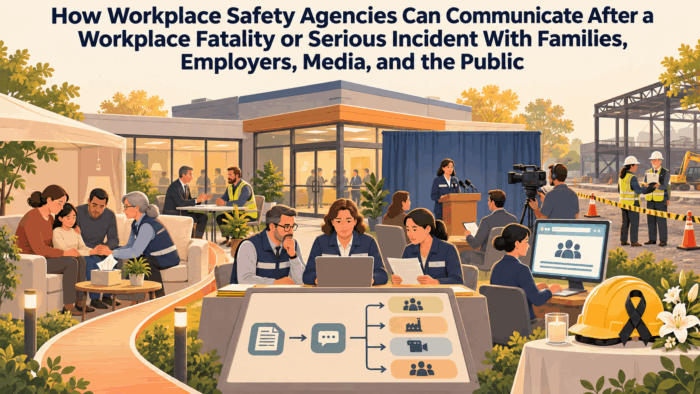
How Workplace Safety Agencies Can Communicate After a Workplace Fatality or Serious Incident With Families, Employers, Media, and the Public
A workplace fatality or serious incident creates one of the most difficult communication environments a workplace safety agency will face. Families may be grieving and searching for answers, employers may be managing an active emergency and legal obligations, workers may be frightened or uncertain about returning to the site, reporters may be seeking immediate details, and the public may want to know whether a broader safety threat exists. At the same time, the agency may still be gathering basic facts and may not yet know what caused the incident, whether violations occurred, or what enforcement action may follow.
The pressure to communicate quickly can conflict with the need to communicate carefully. Saying too little can create a vacuum that is filled by speculation, while saying too much can compromise privacy, mischaracterize an ongoing investigation, or cause families to learn sensitive information through the media. Workplace safety agencies need a communication framework that helps them move quickly without outrunning verified facts or their legal and investigative responsibilities.
The agency’s audiences also have different needs. Families need respectful, direct communication about process and available information. Employers need clarity about reporting, site access, preservation of evidence, interviews, and other procedural expectations. Workers may need reassurance about immediate safety conditions and information about how to raise concerns. Media and the public need verified facts, an explanation of what the agency is doing, and realistic expectations about when additional information may become available.
The strongest communication approach does not attempt to satisfy every audience through one message. It establishes separate but coordinated communication paths, clear approval responsibilities, and firm boundaries around what can be confirmed. The goal is to provide timely information, protect the integrity of the investigation, respect the people affected, and help the public understand what the agency can and cannot determine in the immediate aftermath.
Establish Communication Leadership Immediately After Notification
 Communication responsibilities should be assigned as soon as the agency becomes aware of a fatality or serious workplace incident. The first hours can involve investigators, supervisors, legal staff, public information officers, senior leadership, emergency responders, employer representatives, and other agencies. Without clear coordination, different officials may provide incomplete or inconsistent explanations.
The agency should identify who is responsible for external media communication, family communication, employer coordination, internal staff updates, and interagency messaging. These roles may be held by different people, but they should operate from a shared set of verified facts. Staff who are not authorized to speak publicly should know where inquiries should be directed.
A central communication lead can maintain the current approved facts, outstanding questions, contact history, and anticipated updates. This is particularly important when information is changing rapidly. A single communication record reduces the chance that an outdated detail continues circulating after investigators have learned something new.
Leadership should also decide how frequently the communication team will reconnect with investigators. Public information staff should not need to interrupt investigators continuously for updates, but they do need a predictable process for learning when the agency can confirm new information. Establishing that rhythm early helps both functions work more effectively.
Confirm the Basic Facts Before Communicating Publicly
The first public statement after a serious incident should be limited to information the agency can verify. Early reports may contain conflicting information about the number of workers involved, the nature of injuries, the employer, the worksite, the equipment involved, or even whether the incident falls within the agency’s jurisdiction. Initial communication should acknowledge uncertainty rather than turn preliminary information into established fact.
Verified facts may include that the agency was notified, investigators have responded or are responding, the location of the incident, and the general nature of the event when appropriate. The agency can also explain that the investigation is in an early stage and that additional facts will be released when they can be confirmed. This provides meaningful information without speculating about cause.
Agencies should be especially cautious with descriptions of how the incident occurred. Early accounts may come from witnesses, emergency dispatch information, or employer reports that have not yet been fully evaluated. Describing an unverified sequence as the cause of the incident can create a false public narrative that becomes difficult to correct later.
If the agency later learns that an early detail was incorrect, it should correct the record clearly. Attempting to quietly replace inaccurate information can create more confusion, especially if reporters or community members have already repeated the original statement. Transparent correction supports credibility.
Communicate With Families Before Releasing Sensitive Information Whenever Possible
Families of deceased or seriously injured workers should not learn significant details from a press release or television report when the agency has a reasonable opportunity to communicate with them directly. Workplace safety agencies should establish protocols for coordinating family communication with law enforcement, medical authorities, employers, and other agencies that may have notification responsibilities. The exact sequence will depend on the circumstances and jurisdiction.
Family communication should be compassionate but precise. Agency representatives should explain their role, what the investigation generally involves, what information can currently be shared, and how the family can contact the agency later. Families should not be given assurances about findings or timelines that the agency cannot yet support.
Agencies should also recognize that families may have questions the investigator cannot answer immediately. They may want to know exactly what happened, whether someone was responsible, whether the workplace was safe, or whether the agency had previously inspected the employer. Staff should acknowledge those questions without speculating or implying conclusions before the investigation is complete.
A designated family contact can reduce the burden of navigating the agency. Families should not need to repeatedly explain the incident to different offices or search for the correct investigator every time they have a question. A consistent point of contact can also help the agency manage updates respectfully over a potentially lengthy investigation.
Respect Grief Without Making Assumptions About What Families Want Publicly Shared
Families differ in how they want a workplace fatality discussed publicly. Some may want the worker’s name, occupation, years of service, or personal story recognized, while others may prefer privacy. Agencies should avoid assuming that public acknowledgment is automatically comforting or appropriate.
Information that is legally public may still require thoughtful handling. The fact that an agency can release a detail does not necessarily mean it needs to emphasize that detail in the earliest communication. Public-interest value, privacy considerations, and the family’s circumstances should all be considered within applicable legal requirements.
Agency statements should avoid unnecessarily graphic descriptions of injuries or death. The public rarely needs those details to understand that a serious incident occurred or that an investigation is underway. Respectful communication can still provide meaningful factual information about the incident and the agency response.
The tone should also remain measured. Phrases intended to convey sympathy should not be combined with premature conclusions about the cause of the incident or responsibility for it. Compassion and investigative neutrality can exist in the same communication.
Explain the Agency’s Role Before the Public Assumes What the Investigation Will Determine
Many people do not understand what a workplace safety agency investigates after a fatality or serious incident. The public may expect the agency to determine criminal responsibility, resolve every employment dispute, calculate civil damages, or provide immediate answers about fault. Early communication should explain the agency’s actual role.
The agency can describe that it is examining workplace conditions, applicable safety requirements, employer practices, equipment, records, training, or other factors within its authority. It can also explain that other agencies may have separate responsibilities. This helps audiences understand why multiple investigations may occur at the same time.
Agencies should avoid suggesting that an investigation automatically means a violation occurred. The purpose of the investigation is to determine what happened and whether requirements within the agency’s jurisdiction were followed. This distinction should appear consistently in media responses and public statements.
Clear role explanations also help families and workers. They may have questions that fall outside the workplace safety agency’s authority, and early clarification can help direct them toward the appropriate organization. This is more useful than allowing people to spend weeks expecting an answer the agency cannot legally provide.
Separate Immediate Safety Communication From the Longer Enforcement Investigation
The public may need information about immediate safety before the agency is ready to discuss enforcement. These are different communication needs and should be handled separately. Workers may need to know whether a site remains closed, whether a hazard has been controlled, or whether work can resume before the investigation reaches any conclusion about violations.
Agencies should communicate confirmed immediate protective actions where disclosure is appropriate. This may include explaining that a particular area remains restricted, that an employer has stopped certain operations, or that investigators are examining whether additional protective measures are necessary. The communication should avoid presenting temporary measures as final findings.
The distinction is especially important when workers are expected to return to the workplace quickly. Employees may reasonably ask whether the condition that contributed to the incident is still present. The agency should provide what information it can while explaining what remains under investigation.
Employers also benefit from this distinction. Immediate hazard control may be required even while questions about causation and enforcement remain unresolved. Clear communication helps prevent the mistaken belief that correcting a hazard is the same as admitting a violation or that the absence of an immediate enforcement announcement means the investigation is complete.
Give Employers Clear Instructions About Communication and Investigation Expectations
Employers may be managing emergency response, employee communication, family contact, production disruption, legal counsel, insurance, and regulatory obligations simultaneously. Workplace safety agencies should provide clear procedural information about what the agency expects from the employer during the initial response. This can reduce confusion without providing legal advice.
Communication may include instructions regarding reporting obligations, investigator access, preservation of relevant records or equipment, availability of management personnel, and other process requirements within the agency’s authority. The employer should know who the agency contact is and how urgent questions should be routed.
Agencies should also explain what they can and cannot discuss while the investigation is active. Employers may ask whether the agency plans to issue citations, what investigators currently believe caused the incident, or what information will be released publicly. Staff should avoid speculation and explain that conclusions will depend on the completed investigative process.
The agency should maintain a professional tone even when the incident is severe. An employer’s obligations should be communicated firmly, but the initial interaction should not presume wrongdoing. Investigative neutrality supports both fairness and the credibility of any later enforcement action.
Communicate Directly With Workers Who May Fear an Ongoing Hazard
Workers at the affected site may have immediate concerns that differ from those of the public. They may have witnessed the incident, lost a coworker, fear the same thing could happen to them, or question whether they can safely return to work. Communication should recognize both the emotional and practical dimensions of those concerns.
Agencies should provide clear information about how workers can report safety concerns, provide information to investigators, or ask questions about the agency’s role. Workers should understand that relevant information can be important to the investigation and that there are established channels for communicating with the agency.
Where appropriate, agencies can explain what is known about immediate hazard control without discussing conclusions that have not yet been reached. Workers should not have to rely solely on rumors or informal workplace conversations to understand whether an active safety issue is being addressed.
Communication should also be available to workers who face language, literacy, disability, or access barriers. Serious incidents can affect workforces with many languages and communication preferences. If urgent safety information is available only through one English-language statement, a significant portion of the workforce may remain uncertain.
Prepare an Initial Holding Statement Before Media Pressure Escalates
Media inquiries can begin within minutes of a fatality or major workplace incident. Agencies should have a holding-statement structure that can be adapted quickly once essential facts are verified. This reduces the likelihood that staff draft under extreme pressure or provide inconsistent informal responses.
The initial statement should generally confirm the agency’s involvement, identify the location or employer when appropriate, acknowledge the seriousness of the event, and explain that the investigation is underway. It should also establish what the agency cannot yet confirm. The statement does not need to answer every likely question.
Agencies should avoid filling early statements with generic language that provides no useful information. Even when facts are limited, the agency can explain its role, what the investigation generally involves, and when another update may be provided if that can be estimated responsibly. This gives reporters something accurate to communicate while the investigation develops.
The holding statement should be updated as soon as significant verified information becomes available. Repeating the same statement for days while circumstances change can make the agency appear unresponsive. A disciplined update process provides transparency without forcing investigators to provide premature conclusions.
Avoid Speculating About Cause, Fault, or Violations
Questions about the cause will usually dominate early media coverage. Reporters may ask whether equipment failed, whether an employer ignored warnings, whether a worker made an error, or whether a particular safety standard was violated. Agencies should consistently explain that those questions are part of the investigation until sufficient evidence supports a conclusion.
Speculation can cause harm in several directions. It can unfairly assign blame to an employer or worker, create expectations for an enforcement outcome, distress families, and complicate later communication if the evidence leads elsewhere. Once a causal explanation appears in public coverage, it can remain influential even after it has been corrected.
Agency representatives should distinguish between describing the physical event and explaining why it happened. Investigators may be able to confirm that a worker fell, was struck by equipment, or was exposed to a hazardous condition without being able to explain what caused the event. That distinction should be maintained in public messaging.
When the investigation eventually reaches supported conclusions, the agency can explain them with appropriate context. Early restraint makes that later communication more credible because the public can see that the agency waited for evidence before assigning significance.
Coordinate With Other Agencies Without Creating Conflicting Public Accounts
A serious workplace incident may involve fire departments, law enforcement, medical examiners, emergency management agencies, transportation authorities, environmental regulators, local government, federal agencies, or other organizations. Each may have different authority, information, and disclosure rules. Without coordination, the public may receive several versions of the same event.
Workplace safety agencies should identify the relevant public information contacts as early as possible. Coordination can help agencies confirm which facts are shared, which organization is responsible for particular information, and whether joint or sequential updates would reduce confusion. This does not require every agency to use identical messaging.
Agencies should avoid speaking for another organization unless that responsibility has been explicitly coordinated. A workplace safety regulator should not speculate about a criminal investigation, medical determination, or environmental finding controlled by another agency. Clear boundaries reduce contradictory statements.
Interagency communication is particularly important when one agency reaches a conclusion before another. The public should understand that different investigations answer different questions and may operate on different timelines. One agency closing its work does not necessarily mean every aspect of the incident has been resolved.
Explain Why Serious Incident Investigations Take Time
Families, workers, employers, elected officials, and reporters may all want rapid answers after a fatality. Workplace safety agencies should explain early that serious incident investigations can require interviews, document review, equipment examination, technical analysis, expert input, and coordination with other agencies. The exact process will vary with the incident.
Agencies should avoid promising a completion date unless they can reliably meet it. A missed public deadline can create additional frustration and may cause audiences to interpret ordinary investigative complexity as agency delay. It is often more useful to describe the major stages of the process than to predict the exact day a conclusion will be reached.
Periodic communication can also help when little visible progress occurs. An agency may confirm that the investigation remains active and explain the kinds of work underway without releasing confidential or incomplete findings. This reassures audiences that the absence of a public update does not mean the matter has been abandoned.
Expectation setting is particularly important for families. Their need for answers may remain intense long after public and media attention declines. A communication system should provide a way for them to receive appropriate updates throughout the investigation rather than relying exclusively on public announcements.
Treat the First 24 Hours as the Beginning of a Longer Communication Process
Communication after a workplace fatality should not be designed only around the first press release. The incident may remain active for months as the investigation develops, citations are issued, findings are contested, hearings occur, or corrective actions are completed. Agencies should anticipate this longer lifecycle from the beginning.
Early communication should establish terminology and expectations that can remain consistent later. If the agency carefully distinguishes investigation from findings in the first hours, it will be easier to explain subsequent developments without correcting exaggerated early statements. Consistency supports credibility across the entire case.
The agency should also maintain records of what has been publicly communicated, what families and employers have been told, and what questions remain unresolved. This prevents later updates from contradicting earlier explanations and helps new staff understand the communication history if responsibility changes.
A serious workplace incident tests more than an agency’s ability to issue timely information. It tests whether the agency can communicate with compassion, accuracy, neutrality, and discipline under intense pressure. Establishing those principles at the beginning creates the foundation for every communication that follows.
Create a Separate Communication Path for Families
Families should not have to rely on public statements to understand what the workplace safety agency is doing. A dedicated communication path can provide a more respectful and useful source of information while reducing the likelihood that relatives repeatedly contact investigators, call centers, or senior leadership for basic updates. The agency should identify who will serve as the family contact and what information that person is authorized to share.
The family contact should explain the investigation process in plain language, including what the agency is examining, what stages may follow, and why some information cannot yet be released. Families may not be familiar with inspections, citations, technical reviews, employer responses, or administrative appeals. Process explanations can help them understand why an investigation may continue even when the physical circumstances of the incident seem obvious.
Communication should not depend entirely on the family initiating contact. Where appropriate, the agency should establish a reasonable update rhythm so relatives know when they can expect to hear from someone even if no major finding has been reached. A short update that confirms the investigation remains active can be more respectful than prolonged silence.
The agency should also document family contacts carefully. When several relatives are involved, staff should understand who has been designated to receive information and what has already been communicated. Consistency protects both the family and the agency from contradictory explanations during an emotionally difficult process.
Explain Investigative Milestones Without Promising Findings
Families, employers, workers, and reporters may interpret a lack of public news as a lack of investigative progress. Agencies can reduce that uncertainty by explaining major investigative milestones without revealing incomplete findings. Communication can describe the process even when the ultimate cause or enforcement outcome is not yet known.
For example, the agency may be able to explain that interviews are continuing, records are being reviewed, equipment is being examined, technical information has been requested, or coordination with another agency remains underway. These descriptions help audiences understand that serious investigations involve multiple streams of work. They should not imply that any particular evidence has already established responsibility.
Milestone communication should remain general enough to protect investigative integrity. The agency does not need to publish every interview completed or every document requested. The objective is to provide meaningful process transparency without turning an active investigation into a running public narrative.
This approach can also help manage expectations when one stage takes longer than anticipated. If technical analysis or another agency’s work affects the timeline, the workplace safety agency can explain that dependency without assigning blame. Process transparency is often more useful than an uncertain completion estimate.
Prepare Employers for Ongoing Communication Obligations
Employer communication should continue beyond the initial site response. As the investigation proceeds, the agency may request records, interviews, corrective information, follow-up access, or confirmation that particular conditions have been addressed. Employers should understand how those requests will be communicated and which agency contact is responsible.
Agencies should distinguish between investigative requests and public communication. An employer may receive detailed questions from investigators while the agency’s external statement remains limited. The difference should not be interpreted as inconsistency. Public communication has a different purpose and may be subject to different disclosure constraints.
Employers should also know how the agency will handle questions about public statements. If the agency plans to release a citation, settlement, or final finding publicly, there may be established procedures governing notification or release. Those procedures should be followed consistently rather than improvised for high-profile cases.
The agency should avoid allowing communication coordination to become negotiation over factual language that the agency is authorized to publish. Employers may dispute findings or object to particular characterizations, but the agency’s obligation is to communicate the official record accurately and fairly. Clear internal standards make that distinction easier to maintain.
Communicate With Workers About Safety Without Asking Them to Interpret the Investigation
Workers may know important facts about the incident while also experiencing fear, grief, anger, or uncertainty. Agencies should make it easy for workers to provide information without placing the burden on them to determine what caused the event. Investigators can evaluate evidence, while workers can describe what they saw, experienced, or know about workplace practices.
Communication should explain how workers can speak with the agency and what types of information may be relevant. Employees may have knowledge about equipment, training, staffing, work procedures, prior incidents, near misses, or concerns raised before the event. Clear outreach can help investigators receive information that might otherwise remain unreported.
Workers should also know that an interview is different from a public statement. Information provided during an investigation may not immediately appear in agency communication, and the absence of public acknowledgment does not mean the information was ignored. Explaining that distinction can reduce frustration.
Where workers are represented by unions, worker organizations, or other legitimate representatives, agencies should coordinate communication within applicable procedures while preserving appropriate investigative channels. The goal is to make participation understandable and accessible without allowing outside narratives to substitute for the agency’s own fact-finding.
Address Return-to-Work Questions With Care
After a serious incident, employees may be especially concerned about whether the workplace is safe enough to return. Workplace safety agencies should be prepared for these questions even when final investigative conclusions remain far away. Immediate hazard conditions and long-term enforcement findings should be communicated as separate issues.
The agency may be able to confirm whether a particular operation remains stopped, whether specific equipment is restricted, or whether corrective measures have been taken within its authority. It should avoid implying that the entire workplace has been declared safe if the agency has not made such a determination. Broad reassurance can create confusion when the investigation remains open.
Workers should also know where to report new concerns after operations resume. A serious incident can reveal hazards that were not fully understood before the event, and employees may notice conditions investigators have not yet examined. Clear reporting information gives workers a constructive pathway for those concerns.
Employers likewise need clarity about what resumption of work means. Restarting operations does not necessarily indicate that the agency has completed its investigation or found no violation. Public and internal communication should preserve that distinction.
Build a Media Briefing Framework for Serious Incidents
High-profile incidents may require more than a short holding statement. Agencies should have a framework for media briefings that allows spokespeople to provide useful information while maintaining consistent boundaries. The structure should begin with verified facts, the agency’s role, current procedural status, and what remains unknown.
Spokespeople should be prepared for repeated questions about cause, blame, prior inspections, employer history, worker conduct, citations, and potential penalties. A prepared framework can help them answer directly without speculating. Saying that a question remains under investigation is more credible when the spokesperson can also explain what the agency is doing to examine it.
Agencies should coordinate media availability with investigators so public communication does not interfere with field work. Investigators should not routinely become the primary public spokesperson simply because they possess the most technical knowledge. Communications staff can translate verified information while investigators remain focused on evidence and case development.
For especially significant incidents, the agency may also need to coordinate who speaks on behalf of senior leadership. Leadership remarks should add context, empathy, or explanation of agency responsibility rather than introduce new facts that have not gone through the established verification process.
Prepare for Questions About Prior Inspections and Complaints
After a fatality or serious incident, reporters and workers may immediately ask whether the agency had previously inspected the employer or received earlier complaints. These questions can become central to public perception of the agency’s own performance. Agencies should prepare to address them accurately and without defensiveness.
If prior enforcement information is public, the agency can explain what occurred and how it relates to the current investigation, if that relationship is known. A previous inspection at the same employer does not necessarily mean the same hazard was involved. The communication should avoid implying a connection that has not been established.
If the agency cannot discuss certain complaint or investigative information, it should explain the limitation rather than simply refusing to comment. A concise explanation of confidentiality or disclosure rules can help the public understand why information is unavailable. Staff should apply those rules consistently across cases.
Agencies should also be prepared for scrutiny of their own follow-up. If earlier violations or hazards are relevant, leadership may need to explain what actions the agency took at the time. Transparency about agency process is an important part of maintaining credibility during serious incidents.
Coordinate Public Records and Media Communication
Serious incidents often generate public records requests while the investigation is still active. Media teams, records staff, legal staff, and investigators should coordinate so public statements and document releases do not contradict each other. A fragmented response can create confusion about what the agency considers verified or releasable.
Agencies should establish internal procedures for identifying records associated with the incident and determining which are public under applicable requirements. Communications staff do not need to make those determinations themselves, but they should understand enough about the process to explain why some records may not be immediately available.
The timing of records releases can also affect public understanding. A document may contain preliminary information that was later corrected or refined. When appropriate, the agency can provide context so a preliminary record is not mistaken for a final investigative conclusion.
Coordination also reduces the risk that the agency publicly states that a fact is unknown while simultaneously releasing a document that appears to answer the question differently. Consistent internal communication is essential when public scrutiny is high.
Prepare for Misinformation and Unverified Accounts
Serious incidents can generate rumors quickly, especially when coworkers, witnesses, emergency responders, community members, or social media users begin sharing partial accounts. Some information may be accurate, while other claims may be incomplete or entirely wrong. Agencies should monitor significant misinformation without attempting to respond to every online statement.
The priority should be correcting claims that materially affect public safety, the integrity of the investigation, or understanding of the agency’s actions. If a false report suggests that another hazard remains uncontrolled, for example, the agency may need to provide verified information promptly. Less consequential speculation may not warrant a response.
Corrections should focus on the accurate fact rather than amplifying the rumor unnecessarily. The agency can state what it has confirmed and what remains under investigation. This keeps attention on verified information.
Agencies should also be cautious about repeating unverified claims in order to deny them. Repetition can unintentionally give a rumor greater visibility. A disciplined correction strategy protects credibility without allowing social media speculation to dictate the agency’s communication agenda.
Communicate When the Investigation Expands Beyond the Original Incident
A fatality or serious incident may reveal hazards that extend beyond the immediate event. Investigators may identify concerns at other locations, with similar equipment, or within broader employer practices. If the agency expands its activity, communication should explain that development carefully.
The agency should distinguish between an expanded investigation and an established broader violation. Examining additional sites or practices does not itself prove that the same problem exists elsewhere. Public wording should preserve that distinction.
If the broader review creates an immediate safety message for other employers or workers, the agency may need to communicate separately from the case-specific investigation. A safety alert or industry advisory can explain preventive measures without disclosing unsupported conclusions about the original incident.
This separation can improve both fairness and public safety. The agency can address a potential hazard broadly while continuing to investigate the individual case on its own evidentiary record.
Explain Citations and Enforcement Actions When They Are Issued
If the investigation results in citations, penalties, corrective requirements, or other enforcement actions, the agency should explain them in language that workers, families, employers, and the public can understand. A technical citation alone may not explain what investigators found or why the requirement matters.
The communication should identify the established violations, the relevant workplace conditions, and the required corrective action at an appropriate level. It should also explain whether the employer can contest or appeal the action. This helps the public distinguish an issued citation from a final, unreviewable outcome.
Agencies should avoid treating the issuance of citations as a moment for celebratory language. A worker may have died or suffered life-changing injuries. Enforcement communication should remain factual and respectful even when the agency is announcing significant findings.
Families may need separate communication before or alongside the public release. Learning the investigative outcome through a news alert can compound frustration after a lengthy process. Agencies should build family notification into the enforcement communication plan where appropriate.
Communicate When the Investigation Finds No Citable Violation
Not every serious workplace incident results in a citation. Agencies should be prepared to communicate this outcome with the same care used when violations are found. A fatality does not automatically establish that an enforceable workplace safety requirement was violated.
The agency should explain what the conclusion means within its authority. Saying that no citation was issued is different from declaring that nothing went wrong, that the incident was unavoidable, or that no other legal or organizational questions remain. The communication should avoid conclusions beyond the scope of the investigation.
Families may find this outcome especially difficult. Separate communication should explain the agency’s role, what was reviewed, and what the enforcement conclusion means without minimizing the seriousness of the loss. Staff should anticipate that a procedural explanation may not resolve the family’s broader questions about why the incident occurred.
Public communication should remain equally measured. The absence of a citation should not be framed as vindication unless the agency’s findings support that characterization. Precision protects both families and employers from conclusions the agency did not actually reach.
Maintain Communication After Public Attention Declines
Media coverage often fades before a serious incident investigation ends. Families, workers, and employers do not experience the same decline in interest. Agencies should maintain appropriate communication even when the case is no longer prominent in the news.
Scheduled or milestone-based updates can help families understand that the matter remains active. Employers should continue receiving procedural communication through established channels, while workers should retain access to reporting and inquiry pathways. The communication system should not depend on external attention.
Agencies should also maintain internal continuity if investigators, supervisors, or communication staff change during a long case. Contact records, approved messaging, family communication history, and outstanding commitments should transfer with the case. Losing institutional memory can make an already difficult process more frustrating for affected parties.
Long-term communication demonstrates that agency responsibility continues after the emergency phase ends. A workplace fatality or serious incident may move out of the public spotlight quickly, but respectful, accurate, and consistent communication remains essential until the agency’s role is complete.
Communicate Carefully When Witness Accounts Conflict
Serious workplace incidents often produce multiple accounts of what happened, especially when several workers, supervisors, contractors, or emergency responders were present. Early witness statements may differ because people saw the event from different locations, remembered different details, or experienced the incident under significant stress. Agencies should avoid treating the first coherent account as the definitive explanation.
Public communication should reflect that investigators are gathering and comparing information. The agency can acknowledge that interviews are underway without describing conflicting accounts in a way that invites the public to decide which witness is correct. Witness credibility and evidentiary significance belong within the investigative process.
Families may also hear different versions of the incident from coworkers or employer representatives. Agency staff should explain that conflicting information is one reason investigations take time. This can help relatives understand why the agency may not be ready to provide a final sequence of events immediately.
The same discipline should apply internally. Public information staff should not build messaging around one witness account simply because it is the most detailed account available at the moment. Verified communication should follow the evidence as it develops rather than reinforce an early narrative.
Explain Technical Findings Without Overwhelming the Audience
 Fatality and serious incident investigations can involve highly technical subjects such as machinery, electrical systems, fall protection, structural conditions, hazardous substances, ventilation, excavation, vehicle operations, or industrial processes. When technical findings become public, agencies need to explain them in language that families, workers, employers, reporters, and the general public can follow.
The explanation should begin with the practical safety issue rather than the technical terminology. If a protective system was missing, a machine was not adequately controlled, or a required procedure was not followed, the agency can explain what the protection was intended to prevent. Technical standards and citations can then provide the formal basis.
Agencies should avoid simplifying the issue so much that the explanation becomes inaccurate. A serious incident may involve several contributing conditions rather than one obvious failure. Where the evidence supports multiple factors, public communication should preserve that complexity without requiring the audience to understand every engineering detail.
Visual materials, diagrams, or plain-language summaries can sometimes help explain technical findings, but they should be reviewed carefully before release. The goal is understanding, not dramatization. Any visual communication should respect the seriousness of the event and avoid unnecessarily graphic representations.
Communicate About Worker Actions Without Shifting Blame Prematurely
Serious incident investigations may examine what a worker was doing immediately before the event. That information can be important, but agencies should be extremely careful about how worker actions are described publicly. A description of an action should not automatically become a conclusion that the worker caused the incident.
Workplace conditions, supervision, training, equipment, procedures, workload, communication, and other factors may all influence what occurred. Public communication should avoid reducing a complex safety event to individual behavior unless the completed investigation supports that conclusion within the agency’s authority. Early statements should be particularly restrained.
This is important for families, who may interpret careless wording as an accusation against the person who was killed or seriously injured. It also matters for coworkers, who may become reluctant to participate in an investigation if they believe the agency publicly assigns blame before understanding the full context.
Agencies can still describe relevant worker activity when necessary to explain the incident. The wording should separate observable facts from conclusions about causation or responsibility. That distinction supports both investigative integrity and respectful communication.
Address Contractor and Multi-Employer Worksites With Clear Role Explanations
Serious incidents frequently occur at worksites involving general contractors, subcontractors, staffing firms, property owners, vendors, or multiple employers operating at the same location. Public communication can become confusing if the agency refers broadly to “the employer” when several entities may have different responsibilities.
Agencies should identify the entities involved only to the extent supported by the investigation and public record. The communication should explain which company employed the affected worker, which entity controlled the relevant work or site where appropriate, and which employers were included in any enforcement action. These distinctions help prevent responsibility from being assigned by association.
If the investigation is examining multiple employers, the agency should say so without implying that every entity committed a violation. Different employers may have different duties, findings, or outcomes. Public messaging should preserve those distinctions as the case develops.
This precision also helps other businesses understand the compliance implications. Contractors and host employers may have different responsibilities depending on the work arrangement and applicable requirements. A clear explanation makes the enforcement communication more educational without turning one case into generalized legal advice.
Explain When the Incident Involves Equipment or Products Used at Other Worksites
An investigation may identify a concern involving equipment, machinery, tools, or products used beyond the incident site. This can create a broader public safety communication need before the agency has completed the entire enforcement case. Agencies should separate the immediate preventive message from any unresolved finding about responsibility.
If there is a verified hazard that other employers should address, the agency may issue a safety alert or other advisory explaining what users should inspect or avoid. The message should clearly state what is known and what remains under investigation. It should not imply a product defect or legal finding unless that conclusion has been established.
Coordination with other regulators or manufacturers may also be necessary. Different organizations may have authority over product safety, recalls, transportation, or equipment certification. Workplace safety agencies should explain their own role and avoid speaking beyond it.
This approach allows agencies to act on urgent preventive information without waiting for every enforcement question to be resolved. Public safety communication and case adjudication can proceed on different tracks when the agency clearly distinguishes them.
Communicate When Similar Incidents Have Happened Before
A fatality may prompt questions about whether similar incidents occurred previously at the same employer, worksite, industry, or with similar equipment. These questions can be important, but agencies should distinguish verified patterns from superficial similarities. Two incidents that look alike publicly may involve very different underlying facts.
If prior enforcement history is relevant and publicly available, the agency can explain it with context. A previous citation involving the same hazard may be more significant than an unrelated inspection years earlier. The communication should help the audience understand why the history matters rather than simply listing prior agency contacts.
Agencies should also avoid implying systemic failure based on a small number of superficially similar events. A broader pattern may require additional analysis before the agency can responsibly make that claim. Public pressure for immediate conclusions should not replace evidence.
Where repeated incidents reveal a genuine broader concern, the agency can use the case to support industry outreach, targeted education, or additional enforcement communication. The broader message should be grounded in documented patterns rather than the emotional weight of one serious event.
Handle Graphic Images, Video, and Other Sensitive Evidence With Strong Communication Controls
Modern workplace incidents may be captured by surveillance cameras, mobile phones, body-worn cameras, vehicle systems, or other recording devices. Images and video can become part of the investigative record and may generate intense public interest. Agencies should establish clear controls around how sensitive visual evidence is handled and discussed.
The public value of releasing graphic material is usually different from the value of using it internally for investigation. Even when records may eventually become public under applicable requirements, agencies should coordinate carefully with legal and records staff before using visual evidence in proactive communication. Respect for families and injured workers should remain central.
Communications staff should also prepare for situations where video is released by someone else. A widely circulated clip may appear to show the entire event while omitting important context before or after the recorded moment. The agency should avoid validating public interpretations before investigators have completed their review.
If visual evidence materially clarifies an enforcement finding later, the agency may be able to describe what investigators observed without reproducing disturbing imagery. Communication can support understanding without unnecessarily exposing families, coworkers, and the public to graphic content.
Communicate About Potential Criminal Issues Without Blurring Agency Roles
Some workplace fatalities may raise questions about possible criminal conduct, particularly when law enforcement or prosecutors become involved. Workplace safety agencies should be careful not to characterize conduct as criminal unless that determination falls within their authority and has been formally established.
Public communication should explain which organization is responsible for which part of the response. The workplace safety agency may investigate compliance with occupational safety requirements while law enforcement examines separate issues. Parallel investigations can occur without one determining the outcome of the other.
Agency staff should also avoid commenting on whether evidence gathered during the safety investigation could support criminal action unless authorized and appropriate. Those questions may involve legal considerations outside the communications function. Referring reporters to the responsible agency is often the clearest approach.
This separation protects both investigations. It also prevents the public from interpreting a workplace safety citation as proof of criminal liability or the absence of criminal charges as evidence that no safety violation occurred.
Prepare for Community and Elected Official Interest
A fatality can quickly become a community issue, especially when the employer is large, the incident affects a prominent local workplace, or workers live in the surrounding community. Elected officials may request briefings, issue public statements, or ask the agency for information. The agency should prepare for this attention without creating a separate factual standard for politically visible audiences.
Briefings should rely on the same verified information used for other official communication. Elected officials may receive appropriate procedural context, but public visibility should not lead the agency to share unsupported conclusions or confidential investigative detail. Consistent boundaries protect the integrity of the case.
Community organizations may also seek information or want to support affected workers and families. Agencies can provide public process information, reporting channels, safety guidance, or available resources without asking outside groups to speak for the agency. Partnerships should support communication rather than create competing official narratives.
Senior leaders should be especially disciplined when speaking publicly in politically sensitive cases. Expressions of concern or commitment to a thorough investigation can be appropriate, while predictions about findings or penalties should be avoided. Leadership tone can strongly influence how the public interprets an active investigation.
Explain Delays Without Sounding Defensive
Lengthy investigations can create frustration, particularly when families and workers feel that the basic facts should already be obvious. Agencies should explain delays in a way that provides context without appearing to excuse inaction. The communication should focus on what work remains and why accuracy matters.
Different factors may affect timing, including technical testing, witness availability, document review, coordination with other agencies, expert analysis, or procedural requirements. Agencies should explain these factors at an appropriate level when they materially affect the case. General references to “an ongoing investigation” may become less useful over time.
The agency should also distinguish between unavoidable investigative complexity and internal delay. If a matter has taken longer than expected, staff should avoid making promises merely to relieve pressure. A realistic explanation is more credible than a deadline the agency later misses.
Families may need a more personal explanation than the general public. The family contact can provide additional process context where appropriate while remaining within disclosure limits. Even when there is no major new finding, acknowledging the passage of time can demonstrate that the agency understands the family’s continued need for answers.
Communicate Findings in a Way That Separates Cause, Contributing Factors, and Violations
A completed investigation may identify several layers of explanation. The physical event that caused the injury may be different from the conditions that contributed to it, and those conditions may not align perfectly with the violations the agency is authorized to cite. Public communication should distinguish these categories rather than compressing them into one statement.
For example, the agency may determine that a worker was struck by equipment, that visibility and work-zone controls contributed to the event, and that specific requirements were violated. These are related but not identical findings. Clear communication helps the audience understand how the agency moved from evidence to enforcement.
This distinction also protects against overclaiming. The agency should not imply that every contributing factor constitutes a legal violation or that every citation independently caused the incident. Precise wording is particularly important when a case may later be reviewed or contested.
Families and the public may still want a single answer to the question of why the incident happened. The agency can acknowledge that serious incidents often result from multiple interacting conditions. A careful explanation can be more useful than an artificially simple conclusion.
Communicate Corrective Actions as Part of the Safety Story
Public communication should not end with a description of what went wrong. Where appropriate, agencies can also explain what corrective measures were required, completed, or underway. This helps workers and the public understand how the enforcement process connects to prevention.
Corrective actions may include equipment changes, revised work procedures, training, engineering controls, hazard abatement, or other requirements. The agency should distinguish between measures voluntarily taken by the employer and actions formally required through enforcement. Both may be relevant but carry different meanings.
Workers may be particularly interested in whether corrective measures apply before similar work resumes. Clear communication can help address ongoing safety concerns without implying that all risk has been eliminated. The agency should avoid broad guarantees about future safety.
Explaining corrective action also gives employers in similar industries a practical lesson. They can review their own operations for comparable risks. This turns a tragic incident into a broader prevention opportunity while keeping the communication grounded in verified findings.
Prepare for Strong Public Reactions to Enforcement Outcomes
The final enforcement outcome may not match public expectations. Families or worker advocates may believe penalties are too low, while employers or industry groups may believe the agency acted too aggressively. Agencies should prepare to explain the basis and limits of their authority without becoming argumentative.
Public communication can describe how citations, classifications, penalties, corrective actions, and review rights fit within the applicable enforcement framework. It should avoid suggesting that the agency had unlimited discretion if amounts or remedies are constrained by law or policy. Context can help audiences understand why a serious event does not always result in the outcome they expected.
The agency should also be prepared for criticism when no citation is issued or when an initial enforcement action is later modified. Those developments should be explained using the same principles of accuracy and procedural fairness applied earlier in the case. A difficult outcome does not justify vague communication.
Consistency is important because the agency’s credibility may be judged by how it communicates results that disappoint one or more audiences. Respectful, clear explanation demonstrates that the agency’s role is to apply its authority based on the evidence, not to produce the most publicly satisfying outcome.
Use Serious Incident Communication to Improve Future Prevention
A completed fatality or serious incident investigation can provide lessons beyond the individual case. Agencies should evaluate whether findings point to broader communication needs for an industry, occupation, equipment type, or hazard. Prevention communication can extend the value of the investigation without continuing to center the tragedy itself.
The agency may develop safety alerts, employer guidance, worker education, training materials, or targeted outreach based on the lessons learned. These materials should separate general preventive guidance from the specific enforcement record. The case can provide context without becoming the only reason employers should act.
Family considerations should remain important when the agency continues referencing a fatal incident publicly. Repeatedly using the worker’s name, image, or story in later campaigns may not be necessary to communicate the safety lesson. Agencies can preserve the educational value while showing restraint.
This transition from incident response to prevention is an important part of the communication lifecycle. A strong system does not treat the investigation as complete simply because a citation or final decision has been issued. It asks how the agency can convert verified lessons into communication that reduces the risk of another serious incident.
Build a Formal Serious Incident Communication Protocol
Workplace safety agencies should not wait for a fatality or catastrophic event to decide how communication responsibilities will work. A formal protocol can establish who leads communication, who coordinates with investigators, who communicates with families, who handles media, and who approves public statements. This preparation reduces confusion during the first hours, when pressure is high and reliable information may still be limited.
The protocol should distinguish between operational response, investigative communication, family communication, employer coordination, worker outreach, media relations, public records, and leadership messaging. These functions may overlap, but they should not compete for control of the same information. Clear roles make it easier to maintain consistency while allowing each audience to receive the type of communication it needs.
Agencies should also identify thresholds for when senior leadership becomes involved. A routine serious injury may be handled primarily by program and communications staff, while a multiple-fatality event, high-profile incident, or event with broader public safety implications may require executive participation. Those thresholds should be defined before political or media pressure begins.
The protocol should be tested periodically. Tabletop exercises can help agencies identify where approval chains are too slow, family communication is unclear, or interagency responsibilities overlap. A plan that has never been practiced may fail when the agency needs it most.
Create a Single Verified Information Structure for the Entire Agency
Serious incidents can generate dozens of internal conversations at the same time. Investigators may have one set of facts, leadership another, communications staff a third, and call center employees only the information available when the incident was first reported. Agencies need a single verified information structure that distinguishes confirmed facts from preliminary reports and unresolved questions.
This structure can include the incident location, employer, known injuries or fatalities, investigative status, involved agencies, approved public language, family notification status, and information that should not be released. It should be updated whenever a material fact changes. Staff should know which version is current.
The system should also distinguish between information that is verified internally and information approved for public release. Investigators may know details that cannot yet be disclosed because they remain preliminary, confidential, or sensitive. Communications staff need to understand that difference so internal knowledge does not automatically become public messaging.
A disciplined information structure also helps with later accountability. If the agency must explain why an early statement changed, staff can identify what was known at each point in time. This protects against the unrealistic expectation that the agency should have known final facts during the first hours of an evolving investigation.
Establish a Family Communication Standard That Extends Through the Full Case
Family communication should be governed by a standard rather than left entirely to individual investigators. The standard can define who makes initial contact, who provides later updates, how family preferences are documented, and how the agency handles significant developments such as citations, findings, settlements, or case closure. Consistency becomes especially important when an investigation lasts many months.
The agency should establish expectations for contact even when little has changed. Families may interpret long periods of silence as neglect or assume that the investigation has stalled. A scheduled or milestone-based update can reassure them that the matter remains active without requiring the agency to disclose incomplete findings.
The standard should also address how the agency handles multiple family members. One relative may be designated as the primary contact, or the agency may need another arrangement depending on the circumstances. Staff should avoid providing materially different explanations to different relatives unless there is a clear reason.
Significant public announcements should be coordinated with family communication whenever possible and appropriate. Families should not routinely discover a major citation or final investigative outcome through news coverage before the agency has attempted direct contact. This is both a communication and a trust issue.
Develop Communication Standards for Employers During Active Investigations
Employers need a predictable understanding of how the agency will communicate throughout a serious incident investigation. This does not mean giving advance insight into every investigative conclusion, but it does mean establishing clear channels for procedural communication, requests for information, site access, corrective actions, and case developments.
The agency should identify a primary contact and explain how official requests will be transmitted. Employers should know which communications require a response, which are informational, and which may trigger additional procedural obligations. Clear channels reduce misunderstandings that can delay the investigation.
Agencies should also establish how communication will be handled when employer counsel, insurers, corporate offices, contractors, or other representatives become involved. Multiple representatives can create duplication and conflicting messages. The agency should maintain a clear official communication path.
The same standard should apply regardless of the employer’s size or public profile. A major corporation should not receive a fundamentally different communication process simply because it has a sophisticated communications department or greater political visibility. Consistency supports fairness.
Integrate Worker Communication Into Serious Incident Response
Workers are often a critical audience but can be overlooked between family communication and media response. A serious incident can create fear, grief, uncertainty, and rumors throughout the workforce. Agencies should include worker communication in their incident-response planning rather than assuming the employer will address every information need.
Workers should be told how to provide information, raise safety concerns, and understand the agency’s role. They should also know whether the agency can discuss immediate hazard conditions or whether particular questions remain under investigation. Clear access to the agency can reduce reliance on workplace rumor.
Communication should account for language, literacy, disability, and work schedules. A multilingual workforce may require translated materials, interpretation, alternate formats, or outreach outside normal business hours. These needs are easier to address when they are anticipated in advance.
Worker communication should also recognize the emotional impact of the event without turning the agency into a counseling provider. Staff can acknowledge the seriousness of the incident, explain available procedural resources, and direct workers toward appropriate assistance where applicable. The agency’s role should remain clear.
Create Preapproved Holding Statements and Message Frameworks
Agencies can save valuable time by developing holding-statement templates before a serious incident occurs. These templates should not contain case-specific conclusions, but they can establish the structure for confirming agency involvement, acknowledging the seriousness of the event, explaining the investigative role, and setting expectations for future updates.
Different templates may be useful for a fatality, multiple serious injuries, a chemical release, structural collapse, transportation-related workplace event, or other major incident. The purpose is not to script the entire response. It is to avoid drafting basic language from scratch while facts are still developing.
Templates should include clear placeholders for verified information and warnings against inserting unconfirmed details. They should also include approved language explaining that an investigation is underway and that cause or violations have not yet been determined. This helps staff resist pressure to make premature statements.
Agencies should review these templates regularly. Changes in leadership, law, procedure, technology, or media practice can make older language less useful. Prepared messaging only helps if it remains operationally current.
Establish Update Triggers Instead of Communicating Only When Media Pressure Increases
Public updates should be based on meaningful case developments rather than the intensity of outside pressure. Agencies should define the types of events that may justify an update, such as confirmation of key facts, completion of an immediate hazard response, issuance of citations, significant procedural changes, or conclusion of the investigation.
This does not mean every development requires a public statement. The agency should consider whether the information materially changes what families, workers, employers, media, or the public need to understand. Update criteria help staff make those decisions consistently.
A trigger-based model also reduces the risk that high-profile cases receive frequent updates while similar lower-profile incidents receive little communication. Media attention should not determine the agency’s transparency standards. Comparable events should follow comparable communication principles.
Agencies can also establish periodic status confirmations for unusually long investigations. Even when no major milestone has occurred, a brief confirmation that the investigation remains active can prevent the public record from going silent for an extended period.
Build a Structured Review Process for Fatality and Serious Incident Communications
Every major public statement should undergo a defined review before release. The process should confirm factual accuracy, procedural status, privacy considerations, family communication status, employer identification, involved agencies, and any legal or investigative limitations on disclosure. This review protects both speed and accuracy by making responsibilities clear.
The process should also examine tone. A statement can be technically accurate while still sounding insensitive, accusatory, defensive, or overly celebratory about enforcement. Serious incidents require language that recognizes human impact without compromising regulatory neutrality.
Headlines and social media posts should receive the same scrutiny as formal statements. A carefully written press release can be undermined by a short social post that overstates cause or blame. Every public-facing format should reflect the same verified facts.
Agencies should document final approval and maintain the released version. This creates a clear communication record and helps future staff understand what the agency publicly said at each stage of the case.
Establish Rules for Sensitive Names, Images, and Personal Information
Workplace fatality communication can involve names, photographs, video, medical information, family details, and other sensitive material. Agencies should establish rules for how these materials are handled before they become the subject of urgent requests. Legal availability and proactive communication value should be considered separately.
The agency should define when a worker’s name may be released and how that decision interacts with family notification or other agencies’ responsibilities. The same care should apply to photographs, recordings, and graphic evidence. Public interest does not automatically require maximum disclosure.
Staff should also consider indirect identification. A statement may omit a worker’s name while providing enough details about job title, shift, location, and circumstances that coworkers or community members can identify the individual. Privacy review should consider the combined effect of the information.
Clear rules protect families and staff alike. Communications employees should not have to make high-stakes privacy decisions independently during an emergency. Established standards allow faster and more consistent judgment.
Coordinate Communication Across Jurisdictions and Agencies
Serious incidents can involve multiple regulators and public agencies, particularly when they affect transportation, hazardous materials, construction, emergency response, public infrastructure, or criminal investigation. Workplace safety agencies should develop interagency communication protocols before a crisis whenever recurring relationships make that possible.
These protocols can establish points of contact, processes for confirming shared facts, and expectations about which organization will lead particular announcements. They should also clarify how agencies will handle situations where one investigation advances more quickly than another. Coordination does not require a single spokesperson for every issue.
Agencies should agree on basic terminology where conflicting language could create public confusion. One agency may describe an event as an accident, another as an incident, and another using a technical classification. Where terminology carries substantive implications, coordination can prevent unintended contradictions.
Interagency communication should still preserve each organization’s authority. A workplace safety agency should not allow a joint statement to imply conclusions beyond its jurisdiction. Coordination works best when roles are explicit.
Create Communication Procedures for Citations, Settlements, Appeals, and Final Outcomes
The communication protocol should extend beyond the initial emergency phase. Agencies should define how they will announce citations, explain settlements, communicate appeals, update modified outcomes, and close the public record when their role is complete. These later stages often receive less planning even though they can be highly consequential.
Citation communication should explain what the agency found, what requirements were violated, what corrective actions or penalties were imposed, and what review rights remain. Settlement communication should accurately describe what was agreed to without implying findings that the agreement does not establish. Appeals should be communicated as part of the procedural lifecycle.
If an enforcement action changes, the agency should update prior communication where appropriate. A reduced penalty, vacated citation, modified finding, or final settlement can materially change how the case should be understood. Fair communication requires the agency to reflect those developments.
The final outcome should also be communicated in a way that families and workers can understand. Closure should not merely mean that a case disappeared from the agency’s active workload. The agency should explain what its process concluded and whether any additional agency role remains.
Measure the Performance of Serious Incident Communication
Agencies should evaluate how well their communication systems function after major incidents. The review should examine whether families received timely contact, whether media messaging remained accurate, whether workers knew how to reach the agency, whether employers understood procedural requirements, and whether public statements were updated appropriately as facts changed.
Operational indicators can also be useful. The agency can track repeated media questions, conflicting internal messages, delays in approvals, misinformation that required correction, or complaints about lack of communication. These patterns can reveal weaknesses in the response system.
Post-incident debriefs should include investigators, communications staff, leadership, legal personnel, call center employees, and other relevant participants. Different teams may have experienced very different communication problems. A cross-functional review provides a more complete picture.
The goal is not to evaluate communication solely by whether the agency avoided criticism. Serious incidents will often generate strong reactions regardless of messaging quality. The better measure is whether the agency communicated accurately, respectfully, consistently, and in a way that supported the investigation and affected audiences.
Preserve Institutional Knowledge From Serious Incidents
A major workplace incident can expose communication challenges that may not arise during routine enforcement. Those lessons should be captured rather than lost when the case closes or staff change roles. Agencies can use after-action reviews to improve protocols, templates, training, approval procedures, and interagency coordination.
The agency should distinguish lessons that are specific to one unusual event from those that reveal broader system weaknesses. A delayed family notification process, unclear media approval chain, or inconsistent worker outreach may deserve agency-wide correction. Other challenges may be unique to one worksite or jurisdiction.
Updated protocols should be incorporated into training rather than stored only in an after-action report. New investigators, supervisors, communications staff, and leaders should understand how prior incidents changed the agency’s approach. Institutional learning becomes meaningful only when it changes future practice.
Agencies should also revisit those lessons periodically. A protocol designed after one crisis may become outdated as technology, staffing, public expectations, or agency relationships change. Serious incident communication should evolve with the organization.
Make Serious Incident Communication a Core Part of Agency Readiness
Workplace safety agencies often prepare extensively for investigative response but less systematically for the communication demands surrounding a fatality or catastrophic event. Those functions should be treated as equally important components of readiness. Communication failures can compound an already difficult situation even when the technical investigation is strong.
Readiness should include protocols, designated roles, templates, family communication standards, media procedures, worker outreach plans, language-access resources, interagency contacts, and approval pathways. These systems allow staff to respond with greater discipline when emotions and public pressure are intense.
Leadership should reinforce that speed and caution are not opposing goals. A prepared agency can communicate quickly because it already knows what information must be verified, who approves it, and what boundaries apply. Preparation reduces the time lost to uncertainty.
A mature serious incident communication system supports families, workers, employers, investigators, and the broader public without compromising the agency’s enforcement responsibilities. When communication is treated as part of operational readiness, workplace safety agencies are better positioned to respond with the accuracy, compassion, and consistency that serious incidents demand.
Strategic Communication Support for Workplace Fatalities and Serious Incidents
 A workplace fatality or serious incident places extraordinary demands on a safety agency’s communication system. Families may need compassionate and direct updates, workers may need information about immediate hazards and reporting channels, employers may need clear procedural guidance, reporters may be seeking verified facts, and the public may want to understand whether a broader safety concern exists. These audiences often require different information at different times, while investigators are still developing the factual record.
Stegmeier Consulting Group (SCG) can support workplace safety agencies by developing serious incident communication protocols, family communication frameworks, media response procedures, holding statements, worker outreach materials, employer communication guidance, internal briefing tools, interagency coordination plans, language-access approaches, and message approval processes. SCG can also help agencies prepare communication frameworks for later stages of a case, including citations, settlements, appeals, corrective actions, and final outcomes.
Strategic communication support can be especially valuable when agencies want to improve readiness before a crisis occurs. Reviewing prior incidents, mapping communication responsibilities, testing approval chains, developing multilingual resources, preparing spokesperson guidance, and conducting tabletop exercises can reveal weaknesses that may otherwise emerge only during a real emergency. A stronger communication system allows the agency to respond more quickly because staff already understand their responsibilities, boundaries, and decision pathways.
SCG’s role remains focused on communication strategy, crisis communication systems, stakeholder communication, internal coordination, message development, public information, accessibility, language access, and communication evaluation. SCG does not conduct workplace investigations, determine causation, issue citations, make findings of fact, provide legal advice, determine criminal responsibility, establish regulatory requirements, or replace investigators, agency counsel, emergency responders, medical authorities, or other authorized professionals. Strategic communication support helps agencies explain verified information clearly and respectfully while preserving investigative integrity and formal decision-making responsibilities.
Future Trends
Workplace safety agencies are likely to place greater emphasis on pre-incident communication readiness rather than building messaging systems after a fatality occurs. Formal family communication protocols, preapproved holding statements, multilingual templates, media briefing structures, interagency contact plans, and tabletop exercises can become standard elements of operational preparedness. Communication readiness will increasingly be viewed alongside investigative readiness rather than as a separate administrative function.
Digital communication will also continue to change expectations after serious incidents. Reporters, workers, families, elected officials, and community members may learn about an event within minutes through social media, employee messaging platforms, or emergency scanner information. Agencies will face greater pressure to provide an authoritative initial statement quickly, even when very little can yet be verified. The agencies that perform best in that environment will be those with established processes for distinguishing confirmed facts from preliminary reports and communicating uncertainty clearly.
There may also be greater emphasis on maintaining a public communication record across the full lifecycle of a serious incident. Instead of a single early statement followed months later by a citation announcement, agencies may increasingly provide structured updates explaining investigative status, enforcement milestones, appeals, modified outcomes, corrective actions, and case closure. This can help families, workers, employers, and the public understand how workplace safety investigations actually progress.
Serious incident communication may also become more closely connected to prevention. Once verified findings are available, agencies can translate lessons into safety alerts, industry guidance, worker education, employer outreach, and targeted communication campaigns. The challenge will be to preserve respect for the individuals affected while using credible findings to reduce the likelihood of similar incidents elsewhere.
Conclusion
Communication after a workplace fatality or serious incident requires more than a fast press release. Workplace safety agencies must simultaneously manage grief, uncertainty, public scrutiny, investigative integrity, privacy, employer obligations, worker concerns, and the possibility that early information will change. A strong response depends on having systems in place before those pressures arrive.
Families should have a communication path that does not depend on media coverage. Workers should know how to provide information and raise immediate safety concerns. Employers should understand procedural expectations without being presumed responsible before the investigation is complete. Reporters and the public should receive verified facts, a clear explanation of the agency’s role, and realistic expectations about what remains unknown.
The agency must also maintain those standards as the case evolves. Citations, settlements, appeals, changed findings, corrective actions, and final outcomes can all alter how the incident should be understood. Fair and credible communication requires agencies to update the public record when material developments occur rather than allowing an early narrative to remain unchanged.
The strongest serious incident communication systems combine compassion with discipline. They acknowledge the human consequences of the event while refusing to speculate about cause or responsibility before the evidence supports a conclusion. When workplace safety agencies communicate this way, they can better support affected families and workers, preserve trust in the investigative process, and use verified lessons to strengthen future prevention.
Stegmeier Consulting Group’s Strategic Approach to Communication Systems
Build serious incident communication systems that support families, workers, employers, and the public while protecting investigative integrity.
Workplace safety agencies need communication systems that connect family outreach, worker communication, employer coordination, media response, internal briefings, interagency messaging, language access, public updates, enforcement announcements, and prevention communication into one coordinated framework. Stegmeier Consulting Group (SCG) helps agencies develop serious incident protocols, crisis message frameworks, stakeholder communication plans, approval processes, staff tools, tabletop exercises, and measurement approaches that support accurate, respectful, and consistent communication from the first notification through the final outcome.
Use the form below to connect with our team and explore how strategic communication support can strengthen workplace fatality and serious incident communication, family and worker outreach, media response, interagency coordination, and long-term prevention messaging.