
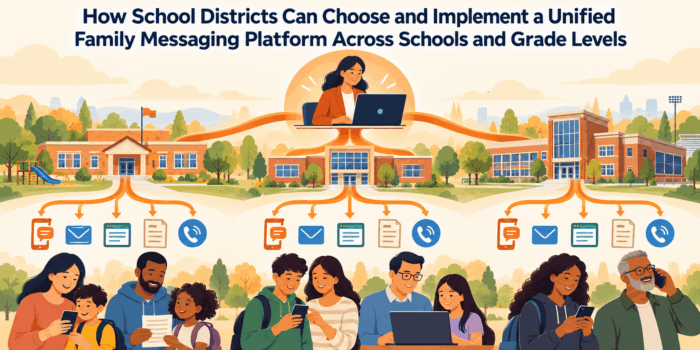
How School Districts Can Choose and Implement a Unified Family Messaging Platform Across Schools and Grade Levels
Families today receive school communication through an astonishing number of channels. A single household with children in elementary, middle, and high school may receive district emails, school newsletters, classroom app notifications, teacher text messages, robocalls, learning management system alerts, cafeteria account notices, athletics updates, social media posts, and printed flyers, often from different tools with different logins and settings. Teachers may choose their own classroom apps, schools may purchase separate newsletter tools, departments may maintain their own lists, and the district may use yet another system for emergency notifications. Each tool may have been adopted for a good reason, but together they create a fragmented experience that confuses families, burdens staff, and makes it difficult for the district to ensure that important messages reach everyone.
Many districts are responding by choosing a unified family messaging platform, a single system that supports district, school, and classroom communication across email, text, voice, mobile app, and sometimes web and social channels. A unified platform can simplify communication for families, provide consistent translation and accessibility features, connect to the student information system so contact data stays current, give communication staff visibility into what is being sent, and provide reliable emergency notification. It can also reduce costs by replacing overlapping subscriptions and give the district data about which messages reach families and which do not.
Yet choosing and implementing a unified platform is a significant undertaking. The wrong choice, or a poorly planned rollout, can frustrate families and staff, leave gaps in communication, and waste resources. Teachers who are attached to their current classroom apps may resist change. Families may miss messages during the transition or fail to download a new app. Data integration problems may send messages to outdated contacts. Translation features may not work as expected for certain languages. Success requires a thoughtful process that begins with understanding needs, includes families and staff in decisions, evaluates options carefully, plans implementation in stages, and communicates clearly with everyone affected. This article explores how school districts can choose and implement a unified family messaging platform across schools and grade levels, from defining requirements through selection, rollout, adoption, and ongoing measurement.
Why a Unified Platform Matters
 The case for a unified platform rests on the experience of families. Families want to receive school information in one predictable place, in a format they can easily read, in a language they understand, and at a frequency that feels manageable. When information is scattered across many tools, families must remember which app to check for which kind of message, manage multiple logins, and filter through notifications that may duplicate or contradict one another. Families with children at several schools experience this fragmentation most acutely, but every family benefits from a simpler, more consistent experience.
A unified platform also matters for equity. Families who speak languages other than English, families with disabilities, and families with limited technology access are often the least served by fragmented systems. One tool may offer translation while another does not, one may support text messaging while another requires a smartphone app, and one may meet accessibility standards while another does not. When every school and classroom uses the same platform with consistent translation, accessibility, and multi-channel delivery, the district can ensure that every family receives the same level of access regardless of which school or teacher is communicating.
The Problem With Too Many Channels
Fragmented communication creates problems that are often invisible until something goes wrong. A district may send an important message about a schedule change through its official system, while a school sends a slightly different message through its newsletter tool and a teacher posts yet another version in a classroom app. Families who see conflicting information may not know which to trust. During emergencies, the consequences can be more serious, if some families are reached quickly while others never receive the message because their contact information exists only in a tool that was not used.
Staff experience the burden of fragmentation as well. Teachers may spend time managing multiple tools, updating contact lists manually, and translating messages individually. Office staff may maintain separate lists for different purposes. Communication staff may have no visibility into what schools and classrooms are sending, making it difficult to coordinate messages or ensure quality. When staff leave, knowledge about which tools and lists they used may leave with them.
Fragmentation also creates data privacy and security risks. Free classroom apps adopted by individual teachers may not have been reviewed for compliance with student privacy laws or district data agreements. Contact lists stored in multiple places increase the chance that information is outdated, duplicated, or improperly shared. A unified platform, selected and managed by the district, allows privacy and security to be reviewed and monitored consistently.
What a Unified Platform Can and Cannot Do
Districts should be realistic about what a unified platform can accomplish. A good platform can deliver messages across multiple channels, translate messages automatically into many languages, sync contact information from the student information system, allow two-way messaging between teachers and families, provide emergency notification, track delivery and engagement, and give communication staff tools to manage templates and approvals. Some platforms also include school websites, newsletters, mobile apps, attendance notifications, and integration with learning management systems.
A platform cannot, however, fix unclear messages, inconsistent communication practices, or weak relationships with families. If messages are too long, filled with jargon, or sent too frequently, a new platform will deliver those same messages more efficiently. If teachers do not communicate regularly with families, a platform will not change that on its own. A platform is a tool that supports a communication strategy, not a replacement for one. Districts that treat platform selection as part of a broader effort to improve communication practices see far better results than those that expect technology alone to solve communication problems.
Districts should also recognize that automatic translation has limits. Machine translation can make routine messages accessible to many families, but it may produce errors in complex, sensitive, or technical messages and may perform poorly for some languages. Districts should plan for human translation review of high-stakes messages and continue to use qualified interpreters for important conversations. Communicating these limits honestly to staff helps them use translation features appropriately.
Learning Together: Communication Strategies for K-12 School Districts and Public Education Agencies
This article is part of our series on strategic communication for K-12 School Districts and Public Education Agencies. To learn more and to see the parent article, which links to other content just like this, click the button below.
Defining Needs Before Choosing a Platform
The most common mistake districts make in selecting a messaging platform is starting with vendor demonstrations rather than with a clear understanding of their own needs. Vendors will show impressive features, but districts that have not defined their requirements may choose a platform based on presentation quality rather than fit. A thoughtful needs assessment, involving families, teachers, principals, office staff, communication staff, technology staff, and district leaders, provides the foundation for a sound decision.
Defining needs also builds support for the eventual choice. When families and staff are invited to share their experiences and priorities early, they are more likely to understand and accept the platform the district selects. The needs assessment becomes the first stage of change management, signaling that the district is making the change to improve communication for everyone, not simply to impose a new tool.
Listening to Families and Staff
Districts should begin by learning how families currently receive and prefer to receive information. Surveys, available in the languages families speak and in multiple formats, can ask which channels families use, which they prefer for different kinds of messages, how many messages they receive, whether they understand messages, and what frustrates them. Focus groups with families from different schools, grade levels, language groups, and backgrounds can provide deeper insight. Families with limited technology access, families with disabilities, and families who rarely engage with schools should be specifically included, since their needs often reveal requirements that more engaged families do not mention.
Staff input is equally important. Teachers can share which tools they currently use, what features they value, what problems they encounter, and what would make communication easier. Principals and office staff can describe how school-level communication works and where it breaks down. Communication staff can identify needs related to coordination, approvals, branding, and analytics. Technology staff can describe integration requirements, security standards, and support capacity. Special education, multilingual learner, transportation, food service, and athletics staff may have specific communication needs as well.
The district should also inventory its current tools. A simple inventory listing every communication tool used across the district, who uses it, what it costs, what data it stores, and what it is used for often reveals surprising duplication and costs. This inventory helps the district understand what a unified platform must replace and what transition will involve.
Setting Requirements for Language, Accessibility, Privacy, and Integration
From this listening, the district can develop a clear list of requirements, distinguishing essential needs from desirable features. Essential requirements often include multi-channel delivery through email, text, voice, and mobile app; translation into the languages families speak, with families able to choose their preferred language; accessibility compliance for families with disabilities; two-way messaging with appropriate monitoring and record keeping; emergency notification capabilities; integration with the student information system for automatic contact updates; role-based permissions for district, school, and classroom users; and compliance with student privacy laws and district data security standards.
Language and accessibility requirements deserve careful definition. The district should list the languages spoken by its families and test how each platform handles them, including languages that use non-Latin scripts and languages with smaller speaker populations. Families should be able to receive messages in their preferred language and reply in that language, with responses translated for staff. Accessibility requirements should address screen reader compatibility, readable text sizes, captions for video, and alternatives for families who cannot use smartphone apps.
Integration requirements should be specified in detail. The platform should sync with the student information system to reflect enrollment changes, contact updates, custody restrictions, and family relationships accurately. It may need to integrate with learning management systems, attendance systems, food service accounts, and transportation systems. Technology staff should define integration standards and data flows before evaluation begins, since integration problems are among the most common causes of implementation difficulty.
Evaluating and Selecting a Platform
With requirements defined, the district can evaluate platforms systematically. A structured evaluation process, with clear criteria, a diverse evaluation team, and opportunities for hands-on testing, helps the district choose a platform that fits its needs. The process should be transparent, documented, and consistent with district procurement policies.
Selection should balance features, usability, cost, vendor reliability, and support. The most feature-rich platform is not always the best choice if it is difficult for staff and families to use or if the vendor cannot provide reliable support. Districts should consider not only the platform’s current capabilities but also the vendor’s track record, product roadmap, and responsiveness to customers.
Structured Evaluation and Vendor Demonstrations
The evaluation team should include representatives from each group that will use the platform, including teachers from different grade levels, principals, office staff, communication staff, technology staff, and families. Each member can evaluate platforms against the requirements using a shared scoring rubric. Including families on the evaluation team, or at least gathering family feedback on finalist platforms, ensures that the family experience receives appropriate weight.
Vendor demonstrations should be structured around the district’s requirements and real scenarios rather than vendors’ standard presentations. The district can provide vendors with specific scenarios to demonstrate, such as sending a translated school closure message by text, email, and voice to all families in a school; a teacher sending a classroom update and receiving a reply in another language; a principal reviewing message delivery reports; and the communication office approving a district-wide message. Scenario-based demonstrations reveal how platforms actually work and allow fair comparison.
The district should also contact references from districts similar in size and demographics, asking about implementation experience, family adoption, translation quality, integration reliability, support responsiveness, and lessons learned. Reference conversations often reveal practical issues that demonstrations do not show.
Families should have a voice in the final comparison as well. The district can invite a small group of families, including families who speak different languages, families of students with disabilities, and families with limited technology access, to try the family-facing features of each finalist platform. Families can receive sample messages in their preferred language, install the mobile app, adjust notification settings, and reply to a teacher message. Their observations about clarity, ease of use, and translation quality often differ from those of staff, and they can reveal problems that would otherwise appear only after launch. Asking families which platform they would prefer, and why, gives the evaluation team valuable evidence and demonstrates that the district is choosing a tool with families in mind rather than for administrative convenience alone.
Pilots, Total Cost, and Contract Terms
When possible, districts should pilot finalist platforms or the selected platform in a small number of schools before full implementation. A pilot allows the district to test integration, translation, usability, and family response in real conditions. Pilot schools should represent different grade levels and family populations. Gathering feedback from pilot teachers, principals, and families helps the district refine implementation plans and identify training needs.
Districts should calculate the total cost of ownership, not only the subscription price. Costs may include implementation fees, integration work, training, additional modules, text messaging volume charges, translation services, staff time, and the cost of ending existing contracts. Comparing total costs against the costs of current fragmented tools helps the district understand the financial case for consolidation.
Contract terms deserve careful review. Districts should ensure that contracts include clear data privacy protections, data ownership provisions, security requirements, uptime guarantees, support response times, training commitments, and terms for data export if the district later changes platforms. Legal and technology staff should review contracts before signing, and privacy agreements should meet state and federal requirements.
Once a decision is made, the district should explain it publicly. A short announcement to families and staff can describe why the district chose a unified platform, how the decision was made, who participated in the evaluation, what families and staff told the district during the needs assessment, and what will happen next. Sharing the evaluation process openly helps staff who preferred a different tool understand the reasoning, and it shows families that their input shaped the outcome. A presentation to the school board can summarize the needs assessment, evaluation results, total cost, and implementation plan, creating a public record of the decision and building support for the resources implementation will require.
Planning Implementation Across Schools and Grade Levels
 Implementation is where many platform initiatives succeed or fail. A district that selects an excellent platform but rolls it out hastily, without clear governance, accurate data, or adequate training, may end up with confused families and frustrated staff. A careful implementation plan addresses governance, roles, message standards, data accuracy, phased rollout, and communication with families and staff at every stage.
Implementation should be planned as a project with a dedicated leader, a cross-functional team, a timeline, and clear milestones. The team should include communication, technology, school leadership, teaching, and family engagement representatives. Regular progress meetings and a shared project plan help keep implementation on track.
Governance, Roles, and Message Standards
A unified platform requires clear governance. The district should define who can send messages to which audiences, who approves district-wide messages, how schools coordinate with the district on major announcements, and how emergency messages are authorized. Role-based permissions in the platform should reflect these decisions. For example, teachers may send messages to families of their own students, principals may send messages to their school community, and the communication office may send district-wide messages and emergency alerts.
Message standards help ensure that the platform improves communication quality, not only delivery. Standards can address message length, plain language, frequency, timing, tone, branding, accessibility, and translation review. For example, the district might set guidelines that routine school messages are sent at consistent times each week, that urgent messages are reserved for genuinely time-sensitive information, that messages begin with the most important information, and that high-stakes messages receive human translation review. Templates for common messages, such as weekly newsletters, event reminders, and attendance notices, make it easier for staff to follow standards.
Frequency guidelines are particularly important. A unified platform makes it easy to send messages, which can lead to message overload if not managed. The district can establish coordination practices, such as a shared communication calendar and guidelines for how many messages families should receive in a typical week, to prevent families from tuning out.
Data Accuracy and Integration
A messaging platform is only as reliable as the contact data it uses. Before implementation, the district should review contact data in the student information system, identifying missing phone numbers, outdated email addresses, incorrect language preferences, and families without any working contact method. Schools can conduct data verification campaigns, asking families to confirm their contact information and preferred language through forms, phone calls, and enrollment updates.
Integration between the platform and the student information system should be tested thoroughly before launch. The district should verify that family relationships, custody restrictions, multiple households, and language preferences sync correctly, and that changes in the student information system update the platform promptly. Errors in custody or family relationship data can have serious consequences, so testing should include complex family situations.
Ongoing data maintenance should be built into regular practices. The district can remind families periodically to update contact information, provide easy ways to update preferences in the platform, and monitor delivery reports for bounced emails and failed text messages. Office staff should know how to correct data quickly when problems arise.
A phased rollout reduces risk and allows the district to learn as it goes. Many districts begin with district-level and emergency messaging, then add school-level communication, and finally add classroom messaging once staff are comfortable with the platform. Others roll out by school level, starting with a group of elementary schools, then middle schools, then high schools. Each phase should include a short review of what worked and what needs adjustment before the next phase begins. A phased approach also spreads training demands over time, allowing support staff to help each group of schools thoroughly. The district should communicate the rollout schedule clearly so that families and staff know when each change will reach them and are not surprised by tools appearing or disappearing without notice.
Introducing the Platform to Families and Staff
The transition to a unified platform is itself a major communication effort. Families must learn about the new platform, update their preferences, download an app if needed, and understand that older tools will be retired. Staff must learn to use the platform, adopt new practices, and stop using familiar tools. Clear, well-timed communication helps both groups make the transition smoothly.
Change can be difficult, especially for teachers who have built strong relationships with families through tools they chose themselves. The district should acknowledge these relationships, explain the reasons for the change, and show how the new platform will support teachers’ communication rather than limit it.
Family Onboarding and Transition From Old Tools
Families should hear about the new platform well before it launches. Initial communication can explain why the district is making the change, what families will experience, when the change will happen, and what families need to do. Messages should emphasize benefits from the family’s perspective, such as receiving all school messages in one place, choosing a preferred language, and controlling how they receive notifications.
Onboarding should be simple and supported. If families need to download an app or activate an account, instructions should be short, visual, and available in multiple languages. Schools can offer help sessions at back-to-school events, family nights, and parent conferences, where staff can help families install the app and set preferences. Families who do not use smartphones should receive messages by text, email, or voice automatically, and they should be told clearly that they do not need an app to stay informed.
The transition from old tools should be planned carefully. The district should set a date when older tools will be retired, communicate this date to families and staff in advance, and run old and new systems in parallel briefly if needed. Teachers can send a final message through old classroom apps directing families to the new platform. Monitoring which families have not engaged with the new platform, and reaching out to them personally, helps ensure that no family is lost in the transition.
Schools play an essential role in family onboarding because families trust messages from their own principals and teachers more than district announcements. Districts can provide schools with a launch toolkit that includes a principal letter template, a short video showing families how to set preferences, printed instruction cards in multiple languages, social media posts, and talking points for front office staff. Teachers can mention the platform at the beginning of the year and send a welcome message through it so families see how classroom communication will work. Family liaisons and community partners can help families who need extra support, such as grandparents raising grandchildren, families new to the country, or families with limited reading skills. When onboarding is woven into routines families already know, adoption rises quickly.
Staff Training and Adoption
Staff training should be practical, role-specific, and ongoing. Teachers need to learn how to send classroom messages, communicate with individual families, use translation features, and view message history. Principals need to learn how to send school messages, use templates, and review delivery reports. Office staff need to learn how to manage contact data and send attendance or emergency notices. Communication staff need to learn administrative features, approvals, and analytics.
Training should include short live sessions, recorded tutorials, quick reference guides, and opportunities for hands-on practice. Identifying platform champions in each school, staff members who receive additional training and help colleagues, can accelerate adoption. Champions can also share feedback with the implementation team about problems and needs.
Adoption should be monitored and supported. Platform analytics can show which schools and teachers are using the platform and which are not. Rather than enforcing use through mandates alone, the district can follow up with schools that are slow to adopt, identify barriers, and provide additional support. Sharing success stories, such as a teacher who saw increased family responses after using translated messages, can encourage others.
Districts should also listen carefully to staff concerns during adoption. Some teachers may worry that a unified platform will make their messages more formal, that district monitoring will limit their voice, or that two-way messaging will create expectations to respond at all hours. These concerns deserve direct answers. The district can explain how teachers can personalize messages, what monitoring is used for and what it is not, and what expectations exist for response times and after-hours communication. Clear guidelines that protect teachers’ time, such as scheduled sending and office hours settings, can ease concerns and support healthy communication habits. When staff see that the district has considered their perspective, they are far more likely to use the platform willingly and well.
Sustaining Use and Measuring Results
Implementation does not end at launch. Sustaining effective use requires ongoing training, governance, data maintenance, and evaluation. Over time, the district should refine its communication practices based on what it learns from families, staff, and platform data. The platform should become part of a continuous improvement cycle for family communication.
Measuring results helps the district understand whether the platform is delivering its intended benefits. Measures should include both technical performance, such as delivery rates and integration reliability, and communication outcomes, such as family understanding, engagement, and satisfaction.
Ongoing Governance and Support
The district should maintain a governance group that meets regularly to review platform use, address problems, update message standards, and plan improvements. This group can review new features offered by the vendor, decide whether to adopt them, and coordinate training. It can also review frequency and coordination practices to prevent message overload.
Ongoing training should support new staff and introduce new features. New teachers and staff should receive platform training during onboarding. Annual refresher sessions and updated guides help staff stay current. Communication staff can share tips and examples of effective messages through newsletters or staff meetings.
Vendor relationships should be managed actively. Regular meetings with the vendor can address support issues, review performance, and discuss upcoming changes. The district should monitor whether the vendor meets contract commitments, such as uptime and support response times, and address problems promptly.
Measuring Reach, Engagement, and Family Experience
Platform analytics can measure message delivery rates, open rates, response rates, and engagement by school, grade level, language, and channel. The district can identify families who are not being reached, such as those with bounced emails or failed text messages, and follow up to update contact information. Comparing reach across language groups and schools helps the district identify equity gaps.
Family surveys provide insight into the family experience. Surveys can ask whether families receive the information they need, whether messages are clear, whether they receive too many or too few messages, whether translation is accurate, and whether they can easily communicate with teachers. Surveys should be conducted in families’ languages and repeated over time to track improvement.
Staff feedback is also important. Teachers and principals can share whether the platform makes communication easier, what problems they encounter, and what features would help. The district can also measure cost savings from retiring older tools and time savings for staff. Sharing results with families, staff, and the school board demonstrates accountability and helps sustain support for the unified platform.
The most meaningful measure of success is whether communication actually improves for families. Over time, the district can look for signs such as fewer complaints about missed messages, more families responding to teacher outreach, higher attendance at events promoted through the platform, faster acknowledgment of emergency messages, and stronger survey results from families who speak languages other than English. These outcomes connect the platform investment to the district’s broader goals for family partnership and student success. Reviewing them annually, and using them to guide training, message standards, and feature decisions, keeps the platform focused on its real purpose: helping every family stay informed and connected to their children’s education.
How Unified Family Messaging Compares With Other Agency Types
Many public agencies have moved toward unified communication systems, and their experiences offer useful lessons for school districts. City and county governments increasingly use centralized notification systems for emergency alerts, service updates, and public meetings, often consolidating separate departmental lists into a single opt-in system with language and channel preferences. Public health agencies use unified platforms to send appointment reminders, health alerts, and program information. Public utilities consolidate customer communication for outages, billing, and service changes. The most successful of these agencies define governance clearly, maintain accurate contact data, offer multiple channels and languages, and avoid overwhelming residents with too many messages. They also learned that a single system improves reliability during emergencies, when consistent reach matters most.
School districts face distinctive challenges, however. Their communication involves not only district-level announcements but also thousands of daily school and classroom interactions between teachers and families, often personal and two-way. Districts must balance central coordination with teachers’ professional autonomy and relationships. They must manage complex family relationships, including multiple households, custody restrictions, and guardians, and they must protect student privacy under specific federal and state laws. Families also interact with schools far more frequently than with most government agencies, sometimes daily. These factors make platform selection and implementation more complex in school districts, and they make it essential to involve teachers and families throughout the process.
Tying It All Together
Unified family messaging communication is not a side function. It determines whether families receive school information in one predictable place, in their preferred language and channel, without the confusion of scattered tools and conflicting messages. It determines whether teachers and schools can communicate efficiently and consistently, whether the district can coordinate messages and reach every family in an emergency, and whether student privacy and data security are protected across every communication tool.
Effective districts recognize the problems fragmentation creates, including conflicting messages, missed families, staff burden, and privacy risks, and they understand both what a unified platform can accomplish and what it cannot. They treat the platform as a tool that supports a broader communication strategy, and they plan for the limits of automatic translation in high-stakes messages.
They define needs before evaluating vendors, listening to families and staff through surveys and focus groups that include families with limited technology access, families with disabilities, and families who speak many languages. They inventory current tools and set clear requirements for multi-channel delivery, translation, accessibility, two-way messaging, emergency notification, privacy, and integration with the student information system.
They evaluate platforms through structured, scenario-based demonstrations, diverse evaluation teams, reference checks, pilots, total cost analysis, and careful contract review. They plan implementation with clear governance, role-based permissions, message standards, frequency guidelines, thorough data verification, and integration testing that includes complex family situations.
They introduce the platform to families with clear explanations, simple onboarding, help sessions, and planned retirement of older tools, and they train staff through role-specific sessions, recorded tutorials, and school-based champions. They sustain use through ongoing governance, training, and vendor management, and they measure reach, engagement, family experience, staff feedback, and cost savings.
Taken together, these practices help districts move from fragmented communication to a unified system that families trust and staff value. The result is communication that reaches every family reliably, supports strong relationships between schools and homes, and gives the district a foundation for continuous improvement in how it communicates.
Strategic Communication Support for Unified Family Messaging
 A unified family messaging platform determines whether families receive school information in one reliable place, in their preferred language and channel, and whether the district can reach every household consistently during routine updates and emergencies. When districts select platforms without clear requirements or roll them out without careful planning, families may miss messages, teachers may resist change, and data problems may undermine trust. Because platform selection and implementation require coordination across communication, technology, school leadership, teaching, family engagement, procurement, and legal teams, districts often partner with Stegmeier Consulting Group (SCG) to approach the transition strategically. SCG helps districts treat a messaging platform as part of a broader communication system rather than a technology purchase alone.
SCG supports districts in assessing current communication tools and needs before vendor conversations begin. This can include inventorying the tools used across schools and departments, surveying families and staff about how they receive and send information, reviewing contact data quality, and identifying language, accessibility, privacy, and integration requirements. These findings help districts define essential requirements and evaluation criteria. Scenario-based demonstration scripts, scoring rubrics, and pilot plans then help districts compare platforms fairly and choose the one that best fits their families and staff.
Sustained adoption depends on the people who will use the platform every day. Teachers, principals, office staff, and communication teams need clear roles, practical training, and shared expectations for message quality and frequency. SCG helps districts develop governance structures, role-based permission models, message standards, templates, frequency guidelines, and role-specific training plans. Family onboarding materials, translated into the languages families speak, can explain the change, show families how to set preferences, and reassure families without smartphones that they will still receive messages.
Contract renewals for existing tools, emergency notification gaps, privacy concerns about classroom apps, district reorganizations, and new school years can make this work especially urgent. SCG helps districts plan implementation timelines, coordinate data verification campaigns, sequence the retirement of older tools, and communicate each stage of the transition to families and staff. By planning communication alongside technical implementation, districts can reduce the risk of missed messages and build confidence in the new system.
SCG also helps districts evaluate whether a unified platform is improving communication for the families who depend on it. Delivery and engagement data by school, language, and channel, family surveys, staff feedback, adoption rates, and cost savings can reveal where the platform is working and where gaps remain. By incorporating these findings into regular governance reviews and communication planning, districts can make unified messaging an ongoing organizational practice that strengthens reach, equity, and trust across every school and grade level.
Future Trends
Districts are increasingly consolidating communication tools into unified platforms that combine messaging, mobile apps, websites, and newsletters. This consolidation will continue as districts seek to simplify the family experience and reduce costs.
Translation features are improving, with more platforms offering two-way translated messaging in many languages. Districts will still need to review high-stakes translations and use qualified interpreters for important conversations, but improved translation will expand access for many families.
Integration between messaging platforms and other district systems, such as student information, learning management, attendance, and transportation systems, is deepening. These integrations can automate routine notifications and personalize communication, but they require careful data governance.
Student privacy expectations continue to rise, and districts are reviewing classroom apps and communication tools more closely. Unified platforms selected and managed by districts can help ensure consistent privacy protections.
Finally, districts are paying closer attention to message volume and family attention. Analytics and family feedback are helping districts refine how often and when they communicate, focusing on clear, purposeful messages rather than more messages.
Conclusion
A unified family messaging platform can transform how districts communicate, replacing scattered tools with one reliable system that reaches every family. But the platform alone is not the solution. Its value depends on thoughtful selection, careful implementation, and sustained attention to communication quality.
By defining needs with families and staff, evaluating platforms systematically, planning governance and data accuracy, introducing the platform clearly, supporting staff adoption, and measuring results, districts can choose and implement a platform that strengthens communication across every school and grade level.
When families know where to find school information and receive it in a way they understand, and when staff can communicate efficiently and consistently, the district builds a communication foundation that supports trust, partnership, and student success.
Stegmeier Consulting Group’s Strategic Approach to Communication Systems
Bring every school, classroom, and family onto one reliable communication system.
Stegmeier Consulting Group helps school districts choose and implement unified family messaging platforms across schools and grade levels. We begin by assessing your current communication tools, family and staff needs, contact data quality, and requirements for language, accessibility, privacy, and integration.
Our team works alongside communication, technology, and school leaders to develop evaluation criteria, demonstration scenarios, pilot plans, governance structures, message standards, frequency guidelines, family onboarding materials, staff training plans, and transition timelines that retire older tools without leaving families behind.
We treat a messaging platform as part of a broader communication system. That means grounding decisions in what families and staff actually need, planning implementation carefully, and measuring whether the platform improves reach, understanding, and trust.
Use the form below to connect with our team and explore how a strategic approach to unified family messaging can help your district choose the right platform, implement it smoothly across every school and grade level, and reach every family with clear, reliable communication.