
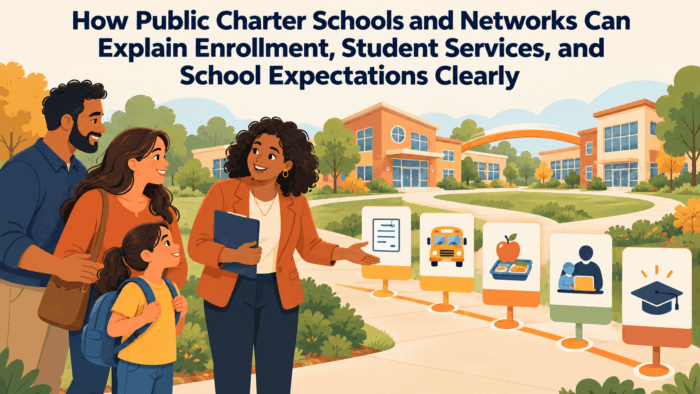
How Public Charter Schools and Networks Can Explain Enrollment, Student Services, and School Expectations Clearly
Public charter schools occupy a distinctive place in the public education landscape. They are tuition-free public schools, open to all students, yet they operate with more independence than traditional district schools and are governed under a performance agreement, called a charter, with an authorizer. Some are single, independent schools founded by educators or community groups, while others are part of regional or national networks that operate many campuses under a shared model. Families choose charter schools for many reasons, including a specific academic focus, a smaller learning community, a distinctive instructional approach, a longer school day, or simply the hope of a better fit for their child. Because enrollment is a choice rather than an assignment, charter schools must explain themselves to families in ways that district schools often do not. Families need to understand how to apply, what the school offers, how it differs from other options, and what it will expect of students and families once they enroll.
That communication challenge is larger than it may appear. Many families do not know that charter schools are public, free, and open to students with disabilities and multilingual learners. Others are unsure whether a charter school provides transportation, meals, special education, or after-school care, and they may assume the answers are no without asking. Application deadlines, lotteries, waitlists, and sibling preferences can be confusing, especially for families who are new to the country, new to the area, or simply new to school choice. Once enrolled, families may discover expectations they did not anticipate, such as uniforms, longer hours, family volunteer commitments, or specific behavior and homework policies. When these surprises appear after enrollment, trust erodes quickly, and some families leave in the middle of the year, which disrupts learning for the student and destabilizes the school community.
Clear, honest, and accessible communication protects everyone involved. It helps families make informed choices, it helps charter schools enroll students who will thrive in their model, and it supports the public commitment that charter schools serve all students fairly. This article explores how charter schools and charter networks can explain enrollment, student services, and school expectations clearly, from the first outreach to a prospective family through the first months of the school year and beyond. It considers the specific challenges of single-site charters and multi-campus networks, the importance of language access and accessibility, the communication responsibilities that come with enrolling students with disabilities, and the ways charter schools can measure whether families truly understand what they have chosen.
Why Clear Communication Matters for Charter Schools
 Every public school must communicate with families, but charter schools carry additional responsibilities because families actively choose them. In most districts, a family is assigned to a neighborhood school and can learn about it gradually over time. A charter school, by contrast, must earn every enrollment through outreach, and it must do so honestly. If a school describes itself in glowing but vague terms, families may enroll with expectations the school cannot meet. If a school leaves out important details about services or requirements, families may feel misled when they discover them. Over time, the quality of a charter school’s communication becomes part of its reputation in the community, shaping whether families recommend it to neighbors, whether community partners trust it, and whether its authorizer views it as a responsible steward of public funds.
Clear communication also matters because charter schools are public institutions with public obligations. They must enroll students without discrimination, provide services to students with disabilities, support multilingual learners, and follow open enrollment and lottery procedures defined in law and in their charters. Communication is one of the main ways a charter school demonstrates that it honors these obligations. When enrollment materials state plainly that the school welcomes students with disabilities and explains how services are delivered, families who might otherwise assume they are unwelcome are more likely to apply. When lottery procedures are described step by step and conducted transparently, families trust that the process is fair. Communication, in other words, is not only marketing for charter schools; it is a core part of public accountability.
The Difference Between Marketing and Informing
Charter schools need to attract applicants, and it is natural for their outreach to highlight strengths, such as strong academic results, a caring culture, or distinctive programs. Yet there is an important difference between marketing a school and informing families about it. Marketing tends to emphasize what makes the school appealing, while informing helps families understand what the school actually requires, provides, and expects. Families need both, but they need accurate information most of all. A colorful flyer promising an excellent education tells a family very little about whether the school offers bus service from their neighborhood, whether the school day ends at three or at five, or whether their child’s individualized education program will be implemented in a general classroom or a separate setting.
The most trusted charter schools treat informing as the foundation and marketing as a layer on top. Their outreach materials include a clear summary of key facts, such as grade levels served, school hours, transportation options, meal programs, special education and multilingual services, uniform requirements, and family commitments. Their websites answer the questions families actually ask rather than repeating mission statements. Their information sessions leave time for honest questions and honest answers, including answers that may lead some families to decide the school is not the right fit. This honesty may reduce some applications in the short term, but it increases the number of families who enroll with realistic expectations and stay for many years, which ultimately benefits students, staff, and the school’s long-term stability.
Schools can test the balance between marketing and informing by reviewing their materials from the perspective of a skeptical but interested parent. Does every major claim come with a specific detail? Can a family find the school hours, transportation policy, and enrollment deadline within a minute on the website? Is there anything a family would be surprised to learn after enrollment that is missing from the materials? Asking current families what they wish they had known before enrolling is one of the most useful ways to identify gaps, since their answers often reveal exactly what prospective families need to hear.
Building Trust in a Choice Environment
In communities with many school options, families may be overwhelmed by information, recruitment events, and competing claims. Charter schools that communicate plainly and respectfully stand out in this environment. Families notice when a school returns calls promptly, answers questions directly, provides information in their language, and does not pressure them to commit before they are ready. They also notice when a school speaks respectfully about other options in the community, including district schools and other charters. Schools that disparage other schools in recruitment can damage their own credibility and community relationships, while schools that focus on describing their own model clearly tend to earn more trust.
Trust is especially important for families who have had difficult experiences with schools in the past, such as families whose children were suspended frequently, families whose children’s disabilities were not well supported, or families who felt unwelcome because of language or immigration concerns. These families may approach a new school cautiously and may test the school’s responsiveness through early questions. A school that answers those questions patiently and honestly, explains how it will support their child, and follows up on promises builds a foundation that carries through enrollment and into the school year. A school that responds with vague reassurance, or that seems to discourage applications from students with greater needs, will lose not only that family’s trust but also the trust of the community networks where families share their experiences.
Charter schools can strengthen trust by being consistent across every point of contact. The information on the website, in printed materials, at information sessions, in phone calls with the front office, and in conversations with teachers should match. When different staff members give different answers about transportation, uniforms, or services, families become uncertain about what is true. A simple internal fact sheet, updated each year and shared with every staff member who talks with prospective families, helps ensure that everyone gives the same accurate answers.
Learning Together: Communication Strategies for K-12 School Districts and Public Education Agencies
This article is part of our series on strategic communication for K-12 School Districts and Public Education Agencies. To learn more and to see the parent article, which links to other content just like this, click the button below.
Explaining Enrollment Clearly
Enrollment is often the first substantial interaction between a family and a charter school, and it can shape the entire relationship. Charter enrollment processes vary by state and by school, but they commonly include an application period, eligibility rules based on residency or grade level, enrollment preferences for siblings or children of staff, a public lottery when applications exceed available seats, waitlists, and deadlines for accepting offers and completing registration. Some communities use a common or unified enrollment system in which families apply to district and charter schools through a single application, while in other communities each charter school runs its own process. Each of these elements can confuse families if it is not explained clearly, and confusion often falls hardest on the families who have the least time, the least experience with school choice, or the least familiarity with English.
The goal of enrollment communication is that every family who might benefit from the school understands how to apply, when to apply, what will happen after they apply, and what they need to do at each step. Schools should design enrollment communication around the family’s journey rather than around internal processes. A family does not need to understand every detail of lottery software, but they do need to know when the lottery will occur, how they will learn the results, what a waitlist number means, and how long they have to accept a seat. Explaining each step in plain language, in the languages families speak, and through multiple channels helps ensure that enrollment is genuinely open to everyone.
Applications, Deadlines, and Lotteries
Application materials should state clearly that the school is public, tuition-free, and open to all eligible students regardless of disability, language, academic history, or background. They should list the grades available, the application deadline, the date of the lottery, and how families will be notified. Schools should avoid asking for information on applications that could discourage families or appear to screen students, such as test scores, discipline records, or detailed disability information, unless state law specifically allows it for limited purposes. Even when such information is collected after enrollment for legitimate reasons, asking for it at the application stage can send the message that some students are less welcome than others.
Lotteries are often the most misunderstood part of charter enrollment. Families may believe that applying early improves their chances, that knowing someone at the school helps, or that the lottery is not really random. Schools can address these concerns by explaining exactly how the lottery works, which preferences apply and in what order, and how results are generated and verified. Many schools conduct lotteries publicly, either in person or through a livestream, and publish the procedures in advance. Some invite an independent observer, such as a representative from the authorizer or a community member, to verify that the process is fair. After the lottery, schools should notify every applicant promptly, in their preferred language and through more than one channel, with a clear explanation of what their result means and what they need to do next.
Deadlines deserve particular attention, because a missed deadline can cost a family a seat. Schools should send reminders before the application deadline, before the lottery, and before the deadline to accept an offer, using text messages, email, and phone calls rather than relying on a single channel. Reminders should include the specific action required, such as submitting proof of residency or signing an enrollment form, and should provide a contact person who can help. Families who do not respond to an offer should receive at least one follow-up call before their seat is released, since a missing response is often caused by an outdated phone number or an email that went to a spam folder rather than a lack of interest.
Waitlists and Common Enrollment Systems
Waitlists can be a source of anxiety and confusion. Families often want to know their position, how quickly the list typically moves, and whether they should pursue other options while they wait. Schools should explain how waitlist positions are assigned, how families will be contacted if a seat opens, how long the waitlist remains active, and whether families need to reapply the following year. Honest information about how many students typically move off the waitlist for each grade helps families make realistic plans. Telling a family that they are number forty on a list for a grade that rarely has openings may be disappointing, but it is far kinder than leaving them hopeful through the summer and scrambling for a placement in late August.
In communities with common enrollment systems, charter schools share responsibility for explaining a system they do not fully control. Families may apply to many schools at once and receive a single match, and the rules governing rankings, preferences, and matching can be complex. Charter schools should coordinate with the agency that manages the system to ensure their own information is consistent with official guidance, and they should help families understand how to rank choices strategically and honestly. A family that lists only one school, believing that listing more will hurt their chances, may end up without any placement, and charter schools that meet families at information sessions are well positioned to correct this kind of misunderstanding.
Enrollment communication should continue after a family accepts a seat. The period between acceptance and the first day of school is when families complete registration forms, submit records, order uniforms, arrange transportation, and prepare their children for a new environment. A clear onboarding sequence, with a checklist of required steps, key dates, and contacts, helps families complete these tasks without confusion. Schools that invite newly enrolled families to orientation events, summer visits, or welcome calls from current parents help families feel connected before the school year begins, reducing the likelihood that families change their minds over the summer.
Explaining Student Services Honestly
Families considering a charter school often have practical questions that determine whether the school is a realistic option. Will my child have a way to get to school? Will meals be provided? Is there before or after school care? Will my child with a disability receive the same services they receive now? Will my child who is learning English receive language support? Will my child have access to counseling, nursing, and extracurricular activities? These questions are not secondary concerns. For many families, the answers decide whether enrollment is possible at all, and a school that fails to answer them clearly effectively excludes families who cannot afford to guess.
Charter schools vary widely in the services they provide, often because of differences in funding, facilities, size, and state requirements. Some provide extensive transportation and a full range of support services, while others provide limited transportation and rely on partnerships for some services. Variation itself is not the problem; the problem arises when families do not know what is available until after they enroll. Clear, specific, and honest descriptions of services, presented early in the enrollment process, allow families to plan and allow schools to identify needs they may need to address.
Special Education and Disability Services
Charter schools are public schools, and students with disabilities have the same rights in a charter school as in any other public school. This includes the right to a free appropriate public education, an individualized education program or Section 504 plan when eligible, and services in the least restrictive environment appropriate to the student. Yet many families of children with disabilities have heard that charter schools cannot serve their children, or they have been told informally that their child might do better elsewhere. Clear communication is one of the most powerful tools charter schools have to correct these misperceptions and demonstrate genuine commitment to serving all students.
Enrollment materials and websites should include a dedicated section explaining how the school serves students with disabilities. This section should describe the school’s special education staffing and partnerships, the range of services typically available, how existing individualized education programs are reviewed and implemented when a student transfers, and whom families can contact with questions. In states where charter schools are part of a district or a special education consortium for special education purposes, the school should explain how that relationship works in plain language. Families should be encouraged to apply and to share their child’s needs after enrollment so the school can plan services, not before, so that disability information does not appear to influence admissions.
When a student with a disability enrolls, the school should communicate promptly and personally with the family to review the existing plan, discuss how services will be delivered, and identify any changes that may be needed. A meeting before the school year begins, or within the first weeks, helps families feel confident that their child’s needs are understood. Ongoing communication about progress, regular opportunities to ask questions, and clear explanations of procedural safeguards help families participate as true partners. Schools should also ensure that families understand their rights, including how to request evaluations, how to raise concerns, and how disputes are resolved, presented in accessible language rather than only in dense legal notices.
Transportation, Meals, Language Support, and Other Services
Transportation is often the deciding factor for families considering a charter school. Schools should state clearly whether they provide bus service, what areas it covers, how stops are determined, whether transit passes or reimbursement are available, and what families need to do to arrange transportation. If the school does not provide transportation, it should say so directly and, where possible, share information about public transit routes, carpool networks, or community resources. Families who assume transportation is available and later discover it is not may be forced to withdraw, which is disruptive for the student and the school.
Meal programs, before and after school care, health services, and counseling should be described with the same specificity. Families should know whether the school participates in federal meal programs, how to apply for free or reduced-price meals if applications are required, whether breakfast is served, and whether students can bring meals from home. They should know whether a nurse is on campus, how medications are managed, what mental health support is available, and how the school connects families with community services. Clear descriptions of these supports help families who rely on them plan with confidence.
Language support deserves its own explanation. Charter schools must identify and serve multilingual learners, and they must communicate with families in languages they understand. Enrollment materials should explain how the school assesses English proficiency, what instructional support multilingual learners receive, and how the school communicates with families who speak languages other than English, including the availability of qualified interpreters at meetings. When families see that the school has thought carefully about language access, they are more likely to trust that their child will be supported academically and that they will be included as partners.
Explaining School Expectations Before Families Commit
 Many charter schools are built around distinctive models that come with specific expectations for students and families. These may include longer school days or school years, uniform or dress code requirements, homework policies, behavior systems, family engagement commitments, specific instructional approaches such as project-based learning or classical education, or college preparatory expectations that include rigorous coursework from early grades. These expectations are often central to what makes a school effective, and many families choose a charter school precisely because of them. Yet expectations that are not explained clearly before enrollment can feel like unwelcome surprises afterward, and surprises are one of the most common reasons families leave charter schools in the middle of the year.
Explaining expectations clearly is not about discouraging families. It is about helping families make informed decisions and preparing them to succeed. A family that understands from the beginning that the school day ends at four thirty can arrange work schedules and childcare. A family that knows about uniform requirements can budget for them or apply for assistance. A family that understands the school’s behavior system can discuss it with their child and support it at home. When expectations are clear and families choose the school knowing them, the partnership between home and school becomes much stronger.
Academic Model, Schedule, and Behavior Expectations
Schools should describe their academic model in concrete terms rather than slogans. Instead of saying that the school offers rigorous, personalized learning, a school might explain that students spend two hours each morning in literacy and mathematics blocks, that afternoons include science projects and electives, that students receive about thirty to forty-five minutes of homework each night in middle school, and that teachers meet with families three times each year to review progress. These specifics help families picture daily life at the school and judge whether it fits their child. Short videos showing a typical day, classroom visits during the enrollment period, and conversations with current students can make the model even more tangible.
The school calendar and daily schedule should be published early and explained clearly, especially when they differ from district schools in the area. Families need to know the start and end times, early dismissal days, the length of the school year, and how the calendar compares with local district calendars, since many families have children in more than one school. Differences in calendars can create childcare challenges, and families who know about them in advance can plan accordingly.
Behavior expectations and discipline policies should be explained with the same honesty. Families should understand the school’s approach to behavior, including how positive behavior is recognized, how misbehavior is addressed, what consequences may occur, and how the school works with families when concerns arise. Policies should be written in plain language, available in families’ languages, and reviewed with families during orientation. Schools should also explain how discipline policies protect the rights of students with disabilities and how families can raise concerns if they believe a consequence is unfair. When families understand behavior expectations before enrollment and see that policies are applied consistently and fairly, conflicts during the year become easier to resolve.
Family Commitments, Uniforms, and Costs
Some charter schools ask families to sign agreements, attend orientation sessions, participate in conferences, or volunteer a certain number of hours each year. These commitments can strengthen family engagement, but schools must explain them carefully. Families should understand what is expected, why it matters, and what flexibility exists for families with demanding work schedules, multiple children, disabilities, or other constraints. Schools should state clearly that enrollment is never conditioned on volunteer hours or family participation, since public charter schools cannot exclude students based on a family’s ability to meet such expectations. Offering many ways to participate, such as evening events, remote meetings, or tasks that can be completed at home, makes commitments achievable for more families.
Uniforms, supplies, field trip fees, and other costs should be explained transparently. Families should know what items are required, approximately how much they cost, where they can be purchased, and what assistance is available for families who cannot afford them. Many schools maintain uniform exchanges, provide free uniforms to families who need them, or cover fees through donations, and families should know about these options without having to ask. A family that cannot afford a required uniform and does not know help is available may feel ashamed or may keep their child home, which undermines attendance and trust.
Schools should also be careful to distinguish between requirements and suggestions. If a school recommends that families purchase a particular laptop or participate in an optional fundraising event, materials should make clear that these are optional and will not affect a child’s standing. Ambiguity about what is required can lead families to make sacrifices they did not need to make or to feel excluded when they cannot participate.
Communication Across Charter Networks and Campuses
Charter networks that operate multiple campuses face additional communication challenges. Networks often share a common mission, academic model, policies, and brand, while individual campuses have their own leaders, staff, schedules, and community relationships. Families experience the network through their child’s campus, and they may not understand which decisions are made by the network and which are made locally. When a policy changes, a calendar shifts, or a campus leader departs, families need to know who made the decision, why it was made, and whom to contact with questions. Clear coordination between network and campus communication helps families navigate this structure.
Networks also have opportunities that single-site schools may lack. They can invest in shared communication staff, translation services, enrollment systems, websites, and family engagement resources that individual campuses could not afford alone. They can develop consistent templates and messaging that ensure accuracy across campuses while leaving room for campus leaders to add local details and personal voice. The most effective networks treat communication as a shared system, with clear roles, consistent standards, and strong support for campus teams.
Network and Campus Roles
Networks should define which communication responsibilities belong to the network and which belong to campuses. Typically, the network leads communication about enrollment processes, network-wide policies, calendars, budget and governance decisions, and major changes such as campus openings or relocations. Campuses lead daily communication with families about classroom learning, events, attendance, behavior, and student progress. During emergencies, roles should be defined in advance so that campus leaders can respond immediately while the network provides support and coordinates communication across campuses if needed. Written agreements about these roles, shared with campus leaders and reviewed annually, prevent confusion and duplication.
Families should also understand this structure. Enrollment materials and family handbooks can explain, in simple terms, how the network and campus work together, who leads the network, how the governing board makes decisions, and how families can raise concerns at each level. A clear escalation path, starting with the teacher, then the campus leader, then a network family support office, and finally the governing board, helps families resolve concerns without feeling lost. Publishing board meeting schedules and agendas, and inviting families to attend or comment, demonstrates that the network values transparency and public accountability.
Consistency across campuses matters for credibility. If one campus describes transportation differently than another, or if one campus applies a uniform policy strictly while another ignores it, families who talk with each other will notice and may question whether network policies are real. Networks can reduce inconsistency by maintaining shared fact sheets, providing communication training for campus leaders and front office staff, and periodically reviewing campus websites and materials for accuracy.
Shared Tools, Templates, and Local Voice
Shared communication tools can significantly improve quality across a network. A network might maintain a common website platform with consistent pages for enrollment, services, and policies on every campus site, a shared messaging system that supports translation and text messaging, and a library of templates for common communications such as enrollment reminders, orientation invitations, attendance notices, and emergency messages. Templates should be written in plain language, translated by qualified professionals, and reviewed regularly. When campuses use shared templates, families receive accurate, consistent information, and campus staff save time they can devote to relationships with families.
Shared tools should not erase local voice. Families want to hear from the leaders and teachers they know, and messages that feel generic or corporate can weaken relationships. Networks can encourage campus leaders to personalize templates, add campus-specific details, and communicate in their own voice while preserving essential information. A weekly letter from the campus leader, written personally but drawing on network resources for accuracy, often strikes the right balance. Networks can also highlight campus stories in network communication, showing families that each campus is valued as a unique community within the larger organization.
Networks should invest in the communication skills of campus leaders and staff. Training on plain language writing, interpreter use, difficult conversations, social media, and crisis communication helps campus teams communicate confidently. Regular meetings among campus communication leads, office managers, and family engagement staff allow networks to share successful practices and identify common challenges, building a culture of strong communication across every campus.
Language Access, Accessibility, and Measuring Understanding
Clear communication only works if every family can access it. Charter schools serve families who speak many languages, families with disabilities, families with limited internet access, and families with varying levels of literacy and familiarity with American schools. Communication designed only for families who read English fluently and use email regularly will exclude many of the families charter schools are meant to serve. Language access and accessibility are not optional enhancements; they are legal obligations and essential conditions for fair enrollment and meaningful partnership.
Charter schools should also measure whether their communication is working. Enrollment outcomes, family surveys, mid-year withdrawals, and questions families ask can reveal whether families understand the school’s processes, services, and expectations. Schools that review these signals regularly can identify gaps and improve communication before misunderstandings lead to frustration, withdrawals, or complaints to the authorizer.
Reaching Every Family
Enrollment information should be available in the languages spoken in the community, not only in the languages already represented at the school, since the goal is to reach families who are not yet enrolled. Translations should be completed by qualified professionals and reviewed for clarity, and information sessions should offer interpretation. Schools should ensure that phone lines are answered by staff who can connect callers with interpreters and that online application systems are available in multiple languages. When families see their language represented throughout the enrollment process, they are more likely to believe the school genuinely welcomes them.
Accessibility also includes digital and physical access. Websites and online applications should meet accessibility standards so that families who use screen readers or other assistive technology can apply independently. Printed materials should use readable fonts and clear layouts. Information sessions should be held in accessible locations and at times that work for working families, and recordings should be available for families who cannot attend. For families with limited internet access, schools can offer paper applications, in-person application assistance, and phone support. Outreach through community organizations, libraries, faith communities, early childhood programs, and community health centers helps reach families who may not search for school options online.
Plain language is a form of accessibility that benefits everyone. Enrollment materials, handbooks, and policies should use short sentences, everyday words, and clear structure, with key information highlighted and jargon defined. Testing materials with families before publishing them, by asking a few parents to read a draft and explain what it means, often reveals confusing phrases that staff did not notice.
Measuring Whether Families Understand
Charter schools can measure communication effectiveness in several ways. Enrollment data can show whether applicants reflect the diversity of the community, including students with disabilities, multilingual learners, and students from low-income families. If certain groups are underrepresented, the school can examine whether its outreach reaches them and whether its materials address their concerns. Lottery and waitlist data can show whether families respond to offers on time, and patterns of non-response may point to communication barriers such as outdated contact information or messages sent only in English.
Mid-year withdrawals are one of the most revealing indicators. When families leave, schools should ask why, through brief exit conversations or surveys, and look for patterns. If many families cite transportation problems, uniform costs, schedule conflicts, or surprise about behavior policies, these patterns suggest that enrollment communication did not prepare families adequately. Addressing these gaps in next year’s outreach can reduce withdrawals and improve stability for students and the school.
Family surveys conducted early in the school year can ask directly whether families felt well informed during enrollment, whether anything surprised them, and what information they wish they had received. Schools can also track the most common questions families ask the front office in the first weeks of school, since repeated questions often reveal gaps in written materials. Sharing what the school learned and how it is improving, through a brief note to families or a report to the governing board, demonstrates accountability and helps build a culture of continuous improvement in communication.
How Charter School Communication Compares With Other Agency Types
Traditional school districts communicate about enrollment, services, and expectations as well, but their starting point is different. Most district students are assigned to a neighborhood school, so district communication about enrollment focuses on registration, boundaries, and transfer options rather than recruitment. District services such as transportation, special education, and meal programs are generally standardized across schools, and families often assume they will be available. Charter schools, by contrast, must explain their services because they vary from school to school and families cannot assume them. Charter schools also communicate in a choice environment, where families compare options actively, so their communication must be both persuasive and scrupulously accurate. A district can rely on years of shared community understanding about how its schools work, while a new charter school must build that understanding from the beginning with every incoming family.
Other public organizations that serve people who choose them offer useful comparisons. Community colleges, public universities, and workforce training programs must explain admissions, financial aid, support services, and program expectations to prospective students who are deciding whether to enroll. The most effective of these institutions publish clear program requirements, total cost estimates, and support service descriptions, and they invest in advising to help students make informed decisions. Public health programs that rely on voluntary enrollment, such as insurance marketplaces, also face the challenge of explaining eligibility, deadlines, and benefits to people with varying levels of familiarity and language proficiency. Charter schools can learn from these organizations’ use of navigators, plain language summaries, and deadline reminders. Unlike most of them, however, charter schools serve children and families over many years, so the relationship established during enrollment shapes a long and personal partnership, and the cost of a misunderstanding is measured in a child’s education and sense of belonging.
Tying It All Together
Charter school communication is not a side function. It determines whether families understand that charter schools are public, free, and open to all students, whether they can navigate applications, lotteries, and waitlists without missing important deadlines, and whether they enroll with a realistic picture of the services the school provides and the expectations it holds. For a school whose every enrollment depends on a family’s choice, the quality of that communication shapes the student body, the stability of the school community, and the school’s standing with its authorizer and its neighbors.
Effective charter schools distinguish between marketing and informing, and they lead with information. Their materials answer the practical questions families actually ask, such as school hours, transportation, meals, uniforms, special education, and language support, with specific details rather than slogans. They build trust through consistent answers at every point of contact, respectful descriptions of other schools in the community, and honest conversations that help families decide whether the school is the right fit, even when the answer is no.
They explain enrollment as a journey, walking families through applications, deadlines, preferences, public lotteries, waitlists, common enrollment systems, and the onboarding steps between acceptance and the first day of school. They send reminders through multiple channels and in families’ languages, follow up personally before releasing seats, and give waitlisted families honest information so they can plan.
They describe student services honestly and early. They make clear that students with disabilities and multilingual learners are welcome, explain how services are delivered and how existing plans are implemented, and avoid any appearance of screening students during admissions. They describe transportation, meals, health services, counseling, and care options with enough specificity that families can plan with confidence.
They explain expectations before families commit, describing their academic model, schedule, behavior systems, family commitments, uniforms, and costs in concrete terms, and making clear what is required, what is optional, and what assistance is available. Networks define the roles of the network and campuses, provide shared tools and templates, preserve local voice, and invest in staff skills. Every school ensures language access, accessibility, and plain language throughout.
Taken together, these practices create a communication system in which families choose charter schools with understanding rather than hope alone. They also give schools the evidence they need to improve, through enrollment patterns, withdrawal reasons, family surveys, and common questions, so that each year’s families arrive better informed than the last and stay long enough for the school’s model to make a difference in their children’s lives.
Strategic Communication Support for Charter School Communication
 Charter school communication determines whether families understand that charter schools are public, tuition-free, and open to all students, whether they can navigate applications and lotteries, and whether they enroll with realistic expectations about services and school requirements. When communication is unclear, families may miss deadlines, misunderstand services for students with disabilities and multilingual learners, or discover unexpected expectations after enrollment. Because clear charter communication requires coordination across school leaders, enrollment staff, special education and multilingual program leaders, front office teams, network staff, and governing boards, charter schools and networks often partner with Stegmeier Consulting Group (SCG) to build a more consistent approach. SCG helps schools treat family communication as a core part of public accountability rather than recruitment alone.
SCG supports charter schools and networks in assessing how families experience communication from first contact through the first months of enrollment. This can include reviewing websites, enrollment materials, lottery and waitlist procedures, family handbooks, information sessions, and front office practices, along with gathering feedback from current families about what surprised them. These findings help schools identify unclear information and missing details about services and expectations. Plain language fact sheets, enrollment journey maps, and reminder sequences then help families understand each step.
Sustained consistency depends on every staff member who talks with families. Enrollment staff, teachers, office managers, and campus leaders may give different answers to the same questions without shared information. SCG helps schools develop internal fact sheets, training for staff who interact with prospective families, and clear descriptions of services for students with disabilities, multilingual learners, transportation, and meals. For networks, SCG helps define network and campus communication roles and build shared templates that preserve local voice.
Charter renewal, expansion, entry into common enrollment systems, high mid-year withdrawals, and efforts to diversify enrollment can make this work especially urgent. SCG helps schools plan communication for these moments, align enrollment messaging with authorizer expectations, and prepare orientation programs that set families up for success. By clarifying information before families commit, schools can reduce misunderstandings and improve enrollment stability.
SCG also helps charter schools evaluate whether communication is helping families understand what they have chosen. Enrollment patterns, withdrawal reasons, family surveys, common questions, and lottery response rates can reveal where communication is working and where gaps remain. By incorporating these findings into each enrollment cycle, schools can make clear communication an ongoing practice that supports equitable access and long-term family partnership.
Future Trends
Common enrollment systems continue to expand in communities with many school options, allowing families to apply to district and charter schools through a single process. Charter schools participating in these systems will need to coordinate closely with system managers and help families understand rankings, matches, and deadlines, while ensuring their own information remains accurate and consistent.
Expectations for transparency about student services, especially for students with disabilities and multilingual learners, are rising among families, authorizers, and policymakers. Charter schools will increasingly be expected to publish clear descriptions of services and to demonstrate, through enrollment data and family feedback, that they welcome and serve all students.
Families are relying more heavily on mobile devices and text messaging for school information, and enrollment systems are moving toward mobile-friendly applications, automated multilingual reminders, and two-way text conversations with enrollment staff. Schools that adopt these tools thoughtfully, while maintaining phone and in-person options for families who need them, will reach more families more effectively.
Short videos, virtual tours, and recorded information sessions are becoming standard ways for families to learn about schools, especially families who cannot attend events during working hours. Schools that use these formats to show daily life honestly, including schedules, classrooms, and expectations, will help families make better decisions.
Finally, charter schools are paying closer attention to retention as a measure of communication quality. Exit surveys, early-year check-ins, and analysis of withdrawal patterns are helping schools understand where communication fell short and how to prepare future families more effectively.
Conclusion
Public charter schools depend on families choosing them, and that choice should always be an informed one. When families understand how to apply, what services the school provides, and what the school will expect of their children and themselves, they can decide with confidence and begin the school year as true partners.
By distinguishing informing from marketing, explaining enrollment step by step, describing services honestly, clarifying expectations before families commit, coordinating network and campus communication, and ensuring every family can access information in their language and format, charter schools can strengthen trust, reduce mid-year withdrawals, and demonstrate their commitment to serving all students.
Clear communication is one of the most visible ways charter schools fulfill their public promise. Schools that invest in it build stable, diverse, and engaged communities where students can thrive for many years.
Stegmeier Consulting Group’s Strategic Approach to Communication Systems
Help every family choose your school with clarity and confidence.
Stegmeier Consulting Group helps public charter schools and charter networks explain enrollment, student services, and school expectations clearly. We begin by reviewing how families experience your school today, from the first website visit and information session through the lottery, onboarding, and the first months of the school year.
Our team works alongside school and network leaders to develop plain language enrollment materials, lottery and waitlist explanations, honest service descriptions for special education, multilingual learners, transportation, and meals, clear statements of school expectations, and coordinated network and campus communication systems. We also help schools build reminder sequences, orientation programs, and staff training that keep information consistent at every point of contact.
We treat charter communication as a system of public accountability, not only recruitment. That means designing communication that welcomes every family, prepares families for success, and measures whether families truly understand what they have chosen.
Use the form below to connect with our team and explore how strategic charter school communication can help your school or network explain enrollment, student services, and expectations clearly, welcome every family, and build a stable community of families who chose your school with understanding.