
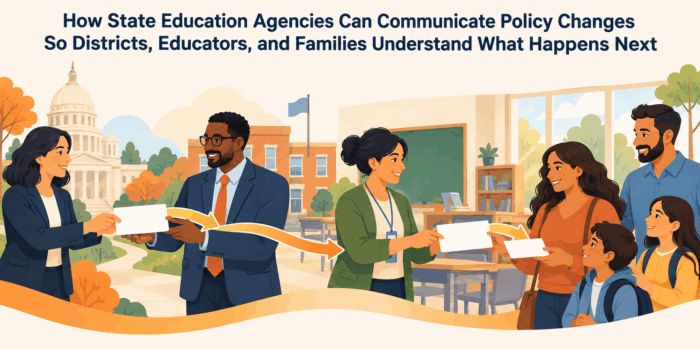
How State Education Agencies Can Communicate Policy Changes So Districts, Educators, and Families Understand What Happens Next
State education agencies sit at the center of a complex system of policy and implementation. When a legislature passes a new law, when the state board adopts new regulations, when federal requirements change, or when the agency revises standards, assessments, graduation requirements, accountability systems, funding formulas, licensure rules, or reporting requirements, the state education agency is responsible for explaining what has changed and what it means. Those explanations travel through superintendents, principals, district administrators, teachers, school boards, families, students, advocates, and the media. Every year, state agencies issue a substantial volume of guidance documents, memos, webinars, frequently asked questions, and data system updates, often under tight timelines driven by legislative calendars and federal deadlines. The quality of this communication shapes whether policies are implemented as intended, whether districts can plan effectively, and whether families understand changes that affect their children.
Too often, policy communication from state agencies arrives in forms that are difficult to use. Guidance may be issued as long legal memos that restate statutory language without explaining practical implications. Different offices within the agency may issue overlapping or inconsistent guidance. Timelines may leave districts little time to prepare, and guidance may arrive after districts have already made decisions based on incomplete information. Questions from districts may go unanswered for weeks, or answers may vary depending on which staff member responds. Families often hear nothing directly from the state and must rely on districts, which may themselves be uncertain. Teachers may learn about changes affecting their classrooms secondhand, sometimes through social media or union communications. The result is confusion, inconsistent implementation, frustration, and erosion of trust in both the state agency and the policy itself.
Clear, coordinated, and timely communication can transform how policy changes are understood and implemented. When state agencies explain what is changing, why, who is affected, what actions are required, by when, and where to get help, districts can plan and implement with confidence. When agencies provide tailored information for different audiences, including district leaders, educators, and families, each group can understand what the change means for them. When agencies listen to questions and feedback and update guidance accordingly, implementation improves over time. Effective policy communication is not merely a public relations function; it is a core implementation strategy that determines whether policies achieve their intended outcomes.
This article examines how state education agencies can communicate policy changes so that districts, educators, and families understand what happens next. It looks at why state policy communication often falls short, how to plan communication as part of policy implementation, and how to write guidance that is clear and actionable. It covers how to tailor communication for different audiences, how to coordinate across agency offices and with partner organizations, how to support districts in communicating with their own communities, how to manage questions and feedback, and how to time communication effectively. It also addresses communication about changes that remain uncertain, accessibility and language access, and measuring whether communication is working. The goal is state policy communication that every audience can understand and act on.
Why State Policy Communication Often Falls Short
 State education agencies operate under significant constraints that shape their communication. They must interpret statutes and regulations precisely, often with input from legal counsel, and they may be cautious about saying anything that could be construed as going beyond the law. They serve a large and diverse set of districts, from large urban systems with sophisticated central offices to small rural districts where the superintendent also serves as principal. They often work under tight timelines set by legislatures and federal agencies. Staff may be organized into program offices that each manage their own communication. Understanding these constraints helps explain why policy communication often falls short and points toward practical improvements that respect the agency’s legal obligations while serving the needs of the field.
Legal Precision Versus Practical Clarity
Guidance documents are frequently written to ensure legal accuracy, restating statutory or regulatory language closely and avoiding interpretation. While legal precision is important, documents that simply restate the law often fail to answer the questions practitioners actually have: What exactly must we do differently? By when? What are the options? What happens if we cannot comply in time? How will compliance be monitored? Districts may need to consult attorneys or wait for additional guidance to understand basic requirements, which delays implementation and leads to inconsistent interpretations across the state.
State agencies can provide both legal accuracy and practical clarity by pairing formal guidance with plain language summaries, examples, and frequently asked questions that address real implementation scenarios. A guidance document might begin with a one-page summary explaining what changed, who is affected, required actions, deadlines, and where to get help, followed by the detailed legal discussion. Examples showing how a requirement applies in typical situations, such as a small rural district, a large urban district, or a charter school, help practitioners understand how the policy works in practice.
Agencies can also work with legal counsel to identify where interpretation is permitted and where the agency can provide more definitive answers. Practitioners generally prefer clear guidance that acknowledges limits over vague guidance that leaves every decision to local interpretation.
Fragmented and Inconsistent Messages
State agencies are typically organized into offices responsible for different programs, such as assessment, accountability, special education, federal programs, school finance, educator licensure, career and technical education, and data collection. Each office may communicate directly with district counterparts through its own listservs, webinars, and documents. When a policy change affects multiple offices, districts may receive several communications that overlap, contradict, or use different terminology. District leaders may struggle to piece together a coherent picture, and different district staff may receive different information depending on which office they work with.
Inconsistency also arises over time. Guidance may be updated without clear indication of what changed, leaving districts uncertain whether older documents remain valid. Answers to questions may vary depending on which staff member responds. These inconsistencies undermine confidence and can lead to uneven implementation across districts.
Coordinating communication across the agency, maintaining a single authoritative source for each policy, and clearly versioning guidance documents are essential to reducing fragmentation. These practices require internal processes and leadership commitment, but they significantly improve the experience of districts and the consistency of implementation.
Timing That Leaves Little Room to Act
Policy changes often take effect on timelines that leave little room for planning. Legislatures may pass laws late in session with effective dates at the start of the next school year. Federal guidance may arrive late. Regulations may be adopted after districts have finalized budgets, staffing, and schedules. When guidance arrives late, districts must scramble to implement changes, often with incomplete information, and may make decisions that later need to be revised.
While agencies cannot always control timelines, they can communicate early about anticipated changes, share preliminary information with appropriate caveats, and provide timelines that show when additional guidance will be available. Early signals allow districts to begin planning even before details are final. Agencies can also advocate within government for realistic implementation timelines informed by the practical realities districts face.
When compressed timelines cannot be avoided, agencies can reduce the burden on districts by phasing requirements, offering transition periods, prioritizing the most essential actions, and being explicit about what flexibility exists. A message that acknowledges the short timeline, explains what districts must do immediately and what can wait, and describes how the agency will support districts through the transition demonstrates understanding of district realities and builds goodwill even under difficult circumstances.
Learning Together: Communication Strategies for K-12 School Districts and Public Education Agencies
This article is part of our series on strategic communication for K-12 School Districts and Public Education Agencies. To learn more and to see the parent article, which links to other content just like this, click the button below.
Planning Communication as Part of Policy Implementation
Effective policy communication begins long before guidance is issued. It should be planned as an integral part of implementation, with the same attention given to program design, data systems, and monitoring. A communication plan for a significant policy change identifies the audiences affected, what each needs to know and when, which channels and messengers will reach them, what tools and resources they will need, how questions will be handled, and how success will be measured. Planning communication early allows agencies to anticipate confusion, prepare resources, and coordinate across offices.
Communication planning should involve communication staff from the beginning of policy implementation, not only at the point when guidance is ready for release. When communication staff participate in early implementation discussions, they can identify messages that will be difficult to explain, anticipate questions from different audiences, and recommend timing that aligns with district calendars.
Agencies can also develop a standard communication plan template for significant policy changes, so that every program office follows a consistent process. A template might prompt staff to identify audiences, key messages, required actions, deadlines, channels, materials, intermediaries, translation needs, accessibility requirements, question handling, and measures of success. Over time, a consistent planning process improves the quality of policy communication across the agency and makes it easier for leaders to see where support is needed.
Mapping Audiences and Their Needs
Every significant policy change affects multiple audiences with different information needs. Superintendents need to understand strategic implications, costs, and decisions they must make. District program staff need detailed implementation guidance. Principals need to know what changes in their schools and how to support staff. Teachers need to understand how the change affects their classrooms and practice. School boards may need to adopt policies or approve budgets. Families and students need to know how the change affects them and what, if anything, they need to do. Advocates, legislators, and the media may also seek information.
Mapping these audiences and their needs allows agencies to design communication that serves each group. For example, a change in graduation requirements might require detailed technical guidance for counselors, a summary for superintendents and boards, a classroom-focused explanation for teachers, and a family-friendly overview that districts can share with parents and students. Planning these products together ensures consistency while meeting distinct needs.
Agencies can involve representatives of each audience in reviewing communication plans and draft materials, which helps identify gaps and confusing language before materials are released. Advisory groups of district leaders, educators, and families can provide valuable perspective.
Implementation Timelines and Milestones
A clear implementation timeline helps everyone understand what happens when. The timeline should show when the policy takes effect, when guidance and tools will be released, when training will be available, when districts must take specific actions, when data must be reported, and when monitoring will begin. Publishing this timeline early, and updating it as plans evolve, allows districts to plan their own work and communication. Visual timelines are particularly helpful for busy district leaders who need to see the big picture quickly.
Timelines should be realistic and should account for district calendars, such as budget adoption, staffing decisions, and the start of the school year. When timelines change, agencies should communicate promptly and explain the reasons.
Timelines should also identify dependencies that districts need to understand, such as a data system update that must be completed before districts can report new information, or a state board decision that must occur before final guidance can be issued. Making these dependencies visible helps districts understand why certain information is not yet available and when they can expect it. A simple status indicator for each milestone, showing whether it is on track, delayed, or complete, gives districts a quick way to monitor progress without needing to contact the agency.
Writing Guidance That Is Clear and Actionable
Guidance documents are the core of state policy communication, and their clarity determines how well districts can implement policies. Clear, actionable guidance answers practitioners’ questions directly, uses plain language, organizes information logically, and provides practical tools. It distinguishes between what is required and what is recommended, and it is explicit about deadlines, responsibilities, and resources.
Before release, significant guidance should be reviewed by people who were not involved in writing it, ideally including district practitioners. A simple test is whether a busy district administrator, reading the first page, can identify what changed, whether it applies to their district, what they must do, and by when. Guidance that passes this test is far more likely to be implemented correctly.
Structure and Plain Language
Effective guidance follows a consistent structure that districts come to recognize. A typical structure might include a summary of what changed, who is affected, required actions and deadlines, detailed explanation, frequently asked questions, examples, resources and tools, and contacts. Plain language principles, such as short sentences, active voice, defined terms, and headings that reflect practitioners’ questions, make guidance easier to read and apply. Agencies can develop a guidance template and style guide to promote consistency across offices.
Guidance should clearly distinguish between requirements, which districts must follow, and recommendations, which districts may choose to adopt. Mixing the two without clear labels causes confusion about what is mandatory. Using consistent labels, such as required and recommended, throughout guidance helps districts prioritize.
Accessibility should be built into every guidance document. Documents should be published in accessible formats with proper headings, alternative text for images, and accessible tables, so that district staff and members of the public who use assistive technology can read them. Long documents should include a table of contents and links to sections. Webinars should be captioned and recordings posted with transcripts. These practices are required for many public agencies and also make guidance easier for everyone to navigate.
Practical Tools and Examples
Districts benefit from practical tools that help them implement policies, such as checklists, templates, sample policies, model letters to families, decision trees, and implementation planning worksheets. Examples drawn from real or realistic scenarios show how requirements apply in practice. Webinars and recorded walkthroughs can supplement written guidance for complex changes. Providing these tools reduces the burden on districts and promotes consistent implementation across the state.
Tools are most useful when they are developed with input from practitioners who will use them. Piloting a checklist or template with a small group of districts before statewide release often reveals steps that are unclear, assumptions that do not hold in smaller districts, or formats that do not fit local systems. Incorporating this feedback before release saves time for every district and reduces the volume of follow-up questions the agency must answer.
Agencies should also make tools easy to find. A policy-specific web page that gathers the guidance document, summary, frequently asked questions, tools, webinar recordings, and contacts in one place allows district staff to locate everything they need quickly. Consistent naming conventions and a searchable resource library help staff find tools for past policies as well, which is valuable for new district staff who are learning requirements that predate their arrival.
Tailoring Communication for Different Audiences
One guidance document cannot serve every audience. State agencies that tailor communication for district leaders, educators, and families, while maintaining consistent core messages, help each group understand what a change means for them. Tailoring does not mean creating entirely separate messages; it means presenting the same facts in formats, levels of detail, and channels suited to each audience.
District Leaders and Program Staff
Superintendents and district leaders need concise briefings that explain the policy, its implications for budgets, staffing, and operations, key decisions they must make, deadlines, and how the state will support implementation. Program staff need detailed technical guidance and opportunities to ask questions. Regular channels, such as weekly superintendent updates, program-specific newsletters, and standing webinars, give district staff predictable sources of information.
Agencies can strengthen communication with district leaders by holding regional meetings or virtual office hours where leaders can discuss implementation challenges and share solutions. These conversations also provide the agency with valuable feedback on how policies are working in practice and where additional guidance is needed.
Small and rural districts often have limited central office capacity, with a few administrators covering many responsibilities. Agencies should consider how these districts will receive and use guidance, providing concise summaries, ready-to-use templates, and regional support through educational service agencies.
Educators
Teachers and other educators are often the people who implement policy changes in classrooms, yet they frequently receive information secondhand. State agencies can communicate directly with educators through educator newsletters, professional organizations, social media, and resources designed for classroom use. Explanations should focus on what changes in practice, why it matters for students, and what support is available, such as professional learning or instructional materials. Collaborating with educator associations to share information can extend reach and credibility.
Communication with educators should respect their time and expertise. Teachers receive large volumes of information from many sources, and state messages compete for attention with district, school, and classroom demands. Brief, focused messages that lead with what changes for teachers and students, followed by links to more detail, are more likely to be read than long documents. Short explanatory videos featuring practicing educators, rather than agency officials, can make changes feel more relevant and credible. Agencies should also coordinate with districts so that teachers do not receive conflicting messages from state and local sources about the same change.
Educators also need time and support to adjust. When policies require changes in instruction, assessment, or reporting, agencies should communicate about available professional learning and resources early, so that districts can plan training before changes take effect.
Educators should also be invited to provide feedback on how policies are working in classrooms. Teacher advisory groups, surveys, and focus groups can reveal implementation challenges that district leaders may not see, such as unclear assessment directions, reporting requirements that consume instructional time, or resources that do not match classroom realities. Communicating how educator feedback influenced revisions shows educators that the agency values their expertise and encourages continued engagement.
Families and Students
Families and students are directly affected by many state policy changes, such as graduation requirements, assessments, accountability ratings, school choice options, and special education rules, but they rarely receive direct communication from state agencies. Agencies can create family-friendly explanations of major changes, written in plain language and translated into commonly spoken languages, that districts can share or adapt. These resources should explain what is changing, how it affects students, what families need to do, and where to get more information. Short videos, infographics, and frequently asked questions can make information accessible.
Providing these resources to districts ready to use reduces the burden on districts and ensures consistency in how families across the state learn about changes. Agencies can also share family resources directly through their own websites, social media, and partnerships with statewide parent organizations.
Family-facing communication should be tested with families before release. A short review by a diverse group of parents, including parents who speak languages other than English and parents of students with disabilities, can reveal confusing terms and missing information. Statewide parent organizations, parent training and information centers, and family engagement networks can help organize these reviews and distribute materials once they are finalized, extending the agency’s reach to families who may not follow district communications closely.
Coordinating Across the Agency and With Partners
 Policy changes often involve multiple offices within the agency and multiple partner organizations, such as educational service agencies, professional associations, advocacy groups, and higher education institutions. Coordination ensures consistent messages and avoids duplication or contradiction.
Internal Coordination
Agencies can designate a lead office or communication coordinator for each major policy change, responsible for coordinating messages across offices, maintaining a single authoritative web page, and reviewing communication before release. Internal briefings ensure that all staff who interact with districts understand the policy and can provide consistent answers. A shared frequently asked questions document, updated regularly and used by all staff, helps maintain consistency.
Version control is essential. Each guidance document should include a date and version number, and updates should be clearly marked with a summary of changes. Outdated documents should be archived or clearly labeled to prevent confusion.
Agencies can also designate a single public web page for each major policy as the authoritative source, and all communication, including memos, newsletters, webinars, and social media, should link back to it. When district staff know that this page always contains the current guidance, they can rely on it rather than searching through email archives for the latest version. Internal processes should require that any new or revised guidance be posted to the authoritative page before it is distributed through other channels.
Working With Intermediaries
Educational service agencies, regional offices, and professional associations are trusted intermediaries that can help explain policies to districts and educators. Agencies can brief these intermediaries early, provide them with materials and talking points, and invite them to share feedback from the field. Coordinated communication through trusted intermediaries extends reach and helps ensure that consistent messages reach every district.
Intermediaries can also help translate state guidance into regional context. An educational service agency might host a workshop that walks districts in its region through a new requirement, shares examples from neighboring districts, and connects small districts that face similar challenges. Professional associations can explain policies to their members in familiar terms and gather concerns that members might hesitate to raise directly with the agency. When intermediaries are well informed and well supported, they multiply the agency’s capacity to reach the field.
To make these partnerships work, agencies should provide intermediaries with materials before public release whenever possible, invite them to briefings, and maintain regular contact with designated liaisons. Agencies should also listen carefully to what intermediaries report from the field, since they often detect confusion or implementation problems early. A standing monthly call with regional partners, for example, can surface issues before they spread and allow the agency to adjust guidance promptly.
Supporting Districts in Communicating With Their Communities
Districts are usually the primary communicators with families, educators, and local communities about state policy changes. State agencies can make districts’ work easier by providing communication toolkits, consistent messages, and timely information.
Communication Toolkits
Toolkits for major policy changes might include plain language summaries, frequently asked questions, model letters and newsletter articles, social media posts, presentation slides, infographics, and translated versions of key materials. Toolkits allow districts to communicate accurately and efficiently and help ensure that families across the state receive consistent information. Toolkits should be editable so districts can add local details.
Translation is an important part of toolkit design. Many districts lack the capacity to translate complex policy information into every language their families speak, and inconsistent translations across districts can create confusion. State agencies can provide professionally translated family materials in the most commonly spoken languages across the state, along with a glossary of key terms, so that families receive accurate information regardless of where they live. Accessible formats, such as large print and screen reader friendly documents, should also be included.
Toolkits should be released with enough lead time for districts to use them before changes take effect or before families begin asking questions. A toolkit released the day results become public, for example, leaves districts little time to prepare. Notifying districts when toolkits are available, and highlighting the most important items for immediate use, helps busy communication and administrative staff take advantage of them.
Advance Notice to Districts
Districts should hear about significant changes, such as accountability ratings or assessment results, before public release whenever possible, so they can prepare to communicate with their communities. Embargoed previews, briefings, and talking points help districts respond to questions from families and media.
Advance notice is particularly important for information that may generate strong reactions, such as school ratings, identification for improvement, changes to funding allocations, or assessment results that show significant declines. Districts that learn about such information at the same time as the public may be caught unprepared, unable to answer questions or explain context, which can damage trust in both the district and the state. A predictable schedule of previews before public releases, clearly communicated at the start of each year, allows districts to plan.
Agencies should also coordinate the timing of public releases with districts’ needs where possible, avoiding releases at times when districts have limited capacity to respond, such as the first days of school or holiday breaks. When releases must occur at difficult times, agencies can provide additional support, such as expanded office hours or ready-to-use statements, to help districts respond effectively.
Managing Questions, Feedback, and Uncertainty
Policy changes inevitably generate questions, and how agencies handle those questions affects implementation and trust. Agencies must also communicate honestly about uncertainty when details are not yet final.
Responsive Question Handling
Agencies can establish clear channels for questions, such as dedicated email addresses or online forms for each major policy, and commit to response timelines. Answers to common questions should be added to public frequently asked questions so all districts benefit. Office hours and webinars provide opportunities for real-time questions.
Consistency in answers is as important as speed. Agencies can route questions to designated subject matter experts, review answers to complex questions before they are sent, and maintain an internal database of approved answers that all staff can reference. When an answer to one district reveals an interpretation that affects all districts, the agency should share it publicly rather than leaving other districts unaware. Publishing an updated frequently asked questions document on a regular schedule, with new questions clearly marked, helps districts stay current without repeatedly checking for changes.
Agencies should also track the volume and types of questions they receive. Patterns in questions reveal where guidance is unclear or where districts face implementation barriers, and this information can guide revisions, additional tools, or targeted support. Sharing a summary of common questions and how the agency responded demonstrates responsiveness and helps districts see that their concerns are being heard.
Communicating Uncertainty
When details are not yet final, agencies should say so clearly, explain what is known, what is still being decided, and when more information will be available. Honest communication about uncertainty helps districts plan for contingencies and maintains credibility.
Agencies sometimes hesitate to share preliminary information for fear that it will change and cause confusion. But silence often causes more confusion, as districts make assumptions or rely on rumors. Clearly labeled preliminary information, such as a statement that the agency expects to require a particular approach but final decisions will be made by a specific date, allows districts to begin planning while understanding that details may shift. When information does change, the agency should explain what changed and why, which maintains trust even when plans evolve.
When policies are subject to litigation, pending legislation, or federal decisions, agencies should explain the situation plainly, describe the possible outcomes, and advise districts on how to prepare for each. Scenario planning guidance, which describes what districts should do under different outcomes, can be especially helpful during periods of prolonged uncertainty.
Finally, agencies should measure whether policy communication is working. Useful indicators include the timeliness of guidance relative to effective dates, the volume and types of questions received, the consistency of implementation across districts, district and educator ratings of guidance clarity, and family awareness of major changes. Short surveys after major guidance releases can ask district staff whether the guidance answered their questions and what was missing. Reviewing these indicators after each significant policy change, and sharing what the agency learned and will do differently, builds a culture of continuous improvement. Over time, measurement helps agencies identify which formats, channels, and practices work best for different audiences, and it demonstrates to the field that the agency takes the quality of its communication seriously.
How State Education Agency Communication Compares With Other Agency Types
Many state agencies communicate policy changes to local implementers and the public. State health departments issue guidance to local health departments, hospitals, and providers. State environmental agencies communicate regulatory changes to municipalities and businesses. State labor and workforce agencies explain new requirements to employers. Federal agencies issue guidance to states. Across these contexts, agencies that communicate effectively share common practices: they plan communication as part of implementation, provide plain language summaries alongside technical guidance, maintain authoritative sources with clear version control, engage intermediaries, and offer responsive channels for questions. Health agencies, for example, often issue guidance with a brief summary of what changed at the top, use consistent templates, and hold regular calls with local partners during periods of rapid change. These practices are directly applicable to state education agencies.
State education agencies face distinctive challenges as well. They communicate with a very large number of local implementers, including hundreds of districts and charter schools of widely varying size and capacity. Their policies affect children and families directly, raising the stakes of clear communication. Education policy is often politically visible and subject to frequent legislative change, which can make guidance feel like a moving target. And state agencies must communicate both with the professional education workforce and, increasingly, with families who want to understand how state decisions affect their children. These features make thoughtful, coordinated, and audience-centered communication essential to effective policy implementation.
Tying It All Together
State policy communication is not a side function. It determines whether districts, educators, and families understand what is changing, what it means for them, and what happens next, and it directly shapes whether policies are implemented consistently and achieve their intended outcomes.
Effective state agencies recognize why policy communication often falls short, including the tension between legal precision and practical clarity, fragmented and inconsistent messages across offices, and timelines that leave little room for districts to act.
They plan communication as an integral part of policy implementation, mapping audiences and their needs and publishing realistic implementation timelines and milestones. They write guidance that is clear and actionable, with consistent structure, plain language, clear distinctions between requirements and recommendations, and practical tools and examples.
They tailor communication for district leaders, program staff, educators, families, and students, presenting consistent core messages in formats suited to each audience. They coordinate across agency offices and with intermediaries such as educational service agencies and professional associations, maintaining authoritative sources and clear version control.
They support districts in communicating with their own communities through toolkits and advance notice. They manage questions responsively, communicate honestly about uncertainty, and ensure that materials are accessible and available in the languages families speak.
Taken together, these practices transform state policy communication from a stream of memos into a coordinated system that helps every audience understand and act on change.
Strategic Communication Support for State Policy Communication
 State policy changes affect every district, school, educator, and family, yet their meaning is often unclear to the people who must implement them. New requirements related to graduation, assessment, accountability, funding, staffing, and student services may arrive through dense guidance documents, leaving districts uncertain about next steps and families unsure how changes affect their children. Because clear policy communication requires coordination across policy offices, program divisions, legal staff, communication teams, regional partners, and district leaders, state education agencies often partner with Stegmeier Consulting Group (SCG) to explain policy changes more effectively. SCG helps agencies communicate not only what a policy says but what happens next for the people it affects.
SCG supports agencies in assessing how policy information currently reaches districts, educators, and families. This can include reviewing guidance documents, memos, webinars, websites, and frequently asked questions, along with gathering feedback from district staff about what is clear, what is confusing, and where they turn for answers. These findings help agencies identify gaps in timing, clarity, and consistency. Plain language summaries, implementation timelines, role-specific guidance, and family-facing explanations then help each audience understand what is required and when.
Sustained clarity depends on the people who develop and deliver policy communication. Program staff, regional liaisons, and agency leaders may each explain policies differently, creating confusion across districts. SCG helps agencies establish writing standards, review processes, and coordinated release procedures that ensure consistency. Training for program staff on plain language and audience-centered communication, along with toolkits that districts can adapt for local families, helps policy information travel accurately from the state to classrooms and homes.
New legislation, federal requirements, implementation deadlines, and public attention to policy changes can make this work especially urgent. SCG helps agencies plan communication around legislative calendars and implementation milestones, coordinate with regional agencies and district associations, and prepare responses to common questions before guidance is released. By planning communication alongside policy development, agencies can reduce the confusion and repeated inquiries that follow unclear rollouts.
SCG also helps agencies evaluate whether policy communication is helping districts and families understand what happens next. Inquiry volume, webinar participation, district surveys, website analytics, and implementation progress can reveal where guidance is working and where additional clarification is needed. By incorporating these findings into future policy rollouts, agencies can make clear communication an ongoing practice that supports consistent, confident implementation across the state.
Future Trends
State education policy continues to change rapidly, with frequent legislative action on topics such as literacy instruction, graduation pathways, school choice, assessment, accountability, educator workforce, and student well-being. Agencies will need communication systems that can respond quickly while maintaining clarity and consistency.
Digital tools, such as searchable guidance portals, interactive timelines, and centralized question tracking systems, are helping agencies organize information and improve responsiveness. These tools are most effective when paired with plain language content and clear governance.
Agencies are increasingly communicating directly with families and the public, recognizing that families want to understand how state decisions affect their children. This trend will require family-friendly content, translation, and partnerships with community organizations.
Attention to implementation science is growing, and agencies are recognizing communication as a core component of successful implementation rather than an afterthought.
Finally, trust in public institutions remains fragile in many communities. Agencies that communicate transparently, acknowledge uncertainty, and respond to feedback will be better positioned to maintain credibility with districts and families.
Conclusion
State education agencies shape the conditions under which every public school operates. When their communication is clear, coordinated, and timely, districts can implement policies effectively, educators can adjust their practice, and families can understand changes affecting their children. When communication is confusing or late, implementation suffers and trust erodes.
Agencies that plan communication as part of implementation, write clear and actionable guidance, tailor communication for each audience, coordinate across offices and partners, support districts, manage questions responsively, and communicate honestly about uncertainty can transform how policy changes are understood and implemented.
When every district leader, educator, and family understands what is changing and what happens next, state policy becomes a shared effort to improve education rather than a source of confusion.
Stegmeier Consulting Group’s Strategic Approach to Communication Systems
Help every audience understand what state policy changes mean and what happens next.
Stegmeier Consulting Group helps state education agencies communicate policy changes clearly to districts, educators, and families. We begin by assessing current guidance, channels, coordination, and feedback from the field, identifying where communication creates confusion or delays implementation.
Our team works alongside agency leaders and program offices to develop guidance templates and plain language standards, create communication plans for major policy changes, design toolkits for districts, develop family-facing resources, and strengthen coordination across offices and with intermediaries.
We treat policy communication as a system that spans planning, guidance, audience-specific outreach, question management, and measurement. That means aligning messages across the agency and building feedback loops that improve communication over time.
Use the form below to connect with our team and explore how strategic policy communication can help your agency explain what changes, why it matters, and what happens next, so that districts, schools, and families can act on new policy with confidence.