
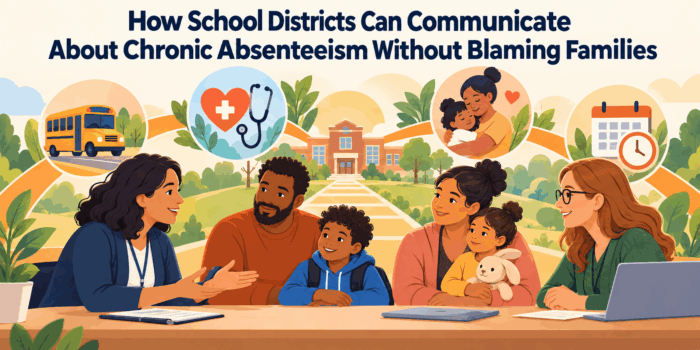
How School Districts Can Communicate About Chronic Absenteeism Without Blaming Families
Chronic absenteeism, usually defined as missing ten percent or more of school days for any reason, has become one of the most persistent challenges facing public school systems. In a typical 180-day school year, that threshold is just eighteen days, or roughly two days a month, which means many students cross it without their families ever realizing that a pattern has formed. Rates rose sharply in recent years and remain stubbornly elevated in many communities, even as other indicators have begun to recover. Students who miss significant amounts of school fall behind in reading and math, lose connection with teachers and classmates, and face a higher likelihood of disengaging from school entirely. State accountability systems increasingly include chronic absence as a measured indicator, and school boards and communities are asking district leaders what they plan to do about it. As a result, attendance has moved from a back-office compliance function to a front-line strategic priority.
Communication sits at the center of nearly every attendance strategy, whether districts recognize it or not. Families receive automated calls and texts when a student is marked absent, letters when absences reach defined thresholds, attendance summaries on report cards, and campaign messages reminding them that school matters. Teachers, attendance clerks, counselors, and administrators all communicate about attendance in their own ways, sometimes consistently and sometimes not. Much of this communication was built on a truancy enforcement model that predates current thinking about attendance, and it often carries an implicit message that families are not taking school seriously. Letters cite compulsory attendance statutes in their opening lines, list potential penalties before they offer any help, and describe students as truant or habitually absent. Even when district leaders have shifted their philosophy toward prevention and support, the words families actually receive frequently still reflect the older approach.
For many families, the assumption behind blame-based messaging is simply wrong. Students miss school because of asthma flare-ups and dental pain, because the car broke down or the bus route changed, because the family moved in with relatives across town, because an older sibling had to stay home with a younger one, because of anxiety or depression, because of bullying or conflict with peers, or because school has stopped feeling like a place where they belong. Families dealing with these barriers are often already worried and already stretched thin. A letter that threatens court referral does nothing to fix a broken car or treat a child’s anxiety, and it frequently damages the very relationship the school needs in order to help. Parents who feel accused tend to stop answering calls, avoid meetings, and become less willing to share what is actually going on at home, which leaves the school with less information and fewer options.
This article examines how school districts can communicate about chronic absenteeism in ways that build partnership rather than blame. It looks at why punitive messaging tends to backfire, how to reframe attendance around learning, belonging, and health, how to redesign the notifications, letters, and reports families receive most often, and how to use two-way conversation to understand the real barriers behind absences. It also covers how to match communication to tiers of support, how to prepare staff and community partners to communicate consistently, and how to measure whether attendance communication is actually helping students return to school. Throughout, the emphasis is on practical changes that districts can make within existing legal requirements and staffing realities. The goal is attendance communication that brings students back to school by bringing families into the solution as partners rather than treating them as the source of the problem.
Why Blame-Based Attendance Communication Falls Short
 Traditional attendance communication grew out of truancy enforcement, and its structure still reflects that origin. Letters were designed primarily to establish legal notice, document that the district had informed the family of compulsory attendance requirements, and create a paper trail that could support escalation if absences continued. That purpose is legitimate, and in many states specific notices are still required at defined thresholds. The problem arises when the legal purpose of a notice is allowed to define its entire tone and content. A document written to protect the district in a future hearing is rarely a document that persuades a worried, overextended parent to pick up the phone and ask for help. When the first substantive attendance message a family receives reads like a summons, the opportunity for partnership is often lost before it begins, and every subsequent message is filtered through that first impression.
What Families Hear in Punitive Messages
When a family opens a letter that begins with a statute citation, refers to their child as truant, and lists fines or court involvement before mentioning any support, the message they take away is unmistakable: the school sees them as the problem. For a single parent working overnight shifts while managing a child’s chronic asthma, or for a family that has moved three times in a year because of rising rent, that message lands as both unfair and humiliating. It does not acknowledge the circumstances they are navigating, and it offers no realistic path forward beyond a vague instruction to improve attendance. Some families respond by keeping a child home even longer because they dread the conversation that will follow when the student returns. Others stop opening mail from the school altogether. In both cases, the communication has made the attendance problem harder to solve rather than easier.
These effects are often strongest among families who already approach institutions with caution. Parents with limited English proficiency may receive a translated letter in which formal legal language sounds even more alarming than it does in English. Families who have had difficult experiences with child welfare agencies, courts, or immigration enforcement may read any reference to legal consequences as a genuine threat to their household, not simply a policy reminder. Families from communities that have historically experienced disproportionate discipline and enforcement in schools may see a punitive attendance letter as one more example of a pattern they already recognize. For these families, the cost of a harsh message is not merely a missed opportunity. It can push them further from the school at precisely the moment when connection matters most, and it can shape how they respond to every future contact from that school.
What the Evidence Says About Supportive Messaging
Research on attendance interventions has consistently found that positive, informative, and personalized communication can reduce absences, while approaches built primarily on threats tend to show limited or short-lived effects. One of the most robust findings is that many families significantly underestimate how many days their child has missed. A parent who remembers a handful of sick days may be genuinely surprised to learn that the total has reached fifteen by midyear. Studies of mailed attendance reports that simply show families the total number of absences, sometimes compared with the typical student at the school, have produced measurable reductions in chronic absence at very low cost. The mechanism is not pressure. It is information delivered clearly, respectfully, and early enough that families can act on it before a pattern becomes entrenched.
Supportive messaging also works because it makes it easier for families to ask for help. When a letter or call communicates that the school has noticed, cares, and has specific resources available, families are more likely to explain what is happening and accept assistance. That conversation is what allows a school to arrange a bus pass, connect a family with a clinic, adjust a schedule, or bring in a counselor. None of this means lowering expectations. Effective attendance communication pairs a clear statement that daily attendance matters with an equally clear statement of belief in the family and willingness to work together. High expectations delivered with suspicion tend to produce defensiveness. High expectations delivered with respect and concrete support tend to produce engagement, and engagement is what ultimately changes attendance patterns over time.
Meeting Legal Requirements Without Leading With Them
Many states require districts to send specific notices when unexcused absences reach defined levels, and those requirements must be met. Meeting them, however, does not require that legal language set the tone of the entire communication. A threshold letter can open with a sentence expressing care for the student, explain clearly how many days have been missed and why that matters for learning, acknowledge that families sometimes face challenges that make attendance difficult, and offer specific forms of help with a named contact person. The legally required language can then appear later in a clearly labeled section, written as plainly as the statute allows. This structure satisfies the notice obligation while ensuring that the first thing a family reads is an invitation rather than an accusation.
Districts should work with legal counsel to identify precisely which language is required and where flexibility exists. In many cases, staff discover that much of the punitive tone in existing templates came from inherited documents, copied phrasing, or a cautious interpretation of what the law demands, rather than from any actual statutory requirement. A careful review often reveals that required elements can be expressed in plain language, that penalties do not need to be listed in the opening paragraph, and that supportive content can be added freely. Counsel can also help ensure that any changes preserve the district’s ability to document notice if a case does eventually escalate. Doing this work once, and building it into standardized templates, allows every school in the district to send letters that are both legally sound and genuinely helpful.
Learning Together: Communication Strategies for K-12 School Districts and Public Education Agencies
This article is part of our series on strategic communication for K-12 School Districts and Public Education Agencies. To learn more and to see the parent article, which links to other content just like this, click the button below.
Reframing Attendance Around Learning, Belonging, and Health
Effective attendance communication starts with a clear and positive frame that families can recognize as aligned with their own goals. Rather than presenting attendance primarily as a compliance obligation, districts can present it as a shared commitment rooted in students’ learning, their relationships with teachers and friends, and their long-term opportunities. This framing is not a public relations exercise. It reflects what families already care about, and it positions the school as an ally in pursuing those goals rather than an authority enforcing rules. When attendance messages consistently reinforce this frame across the year, families are more likely to see a later conversation about absences as part of an ongoing partnership. When the first time a family hears about attendance is in a warning letter, even well-intended support can feel like an afterthought attached to an accusation.
Explaining Why Every Day Matters
Families respond most strongly to attendance messages that connect directly to their child’s experience. Explaining that missing just two days a month adds up to nearly a month of school over a year helps families see how small, seemingly reasonable absences accumulate into a significant loss of instruction. Explaining that absences in kindergarten and first grade are linked to weaker reading skills by third grade gives families of young children a concrete reason to prioritize attendance early, at a stage when many assume missed days do not matter much. For older students, connecting attendance to course credit, graduation, and the relationships with teachers that lead to recommendations and opportunities makes the stakes tangible. These messages work best when they are specific, brief, and free of moralizing, so that families experience them as useful information rather than a lecture.
Timing matters as much as content. These messages should be woven into start-of-year communication, kindergarten orientation, back-to-school nights, newsletters, and conferences, long before any individual student has a problem. Families who understand the importance of consistent attendance in September are far better prepared to respond in November when their child has missed several days. Schools can reinforce the message through classroom practices as well, such as teachers explaining to students what they will miss if they are absent and welcoming them warmly when they return. When attendance is presented as part of the ordinary rhythm of school life rather than as a crisis topic, families are more likely to treat it as a shared priority and less likely to feel singled out when the school reaches out.
Giving Clear Guidance on Illness
Illness is one of the most common reasons students miss school, and it has become one of the most confusing areas of attendance communication. In recent years, families received strong and repeated messages urging them to keep children home at the first sign of illness. Many attendance campaigns now urge families to send children every day. Without clear guidance that reconciles these messages, families are left to resolve the tension themselves, and many understandably keep children home for a mild runny nose, a slight cough, or a vague complaint of not feeling well. The result is a significant volume of avoidable absence, along with frustration among families who feel they are being criticized for following earlier advice. Clear, consistent guidance is one of the simplest and most effective tools a district has for addressing this problem.
Districts can develop simple, health-informed guidance with school nurses and local health partners that explains when a child should stay home and when they can safely attend. A one-page visual guide might explain that children with a fever, vomiting, diarrhea, or certain contagious conditions should stay home, while children with mild cold symptoms, seasonal allergies, or minor aches can usually come to school. The guide should explain when a child can return after illness and what the school nurse can do if symptoms appear during the day. Shared in every language families speak, posted on the website, sent home at the start of the year, and repeated before cold and flu season, this guidance gives families confidence on busy mornings. It should be framed as help for families making a hard decision, not as a rule designed to protect attendance numbers.
Recognizing Progress Instead of Perfection
Traditional perfect attendance awards are well intended, but they can send the wrong message. Students with chronic health conditions, students who have experienced a family emergency, and students whose families face housing or transportation instability may never qualify, no matter how hard they work to attend. For these students, perfect attendance recognition can become one more reminder that they do not measure up. Some families have also reported sending children to school while ill in order to preserve a perfect record, which undermines both health and attendance goals. Recognizing improvement instead of perfection keeps attention on growth and makes recognition attainable for students who need encouragement most. A student who goes from missing four days a month to missing one has accomplished something significant, and acknowledging that progress reinforces the behavior the school wants to see.
Recognition is most powerful when it reaches families directly and personally. A short phone call or note from a teacher saying that a student’s attendance has improved, and that the class is better with them there, can change how a family feels about the school. Classroom and schoolwide recognition can focus on collective progress, such as a grade level meeting a monthly attendance goal, which builds a sense of shared effort without singling out students who are struggling. Schools can also recognize families who have partnered with staff to overcome barriers, with permission and without revealing private details. Each of these practices sends the same message: the school notices effort, values every student’s presence, and sees attendance as something families and educators achieve together rather than a test families pass or fail.
Redesigning Notifications, Letters, and Attendance Reports
Automated absence notifications, threshold letters, and attendance reports are the attendance communications families receive most often, and they are sent at enormous scale across a district. Because of that reach, redesigning them is one of the highest-impact changes a district can make. A single revised template can change the tone of thousands of interactions in a year without any additional staff time. These documents are also among the easiest to test and improve, because they are standardized and their effects can be tracked through response rates and attendance patterns. Districts that treat these routine messages as strategic communication, rather than as automated system outputs, often find that families begin responding differently within a single semester.
Daily Absence Notifications
Daily automated notifications let families know when a student has been marked absent, and they serve an important safety function as well as an attendance function. Their tone, however, varies widely. A message that says a student was marked absent and that unexcused absences may result in further action begins the relationship on a defensive note. A message that says the student was marked absent today, asks the family to reply or call if this is a mistake or if they need help, and provides a direct number accomplishes the same purpose while opening a door. Notifications should be sent in the family’s preferred language through the channel they actually use, which for many families is text messaging rather than email or voice calls. They should be short enough to read in a few seconds and specific enough that families know exactly what to do next.
The most effective notifications allow families to respond directly. Two-way text platforms make it possible for a parent to reply that their child is at a medical appointment, that the absence was an error, or that they are having trouble getting the child to school. Those replies give attendance staff immediate information that would otherwise require multiple phone calls to obtain, and they allow the school to correct inaccurate records quickly. A reply that signals a barrier, such as a missed bus or a sick parent, can be routed to a staff member who follows up the same day. Over time, these exchanges turn a routine automated alert into a channel for relationship building. Families learn that the school is responsive, and staff learn which families may need additional support before absences accumulate into a chronic pattern.
Threshold Letters That Open Conversations
Letters sent when absences reach a defined level are often the most consequential attendance communication a family receives, and they deserve the most careful design. An effective letter begins by expressing care for the student and noting that the school has missed them. It then states clearly how many days have been missed, explains in one or two sentences why that matters for learning, and acknowledges that families sometimes face challenges that make attendance hard. The center of the letter should be a specific offer of help, naming the kinds of support available, such as transportation assistance, health services, counseling, or schedule adjustments, and inviting the family to contact a named staff member by phone or text. Required legal language follows in a clearly labeled section. This sequence respects the family, satisfies notice requirements, and makes the most important action, reaching out to the school, easy and inviting.
Testing letter drafts with families before adopting them is one of the most valuable steps a district can take. Small changes in wording often produce large differences in how a letter is received. Replacing a phrase like “your child is truant” with “we have noticed your child has missed several days and we want to help” changes the emotional temperature of the entire document. Reviewers from the community may point out terms that sound threatening in translation, sections that are confusing, or offers of help that are too vague to act on. Districts can recruit reviewers through parent advisory groups, family liaisons, and community partners, and should include families who have received attendance letters in the past. Their feedback ensures that the final template reflects how real families read it, not how staff assume it will be read.
Personalized Attendance Reports
Because families frequently underestimate how many days their child has missed, periodic personalized attendance reports can be a powerful prompt for action. A simple mailed or texted report that shows the student’s total absences to date, compares that number to the school average or to a target, and explains what the numbers mean gives families information they may not have had. The report should include a brief message of encouragement, such as noting that every day counts and that the school is glad to help, along with a direct contact for questions or support. Districts have used these reports successfully at a very low cost per student, and they can be scheduled at intervals that catch emerging patterns, such as after the first month of school and again at midyear, rather than waiting for formal thresholds.
Accuracy is essential to the credibility of personalized reports. If a report lists absences that the family believes were recorded in error, or counts excused medical absences in a confusing way, trust erodes quickly and the family may dismiss future communication. Reports should clearly distinguish between excused and unexcused absences where that distinction matters, explain how absences are counted, and tell families exactly how to request a correction. Front office staff should be prepared for an increase in calls after reports go out and should treat those calls as opportunities to confirm contact information and ask whether the family needs support. When families see that the school responds promptly and fixes mistakes, they become more confident in the data and more receptive to the underlying message about consistent attendance.
Understanding Barriers Through Two-Way Conversation
 Attendance data can tell a school which students are missing days and when, but it cannot explain why. That explanation lives with families and students, and the only way to obtain it is through genuine two-way conversation. Schools that skip this step often apply the same response to every absent student, sending more reminders or escalating consequences, regardless of whether the underlying cause is a health condition, a transportation gap, a housing crisis, or a student who feels unsafe at school. Each of those causes calls for a different response, and none is solved by repeating the message that attendance matters. Building conversation into the attendance process from the earliest stages allows schools to direct resources where they will actually make a difference and signals to families that the school wants to understand rather than judge.
Asking Before Assuming
The first personal contact after a student begins missing school should ask rather than tell. A call that opens with “We have missed your daughter in class this week and wanted to check in to see how she is doing and whether there is anything we can help with” invites a very different response than a call that opens by stating the number of absences and the attendance policy. Staff should be prepared to listen to a wide range of explanations without visible judgment, to ask follow-up questions that clarify the barrier, and to respond with something practical before ending the conversation. Even when the school cannot solve the problem immediately, offering a next step, such as a meeting with the counselor or a referral to a community resource, demonstrates that the conversation was worth having.
Asking before assuming also means being careful about the setting and format of early conversations. Some families are comfortable with a phone call, while others respond better to a text message that allows them to reply when they have a moment of privacy. Some prefer to talk in person at pickup, and some will only share sensitive information with a staff member they already know and trust, such as a family liaison who speaks their language. Schools should use the channel and messenger most likely to be welcomed by each family, and they should avoid holding initial attendance conversations in public settings where other parents or students might overhear. These choices may seem small, but they strongly influence whether a family feels safe enough to explain what is really happening at home.
Responding to Common Barriers
Once a barrier is identified, communication should shift immediately to practical support. If the barrier is transportation, staff can explain bus eligibility, offer transit passes, help organize carpools, or connect the family with walking school bus programs. If the barrier is health related, the school nurse can help the family develop a health plan, connect them with a clinic or school-based health center, and clarify when the child can safely attend. If the family is experiencing housing instability, the district liaison for students experiencing homelessness can explain the student’s rights, including transportation to the school of origin in many cases. If a student is caring for younger siblings, the school can explore before and after school care options. The key is that the response is specific to the barrier and delivered quickly, so that the family experiences the conversation as the beginning of a solution.
Some barriers are rooted in the student’s experience at school rather than circumstances at home. Students may avoid school because of bullying, conflict with a teacher, academic frustration, social anxiety, or a sense that no adult at school knows or cares about them. These barriers require a different kind of communication, one that involves the student directly and brings in counselors, teachers, and administrators who can change something about the school experience. Families may be reluctant to raise these issues for fear of making things worse for their child, so staff should ask about them gently and explicitly. When a school responds to a school-based barrier by taking visible action, such as addressing a bullying situation or adjusting a schedule, families see that the attendance conversation is about the student’s well-being rather than about compliance.
Listening to Students Directly
Students, particularly in middle and high school, often understand their own absences better than anyone else, and they are frequently the ones deciding whether to attend on a given day. Conversations with students about why they miss school, what would make school feel more worthwhile, and what support would help can reveal barriers that families do not know about or do not mention. A student might explain that first period feels pointless because they are far behind, that they skip lunch periods to avoid a particular group of peers, or that they are working late hours to help the family pay rent. These conversations should be held by adults the student trusts, in private settings, and with a clear message that the purpose is to help rather than to punish.
At a broader level, student surveys and focus groups can reveal patterns across many students that individual conversations might miss. A school might discover that a significant share of absences cluster on Mondays and Fridays, that students in a particular grade feel disconnected, or that a specific class period has unusually high absence rates. Sharing what the school learned with students, and describing what it plans to change in response, builds credibility and demonstrates that student voice matters. Some schools involve student leaders in designing attendance campaigns, which often produces messages that resonate with peers far more effectively than adult-produced materials. When students see themselves as partners in improving attendance rather than targets of enforcement, they are more likely to take ownership of their own patterns.
Matching Communication to Tiers of Support
Many districts organize attendance work into tiers: universal strategies that reach every student, targeted support for students showing early signs of chronic absence, and intensive support for students with severe or persistent absence. Communication should follow the same structure, so that the volume, personalization, and intensity of contact increase as a student’s needs increase. Without this alignment, districts often send the same generic messages to every family regardless of circumstance, which wastes effort on families who do not need it and fails to provide enough support to families who do. Mapping communication to tiers also clarifies who is responsible for each contact, preventing gaps in which no one reaches out and overlaps in which a family hears from five different staff members in a single week.
Universal and Targeted Communication
Universal communication reaches every family and focuses on building understanding, creating a welcoming climate, and establishing positive attendance norms before problems arise. It includes start-of-year messages explaining why attendance matters, plain language summaries of the attendance policy, guidance on when to keep a sick child home, attendance awareness campaigns, and recognition of improvement. It also includes the everyday experiences that tell students they belong, such as being greeted by name at the door and having teachers notice when they return after an absence. Universal communication should be warm, consistent, and repeated throughout the year, so that families encounter the same supportive message many times before any individual concern is raised. Its purpose is to make attendance a shared value and to make the school a familiar, trusted presence in families’ lives.
Targeted communication begins when a student shows an emerging pattern, often after three or four absences in a month or a defined percentage of days missed. At this stage, communication becomes personal. A teacher or attendance staff member calls the family, a personalized attendance report is sent, and the family is invited to talk about what is happening. The emphasis is on early contact, well before legal thresholds are reached, because barriers are easier to address before they become entrenched. Targeted communication often connects families with specific supports such as mentoring, transportation assistance, health services, or an adult check-in program. Schools should track who has been contacted and what was learned, so that follow-up is consistent and so that the family does not have to repeat their story to a new person each time.
Intensive Communication and Re-Engagement
Students with severe chronic absence, often missing twenty percent or more of school days, usually face multiple overlapping barriers that require coordinated case management. At this level, a designated staff member works closely with the family, often through home visits and frequent contact, to develop a plan that addresses the specific causes of absence. Communication must be consistent and coordinated among everyone involved, including counselors, social workers, nurses, teachers, and any outside agencies, so that the family is not overwhelmed by contacts carrying different messages. Families should know exactly who their primary contact is, what the plan involves, and how progress will be shared. Regular, predictable check-ins build trust and allow the plan to be adjusted as circumstances change.
Some students stop attending entirely for extended periods, and re-engagement communication requires particular care. Students returning after weeks away often fear that they are too far behind to catch up or that teachers and classmates will judge them. Outreach should come from someone the student already trusts, emphasize that the school wants them back, and describe a concrete plan for catching up rather than focusing on the number of days missed. A welcome meeting with the student and family before or on the first day back helps everyone start with the same understanding. Teachers should be informed in advance so they can greet the student warmly and avoid comments that single them out. Follow-up during the first few weeks, when the risk of disengaging again is highest, reinforces the plan and catches new problems early.
Preparing Staff and Partners to Communicate Without Blame
Even the best-designed letters and campaigns can be undermined by a single difficult conversation. Teachers, attendance clerks, counselors, and administrators communicate about attendance every day, often under time pressure and sometimes with frustration of their own. Some staff carry assumptions about why students miss school that shape their tone and word choice in ways they may not notice. Community partners who interact with families also influence how attendance messages are received. Preparing all of these messengers to communicate consistently and supportively is essential to making a partnership approach real rather than rhetorical. This preparation includes training, practical tools, attention to language access, and clear agreements with partners about the messages they will share.
Training and Conversation Guides
Training for staff who handle attendance should focus on practical skills: opening conversations with care, asking open questions, listening without interrupting or judging, responding to defensiveness calmly, and closing every conversation with a clear next step. Role-playing realistic scenarios is particularly effective. Staff might practice responding to a parent who becomes angry and says the school never helps, a grandparent raising a child who is overwhelmed, or a teenager who admits they skip school to avoid a peer. Training should also address the range of barriers that affect attendance and the specific resources available to address each one, so that staff can respond with something concrete. Discussion of how assumptions and implicit bias can shape attendance conversations helps staff reflect on their own habits without feeling accused.
Conversation guides give staff consistent language to draw on when they are busy or unsure what to say. A good guide includes opening lines, questions to understand barriers, phrases to avoid, examples of how to describe available support, and suggested wording for explaining legal requirements when necessary. It should also include a current resource list with contact information for transportation, health, housing, mental health, and family support services. Guides are most useful when experienced attendance staff and family liaisons help write them, contributing language that has actually worked in real conversations. Updating the guide each year, based on feedback from staff and families, keeps it practical and credible. When every school uses the same guide, families receive a consistent experience regardless of which campus their child attends.
Language Access and Channel Choice
Attendance communication only works if families can understand it and respond in a way that is comfortable for them. Letters, notifications, and reports should be available in the languages families speak, translated by qualified professionals and reviewed for tone as well as accuracy, since formal attendance language can sound even more threatening in translation than in English. Calls and meetings about attendance should include qualified interpreters. Families should never be asked to rely on their own children to interpret conversations about the child’s attendance, a practice that places students in an inappropriate position and often produces incomplete or inaccurate communication. Every translated message should also make clear how families can reply in their own language, since a translated letter that directs families to an English-only phone line does not provide meaningful access.
Channel choice is equally important. Families who do not regularly use email or the parent portal may never see attendance messages sent through those channels, and they are often the same families facing the barriers that drive chronic absence. Text messages, phone calls, mailed letters, and personal contact from trusted staff are often far more effective for these households. Attendance teams can review which families lack a confirmed working channel and prioritize them for personal outreach early in the year, before absences accumulate. Every attendance conversation is also an opportunity to confirm current contact information and the family’s preferred way of hearing from the school. Keeping that information accurate is especially important for families who change phone numbers or addresses frequently.
Engaging Community Partners as Messengers
Families hear about school from many sources beyond the school itself, and community partners can reinforce attendance messages in ways that carry special credibility. Pediatricians and clinic staff are trusted voices on when children should stay home and how chronic conditions can be managed to support attendance. Faith leaders, cultural organizations, and neighborhood associations can share attendance information within their communities and help families connect with school support. Employers can support attendance by allowing parents flexibility to handle school needs and by sharing messages about the importance of school with their employees. Housing providers, food banks, and social service agencies often know when a family is going through a crisis that is likely to affect attendance, and with appropriate consent they can help families connect with the school.
Partners are most effective when the district equips them with clear, consistent materials and maintains a genuine relationship over time. Simple message kits that include translated flyers, short text that can be shared by word of mouth or social media, and contact information for school attendance teams make it easy for partners to help. Regular briefings, such as a short update at the start of each semester, keep partners informed about changes in policy or available resources. Districts should also listen to partners, who often hear about barriers that families do not raise directly with schools. A community-wide attendance campaign developed with partner input tends to reflect local values and avoid stereotypes about which families struggle with attendance, making the message more inclusive and more persuasive.
Measuring Whether Attendance Communication Helps
Attendance communication should be evaluated by its effects on families and students, not simply by whether messages were sent on schedule. Many districts can report how many letters went out at each threshold but cannot say whether those letters led families to engage, whether barriers were addressed, or whether attendance improved afterward. Building measurement into attendance communication from the start allows districts to see which approaches work, for which families, and under what conditions. It also provides evidence that can justify continued investment in staff time for personal outreach, which is often the first thing cut when budgets tighten. Measurement should combine attendance data with information about family responses and direct feedback from families and students.
Indicators That Matter
Useful outcome indicators include changes in chronic absence rates overall and for specific student groups, improvement among students who received targeted or intensive outreach, and return rates for students who had stopped attending. Process indicators reveal how communication is functioning: the share of families contacted after early absences, the time between the first sign of a pattern and the first personal contact, response rates to letters and calls, and the number of families connected with specific supports such as transportation or health services. Districts can also track how often families reply to two-way notifications and what barriers those replies reveal. Reviewing these indicators by school, grade, language, and student group helps identify where communication is working well and where gaps remain.
Comparing results across schools or across time can help districts identify effective practices. If one school achieves strong attendance improvement after redesigning its letters and training staff in supportive conversations, while another using older templates sees little change, that comparison offers useful evidence. Some districts pilot new letter designs or report formats in a subset of schools before adopting them districtwide, allowing a clearer view of their effects. Results should be shared with principals and attendance staff regularly, not just at the end of the year, so that adjustments can be made while there is still time to help students. Sharing successes also helps build support for the partnership approach among staff who may be skeptical.
Learning From Families and Students
Quantitative indicators show where communication is or is not working, but families and students can explain why. Short surveys after attendance meetings can ask whether the conversation felt respectful, whether the family understood the next steps, and whether the support offered was useful. Focus groups with families who received attendance letters, recruited through community partners and conducted in families’ languages, can reveal how messages are actually received and what would have made them more helpful. Conversations with students, particularly those who improved their attendance after outreach, can identify which actions made the biggest difference. Families and students who did not respond to outreach are harder to reach but especially important to hear from, since their experiences often reveal barriers the school has not yet recognized.
What districts learn should be shared back with families and staff, along with a clear description of what will change as a result. If families report that letters still feel threatening, the district can explain how templates will be revised. If students report that they did not know who to talk to, the school can explain new check-in structures. Closing the loop in this way demonstrates that the district takes feedback seriously and reinforces the partnership message at the heart of supportive attendance communication. Over time, a cycle of measurement, feedback, and improvement allows attendance communication to become steadily more effective, more trusted, and more closely aligned with the real needs of the families it serves.
How Attendance Communication Compares With Other Agency Types
Many public agencies communicate with the public about meeting requirements, and several have learned lessons that apply directly to school attendance. Court systems communicate about required appearances and have found that simple, timely reminder messages significantly reduce missed court dates, often far more than warnings about penalties. Health systems communicate about appointments and follow-up care and have found that addressing practical barriers such as transportation and scheduling improves attendance more than repeated reminders alone. Benefits agencies communicate about renewals and reporting requirements and have found that plain language, multiple channels, and offers of help reduce lapses in eligibility. Across these fields, the consistent lesson is that people usually miss obligations because of confusion, forgetfulness, or practical barriers, not because they do not care, and that communication designed around that reality is more effective.
School attendance differs from these examples in important ways. The requirement occurs every school day rather than at occasional intervals, which means families must navigate it continuously while managing work, health, transportation, and caregiving. The person most affected by absences and by the communication surrounding them is a child, not the adult who receives the message. Schools also have far more opportunities for relationship-based communication than most agencies, because teachers and staff see students daily and can build the kind of personal connection that makes supportive conversations possible. Finally, attendance communication shapes how families feel about school as a whole. A punitive approach can damage engagement far beyond attendance, affecting conferences, family involvement, and trust. For these reasons, schools have both a greater need and a greater ability than most agencies to treat attendance communication as part of an ongoing partnership.
Tying It All Together
Attendance communication is not a side function. It shapes whether families see the school as a partner working alongside them or as an authority monitoring them, and that perception determines whether families engage in solving attendance problems or withdraw from them. Because attendance messages reach so many families so often, their tone and content have an outsized influence on the relationship between schools and the communities they serve.
Districts that communicate effectively about chronic absenteeism recognize the limits of blame-based messaging. They meet legal notice requirements without allowing legal language to define the tone of every communication, and they rely on what research shows: that clear, personalized information and genuine offers of help are more effective than threats.
They reframe attendance around learning, belonging, and health, explaining why every day matters in terms families recognize. They provide clear guidance on illness that resolves the confusion many families feel, and they recognize progress rather than reserving praise for perfection.
They redesign the notifications, letters, and attendance reports families receive most often, testing new versions with families and making it easy to respond. They use two-way conversation to understand the real barriers behind absences, asking before assuming and responding with specific, practical support.
They match communication to tiers of support, increasing personalization and coordination as student needs grow, and they plan re-engagement carefully for students who have been away. They prepare staff with training and conversation guides, provide meaningful language access, choose channels families actually use, and engage community partners as trusted messengers.
Finally, they measure whether communication is helping, combining attendance data with family and student feedback and sharing what they learn. Taken together, these practices turn attendance communication into a tool for partnership, and partnership is what ultimately brings students back to school and keeps them there.
Strategic Communication Support for Student Attendance Communication
 Attendance communication influences whether families view absences as a problem to address collaboratively or an issue that could lead to blame and conflict. Districts must communicate attendance expectations clearly while recognizing that absences can stem from transportation difficulties, health concerns, family responsibilities, disengagement, or other barriers to consistent school participation. Because improving attendance messaging requires coordination among multiple departments, careful policy review, and a shift in how staff communicate with families, districts often engage Strategic Communication Support (SCG) to help redesign their approach without placing additional strain on teams managing daily attendance operations. SCG helps districts establish communication practices that uphold attendance expectations while encouraging constructive conversations about the factors affecting student participation.
SCG supports districts in reviewing attendance letters, automated notifications, phone scripts, and other family-facing materials to identify language that may cause confusion or discourage engagement. This includes clarifying attendance thresholds, explaining applicable policies, and distinguishing routine reminders from notices requiring a more immediate response. By organizing messages around clear information and practical next steps, SCG helps districts communicate the seriousness of attendance concerns while giving families a more constructive way to respond.
Consistency across communication channels is equally important. Families may receive an automated text, a formal letter, and a phone call from school staff, each addressing the same attendance concern. If these communications use conflicting language or different expectations, families may struggle to understand what action is required. SCG helps districts align messaging across systems, develop conversation guides for staff, and create training resources that prepare employees to discuss absences with clarity, empathy, and confidence. Shared message kits can also help community partners reinforce attendance guidance without creating confusion.
Districts facing rising chronic absenteeism, implementing tiered attendance interventions, or introducing new two-way messaging platforms may need to rethink how communication supports broader student services. SCG helps align attendance outreach with family engagement and student support efforts, ensuring that messages do more than report missed days. Communication can instead encourage families to explain their circumstances, understand available assistance, and work with school staff on practical steps toward improved attendance.
To determine whether these changes are effective, SCG helps districts establish ways to evaluate communication alongside attendance outcomes. Trends in chronic absenteeism, family response rates, requests for assistance, and feedback from students and caregivers can reveal whether messages are prompting meaningful engagement or leaving important barriers unaddressed. By using these findings to refine materials, staff practices, and outreach strategies, districts can build a more responsive attendance communication system that supports sustained improvement and stronger family relationships.
Future Trends
Districts across the country are moving away from punitive truancy approaches toward prevention and support, and attendance communication is changing accordingly. Expect continued redesign of threshold letters and notification templates, along with growing attention to the tone and accessibility of every attendance message families receive. Some states are revising their own notice requirements to encourage supportive language, which will give districts more flexibility.
Personalized, data-informed attendance messaging is becoming more common. Districts are sending families regular updates on their child’s attendance, sometimes compared with school averages or individual goals, and are using simple behavioral insights to make those messages more effective. As student information systems improve, these messages are likely to become more timely and more tailored.
Two-way messaging platforms with automatic translation are making it easier for families to explain absences and request help in their own language. As these tools become standard, attendance communication will become more conversational and more responsive, with staff able to address barriers within hours rather than days.
Attendance is also increasingly understood as connected to student well-being, mental health, school climate, and family stability. Communication will need to reflect those connections, presenting attendance support as part of a broader commitment to students’ health and belonging rather than as a separate compliance function.
Finally, accountability systems that include chronic absenteeism are likely to keep attendance a high priority for years to come. Districts that invest now in supportive, measurable attendance communication will be better positioned to make sustained progress and to demonstrate that progress to their boards and communities.
Conclusion
Chronic absenteeism is a serious and persistent challenge, and districts are right to make it a priority. But the way districts communicate about attendance can either open the door to solutions or quietly close it. Communication that treats families as the problem tends to push them away at exactly the moment the school most needs their insight and cooperation.
Communication that informs clearly, listens carefully, and offers concrete help draws families in. Districts that redesign their attendance communication around partnership can meet every legal obligation while building the trust that makes real progress possible. The changes involved are practical and achievable, from rewriting a letter template to training staff in supportive conversation to measuring how families respond.
Every student who returns to school because their family felt supported rather than accused is evidence that this approach works. Over time, those individual successes add up to stronger attendance, deeper trust between families and schools, and a shared community commitment to making sure every student is present, connected, and ready to learn.
Stegmeier Consulting Group’s Strategic Approach to Communication Systems
Bring students back to school by bringing families into the solution.
Stegmeier Consulting Group helps school districts redesign attendance communication so that it builds partnership rather than blame. We begin by reviewing the full range of attendance messages families receive, including automated notifications, threshold letters, attendance reports, campaign materials, and staff conversation practices, and we examine them from the family’s perspective. This review identifies where tone, content, timing, or channel may be discouraging the engagement that attendance improvement depends on.
Our team works alongside attendance offices, student services, school sites, and legal counsel to rewrite letters and notifications that meet notice requirements while opening conversations, to design attendance messaging that balances high expectations with genuine understanding, and to create conversation guides and training that prepare staff for supportive, consistent outreach. We help districts gather input from families and students about the barriers behind absences and translate that input into practical communication strategies.
We approach attendance communication as a system aligned with tiered support. That means coordinating messages across universal, targeted, and intensive levels, clarifying who contacts families and when, engaging community partners as trusted messengers, and building measurement that shows whether communication changes are helping students return to school and stay there.
Use the form below to connect with our team and explore how strategic attendance communication can help your district address chronic absenteeism through partnership rather than blame, understand the barriers families face, and bring every student back to school.