
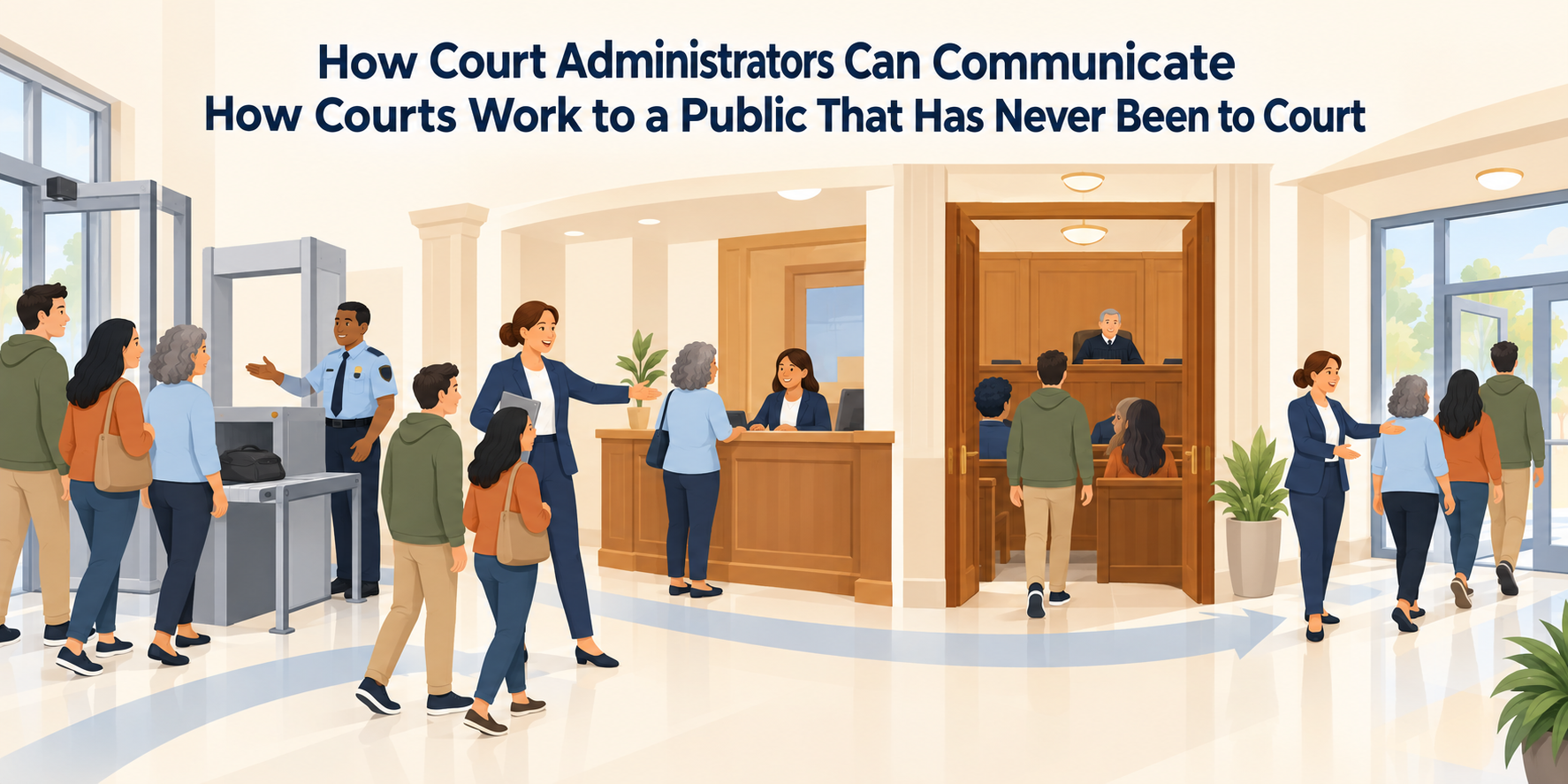
How Court Administrators Can Communicate How Courts Work to a Public That Has Never Been to Court
For many people, the courthouse becomes understandable only after they are required to use it. A summons arrives, a family matter reaches the court, a landlord-tenant dispute escalates, a traffic or criminal case requires an appearance, or someone must file paperwork without an attorney. Until that moment, much of the public may have only a fragmented understanding of what courts do, who works inside them, how cases move, and what is expected of a person who enters the system. Popular culture, news coverage, and high-profile trials can provide impressions of court, but they rarely prepare someone to navigate an ordinary court process.
That creates a distinctive communication responsibility for court administrators. Courts cannot provide legal advice to individual litigants, promise outcomes, or communicate in ways that compromise judicial neutrality. Court administration can, however, make the institution itself easier to understand. People can be told where to go, what different court personnel do, how a proceeding generally moves from one stage to another, what documents and deadlines mean procedurally, what services are available, and where to find authoritative information. Those explanations can reduce confusion without telling anyone what legal strategy to pursue.
The distinction matters because unfamiliarity with court operations can quickly become a practical access problem. A person who does not understand the difference between the clerk’s office and the judge may direct a question to the wrong place. Someone unfamiliar with the difference between filing a document and obtaining a ruling may assume that submitting paperwork completes the matter. A self-represented litigant may arrive at a hearing without understanding what kind of event it is or what procedural steps remain afterward. These misunderstandings can create delays and frustration for court users while increasing repetitive questions for clerks and administrative staff.
Court communication should therefore begin before people are expected to understand legal procedure on their own. Court administrators can build a basic public framework that explains the institution, the people within it, the stages court users are likely to encounter, and the boundaries between procedural information and legal advice. The goal is not to turn members of the public into legal experts. It is to give them enough orientation that the court does not feel like an institution whose basic rules become visible only after someone makes a mistake.
Start With the Court System People Actually Encounter
 Court communication often begins with institutional language that assumes the public already understands the structure. Websites may ask visitors to choose among divisions, case types, filing categories, judicial departments, or procedural resources before explaining what those choices mean. For an experienced attorney, this organization may be logical. For someone entering a courthouse for the first time, it can require knowledge the person does not yet possess.
Court administrators should organize introductory communication around the situations that bring people to court. Someone who has received court papers, needs to respond to a case, has been ordered to appear, wants to locate a hearing, needs an interpreter, or is trying to understand a filing process should be able to find an understandable starting point without first identifying the correct administrative unit. The underlying court structure can remain intact, but the public entrance into that structure should begin with recognizable needs.
This approach is particularly important because different kinds of court users arrive with very different levels of preparation. Attorneys and frequent institutional users may understand docket information, filing rules, and courtroom procedures immediately. A first-time litigant may not understand why one question belongs with the clerk, another with a self-help service, and another can be answered only through legal counsel or by the judge in a proceeding. Public communication should make those distinctions visible before the person is required to navigate them.
A user-centered structure also improves administrative efficiency. When people understand where to begin and what each resource is designed to provide, court staff spend less time redirecting questions and correcting avoidable procedural misunderstandings. Public orientation becomes part of court operations rather than an optional educational function.
Court Communication Strategies for State and Local Judicial Systems: Building Public Trust, Improving Access to Justice, and Explaining Court Processes
This article is part of our series on strategic communication for State and Local Courts, Judicial Systems, and Court Administration. To learn more about court communication strategies for building public trust, improving access to justice, and explaining court processes, and to see the parent article, which links to other content just like this, click the button below.
Explain Who Does What Inside a Court
A courthouse contains people with very different responsibilities, yet first-time users may perceive everyone associated with the institution as simply representing “the court.” Judges, clerks, court administrators, bailiffs or security personnel, interpreters, self-help staff, probation personnel where applicable, and outside attorneys can all play different roles. When those distinctions are unclear, court users may expect the wrong person to answer a legal question, change a court order, accept a filing, or explain what decision a judge will make.
Court administrators should provide plain-language explanations of the functions people are most likely to encounter. The judge or judicial officer decides matters properly before the court. Clerks and administrative staff perform defined procedural and records-related functions but do not decide the merits of a case. Court self-help services may provide legal information and assistance within the limits of the program without acting as the person’s attorney. Interpreters facilitate language access rather than advocate for either side. The exact structure differs among court systems, so public materials should reflect the roles that actually exist locally.
Role explanations should also clarify boundaries. Court users benefit from knowing not only what a staff member can do, but what that person cannot do. A clerk may be able to explain where a form is filed or identify a procedural resource while being unable to advise someone what claim to make or whether a legal position is likely to succeed. Explaining this boundary respectfully can reduce the perception that staff are being unhelpful when they are actually preserving the court’s neutral institutional role.
These distinctions also reinforce confidence in the judicial process. When the public understands that administrative staff, judicial officers, attorneys, and support services perform different functions, the court becomes easier to interpret as a structured institution rather than a single authority making every decision behind the same counter.
Separate Legal Information From Legal Advice
One of the most important distinctions court administrators can communicate is the difference between helping someone understand the process and advising that person what to do strategically in a case. For people without legal training, that boundary may not be intuitive. A procedural question can easily turn into a request for an opinion about what argument to make, which evidence to present, whether to settle, or what outcome is likely.
Court communication should explain that the institution can provide substantial information about how the system operates without becoming an advocate for either party. Court users can be directed toward forms, procedural instructions, calendars, filing information, self-help resources, interpreter services, accessibility assistance, and other authorized sources of support. Where questions require individualized legal judgment, the communication should identify appropriate outside legal assistance pathways when such resources are available.
Making this boundary visible before an interaction becomes frustrating helps both court users and staff. People are more likely to understand why a particular question cannot be answered by court personnel, while staff have a clearer communication framework for remaining helpful without crossing into individualized legal advice.
Explain the Sequence of a Case Before Explaining Individual Procedures
First-time court users often encounter individual procedural requirements without understanding where those requirements fit within the larger case. A notice may contain a hearing date, a filing may trigger another deadline, or a court appearance may conclude without the person understanding whether the entire case is finished. Court administrators can reduce this confusion by giving people a basic map of how cases generally progress.
That map should remain broad enough to avoid implying that every case follows an identical path. Different case types can involve different procedures, and individual cases may change direction based on judicial rulings, settlement, additional filings, or other circumstances. Even so, users benefit from understanding basic concepts such as initiation, response, scheduling, hearings or conferences, possible trial or resolution stages, orders, and post-decision procedures where applicable.
Communication should explain the purpose of each major stage rather than merely naming it. A first appearance, status conference, motion hearing, mediation session, or trial is easier to prepare for procedurally when people understand that these are different events with different functions. Court users should not have to infer the significance of a proceeding from its title alone.
Sequence-based communication also helps manage expectations about timing. A court appearance may resolve one issue without resolving the entire case. A filing may place a matter before the court without producing an immediate decision. A judicial ruling may create additional procedural steps. Showing how individual actions fit into a larger process helps court users understand why the system may continue after a moment they assumed would be final.
Explain Court Language Before It Becomes a Barrier
Courts rely on terminology developed for legal precision, but many of the words used routinely inside the judicial system are unfamiliar to people encountering the system for the first time. Terms such as docket, motion, continuance, service, appearance, hearing, order, judgment, petitioner, respondent, plaintiff, defendant, or disposition may carry specific meanings that are not obvious from ordinary usage.
Court administrators should identify the terms that repeatedly generate confusion and explain them where people actually encounter them. A glossary can help, but definitions are often more useful when integrated directly into notices, webpages, hearing information, filing instructions, and self-help materials. Court users should not need to leave one page and search a separate legal dictionary simply to understand the next procedural step.
Plain language should preserve legal meaning rather than replace necessary terms indiscriminately. In many cases, the strongest approach is to retain the official term and immediately explain it in ordinary language. This helps people learn the vocabulary they will continue seeing throughout the case while reducing the risk that simplified wording creates a different legal meaning.
Clear terminology also supports consistency across the institution. When webpages, notices, staff explanations, and self-help materials use the same understandable definitions, court users are less likely to receive competing explanations of basic procedures. Over time, that consistency can make the court easier to navigate even for people who begin with no prior familiarity with judicial processes.
Explain What Happens Before, During, and After a Court Appearance
For first-time court users, the appearance itself often feels like the entire process. In reality, many important procedural steps happen before a person enters the courtroom and after the hearing ends. Court administrators can improve understanding by showing users how preparation, appearance, and follow-up fit together rather than treating each stage as a separate information problem.
Before a court date, users may need to know where to check the calendar, what time to arrive, what security procedures to expect, where to go inside the courthouse, what documents to bring, and whether remote appearance options exist. These are administrative questions, but uncertainty around them can create significant stress. Clear pre-appearance communication helps people focus on the legal proceeding instead of trying to solve basic logistical problems at the last minute.
During the appearance, communication should help users understand the general structure of what they may encounter without implying how the judge will handle a particular case. People may need to know where to wait, when their case may be called, how to address the court, whether they may be asked to speak, and what role attorneys or interpreters play. Administrative guidance should prepare people for the environment while remaining neutral about the substance of the case.
After the appearance, users often need the most help understanding what happens next. A hearing may result in an order, another court date, a filing deadline, a referral, or additional procedural steps. Courts should provide clear pathways for locating orders, checking future dates, obtaining copies of records, and understanding where authoritative follow-up information will appear. Good post-hearing communication reduces the risk that users leave the courthouse without understanding whether the case is finished or whether further action is required.
Explain Court Notices as Action Documents, Not Just Formal Correspondence
Court notices can contain important procedural information, but they are often written in a format that assumes familiarity with legal systems. A first-time user may see a case number, caption, hearing type, deadline, and location without understanding which information requires immediate action. Court administrators can make notices more usable by treating them as decision-support documents rather than as formal correspondence alone.
The most important procedural information should be easy to locate. Users should be able to identify what the notice concerns, what date or deadline applies, whether attendance or another response is required, where the action takes place, and where to find additional information. When formal language must remain, plain-language explanation can be placed alongside it rather than forcing users to interpret the notice unaided.
Courts should also explain that different notices serve different purposes. A scheduling notice is not necessarily the same as an order. A notice of hearing does not automatically indicate that the hearing will resolve the entire case. A document sent by another party may not carry the same procedural meaning as a document issued by the court. These distinctions can prevent people from overreacting to one document or overlooking another.
Notice design is also an opportunity to reduce repetitive staff inquiries. When people can quickly identify what they need to do, court staff spend less time answering basic questions about dates, locations, and procedural status. Better notice communication therefore improves both public access and administrative efficiency.
Make Courthouse Navigation Part of Public Understanding
Court communication does not end at the courthouse door. For people who have never been to court, the physical environment can be as confusing as the legal process. Security screening, clerk windows, self-help centers, courtrooms, elevators, waiting areas, and administrative offices may all be located in unfamiliar places with little explanation of how they relate to the user’s purpose.
Court administrators should provide clear courthouse navigation information before arrival and reinforce it on site. Maps, entrance guidance, signage, floor directories, and staff assistance should use the same terminology as online materials and court notices so users do not have to translate between different naming systems.
The physical environment should also make role distinctions visible. If self-help services are separate from filing windows, or if particular case types are handled in different locations, those differences should be understandable without requiring users to ask several staff members for direction. Consistency between digital and physical communication reduces confusion and helps users move through the courthouse more independently.
Navigation also affects perceptions of fairness and professionalism. A person who repeatedly goes to the wrong office or misses a courtroom because signs are unclear may interpret the experience as evidence that the court is inaccessible. Good wayfinding does not change the legal process, but it can significantly change whether people feel capable of participating in it.
Explain Security Procedures Before People Arrive
Security is an unavoidable part of courthouse access, but first-time users may not know what to expect. Uncertainty about prohibited items, screening procedures, identification, electronics, or building entry can create delays and anxiety before the legal proceeding has even begun.
Court administrators should provide concise pre-arrival guidance about the security process and direct users to current rules where those requirements vary by location. The explanation should be practical and focused on what people need to know to enter the building successfully.
Clear security communication also supports court operations. Fewer people arrive with prohibited items, staff spend less time resolving predictable entry issues, and court users are less likely to experience the first point of contact with the judicial system as confusing or punitive.
Explain Remote and Hybrid Court Processes as Distinct Court Environments
 Remote hearings and hybrid proceedings have expanded access for some court users while creating new forms of confusion for others. A person joining by video may not understand how to check in, whether the hearing has started, when to speak, what happens if the connection fails, or whether the same courtroom expectations apply online.
Court administrators should treat remote participation as its own communication environment rather than assume that in-person instructions transfer automatically. Users need clear information about how to join, when to connect, how names should be displayed, what technology is required, what backup procedures exist, and whom to contact if access fails.
The court should also explain that remote participation does not necessarily change the legal significance of the proceeding. A video hearing can still be a formal court event, and users should understand expectations around conduct, confidentiality, interpretation, and document access where applicable.
Hybrid proceedings require even greater clarity because some participants may be physically present while others appear remotely. Court communication should explain how those arrangements affect check-in, document exchange, speaking order, interpretation, and follow-up. The goal is to prevent technology from becoming an additional procedural barrier for people who are already unfamiliar with court.
Explain Case Information Systems Without Assuming Users Understand Court Records
Online case lookup systems, docket portals, hearing calendars, and document repositories can give the public valuable access to court information, but they often expose users to terminology and structure designed for experienced legal users. A first-time litigant may find a docket entry without understanding whether it reflects a filing, court action, hearing, or final disposition.
Court administrators should provide basic guidance on what users are seeing. A case number, party listing, docket entry, scheduled event, and filed document each serve different purposes. Public-facing explanations can help people understand that the presence of an item in the system does not necessarily mean the court has ruled on it.
Courts should also explain the limits of online information. Some documents may not be publicly available, some entries may take time to appear, and some case types may have restricted access. Users should know when the online record is authoritative for a particular purpose and when they may need to contact the clerk or review a formal order.
Improving digital orientation makes court records more meaningful. Access is not only a matter of putting information online. It also requires enough explanation that people can interpret what they see without drawing unsupported conclusions about the status or outcome of a case.
Explain What Court Staff Can Help With at the Point of Contact
First-time court users often approach the first staff member they encounter with a mixture of procedural, legal, and personal questions. Court administrators should make staff assistance boundaries visible before an interaction becomes frustrating. People should understand what kinds of information court staff can provide and where different needs should be directed.
Front-line communication can explain that staff may assist with locating forms, identifying procedural resources, explaining filing logistics, finding court dates, accessing records, or directing users toward self-help services where available. These functions can be described positively rather than through a long list of things staff are prohibited from doing.
When a question crosses into individualized legal advice, staff should have a clear referral framework. Depending on the court system, that may include self-help centers, legal aid organizations, lawyer referral services, or other resources. The court should not imply that those outside resources will provide a particular outcome, but it can help users understand where legal guidance may be available.
A clear assistance framework supports both neutrality and service. Court staff can remain within appropriate boundaries while still helping people move forward instead of simply telling them that a question cannot be answered.
Design Court Communication Around the Moments When Confusion Is Most Likely
Court administrators can make communication more effective by identifying the points in the court user journey where misunderstandings most often occur. These moments may include receiving an initial notice, determining where to file, preparing for a hearing, locating the correct courtroom, interpreting an order, or understanding whether additional action is required. Each point represents a predictable communication need.
A useful strategy is to map the court user’s experience from first contact through case completion and identify where people commonly seek clarification. Staff questions, call center patterns, website searches, rejected filings, missed appearances, and self-help inquiries can reveal where the current communication system is not working as intended.
Once those points are identified, courts can develop targeted explanations that appear before the confusion occurs. A hearing reminder can explain what type of event is scheduled. A filing page can clarify what happens after submission. An order-access page can explain where to find the official document and how future dates may be listed.
This approach turns communication into a preventive operational tool. Rather than relying on staff to correct the same misunderstandings repeatedly, the court can build guidance into the places where users are most likely to need it.
Use Plain Language Without Distorting Legal Meaning
Court communication requires a balance between accessibility and precision. Legal terminology often exists because it carries a specific procedural or substantive meaning, but repeating that terminology without explanation can make basic court information inaccessible to people who do not have legal training.
Court administrators should use plain language to explain process while retaining formal terms when they are necessary. Instead of removing the name of a hearing or document entirely, communication can state the official term and then explain what it generally means in practical terms.
Sentence structure also matters. Long passages that combine legal authority, procedural conditions, exceptions, and instructions can be difficult to follow even when every individual word is technically accurate. Breaking information into a logical sequence can improve comprehension without changing its meaning.
Plain language is most effective when it is treated as part of procedural access rather than as an editing preference. When users understand what a notice, deadline, hearing, or filing requirement means, they are better positioned to participate in the process correctly.
Build Consistency Across Notices, Websites, Staff Explanations, and Signage
Court users often encounter the same process through several communication channels. A notice may use one term, the website another, courthouse signage a third, and staff a fourth. Even small inconsistencies can make a familiar process appear more complicated to someone who is encountering it for the first time.
Court administrators should identify core procedural terms and explanations that should remain consistent across channels. Hearing names, filing locations, self-help services, interpreter requests, document access, and case status information are examples where consistent language can significantly reduce confusion.
Consistency does not require every message to be identical. A text reminder should be shorter than a webpage, and courthouse signage should be more directional than a procedural guide. The important point is that the underlying terminology, sequence, and referral information should align.
A coordinated communication system helps users build knowledge over time. When the same words and explanations appear repeatedly, people can connect what they learned from one interaction to the next instead of having to reinterpret the process at every stage.
Create a Shared Plain-Language Vocabulary for Court Operations
A shared vocabulary can help judges’ chambers, clerks, administrators, self-help staff, communications teams, and other court personnel explain common procedures in a consistent way. The purpose is not to script every interaction but to establish understandable definitions for frequently used concepts.
Terms such as filing, service, hearing, continuance, order, appearance, case status, and disposition can be reviewed to determine how they should be described to a general audience without changing their legal significance.
A shared vocabulary also supports digital content development, training, signage, and translation. Courts can reduce the risk that one concept is explained differently across departments or languages.
Use Visual Process Maps to Show How Court Procedures Fit Together
Some court processes are easier to understand visually than through paragraphs alone. A simple process map can show how a case moves from one stage to another, where decisions occur, where users may need to act, and where the process can branch depending on what happens.
Court administrators should use visual process explanations carefully. They should show typical pathways without implying that every case follows the same sequence or that a particular legal outcome is predetermined.
Visuals can be especially useful for orientation materials, self-help content, courthouse kiosks, and online guides. A person who has never been to court may understand the relationship between filing, scheduling, hearing, order, and follow-up more quickly through a well-designed sequence than through a dense procedural description.
Each visual should also be supported by explanatory text. This helps users who need more detail and improves accessibility for people who cannot rely on the visual alone.
Explain Deadlines in Relation to Consequences and Next Steps
Court deadlines can be among the most consequential pieces of information a user receives, yet first-time litigants may not understand why a date matters or what follows if action is not taken. Court administrators should communicate deadlines in a way that makes their procedural significance clear without providing individualized legal advice.
A deadline notice should identify the action associated with the date and direct users toward authoritative resources for understanding the procedure. When appropriate, communication can explain that missing a deadline may affect the case while avoiding speculation about what a judge will decide in a particular situation.
Courts should also distinguish between different kinds of dates. A filing deadline, hearing date, response period, payment date, and document availability date may all appear in one case but serve different functions. Users should not have to infer those distinctions from context.
Clear deadline communication supports more reliable participation. People are better able to organize their response when they understand not only the date itself but also what procedural step the date controls.
Make Interpretation and Language Access Part of the Core Court Experience
For court users with limited English proficiency, understanding basic court operations can be significantly more difficult if language access is treated as a separate service that must be discovered after confusion has already occurred. Court administrators should incorporate language access information into the same public-facing systems used for all court users.
Notices, websites, courthouse signage, hearing instructions, and self-help materials should explain how interpreter services can be requested or accessed where available. Language assistance information should be visible early enough that users can prepare before the proceeding rather than discovering the process only after arrival.
Translated materials should preserve the distinction between procedural information and legal advice. They should also use consistent terminology across different documents so users are not confronted with multiple translations for the same court concept.
Language access strengthens procedural understanding because it allows users to engage with the institution directly rather than depending on informal interpretation from family members, friends, or other people who may not understand court terminology accurately.
Communicate Accessibility Services Before They Are Needed
People with disabilities may face barriers that are procedural, physical, digital, or communication-related. Court administrators should make information about available accommodations and accessibility processes easy to find before a hearing or courthouse visit.
Users may need to know how to request an accommodation, where accessible entrances are located, whether assistive listening or communication supports are available, and how accessibility needs are handled in remote proceedings. The precise services and procedures vary among court systems, so public communication should reflect the local court’s actual process.
Accessibility information should not be buried in a general policy page. It should appear wherever users are preparing to participate, including hearing information, courthouse directions, and remote appearance guidance.
Proactive accessibility communication supports equal participation and reduces the likelihood that court users must solve accommodation issues at the last moment.
Use Self-Help Services as a Bridge Between Court Information and Legal Complexity
Self-help centers and related court services can play a critical role for people who need more than basic procedural orientation but do not have legal representation. Court administrators should explain clearly what these services provide and how they fit within the court system.
Public materials should identify who may use the service, what types of assistance may be available, whether appointments are required, and what limitations apply. Users should understand that self-help services can provide information and assistance within their authorized scope without becoming personal legal counsel.
Court communication should also connect users to self-help resources at relevant decision points rather than placing the information only on a separate services page. A filing instruction, notice, or case-type guide may be an appropriate place to identify available assistance.
When integrated effectively, self-help communication helps bridge the gap between general court information and the more complex procedural questions that first-time or self-represented litigants may encounter.
Explain Why Court Processes Sometimes Take Time
People who have never participated in court may interpret delay as inattention, administrative failure, or evidence that their case is not being taken seriously. Court administrators cannot predict or justify the timing of individual judicial decisions, but they can explain the general operational factors that shape court schedules.
Public-facing communication can clarify that cases may involve required notice periods, responses from other parties, document review, scheduling constraints, evidentiary proceedings, statutory or procedural steps, and judicial decision-making. The exact sequence varies, but people benefit from understanding that many intervals in a case are tied to process rather than simple inactivity.
Courts should avoid promising timelines that cannot be controlled. Instead, they can explain where users can check current case status, how future dates are communicated, and which official sources should be used for updates.
This type of communication helps set realistic expectations without defending delay or minimizing frustration. It gives first-time court users a framework for understanding why a legal process often unfolds differently from other government service transactions.
Strategic Communication Support for Court Administration and Public Understanding
 Courts operate under communication constraints that differ from those of many other public institutions. They must remain neutral, avoid giving individualized legal advice, protect the integrity of judicial proceedings, and communicate procedures accurately across a wide range of case types and user needs. At the same time, the public increasingly expects government systems to be understandable, accessible, and easy to navigate. For court administrators, the challenge is therefore not simply to produce more information. It is to build communication systems that help first-time court users understand the institution without blurring the boundaries between procedural guidance and legal counsel.
Stegmeier Consulting Group (SCG) can support court administrators by developing plain-language court user guides, courthouse navigation materials, procedural explainers, website content frameworks, staff communication tools, self-help resource pathways, notice redesign strategies, public education materials, digital content systems, accessibility and language-access communication, and cross-department messaging standards. SCG can also help courts identify recurring points of confusion, organize information around user needs, and create consistent explanations across websites, mailed notices, courthouse signage, staff interactions, and community-facing materials.
External communication support can be particularly useful when courts are dealing with fragmented information systems, outdated public materials, inconsistent terminology, or high volumes of repetitive user questions. SCG’s role remains focused on communication strategy, information design, stakeholder communication, and public-facing systems. SCG does not provide legal advice, interpret law for individual litigants, determine court procedures, make judicial decisions, or perform functions reserved for judges, clerks, attorneys, or other authorized court personnel.
Future Trends
Court communication will continue to move toward user-centered design as judicial systems expand digital services and remote access. Websites, online filing systems, case portals, text reminders, remote hearings, and digital self-help resources can make courts easier to access, but only when the information surrounding those tools is understandable to people without legal training. Court administrators will increasingly need to evaluate digital services not only for functionality but also for whether first-time users can understand what the tools are for and what they need to do next.
Artificial intelligence and automated assistance may also become more visible in court communication environments. Automated systems may help users locate procedural information, navigate websites, or identify relevant resources, but courts will need clear safeguards around accuracy, legal advice boundaries, privacy, and the distinction between general information and authoritative court instructions. Technology can improve access, but it should not create another layer of uncertainty about which information comes from the court and which guidance users can safely rely on.
Multilingual access and accessibility will become more integrated into core court communication rather than being treated as separate services. As courts continue to modernize digital and physical systems, administrators will need to ensure that translated content, accessible documents, captions, interpreter information, assistive technologies, and accommodation procedures are incorporated into the same user pathways as all other public information.
Court systems are also likely to place greater emphasis on measuring whether users actually understand court processes. Operational signals such as repeated staff inquiries, navigation problems, incomplete filings, failed remote connections, and confusion about notices can help courts identify where communication systems are creating preventable barriers. Public understanding will increasingly become part of how courts evaluate administrative effectiveness.
Conclusion
For people who have never been to court, the judicial system can appear far more complicated than it does to those who work within it every day. unfamiliar terminology, unfamiliar roles, procedural deadlines, formal notices, physical courthouse navigation, digital systems, and the boundary between legal information and legal advice can all create barriers before a person ever reaches the substance of a case.
Court administrators are uniquely positioned to reduce that confusion because they oversee many of the systems through which the public encounters the judiciary. Clear notices, understandable websites, consistent staff explanations, effective wayfinding, accessible self-help pathways, and practical pre-hearing guidance can help people participate more successfully without altering legal standards or compromising judicial neutrality.
The strongest court communication systems do not assume that users already understand how courts work. They begin with the reality that many people are encountering the institution for the first time and may not know what different court personnel do, what a hearing means, where to find an order, or what happens after an appearance. Communication should provide enough orientation that these questions are answered before they become procedural problems.
Making courts understandable does not require simplifying the law beyond recognition. It requires translating the administrative experience of the judicial system into a structure that people can navigate. When court users understand where they are in the process, what resources are available, what actions may be required, and where the court’s role begins and ends, the institution becomes more accessible while preserving the neutrality and procedural integrity on which public confidence depends.
Stegmeier Consulting Group’s Strategic Approach to Communication Systems
Build court communication systems that make judicial processes easier to understand without compromising neutrality, accuracy, or legal boundaries.
Court administrators need communication systems that help first-time court users understand how the institution works, where to go, what different personnel do, what procedural steps mean, and where to find appropriate assistance. Stegmeier Consulting Group (SCG) helps public agencies and institutions organize complex information, improve plain-language communication, strengthen digital and in-person user experiences, align staff messaging, and build durable communication frameworks that reduce confusion across multiple public touchpoints.
Use the form below to connect with our team and explore how strategic communication support can help make court operations more understandable and accessible to the public.