
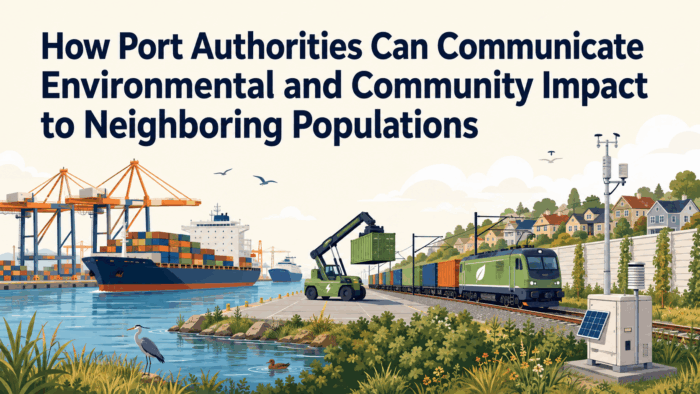
How Port Authorities Can Communicate Environmental and Community Impact to Neighboring Populations
Port authorities operate some of the most consequential and most contested industrial facilities in any metropolitan area, and they do so in close proximity to residential communities that bear the concentrated environmental and quality-of-life costs of port operations that serve regional and national economic purposes. The diesel emissions from thousands of trucks, the noise and light from twenty-four-hour vessel operations, the particulate matter from cargo handling and industrial activities, and the traffic congestion on surface streets serving port facilities, are experienced daily by the residents of neighborhoods adjacent to ports whose economic benefits are distributed across a far wider geography than the environmental burdens they impose.
Port environmental communication operates in a context of structural asymmetry that shapes every communication challenge the port authority faces. The port authority has technical expertise, regulatory relationships, and institutional resources that community organizations and neighborhood residents do not have. The communities adjacent to port facilities have direct, lived experience of the environmental and quality-of-life impacts of port operations that technical monitoring programs measure only imperfectly. And the economic argument for port operations, which is typically made in terms of regional jobs, trade facilitation, and tax revenue, is made by people who do not live with port impacts, while the environmental and quality-of-life costs of those operations are borne by people who have relatively little voice in the decisions that produce them.
This asymmetry is not unique to port authorities. It characterizes the governance of many environmental facilities that serve broad regional purposes while concentrating their impacts on specific communities. What distinguishes port environmental communication from other environmental facility communication is the scale and complexity of port operations, the multiplicity of the environmental pathways through which port activities affect neighboring communities, and the contested politics of port development in regions where ports are simultaneously major economic assets and major sources of environmental injustice.
This article examines how port authorities can communicate environmental monitoring results and mitigation programs to neighboring communities honestly, engage meaningfully with community organizations that advocate for affected residents, communicate port development and expansion plans in ways that acknowledge community impact while explaining economic rationale, and build the sustained community relationships that make port operations politically sustainable in communities that bear their environmental costs.
Environmental Monitoring Communication for Port Operations
 Port environmental monitoring programs generate data across multiple environmental pathways including air quality, noise, traffic, water quality, and biological conditions in adjacent waterways and wetlands. Each of these monitoring programs produces data that is technically available to the public and that is directly relevant to the health and quality-of-life concerns of neighboring residents. Making that data accessible, not just technically available, requires the same plain-language translation discipline that applies to any technical environmental monitoring communication, plus the specific commitment to community-level disaggregation that allows residents of specific neighborhoods to understand the monitoring results that reflect conditions in their own immediate environment rather than at monitoring stations that may be located at strategic technical points that do not correspond to where people live.
Air quality monitoring communication for port operations is the most health-critical form of port environmental communication because diesel particulate matter, volatile organic compounds, and nitrogen oxides from port vehicle and vessel operations create respiratory health risks that are directly experienced by the residents of adjacent communities. Monitoring results that show air quality parameters in relation to regulatory standards, health-based thresholds, and the community’s own historical air quality baseline give neighboring residents the information they need to evaluate whether port operations are contributing to health risks they should be concerned about. Monitoring results presented only in terms of regulatory compliance, without the health context and community baseline that make regulatory compliance meaningful for residents without environmental health expertise, are technically accurate and practically incomplete.
Community-facing monitoring reports should be produced at a frequency that reflects the pace of change in the environmental conditions they document. Annual reports that aggregate a full year of monitoring data are appropriate for environmental parameters that change slowly, including the long-term trend in polycyclic aromatic hydrocarbon concentrations in sediments or the multi-year trajectory of macroinvertebrate community health in adjacent waterways. But air quality parameters that can change significantly from day to day, and that may be affected by specific operational events including vessel berthing, cargo handling activities, or heavy truck traffic peaks, deserve near-real-time communication through monitoring data dashboards that allow community members to see current air quality conditions in relation to the port’s monitoring network.
When monitoring results reveal that port operations are contributing to environmental conditions that exceed regulatory standards or health-based thresholds, the communication obligation is to disclose that finding proactively with specific information about what was measured, what the threshold is, what operational activities may have contributed to the exceedance, and what corrective measures the port authority is taking. An authority that discovers a monitoring exceedance and communicates it before community members or regulators discover it through other channels is demonstrating the transparency commitment that builds the institutional credibility that port environmental communication requires. An authority that manages exceedances internally without community disclosure is building the credibility problem that eventual discovery will create.
From Pipelines to Public Trust: How Municipal Utilities Can Make Communication Central to Ratepayer Trust, Infrastructure Investment, and Long-Term Service Reliability
This article is part of our series on strategic communication for Public Utilities, Infrastructure Agencies, Municipal Utilities, and Public Works departments. To learn more and to see the parent article, which links to other content just like this, click the button below.
Engaging Community Organizations as Genuine Partners
Community organizations that advocate for the residents of neighborhoods adjacent to port facilities have developed, through years of sustained engagement with port environmental issues, a level of technical knowledge about port operations and their environmental impacts that most agency communication programs do not recognize or engage. Environmental justice organizations, community health advocates, neighborhood associations, and faith communities near ports have become sophisticated evaluators of environmental monitoring data, permit requirements, mitigation programs, and the gap between regulatory compliance and genuine community protection. Communication with these organizations that treats them as audiences for institutional information rather than as genuine partners in environmental governance will not produce the community relationships that sustainable port operations require.
Genuine community organization partnership for port environmental communication requires several commitments that most port authorities have not made. Early engagement in planning processes, before operational and environmental decisions are finalized, gives community organizations an opportunity to influence outcomes rather than only to respond to completed decisions. Shared access to the monitoring data, technical analyses, and regulatory correspondence that form the basis of the port authority’s environmental program gives community organizations the information they need to evaluate the program’s adequacy rather than relying on the port authority’s characterization of it. And responsive engagement with community organization concerns, including specific written responses to the technical and policy questions those organizations raise, demonstrates the institutional seriousness that genuine partnership requires.
Community benefit agreements, which formalize the port authority’s commitments to specific mitigation measures, community investment programs, and environmental performance standards as a condition of port expansion or significant operational changes, are the most concrete form of community partnership that port environmental governance can produce. Communication about these agreements, including what the port authority committed to, how those commitments are being implemented, and what accountability mechanisms ensure that they will be honored, is the highest standard of environmental accountability communication available to port authorities seeking to build genuine community trust.
Environmental justice framing for port community communication acknowledges the specific demographic characteristics of the communities that bear port environmental impacts, and the historical context of environmental decision-making that has concentrated industrial facilities in communities with less political power, lower income levels, and higher proportions of people of color. Port authorities that communicate about their environmental programs within this environmental justice context, that explain what specific measures are being taken to address the disproportionate burden borne by adjacent communities, and that engage with the environmental justice organizations that represent those communities as genuine partners in environmental governance, are building the institutional credibility that communities with environmental justice concerns most need to see demonstrated.
Communicating Port Development and Expansion Plans
 Port development and expansion proposals are the most significant community communication challenges that port authorities face because they involve decisions that will materially affect the long-term environmental and quality-of-life trajectory of adjacent communities, and because the communities most affected by those decisions have often been the least involved in the planning processes that produce them. An expansion proposal that arrives at a public hearing with a completed environmental impact assessment is a proposal that has been developed with significant technical analysis but without the community engagement that might have shaped its design to better accommodate community concerns.
Early community engagement in port development planning, before project alternatives are evaluated and before preferred alternatives are identified, gives adjacent communities a genuine opportunity to provide input that can shape project design rather than only to respond to completed proposals. A community that has been engaged from the beginning of a port expansion planning process, whose concerns about air quality impacts, truck traffic routing, noise hours, and buffer zone design have been incorporated into the alternatives analysis, and whose representatives have been engaged as participants in the planning process rather than as commenters on completed plans, is a community that may still oppose aspects of the expansion but that has experienced a planning process that treated its concerns as legitimate inputs rather than as political obstacles to manage.
Cumulative impact communication for port development proposals must address the combined environmental burden of existing port operations and proposed expansion in terms that reflect the community’s actual lived experience rather than the regulatory analytical framework that treats each project in isolation from the environmental context in which it will operate. A community that is already experiencing air quality that exceeds health-based guidelines for sensitive populations does not benefit from an environmental analysis that evaluates an expansion’s incremental air quality impact against the regulatory standard rather than against the community’s existing environmental condition. Communication about cumulative impacts that is honest about the existing environmental burden and specific about how the expansion will affect communities that are already at or above protective thresholds is the environmental justice communication standard that port development proposals in impacted communities require.
Economic argument communication for port expansion must acknowledge the distributional asymmetry that port economic benefits rarely accrue to the communities that bear their environmental costs. The regional jobs and trade facilitation that port expansion produces are real economic benefits, but they are distributed across a region whose residents are not the same as the neighborhood residents who bear the port’s concentrated environmental impacts. Communication about port expansion economics that acknowledges this distributional asymmetry, and that explains what specific mechanisms will ensure that adjacent communities share in the economic benefits of the expansion they are being asked to accept environmental costs for, is more honest and ultimately more credible than economic impact analyses that present aggregate regional benefits without acknowledging how unevenly those benefits and costs are distributed.
Odor, Noise, and Light Impact Communication
Odor, noise, and light impacts from port operations are among the most directly experienced quality-of-life consequences for neighboring residents, and they are among the most consistently underaddressed in port environmental communication programs. These sensory impacts are not captured by the regulatory monitoring programs that generate most port environmental data, they are highly variable depending on operational activities and atmospheric conditions, and they affect different residents differently depending on proximity, orientation, and sensitivity. Communication about these impacts requires a community-responsive approach that takes resident experience seriously as environmental data rather than dismissing it as subjective or as below regulatory significance thresholds.
Resident impact reporting systems that allow neighboring residents to log specific odor, noise, or light incidents with time, location, and intensity information provide the community-sourced data that supplements the port authority’s own monitoring program and demonstrates that the authority is tracking community experience of port impacts alongside the regulatory metrics it is required to report. These systems require both the technical infrastructure to collect and analyze resident reports and the organizational commitment to act on patterns that emerge from the data. An authority that operates a resident reporting system but does not investigate patterns of reported impacts or report back to the community on what its analysis found, is conducting a community engagement performance rather than a genuine environmental accountability program.
Truck traffic communication is a specific quality-of-life impact category that port authorities often address inadequately in their community communication programs. The diesel emissions, noise, and road wear from thousands of truck movements per day on the surface streets serving port facilities are among the most significant and most personally experienced impacts of port operations for residents of neighborhoods through which those trucks travel. Communication about truck traffic management programs, routing requirements, overnight restrictions, and enforcement mechanisms, alongside monitoring data on the air quality and noise impacts of truck traffic in specific residential corridors, provides the community-level specificity that port truck traffic communication requires.
Long-Term Community Relationship Building
The community relationships that make ongoing port operations politically and socially sustainable in adjacent neighborhoods are built through the sustained, honest, and genuinely responsive communication maintained over years. Ports that have invested in these relationships find that their environmental compliance issues, their expansion proposals, and their operational changes are received within a framework of established institutional credibility that makes them manageable. Ports that have not built these relationships find that every environmental event, every expansion proposal, and every operational change is received within a framework of accumulated distrust that makes them protracted political conflicts.
Neighborhood liaison programs that designate specific port authority staff as primary contacts for adjacent community concerns, who attend community meetings in affected neighborhoods, who investigate specific resident concerns with the same seriousness applied to regulatory complaints, and who maintain ongoing relationships with neighborhood associations and community organizations near the port, provide the relational infrastructure that community-level port communication requires. These liaisons are the institutional face of the port in its adjacent communities, and the quality of the relationships they build determines the quality of the port-community relationship as much as any formal environmental program.
Community health programs that the port authority funds in adjacent neighborhoods, including health monitoring studies that document the health conditions of port-adjacent residents, community health clinics that provide accessible healthcare to communities with elevated environmental health risks, and school-based air quality education programs that help children and families understand and respond to air quality conditions near the port, demonstrate the port authority’s recognition of its responsibility to the communities that bear its environmental impacts. Communication about these programs should be specific about what they provide and what the port authority’s rationale for providing them is, and should be accountable to the health outcomes they are designed to improve rather than primarily to the community relations benefits they might provide.
How Port Communication Compares With Other Environmental Facility Communication
Port environmental communication shares many characteristics with the communication challenges of other large environmental facilities that operate in close proximity to residential communities, including refineries, power plants, and large industrial complexes. All of these facilities generate air quality, noise, and traffic impacts that affect neighboring residents, operate under environmental permit requirements that produce monitoring and compliance data the community has a right to access, and face governance challenges around the distributional asymmetry between regional economic benefits and localized environmental costs.
What distinguishes port environmental communication is the scale and complexity of port operations, the multiplicity of environmental pathways through which port activities affect communities, the intensity of the political contest around port development and expansion, and the specific environmental justice dimensions of port siting in communities that have historically had less political power to resist environmentally burdensome facilities. These distinguishing characteristics make port environmental communication among the most demanding and most consequential forms of environmental facility communication in local government.
Air Quality Communication in Depth
Air quality is the environmental issue that most directly connects port operations to community health outcomes, and it deserves the most specific and most accessible communication of any port environmental monitoring program. The diesel particulate matter generated by thousands of truck movements per day, the stack emissions from vessel engines operating in port, the fugitive dust from cargo handling operations, and the emissions from port-related industrial activities, collectively contribute to air quality conditions that affect the respiratory health of residents in adjacent communities in ways that extend beyond regulatory compliance metrics to include health outcomes that regulatory standards were not designed to fully protect against.
Health-based air quality communication, which connects monitoring results not only to regulatory standards but to the health-based guidelines established by public health agencies, gives adjacent community members a more complete picture of the air quality risk they face than regulatory compliance reporting alone provides. The regulatory standards that ports are required to meet reflect negotiated compromises among environmental protection, economic feasibility, and political considerations. The health-based guidelines published by the Environmental Protection Agency, the World Health Organization, and state health departments reflect the best current scientific evidence about the air quality levels that protect sensitive populations, including children, elderly residents, and people with respiratory conditions. When regulatory standards and health-based guidelines diverge, communicating both gives community members the information they need to evaluate their actual health risk rather than their port authority’s regulatory compliance status.
Sensitive receptor mapping, which identifies schools, daycare centers, parks, healthcare facilities, and residential areas in proximity to significant port air emission sources, provides the community-level geographic specificity that aggregate air quality monitoring data cannot supply. A community that knows which specific facilities within their neighborhood are identified as sensitive receptors in the port’s air quality analysis, and that receives air quality monitoring data organized around those sensitive receptor locations rather than around technically convenient monitoring stations, is receiving air quality information that is specifically relevant to the health exposure situations they care most about.
Air quality action programs for port-adjacent communities, including clean air day notifications that provide advance warning of high-emission operational periods when sensitive populations should take protective measures, and green space investments that provide residents with low-emission areas for outdoor activity, demonstrate the port authority’s commitment to protecting community health beyond the minimum required by regulatory compliance. Communication about these programs, including how the air quality notification system works, how residents can enroll to receive notifications, and what protective measures are recommended during high-emission periods, connects the port’s environmental program to residents’ daily decisions about outdoor activity and health protection.
Port Traffic Management Communication
Truck traffic generated by port operations is among the most visible and most consistently problematic community impacts of port facilities, and it is an area where port authority communication programs frequently fail to provide the specific, actionable information that adjacent residents and businesses need to manage the traffic impacts they experience. Truck routing requirements that are designed to keep heavy freight vehicles off residential streets are only as effective as the combination of enforcement, driver compliance, and public communication that makes them real. A truck routing requirement that is documented in port operational guidelines but never communicated to adjacent neighborhoods provides those neighborhoods with no basis for identifying routing violations or for holding the port authority accountable for enforcing the requirements it has established.
Truck route communication that maps the designated truck routes, identifies the residential streets that are prohibited to port trucks, and explains the enforcement mechanisms and complaint reporting process that the port authority maintains for routing violations, gives adjacent communities the information they need to identify and report violations rather than simply experiencing them. A resident who knows that the truck that just drove down their residential street was in violation of the port’s routing requirements, and who knows how to report that violation, is a resident who can contribute to routing enforcement in ways that the port authority’s own enforcement cannot match in geographic coverage.
Truck traffic data communication that provides regular reports on the volume, timing, and routing compliance of truck traffic serving the port gives adjacent communities an ongoing picture of traffic impacts that periodic surveys and occasional public reports cannot provide. Daily traffic count data for major truck routes, routing compliance rates based on monitoring program findings, and trend analysis that shows whether truck traffic impacts are increasing or decreasing over time, provide the accountability information that adjacent communities need to evaluate whether the port authority’s truck management commitments are producing the results that were promised.
Truck reservation systems and appointment scheduling programs that spread truck traffic more evenly across operating hours, reducing the peak traffic concentrations that create the most significant neighborhood impacts, are operational traffic management tools with community communication dimensions that most ports underutilize. Communication about these programs, explaining how they work, what traffic reduction benefits they produce, and what the port authority’s targets for system adoption are, connects the operational tool to the community impact it is designed to address and gives adjacent communities a basis for evaluating whether the program is achieving its intended effect.
Community Health Monitoring and Communication
Community health monitoring programs that systematically track the health outcomes of port-adjacent residents, including respiratory disease rates, asthma hospitalization rates, and environmental health indicators in communities proximate to port operations, provide the most direct evidence of the connection between port environmental impacts and community health consequences. Some port authorities have funded or co-funded these monitoring programs as part of community benefit agreements or mitigation commitments. Communication about these programs, including what they measure, who conducts the monitoring, how the results are reported to the community, and what actions the port authority takes in response to the findings, demonstrates the institutional seriousness about community health that adjacent communities most need to see.
Health outcome communication that reports monitoring findings in terms that connect to residents’ personal health experiences, identifying specific health conditions that are more prevalent in port-adjacent communities than in comparable communities without port environmental exposures, and explaining the port authority’s analysis of the relationship between port operations and those health disparities, is the most direct form of environmental accountability communication available to port programs that have conducted community health monitoring. This communication is more difficult than general environmental monitoring reporting because it requires engaging with health outcome data that may be adverse and that may implicate port operations more directly than the port authority would prefer to acknowledge. But it is precisely this difficulty that makes the decision to communicate honestly about community health monitoring results the most significant accountability commitment a port authority can make.
Communicating During Port Incidents and Environmental Events
Port incidents that create acute environmental impacts, including oil spills, chemical releases, vessel groundings, and fire events, require the same rapid, accurate, and multi-channel communication that applies to other environmental emergency events. The specific complexity of port incident communication is the multi-agency coordination it requires: the Coast Guard, state environmental agencies, local emergency management, public health agencies, and the port authority itself all have communication responsibilities that intersect during a port environmental incident, and the coordination of those communications to prevent conflicting information from reaching adjacent communities is a pre-incident preparation challenge that most ports have not fully addressed.
Pre-incident communication protocols for the most likely port incident scenarios, including vessel collision, petroleum product release, chemical cargo incident, and fire or explosion, provide the message frameworks and coordination structures that allow rapid, accurate communication from the first moments of an incident. These protocols should be developed in coordination with the Coast Guard, state environmental agencies, and local emergency management, should be tested through tabletop exercises that simulate the communication demands of specific incident scenarios, and should be reviewed and updated annually to reflect changes in port operations, regulatory requirements, and the community communication lessons learned from actual incidents.
Measuring Port Community Relationship Quality
The quality of the relationship between a port authority and its adjacent communities is difficult to measure but not impossible to assess. Community survey programs that ask adjacent residents about their satisfaction with port communication, their confidence in the port authority’s commitment to environmental accountability, and their assessment of whether the port’s community engagement is genuine or performative, provide the community perspective on relationship quality that internal metrics cannot capture. These surveys should be conducted regularly rather than only in response to specific controversies, and their results should be shared publicly rather than treated as internal management information.
Community organization relationship health assessments, conducted through structured conversations with the advocacy organizations, neighborhood associations, and faith communities that represent port-adjacent residents, provide qualitative relationship quality information that surveys cannot fully capture. A community organization that reports that the port authority has become more responsive to their concerns over the past year, that the monitoring data they receive has become more accessible and more complete, and that the engagement process for the pending expansion proposal has been more genuine than previous processes, is providing the relationship quality indicator that demonstrates whether the port authority’s communication investment is producing the institutional credibility that adjacent community trust requires.
Media coverage analysis that tracks the tone and content of news coverage of port-community relations over time provides an external accountability measure that reflects how third parties are interpreting the quality of the port authority’s community engagement. A port authority that consistently receives negative media coverage of its community engagement practices, or that regularly features in environmental justice news as an example of poor community communication, is receiving a signal about its community relationship quality that internal metrics may not fully reveal. Using media coverage as a communication effectiveness indicator, alongside community surveys and organization relationship assessments, provides a more complete picture of port-community relationship quality than any single measure can supply.
Port Community Advisory Committees
Community advisory committees for port environmental programs, which provide adjacent community members and their organizational representatives with a formal role in reviewing environmental monitoring data, commenting on environmental mitigation programs, and engaging with port operational decisions that affect community quality of life, are the most structured form of community governance partnership available for port environmental management. These committees, when they function as genuine advisory bodies rather than as consultation forums designed to generate the appearance of engagement without its substance, provide the ongoing accountability relationship that episodic public meetings and periodic environmental reports cannot sustain.
Effective port community advisory committees require specific structural commitments from the port authority: meaningful access to the technical information that underlies environmental program decisions, responsive engagement with committee recommendations including specific written responses that explain how those recommendations were or were not incorporated into program changes, staff support that allows committee members to understand complex technical issues without needing professional environmental expertise, and compensation for the time that community members, particularly those from lower-income communities, invest in committee participation. Committees that lack these structural supports function as compliance exercises rather than as genuine governance partnerships.
Transparency about the limits of advisory committee authority is as important as the genuine responsiveness to committee input that makes that authority meaningful. A community advisory committee that is engaged on operational decisions that the port authority has already effectively made, or that receives responsive acknowledgment of its recommendations without specific explanation of how those recommendations affected outcomes, will eventually recognize that its advisory role is more nominal than substantive. Honest communication about what the committee can and cannot influence, alongside genuine responsiveness within those limits, is more credible and more sustainable than the suggestion of advisory authority that the committee’s actual influence does not support.
Port Environmental Justice Communication
Environmental justice communication for port authorities requires acknowledging specifically that port environmental impacts fall disproportionately on communities that did not choose to host port facilities and that have historically had less power to shape the decisions that created those impacts. This acknowledgment is not simply a rhetorical gesture. It is the foundation of a communication posture that treats the distributional inequity of port impacts as a legitimate governance concern requiring specific programmatic response, rather than as a political complication to be managed through community relations outreach.
Port environmental justice communication should connect to the specific demographics of port-adjacent communities, explaining what the port authority knows about the income levels, racial composition, and health status of those communities, and what that knowledge implies about the community’s vulnerability to port environmental impacts and its capacity to advocate for environmental protection. A port authority that has conducted a health vulnerability assessment of its adjacent communities and that communicates the findings of that assessment, including the specific health conditions and risk factors that make those communities particularly sensitive to air quality and noise impacts, is treating environmental justice as an evidential commitment rather than as a rhetorical aspiration.
Environmental justice commitments that are specific enough to be verified, including commitments to achieve specific air quality improvements in specific community health metrics within defined timeframes, provide the accountability mechanism that environmental justice communication requires. General commitments to community health and environmental equity are insufficient accountability communication for communities that have experienced decades of environmental burden from port operations. Specific, measurable, time-bound commitments, communicated clearly and tracked publicly, are the environmental justice accountability standard that the communities bearing concentrated port impacts have a right to expect.
Communicating About Zero-Emission Transition Programs
Zero-emission port transition programs represent one of the most significant communication opportunities available to port authorities seeking to demonstrate genuine environmental commitment to adjacent communities. The transition from diesel-powered cargo handling equipment to electric or hydrogen-powered alternatives, the adoption of shore power systems that allow berthed vessels to connect to shore-based electrical supply rather than running their engines while in port, and the transition from diesel drayage trucks to zero-emission vehicles, all represent substantial investments in air quality improvement that deserve specific, sustained communication to the communities that have been living with the air quality consequences of diesel-powered port operations.
Zero-emission transition timeline communication must balance the genuine ambition of these programs against the realistic pace of technology adoption, regulatory approval, equipment availability, and infrastructure development. Communities that have been told that zero-emission port operations are achievable within a specific timeframe deserve honest updates on the program’s progress against that timeline, including honest acknowledgment when specific milestones are taking longer than projected and specific explanation of the technical or regulatory factors producing the delay. Overpromising on zero-emission transition timelines and then failing to deliver produces the same credibility damage that any other capital program overpromising produces, compounded by the community’s long history of environmental disappointment from port operations.
Air quality improvement measurement for zero-emission transition programs provides the accountability data that connects the capital investment in zero-emission equipment and infrastructure to the community health outcomes the investment is designed to produce. Before-and-after monitoring data that documents the air quality improvement in adjacent communities as zero-emission equipment replaces diesel equipment, communicated specifically and regularly as the transition progresses, gives community members the evidence that the investment is producing the health benefits it was designed to provide. This monitoring-to-outcome accountability communication is the most compelling form of zero-emission program accountability available and the form that most directly demonstrates the port authority’s genuine commitment to community health improvement.
Technology education communication that explains to adjacent communities what zero-emission technologies are being deployed, how they work, what air quality improvements they produce compared with the diesel equipment they replace, and what the operational differences between zero-emission and diesel-powered port operations are, builds the community understanding of the transition that sustains its political support through the years of capital investment and operational change it requires. Communities that understand what zero-emission port technology looks like and what it accomplishes are better positioned to recognize and value the improvements it produces than those who receive only the announcement of capital investments without the technical education that makes those investments meaningful.
Tying It All Together
Port environmental communication is ultimately a governance accountability practice: the demonstration by a public authority that it takes seriously the environmental and quality-of-life consequences of its operations for the communities that did not choose to host it but that must live with its impacts every day. The port authority that communicates honestly about its environmental monitoring results, that engages community organizations as genuine partners in environmental governance rather than as political obstacles to be managed, and that acknowledges the distributional asymmetry between regional port benefits and local port costs, is demonstrating the institutional accountability that communities bearing concentrated environmental burdens have a right to expect.
The communication investment required to build genuine port-community relationships is substantial, sustained, and not reducible to a periodic community relations program. It requires organizational commitment to treating community communication as an essential operational function rather than as a public relations supplement, and it requires genuine responsiveness to community concerns that goes beyond the management of public perception. Ports that make this investment find that it produces the most durable form of community license to operate available: the institutional credibility that comes from demonstrated accountability rather than from claimed compliance.
Strategic Communication Support for Port Environmental Communication
 Developing the monitoring communication systems, community partnership programs, development proposal engagement processes, and long-term community relationship infrastructure that effective port environmental communication requires is work that most port authority communication teams have not been staffed or resourced to accomplish alongside operational and regulatory responsibilities. The specialized requirements of environmental justice communication, multi-pathway monitoring result translation, community organization partnership, and development proposal community engagement make external communication expertise a productive investment for port authorities seeking to build genuine community trust in environments where that trust has been difficult to establish.
Stegmeier Consulting Group (SCG) works with port authorities to develop environmental communication programs that are built around the specific operational realities, community contexts, and environmental justice dimensions of each port’s situation. This includes developing the monitoring result communication frameworks that translate technical data into accessible community information, designing the community organization partnership programs that engage advocacy organizations as genuine governance partners, creating the development proposal engagement processes that involve adjacent communities before proposals are finalized, and building the neighborhood liaison programs that provide community members with direct, responsive access to port environmental information. The objective is a communication program that treats adjacent community trust as the most essential operational asset that port environmental management can build.
Future Trends in Port Environmental Communication
Port environmental communication is being reshaped by the accelerating policy focus on environmental justice at federal and state regulatory levels. Environmental impact assessments that are required to include meaningful analysis of cumulative environmental burdens on communities of color and low-income communities, permitting processes that require genuine community engagement before decisions are finalized, and regulatory enforcement that treats environmental justice communities as priority enforcement areas, are all creating new external accountability requirements that port environmental communication programs must be designed to meet.
Zero-emission port initiatives, which are being adopted at a growing number of major port facilities in response to air quality standards and climate commitments, are creating new communication opportunities and new communication obligations. The electrification of cargo handling equipment, the adoption of shore power for berthed vessels, and the transition to zero-emission trucks for drayage operations are investments that will substantially reduce the air quality impacts of port operations in adjacent communities, and communicating about them honestly, including the timeline for their implementation, the air quality improvements they will produce, and the community health benefits that are expected to result, is the environmental accountability communication that adjacent communities most need to see from ports making these investments.
Community-controlled monitoring programs, in which adjacent communities operate their own air quality monitors and share monitoring data with the port authority on equal terms, are becoming more feasible as low-cost air quality monitoring technology improves. Communication programs that integrate community monitoring data alongside the port authority’s own monitoring program, that treat community-sourced data as legitimate environmental evidence rather than as supplementary anecdote, and that use community monitoring findings to identify operational situations that the port authority’s own monitoring network may not capture, are building the most equitable form of environmental monitoring partnership available in the port-community context.
Conclusion
Port authorities that communicate their environmental impacts honestly, that engage adjacent communities as genuine partners in environmental governance, and that treat the distributional inequity of port impacts as a legitimate governance concern rather than a political obstacle to be managed, are building the institutional credibility that makes their operations sustainable in communities that would otherwise be organizing against them. The environmental and quality-of-life burden that adjacent communities bear is real, it is measurable, and it is not adequately addressed by compliance with regulatory standards alone. Communication that acknowledges this reality and that demonstrates the port authority’s commitment to addressing it through specific programs and genuine accountability is the communication standard that port environmental governance requires.
The communities that host ports deserve more than compliance and periodic public relations outreach. They deserve the environmental transparency, the genuine partnership, and the institutional accountability that characterize the relationship between a public authority and the communities it is supposed to serve. Building that relationship in port communities where it does not currently exist requires sustained communication investment, genuine organizational commitment to community engagement, and the intellectual honesty to acknowledge the distributional inequities that port operations create and the specific measures being taken to address them.
Stegmeier Consulting Group’s Strategic Approach to Communication Systems
Build port environmental communication around monitoring transparency, genuine community partnership, development proposal engagement, and the long-term relationship investment that makes port operations sustainable in adjacent communities.
Port authorities that communicate environmental monitoring results honestly, engage community organizations as genuine governance partners, and acknowledge the distributional inequity of port impacts with specific mitigation commitments build the institutional credibility that makes their operations politically sustainable in communities that bear concentrated environmental costs. Stegmeier Consulting Group (SCG) helps port authorities develop the monitoring communication systems, community partnership frameworks, development proposal engagement processes, and neighborhood liaison programs that transform port-community relations from contested compliance management into genuine environmental accountability.
Use the form below to connect with our team and explore how strategic communication support can strengthen your port authority’s community environmental communication program.