How Solid Waste, Recycling, and Garbage Collection Agencies Can Build Public Education Programs Around Recycling, Composting, and Waste Reduction
Recycling and composting programs are among the most behaviorally dependent public services that local governments operate. Unlike water service or electricity, whose value is delivered to residents passively regardless of their behavior, recycling and composting programs produce value only when residents participate actively and correctly. The quality of that participation, whether residents place the right materials in the right containers at the right time and in the right condition, determines directly whether the program diverts material from landfill as intended or generates contaminated streams that reduce the program’s environmental value, increase its cost, and ultimately threaten its operational viability.
The relationship between resident knowledge and program performance is well established and consistently underestimated. Contamination in recycling streams, which occurs when residents place non-recyclable materials in recycling containers or place recyclable materials in ways that render them unrecyclable, is almost entirely a product of inadequate public education about what is and is not accepted. The resident who puts a pizza box in the recycling bin is not being careless. They are acting on an incomplete or inaccurate understanding of the program’s material requirements. The resident who bags their recyclables before placing them in the recycling container is following an intuition about cleanliness that conflicts with the program’s operational requirements. These are communication failures, not resident failures.
The cost of contamination to solid waste programs is significant and direct. Contaminated recycling loads may be rejected at processing facilities, sent to landfill at a higher cost than clean loads, or processed at a penalty rate that increases program costs. Composting programs that receive materials contaminated with non-compostable items, including plastic bags, conventional food service ware, and other non-certified compostable materials, produce compost of lower quality that may be unsaleable or require additional processing. And programs that consistently receive contaminated loads from specific neighborhoods or collection zones face operational decisions about whether to continue service in those zones that ultimately affect program access and equity.
Public education programs for recycling, composting, and waste reduction are communication programs in the fullest sense: they must change behavior at scale, across a diverse population with varying levels of environmental engagement, varying baseline knowledge of program requirements, and varying motivations for participation. Designing these programs effectively requires understanding the specific knowledge gaps and behavioral barriers that produce contamination and low participation in the specific community being served, building communication that addresses those gaps and barriers in terms that reach and motivate different audience segments, and measuring program performance through the participation and contamination data that reveal whether the communication is working.
Understanding Why Recycling Communication Fails
Most recycling communication programs fail not because they say the wrong thing but because they do not say the right things to the right people through the right channels at the right moments. A recycling guide that lists every accepted and non-accepted material comprehensively is technically complete and practically overwhelming. Most residents will not read it in full, will not remember its specific guidance when standing at their recycling bin with a questionable item in hand, and will default to wishful recycling, placing the item in the bin in the hope that it qualifies, rather than taking the less convenient option of placing it in the garbage.
Wishful recycling is the single most significant behavioral cause of recycling contamination, and it is a behavior that communication programs rarely address directly. A resident who is motivated to recycle but is uncertain about a specific item will, in the absence of specific guidance about that item, place it in the recycling container rather than the garbage because the psychic cost of believing they are sending something recyclable to landfill is higher than the psychic cost of contaminating the recycling stream in ways they will not directly observe. Communication that addresses this specific decision point, that gives residents a simple decision rule for uncertain materials and a psychologically acceptable way to dispose of non-recyclable items without feeling guilty, addresses the behavioral mechanism that produces contamination at scale.
Confusion about program specifics is a second major failure category. Recycling program requirements are not standardized across communities, and residents who have moved from another jurisdiction, who share information with friends or family in different service areas, or who encounter generic recycling information online may have accumulated guidance that does not apply to their specific program. A resident who learned in their previous home that plastic bags can be returned to grocery stores for recycling may place them in the curbside bin in their new community because they believe plastic bags are generally recyclable and do not realize that the specific guidance varies by program. Correcting this kind of misinformation requires communication that directly addresses the most common incorrect recycling practices in the specific community rather than only communicating the correct practices.
Motivation is a third category. Some residents do not recycle or compost despite adequate knowledge because they do not believe their participation makes a meaningful difference, because they do not experience any consequence for non-participation, or because the convenience cost of participation is higher than they are willing to incur without a clear sense of the benefit their participation produces. Communication that addresses motivation, that makes the local program’s diversion impact concrete and specific, that tells residents what their individual participation contributes to the program’s performance, and that acknowledges the convenience constraints that make participation difficult while providing guidance that makes it easier, addresses behavioral barriers that knowledge-focused communication cannot touch.
From Pipelines to Public Trust: How Municipal Utilities Can Make Communication Central to Ratepayer Trust, Infrastructure Investment, and Long-Term Service Reliability
This article is part of our series on strategic communication for Public Utilities, Infrastructure Agencies, Municipal Utilities, and Public Works departments. To learn more and to see the parent article, which links to other content just like this, click the button below.
Designing Recycling Education That Changes Behavior
The Simplicity Principle
The most effective recycling education communication is built around a simple, memorable decision rule rather than a comprehensive materials list. Programs that educate residents on the complete list of accepted and non-accepted materials produce residents who understand the program’s scope but cannot apply that knowledge at the bin. Programs that give residents a simple, memorable rule, such as placing only dry, empty, clean containers in the recycling bin, produce residents who can apply the rule correctly in the moment of decision even when they encounter materials they have not specifically been educated about.
Simplicity does not mean incompleteness. A simple decision rule should be accompanied by clear guidance about the materials that residents are most likely to be uncertain about, including the most common sources of contamination in the specific program. The simple rule handles the routine decisions. Specific guidance about the most common problem materials handles the decisions where residents are most likely to make errors. Together, they provide the practical decision-making support that residents need at the bin without requiring them to consult a comprehensive materials list for every item.
Visual communication is often more effective than textual communication for recycling education because it allows residents to match specific items to specific guidance without the translation step that text requires. A visual guide that shows images of accepted and non-accepted materials, organized by the category of confusion they represent, allows residents to quickly find guidance for specific items they are uncertain about. Digital versions of visual guides, accessible through QR codes on collection containers or bin stickers, provide the reference tool that residents need at the moment of decision without requiring them to remember what they read in a guide they received months ago.
Addressing Contamination Directly
Contamination reduction communication must be honest and specific about what is contaminating the program and what the consequences of contamination are. General messages about recycling correctly, without specificity about what incorrect recycling looks like and what it costs, do not motivate the behavior change that contamination reduction requires. Residents who do not know that their plastic bags are contaminating the recycling stream because they have never been told that plastic bags are not accepted in the curbside program, or who do not understand that contamination increases program costs and threatens program viability, have no behavioral reason to change the practices that produce contamination.
Contamination feedback programs that provide specific feedback to residents or neighborhoods whose recycling has high contamination rates are among the most effective tools for contamination reduction because they connect the communication directly to the behavior being addressed. A program that identifies neighborhoods with above-average contamination rates and delivers targeted communication about the specific contaminants found in those neighborhoods’ recycling, alongside guidance about how to correctly dispose of those materials, is providing the specific, locally relevant information that generic program-wide communication cannot.
Visual feedback on collection vehicles, tags left on recycling containers that identify the contamination that was found and explain why it could not be processed, provide the most immediate and most directly connected form of contamination feedback. A resident who places plastic bags in their recycling container and finds a tag on the container explaining that plastic bags are not accepted in curbside recycling and directing them to the nearest plastic bag collection point has received exactly the right information at exactly the right moment. Programs that have implemented contamination tagging report significant reductions in repeat contamination from tagged addresses.
Reaching Residents With Different Levels of Environmental Engagement
Recycling and composting programs serve populations with radically different levels of environmental motivation, from residents who are deeply committed to waste reduction and who will seek out the most rigorous participation possible, to residents who are broadly indifferent to environmental outcomes and who participate only when it is convenient and effortless. A public education program designed primarily for the motivated minority will fail to reach the indifferent majority. A program designed for the indifferent majority will underserve the motivated minority and waste the opportunity to build the program ambassadors that peer-to-peer behavior change requires.
Segmented communication that reaches different resident groups through the channels and with the messages that are most effective for each group is more expensive and more complex to design than uniform communication, but it produces better participation and contamination outcomes by addressing the specific barriers that different groups face. The highly motivated resident who wants to maximize their diversion impact needs detailed guidance about the program’s full range of accepted materials, emerging program expansions, and ways to reduce waste beyond what the program itself requires. The moderately engaged resident who participates but is uncertain about specific materials needs clear, specific guidance about the most common sources of contamination in terms they can act on immediately. The disengaged resident needs communication that makes participation easier and more convenient rather than more comprehensive.
Positive behavior reinforcement, which communicates the program’s diversion outcomes back to residents in ways that make individual participation feel meaningful, serves the motivation of engaged residents without requiring them to trust abstract environmental impact claims. An annual program report that tells residents how many tons of material the program diverted from landfill, what percentage of that material was recycled or composted locally, and what the carbon equivalent of that diversion represents, gives motivated residents the validation that their participation is producing the outcomes they care about. That validation reinforces continued participation and motivates the social sharing that extends program awareness through peer networks.
Communicating Composting Programs
Composting programs present public education challenges that are distinct from recycling because composting requires residents to manage organic material that is more variable, more perishable, and more operationally sensitive than the dry, clean containers that recycling programs accept. The specific guidance that composting programs require, about which food scraps are accepted, how to store food scraps between collections, how to manage odor, and how to handle materials that might seem compostable but are not accepted in the program, is more detailed and more action-requiring than recycling guidance.
Starter kits and in-home food scrap storage containers provided to new composting participants at program enrollment address the practical barriers that prevent otherwise motivated residents from participating consistently. A resident who does not have a convenient container for collecting food scraps in the kitchen will not participate consistently in a food scrap composting program regardless of their motivation. Providing the physical infrastructure of participation alongside the educational communication removes the convenience barrier that physical resources address more effectively than communication can.
Contamination in composting programs, which occurs when residents place non-compostable materials including conventional plastics, non-certified compostable service ware, and other synthetic materials in the compost bin, requires the same specific and direct communication that recycling contamination requires. The challenge is compounded by the proliferation of materials marketed as compostable that are not accepted in many industrial composting programs because they do not break down within the composting facility’s operational timelines. Communication that specifically addresses these certified-compostable-but-not-program-accepted materials, explaining why they are excluded and how to dispose of them correctly, prevents the contamination that residents cause when they place these materials in composting containers based on product labeling rather than program guidance.
Apartment and multifamily composting programs face additional communication challenges because residents share collection infrastructure and individual participation decisions affect neighbors’ access to composting service. A single resident who consistently contaminates a shared composting container can generate service disruptions that affect all residents in the building. Communication for shared composting infrastructure should address both the individual participation guidance and the community dimension of shared infrastructure management, including how residents can report contamination problems without identifying neighbors, and how the program handles persistent contamination in shared collection.
Waste Reduction Communication Beyond Diversion
Waste reduction is the highest-priority outcome in the waste management hierarchy, ranking above recycling and composting because it avoids the creation of material that must be managed rather than diverting material that has already been created. Public education programs that focus exclusively on recycling and composting miss the waste reduction dimension that the most environmentally ambitious programs seek to address. Communication about waste reduction requires a different behavioral approach because it asks residents to change purchasing and consumption decisions before waste is generated, rather than simply managing waste correctly after it has been created.
Waste reduction communication that is connected to concrete, practical actions, rather than to abstract environmental outcomes, reaches residents who are not primarily motivated by environmental values but who are motivated by cost savings, convenience, and the practical satisfactions of reducing the volume of material they need to manage. A communication program that connects waste reduction to grocery bill savings through reduced food waste, to the convenience of less frequent collection for households that generate less garbage, and to the practical simplicity of buying less and disposing of less, reaches residents for whom environmental messaging alone would not be motivating.
Food waste reduction is the most impactful individual household waste reduction action and the one most amenable to communication-driven behavior change. Food waste represents a significant share of household garbage by weight, is largely preventable through meal planning, storage practices, and consumption habits that most households can adopt without significant lifestyle change, and is a source of economic waste that resonates with residents regardless of their environmental motivation. Public education programs that include practical food waste reduction guidance alongside recycling and composting education are building a more complete waste reduction communication program than those that address only diversion.
Measuring Communication Effectiveness Through Program Data
The most valuable measure of recycling and composting education communication effectiveness is not outreach volume, the number of mailings sent, social media posts published, or public meetings held, but program performance data that reflects actual resident behavior. Diversion rate, the share of material generated in the service area that is diverted from landfill through recycling and composting, measures the cumulative effect of all program education efforts on resident behavior. Contamination rate, the share of collected recycling or composting that is rejected or downgraded at the processing facility, measures how well residents understand and follow program material requirements. Participation rate, the share of eligible households that actively use recycling and composting services, measures how broadly the program’s behavioral expectations have been adopted.
Geographic analysis of program performance data is the most actionable form of measurement because it identifies where communication is working and where it is not with the specificity needed to direct communication improvements. A recycling program with strong participation and low contamination in one portion of the service area and weak participation and high contamination in another has a communication performance gap that geographic analysis can identify and that targeted communication improvements can address. That analysis requires the data infrastructure to associate program performance metrics with the geographic areas from which the data is collected, which is a capability that many agencies have in their operational systems but do not apply systematically to communication program evaluation.
Before-and-after measurement of program performance metrics following specific communication interventions allows agencies to assess the communication return on specific education investments. An agency that implements a targeted contamination reduction campaign in high-contamination neighborhoods, measures contamination rates in those neighborhoods before and after the campaign, and compares the change against control neighborhoods that did not receive the targeted communication is conducting the most rigorous form of communication program evaluation available. The results of this kind of evaluation provide the data needed to decide which communication approaches are worth repeating and scaling, and which produce insufficient behavior change to justify their cost.
Resident surveys that measure knowledge and behavior rather than awareness provide a more direct link between communication program activity and behavioral outcomes than awareness surveys alone. A survey that asks residents to answer specific questions about program requirements, such as which materials are accepted in curbside recycling, and that compares knowledge levels before and after a specific education program, measures the communication program’s ability to change what residents know. Follow-up measurement of program performance metrics in the same period measures whether what residents know affects what they do. This knowledge-to-behavior measurement chain is the most complete form of communication program evaluation available to solid waste agencies.
How Recycling Education Compares With Other Public Behavior Change Communication
Recycling and composting public education is among the most demanding forms of public behavior change communication because it asks residents to modify habitual daily behaviors that occur dozens of times per week, across a diverse population with varying motivations and knowledge levels, in the service of environmental outcomes that are largely invisible in their daily experience. The comparison with other public health and safety behavior change communication is instructive: handwashing campaigns must change behavior that people perform many times daily; seat belt use campaigns must change behavior that people perform every time they enter a vehicle. Both require sustained, visible, multi-channel communication to produce lasting behavior change, and neither achieves complete behavioral adoption in any population. Recycling education faces the same fundamental behavioral challenges with the additional complication that program requirements vary by material, change over time, and differ across communities in ways that create confusion that generic environmental messaging cannot resolve.
The comparison with energy efficiency program communication reveals a shared characteristic: both are attempting to motivate behavior that produces public benefit but requires individual action and is not mandated by law for most residents. Energy efficiency communication addresses this by connecting efficiency behavior to direct financial benefit for the individual resident. Recycling and composting communication often lacks the direct individual financial benefit argument that makes energy efficiency behavior change more motivationally tractable. Programs that introduce financial connections, through variable-rate billing that charges based on garbage volume, through financial incentives for high composting participation, or through community diversion rate challenges with tangible rewards, are creating behavioral motivational structures that pure environmental messaging cannot replicate.
Tying It All Together
Recycling and composting public education programs succeed when they design communication for the behavioral reality of the resident population they serve, not for the motivated minority that would participate correctly with minimal instruction. That means understanding specifically what residents do not know and what they get wrong, designing communication that addresses those specific gaps with the simplicity and specificity that behavior change requires, reaching residents through channels that match their actual information-seeking behavior rather than the channels that are easiest for the agency to operate, and measuring program performance through the behavioral data that reveals whether communication is actually changing what residents do.
The agencies that build strong public education programs for recycling and composting are not the ones with the largest communication budgets or the most sophisticated digital outreach programs. They are the ones that understand what is causing contamination and low participation in their specific community, that design targeted communication to address those specific causes, that test different approaches and measure the results, and that iterate based on what the data shows rather than repeating the same approaches regardless of the results they produce. That discipline, applied consistently over time, is what drives the diversion rate improvements and contamination reductions that make recycling and composting programs operationally and financially sustainable.
The environmental outcomes that recycling and composting programs are designed to produce are real, significant, and dependent on resident behavior at a scale that only sustained public education can build and maintain. Programs that invest in communication as a core operational function, not as a supplementary outreach activity, produce the resident behaviors that make those outcomes achievable. Those that treat communication as an administrative obligation produce the contamination rates, low participation rates, and program costs that reflect the behavior of a population that was never adequately educated about what it was being asked to do.
School and Youth Engagement in Recycling Education
Schools are among the most effective channels for recycling and composting education because they reach children during the developmental period when habits and values are most malleable, and because children are influential agents of behavior change within their households. A student who learns correct recycling practices in school and corrects their parents’ recycling mistakes at home is a recycling education outcome that no adult-focused outreach program can replicate. Agencies that invest in school-based recycling education programs are building the long-term behavior change infrastructure that adult education programs cannot substitute for.
Effective school recycling education is integrated into the school’s operational environment rather than delivered only as classroom curriculum. Schools that have in-classroom recycling and composting bins, that operate cafeteria sorting programs where students sort their food service waste into recycling, composting, and garbage streams, and that track school-level diversion rates that students can monitor and improve, create learning environments where correct waste management behavior is practiced daily rather than only discussed in educational settings. The practical experience of making sorting decisions in a familiar environment, with teacher guidance and peer reinforcement, builds behavioral competency that classroom instruction without practice cannot produce.
School education programs that include take-home materials for families extend recycling education from the school to the household, creating the bridge between in-school behavior and home behavior that most school programs do not deliberately build. A student worksheet that involves the student in an at-home sorting activity with their family, a family guide to the household recycling program that the student brings home as part of a school assignment, or a household diversion challenge that the student tracks over a week and reports back to the class, connects the school learning environment to the household decision-making context where residential recycling participation is actually determined.
Youth engagement beyond the school setting, through community youth organizations, after-school programs, and summer programs, extends recycling education to young people who may not be reached by school-based programs and builds the peer-to-peer education capacity that young people are particularly effective at exercising. Young people who are trained as recycling ambassadors for their communities, who lead sorting demonstrations at community events, who create social media content about recycling program requirements for their peer networks, and who advocate for improved recycling infrastructure in their neighborhoods are multiplying the agency’s recycling education reach through the most credible channel available for peer audiences.
Multilingual and Culturally Adapted Recycling Education
Recycling program requirements are not culturally neutral. The specific materials accepted and rejected by a recycling program reflect the packaging and consumption patterns of the dominant consumer culture, and residents whose consumption patterns differ from those assumptions may face recycling challenges that standard education does not address. A household that primarily purchases food in glass containers faces different recycling questions than one that primarily purchases food in plastic packaging. A household that uses specific food preparation materials that have no clear category in the standard recycling guide faces sorting questions that the guide does not answer. Culturally adapted recycling education recognizes these specific contexts and addresses them with guidance that is relevant to the actual consumption patterns of the population being served.
Translated recycling education materials should be reviewed by native speakers of the target language who are familiar with the specific community’s relationship with recycling programs, not only by professional translators working from English originals. A translated recycling guide that is linguistically accurate but uses examples that are culturally unfamiliar or that applies the logical structure of English-language instructions to a language where that structure is unnatural may be technically translated but practically inaccessible. Culturally adapted translation works with the logic and examples that are natural in the target language and culture, not just the words.
Ethnic media partnerships, including newspapers, radio stations, television channels, and online platforms that serve specific language communities, provide recycling education channels that reach non-English-speaking residents in the information environments where they are most engaged. An agency that places recycling education content in local Spanish-language radio programs, that produces bilingual recycling guides distributed through Chinese-language community newspapers, or that partners with Vietnamese community organizations to produce recycling education video content for distribution through community social media networks, is reaching non-English-speaking residents through channels that the agency’s own communication platforms cannot access.
Community celebration and cultural event partnerships provide high-engagement settings for recycling education that reach diverse populations in contexts where they are gathered and receptive rather than in their homes where communication must compete with many other information inputs. An agency that operates a recycling information and sorting demonstration booth at a cultural festival, that provides multilingual recycling guides at community cultural events, or that partners with ethnic community organizations to incorporate recycling education into their regular programming, is building the community relationship that makes recycling education communication welcomed rather than ignored.
Digital and Social Media in Recycling Education
Social media platforms are increasingly important channels for recycling education because they allow agencies to reach residents where they encounter information about daily life decisions and to provide the specific, shareable content that peer networks amplify. A well-designed social media recycling education program does not simply post reminders to recycle. It provides the specific, actionable information that residents need at the moment of decision, in formats that residents find useful enough to share with friends and family whose recycling behavior they care about influencing.
Short-form video content that shows the sorting decision for specific items, particularly items that residents commonly get wrong, is among the most effective social media recycling education formats because it addresses the point-of-decision information need in the most accessible possible format. A thirty-second video that shows a pizza box being opened, explains that the greasy bottom half goes in the garbage and the clean top half can be recycled, and demonstrates the sorting decision in real time, provides exactly the specific guidance that residents need in exactly the format they are most likely to watch and share.
Searchable digital recycling guides that allow residents to type or speak the name of a specific item and receive immediate guidance about how to dispose of it correctly address the most significant practical barrier to correct recycling: the inability to find guidance about specific items at the moment of decision. Agencies that have invested in these digital lookup tools find that they reduce both contamination and the customer service contacts that arise from resident uncertainty about specific items. The investment in building and maintaining a comprehensive digital recycling guide is modest relative to the contamination reduction and customer service efficiency gains it produces.
Influencer and community ambassador programs that recruit locally trusted voices, including local bloggers, community organization leaders, neighborhood association leaders, and other community members whose opinions and recommendations carry weight in their networks, extend recycling education into the peer-to-peer communication channels that agency-produced content cannot reach. An agency that trains and supports a network of community recycling ambassadors, who share agency-produced recycling education content through their own social media channels and who answer recycling questions in their community networks, is multiplying its education reach through the most credible communication channels available in community information environments.
The Role of Behavioral Economics in Recycling Education Design
Behavioral economics research on environmental behavior change has produced a set of principles that are directly applicable to recycling education program design, and agencies that apply these principles produce better behavior change outcomes than those that design programs based on the intuition that providing correct information will produce correct behavior. The information-behavior gap is well documented in environmental behavior research: residents who know the correct sorting rules often do not follow them consistently, and residents who follow them consistently often cannot articulate the rules correctly. Behavior change communication must address the psychological mechanisms that produce the gap between knowledge and behavior.
Social norms messaging, which communicates what the majority of community members are doing rather than what they should be doing, leverages the human tendency to follow perceived community norms. A communication that tells residents that seventy percent of households in their neighborhood correctly sort their recycling, and that invites them to join that majority, is more effective at motivating participation than one that tells residents they should recycle because it is good for the environment. The normative framing activates social motivation that is more powerful than individually directed environmental obligation for most residents.
Default option design, which makes correct participation the path of least resistance rather than the alternative to a simpler default, is the most powerful behavioral intervention available in physical program design. A composting program that provides in-kitchen food scrap containers to all participating households by default, rather than requiring residents to acquire their own, removes the most common barrier to consistent participation at the moment of decision. A recycling program that provides a recycling cart that is the same size as the garbage cart, rather than a smaller cart that signals recycling as the secondary option, is designing for recycling as the equivalent default rather than as the alternative. Communication that explains the logic of default option design and its intended behavioral effect is itself a transparency practice that builds resident trust in the program’s design.
Commitment and goal-setting interventions, which invite residents to make explicit commitments to improve their recycling behavior and to set specific household diversion goals, leverage the psychological mechanism of commitment consistency to motivate behavior change beyond what informational communication alone produces. An agency that invites residents to take a recycling pledge, to set a household waste reduction goal for the coming year, or to commit to composting participation for a defined trial period, is creating the psychological conditions for the commitment consistency that behavioral economics research shows is among the most effective drivers of sustained behavior change.
Program Ambassadors and Community-Based Education
Community-based recycling education, which recruits and supports residents as program ambassadors who carry recycling education into their own social networks and community relationships, is among the most effective approaches to reaching the residents that agency-directed communication consistently misses. A recycling ambassador who is a trusted member of a specific community, who speaks the community’s language, who understands the specific recycling questions and confusion points that are most common in that community, and who is equipped with accurate program information and practical education materials, can reach residents in the most credible communication context available: a recommendation from someone they already know and trust.
Ambassador program design requires investment in training, support, and recognition that goes beyond simply asking volunteers to distribute agency materials. Ambassadors who receive thorough training on program requirements, who are provided with current, accurate, and easy-to-share materials, who have a direct contact at the agency they can reach with questions that arise in community conversations, and who receive recognition for their contribution to program education, are ambassadors who sustain their engagement over time. Ambassador programs that recruit enthusiastically but fail to provide ongoing support, current materials, and recognition produce rapid volunteer attrition and limited program impact.
Employer partnerships for workplace recycling education extend the program education reach into the work environment where residents spend a significant share of their waking hours. An employer that incorporates recycling program information into employee onboarding, that posts current recycling guidance in break rooms and near waste stations, and that designates a workplace sustainability champion who communicates about recycling program updates to colleagues, is extending the agency’s education reach into a setting where it would otherwise have no presence. Employer partnership programs that provide businesses with current, accurate, and branded recycling education materials in exchange for agreeing to incorporate them in workplace communication create a mutually beneficial channel extension.
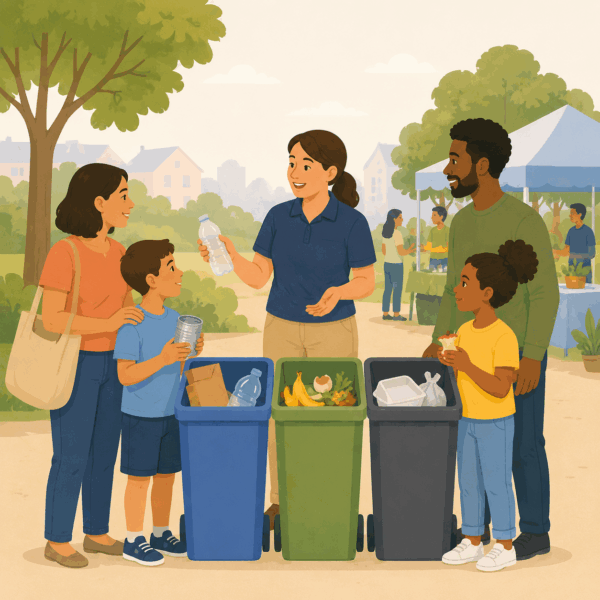
Community event demonstration programs that set up sorting stations at farmers markets, community festivals, neighborhood block parties, and other high-attendance community gatherings provide the hands-on, in-person education that print and digital materials cannot fully substitute for. A resident who works through a real sorting exercise with a knowledgeable volunteer demonstrator, handling actual materials and receiving immediate feedback on their sorting decisions, retains the practical knowledge from that interaction more reliably than one who reads the same information in a recycling guide. Event demonstrations are resource-intensive, but they are particularly effective for reaching communities where trust in institutional communication is lower and peer-to-peer education is correspondingly more important.
Integrating Waste Reduction Into the Broader Sustainability Communication
Solid waste agencies that communicate about recycling and composting in isolation, without connecting those programs to the broader sustainability commitments and environmental outcomes that their community has articulated, are missing an opportunity to position waste management behavior as part of a community identity rather than only as a service compliance expectation. Communities that have adopted climate action plans, sustainability goals, or environmental stewardship commitments have created a public narrative context into which recycling and composting behavior can be positioned as participation in a community project rather than compliance with a service requirement.
Cross-agency communication coordination between solid waste, parks, public works, planning, and environmental services agencies can amplify recycling and composting education by embedding it in the communication of other agencies with different community relationships and different audience reach. A parks and recreation department that includes composting program information in its community garden newsletter, a public works department that includes recycling guidance on its street repaving project communication, and a planning department that incorporates waste reduction into its sustainable development communication, are all creating touchpoints for recycling and composting education in communication environments where residents are receptive and engaged.
Procurement and event sustainability communication, which addresses how the agency and the community manage waste at public events, in public buildings, and through public procurement decisions, connects recycling and composting education to the institutional behavior that residents observe in public settings. An agency that communicates about its own composting of organic waste from public events, that publicizes its procurement of recycled-content materials, and that provides visible, labeled sorting infrastructure at public events, is demonstrating institutional commitment to the behavior it is asking residents to adopt. The gap between institutional rhetoric and institutional behavior is one of the most corrosive forces in public environmental communication, and agencies that close that gap through demonstrated institutional sustainability practice build the credibility that resident behavior change campaigns require.
 Strategic Communication Support for Recycling Education Programs
Building a public education program that measurably changes recycling and composting behavior at scale requires communication expertise, behavioral research capability, and measurement infrastructure that most solid waste agency communication teams do not maintain as core competencies. The combination of behavioral design, audience segmentation, multilingual communication development, and program performance measurement that effective recycling education requires makes external communication expertise a productive investment for agencies seeking to systematically improve their diversion and contamination performance.
Stegmeier Consulting Group (SCG) works with solid waste agencies to develop recycling and composting education programs that are designed for behavioral impact rather than outreach volume. This includes developing the behavioral research that identifies the specific knowledge gaps and behavioral barriers driving contamination and low participation in the specific community, designing communication that addresses those barriers with the specificity and simplicity that behavior change requires, creating audience-segmented outreach that reaches different resident groups through the channels and with the messages that are most effective for each group, and building the measurement systems that track program performance data rather than outreach activity. The objective is a communication program that produces measurable diversion and contamination improvements rather than only documented outreach.
Future Trends in Recycling Education Communication
The recycling education communication landscape is being reshaped by several converging trends that agencies need to anticipate. Extended producer responsibility programs, which shift some of the cost and responsibility for recycling program management to the producers of packaged goods, are creating new communication dynamics as program funding and operational responsibility shifts. Communication about these programs must explain not only what residents should do but why the program structure is changing and what obligations producers are now meeting that were previously funded by rates.
Artificial intelligence and machine learning are beginning to enable personalized recycling guidance that can respond to resident-specific questions about specific materials in real time. Chatbot interfaces that allow residents to photograph or describe a specific item and receive guidance about whether it belongs in recycling, composting, or garbage, address the point-of-decision information need that general education programs cannot reach. Agencies that invest in these digital guidance tools are providing the just-in-time, item-specific information that drives contamination reduction more effectively than scheduled education campaigns can.
Climate communication is increasingly connecting recycling and composting education to the broader context of climate action. Programs that communicate the carbon equivalent of their diversion outcomes, that explain how recycling reduces the energy and emissions associated with virgin material production, and that connect composting to the sequestration of organic carbon in soil, are building the environmental motivation case for recycling and composting participation in terms that resonate with residents who are increasingly attuned to climate outcomes. This connection does not replace the practical, behavioral guidance that contamination reduction requires. It supplements that guidance with a motivational context that makes participation feel part of a larger and more meaningful commitment.
Conclusion
Recycling and composting programs will divert material from landfill only if residents participate correctly, and residents will participate correctly only if they have been adequately educated about what participation requires. That simple causal chain is the argument for treating public education as a core operational function of solid waste program management rather than as a supplementary communication activity that operates alongside the program without being integrated into its performance management.
Programs that invest in public education design based on behavioral research, that measure program performance through contamination and participation data, that iterate communication approaches based on what the data shows, and that reach residents through channels and with messages appropriate for different levels of engagement, are programs that improve over time. Those that invest in education only when a new program launches, that measure success through outreach volume rather than behavioral outcomes, and that repeat the same communication approaches regardless of the contamination and participation data they generate, are programs that accept their current performance as permanent.
The difference between those two program management approaches, measured in diversion tons, contamination rates, and program costs over a decade, is the return on public education investment. It is also the difference between recycling and composting programs that fulfill their environmental purpose and those that consume resources while producing outcomes well below their potential.
Stegmeier Consulting Group’s Strategic Approach to Communication Systems
Build recycling and composting education around behavioral impact, measured through program performance data rather than outreach volume.
Solid waste agencies that design recycling education for behavioral change rather than awareness produce the diversion and contamination outcomes that make their programs operationally and financially sustainable. Stegmeier Consulting Group (SCG) helps agencies develop behavioral research-based education programs, audience-segmented communication, measurement frameworks, and digital guidance tools that transform public education from an outreach obligation into a program performance driver.
Use the form below to connect with our team and explore how strategic communication support can strengthen your recycling and composting program outcomes.