
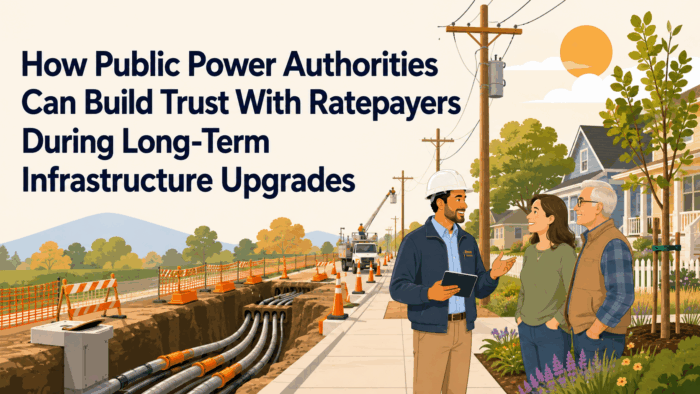
How Public Power Authorities Can Build Trust With Ratepayers During Long-Term Infrastructure Upgrades

The trust that ratepayers extend to a public power authority at the beginning of a major infrastructure upgrade program is almost always greater than what they extend at the middle of one. This is not because infrastructure programs fail to deliver value. Most do, over their full lifecycle, deliver the reliability improvements, efficiency gains, and service quality enhancements they were designed to produce. Trust erodes during long-term infrastructure upgrades because the communication that was intensive during the program launch fades as the program moves into its operational phases, because the visible construction activity that creates a sense of tangible progress gives way to less visible system integration work that seems to produce no public-facing milestones, and because the rate impacts that fund the program remain visible on every bill while the benefits accumulate invisibly in the background.
The erosion of ratepayer trust during long-term infrastructure programs is a well-documented pattern that public power authorities have not consistently found ways to prevent. It follows a predictable arc: strong initial public engagement during program announcement, high visibility and moderate public attention during peak construction activity, declining engagement during the integration and commissioning phases, and a final period in which the program is functionally complete but the public narrative has not been closed in a way that connects the completed investment to the ratepayer’s experience of improved service. Programs that follow this arc without deliberate communication intervention leave ratepayers uncertain about whether the investment delivered what was promised, skeptical about the next capital commitment, and less inclined to extend the trust that the next rate adjustment will require.
Long-term infrastructure upgrade communication is fundamentally different from project launch communication in its requirements and its disciplines. Launch communication creates a narrative. Long-term communication maintains it, updates it, adapts it to setbacks and delays, sustains it through the periods when it is hardest to maintain, and ultimately closes it in a way that connects the arc of the program to the ratepayer experience it was designed to improve. Each of these phases requires specific communication choices that the launch communication framework, however well-designed, cannot anticipate in full.
This article examines how public power authorities can build and maintain ratepayer trust across the full lifecycle of long-term infrastructure upgrade programs. It covers the communication disciplines that prevent trust erosion during the middle phases, the specific approaches to communicating setbacks and delays that preserve credibility rather than spending it, the progress communication strategies that keep ratepayers informed without overwhelming them, and the final communication practices that close the narrative loop in ways that build the foundation for the next long-term investment.
Understanding the Trust Dynamics of Long-Term Programs
Trust in the context of a public power authority’s infrastructure program is not a single, monolithic thing. It is a composite of several distinct beliefs that ratepayers hold about the institution and its program: trust that the program is genuinely necessary, trust that it is being executed competently, trust that its costs are being managed responsibly, trust that the authority is being honest about its progress and challenges, and trust that the promised benefits will actually materialize as described. Each of these components can erode independently of the others, and a program that is strong on some dimensions of trust and weak on others will eventually experience the trust deficits that the weak dimensions create.
The most consequential trust dimension for long-term programs is honesty about progress and challenges. Ratepayers who believe that a public power authority is communicating honestly with them about both the achievements and the difficulties of a major infrastructure program will extend significant patience with delays, cost revisions, and technical setbacks. Ratepayers who have reason to believe that the authority is managing their perception of the program rather than communicating honestly about it will withdraw their trust quickly when a delay or cost overrun surfaces through a source other than the authority itself. The difference between these two ratepayer populations is almost entirely a function of the communication approach the authority has adopted, not a function of the program’s actual performance.
Time horizon is a second critical dimension of trust dynamics in long-term programs. Programs that extend over five, ten, or fifteen years outlast the attention spans that most communication approaches are designed to sustain. The ratepayers who were most engaged at program launch will have had dozens of other public information demands compete for their attention by the time the program reaches its middle phases. New ratepayers who joined the service area after program launch may have no awareness of the program’s rationale or its current status. And the ratepayer understanding that does persist from the launch period may have drifted, simplified, or distorted in ways that do not accurately represent the program’s current status.
The political dimension of long-term program trust is also distinctively challenging. Infrastructure upgrade programs that span multiple electoral cycles will be governed by different board compositions at different phases of their lifecycle. Board members who were elected on a platform that includes support for the infrastructure program create one governing environment. Board members elected by constituencies that are skeptical of the program or its cost create a different one. The communication system that sustains ratepayer trust across these political transitions must be robust enough to function under different governance environments without losing the narrative continuity that long-term programs require.
From Pipelines to Public Trust: How Municipal Utilities Can Make Communication Central to Ratepayer Trust, Infrastructure Investment, and Long-Term Service Reliability
This article is part of our series on strategic communication for Public Utilities, Infrastructure Agencies, Municipal Utilities, and Public Works departments. To learn more and to see the parent article, which links to other content just like this, click the button below.
Communicating Project Rationale and Timelines From the Start
Setting Honest Expectations at Program Launch
The communication choices made at program launch have consequences that extend throughout the full lifecycle of the infrastructure program. An honest, comprehensive launch communication that accurately represents the program’s scope, cost, timeline, and anticipated challenges sets the expectations against which all subsequent communication will be evaluated. A launch communication that emphasizes the benefits, minimizes the costs, and presents an optimistic timeline sets expectations that the program will almost certainly fail to meet, creating the credibility gap that will characterize the program’s entire subsequent communication environment.
Honest timeline communication at launch is particularly important. Infrastructure upgrade programs routinely experience delays, and the utilities that acknowledge this reality at launch, explaining that complex infrastructure programs involve technical, regulatory, and construction challenges that can affect timelines, are setting ratepayers up to receive the inevitable schedule adjustments as normal program management rather than as evidence of failure. Utilities that present their program timelines as fixed commitments rather than as informed estimates will find that every schedule adjustment is received as a broken promise.
Cost communication at launch requires the same honesty about uncertainty. Capital cost estimates for major infrastructure programs are based on assumptions about materials prices, labor markets, site conditions, and regulatory requirements that will change over the course of a multi-year program. A utility that presents its initial cost estimate as a precise commitment rather than as the best current estimate, subject to revision as more information becomes available, is setting itself up for credibility damage when the inevitable cost revisions occur. Framing the initial cost estimate explicitly as an estimate, explaining the uncertainty range around it, and committing to transparent reporting as actual costs are incurred gives ratepayers the information they need to evaluate subsequent cost communication in context.
Making the Case for Why This Investment Now
The communication case for a major infrastructure investment must answer a specific question that ratepayers and elected officials will ask in one form or another: why this investment, why now, and why at this cost. The case for urgency is often clearer for emergency repairs than for planned infrastructure upgrades, but long-term upgrade programs often have urgency drivers that are not obvious to the general ratepayer without explicit communication.
Infrastructure condition data provides the most compelling case for urgency when it is presented specifically and honestly. An authority that can show ratepayers the age distribution of its grid infrastructure, the failure rate trends for components that are past their design life, and the service reliability consequences that the current infrastructure condition is producing gives ratepayers a concrete basis for understanding why the upgrade program is necessary now rather than deferrable. Abstract statements about the importance of infrastructure reliability are far less compelling than specific data about the infrastructure condition that makes the current investment urgent.
Regulatory and policy drivers for infrastructure upgrades also provide urgency arguments that deserve explicit communication. An infrastructure upgrade that is required to meet new interconnection standards, to comply with updated reliability requirements, or to integrate mandated renewable generation cannot simply be deferred because the authority would prefer to delay the capital commitment. Communicating the regulatory context honestly, explaining what the compliance consequences of deferral would be, and presenting the infrastructure upgrade as the responsible management of a regulatory obligation rather than a discretionary investment gives ratepayers additional context for evaluating the program’s necessity.
Providing Regular Progress Updates Without Overwhelming Ratepayers
The communication challenge of regular progress updates for long-term infrastructure programs is one of calibration. Too infrequent and ratepayers lose track of the program’s status, allowing their understanding to drift and their trust to erode in the absence of new information. Too frequent and the volume of communication creates its own barrier, with ratepayers learning to ignore routine updates because they appear too often to all contain significant new information. The right cadence depends on the program’s phase, the significance of recent developments, and the baseline level of ratepayer engagement with utility communication.
A quarterly update cadence for most phases of a long-term infrastructure program provides the regularity that prevents narrative drift without the frequency that produces communication fatigue. Quarterly updates should contain genuine new information about program progress: milestones completed, specific infrastructure components installed or upgraded, service reliability improvements that can be attributed to completed work, and a clear statement of where the program stands relative to its plan. An update that simply reaffirms that the program is proceeding as planned without providing specific new information is a missed communication opportunity and, over time, trains ratepayers to discount updates as containing nothing worth reading.
Annual summary communications that review the full year’s progress in context of the overall program trajectory are valuable supplements to quarterly updates. The annual summary can provide the cumulative picture that individual quarterly updates cannot, showing the progression of investment and achievement across the full year alongside the multi-year picture of where the program has come from and where it is going. These summaries are the most natural point of connection between the infrastructure upgrade program’s progress communication and the utility’s annual report, and a utility that integrates its annual infrastructure progress reporting into its annual report is creating a single, comprehensive accountability document rather than parallel accountability narratives.
Choosing What to Communicate and What to Skip
Not every development in a long-term infrastructure program warrants a public communication. Programs that generate hundreds of individual procurement actions, construction milestones, and technical integration events over their lifecycle cannot communicate about each of them without overwhelming ratepayers with operational detail that has no significance at the level of their service experience or their financial stake in the program. The judgment about what rises to the level of a public communication and what remains in the operational record is one of the most important communication disciplines in long-term program management.
The threshold for public communication should be based on the ratepayer’s perspective: does this development change the ratepayer’s understanding of the program’s progress, cost, or timeline in a way that is significant to their stake in the program. A major milestone completed ahead of schedule warrants communication because it provides positive evidence of program performance. A significant delay in a critical path component warrants communication because it affects the timeline that ratepayers have been given. A routine procurement award at planned cost does not warrant a standalone communication, but it appropriately appears in the quarterly update as evidence of program execution.
The more difficult threshold question is what to communicate about developments that are negative but operationally manageable. A cost increase that is significant in absolute terms but within the contingency budget does not necessarily change the overall cost picture that ratepayers have been given, but it represents a real development that a transparent communication program should acknowledge. A schedule delay that affects an individual component but not the overall program completion date is operationally insignificant but may warrant a brief communication that demonstrates the authority’s commitment to transparency even for minor adjustments. The principle is that ratepayers should not be surprised by program developments, and the communication threshold should be calibrated to ensure that no significant development reaches ratepayers through channels other than the authority’s own communication.
Communicating Setbacks and Delays Honestly
The moments when a long-term infrastructure program encounters setbacks and delays are the moments that most test the communication discipline of the public power authority managing it. The instinct toward delay and minimization in the communication of negative developments is almost universal in institutional settings, and it is almost universally counterproductive. Ratepayers who learn about significant program setbacks from media coverage, regulatory filings, or community members who encountered the information before the authority communicated it are positioned to interpret the authority’s subsequent communication through a frame of managed disclosure rather than honest transparency. That frame is very difficult to dislodge once established.
The discipline of proactive disclosure for program setbacks requires institutional commitment that goes beyond communication staff. It requires executive and governance leadership that genuinely believes that honest communication is a better strategy than managed disclosure, and that is willing to accept the short-term discomfort of being the source of bad news rather than the longer-term damage of being caught withholding it. That belief must be institutionalized in the communication protocols of the program, so that the threshold for proactive disclosure is established in advance rather than negotiated in the moment when the setback has occurred and the pressure to minimize is at its highest.
Proactive disclosure of program setbacks should include four elements: an honest account of what has changed, an explanation of why it changed, a clear statement of the consequences for the program’s cost and timeline, and a specific description of the corrective measures being taken. Communications that include all four elements give ratepayers the information they need to evaluate the setback in context. Communications that include the first element without the others leave ratepayers with a disclosure that raises more questions than it answers.
Maintaining Credibility When Cost Projections Change
Capital cost revisions are among the most politically sensitive developments in long-term infrastructure programs and require communication that is both honest about the magnitude of the change and clear about the factors that drove it. Ratepayers who have been given a cost estimate at program launch will hold that estimate as the reference point against which subsequent cost information is evaluated. A cost revision that is communicated proactively, explained clearly, and connected to specific factors that have changed since the original estimate is a very different communication event from one that is discovered by ratepayers or officials in a regulatory filing or a news report.
The explanation of cost revision drivers is an important component of the credibility management that honest disclosure requires. Cost revisions that are driven by factors outside the authority’s control, such as supply chain disruptions, materials price inflation, or regulatory requirement changes, call for a different explanation than revisions driven by scope changes or initial cost estimation that proved inaccurate. The communication should be honest about the actual drivers rather than selecting the most sympathetic explanation available. Ratepayers and officials who have access to other information about the program will evaluate the authority’s cost revision explanation against what they know, and inconsistencies between the authority’s explanation and other available information are more damaging than the cost revision itself.
Cost revision communication should also address the implications for future rate impacts explicitly. A cost overrun that is absorbed within existing contingency budgets has different rate implications than one that requires additional borrowing or rate structure adjustment. Communicating this distinction clearly gives ratepayers the information they need to understand the cost revision’s practical consequences, rather than leaving them to assume the worst case. A utility that explains that a cost revision is being managed within the program’s contingency budget and will not require additional rate adjustment is providing genuinely reassuring information that the bare fact of a cost revision does not convey.
Connecting Infrastructure Investment to Visible Service Improvements
The most compelling and the most durable ratepayer trust builder in a long-term infrastructure program is the demonstrated connection between the investment being made and the service reliability improvements that ratepayers actually experience. An authority that can show, specifically and with verifiable data, that the grid modernization work completed in a given year has produced measurable improvements in outage frequency, outage duration, or power quality in the portions of the system where that work has been completed is making the investment case with evidence rather than with promises.
Connecting investment to service outcomes requires the discipline to track service reliability metrics at a level of geographic specificity that allows before-and-after comparisons in the areas where infrastructure work has been completed. A grid modernization program that tracks outage frequency and duration by distribution circuit or substation service area can demonstrate specific, localized service improvements that ratepayers in those areas will recognize from their own experience. That recognition is the most powerful validation of program value available to a public power authority, because it converts an abstract infrastructure investment into a personal service improvement.
Progress maps that show ratepayers which portions of the system have been upgraded and what service reliability improvements those upgrades have produced are among the most effective visual communication tools for long-term grid programs. A ratepayer who can see their neighborhood on a map that shows completed grid modernization work alongside the before-and-after reliability data for that area has a specific, localized understanding of program value that no amount of aggregate program statistics can replicate. The geographic specificity of this communication connects the capital program to the individual ratepayer’s experience of service in a way that builds genuine understanding rather than abstract awareness.
Managing the Gap Between Investment and Visible Benefit
Long-term infrastructure programs often include significant phases where capital investment is proceeding but visible service improvements are not yet apparent to ratepayers. Design and engineering phases, underground construction work that is invisible at the surface, substation upgrades whose service reliability benefits depend on the completion of associated distribution circuit work, and system integration phases that require significant technical work before the benefits materialize at the customer level all create periods where the utility is investing heavily but the ratepayer’s service experience has not yet changed.
Managing communication through these benefit-lag periods requires honesty about the phase the program is in and clear explanation of why the visible service improvements are not yet apparent. A ratepayer who understands that the current work being funded represents the foundational investment that will enable the service improvements in the next program phase is better equipped to maintain patience with the current phase than one who expected visible improvements before now and does not understand why they have not materialized.
The benefit-lag period is also a natural point at which the communication program risks losing narrative coherence. Ratepayers who no longer see visible construction activity in their neighborhoods, who have been receiving program updates for a year or more, and who have not yet experienced service improvements may begin to question whether the program is real or whether the improvements will ever materialize. Proactive communication during benefit-lag periods, specifically addressing the phase the program is in and providing a clear timeline for when service improvements will begin to be visible, prevents the narrative drift that these periods otherwise produce.
How Long-Term Infrastructure Upgrade Communication Compares With Other Utility Communication
Long-term infrastructure upgrade communication is the most sustained and the most complex form of utility communication, because it must maintain a coherent public narrative across a timeframe that exceeds the attention span of most communication strategies and the political tenure of the governing boards that make key program decisions. Rate change communication is episodic and intensive but time-limited. Annual reporting is cyclical and comprehensive but does not require a continuous narrative between cycles. Crisis communication is acute and high-intensity but brief. Long-term infrastructure upgrade communication must be all of these things at appropriate moments across a multi-year program lifecycle, while also maintaining the baseline of continuous engagement that prevents narrative drift during the program’s quieter phases.
The closest analog in other public agency communication contexts is the multi-year transportation infrastructure program, where a transit authority or transportation department manages public communication for a capital project that extends over several years and involves visible construction activity in the communities it serves. The parallels include multi-phase communication planning, honest treatment of cost and schedule uncertainty, proactive disclosure of setbacks, and the challenge of connecting visible construction activity to the service improvements that ratepayers will eventually experience. The primary difference is that transportation infrastructure programs typically have visible physical milestones, such as bridge openings and station completions, that grid modernization and generation transition programs often lack.
Tying It All Together
Building ratepayer trust during long-term infrastructure upgrades is not a single communication act or a single campaign. It is a sustained organizational discipline that requires consistent investment in honest, specific, and accessible communication across every phase of a program that may extend for years or decades. The authorities that build this discipline deliberately, that institutionalize the communication protocols that prevent trust erosion during the program’s challenging phases, and that maintain the narrative coherence that multi-year communication requires, emerge from their infrastructure programs with the ratepayer trust that makes the next long-term commitment possible.
The key disciplines are few but demanding. Setting honest expectations at launch means resisting the temptation to present the program in its most favorable light and instead providing the full picture of costs, timelines, and uncertainties that ratepayers need to evaluate it accurately. Maintaining regular, substantive progress communication means treating the quarterly update as a genuine accountability obligation rather than an administrative formality, and ensuring that each update contains real new information about program progress. Disclosing setbacks proactively means being the first source of negative information about the program rather than waiting for it to surface elsewhere. And connecting the investment to visible service improvements means tracking and communicating the specific, localized service reliability changes that ratepayers can recognize from their own experience.
The authority that maintains these disciplines across the full lifecycle of a long-term infrastructure program builds something that is more valuable than any individual infrastructure asset: a ratepayer relationship grounded in the demonstrated belief that the authority communicates honestly, follows through on commitments, and manages ratepayer resources with the competence and integrity that public trust demands. That relationship is the foundation on which every subsequent capital commitment and every subsequent rate adjustment rests.
Governance Communication During Long-Term Programs
Governing board members who oversee long-term infrastructure upgrade programs face specific communication responsibilities that extend beyond their governance roles. As the elected or appointed representatives of the community funding the program, board members are among the most credible voices available to the utility for communicating program purpose, progress, and challenges to the public. When board members are well-informed, actively engaged, and able to articulate the program’s rationale and status accurately in community settings, they provide a governance communication resource that staff communication cannot replicate.
Board communication for long-term programs requires the same sustained education investment that ratepayer communication requires. Board members who were briefed on the program at its launch but have not received substantive updates on its progress, cost performance, and technical status since will find their ability to serve as informed public spokespersons eroding over time as the gap between their knowledge and the program’s current state grows. Regular board education sessions that review program progress in the context of the overall program trajectory, address the most significant recent developments, and prepare board members for the questions they are likely to receive from constituents and media keep the board’s knowledge current and their communication credibility intact.
Board members who serve on governing bodies that oversee long-term programs should also receive preparation for the specific governance communication moments that major programs create. Rate cases that fund program capital investment, public hearings on program progress or cost revisions, and regulatory proceedings that affect program parameters all require board members to engage in public settings where the quality of their communication has direct consequences for the program’s political and regulatory environment. Preparation for these moments, including briefings on the specific questions board members are likely to face and the communication approaches that address those questions most effectively, is an investment in governance communication that the most consequential program moments require.
Board turnover during long-term programs creates a specific governance communication challenge. New board members who are elected to govern a program that is already well into its implementation may have limited background knowledge of the program’s history, its original rationale, and the commitments that were made at program launch. A systematic orientation program for new board members that covers the full arc of the program’s history, its current status, and the prior commitments that continue to govern its implementation is essential for maintaining governance continuity across the board composition changes that long-term programs inevitably experience.
Media Relations for Long-Term Infrastructure Programs
Media coverage of long-term infrastructure programs follows a predictable pattern that public power authorities need to anticipate and manage proactively. Coverage is most intensive at program launch, when the announcement generates significant public interest. It tends to spike when significant milestones are reached, when cost or schedule revisions are reported, and when service disruptions that can be attributed to the infrastructure being upgraded occur. Between these high-attention moments, media interest tends to be low, and the program operates largely outside public consciousness.
Proactive media engagement for long-term programs requires a communications approach that gives reporters substantive, newsworthy information on a schedule that is driven by program milestones rather than only by external events. A utility that pitches media stories about significant program achievements, that provides background briefings to reporters who cover energy issues at regular intervals, and that makes program leaders available for interviews at key program milestones is creating the kind of ongoing media relationship that supports accurate and contextualized coverage when significant program developments occur.
The most important media communication discipline for long-term programs is the handling of negative developments. A utility that proactively contacts reporters it has relationships with when a significant cost revision or schedule delay occurs, providing a full and honest account of what has happened and what the program is doing to address it, is in a fundamentally better position than one that issues a press release and waits to see how the story is covered. Proactive engagement with reporters during difficult moments gives the utility the opportunity to ensure that the full context of the development is represented in the coverage, rather than only the dramatic elements that make for the most compelling story in the absence of utility-provided context.
Long-term programs that span multiple years will be covered by multiple generations of reporters, as individual journalists move between beats and publications. Building media relationships for a long-term program requires regular investment in new relationships with reporters who have recently taken on the energy or utility beat, not only maintenance of existing relationships with reporters who have followed the program since its launch. A utility that ensures that any reporter newly assigned to the energy beat receives a briefing on the utility’s infrastructure program, its rationale, and its current status is investing in the accuracy of future coverage from a relationship that may not have existed at program launch.
Addressing Media Misinformation During Program Implementation
Media coverage of long-term infrastructure programs is not always accurate, and inaccuracies can become entrenched in the public narrative about a program if they are not corrected quickly and specifically. A utility that does not correct factual errors in media coverage of its infrastructure program, or that corrects them only through formal letters to the editor or regulatory filings that most ratepayers and media will not see, allows inaccurate characterizations to circulate without effective rebuttal.
The most effective approach to media misinformation is to correct it through the same channels where it appeared and as quickly as possible after the inaccurate coverage is published. A utility that reaches out directly to the reporter who published an inaccurate cost or schedule characterization, provides the specific accurate information that contradicts the error, and offers additional context that helps the reporter understand the full picture, is addressing the misinformation at its source. Most reporters who publish inaccuracies do so from incomplete information rather than deliberate misrepresentation, and a utility that provides complete and accurate information is likely to receive a correction or a follow-up story that provides the missing context.
Program Completion and the Closing Communication
The completion of a long-term infrastructure upgrade program is a communication moment that many utilities underinvest in, treating it as an administrative endpoint rather than as the culmination of a multi-year communication commitment that deserves formal closure. A program that ends without a comprehensive communication of what was accomplished, what the investment produced, and how the ratepayers who funded it have benefited leaves the public narrative open rather than closed. Ratepayers who followed the program over its lifecycle deserve a final accounting that validates their patience and their investment.
Program completion communication should accomplish several specific things. It should document the full scope of what was accomplished: the specific infrastructure components upgraded or replaced, the total investment made, the schedule against the original plan, and any adjustments that were made and the reasons for them. It should report the service reliability and efficiency outcomes that the completed program has produced, using the before-and-after metrics that the program tracked throughout its implementation. And it should acknowledge the ratepayers and community partners whose patience and support made the program possible.
The completion communication is also the natural point for beginning the communication about what comes next. Long-term infrastructure programs are rarely the last investment a public power authority will make, and the ratepayers who have followed one program through its full lifecycle are the most informed and most invested audience for communication about the authority’s next major initiative. A completion communication that briefly introduces the infrastructure challenges or investment opportunities that will drive the next program phase is a natural bridge between the closing of one program narrative and the opening of another, and it demonstrates that the utility is thinking about its infrastructure obligations over the long term rather than one program at a time.
Community recognition of program completion is an underutilized communication opportunity for public power authorities. A community event, a public presentation to the governing board, or a recognition of the ratepayers and organizations that supported the program through its implementation creates a public milestone that marks the program’s completion in a way that is more memorable and more community-building than a press release. The investment in a meaningful completion recognition is modest relative to the capital investment the program represented, and it produces a communication event that closes the program’s public narrative with the kind of shared acknowledgment that sustains institutional credibility beyond the program itself.
Community Engagement During Active Construction Phases
The active construction phases of a grid modernization or infrastructure upgrade program are the periods when ratepayer experience of the program is most immediate and most personal. Construction activity in neighborhoods, street closures, noise and dust, altered access to properties and businesses, and the visual disruption of construction equipment and staging areas all create direct impacts on community members who may or may not have been following the program’s communication closely. Managing community relationships during active construction phases requires communication that is geographically specific, operationally specific, and responsive to the particular concerns of the communities directly affected.
Construction notification communication should reach directly affected residents and businesses at least two weeks in advance of work that will significantly affect their access, parking, or daily routines. The notification should identify specifically what work will be done, where it will occur, what dates and hours it is planned for, what access impacts to expect, and who to contact with questions or concerns. Generic construction notices that provide only a project name and a general timeline are insufficient for residents and businesses who need to make specific plans around the construction activity.
Construction phase community liaison programs, which designate a specific contact person for neighborhood residents and business owners to reach with questions, concerns, or complaints during active construction phases, demonstrate a level of community responsiveness that generic customer service lines cannot provide. A liaison who knows the specific construction project, can answer specific questions about the work schedule and impacts, and can escalate genuine concerns to the appropriate operational contact is providing a community relationship service that transforms the construction phase from an adversarial community experience into a managed, responsive one.
Post-construction follow-up with the communities where work has been completed demonstrates that the utility’s engagement did not end with the construction activity. A brief communication that notes the completion of the work, identifies the infrastructure that was upgraded and the service benefit that upgrade is expected to produce, and thanks the community for their patience during the construction period is a closing-the-loop communication that many utilities skip. The cost is minimal and the goodwill it generates, particularly with residents and businesses who experienced significant disruption, is disproportionate to the investment. It also creates a natural point of connection between the completed infrastructure work and the service reliability improvement that the community will subsequently experience.
Building Internal Communication Capacity for Long-Term Programs
Long-term infrastructure upgrade programs require communication capacity that is sustained over years, and building that capacity internally requires investment in staff, systems, and processes that most utilities do not have in place before a major program begins. A communication team that is sized for routine utility communication may be adequate for the ordinary demands of rate announcements, annual reports, and service disruption notifications, but may be significantly under-resourced for the sustained quarterly reporting, stakeholder engagement, media relations, and community liaison requirements of a major multi-year infrastructure program.
Staff investment for long-term program communication should be treated as part of the program budget rather than as an overhead cost to be minimized. A program that requires quarterly progress communications, regular stakeholder briefings, community liaison services during active construction phases, annual summary reports, and ongoing media engagement needs dedicated communication staff capacity to perform those functions reliably across a multi-year program. Utilities that assign long-term program communication to existing staff alongside their routine responsibilities will find that the program communication is consistently the function that gets deprioritized when competing demands arise, which is exactly when the program is most in need of communication investment.
Communication systems for long-term programs, including stakeholder databases, progress tracking platforms, media contact management systems, and community feedback tracking tools, require upfront investment that produces ongoing efficiency dividends across the program’s full lifecycle. A utility that builds its stakeholder database at program launch, maintaining accurate contact information and communication history for the full range of program stakeholders, can communicate with those stakeholders efficiently throughout the program rather than rebuilding contact lists and relationships at each communication moment. These system investments are modest relative to the program’s capital investment but significant relative to the communication team’s ordinary operating budget, and they should be planned and funded as program costs.
Knowledge management for long-term programs is a specific internal communication challenge that most utilities underestimate. A program that extends for seven years will see significant staff turnover in the communication, operations, and governance functions that manage it. The institutional knowledge of why specific program decisions were made, what commitments were communicated at what points, what ratepayer concerns were most prominent during different phases, and what communication approaches proved most effective is valuable knowledge that should be documented and preserved rather than held only in the memories of staff who may leave the organization before the program concludes. Regular documentation of communication decisions, stakeholder feedback, and program communication history creates the institutional memory that allows new staff to engage effectively with the program’s accumulated history.
The Role of Customer Data in Long-Term Program Communication
Smart metering and advanced grid technology are producing customer data that creates new opportunities for long-term infrastructure program communication that were not available for earlier generations of utility capital programs. Utilities that can show ratepayers the specific service reliability data from their own meter, demonstrating how the frequency and duration of power interruptions at their specific location has changed as nearby grid modernization work has been completed, are providing the most compelling form of program value communication available: the ratepayer’s own experience, documented and quantified.
Interval data from smart meters allows utilities to demonstrate program impacts at the individual account level in ways that aggregate system performance statistics cannot. A ratepayer who receives an annual account summary showing that the number of interruptions at their location decreased by a specific percentage following the grid modernization work in their neighborhood, and that the average duration of interruptions that did occur decreased by a comparable amount, is receiving program accountability data that is directly relevant to their personal experience of service quality. This kind of personalized performance reporting closes the loop between the infrastructure investment and the ratepayer’s service experience in the most concrete and credible way available.
Customer data also enables proactive communication about infrastructure vulnerabilities that the program is addressing before those vulnerabilities produce service failures. A utility that can identify, from smart meter and grid monitoring data, that specific portions of its service area are experiencing elevated levels of voltage variation, momentary interruptions, or other power quality events that indicate underlying infrastructure stress can communicate proactively with ratepayers in those areas about the infrastructure upgrade work planned to address those conditions. This proactive communication transforms the program from a generic capital improvement into a specific response to documented service quality issues that affected ratepayers can recognize from their own experience.
Privacy considerations are important in the use of customer data for program communication. Individual account-level consumption and reliability data is personal information that ratepayers have an interest in controlling, and communication programs that use that data must do so in ways that are consistent with the utility’s privacy commitments and with applicable regulations. The most effective approach is to use customer data to trigger personalized communication with the specific ratepayer to whom the data belongs, rather than aggregating individual account data in ways that might reveal information ratepayers did not intend to share. A utility that is transparent about how it uses customer data in its program communication, and that provides ratepayers with meaningful control over how their data is used, builds the trust that personalized communication requires.
Maintaining Ratepayer Patience Through Program Extensions
Long-term infrastructure programs sometimes need to extend their timelines beyond what was originally planned, and the communication of program extensions is among the most difficult challenges that public power authority communication faces. An extension communicates that the original timeline was not met, which ratepayers may interpret as evidence of program mismanagement even when the extension reflects legitimate programmatic reasons. Managing this perception requires communication that is honest about the extension, specific about its cause, and clear about the revised timeline and the commitments associated with it.
Program extensions that are driven by external factors, such as supply chain disruptions, regulatory approval delays, or permitting challenges that affected equipment delivery or construction scheduling, deserve communication that is specific about the external cause and honest about what the utility could and could not control. Ratepayers who understand that a program extension resulted from circumstances outside the utility’s direct control are better positioned to maintain patience with the revised timeline than those who receive a general statement that the program is taking longer than expected without specific explanation of why.
Program extensions that reflect internal management challenges, such as cost control issues, staffing capacity constraints, or design changes that required rework, deserve equally honest communication that acknowledges the management dimension of the extension without being defensive about it. A utility that says ‘we underestimated the complexity of this phase and are taking the additional time needed to do it right’ is demonstrating accountability that ratepayers can evaluate. A utility that attributes every program challenge to external factors without acknowledging any internal contribution to them will eventually lose credibility with ratepayers who have followed the program closely enough to know that not every delay was externally caused.
Revised timeline communication for program extensions should be presented with explicit recognition of the prior timeline commitment that is not being met and should include specific explanation of what is different about the revised timeline that makes it more reliable. A revised estimate that is presented without acknowledgment of the previous estimate’s inaccuracy invites the question of why the new estimate should be trusted when the previous one was not. A revised estimate that is presented with an honest account of what was misestimated in the original timeline, what additional information has been gained since the original estimate, and what specific measures are being taken to manage the risks that produced the extension is a revised estimate that ratepayers can evaluate rather than simply accept or reject.
Cross-Departmental Communication Coordination During Infrastructure Programs
Long-term infrastructure upgrade programs touch every function of a public power authority, and the communication quality of the program depends on coordination across those functions that organizational structures do not always facilitate naturally. Operations staff who manage the day-to-day progress of infrastructure work generate the information that communication staff need to produce accurate progress reports. Finance staff who track program expenditure and cost performance provide the financial data that accountability communication requires. Engineering staff who assess schedule impacts and technical adjustments produce the information that honest timeline communication depends on. Without deliberate coordination mechanisms that move this information efficiently from the functions that generate it to the communication functions that translate it for public audiences, the accuracy and timeliness of program communication will be compromised.
Communication staff who are embedded in or closely connected to the program management team, who attend regular program status meetings, and who have direct relationships with the operational staff who manage the work are better positioned to generate accurate and timely program communication than those who receive information only through formal reporting channels that may be slower and less complete than the informal operational information flow. The organizational investment in integrating communication into the program management process, rather than treating communication as a downstream function that receives polished reports of operational decisions, produces the information access that accurate program communication requires.
Governance communication for long-term programs is a coordination challenge that is separate from but closely connected to the operational communication coordination. Governing board members, elected officials, and regulatory bodies all need program information on schedules and in formats that serve their specific governance purposes, and those needs are different from the ratepayer communication that forms the core of the program’s public-facing communication. A program communication plan that addresses governance communication needs alongside ratepayer communication needs, and that establishes clear processes for how governance communication is developed and approved, prevents the coordination failures that can produce inconsistent information reaching different stakeholder audiences.
When organizational changes occur during the program, including changes in program management leadership, changes in the operating units responsible for specific program components, or broader organizational restructuring that affects the program’s administrative structure, communication coordination mechanisms must adapt to reflect the new organizational reality. Programs that maintain their communication coordination mechanisms through organizational transitions, by documenting those mechanisms clearly and ensuring that incoming staff understand their communication responsibilities, sustain the communication quality that long-term programs require through the organizational changes that multi-year programs inevitably experience.
 Strategic Communication Support for Long-Term Infrastructure Programs
Sustaining a high-quality communication program across the full lifecycle of a major infrastructure upgrade requires planning, capacity, and communication expertise that most public power authority teams cannot provide on their own alongside their routine communication responsibilities. The multi-phase planning horizon, the diverse stakeholder audiences, the specific requirements of setback and delay communication, and the complex challenge of connecting investment to visible service outcomes all represent communication disciplines that benefit from external expertise and fresh perspective.
Stegmeier Consulting Group (SCG) works with public power authorities to develop long-term infrastructure program communication systems that are designed from the outset for the full program lifecycle rather than only for the launch phase. This includes developing the communication architecture that provides for quarterly progress reporting, annual summaries, milestone communications, and setback disclosure protocols before any of those communication moments have arrived, creating the stakeholder engagement framework that sustains informed participation across political transitions and changing board compositions, and designing the service outcome tracking and communication approach that connects completed investment to ratepayer experience at the local level.
SCG also provides support for authorities at specific points in existing long-term programs where the communication system is underperforming. This includes communication audits that assess the current state of program narrative coherence, stakeholder engagement quality, and progress communication effectiveness, alongside specific recommendations for how the communication program can be strengthened for the program phases ahead. The investment in communication system assessment and improvement at the middle of a long-term program is often more valuable than a redesign at program launch, because it addresses the specific trust erosion patterns that the program has already produced and provides a path to rebuilding the ratepayer confidence that sustained investment requires.
Future Trends in Long-Term Infrastructure Program Communication
The communication environment for long-term grid infrastructure programs is being reshaped by several converging trends that public power authorities need to anticipate. The integration of distributed energy resources, including customer-owned solar generation, battery storage, and electric vehicle charging, into the grid modernization program creates new communication relationships with ratepayers who are simultaneously customers of the utility and contributors to the grid it is upgrading. These prosumer ratepayers have different information needs and different engagement motivations than purely passive customers, and a communication program that does not account for their perspective will miss an important and growing stakeholder group.
Digital infrastructure for program transparency is also rapidly evolving. Interactive project tracking platforms that allow ratepayers to see the real-time status of infrastructure work in their area, the investment completed to date, the projected schedule for work in their neighborhood, and the service reliability data for their portion of the system are becoming increasingly expected for major public infrastructure programs. Authorities that invest in these platforms are creating a transparency infrastructure that strengthens trust continuously rather than only at moments when formal communications are issued.
The intersection of grid modernization with climate resilience is creating a new communication dimension for long-term infrastructure programs. Ratepayers who experience increasingly frequent and severe weather-related disruptions are increasingly receptive to communication that connects grid hardening investments to improved resilience against climate-driven outages. Authorities that frame their infrastructure upgrade programs explicitly in terms of climate resilience, alongside the traditional reliability and efficiency benefits, are speaking to a concern that is becoming more salient to ratepayers who have lived through the disruptions that aging infrastructure and increasing climate stress produce.
Conclusion
Ratepayer trust is not given and held indefinitely. It is built through consistent, honest communication over time and eroded by silence, selective disclosure, or the gap between what was promised and what ratepayers are experiencing. Long-term infrastructure programs test this dynamic more severely than any other form of utility communication because they sustain ratepayer financial commitment across the full arc of a program whose costs are always visible and whose benefits often are not.
The public power authorities that build and maintain ratepayer trust across long-term infrastructure programs are those that understand this dynamic and invest in the communication discipline that prevents trust erosion before it occurs rather than attempting to rebuild it after the gap between promise and experience has become visible. They set honest expectations at launch. They maintain regular, substantive progress communication through every phase. They disclose setbacks proactively and completely. They connect completed investment to visible service improvements with geographic specificity. And they close the program narrative in ways that validate the ratepayer’s investment and build the foundation of confidence that the next long-term capital commitment will require.
Infrastructure is what makes essential services possible. Communication is what makes the investment in infrastructure possible. A public power authority that understands this relationship and invests in both with equal seriousness is an authority that can sustain the long-term infrastructure commitments that reliable public power service requires, through the political changes, the program setbacks, and the years of patient investment that every significant infrastructure upgrade entails.
Stegmeier Consulting Group’s Strategic Approach to Communication Systems
Build long-term infrastructure program communication around honest expectation-setting, sustained progress reporting, and the service outcome connections that make multi-year investment legible to ratepayers.
Public power authorities that communicate long-term infrastructure upgrade programs with honesty, consistency, and sustained attention to ratepayer understanding build the trust that makes the next capital commitment possible. Stegmeier Consulting Group (SCG) helps authorities develop the communication systems, progress reporting frameworks, setback disclosure protocols, and service outcome communication strategies that transform long-term infrastructure programs from trust-eroding obligations into trust-building demonstrations of institutional integrity. Use the form below to connect with our team and explore how strategic communication support can strengthen your authority’s long-term infrastructure program communication.