
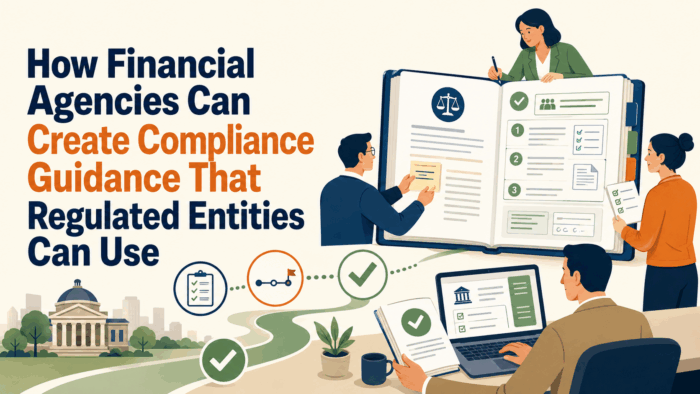
How Financial Agencies Can Create Compliance Guidance That Regulated Entities Can Use
The gap between what a statute or regulation requires and what a regulated entity needs to know to actually comply with that requirement is rarely bridged by the text of the law alone. Statutes establish general requirements in language that are designed for legal precision and durability. Regulations add specificity but are still written primarily for the administrative and legal record rather than for the practical guidance of compliance officers, front-line managers, and business principals who need to know what to do on Monday morning. The compliance guidance that sits between the legal text and the operational reality of compliance is where regulatory agencies can most directly support the regulated entities that are sincerely trying to meet their obligations.
Compliance guidance serves a different purpose from enforcement. Enforcement addresses conduct that has already violated regulatory requirements. Guidance addresses the question of how to avoid violations in the first place. An agency that invests primarily in enforcement and minimally in guidance is producing a compliance environment in which violations are addressed after they occur rather than prevented through accessible, practical instruction. An agency that invests in high-quality guidance creates conditions in which regulated entities that want to comply can do so effectively, which reduces the volume of violations that result from compliance uncertainty rather than from intent to evade.
This article addresses how financial regulatory agencies can create compliance guidance that regulated entities can actually use. It covers the different forms that compliance guidance can take, including FAQs, interpretive letters, examination findings, checklists, webinars, and decision trees, and how to select the right form for the specific guidance need. It covers how to write guidance that is specific enough to be actionable without being so specific that it raises questions it cannot answer. It addresses how to communicate about common compliance problems in ways that help the full regulated population avoid them. And it addresses how to build a sustainable guidance program that produces guidance systematically rather than reactively.
The Forms of Compliance Guidance and When to Use Each
 Compliance guidance is not a single type of document. It is a family of communication products that differ in their format, their level of specificity, their legal status, and the types of compliance questions they are designed to address. Selecting the right form for the specific guidance need is as important as the content of the guidance itself.
Frequently Asked Questions
Frequently asked questions documents are among the most efficient and most immediately useful forms of compliance guidance for regulated entities. When a new regulation is adopted or an existing requirement generates a pattern of compliance questions, a FAQ that directly answers the most common questions in plain language can immediately resolve the compliance uncertainty that the questions reflect and reduce the volume of individual inquiries the agency receives. The FAQ format has the additional advantage of being perceived as informal and accessible, which makes it more likely to be read and used than a formal regulatory opinion or guidance document.
Effective compliance FAQs are organized around the questions that regulated entities actually ask, not around the questions that the agency finds most convenient to answer. The distinction matters because agencies sometimes produce FAQs that address the questions that are easy to answer or that are most favorable to the agency’s position, while avoiding the questions that require nuance, that expose areas of regulatory uncertainty, or that require the agency to acknowledge the limitations of its own guidance. A FAQ that does not address the questions entities are actually asking does not serve the compliance facilitation function that FAQs are designed to provide.
FAQs should be dated and updated regularly, because compliance questions evolve as the regulatory environment changes and as regulated entities encounter new fact patterns that were not addressed in the original FAQ. A FAQ that is accurate when published but that is not updated as the regulatory environment changes becomes a source of compliance misinformation rather than guidance. The FAQ should carry a clear date of last update and should include a mechanism through which regulated entities can submit questions that are not addressed, so that the agency can identify gaps in the FAQ’s coverage.
Interpretive Guidance and No-Action Letters
Interpretive guidance documents and no-action letters provide more formal regulatory analysis of specific legal or regulatory questions than FAQs typically do. These documents are appropriate when a specific legal question requires a considered regulatory position, when a specific business model raises novel compliance questions that cannot be answered through existing guidance, or when an entity needs a formal expression of the agency’s position on a specific set of facts in order to proceed with confidence.
No-action letters, in which the agency states that it will not take enforcement action against a specific entity engaging in specific conduct under specified circumstances, provide the highest level of compliance certainty for entities with genuinely novel situations. The process for requesting and obtaining a no-action letter should be clearly communicated to regulated entities, including what information the request should include, how long the review process takes, what the scope and limitations of the no-action protection are, and whether the letter is publicly available or confidential.
The publication of interpretive guidance and no-action letters, in appropriately redacted form when necessary to protect confidential business information, serves the broader regulated industry by providing publicly available analysis of compliance questions that other entities in similar situations will likely face. An agency that publishes its interpretive guidance and no-action letters creates a body of publicly available regulatory analysis that reduces the need for individual entities to seek identical guidance on the same questions, which reduces both the agency’s response burden and the regulated entities’ compliance uncertainty.
Examination Findings and Supervisory Guidance
Examination findings, when shared with the regulated industry in appropriately anonymized form, are among the most practically useful forms of compliance guidance because they describe actual compliance failures in actual regulated entities rather than hypothetical compliance scenarios. Regulated entities that learn from examination findings about the types of compliance problems that examinations are finding in comparable entities can take preventive action to address those specific risk areas before they become compliance violations in their own operations.
Examination findings communications are most useful when they describe not only what compliance failure was found but also what the examined entity had in place instead of what was required, why that fell short, and what an adequate compliance approach would look like. The examination finding that says the entity’s records were insufficient is less useful than one that says the entity’s records did not include the required disclosures and did not document customer acknowledgment in the required form, and that describes what records would have been sufficient.
Supervisory guidance documents, issued by agencies to communicate their supervisory expectations and examination standards to the regulated industry, provide regulated entities with a preview of what examiners will be looking for before they experience an examination. Clear, publicly available supervisory guidance reduces examination surprises, helps regulated entities allocate compliance resources effectively, and supports a more productive supervisory relationship between the agency and the industry it regulates.
Protecting the Public Interest: Communication Strategies for Financial Regulation, Insurance, and Consumer Protection Agencies
This article is part of our series on strategic communication for Financial Regulatory Agencies, State Insurance Departments, and Consumer Protection Agencies. To learn more and to see the parent article, which links to other content just like this, click the button below.
Checklists and Decision Trees
Checklists and decision trees are compliance tools that are particularly effective for regulated entities that need to ensure they have addressed every required element of a complex compliance obligation. The checklist format reduces the risk that compliance steps will be omitted under the time pressure and operational complexity of real business operations. The decision tree format helps entities navigate compliance obligations that depend on the specific characteristics of their activity, their customer, or their situation.
A compliance checklist for a specific regulatory requirement should include every element that must be addressed for compliance, organized in the logical sequence in which a regulated entity would address them. For complex requirements with multiple components, checklists that are organized around the timing of compliance actions, distinguishing between things that must be done before a transaction, at the time of the transaction, and after the transaction, are more practically useful than those organized by regulatory category.
Decision trees are particularly effective for helping regulated entities determine which specific requirements apply to their specific situation when the applicable requirements depend on factors that vary across transactions, customers, or products. A decision tree for determining which disclosure requirements apply to a specific type of transaction, for example, can guide an entity through the relevant determining factors and reach a clear conclusion about the applicable requirements more efficiently than a prose description of the requirements that the entity must then apply to its specific facts.
Both checklists and decision trees should be tested by compliance professionals from the regulated industry before publication to ensure that they accurately reflect how entities experience the relevant compliance challenge. A checklist or decision tree that seems clear to the agency staff who designed it may be confusing or inadequate from the perspective of a compliance officer trying to use it in an operational context. Pre-publication testing by members of the regulated industry reduces the likelihood that published tools will fail to address the compliance challenges they are designed to help with.
Webinars and Direct Engagement
Webinars, compliance workshops, and other forms of direct engagement between the regulatory agency and regulated entities are among the most effective forms of compliance guidance because they allow for the two-way communication that static guidance documents cannot provide. A regulated entity that has a question about a specific aspect of a compliance requirement can ask that question in a webinar and receive an answer from agency staff that addresses their specific concern. That exchange of specific questions and specific answers is often more efficient and more effective than either party trying to address compliance questions through written guidance documents.
Compliance webinars are most effective when they are organized around specific topics that are generating compliance uncertainty in the regulated industry, when they include a substantial question-and-answer component that gives participants the opportunity to ask specific questions, and when the presentations are delivered by agency staff who have both the regulatory expertise to answer technical questions and the communication skills to explain complex requirements in accessible terms.
The record of questions asked and answers given in a compliance webinar is itself a valuable guidance resource that should be published after the event. Participants who could not attend the live webinar can access the recording. Other regulated entities who face similar compliance questions can benefit from the Q&A even if they did not participate. The agency’s answers to specific questions in a webinar context, while not formal regulatory opinions, provide useful guidance that supplements the formal guidance documents the agency has published.
For regulated industries with significant geographic dispersion or with entities that cannot easily attend in-person events, video recordings of compliance seminars and workshops, published on the agency’s website, provide ongoing access to compliance education that has a much longer useful life than a one-time live event. These recordings should be organized by topic and indexed in a way that allows regulated entities to find the specific compliance education most relevant to their needs without watching an entire session to find the relevant portion.
Writing Compliance Guidance That Is Specific Enough to Be Useful
The most common failure of compliance guidance is insufficient specificity. Guidance that restates the regulatory requirement without explaining how to meet it, that describes what is required without describing what compliance looks like in practice, or that addresses hypothetical situations that are not the ones regulated entities actually encounter, is guidance that entities read and find unhelpful. Specific, practical guidance that tells entities exactly what they need to do and how to do it is the standard that effective compliance guidance should meet.
Specificity in compliance guidance requires the agency to make the translation from regulatory language to operational instruction that regulated entities need but that they often cannot make themselves. A requirement that a lender obtain the consumer’s informed consent before proceeding with an application generates a specific compliance question: what does informed consent look like in an online lending context where there is no face-to-face interaction? The guidance that answers that question specifically, describing what disclosures must be made, in what format, at what point in the application process, and how consent must be documented, is guidance that regulated entities can actually implement.
The line between guidance that is specific enough to be useful and guidance that is so specific that it becomes a rule without going through the rulemaking process requires careful calibration. Agencies that provide very specific operational guidance through informal channels without the procedural protections of formal rulemaking may create compliance expectations that are not formally enforceable but that regulated entities treat as binding. The agency’s guidance program should have a clear understanding of this distinction and should communicate clearly to regulated entities about the legal status and enforceability of different types of guidance.
Communicating About Common Compliance Problems
Regulatory agencies that observe recurring compliance problems across multiple regulated entities have an opportunity to address those problems broadly through guidance communication rather than only through individual enforcement actions. Communicating about common compliance problems in the aggregate, without identifying specific entities, allows the full regulated population to benefit from what the agency has learned through examination and enforcement, which prevents the same compliance failures from recurring across multiple entities.
Common compliance problem communications are most useful when they describe not only the compliance failure that was observed but also the underlying cause of the failure. A compliance failure that consistently results from a misunderstanding of the regulatory requirement is different from one that consistently results from inadequate implementation of a requirement that is correctly understood. The guidance that addresses a misunderstanding should clarify the requirement. The guidance that addresses an implementation failure should describe what adequate implementation looks like. Addressing the right underlying cause requires knowing what the cause actually is.
The timing of common compliance problem communications should reflect the need to address current compliance risks rather than documenting past problems. An agency that publishes common compliance problems based on the examination findings of several years ago is providing guidance that may be relevant to historical compliance challenges but that may not address the current compliance landscape. Regular publication of current compliance problem observations, ideally annually or more frequently for rapidly evolving compliance areas, keeps the guidance current and ensures that it addresses the compliance challenges that regulated entities are actually facing.
Building a Sustainable Compliance Guidance Program
Compliance guidance programs that are developed reactively, producing guidance when enforcement cases or examination findings reveal specific problems, are less effective than those that anticipate compliance challenges and provide guidance before those challenges result in widespread compliance failures. A sustainable compliance guidance program includes both reactive capacity, the ability to produce guidance quickly in response to emerging compliance questions, and proactive capacity, the ability to identify and address potential compliance challenges before they generate significant enforcement activity.
The proactive dimension of a compliance guidance program requires the agency to maintain ongoing awareness of the compliance landscape through examination findings, complaint data, industry intelligence, and monitoring of emerging regulatory developments that may generate new compliance questions. That awareness should drive a guidance development calendar that produces guidance on the topics where compliance uncertainty is greatest, rather than on the topics that are easiest to address or most familiar to agency staff.
Guidance quality assurance requires both internal review by subject matter experts and external review by representatives of the regulated industry who can assess whether the guidance is actually usable in operational contexts. An internal review process that ensures regulatory accuracy is necessary but not sufficient for producing guidance that regulated entities can use. External review by compliance professionals, legal counsel, and industry representatives ensures that the guidance is also operationally realistic and accessible to its intended audience.
Compliance Guidance for Specific Regulatory Requirements
 The most immediately useful compliance guidance addresses specific regulatory requirements that are generating compliance uncertainty across the regulated industry. These are the requirements where compliance professionals routinely ask the same questions, where examination findings consistently reveal the same failures, and where the gap between what the regulation says and what regulated entities need to know to comply is widest. Identifying and addressing these high-priority guidance needs should be the organizing principle of a compliance guidance program.
Disclosure requirements are a perennial source of compliance questions because the applicable standards often specify what must be disclosed without fully specifying how, in what format, at what point in the transaction, and in what medium. A lender that knows it must provide an annual percentage rate disclosure but that is uncertain whether the disclosure must appear on the first page of the disclosure packet, in a specific font size, highlighted in a specific color, and accompanied by a specific explanatory statement about how the rate is calculated, has regulatory knowledge that is insufficient for operational compliance. The guidance that fills those gaps is guidance that directly prevents the most common disclosure-related compliance failures.
Complaint handling requirements for licensed financial services entities are another area where guidance is frequently needed and frequently inadequate. Regulations that require financial companies to maintain complaint records, provide written responses within specified timeframes, and report complaint data to the regulator generate compliance questions about what counts as a complaint, what level of documentation satisfies the record-keeping requirement, how the response timeframe is calculated, and what specific fields must be included in complaint reports. Guidance that addresses these operational specifics directly supports compliance in an area where deficiencies are commonly found in examinations.
Recordkeeping requirements are among the most common sources of examination findings, because the regulatory requirements for what records must be maintained, in what format, and for how long are often not fully specified in the statute or regulation. Compliance guidance that provides a specific, comprehensive list of required records, organized by the regulatory requirement they support, with clear retention period specifications and format requirements where they apply, gives regulated entities what they need to build an adequate recordkeeping system.
Using Plain Language in Compliance Guidance
Compliance guidance that is written in the same technical language as the regulations it interprets is guidance that requires the same level of regulatory expertise to understand as the regulation itself. If the goal of compliance guidance is to make regulatory requirements accessible to the compliance officers, managers, and business principals who must actually implement them, the guidance must be written at a level of accessibility that those practitioners can engage with without being regulatory specialists.
Plain language compliance guidance uses active sentences that clearly identify who must do what and when. It avoids nominalization, the transformation of action verbs into abstract nouns, which makes regulatory requirements seem like abstract states rather than specific actions. Instead of the licensee is required to maintain documentation of the consumer’s acknowledgment, plain language guidance says you must keep a signed form or electronic record showing the consumer read and agreed to the disclosure before the transaction proceeds. The second version describes the specific action and the specific record in terms that a compliance officer can immediately translate into an operational procedure.
Examples are the most efficient plain language tool for compliance guidance, because they show what compliance looks like in practice rather than just describing it in the abstract. A guidance document that explains a complex disclosure requirement through three or four specific examples, showing how the requirement applies to different common transaction types, gives compliance professionals a concrete reference for how to implement the requirement in their specific operational context. The examples do not eliminate the need for the general statement of the requirement, but they make that general statement accessible in a way that the general statement alone cannot achieve.
Reading level testing of compliance guidance, while the concept may seem out of place in a regulatory context, is a legitimate quality control step for guidance that is intended to be read and used by compliance professionals who are not regulatory attorneys. A compliance guide that reads at the level of a legal brief will not be as widely read or as effectively used as one that communicates the same information at a more accessible level. The technical accuracy of the guidance should not be compromised for readability, but the organization, vocabulary, and sentence structure of the guidance should be calibrated to the range of professional backgrounds of the practitioners who will use it.
Maintaining and Updating Compliance Guidance
Compliance guidance that is published but not maintained becomes a compliance hazard. Regulated entities that rely on published guidance for their compliance programs will base their procedures on what the guidance says. If the underlying regulatory requirement changes and the published guidance is not updated, entities that are relying on it in good faith will be non-compliant despite their compliance efforts. The maintenance of published guidance is a regulatory obligation, not merely an editorial convenience.
A guidance maintenance program requires the agency to maintain a register of all published guidance documents, to track the regulatory provisions that each document interprets, and to review each guidance document when the interpreted provision changes. That review should determine whether the guidance remains accurate, requires updating, or should be retired and replaced. The outcomes of each review should be documented and the guidance updated or retired within a reasonable time after the underlying regulatory change.
When guidance is updated, the agency should clearly identify what changed and why, so that regulated entities that have compliance programs based on the prior version can readily identify what they need to update. A guidance document that is simply replaced with a new version without identifying the changes requires entities to compare the old and new versions to identify what has changed, which is burdensome and may result in compliance programs being updated incompletely. A clearly marked change log, or a redline version showing the changes, significantly reduces the compliance transition burden for entities that are maintaining their programs in reliance on the guidance.
Retirement of guidance that is no longer accurate or that is superseded by subsequent regulatory development should be communicated to regulated entities as prominently as the retirement decision itself. A guidance document that remains published on the agency’s website after it has been superseded will continue to be found and relied upon by regulated entities who do not know it has been superseded. The retired guidance should be removed from the active guidance library, archived with a clear notation that it has been superseded and by what, and the superseding guidance or regulatory development should be clearly referenced.
Coordination Between Compliance Guidance and Enforcement
The relationship between compliance guidance and enforcement should be explicit and consistently applied. Regulated entities that follow published guidance should be able to rely on that guidance as protection against enforcement action for conduct that complies with the guidance’s express terms. Agencies that take enforcement action against entities for conduct that their published guidance affirmatively authorized undermine the entire compliance guidance function, because regulated entities lose the incentive to seek and follow guidance if following it provides no protection from enforcement.
The safe harbor status of compliance guidance, meaning whether following the guidance protects against enforcement for covered conduct, should be clearly stated in the guidance itself or in the agency’s general guidance policy. Regulated entities that do not know whether their reliance on published guidance provides any enforcement protection cannot rationally decide how much to invest in guidance-based compliance versus legal analysis of the underlying regulatory requirements. Clear, consistent safe harbor policy for compliance guidance is among the most important features of a guidance program that regulated entities can trust and rely on.
When enforcement actions are taken against entities for conduct that may appear similar to conduct that published guidance addresses, the agency should explain clearly how the enforcement situation differs from the guidance scenario, if it does. Regulated entities that observe an enforcement action and cannot determine from the agency’s communications whether the action is consistent with the guidance they are relying on face genuine compliance uncertainty that the agency’s communication should resolve. A brief enforcement communication note explaining how the enforcement situation relates to published guidance significantly reduces this compliance uncertainty.
Strategic Communication Support for Financial and Insurance Regulators
 Compliance guidance works best when it helps regulated entities answer practical questions before those questions become compliance problems. Businesses and professionals need more than citations to statutes or regulations. They need clear explanations of what requirements mean in practice, how to apply them to common situations, what documentation or actions may be necessary, and where to turn when circumstances are unclear. Well-designed guidance gives entities that want to comply a more reliable path toward doing so correctly.
Effective compliance guidance is built around the questions regulated entities actually encounter. FAQs, examination findings explanations, checklists, decision trees, webinars, workshops, examples, and other practical resources can translate complex requirements into usable direction. Keeping those resources current is equally important. Outdated guidance can create as much confusion as insufficient guidance, making content review, version control, stakeholder coordination, and ongoing maintenance essential parts of a successful compliance communication system.
Developing this type of communication system requires specialized expertise in regulatory communication, audience research, plain-language content development, instructional communication, information design, stakeholder engagement, and communication evaluation. Many financial and insurance regulators choose to partner with external communication specialists such as Stegmeier Consulting Group (SCG) because these capabilities complement the agency’s regulatory expertise while providing the strategic communication knowledge needed to turn technical requirements and regulatory knowledge into guidance that regulated entities can understand and apply.
Working alongside financial and insurance regulatory agencies, SCG develops compliance guidance programs that make regulatory expectations more practical and accessible. Support may include developing FAQs around recurring compliance questions, translating examination findings into actionable guidance, designing webinars and workshops, creating checklists and decision trees, developing scenario-based communication resources, organizing guidance libraries, and establishing program management processes that support consistent content development, review, approval, and distribution.
Compliance conditions and regulatory requirements can change, while recurring questions and examination findings can reveal where additional guidance is needed. SCG helps agencies establish repeatable content review, governance, feedback, and performance measurement processes that allow guidance programs to respond to those changes. This creates a continuous communication cycle in which questions and compliance challenges inform new guidance, and the effectiveness of that guidance helps shape future communication priorities.
The objective is to create a communication environment in which regulated entities can find reliable answers, understand what compliance requires, and take appropriate action with greater confidence. By strengthening compliance guidance systems, financial and insurance regulators can support voluntary compliance, reduce preventable violations, improve regulatory efficiency, and ultimately strengthen consumer protection through better-functioning regulated markets.
Future Trends in Financial Regulatory Compliance Guidance
Compliance guidance is evolving in response to changes in how regulated entities consume information and in the types of compliance challenges they face. Several trends are shaping the future of compliance guidance communication for financial regulatory agencies.
Digital compliance tools, including AI-assisted compliance research, automated compliance checklists, and real-time regulatory monitoring services, are changing how regulated entities access and use compliance guidance. Agencies that produce guidance in machine-readable formats, that maintain up-to-date digital resources that can be integrated into compliance technology platforms, and that provide application programming interfaces for accessing regulatory guidance databases, are better positioned to serve regulated entities that are increasingly relying on technology-enabled compliance management.
The increasing complexity of financial products and services, combined with the pace of innovation in the financial services industry, is generating compliance questions that existing guidance frameworks were not designed to address. Regulatory agencies that can provide timely, accessible guidance on novel compliance questions, rather than requiring regulated entities to operate in regulatory uncertainty while the agency deliberates, are more effective at supporting compliance in innovative markets.
Conclusion
High-quality compliance guidance does more than explain what the rules say. It helps regulated entities understand how those rules apply to the situations they encounter every day and gives them practical tools for acting on that understanding. When guidance is specific, accessible, current, and organized around real compliance questions, it can address uncertainty before it develops into a violation or requires formal intervention.
The value of this communication extends across the regulatory system. Better guidance can reduce recurring compliance problems, decrease unnecessary enforcement burdens, improve the quality of interactions between regulators and regulated entities, and create greater confidence in the agency’s expectations. Over time, a systematic approach to compliance guidance allows agencies to move beyond reactive clarification toward a regulatory communication environment that helps businesses comply effectively while advancing the broader goal of protecting consumers.
Stegmeier Consulting Group’s Strategic Approach to Communication Systems
Align your compliance guidance with the practical, operational clarity your regulated industry needs.
Financial regulatory agencies need compliance guidance that translates regulatory requirements into actionable operational instructions, addresses the compliance questions that regulated entities actually have, and is maintained to remain current as the regulatory landscape evolves. SCG helps agencies develop compliance guidance programs that produce guidance regulated entities can actually use to prevent violations rather than simply documenting violations after they occur.
Use the form below to connect with our team and explore how stronger compliance guidance can improve compliance rates, reduce enforcement burden, and build the regulatory relationship that supports long-term market quality.