
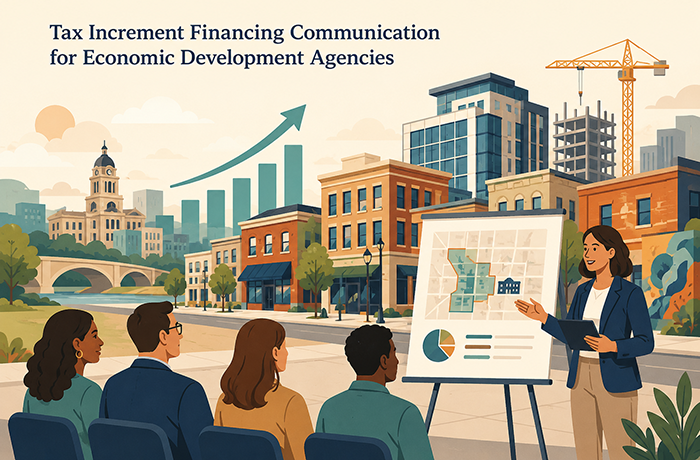
Tax Increment Financing Communication for Economic Development Agencies: How to Explain TIF Clearly to Businesses, Residents, and Elected Officials
Few tools in the economic development toolkit generate as much simultaneous enthusiasm and suspicion as tax increment financing. To the development community, TIF is a practical mechanism for making difficult projects financially feasible, unlocking investment in areas that private capital alone would not reach. To many residents, TIF is a mysterious arrangement in which tax dollars seem to disappear into private developments through a process almost nobody outside of city hall can explain. To elected officials, TIF is frequently a vote they must cast and later defend without fully commanding the technical details themselves. The same tool, viewed from three different vantage points, produces three fundamentally different stories, and the space between those stories is where public controversy over TIF is born.
What makes this situation remarkable is that the underlying mechanics of tax increment financing, while technical, are not inherently incomprehensible. The concept can be explained accurately in a few plain sentences. A district is designated. The property tax revenue generated within it at the time of designation continues flowing to the usual taxing bodies. As new development raises property values within the district, the additional tax revenue above the original baseline, the increment, is captured for a defined period and used to pay for improvements or to reimburse eligible project costs within that district. When the district expires, the full expanded tax base returns to the regular taxing bodies. That is the essential structure. Yet in city after city, the public conversation about TIF proceeds as though the tool were unexplainable, with agencies defaulting to statutory language, consultants speaking in financing jargon, and residents left to fill the vacuum with assumptions that are often far more alarming than the reality.
The gap between how TIF actually works and how it is publicly understood is not primarily a policy problem. It is a communication problem, and it is one that economic development agencies have the ability to solve. An agency that can explain TIF clearly, honestly, and consistently to businesses, residents, and elected officials is not just improving public relations. It is protecting the viability of the tool itself, because a financing mechanism that the public does not understand is a financing mechanism that is perpetually one contentious project away from a political backlash that can constrain or eliminate its use entirely.
This article examines how economic development agencies can build a communication approach to tax increment financing that serves all three of its essential audiences, addressing the plain-language explanation of the mechanism itself, the honest treatment of who benefits and what public resources are involved, the specific communication needs of each audience, and the accountability communication that determines whether TIF is experienced by the public as a transparent tool or a backroom deal.
Why TIF Is So Persistently Misunderstood
 Understanding why TIF communication fails so consistently requires looking honestly at the sources of confusion, because each source calls for a different communication response. The first and most fundamental source of confusion is the counterintuitive nature of the increment itself. Most residents understand property taxes as money that flows to schools, libraries, parks, and city services. When they hear that tax revenue from a TIF district is being directed to a development project, the natural interpretation is that money is being taken away from schools and services. The critical nuance, that the baseline revenue continues flowing to those taxing bodies and only the growth above the baseline is captured, and that this growth arguably would not have occurred without the intervention, is precisely the kind of nuance that gets lost when the explanation relies on technical terms rather than plain narrative.
The second source of confusion is the counterfactual problem, which is genuinely difficult even for sophisticated audiences. The entire premise of TIF rests on the assertion that the new development, and therefore the new tax revenue, would not have happened without the TIF assistance. This is known in the field as the but-for test. The difficulty is that the counterfactual can never be directly observed. No one can prove with certainty what would have happened in the absence of the incentive, which means TIF communication inevitably involves asking the public to accept a judgment call made by the agency and its analysts. Agencies that pretend this judgment is a mathematical certainty undermine their own credibility. Agencies that explain honestly how the but-for determination was made, what evidence supported it, and what independent review it received are communicating in a way that can actually sustain trust.
The third source of confusion is the sheer variety of TIF structures in practice. TIF in one state may operate under very different rules than in another, covering different eligible costs, different district durations, different requirements for blight findings or public benefit commitments, and different relationships to school funding. Residents who read national commentary about TIF abuses in one jurisdiction naturally apply those concerns to their own city, even when the local statutory framework prevents the specific practices they read about. Local TIF communication has to do the work of explaining not only how TIF works generally but how it works here, under this state’s rules, with this city’s specific policies and guardrails.
The fourth source of confusion is the timeline mismatch between when TIF commitments are made and when their results become visible. A TIF district may run for two decades. The public debate happens at the beginning, when the costs are concrete and the benefits are projections. The benefits, if they materialize, arrive gradually and are rarely communicated back to the public with the same intensity that surrounded the original approval. This asymmetry means that the public record on any given TIF district is often dominated by the controversy of its creation, with little visible follow-through demonstrating what actually happened, which feeds the general impression that TIF promises are made loudly and kept quietly, if at all.
The Vocabulary Problem in TIF Communication
TIF communication is burdened by a vocabulary that actively obstructs public understanding. Terms like increment, base assessed value, but-for determination, pay-as-you-go reimbursement, developer notes, and redevelopment project area costs are all precise and necessary in legal documents, but they are barriers in public communication. Even the phrase tax increment financing itself communicates almost nothing to a general audience, and its common abbreviation, TIF, is so opaque that public meetings about TIF districts routinely begin with a substantial portion of attendees not knowing what the letters stand for.
Agencies should develop and consistently use a plain-language vocabulary for public TIF communication, translating each technical concept into everyday terms. The increment becomes the new tax dollars created by the project’s growth in value. The base becomes the taxes the schools and city were already collecting before the project, which they keep receiving. Pay-as-you-go reimbursement becomes the developer pays for improvements up front and is repaid only from the new taxes the project itself generates, only if the project performs. These translations are not dumbing down the material. They are doing the work that communication is supposed to do, which is transferring accurate understanding from the people who have it to the people who need it.
Growing Places: Communication Strategies for Economic Development and Public Finance Agencies
This article is part of our series on strategic communication for Economic Development organizations, including state and local economic development agencies, regional partnerships, and business attraction initiatives. To learn more and to see the parent article, which links to other content just like this, click the button below.
Explaining the Mechanism in Plain Language
Every economic development agency that uses TIF should maintain a standard plain-language explanation of the mechanism, refined and tested until it can be understood by a resident encountering the concept for the first time, and then used consistently across every public communication about every TIF project. The discipline of a single, consistent core explanation matters because inconsistent explanations, where each project description explains TIF slightly differently, force residents to relearn the concept with each project and create the impression that the mechanism itself is shifting from deal to deal.
A strong core explanation proceeds through a logical narrative sequence rather than a definitional one. It begins with the problem the tool exists to solve: some areas or projects will not attract private investment on their own because the costs of development, including infrastructure, environmental cleanup, demolition, or site preparation, exceed what the market will support. It then introduces the mechanism as a response to that problem: instead of the city writing a check from existing tax dollars, the city allows the future growth in property taxes created by the project itself to pay for those extra costs over time. It then addresses the question every resident is silently asking: the taxes that schools, libraries, and city services were already receiving from the area continue to flow to them throughout, and when the arrangement ends, they receive the full taxes from the now more valuable property. And it closes with the honest qualifier: this only works as intended if the growth actually happens, which is why the city evaluates each proposal carefully and, in well-structured deals, puts the risk of underperformance on the developer rather than the public.
Visual explanation deserves particular investment in TIF communication because the mechanism is fundamentally about flows of money over time, which is exactly the kind of content that a well-designed diagram communicates more effectively than paragraphs of text. A simple graphic showing the property tax base as a steady stream continuing to the schools and city, with the growth above it temporarily directed to project costs before rejoining the main stream at the district’s expiration, can convey in seconds what many written explanations fail to convey at all. Agencies should develop a standard TIF explainer graphic, use it consistently across projects, and make it available to journalists, elected officials, and community organizations who are trying to explain the tool to their own audiences.
Communicating Who Benefits and What the Public Is Contributing
 The most politically sensitive dimension of TIF communication is the question of who benefits, and agencies that handle this question evasively do lasting damage to public trust in the tool. The honest answer is that TIF deals produce benefits for multiple parties simultaneously, and a credible communication approach names all of them explicitly rather than emphasizing only the public benefits while treating the private benefits as an awkward detail.
The developer benefits, and the communication should say so plainly. A TIF arrangement improves the financial feasibility of the developer’s project, which is the entire point of the intervention. Attempting to obscure this reality, or describing the arrangement exclusively in terms of community benefit, invites the accurate criticism that the agency is hiding the ball. A communication that says this project works financially for the developer because of this assistance, and here is why the city concluded that making the project work was worth it, is more credible than one that never acknowledges the private benefit at all.
The public benefit case should then be made with specificity rather than generality. Vague claims about economic vitality and revitalization are the weakest form of public benefit communication because they cannot be evaluated or verified. Specific commitments can be: the number of housing units and the share that will be affordable, the infrastructure that will be built and who will use it, the environmental remediation that will occur, the projected jobs with honest framing about the difference between construction jobs and permanent jobs, and the projected growth in the tax base that will eventually flow to schools and city services. Each specific claim should be paired with the mechanism that makes it enforceable, whether a development agreement, a clawback provision, or a performance requirement, because a benefit that is promised but not contractually secured deserves to be described differently than one that is.
The public contribution should be described with equal honesty, including its true nature and its limits. In most TIF structures, the public is not writing a check from existing funds, and communication should make that clear because many residents assume otherwise. But the public is making a real contribution: it is forgoing, for the duration of the district, growth revenue that the taxing bodies would receive if the development happened anyway without assistance. Whether that forgone revenue is real or hypothetical depends entirely on the but-for judgment, which is why honest communication about how that judgment was reached is inseparable from honest communication about what the public is contributing.
Addressing the School Funding Question Directly
In many communities, the single most charged question about any TIF proposal is its effect on school funding, and agencies that fail to address this question proactively will find it dominating public meetings whether they planned for it or not. The honest answer varies by state, because state school funding formulas interact with TIF in different ways, and in some states the school district’s revenue is substantially insulated from TIF capture through state aid adjustments, while in others the impact is more direct. Whatever the local answer is, the agency should research it thoroughly, explain it clearly, and include it in the standard public communication about every TIF proposal rather than waiting for the question to be raised in a hostile framing.
Where school districts have a formal role in TIF approval or review, communication should describe that role explicitly, because the fact that the school district itself reviewed and responded to the proposal is meaningful information for residents evaluating whether schools are being harmed. Where the school district has expressed concerns or negotiated specific protections, describing those honestly signals that the process includes genuine checks rather than presenting a facade of consensus.
Audience-Specific Communication Strategies
While the core explanation of TIF should be consistent across audiences, the emphasis, format, and depth of communication should be calibrated to the distinct needs of businesses, residents, and elected officials, because each group engages with TIF from a different position and with different stakes.
Businesses and developers engaging with TIF as potential applicants need practical, process-oriented communication: what kinds of projects and costs are eligible under the local program, what the application and review process involves, what analysis the agency will perform, what commitments will be expected in return, what the realistic timeline looks like, and what the agency’s policy priorities are. This audience is generally comfortable with technical financing language, but they are poorly served by vagueness about process and criteria. An agency that publishes clear program guidelines, eligibility criteria, and process descriptions reduces wasted effort on both sides, discouraging applications that were never going to fit while giving viable projects a clear path.
Residents need narrative, honest, and accessible communication that respects both their intelligence and their skepticism. Resident-facing TIF communication should lead with what the project is and what it will mean for the neighborhood in concrete terms, then explain the financing in the plain-language framework described above, then address the questions residents predictably have: what happens to school funding, what happens if the project fails, what the developer is required to deliver, and how the public will know whether the promises were kept. Resident communication should be available before decisions are finalized, at a point when public input can still matter, because communication that arrives only after a deal is effectively done is experienced as announcement rather than engagement, regardless of how clear it is.
Elected officials occupy a distinctive position because they must both understand the deal and publicly explain and defend it. Agencies should treat elected official communication as preparation, not just briefing: providing plain-language deal summaries they can absorb quickly, anticipated questions with suggested honest answers, the specific facts and figures they will need when constituents or journalists press them, and clear identification of the deal’s genuine trade-offs so officials are not blindsided by criticisms the agency saw coming but did not share. An elected official who is asked a basic question about a TIF deal at a public meeting and cannot answer it becomes, in that moment, evidence for the proposition that nobody understands these deals, which damages the tool’s credibility far beyond the individual project.
Accountability Communication Across the Life of the District
TIF communication cannot end at approval, because the credibility of the tool depends on the public being able to see, over time, whether the projections that justified the deal actually materialized. This is the dimension of TIF communication that agencies most consistently neglect, and its neglect is a primary reason for public skepticism about TIF compounds over time. Every controversy is remembered; every quiet success is invisible.
Agencies should commit to regular, public, plain-language reporting on active TIF districts, covering the increment actually generated compared to projections, the public improvements completed, the private investment realized, the performance commitments met or missed, and the expected timeline to district expiration. This reporting should be honest about underperformance where it exists, because a track record that includes candidly acknowledged disappointments is far more credible than one that reports only successes. Paradoxically, the willingness to report bad news is what makes the good news believable.
District expiration deserves specific communication attention because it is the moment when the public benefit of a successful TIF district becomes fully tangible, and it routinely passes without any public notice at all. When a district expires and the full expanded tax base begins flowing to schools, the city, and other taxing bodies, that is a concrete, quantifiable public benefit that the agency should communicate: this district was created twenty years ago, the area’s taxable value grew from this amount to this amount, and as of this year, the full taxes on that expanded value, a specific annual figure, now flow to the community’s taxing bodies permanently. Systematically communicating these completions builds, over time, exactly the public evidence base that makes future TIF proposals easier to evaluate on their merits rather than on accumulated suspicion.
Strategic Communication Support for Economic Development Agencies
 Economic development agencies that use tax increment financing are operating one of the most scrutinized tools in local government, and the scrutiny is not going away. Journalism about TIF has become more sophisticated and more critical, community organizations have become more attentive to incentive deals, and elected officials face constituencies that are increasingly skeptical of arrangements they perceive as subsidies to developers. In this environment, an agency’s communication capability is not a soft complement to its financing expertise. It is a core determinant of whether the tool remains politically usable at all.
The communication challenges described throughout this article, the plain-language explanation of a counterintuitive mechanism, the honest treatment of benefits and contributions, the audience-specific calibration for businesses, residents, and elected officials, and the sustained accountability reporting across a district’s multi-decade life, are challenges that most agencies have not been staffed or structured to address systematically. TIF communication in many agencies is produced ad hoc, project by project, by staff whose primary expertise is deal structuring rather than public communication, and the results reflect that structural gap.
Stegmeier Consulting Group (SCG) helps economic development agencies build TIF communication systems that serve businesses, residents, and elected officials with clarity, honesty, and consistency. That support may include development of standard plain-language TIF explanations and visual explainers, project-specific communication planning for proposals likely to draw public attention, elected official briefing materials and preparation frameworks, resident-facing communication design for public meetings and district proposals, accountability reporting frameworks for active districts, and communication audits that assess how the agency’s current TIF materials perform against the standard of genuine public understanding.
The goal of this work is a TIF program whose public communication is an asset rather than a liability: a program the community can understand, evaluate, and hold accountable, which is ultimately the only kind of program that can sustain political support across the decades-long timelines these districts require.
Future Trends in TIF Communication
The environment surrounding TIF communication is evolving in ways that will raise the standard agencies must meet in the years ahead, and agencies that anticipate these shifts will be better positioned than those that continue communicating as they have in the past.
Transparency expectations are rising through both formal and informal channels. A growing number of states have expanded statutory reporting requirements for TIF districts, and national organizations have increased the visibility of incentive transparency as a governance issue. Beyond formal requirements, the informal expectation among journalists, researchers, and civic organizations is increasingly that incentive data should be publicly accessible in usable formats, not buried in annual reports. Agencies that proactively publish district-level data in accessible dashboards will increasingly be distinguished from those that meet only the statutory minimum.
Data visualization and interactive tools are becoming a standard part of how sophisticated agencies communicate about TIF. Interactive maps that show district boundaries, investment to date, increment generated, and commitments met allow residents and journalists to explore the information directly rather than relying entirely on agency-produced summaries. These tools require investment and, critically, require the underlying data discipline to keep them current, but they represent the emerging standard for public finance transparency communication.
Independent evaluation is becoming a more common feature of the TIF landscape, with academic researchers, state auditors, and civic organizations producing analyses of TIF performance that agencies do not control. Agencies whose own communication has been honest and specific are positioned to engage constructively with independent evaluation, while agencies whose communication has been promotional and vague will find independent analysis landing as exposure rather than confirmation. The strategic implication is that the agency’s own accountability communication should be rigorous enough to withstand comparison with independent scrutiny, because that comparison is coming whether the agency prepares for it or not.
Community benefit agreements and equity-focused deal structures are becoming more central to the public conversation about development incentives, and TIF communication will increasingly need to address not only whether a project generates growth but who shares in that growth. Agencies should expect resident audiences to ask more sophisticated questions about affordable housing commitments, local hiring, displacement risk, and neighborhood-level benefit, and should build their communication frameworks to address these dimensions substantively rather than treating them as peripheral concerns.
Conclusion
Tax increment financing occupies a paradoxical position in economic development practice: it is simultaneously one of the most widely used tools in the field and one of the least publicly understood. That paradox is not sustainable indefinitely. In community after community, the accumulated deficit of public understanding eventually converts into political resistance, and tools that cannot be explained eventually become tools that cannot be used.
The path out of this paradox runs through communication discipline: a consistent plain-language explanation of the mechanism, honest acknowledgment of who benefits and what the public contributes, communication calibrated to the distinct needs of businesses, residents, and elected officials, and accountability reporting that follows districts through their full life rather than falling silent after approval. None of this requires agencies to oversell the tool or to concede to its critics. It requires them to trust that an accurately informed public is a better long-term foundation for an incentive program than a confused one, and to invest in the communication work that accurate public understanding requires.
Agencies that make that investment are not just improving the reception of individual projects. They are preserving the long-term viability of a financing tool their communities may genuinely need, by ensuring that the public conversation about it is grounded in how it actually works rather than in the vacuum that poor communication leaves behind.
SCG’s Strategic Approach to Communication Systems
Align your agency’s messaging, processes, and public engagement strategies.
Economic development agencies need TIF communication systems that make a technically complex and politically sensitive tool genuinely understandable to every audience with a stake in it. That means a consistent plain-language core explanation supported by clear visual explainers, honest communication about private benefit and public contribution, audience-calibrated materials for businesses, residents, and elected officials, proactive treatment of predictable concerns including school funding, and sustained accountability reporting that follows every district from designation through expiration.
SCG helps economic development agencies build TIF communication that earns public trust rather than eroding it. Whether your agency needs standard TIF explanation and explainer development, project-specific communication planning, elected official briefing frameworks, resident engagement materials, or district accountability reporting design, SCG can help you build a communication system that keeps this essential tool politically viable and publicly understood.
Use the form below to connect with our team and explore how strategic TIF communication can help your agency explain complex financing clearly, sustain public trust, and protect the long-term usability of one of your most important development tools.