
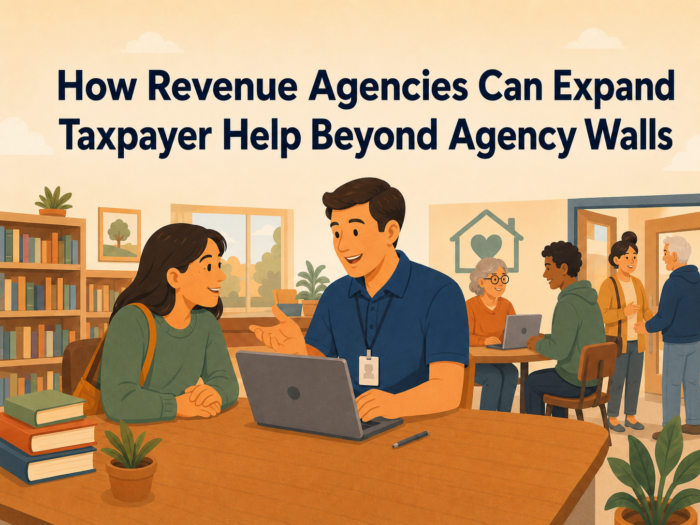
VITA, Libraries, and Community Partners: How Revenue Agencies Can Expand Taxpayer Help Beyond Agency Walls
There is a version of tax administration that happens entirely within the walls of a revenue agency, conducted through official notices, agency-staffed call centers, and the agency’s own website. And there is another version that happens in church basements, library meeting rooms, community center offices, and folding tables set up in the lobby of a nonprofit organization, where a volunteer trained through a federal or state program sits across from a neighbor and helps them complete a tax return they could not have completed alone. Both versions of tax administration are real, both serve the same underlying system, and the second version reaches people the first version often cannot.
Volunteer Income Tax Assistance sites, commonly known as VITA sites, along with public libraries, community action agencies, faith-based organizations, and a wide range of nonprofit service providers, form an informal but essential network that extends accurate tax filing and credit information into neighborhoods and populations that standard agency communication frequently does not reach effectively. These community-based partners interact with taxpayers who may distrust government agencies, who may have limited digital access, who may have limited English proficiency, or who may simply find the prospect of engaging directly with a revenue agency intimidating in a way that engaging with a trusted local organization is not.
For state and local revenue and tax administration agencies, the strategic question is not whether these community partners matter. Decades of program experience and outcome data confirm that they do, particularly for reaching low-income filers, claiming refundable credits, and providing free, accurate alternatives to costly commercial tax preparation. The strategic question is whether the agency is doing everything it reasonably can to support, equip, and coordinate with these partners so that the information and assistance flowing through the community-based network is as accurate, current, and effective as the agency’s own direct communication. In many jurisdictions, the answer is that there is significant room for improvement.
This article examines how revenue and tax administration agencies can build stronger, more deliberate relationships with VITA sites, libraries, and other community partners, equipping them with accurate guidance, current materials, training support, and clear escalation paths that allow the community-based network to function as a genuine extension of the agency’s own service capacity rather than an informally tolerated parallel system that the agency engages with only minimally.
Understanding the Value and the Limits of the Community Partner Network
 The value that VITA sites, libraries, and other community partners provide to the tax administration system is significant and well-documented. VITA programs, which provide free tax preparation assistance to low and moderate income taxpayers, taxpayers with disabilities, and limited English proficient taxpayers through IRS-trained and certified volunteers, have been shown to increase the accuracy of returns filed by the populations they serve, increase the successful claiming of refundable credits among eligible filers, and provide a trusted, no-cost alternative to commercial preparers whose fees can consume a meaningful portion of a low-income taxpayer’s refund.
Public libraries occupy a particularly important role in this network because they are present in nearly every community, including many rural and underserved areas that lack other community service infrastructure, and because libraries are widely trusted, politically neutral institutions that serve the full range of community members regardless of immigration status, income level, or other characteristics that might make some populations hesitant to engage with other institutions. Many libraries host VITA sites directly, provide computer and internet access for taxpayers completing free online filing, distribute tax forms and informational materials, and in some cases have staff trained to provide basic navigational assistance, though not tax preparation advice, to patrons seeking tax help.
Faith-based organizations, community action agencies, immigrant resettlement organizations, and other nonprofit service providers extend the reach of the community partner network into populations with specific needs that a generic VITA site or library may not fully address. An immigrant resettlement organization may serve a population with particular language needs and particular unfamiliarity with the American tax system. A community action agency that already provides other anti-poverty services may have an existing trusted relationship with low-income families that makes its tax assistance referrals more credible than an unfamiliar government communication would be.
The limits of this network are equally important to understand. Community partners, particularly volunteer-staffed VITA sites, have limited capacity, both in terms of the number of returns they can prepare during the relatively short filing season and in terms of the complexity of tax situations their volunteers are trained and certified to handle. A revenue agency that views the community partner network as capable of absorbing unlimited taxpayer demand, or capable of handling the full range of tax complexity that the agency itself manages, will be disappointed and will likely place demands on the network that exceed what it can reasonably deliver. Effective agency engagement with the community partner network requires an honest understanding of what these partners can and cannot do, and a strategy that supports them within those realistic limits rather than treating them as an unlimited substitute for agency-direct service.
Why State and Local Tax Guidance Often Falls Through the Cracks at Community Sites
VITA programs and volunteer training are organized primarily around federal tax law, reflecting the program’s origin and primary funding through the Internal Revenue Service. Volunteers receive certification training and testing that covers federal filing requirements, federal credits, and federal tax software. State and local tax obligations, including state income tax filing requirements, state-specific credits, and any local tax obligations that may apply, are often addressed only minimally in the standard federal training curriculum, if they are addressed at all.
This creates a structural gap where a VITA volunteer may be well prepared to help a taxpayer accurately complete their federal return but may be uncertain about how to handle the corresponding state return, may not be aware of state-specific credits the taxpayer could claim, or may not know about state-specific filing requirements that differ from federal requirements. A taxpayer who receives excellent federal tax assistance at a VITA site but incomplete or inaccurate state tax assistance because the volunteer was not adequately trained on state requirements has not received the full benefit that the VITA program is capable of providing.
State and local revenue agencies have a direct interest in closing this gap, because the accuracy of state tax filings produced through the VITA network affects the agency’s own compliance and revenue outcomes, not only the taxpayer’s experience. An agency that invests in supplemental training, state-specific reference materials, and direct technical support for VITA volunteers is making an investment that pays off in more accurate state filings, fewer state tax errors originating from the VITA network, and stronger claiming of state-specific refundable credits among the low-income population that VITA primarily serves.
Clearer Taxpayer Communication: Strategies for State and Local Assessors, Treasurers, Revenue Departments, and Finance Offices
This article is part of our series on strategic communication for State and Local Assessors, Treasurers, Revenue Departments, and Finance Offices. Clear, timely, and accessible taxpayer communication helps government agencies improve compliance, reduce confusion, strengthen public trust, and enhance the citizen experience. To learn more and to see the parent article, which links to additional resources and best practices for taxpayer outreach and engagement, click the button below.
Building State-Specific Training Resources for Community Partners
Closing the state and local tax knowledge gap within the community partner network requires revenue agencies to develop training resources specifically designed for VITA volunteers, library staff, and other community partner personnel, recognizing that these individuals typically have less time, less ongoing engagement with tax law, and less institutional support than agency staff or professional tax preparers. Training resources designed for this audience need to be more concise, more focused on the most common and most consequential issues, and more accessible in format than training materials designed for agency staff or tax professionals.
An effective state-specific VITA training module should cover the state filing requirement basics, including who is required to file a state return and the relationship between federal and state filing obligations, the most commonly claimed state credits and deductions, particularly any state-level refundable credits that mirror or supplement federal credits, common state-specific situations that differ from federal treatment, such as state taxation of specific income types or state-specific deduction rules, and clear guidance about where to direct a taxpayer or where the volunteer can seek help when a state tax question exceeds what the training module covers.
This training should be delivered in a format that fits within the existing VITA volunteer training and certification timeline rather than requiring a separate, lengthy commitment that volunteers, who are typically donating their time, may not be able to accommodate. A focused one to two hour state tax supplement, delivered online or in a brief in-person session as part of the existing VITA training calendar, is more likely to be completed and retained than a lengthy standalone state tax course that competes for the volunteer’s limited training time.
Agencies should also provide quick-reference materials that VITA volunteers can use during an actual tax preparation session, not only training materials they review once before the filing season begins. A one or two page state tax quick reference guide, covering the most common state-specific questions and providing clear, simple answers, allows a volunteer who encounters a state tax question mid-session to find an answer quickly without having to interrupt the session to research the issue independently or to guess at an answer that may be incorrect.
Direct Technical Support Channels for VITA Sites During Filing Season
Beyond training materials, revenue agencies should consider establishing a direct technical support channel specifically for VITA volunteers and site coordinators, separate from the general taxpayer call center, that can provide faster and more specialized assistance for state tax questions arising during an active filing session. A general taxpayer call center, designed to serve individual taxpayers calling about their own specific situation, may not be optimized to quickly answer the kind of technical, procedural question a VITA volunteer needs answered in the middle of preparing a return for someone else.
A dedicated practitioner or volunteer support line, even if staffed only during peak filing season and only during the hours when VITA sites are typically operating, can provide significantly faster and more useful support than directing volunteers to the same general call center queue that individual taxpayers use. Some agencies have implemented this kind of dedicated support channel specifically for tax professionals, and extending a similar resource to VITA site coordinators and certified volunteers recognizes that these volunteers are, in effect, performing a service function on behalf of the agency’s own compliance and access goals.
Equipping Libraries as Information and Referral Hubs
Libraries occupy a unique position in the community partner network because library staff are not typically trained or certified to provide tax preparation assistance themselves, but they interact daily with community members who have tax-related questions, who need access to forms or computers, or who are looking for a trustworthy referral to free filing assistance. Equipping library staff to serve effectively as an information and referral hub, even without becoming tax experts themselves, is a distinct and valuable communication investment that revenue agencies should pursue.
Library staff need clear, simple guidance about what kinds of basic information they can confidently provide, such as where to find tax forms, how to access free filing software, and where the nearest VITA site or other free tax assistance resource is located, as distinct from substantive tax advice that they should not attempt to provide and should instead refer to a qualified resource. A brief reference card or training session that clarifies this distinction helps library staff feel confident assisting patrons with the navigational and referral questions they are well positioned to answer, without putting them in the position of providing tax advice they are not trained or authorized to give.
Revenue agencies should ensure that libraries have access to current tax forms, both paper copies for patrons who prefer or need physical documents and digital access information for patrons using library computers to file online, and that library staff know how to direct patrons to the agency’s website resources for forms and instructions that the library may not stock physically. Coordinating with library systems to ensure that forms inventory is replenished promptly as filing season approaches, and that any mid-season form changes are communicated to libraries quickly, prevents the frustrating situation where a patron seeks a form at their library and finds an outdated version or no supply at all.
Many libraries host VITA sites directly or partner with local VITA coalitions to provide space for tax preparation assistance. Agencies should actively support this kind of co-location, recognizing that a library that already serves as a trusted, accessible community location becomes an even more effective access point when it also hosts the direct tax preparation assistance that VITA provides. Agency outreach about free filing assistance should specifically highlight library-based VITA sites where they exist, since the library’s existing reputation and foot traffic can drive additional usage to a VITA site located within it.
Nonprofit and Faith-Based Partner Engagement
 Nonprofit service organizations and faith-based institutions that serve specific populations, including immigrant communities, low-income families, seniors, and people with disabilities, represent a critical layer of the community partner network because they have established trust and ongoing relationships with populations that may be among the hardest for a revenue agency to reach through standard outreach, including non-filers, limited English proficient taxpayers, and individuals who have specific reasons to be wary of engaging directly with a government agency.
Engaging these organizations as tax outreach partners requires recognizing that tax assistance is not their primary mission, and that asking them to take on a substantial new function requires providing materials and support that fit easily into their existing operations rather than asking them to build an entirely new program from scratch. A nonprofit organization that already provides food assistance, housing counseling, or other social services can incorporate tax credit awareness and VITA referral information into its existing client intake or case management process with relatively modest additional effort, provided the agency supplies clear, accurate, ready-to-use materials and a simple referral pathway.
Faith-based organizations, particularly those serving immigrant or limited English proficient congregations, can be especially effective partners for reaching populations that may be difficult for the agency to reach through any other channel. A church, mosque, temple, or other religious institution that distributes simple tax credit awareness flyers, mentions free tax assistance resources during a community announcement, or hosts a VITA site or information table during filing season extends the agency’s reach into a trusted community space that government communication alone cannot replicate.
Agencies should approach nonprofit and faith-based partner engagement as a relationship to be built and maintained over time, not a one-time outreach campaign. Organizations that have a positive, low-burden experience providing tax outreach support one filing season are more likely to continue and even expand that engagement in subsequent years, while organizations that are asked to take on more than they can reasonably manage, or that receive inconsistent or unclear support from the agency, are less likely to continue the partnership.
Coordinating Across Multiple Partner Types Without Creating Confusion
In a typical metropolitan area, a revenue agency may be coordinating with dozens of VITA sites, multiple library systems, and a wide range of nonprofit and faith-based partners simultaneously, each with different capacities, different populations served, and different levels of engagement with the agency. Without deliberate coordination, this can result in inconsistent messaging across partners, duplicated outreach efforts in some areas while other areas remain underserved, and confusion among taxpayers about which resource is appropriate for their specific situation.
Establishing a centralized coordination function within the agency, whether a dedicated community partnership coordinator role or a broader team responsibility, that maintains a current directory of all active community partners, distributes consistent and current materials across the full partner network, and tracks which geographic areas and populations are well served versus underserved by the existing partner footprint, allows the agency to manage this complexity strategically rather than reactively. This coordination function can also identify gaps where the agency should actively recruit new partners to serve populations or geographic areas that the current network does not adequately reach.
Materials and Toolkits for Community Partners
The quality and usefulness of the materials a revenue agency provides to its community partner network directly determines how effectively those partners can extend accurate information into the communities they serve. Generic materials designed primarily for the agency’s own direct communication, simply handed to community partners without adaptation, are often less effective than materials specifically designed for the community partner context, where the person sharing the information may not be a tax expert and the person receiving it may be encountering the topic for the first time in an informal setting.
A well-designed community partner toolkit should include a range of material formats suited to different distribution contexts: a brief, highly visual flyer suitable for posting or quick handout distribution, a slightly more detailed one-page guide suitable for a community organization staff member to reference when answering a basic question, talking points that a volunteer or staff member can use verbally when discussing tax assistance with a community member, and clear referral information identifying the nearest VITA sites, the agency’s free filing resources, and any other relevant assistance programs.
Materials should be updated on a predictable schedule aligned with the tax filing calendar, with the most current versions clearly dated and easily distinguishable from prior years’ materials. Community partners should have a simple, reliable way to access the current version, whether through a dedicated partner portal, a regular email distribution, or another consistent channel, so that the materials circulating through the community network do not become outdated as the filing season progresses or as policy changes occur.
Where the partner network serves linguistically diverse communities, the toolkit materials should be available in the languages relevant to each partner’s specific population, recognizing that a one-size-fits-all English-language toolkit will not serve a faith-based organization whose congregation primarily speaks a language other than English, or a nonprofit organization whose clients are predominantly limited English proficient. Coordinating the partner toolkit development with the agency’s broader multilingual communication strategy ensures consistency and avoids duplicating translation effort.
Funding and Capacity Support for Community Partners
Many VITA sites and community partner organizations operate with limited funding and rely heavily on volunteer labor, which means their capacity to serve taxpayers is constrained not only by training and information gaps but by basic resource limitations, including the number of volunteers they can recruit and retain, the hours they can operate, and the technology infrastructure they can provide for tax preparation. Revenue agencies that want to strengthen the community partner network’s capacity should consider how they can contribute resources beyond training and materials.
Some state revenue agencies provide direct grant funding to VITA coalitions and community partner organizations to support program operations, including funding for computer equipment, printing costs for materials, and in some cases stipends or recognition programs that help with volunteer recruitment and retention. Where state law and budget allow for this kind of direct support, it represents one of the most concrete ways an agency can strengthen the community partner network’s actual capacity to serve taxpayers, not only its access to accurate information.
Even where direct funding is not feasible, agencies can provide in-kind support that reduces the operational burden on community partners, including providing printed forms and informational materials at no cost rather than requiring partners to print their own, providing access to agency staff for site visits or volunteer training sessions, and recognizing community partner contributions publicly in ways that help those organizations demonstrate their community value to their own funders and supporters.
Strategic Communication Support for Revenue and Tax Administration Agencies
 The community partner network represents one of the most cost-effective extensions of a revenue agency’s service capacity available, reaching populations and providing a level of trusted, in-person assistance that the agency’s own direct channels often cannot replicate. But realizing the full potential of this network requires a deliberate, sustained communication and support strategy, not an informal relationship that the agency engages with minimally and inconsistently from year to year.
A structured assessment of an agency’s community partner engagement typically identifies a consistent set of gaps: state-specific training materials for VITA volunteers that are minimal, outdated, or nonexistent, no dedicated support channel for community partners during the high-pressure filing season, inconsistent or outdated materials circulating across different partners, library systems that are not equipped with current information or clear referral guidance, and limited or no coordination function within the agency to manage the full partner network strategically rather than reactively.
Stegmeier Consulting Group (SCG) helps revenue and tax administration agencies build stronger, more strategic community partner networks that extend accurate, current tax information and assistance into the neighborhoods and populations that agency-direct communication often cannot reach effectively. That support may include state-specific VITA volunteer training material development, community partner toolkit design, library system engagement strategy, nonprofit and faith-based partner outreach material development, partner coordination framework design, and dedicated support channel planning for the filing season.
The goal of this work is a tax administration ecosystem in which the agency’s own communication and the community partner network work in genuine coordination, sharing consistent, accurate, current information, so that a taxpayer who receives help at a VITA site, a library, or a community organization gets the same quality and accuracy of guidance they would receive from the agency directly, regardless of which door they walked through to get it.
Future Trends in Community-Based Tax Assistance
The community-based tax assistance network is evolving in response to changes in technology, funding priorities, and the broader landscape of tax filing options available to taxpayers. Several trends are shaping the future of this network and the role that revenue agencies will play in supporting it.
Virtual and hybrid VITA service models, which expanded significantly in response to the COVID-19 pandemic and have continued in many communities since, allow VITA volunteers to assist taxpayers remotely through video calls and secure document sharing rather than requiring in-person attendance at a physical site. This model expands the geographic reach of the VITA network, allowing volunteers in one location to serve taxpayers in underserved areas that lack a local VITA site, but it also requires taxpayers to have adequate digital access and comfort, which means it complements rather than replaces in-person service models for taxpayers who lack reliable internet access or digital literacy.
Increased integration between VITA programs and other public benefit access efforts is a growing trend, recognizing that the populations VITA serves often qualify for and could benefit from a range of other public benefits beyond tax credits. Some VITA sites have begun incorporating benefits screening into the tax preparation process, helping taxpayers identify eligibility for programs such as health insurance subsidies, nutrition assistance, or housing support at the same time they are completing their tax return. Revenue agencies that coordinate with other state benefit-administering agencies to support this kind of integrated service model can amplify the impact of the community partner network well beyond tax filing alone.
Greater investment in year-round community partner engagement, rather than activity concentrated only during the filing season, is an emerging best practice that recognizes the value of maintaining relationships with VITA coalitions, libraries, and nonprofit partners throughout the year, not only during the few months when tax filing assistance is most acutely needed. Year-round engagement allows for more thorough training before the next filing season begins, ongoing relationship building that strengthens trust and coordination, and the ability to conduct outreach about tax credits and filing requirements at moments throughout the year when families may be more receptive to that information than during the time-pressured filing season itself.
Conclusion
The community partner network of VITA sites, libraries, faith-based organizations, and nonprofit service providers performs an essential function in the tax administration system, reaching taxpayers and populations that agency-direct communication frequently cannot reach as effectively on its own. This network exists and operates in every state, with or without deliberate agency investment, because the need it serves is real and persistent. The strategic question for revenue and tax administration agencies is not whether to engage with this network, but how thoroughly and how well.
Agencies that invest in state-specific training resources, dedicated support channels, well-designed partner toolkits, and genuine coordination across the full community partner landscape transform an informally tolerated parallel system into a genuine extension of their own service capacity. The taxpayers who are served through this strengthened network receive the same quality and accuracy of guidance that the agency’s own direct channels provide, regardless of whether they encountered that guidance at the agency’s own office or at a folding table in a library meeting room. That consistency, achieved through deliberate investment rather than left to chance, is what allows the community partner network to fulfill its full potential as a force for accuracy, access, and equity in the tax system.
SCG’s Strategic Approach to Communication Systems
Align your agency’s messaging, processes, and public engagement strategies.
Revenue and tax administration agencies need community partner engagement strategies that equip VITA sites, libraries, and nonprofit organizations with accurate, current, and accessible information to extend taxpayer help beyond agency walls. That means state-specific training resources that close the gap volunteers face beyond their federal-focused certification, dedicated support channels during the filing season, well-designed toolkits suited to community distribution contexts, library engagement that equips staff to serve as effective referral hubs, and coordination across the full partner network so that materials and messaging stay consistent and current.
SCG helps revenue and tax administration agencies build stronger, more strategic community partner networks that extend accurate filing and credit information into the neighborhoods and populations that agency-direct communication often cannot reach. Whether your agency needs VITA training material development, community partner toolkit design, library engagement strategy, nonprofit and faith-based outreach materials, or partner coordination framework development, SCG can help you build a network that delivers consistent, accurate guidance no matter which door a taxpayer walks through.
Use the form below to connect with our team and explore how strategic community partner engagement can help your agency extend its reach, improve accuracy across the volunteer and community-based tax assistance network, and serve the populations that need that assistance most.