
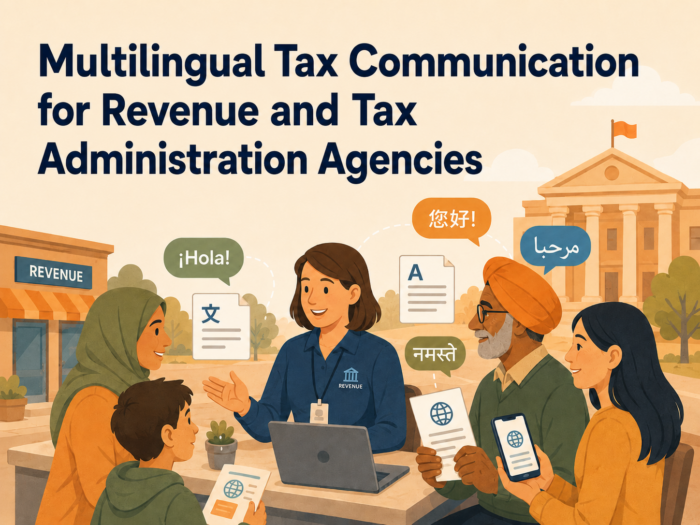
Multilingual Tax Communication for Revenue and Tax Administration Agencies: Reaching Taxpayers in the Languages They Use
A tax notice that is accurate, well-organized, and written in clear plain English still fails completely if the person who receives it cannot read English. This is not a hypothetical edge case in most states. It is the daily reality for millions of taxpayers across the country who speak a language other than English at home, who may have limited English proficiency, or who are more confident managing financial and legal matters in their first language even when their English is functional for everyday conversation. For these taxpayers, the most carefully designed plain-language notice is, in practical terms, no more useful than a notice that was never sent at all.
State and local revenue and tax administration agencies serve increasingly linguistically diverse populations, a reality that reflects broader demographic trends across the country and that varies significantly by jurisdiction but is rarely absent entirely. An agency that has not made a deliberate, sustained investment in multilingual communication is, by default, communicating only with the portion of its taxpayer population that is comfortable navigating government correspondence in English. Every other taxpayer is left to find their own path through the tax system, whether that means relying on a family member to translate, seeking out a paid preparer because the alternative of self-navigating an English-only system feels insurmountable, or simply not engaging with notices, deadlines, and opportunities they cannot understand.
The consequences of this gap are not evenly distributed. They fall hardest on exactly the populations that are already managing other access barriers, including lower income, less familiarity with the American tax and legal system, and in many cases recent immigration status that comes with its own set of anxieties about engaging with government agencies at all. A multilingual communication gap compounds these existing barriers rather than existing independently of them, which means that closing the gap is not simply a matter of fairness in the abstract. It is a matter of ensuring that the agency’s compliance, service, and equity goals are not systematically undermined for a significant portion of the population it is responsible for serving.
This article examines how state and local revenue and tax administration agencies can build multilingual communication systems that genuinely reach taxpayers in the languages they use, across the full range of channels including notices, websites, flyers, videos, and partner materials. It addresses the strategic decisions involved in selecting which languages to prioritize, the translation quality standards that distinguish genuinely useful multilingual communication from technically translated but practically unhelpful content, and the channel and partnership strategies that extend multilingual reach beyond what direct agency translation alone can achieve.
Understanding the Scope of the Multilingual Need
 Before an agency can build an effective multilingual communication strategy, it needs an accurate and current understanding of the languages spoken by the taxpayer population it serves. This sounds like an obvious first step, but many agencies operate with outdated or incomplete data about the linguistic composition of their service area, relying on general census data that may not reflect recent demographic shifts, or making assumptions based on which languages have historically been prioritized rather than which languages are actually most needed by the current population.
Census data, American Community Survey language data, school district enrollment data showing the languages spoken at home by students, and data from other state agencies that track language preference, such as health and human services departments, can all contribute to a more accurate picture of the linguistic landscape an agency serves. This data should be reviewed at the state level for agencies with statewide jurisdiction and at a more granular geographic level for agencies serving specific cities or counties, because the languages most prevalent in one part of a state or city can differ significantly from those most prevalent in another part of the same jurisdiction.
Beyond simply identifying which languages are spoken, agencies need to understand the degree of English proficiency within each language community, because limited English proficiency, not simply the existence of a home language other than English, is the relevant factor in determining who needs multilingual communication to access agency services. A community where most residents are fully bilingual and comfortable with English-language government correspondence has a different multilingual communication need than a community where a significant share of residents have limited English proficiency and rely heavily on their first language for navigating any complex written communication.
Agencies should also recognize that linguistic need is not static. Immigration patterns shift over time, refugee resettlement can introduce new language communities to a jurisdiction relatively quickly, and the language needs of an agency’s taxpayer population in five years may look meaningfully different from its current language needs. Building a periodic review process that reassesses the agency’s language data, ideally aligned with the release of updated census and demographic data, ensures that the multilingual communication strategy remains responsive to the population it is actually serving rather than reflecting a snapshot of need from years in the past.
Prioritizing Languages When Resources Are Limited
Few revenue agencies have the resources to translate every piece of communication into every language spoken within their jurisdiction. Realistic multilingual strategy requires prioritization, and that prioritization should be based on a combination of the number of taxpayers likely to need the language, the degree of limited English proficiency within that language community, and the specific tax administration touchpoints where language access has the highest impact on outcomes.
A reasonable approach to prioritization identifies the top three to seven languages, depending on the agency’s size and the diversity of its jurisdiction, that account for the largest share of limited English proficient taxpayers, and commits to full translation of core materials in those languages as a baseline standard. Beyond that core set, agencies can develop a tiered approach where additional languages receive translation of the most essential materials, such as a basic taxpayer rights notice or instructions for accessing language assistance, even if full translation of every document is not feasible for smaller language communities.
This prioritization should be revisited periodically rather than fixed permanently, because the relative size of language communities within a jurisdiction can shift meaningfully over a period of years. An agency that established its core language list a decade ago based on the demographic data available at that time may be underserving a language community that has grown significantly since, while continuing to invest heavily in translation for a language community that has become a smaller share of the population than it once was.
Clearer Taxpayer Communication: Strategies for State and Local Assessors, Treasurers, Revenue Departments, and Finance Offices
This article is part of our series on strategic communication for State and Local Assessors, Treasurers, Revenue Departments, and Finance Offices. Clear, timely, and accessible taxpayer communication helps government agencies improve compliance, reduce confusion, strengthen public trust, and enhance the citizen experience. To learn more and to see the parent article, which links to additional resources and best practices for taxpayer outreach and engagement, click the button below.
Translation Quality and the Limits of Literal Translation
The single most important principle in multilingual tax communication is that translation quality matters as much as translation existence. A poorly translated notice, one that uses awkward sentence structures, technical terms that do not have a clear equivalent in the target language, or a translation that was produced by an automated tool without human review, can be almost as unhelpful as no translation at all. In some cases, a poor translation can be actively harmful, conveying inaccurate information that leads a taxpayer to take the wrong action or to misunderstand a deadline or requirement.
Human translation by professional translators who are fluent in both the source and target languages and who have some familiarity with tax administration terminology is the standard that genuinely useful multilingual tax communication requires. Machine translation tools have improved significantly and can serve a useful role in producing a first draft or in providing supplementary, lower-stakes communication, but official notices, instructions that affect a taxpayer’s rights or obligations, and any communication where precision genuinely matters should be reviewed and finalized by a qualified human translator, not published directly from an automated translation output.
Beyond linguistic accuracy, translation quality requires cultural and contextual appropriateness. A literal translation of an English-language tax term may be linguistically correct but may not communicate the intended meaning to a reader from a different cultural or administrative background, particularly when the source language describes tax concepts, government structures, or legal processes that do not have a direct equivalent in the tax or legal system the reader is more familiar with. A translator who understands not only the language but the tax administration context, and who can adapt the explanation to make sense within the reader’s frame of reference rather than simply substituting words, produces communication that is significantly more useful than a literal word-for-word rendering.
Agencies should establish a quality review process for translated materials that includes review by native speakers of the target language, ideally including individuals who are not professional translators but who represent the kind of general-audience reader the communication is intended to reach. A translation that reads correctly to a professional translator may still use vocabulary or phrasing that feels overly formal, archaic, or regionally inappropriate to an actual member of the target language community. Including community members in the review process, whether through formal advisory panels or informal feedback sessions with community partner organizations, helps identify these gaps before materials are finalized and distributed.
Maintaining Translation Currency as English Content Changes
One of the most common failures in multilingual government communication is a translation that was accurate when it was produced but has become outdated as the English-language source material has changed. A notice template that is updated in English to reflect a new filing deadline, a revised penalty structure, or a change in available payment options needs a corresponding update to every translated version, and agencies that do not build this update requirement into their content management process frequently find that their translated materials drift out of sync with current English-language guidance over time.
Establishing a clear ownership and workflow process for translation updates, where any revision to a core English-language document automatically triggers a review and update of the corresponding translated versions, is essential to maintaining the accuracy and trustworthiness of multilingual communication over time. Agencies that treat translation as a one-time project rather than an ongoing maintenance responsibility will inevitably accumulate outdated translated materials that, in the worst cases, actively mislead the taxpayers who rely on them.
Multilingual Notices and Correspondence
 Tax notices carry significant consequences, including deadlines, financial obligations, and in some cases the risk of penalties or enforcement action if a required response is not provided. For limited English proficient taxpayers, receiving a notice only in English means receiving a document they cannot act on without external assistance, which they may not have readily available, particularly under the time pressure that many notices create.
The most effective approach to multilingual notice communication is to identify the taxpayer’s language preference at the point of registration or first contact with the agency, and to use that preference to determine the language in which subsequent notices are sent. This requires the agency’s case management and notice generation systems to support language preference as a taxpayer record attribute and to generate notices in the taxpayer’s preferred language automatically, rather than requiring the taxpayer to request a translated notice after receiving one in English they could not understand.
Where systems are not yet capable of automatically generating notices in a taxpayer’s preferred language, an interim approach that several agencies have adopted is including a prominent, multilingual notice at the top of every English-language notice that identifies, in the agency’s priority languages, a brief statement explaining that the document contains important information about taxes, and providing a phone number or instructions for obtaining the notice in the taxpayer’s preferred language. This kind of multilingual tagline does not replace full translation, but it ensures that a limited English proficient taxpayer who receives an English-only notice at least knows that the document is important and knows how to get help understanding it, rather than potentially discarding it without realizing its significance.
Notices that involve particularly high stakes, including delinquency notices, audit notifications, and notices that initiate a formal legal process such as a lien or levy, deserve the highest priority for full translation given the severity of the consequences if the taxpayer does not understand and respond to them. Agencies that cannot immediately translate their full notice inventory should prioritize this category of high-stakes notices first, even if lower-stakes informational notices remain English-only for a longer transition period.
Multilingual Website and Digital Communication
An agency’s website is often the first and most frequently used resource for taxpayers seeking information, and a website that is not accessible in a taxpayer’s preferred language excludes that taxpayer from a significant share of the agency’s self-service capability. Multilingual website strategy requires more than translating individual pages. It requires thinking through the navigation structure, search functionality, and overall user experience in each supported language, not simply the literal translation of the English-language content.
A common and significant failure in government website multilingual strategy is providing translated versions of only a small subset of pages, typically a homepage or a general overview page, while leaving the substantive content, including forms, detailed instructions, and frequently asked questions, available only in English. A taxpayer who navigates to a Spanish-language homepage and then clicks through to a page that is suddenly only in English has not received meaningful multilingual access. They have received a translated welcome mat leading to an English-only house.
Agencies should prioritize translation of the website content that corresponds to the highest-traffic and highest-value taxpayer tasks, including the most commonly accessed forms and instructions, the most frequently asked questions, and the core navigation pages that allow a taxpayer to find their way to the specific task or information they need. A complete multilingual mirror of the entire English-language website is an aspirational long-term goal for many agencies, but a a well-prioritized partial translation that covers the highest-impact content thoroughly serves taxpayers better than a thin translation spread evenly and shallowly across the entire site.
Video content has become an increasingly valuable multilingual communication tool because it can convey information in a format that is accessible to taxpayers with limited literacy in their own language, not only limited English proficiency. A short video that explains, in a taxpayer’s native language and with an on-screen presenter speaking directly to the camera, how to complete a specific task or what a specific notice means, reaches a broader range of taxpayers than a translated written document alone, including taxpayers who may struggle with reading in any language. Agencies that develop video content for their priority languages, covering the most common taxpayer questions and tasks, are investing in a format that serves accessibility needs beyond language alone.
Multilingual Search Engine Optimization
Taxpayers searching online for tax information in their native language need to be able to find the agency’s translated content through standard search engines, which requires deliberate search engine optimization for non-English content, not simply the existence of translated pages somewhere on the agency’s website. A Spanish-language page that is buried deep within the website’s navigation structure and has no specific search optimization may never appear in search results when a Spanish-speaking taxpayer searches for tax help in Spanish, even though the page technically exists. Agencies should ensure that translated pages have appropriate metadata, page titles, and search-friendly URLs in the target language, and should periodically test how easily their multilingual content can actually be found through searches conducted in the target language.
Print Materials, Flyers, and Community Distribution
Printed flyers and informational materials remain an important communication channel for reaching limited English proficient taxpayers, particularly those who may have lower digital engagement or who are more likely to encounter information through physical distribution at community locations than through online search. These materials should be designed specifically for the target language and culture, not simply translated from an English-language flyer template without consideration of whether the visual design, length, and format are appropriate for the intended audience.
Effective multilingual print materials are typically shorter and more visually oriented than their English counterparts, recognizing that print materials distributed in community settings are often skimmed rather than read in depth, and that visual cues, including simple icons or images that reinforce the key message, can communicate effectively across literacy levels within the target language community. A flyer about a tax credit that uses a simple visual representation of a family and a dollar amount, alongside brief text in the target language, communicates the core message even to a reader with limited literacy in that language, in a way that a dense block of translated text does not.
Distribution strategy for multilingual print materials should follow the same trusted messenger and community partner principles that apply to other outreach efforts. Ethnic grocery stores, places of worship that serve specific language communities, community centers, immigrant resource organizations, and language-specific media outlets are all potential distribution points that can reach the target language community more effectively than distribution through the agency’s own offices, which the target population may have limited reason to visit absent an existing tax matter.
Multilingual Call Center and In-Person Service
Translated written materials are necessary but not sufficient for genuine multilingual access, because many taxpayers, including those who can read translated materials adequately, still need to speak with a human representative to resolve questions specific to their situation, and that conversation needs to happen in a language they are comfortable using for a financial or legal matter. Agencies that provide multilingual written materials but only English-language phone and in-person service have closed only part of the access gap.
Call center language access can be provided through several models, including hiring bilingual staff directly for the agency’s priority languages, contracting with a professional interpretation service that can be connected to a call in real time, or a combination of both approaches where bilingual staff handle the highest-volume languages directly and interpretation services cover lower-volume languages on an as-needed basis. Whatever model an agency uses, the language access option needs to be clearly and prominently communicated to taxpayers, including through a multilingual phone menu that allows callers to select their preferred language early in the call rather than navigating an English-only menu before reaching a language access option.
In-person service locations, including walk-in offices and taxpayer assistance centers, should similarly ensure that language access is available either through bilingual staff or through readily accessible interpretation services such as a dual-handset phone interpretation system. Taxpayers who arrive at an in-person service location without confidence that they will be able to communicate in their preferred language may avoid in-person service altogether, even when it would be the most effective channel for resolving their specific issue, simply because they fear the language barrier will make the visit unproductive or embarrassing.
Signage and Wayfinding for Limited English Proficient Visitors
Multilingual signage within agency offices, indicating where to go for service in specific languages and how to request interpretation assistance, helps limited English proficient visitors navigate the physical space confidently rather than relying entirely on guesswork or the willingness of office staff to notice and respond to a language barrier without being asked. Simple, clearly visible signage in the agency’s priority languages, posted at entrances and at key decision points within the office such as where visitors check in or select a service queue, is a low-cost investment that meaningfully improves the in-person experience for limited English proficient taxpayers.
Partner Toolkits for Multilingual Outreach
Community organizations that serve specific language communities are essential partners in extending an agency’s multilingual reach beyond what the agency can achieve through its own direct channels. These organizations often have deeper trust and more frequent contact with the language communities they serve than a government agency can establish on its own, and equipping them with accurate, current, and appropriately translated materials allows them to become an effective extension of the agency’s multilingual communication strategy.
A partner toolkit for multilingual outreach should include ready-to-distribute translated materials covering the most common and most consequential tax topics relevant to the partner organization’s community, talking points that staff or volunteers at the partner organization can use to answer basic questions accurately, and clear guidance about where to refer community members whose questions exceed what the partner organization is equipped to answer. The toolkit should be updated on the same schedule as the agency’s other translated materials, and partner organizations should be given a clear, simple way to confirm they are using current versions.
Training sessions for partner organization staff, conducted in partnership with the agency and ideally available in the relevant language or with interpretation support, can significantly increase the confidence and accuracy with which partner staff communicate tax information to their community. A brief training that walks through the most common questions the partner organization is likely to encounter, the accurate answers to those questions, and the appropriate referral path when a question requires more specialized assistance, equips partner staff to serve as a more effective and more accurate extension of the agency’s communication reach.
Strategic Communication Support for Revenue and Tax Administration Agencies
 Building a genuinely effective multilingual communication system requires sustained investment across translation quality, channel strategy, partnership development, and ongoing maintenance, and most revenue and tax administration agencies have not approached this work with the comprehensive strategy it requires. The result, in many agencies, is a patchwork of partially translated materials, inconsistent quality, and significant gaps between the languages the agency claims to support and the languages in which a taxpayer can actually access complete, accurate, and current information.
A structured communication assessment of an agency’s multilingual communication program typically identifies a consistent set of gaps: outdated language need data that does not reflect current demographic realities, translated materials of inconsistent quality that have not been reviewed by community members from the target language group, website translation that is shallow and covers only a small fraction of the substantive content, notice systems that are not capable of generating correspondence in a taxpayer’s preferred language, and limited or inconsistent language access through call center and in-person service channels.
Stegmeier Consulting Group (SCG) helps state and local revenue and tax administration agencies build multilingual communication systems that genuinely reach taxpayers in the languages they use. That support may include language need assessment and prioritization, translation quality review and improvement, multilingual notice strategy and system requirements, website translation strategy, video content development, print material design for community distribution, partner toolkit development, and call center and in-person language access program design.
The goal of this work is a tax administration communication system in which language is not a barrier between a taxpayer and the information, services, and rights they are entitled to access. That goal requires sustained investment, but it is foundational to the equity and effectiveness of the entire communication system an agency builds.
Future Trends in Multilingual Tax Communication
The technology and practice of multilingual government communication is evolving rapidly, and agencies that anticipate these developments will be better positioned to serve their increasingly diverse taxpayer populations effectively. Several trends are shaping the direction of that evolution.
Artificial intelligence-assisted translation tools are improving in quality and are increasingly capable of producing strong first-draft translations that reduce the time and cost of human translator review, without eliminating the need for that human review entirely. Agencies that adopt these tools as an efficiency aid within a human-reviewed translation workflow, rather than as a replacement for human translation oversight, can expand the volume and currency of their translated materials more cost-effectively than traditional fully manual translation processes allow.
Real-time interpretation technology, including phone and video-based interpretation services that can connect a taxpayer and an agency representative speaking different languages within seconds, is becoming more widely available and more cost-effective, making it increasingly feasible for agencies of all sizes to offer meaningful language access for a much broader range of languages than they could support through dedicated bilingual staff alone.
Personalized digital communication that automatically delivers content in a taxpayer’s preferred language, based on a language preference recorded in the taxpayer’s account, is becoming more technically feasible as agencies modernize their case management and communication systems. This kind of automated language matching reduces the burden on taxpayers to request translated materials and ensures that language access is the default experience rather than an opt-in feature that requires the taxpayer to know to ask for it.
Finally, growing attention to language access as a matter of legal compliance and civil rights, driven by federal guidance under Title VI of the Civil Rights Act and similar state-level requirements, is increasing the expectation that government agencies, including tax administration agencies, provide meaningful language access as a baseline service standard rather than a discretionary enhancement. Agencies that build robust multilingual communication systems proactively will be better positioned to meet this rising compliance and public expectation than those that treat multilingual access as an afterthought.
Conclusion
Language access in tax administration communication is not a peripheral accommodation for a small subset of taxpayers. It is a foundational requirement for ensuring that the entire communication system an agency builds, including its notices, its website, its outreach materials, and its service channels, actually reaches the full population it is responsible for serving. An agency that communicates effectively in English but has not invested seriously in multilingual communication has not built a complete communication system. It has built a system that works well for some taxpayers and leaves others to navigate as best they can without the support their fellow English-speaking taxpayers receive as a matter of course.
State and local revenue and tax administration agencies that invest in genuine, sustained, quality-focused multilingual communication are not simply checking a compliance box. They are ensuring that the clarity, fairness, and accessibility that good tax communication is supposed to provide actually reaches every taxpayer the agency serves, regardless of the language they are most comfortable using to navigate a financial and legal system that already carries enough complexity without an unnecessary language barrier compounding it.
SCG’s Strategic Approach to Communication Systems
Align your agency’s messaging, processes, and public engagement strategies.
State and local revenue and tax administration agencies need multilingual communication systems that reach taxpayers in the languages they actually use, across notices, websites, print materials, video content, and service channels. That means accurate and current language need assessment, high-quality human translation reviewed by community members, full rather than shallow website translation for the highest-impact content, notice systems capable of generating correspondence in a taxpayer’s preferred language, and call center and in-person language access that matches the commitment made in written materials.
SCG helps revenue and tax administration agencies build multilingual communication systems that genuinely close the language access gap. Whether your agency needs a language need assessment, translation quality review, notice strategy development, website translation planning, video content development, partner toolkit creation, or language access program design for call centers and in-person service, SCG can help you build a system that reaches every taxpayer in the language they are most comfortable using.
Use the form below to connect with our team and explore how strategic multilingual communication can help your agency improve access, reduce confusion, and build trust with the full range of language communities you serve.