
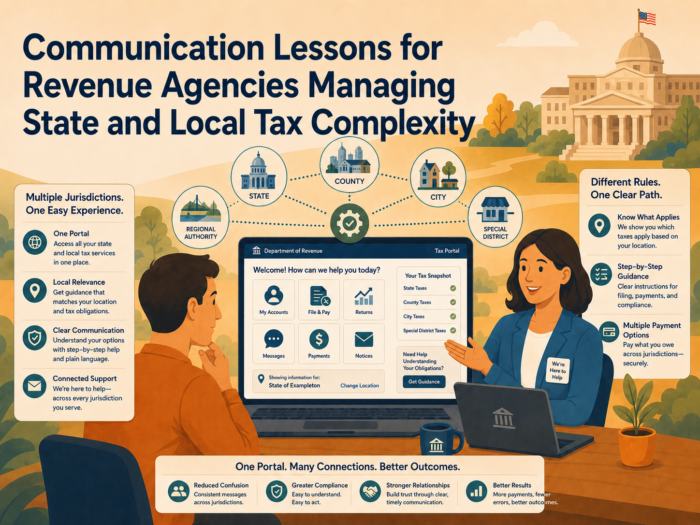
One Portal, Many Jurisdictions: Communication Lessons for Revenue Agencies Managing State and Local Tax Complexity
Tax administration does not always respect the boundaries that taxpayers imagine between different levels of government. A business that operates across multiple counties, or in a state with dozens of local taxing jurisdictions, does not experience its tax obligations as a single, unified system. It experiences them as a layered set of requirements that may share a filing interface, a portal name, or a common registration process while simultaneously applying different rates, different rules, different remittance schedules, and different definitions of what is taxable. For the agency administering these obligations through a single platform, the design of that shared system is a technology and policy decision. For the taxpayer trying to comply accurately across every jurisdiction their business touches, it is a communication problem that the technology alone cannot solve.
This tension is most visible in sales and use tax contexts, where state revenue agencies frequently administer tax on behalf of hundreds of local jurisdictions simultaneously. A single return filed through the state’s online portal may include separate line items for state tax, county tax, city tax, transit district tax, and special purpose district tax, each calculated at a different rate, each potentially subject to different exemptions, and each remitted to a different governmental entity even when the taxpayer sees only one payment leaving their account. The taxpayer who files this return confidently is not simply compliant. They are a skilled interpreter of a system that most agencies have not communicated in language designed for a general-audience business filer.
The communication failure embedded in multi-jurisdiction portal design tends to be invisible to the agencies that build and manage these systems. Inside the agency, the system makes complete sense. The rate tables are accurate. The jurisdiction codes are correct. The remittance routing is properly configured. What the agency does not always see is the taxpayer sitting in front of the portal wondering why there are seventeen rate fields on the return, what the difference is between the county rate and the special district rate, whether they are required to collect a local rate that applies only within a city boundary when they sometimes deliver goods both inside and outside that boundary, and what happens if they select the wrong jurisdiction code for a transaction.
This article examines how revenue agencies that administer multi-jurisdiction tax systems through shared portals can communicate more clearly about the complexity taxpayers encounter inside those systems. It addresses the structural, language, and channel decisions that determine whether a multi-jurisdiction portal becomes a genuine compliance tool or a source of errors that audits and penalty notices eventually have to correct. And it examines why this communication challenge, often treated as a technical footnote in portal implementation planning, deserves the same strategic attention as the architecture of the system itself.
The Taxpayer Experience of Multi-Jurisdiction Complexity
 To understand what multi-jurisdiction communication requires, it is useful to start from the experience of the taxpayer who encounters it. Consider a business that sells taxable goods across a state that has both a statewide sales tax and a patchwork of local option taxes imposed by counties, cities, and special purpose districts. The business may make deliveries to customers in dozens of different geographic locations each month. Each of those locations may sit within a different combination of taxing jurisdictions, each applying a different aggregate rate to the same transaction. The business must determine, for each transaction, which jurisdictions apply, what rates those jurisdictions use, and whether any exemptions or sourcing rules alter the calculation.
A portal that asks this business to report its taxable sales by jurisdiction is asking it to have already completed that determination correctly before it logs in. If the portal groups jurisdictions by code without explaining which codes correspond to which geographic areas, the business must maintain its own jurisdiction mapping. If the portal does not clearly explain how to handle transactions that cross jurisdictional boundaries, such as a delivery that originates in one county and is made to a customer in another, the business must interpret the rules independently. If the portal provides no guidance about which jurisdiction’s rules apply when a transaction involves digital goods, services, or other transaction types that states handle differently from tangible personal property, the business is left to research the answer outside the portal and then return to the portal to apply what it has learned.
This is not a hypothetical scenario. It is the regular experience of the thousands of businesses that file multi-jurisdiction sales tax returns in states that administer local taxes through a combined state-level portal. The volume of errors, amended returns, audit adjustments, and penalty assessments that flow from this complexity is substantial, and a significant portion of it is attributable not to willful non-compliance but to a communication environment that has not given taxpayers the tools they need to navigate the system accurately. The agency that wants fewer errors in multi-jurisdiction filings must invest in the communication that prevents those errors, not only in the audit processes that discover them afterward.
What Makes Multi-Jurisdiction Communication Different From Single-Jurisdiction Communication
Single-jurisdiction tax communication has a clarity advantage that multi-jurisdiction communication lacks: there is one rate, one set of rules, one taxable base definition, and one remittance path. Even when single-jurisdiction communication fails in other ways, such as using technical language or burying the deadline, it at least does not require the taxpayer to navigate among multiple different versions of the same requirement. Multi-jurisdiction communication must explain not only what the rules are but which version of the rules applies to which transaction, which jurisdiction’s rules govern which element of a complex situation, and how differences between jurisdictions interact when a transaction touches more than one.
This additional layer of complexity means that multi-jurisdiction communication must do more work to achieve the same level of taxpayer understanding that single-jurisdiction communication achieves with less. It must define the jurisdictional landscape before explaining the rules within it. It must provide tools for jurisdiction identification that are integrated into the filing experience rather than requiring taxpayers to look up jurisdiction assignments through a separate resource. It must explain how the system handles common situations that create jurisdictional uncertainty, including delivery across boundaries, business activity in multiple locations, and transactions involving mobile or digital goods. And it must do all of this in plain language, at the point in the taxpayer’s workflow where the information is most actionable.
Clearer Taxpayer Communication: Strategies for State and Local Assessors, Treasurers, Revenue Departments, and Finance Offices
This article is part of our series on strategic communication for State and Local Assessors, Treasurers, Revenue Departments, and Finance Offices. Clear, timely, and accessible taxpayer communication helps government agencies improve compliance, reduce confusion, strengthen public trust, and enhance the citizen experience. To learn more and to see the parent article, which links to additional resources and best practices for taxpayer outreach and engagement, click the button below.
Jurisdiction Identification as a Communication Priority
The most fundamental challenge in multi-jurisdiction compliance communication is helping taxpayers correctly identify which jurisdictions apply to each of their transactions or business locations. This is a task that agencies frequently treat as the taxpayer’s responsibility, providing a rate lookup tool or a jurisdiction code table and expecting taxpayers to use those resources to make accurate determinations. In practice, these resources are often harder to use than agencies realize, and the errors that result from misidentification are among the most common sources of multi-jurisdiction filing errors.
A jurisdiction lookup tool that requires a street address to return the correct combination of applicable jurisdictions is more useful than a rate table organized by jurisdiction code, but it is still not a complete solution if the taxpayer does not understand what to do with the information the tool returns. A lookup that tells the taxpayer the applicable state rate, county rate, city rate, and special district rate for a given address has provided accurate data. But if the taxpayer does not understand how to enter those rates into the correct fields on the portal return, or does not know whether the rates returned by the lookup are inclusive or exclusive of each other, the accuracy of the lookup tool does not translate into the accuracy of the filed return.
Communication about jurisdiction identification should be integrated directly into the portal filing experience rather than available only as a separate resource. An in-portal jurisdiction lookup that pre-populates the correct rates into the relevant return fields based on the taxpayer’s address input eliminates the translation step that creates errors. Where that level of integration is not technically feasible, the portal should at minimum provide clear guidance at the point where the taxpayer is required to enter jurisdiction information, explaining in plain language what the jurisdiction field represents, how to determine the correct code or rate for a given location, and what to do if the taxpayer is uncertain whether a transaction falls within a particular jurisdiction’s boundaries.
The communication challenge is particularly acute for businesses that operate across many jurisdictions and may have different taxable activities in different locations. A retail chain with locations in twenty counties does not need a different communication strategy for each county, but it does need communication that explains how the portal’s jurisdiction-by-jurisdiction reporting structure corresponds to its actual business geography, and how to handle situations where a single transaction or a single business activity spans more than one taxing jurisdiction. Guidance that addresses these common multi-location business scenarios is more useful than generic instructions that assume a single-location filer.
Rate Communication and the Risk of Taxpayer-Caused Errors
One of the most operationally significant multi-jurisdiction communication failures is inadequate rate communication. In a state where local option taxes can vary significantly by jurisdiction, the difference between applying the correct local rate and applying the wrong one can be material, both for the amount of tax the business remits and for the distribution of that tax to the correct jurisdictions. Errors in rate application are among the most common audit findings in multi-jurisdiction sales tax contexts, and they are also among the most preventable through better communication design.
Rate communication failures take several forms. A portal that displays jurisdiction rates without clearly indicating what is included in each rate, for example whether the displayed rate includes the state component or represents only the local component above the state base, requires the taxpayer to know the answer to that question before the rate can be applied correctly. A portal that shows separate rate fields for state, county, and city without explaining that only some transactions are subject to city tax, because the delivery address is outside the city limits, places the burden of city boundary determination on the taxpayer without providing a tool to make that determination. A portal that displays rates for dozens of jurisdictions simultaneously without clearly indicating which ones are relevant to the specific business’s locations or delivery areas presents a choice environment that is much more complex than most taxpayers are equipped to navigate accurately.
Strong rate communication provides rates in the context of the rules that determine when and how they apply. It does not simply list rates. It explains the taxable activities to which each rate applies, the geographic boundaries within which each rate is in effect, the transaction types that are subject to the rate versus those that are exempt or subject to a different rate, and the situations where multiple rates must be combined or where only a portion of the transaction value is subject to a particular rate. This contextual rate communication is more detailed than a simple rate table, but it is also far more useful because it gives the taxpayer the information they need to apply the rate correctly, not just the rate itself.
The Portal Interface as a Communication Medium
In a multi-jurisdiction tax filing context, the portal interface itself is one of the most important communication tools available to the agency. The way the portal organizes the filing experience, the language it uses to label fields and sections, the guidance it provides at each decision point, and the feedback it gives when a taxpayer enters information that may be incorrect all communicate something about what the agency expects and how the taxpayer should approach the filing. A portal that is designed around the agency’s data structure rather than the taxpayer’s filing process communicates the wrong things at every step.
Portal interface communication for multi-jurisdiction filing should be organized around the sequence of decisions the taxpayer must make to complete an accurate return. The first decision is typically which jurisdictions to include in the return. The second is what taxable activity occurred in each jurisdiction during the reporting period. The third is what rates apply to that activity. The fourth is what exemptions or deductions reduce the taxable amount. The fifth is the resulting tax due for each jurisdiction and in total. A portal interface that walks the taxpayer through this sequence with clear labels, plain-language guidance at each step, and validation feedback that flags potential errors before submission is functioning as a communication tool, not just a data entry system.
Field labels in a multi-jurisdiction portal deserve specific attention because they often use technical terminology that means something precise to the agency’s database administrator but nothing useful to the taxpayer. A field labeled LOCJURCD is accurate from a data perspective. A field labeled Local Jurisdiction Code communicates that a code is needed but does not tell the taxpayer where to find the correct code. A field labeled Select Your Delivery County with a dropdown populated by county names tells the taxpayer exactly what information is needed and in what format. These labeling choices are communication decisions, and they determine whether the taxpayer can complete the return accurately or must make guesses that may or may not be correct.
In-Portal Guidance Versus Out-of-Portal Instructions
Many revenue agencies that administer multi-jurisdiction portals provide separate instruction documents, help guides, or FAQs that are available on the agency’s website outside the portal environment. These resources may be thorough and accurate, but they require the taxpayer to navigate away from the portal to read them and then return to the portal to apply what they have learned. This workflow interruption increases the likelihood that the taxpayer will either skip the guidance because it is inconvenient to access, or will misapply it because they are working from memory when they return to the portal.
In-portal guidance that is available at the specific point where it is needed is significantly more effective than out-of-portal instruction documents, even when the content of the guidance is identical. A help icon next to a jurisdiction field that opens an explanation of what the field represents and how to determine the correct entry gives the taxpayer the information they need without requiring them to leave the filing context. A worked example embedded in the portal for a common multi-jurisdiction transaction scenario gives the taxpayer a reference point they can compare to their own situation without navigating to a separate resource. A dynamic warning that appears when a taxpayer enters a rate that does not match the agency’s rate table for the selected jurisdiction gives the taxpayer the opportunity to correct an error before it is submitted, at the moment when the correction is easiest to make.
Agencies that invest in in-portal guidance for their multi-jurisdiction systems see lower error rates on filed returns and fewer amended return filings than agencies that rely on out-of-portal instruction resources. This is not surprising. The cognitive burden of applying information read in a separate context to a specific filing situation is much higher than the cognitive burden of applying guidance presented directly within the situation where it is needed. In-portal communication design is a compliance tool, and in the multi-jurisdiction context it is one of the highest-value communication investments an agency can make in its filing system.
Communicating Sourcing Rules in Plain Language
 Sourcing rules determine which jurisdiction’s tax applies to a transaction when the transaction could potentially be assigned to more than one jurisdiction. In sales tax, the most common sourcing question is whether the tax is based on where the sale originates, where the buyer is located, where the goods are delivered, or some combination of these factors. Different states use different sourcing rules, and some states apply different sourcing rules to different types of transactions, applying origin-based sourcing to some sales and destination-based sourcing to others. For a business that sells across multiple jurisdictions, understanding which sourcing rule applies to each type of transaction is foundational to filing accurately.
The communication challenge with sourcing rules is that they are genuinely complex, involve legal distinctions that are not intuitively obvious, and vary in ways that require careful explanation to apply correctly. An agency that simply states that sales tax is destination-based without explaining what destination means for different transaction types, without addressing what to do when the destination is uncertain or when goods are picked up rather than delivered, and without explaining how destination-based sourcing interacts with local jurisdictions that may have boundaries the taxpayer cannot easily determine, has communicated an accurate principle without providing useful guidance.
Plain-language sourcing rule communication should begin with the most common transaction scenarios for the businesses filing through the portal and explain, for each scenario, which jurisdiction’s rules apply and how to determine the correct rate. A retailer whose customers typically take delivery at the retailer’s location needs to understand origin-based sourcing. A business that ships goods to customers at their addresses needs to understand destination-based sourcing. A service business whose work is performed partly at its own location and partly at the client’s needs to understand how the state’s rules allocate the tax between those locations. Each of these scenarios should have a clear, specific explanation in the agency’s multi-jurisdiction guidance materials, written in the language of the scenario rather than the language of the tax code.
Use Tax Communication in a Multi-Jurisdiction Context
Use tax is one of the most underreported tax obligations in state and local tax systems, and multi-jurisdiction complexity makes the underreporting problem worse. Use tax applies when a taxpayer makes a taxable purchase without paying sales tax, either because the seller was not required to collect it or because the purchase was made from an out-of-state source. In a multi-jurisdiction system, the use tax owed may depend not only on the state use tax rate but on the local use tax rate that applies based on where the goods are used, stored, or consumed.
Use tax communication in a multi-jurisdiction portal context requires explaining not only what use tax is and when it applies, but how to determine the correct jurisdiction and rate for use tax purposes when the taxable purchase was not subject to sales tax collection. A business that purchases equipment from an out-of-state vendor without paying sales tax owes use tax in the jurisdiction where the equipment will be used. If that business operates in multiple jurisdictions, it must determine the correct local use tax rate for the specific location where each piece of equipment is used, applying potentially different rates for different pieces of equipment based on their location. This level of complexity requires specific, scenario-based guidance that most multi-jurisdiction portal communication currently does not provide.
Communicating Across Multiple Taxpayer Types
A multi-jurisdiction portal may serve taxpayers whose needs and compliance situations are dramatically different from one another. A sole proprietor with a single retail location filing a quarterly return for one county is using the same system as a regional distribution company with locations in dozens of counties filing monthly returns across multiple jurisdiction categories. A nonprofit organization with specific exemption status is using the same portal as a for-profit business with taxable and exempt sales in varying proportions by jurisdiction. The communication that serves one of these taxpayers well may not serve another at all.
Agencies that administer multi-jurisdiction portals should develop taxpayer type-specific communication pathways that guide different types of filers to the guidance most relevant to their situation. A new filer who has never used the portal should be directed to onboarding guidance that explains the jurisdiction identification process from the beginning. An experienced filer who is accessing the portal for the first time under a newly expanded operation that crosses into additional jurisdictions should be directed to guidance about adding new jurisdictions to an existing account. A filer whose situation involves exempt sales in some jurisdictions but not others should have access to exemption guidance that addresses the multi-jurisdiction application of exemption rules specifically.
This taxpayer-type differentiation does not require the agency to build entirely separate portals or guidance systems for each filer type. It requires organizing the available guidance in a way that allows different types of filers to find the information most relevant to their situation quickly. A well-structured help and guidance section of the portal, organized around taxpayer situations rather than administrative categories, can serve this function without requiring the agency to produce a different complete guide for every filer type. The organizing question is always: what is this type of filer trying to figure out, and where in the guidance system can they find the specific answer?
Communicating System Changes to Established Multi-Jurisdiction Filers
Multi-jurisdiction tax systems change over time. Jurisdictions annex territory and change boundaries. Voters approve new local option taxes. State legislation modifies the distribution of tax among jurisdictions. Rate changes take effect at different times for different jurisdictions. A portal that accurately reflects the current state of the multi-jurisdiction landscape may not accurately reflect the landscape a taxpayer was used to in a prior period, and the communication around these changes is a significant and often underinvested area of multi-jurisdiction portal communication.
When jurisdictional changes occur that affect what a taxpayer must report, the agency should communicate those changes proactively and specifically to affected filers rather than relying on those filers to discover the change on their own through the portal. A notice that tells a specific filer that a new local jurisdiction has become applicable to their account, explains what the new jurisdiction covers geographically, identifies the new rate, and explains how the portal will reflect the change at the point of the next filing gives that filer everything they need to file correctly under the new rules. A general announcement on the agency’s website that a new local option tax has been approved in a particular county gives the filer relevant information but requires them to determine on their own whether the change applies to their account and how to handle it in the portal.
Change communication for multi-jurisdiction systems should be targeted, specific, and timed to reach filers before the first affected filing period rather than after. A filer who discovers a jurisdictional change after filing a return for the period in which the change took effect faces the burden of amended filing. A filer who receives clear communication about the change before the filing deadline can adjust their approach proactively. The operational cost difference between these two outcomes, measured in amended return processing, penalty waiver requests, and staff time, significantly exceeds the communication investment required to produce the proactive notice.
Consistency Between the Portal and Other Communication Channels
The multi-jurisdiction portal is rarely the only channel through which a taxpayer receives information about their multi-jurisdiction obligations. They may also receive mailed notices, email reminders, call center guidance, website instructions, and in some cases practitioner communications that describe the same system and the same requirements. When these channels are not consistent with each other, or with what the taxpayer actually sees inside the portal, the taxpayer is left to reconcile conflicting information in a compliance context where the cost of getting it wrong includes penalties, interest, and the burden of amended filings.
Agencies should audit the consistency of their multi-jurisdiction communication across channels at least annually and whenever significant changes are made to the portal or the jurisdiction structure it supports. This audit should identify cases where the terminology used in mailed notices differs from the terminology used in the portal, where the rate information on the agency’s website does not match the rates currently in the portal, where the call center scripts describe a filing process that differs from what the portal actually asks the filer to do, or where the instructions in the help documentation reference portal screens or field names that have been updated without corresponding updates to the documentation.
Source-of-truth discipline is especially important in multi-jurisdiction systems because the complexity of the underlying subject matter means that inconsistencies are harder for taxpayers to resolve on their own. A taxpayer who receives a notice that refers to a different rate than the rate shown in the portal for the same jurisdiction is not well positioned to determine which source is correct without contacting the agency. A taxpayer who reads a website description of the sourcing rules that conflicts with the guidance shown inside the portal does not have an obvious way to know which version to follow. Maintaining a single authoritative source for jurisdiction rates, rules, and filing instructions, and ensuring that all other communication channels reflect that source accurately, is the operational foundation of consistent multi-jurisdiction communication.
Partner and Practitioner Communication for Multi-Jurisdiction Compliance
Tax practitioners who work with multi-jurisdiction filers are important intermediaries in the communication ecosystem around multi-jurisdiction tax systems. Accountants, enrolled agents, CPAs, payroll processors, and tax software providers who serve businesses with multi-jurisdiction filing obligations can multiply the reach of clear agency communication by incorporating accurate guidance into the advice they give their clients. They can also compound the impact of unclear agency communication by filling the information gaps with their own interpretations, which may or may not accurately reflect the agency’s intended application of its rules.
Agencies that administer multi-jurisdiction portals should invest specifically in practitioner communication resources that address the multi-jurisdiction aspects of the filing system. These resources should explain how the portal handles jurisdiction identification, what the practitioner needs to know to prepare a complete and accurate multi-jurisdiction return on behalf of a client, how to handle common multi-jurisdiction scenarios that generate questions, and where to direct clients when the situation involves a complexity that the practitioner cannot resolve through the standard guidance. Practitioner communication that is accurate, current, and organized around the situations practitioners actually encounter is a high-leverage investment because each practitioner who uses it effectively passes the benefit along to every client they serve.
Tax software providers that interface with the agency’s multi-jurisdiction system through electronic filing integrations are another important partner communication channel. When tax software correctly maps the agency’s jurisdiction structure, populates rate information accurately, and provides in-software guidance about multi-jurisdiction filing requirements, the taxpayers who use that software benefit from a communication design they did not have to seek out independently. Agencies that work actively with software providers to ensure that the software’s representation of the multi-jurisdiction system is accurate and current are investing in a channel that can reach more multi-jurisdiction filers than any direct communication the agency produces.
Strategic Communication Support for Revenue Agencies Managing Multi-Jurisdiction Systems
 Revenue agencies that administer multi-jurisdiction tax systems through shared portals face a communication challenge that sits at the intersection of tax policy complexity, technology design, and plain-language communication discipline. The agencies that navigate this challenge most effectively are not necessarily the ones with the most sophisticated portals. They are the ones that have recognized the communication work required to make those portals usable for a general-audience taxpayer and have invested in that work with the same seriousness they bring to the technical architecture of the system itself.
The communication gaps that create multi-jurisdiction filing errors are typically identifiable through analysis of the errors themselves. Amended returns that correct the same type of jurisdiction misidentification repeatedly suggest that the portal’s jurisdiction identification guidance is insufficient. Audit findings that cluster around specific rate misapplications suggest that the rate communication is unclear for those rate types. Call center inquiries that consistently ask the same sourcing questions suggest that the sourcing rule communication needs to be more accessible and more scenario-specific. These patterns are the data that a structured communication review uses to identify where the most impactful improvements can be made.
Stegmeier Consulting Group (SCG) helps revenue agencies that administer multi-jurisdiction tax systems build communication frameworks that reduce filing errors, improve taxpayer understanding of jurisdiction-specific rules, and make the portal experience more accurate and more accessible for the full range of multi-jurisdiction filers. That support may include portal interface communication audits, in-portal guidance development, plain-language sourcing rule and rate communication, jurisdiction change communication strategy, practitioner and software provider outreach, call center script development for multi-jurisdiction inquiries, and consistency audits across the full channel landscape.
The goal of this work is a multi-jurisdiction tax system in which the taxpayer who files a return across many jurisdictions has the information they need to do it correctly at every step of the process, inside the portal where they are actually working, in language they can understand and apply without specialist knowledge. That standard is achievable, and the compliance benefits of reaching it, measured in fewer errors, fewer amended returns, fewer audit adjustments, and stronger voluntary compliance, are substantial.
Future Trends in Multi-Jurisdiction Tax Communication
The future of multi-jurisdiction tax administration is being shaped by several converging developments that will make the communication challenge both more urgent and more technically addressable in the years ahead. Revenue agencies that anticipate these trends and build communication systems capable of adapting to them will be better positioned to maintain compliance accuracy as the complexity of the multi-jurisdiction landscape continues to grow.
Automated jurisdiction determination is one of the most significant near-term developments in multi-jurisdiction sales tax technology. Systems that can automatically determine the applicable jurisdictions for a given transaction based on address data, without requiring the taxpayer to manually identify and enter jurisdiction codes, have the potential to eliminate one of the most common sources of multi-jurisdiction filing error. As these systems become more widely integrated into state portal environments, the communication challenge shifts from teaching taxpayers how to identify the correct jurisdiction to helping them understand how the automated determination works, when it may produce unexpected results, and how to override or correct an automated determination when their specific situation differs from the standard case the system was designed for.
Economic nexus expansion following the evolution of digital commerce and marketplace facilitator laws has significantly increased the number of businesses with multi-jurisdiction filing obligations in recent years, and that expansion is not complete. Agencies that are communicating their multi-jurisdiction portal to an existing population of experienced filers must now also communicate it to a growing population of new multi-jurisdiction filers who have recently acquired nexus in the jurisdiction for the first time. These new filers bring the full range of confusion that any first-time filer brings to a complex system, compounded by the multi-jurisdiction complexity of the system itself. Onboarding communication for new multi-jurisdiction filers deserves specific investment as the nexus landscape continues to evolve.
Streamlined sales tax initiatives and interstate tax simplification efforts aim to reduce the variation between jurisdictions that creates the most significant multi-jurisdiction communication challenges. As more states adopt standardized definitions, uniform exemption rules, and common rate structures, the communication burden of explaining how different jurisdictions differ from each other decreases. Agencies that are part of streamlined tax systems have a communication advantage because they can tell multi-jurisdiction filers that the rules are consistent across participating jurisdictions rather than requiring filers to track a different set of rules for each one. Communicating the benefits and the residual complexity of streamlined systems clearly is its own communication challenge, but it is a more manageable one than communicating an entirely unharmonized multi-jurisdiction landscape.
Real-time data integration between business accounting systems and state multi-jurisdiction portals is an emerging capability that could dramatically simplify the filing experience for some multi-jurisdiction filers. When a business’s accounting or point-of-sale system automatically categorizes each transaction by jurisdiction, calculates the applicable tax, and pre-populates the information into the agency’s portal at the time of filing, the taxpayer’s communication challenge shifts from understanding how to do the calculation to understanding how to review the pre-populated data for accuracy. Communication for pre-populated multi-jurisdiction returns requires helping taxpayers understand what the system has done on their behalf, what they should verify, and what to do if the pre-populated data does not match their records.
Conclusion
Multi-jurisdiction tax complexity is a structural feature of the American state and local tax system, and it is not going to simplify itself on its own. Revenue agencies that administer these systems through shared portals are asking taxpayers to navigate genuine complexity, and the communication those agencies provide either helps taxpayers navigate that complexity accurately or leaves them to make guesses that audits eventually have to correct. The investment in multi-jurisdiction communication is not optional. It is the condition under which multi-jurisdiction compliance systems actually produce the compliance they were designed to achieve.
The businesses that file multi-jurisdiction returns do so in the context of their broader operations, managing inventory, employees, customers, and competitors alongside their tax obligations. The time they can devote to mastering the intricacies of a multi-jurisdiction portal is limited. Communication that meets them in that context, that explains what they need to know at the moment they need to know it, in language they can apply without specialist training, is the communication that makes multi-jurisdiction compliance achievable. Everything else is documentation that the agency can point to if an error is disputed.
Agencies that treat multi-jurisdiction portal communication as a strategic function, invest in its design, measure its effectiveness through the lens of filing accuracy rather than portal activity, and maintain it consistently across every channel and every change in the jurisdictional landscape, are building something more durable than a compliant filing platform. They are building a taxpayer relationship in which the complexity of the underlying system does not become a barrier to doing the right thing.
SCG’s Strategic Approach to Communication Systems
Align your agency’s messaging, processes, and public engagement strategies.
Revenue agencies managing multi-jurisdiction tax systems through shared portals need communication frameworks that are as carefully designed as the systems themselves. That means in-portal guidance integrated into the filing experience at the points where taxpayers face jurisdictional decisions. It means plain-language sourcing rule and rate communication organized around the transaction scenarios filers actually encounter. It means consistency across portal interfaces, mailed notices, call center scripts, website instructions, and practitioner materials. It means proactive change communication that reaches affected filers before the first impacted filing period. And it means measurement systems that track filing accuracy rather than just portal activity, so the agency knows whether its communication is producing the compliance it was designed to support.
SCG helps revenue agencies build multi-jurisdiction communication frameworks that reduce filing errors, improve taxpayer understanding, and make complex portal systems more accessible and more accurate for the full range of filers they serve. Whether your agency needs a portal communication audit, in-portal guidance development, plain-language sourcing and rate communication, practitioner outreach strategy, change communication planning, or a consistency audit across channels, SCG can help you build a communication system that closes the gap between multi-jurisdiction complexity and accurate voluntary compliance.
Use the form below to connect with our team and explore how a strategic approach to multi-jurisdiction portal communication can help your agency reduce filing errors, lower amended return volume, and build a more effective compliance relationship with the businesses that navigate your jurisdiction landscape.