
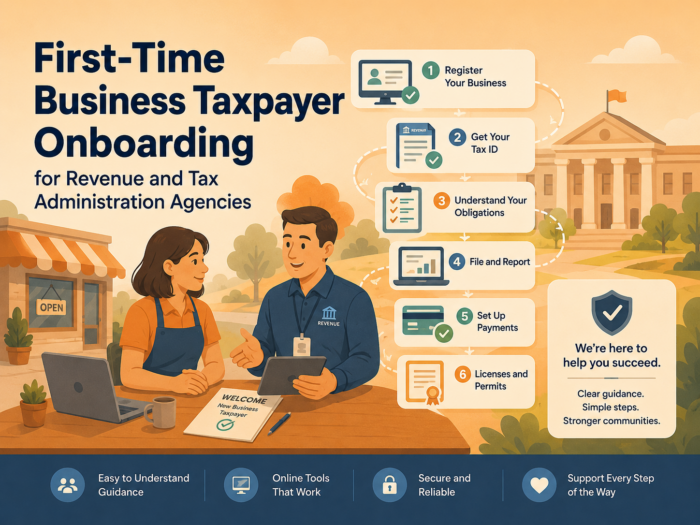
First-Time Business Taxpayer Onboarding for Revenue and Tax Administration Agencies
Opening a business is an act of optimism. It is also an act that immediately creates a set of government obligations the new business owner may not fully understand, may not have anticipated, and may not have anyone to help them navigate. Among those obligations, the tax registration and compliance requirements imposed by state and local revenue agencies are among the most consequential and, for many first-time business owners, the most confusing. The combination of unfamiliar terminology, overlapping filing requirements, multiple tax types with different schedules, and the expectation that the business owner already knows what applies to them is a recipe for confusion that precedes noncompliance, not because the business owner intends to avoid their obligations, but because the system for communicating those obligations was not designed for someone encountering them for the first time.
State and local revenue and tax administration agencies at both the state and local level have a significant opportunity in the period immediately following business registration. During that window, new business owners are actively trying to understand what they need to do. They are searching online, calling agencies, consulting with accountants and attorneys, and asking questions of other business owners. They are more receptive to guidance during this period than at almost any other point in the compliance lifecycle because the questions they have are immediate and practical. What taxes do I need to register for? When are my first filings due? What records do I need to keep? What happens if I make a mistake?
If revenue agencies answer those questions clearly, specifically, and early, they create a foundation for long-term voluntary compliance that is far more cost-effective than the enforcement and collections activity that results when first-time business taxpayers are left to figure out their obligations on their own and inevitably miss something. If agencies do not answer those questions, or answer them in language that is too technical for a general-audience reader to use, the business owner enters the compliance system without the understanding they need to stay current, and the first missed filing or late payment begins a relationship with the agency defined by notices, penalties, and remediation rather than clarity and voluntary compliance.
This article examines how state and local revenue and tax administration agencies can design first-time business taxpayer onboarding communication that gives new business owners the specific, practical, plain-language guidance they need to understand their obligations, meet their first filing and payment requirements, and establish a compliance foundation that serves both the taxpayer and the agency over the long term.
The Onboarding Window and Why It Matters
 The period between a business’s registration with the state or local government and its first required tax filing is the onboarding window. During this window, the business exists in the tax system as a registered entity but has not yet demonstrated whether it will file accurately and on time. The business owner is forming habits, setting up systems, and making decisions about how to manage their financial obligations. The communication they receive from revenue agencies during this window, and the understanding it produces, shapes those habits and decisions in ways that persist well beyond the first filing.
Agencies that treat the onboarding window as a passive period, during which the business owner is expected to learn about their obligations independently and come to the agency only when they have a problem, are missing the moment when proactive communication would be most valuable. A new business owner who receives a clear, plain-language guide to their tax registration requirements, filing schedule, and first-year compliance obligations within the first weeks of registration is in a fundamentally better position than one who first hears from the agency when a notice arrives about a missed first payment.
The onboarding window also matters for equity reasons. Experienced business owners, those who have operated businesses before, who work with professional accountants, or who have access to a business network that includes people familiar with the local tax environment, navigate the first-year compliance requirements more successfully than first-time business owners operating without professional support. The communication gap between these two groups is not primarily a function of effort or ability. It is a function of access to information. Agencies that provide structured onboarding communication help close that gap by giving first-time business owners the same quality of guidance that experienced operators receive through their professional networks.
What First-Time Business Taxpayers Most Need to Know
The questions that first-time business taxpayers most commonly ask in the period after registration reflect a consistent set of knowledge gaps that agency communication can address directly. They want to know which tax types apply to their specific business, because the answer varies by business structure, industry, number of employees, and sales volume in ways that are not always intuitive. They want to know when their first filings and payments are due, because the combination of registration date, fiscal year, filing frequency, and first-period rules can make the initial schedule difficult to calculate independently. They want to know what records they need to keep and for how long, because good recordkeeping habits established at the beginning of a business significantly reduce the difficulty of future filings and audits.
They also want to know what the consequences of a mistake are, specifically whether an error in a first filing is treated differently than a pattern of errors, and whether there is a way to correct a mistake without facing the same penalties as a deliberate non-filer. Many first-time business taxpayers avoid contacting the agency because they fear that acknowledging an error will trigger enforcement action. Clear communication that explains the correction process, the penalty waiver provisions available to taxpayers who self-correct, and the agency’s general approach to first-time errors helps address that fear and encourages the kind of proactive correction that is better for both the taxpayer and the agency than letting an error compound.
Clearer Taxpayer Communication: Strategies for State and Local Assessors, Treasurers, Revenue Departments, and Finance Offices
This article is part of our series on strategic communication for State and Local Assessors, Treasurers, Revenue Departments, and Finance Offices. Clear, timely, and accessible taxpayer communication helps government agencies improve compliance, reduce confusion, strengthen public trust, and enhance the citizen experience. To learn more and to see the parent article, which links to additional resources and best practices for taxpayer outreach and engagement, click the button below.
The Registration Confirmation as an Onboarding Opportunity
In most state and local tax systems, a new business receives some form of confirmation when it completes its registration with the revenue agency. This confirmation may be a letter, an email, an online account notification, or a certificate of registration. It is often the first official communication the business receives from the agency, and it is frequently the least useful it could be. A registration confirmation that provides the business’s tax identification number, confirms the tax type or types for which the business is registered, and tells the business owner to keep the confirmation for their records has done the minimum. It has not onboarded the taxpayer.
The registration confirmation is an underused onboarding opportunity. At the moment the business owner receives the confirmation, they are actively engaged with the registration process, their attention is on their new obligations, and they have the highest receptivity to practical guidance about what comes next. A registration confirmation that includes a clear, plain-language summary of the business’s initial filing obligations, the schedule for first filings and payments, instructions for accessing the online taxpayer account where future filings can be made, and a reference to additional guidance resources for new business taxpayers converts a bureaucratic acknowledgment into a genuinely useful onboarding communication.
This enhanced registration confirmation does not need to be a lengthy document. A one-page summary that answers the four or five most important questions a new business taxpayer has immediately after registration, written in plain language, organized around the actions the business owner needs to take and the dates by which they need to take them, is more useful than a detailed compliance guide that the business owner will not read in full. The goal is to give the business owner enough information to take their first required steps confidently, with references to where they can get more information as their needs develop.
The First-Year Filing Calendar as a Communication Tool
One of the most practical forms of onboarding communication for new business taxpayers is a personalized first-year filing calendar that shows, in plain language and in chronological order, the specific filings and payments the business is required to make during its first twelve months of operation. This calendar reflects the business’s specific tax types, filing frequencies, and registration date, rather than generic information about the agency’s filing schedule that the business owner must interpret and apply to their own situation.
A first-year filing calendar tells the business owner exactly what is due, when it is due, and through what channel it should be submitted or paid. It can also include brief explanations of each filing type, references to the relevant forms and instructions, and notes about the information the business owner should have available before each deadline. This level of specificity is more useful than a general description of the agency’s filing requirements because it reduces the translation work the business owner must do to connect general policy information to their specific situation.
Agencies that provide personalized first-year filing calendars to new business registrants, whether through the registration confirmation, through the online account, or through a dedicated new business onboarding package, see higher rates of on-time first filings than agencies that provide only general filing schedule information. The specificity of the calendar removes the ambiguity that causes many first-time business taxpayers to either guess at their filing dates or delay filing while they try to confirm what they owe and when.
Explaining Multiple Tax Types Without Overwhelming New Business Owners
Many new business owners are surprised to discover that their business may have obligations under several different tax types simultaneously. A business that sells taxable goods may need to collect and remit sales tax, register for and pay business income or gross receipts tax, withhold and remit payroll taxes if it has employees, pay business license fees, and in some jurisdictions file business personal property returns. Each of these tax types has its own registration process, its own filing schedule, its own forms, and its own set of rules. Presenting all of these obligations to a new business owner at once, in agency-organized categories, is likely to produce confusion and overwhelm rather than understanding and action.
Effective onboarding communication for new business taxpayers introduces multiple tax obligations in a structured sequence that is organized around the business’s actual situation rather than the agency’s administrative categories. The communication should start with the tax types that are most immediately relevant, those with the earliest filing deadlines or the most common application to the business’s type, and introduce others in a progression that allows the business owner to build understanding incrementally rather than confronting the full complexity of the tax system at once.
Each tax type explanation should follow a consistent structure that the business owner learns to expect: what this tax is, whether it applies to the business, when the first filing is due, where to file, and where to get more information. This consistent structure reduces the cognitive load of processing multiple tax type explanations by giving the business owner a predictable framework for each one. Once they have read the explanation for sales tax and understood the structure, the explanation for withholding tax is easier to process because the format is familiar.
The Common Tax Registration Errors and How to Prevent Them
First-time business taxpayers make a predictable set of registration and first-filing errors that well-designed onboarding communication can prevent. These errors include registering for the wrong tax type for the business’s activities, choosing the wrong filing frequency when given a choice, applying the wrong taxable period when calculating the first return, missing the first payment because the first-period deadline differs from the ongoing schedule, and failing to register for a required tax type because the business owner did not know it applied to their situation.
Onboarding communication that addresses these common errors specifically and proactively is more effective than communication that simply describes the correct process. A new business owner who reads that businesses in their industry sometimes mistakenly register for the sales tax rate that applies to a different product category, and that the correct rate for their products is a specific rate under a specific classification, is better equipped to avoid that error than one who receives only a general description of the sales tax rate structure. Naming common errors and explaining how to avoid them gives taxpayers actionable awareness that general instructions do not provide.
The Role of the Online Account in New Business Onboarding
 The online taxpayer account is increasingly the primary service channel through which new business taxpayers interact with state and local revenue agencies. Filing returns, making payments, checking account status, submitting documentation, and communicating with agency staff are all functions that can and often should happen through the online account. For a new business owner, learning to use the online account early in their compliance relationship with the agency establishes a habit of digital self-service that reduces their dependence on phone and in-person channels and makes future compliance easier and more efficient.
Onboarding communication for the online account should go beyond simply telling business owners that the account exists. It should explain specifically what they can do through the account, walk them through the account setup process if it has not already been completed as part of registration, identify the tasks they will use the account for regularly such as filing and payment, and set expectations about the confirmation and status communications they will receive through the account after completing transactions. A new business owner who understands how to use their online account before their first filing deadline is significantly more likely to file digitally and confidently than one who discovers the account for the first time in the week before the deadline.
The account setup process itself should be treated as a critical onboarding communication point. Many revenue agency online account systems require taxpayers to complete a multi-step setup process that includes identity verification, credential creation, and in some cases a paper confirmation step. A new business owner who begins this process without knowing what it will involve may not complete it in time to use the account for their first filing. Onboarding communication should include clear, step-by-step guidance on account setup, identify what information the business owner will need to have available, and recommend completing the setup well in advance of the first deadline so any setup issues can be resolved before they become a compliance problem.
First Contact Points and How They Shape the Compliance Relationship
The first time a new business owner contacts the revenue agency, whether through a call, a website inquiry, or an in-person visit, is a defining moment in the compliance relationship. If the contact produces a useful, clear, respectful interaction that gives the business owner the specific information they needed, the business owner is likely to contact the agency again when they have questions, which supports ongoing voluntary compliance. If the contact produces a frustrating, confusing, or unhelpful interaction, the business owner is more likely to avoid future contact and to rely on less reliable information sources, which increases the risk of compliance errors.
Agencies should train front-line staff who are likely to receive calls and inquiries from new business taxpayers to recognize the specific knowledge gaps and anxieties that new business owners commonly bring to first contacts. These include uncertainty about which tax types apply, confusion about filing frequencies and first-period deadlines, questions about what happens if an error is made, and concern about the consequences of late filings. A representative who can answer these questions specifically, in plain language, and with a tone that treats the business owner as a person who wants to comply rather than a suspect who needs to be managed, creates a positive first contact experience that sets the tone for the entire compliance relationship.
Partner and Practitioner Roles in New Business Tax Onboarding
Many new business owners seek tax guidance from sources outside the revenue agency, including accountants, enrolled agents, small business development centers, SCORE mentors, chambers of commerce, industry associations, and community organizations that support entrepreneurship. These partners are an important channel for new business tax onboarding because they reach business owners in the context of a broader relationship where trust is already established and where tax guidance is integrated with other business startup support.
Revenue agencies that provide partners with accurate, up-to-date onboarding materials specifically designed for new business taxpayers can significantly extend the reach of their onboarding communication. A small business development center counselor who has access to the agency’s plain-language new business tax guide, the current version of the first-year filing calendar template, and clear guidance about the agency’s new business assistance resources is better equipped to support their clients than one who relies on general knowledge and must direct clients to the agency’s website to find current, specific information.
Partner materials should be written at the same plain-language standard as the agency’s direct taxpayer communication, should be updated whenever requirements change, and should include clear guidance about where business owners can go for additional help from the agency when their questions exceed what the partner can reliably answer. Partners who receive materials that are too technical, too general, or not current enough to be reliable will either not use them or supplement them with information that may not reflect current requirements. Accessible, practical, current partner materials are one of the highest-leverage investments an agency can make in its new business onboarding reach.
Ongoing Communication After the First Filing
First-time business taxpayer onboarding does not end with the first filing. The period following the first filing is another high-value communication opportunity because the business owner is now processing the experience of the first compliance cycle and forming their understanding of what ongoing compliance requires. This is the moment when filing confirmation, account status updates, and guidance about what comes next in the compliance calendar can reinforce the habits and understanding established during the initial onboarding period.
A communication after the first filing that confirms the return was received, identifies the next filing due date, and provides a brief reminder about the information the business owner should be collecting for the next return reinforces the sequential nature of tax compliance and helps the business owner see the filing calendar as a manageable, predictable cycle rather than a series of disconnected compliance events. This kind of follow-through communication also signals to the business owner that the agency is tracking their account and will be in touch when action is required, which can motivate continued timely compliance more effectively than a notice of missed filing that arrives weeks after a deadline has passed.
Agencies should also plan for the second-year transition in their onboarding communication strategy. The second year of business operation often brings changes to the compliance picture: different filing frequencies based on first-year sales or payroll volume, new tax obligations that kick in after a business reaches a certain threshold, or changes to business structure or activity that alter which tax types apply. Second-year communication that proactively identifies these potential changes and explains how to determine whether they apply gives business owners the information they need to adjust their compliance practices without discovering the change when a notice arrives.
Strategic Communication Support for Revenue and Tax Administration Agencies
 Revenue and tax administration agencies that invest in first-time business taxpayer onboarding communication are making a compliance infrastructure investment, not just a customer service improvement. The first-year compliance behavior of new businesses, the rate at which they file on time, pay accurately, and engage with the agency constructively when they have questions, is significantly shaped by the quality of the onboarding communication they receive. Agencies that provide clear, specific, plain-language onboarding guidance see better first-year compliance rates than those that leave new business owners to navigate their obligations independently.
Building an effective onboarding communication system requires more than revising an existing new business packet or updating the agency’s website with additional information. It requires a clear understanding of the specific knowledge gaps that new business taxpayers have at each stage of the onboarding period, a communication strategy that addresses those gaps in the sequence and format that best supports understanding and action, and a channel strategy that reaches new business owners through the full range of mediums they use to get tax guidance, including direct agency communication, online resources, partner referrals, and practitioner guidance.
Stegmeier Consulting Group (SCG) helps state and local revenue and tax administration agencies design first-time business taxpayer onboarding communication systems that give new business owners the specific, practical guidance they need to understand their obligations and meet their first-year compliance requirements. That support may include onboarding communication audits, registration confirmation redesign, plain-language new business tax guides, first-year filing calendar development, online account onboarding content, call center training for new business inquiries, partner material development, and multi-touch onboarding communication sequencing for the first year of business operation.
The goal is a communication system in which every new business that registers with the agency receives a clear, specific, plain-language path through its first-year compliance requirements, knows how to access help when it needs it, and enters the ongoing compliance relationship with the agency on a foundation of understanding rather than confusion. That foundation is what makes long-term voluntary compliance both more likely and more achievable.
Future Trends in New Business Tax Onboarding Communication
The landscape of new business tax onboarding communication is evolving as agencies modernize their registration systems, expand their digital service capabilities, and develop new approaches to reaching diverse business owner populations.
Integrated business registration systems that allow a new business to complete state and local tax registration alongside other startup requirements, including business entity formation, licensing, and employer registration, are an emerging model that several states and localities are moving toward. These integrated systems create an opportunity to deliver coordinated onboarding communication across multiple agencies at the point of registration, rather than requiring the business owner to seek out and interpret guidance from each agency separately. The communication design of integrated onboarding, including how to present obligations from multiple agencies in a coherent, non-overwhelming sequence, is a significant challenge that will require deliberate attention as integrated systems expand.
Personalized onboarding based on business characteristics is becoming more technically feasible as agency registration data systems improve. An onboarding communication system that can identify the tax types most likely to apply to a specific business based on its industry code, business structure, and reported activities, and deliver a personalized first-year guidance package reflecting those specific obligations, is more useful than generic new business guidance that the business owner must filter for their situation. As data system capabilities expand, the personalization of onboarding communication will become both more feasible and more expected by business owners who are accustomed to personalized digital experiences in other contexts.
Multilingual onboarding is becoming increasingly important as the small business owner population in many states and localities becomes more linguistically diverse. An onboarding communication system that provides registration confirmations, new business guides, and first-year filing calendars only in English is not serving the full range of new business owners who are contributing to local economies and taking on compliance obligations. Developing multilingual onboarding materials requires investment, but agencies that serve linguistically diverse business owner populations will find that the compliance benefits of accessible onboarding justify that investment.
Conclusion
The first year of a new business’s tax compliance life is the most consequential for establishing the habits, understanding, and agency relationship that will define its long-term compliance behavior. Agencies that invest in clear, specific, plain-language onboarding communication during that year create a compliance foundation that returns its value many times over in reduced first-year errors, lower notice and enforcement volume, and a relationship between the agency and the business owner built on clarity and trust rather than confusion and anxiety.
The new business owner who receives a clear registration confirmation with a plain-language summary of first obligations, a personalized first-year filing calendar, accessible guidance about the online account, and a welcoming first contact when they call with questions is not just a better-informed taxpayer. They are a more confident, more capable, and more likely compliant taxpayer who has been given the tools to meet their obligations without the costly experience of learning through error and enforcement.
Onboarding communication is not a welcome packet. It is a compliance strategy. Revenue agencies that treat it as such will see the results in their first-year filing statistics, their call volume patterns, and the long-term compliance trajectories of the business taxpayer population they serve.
SCG’s Strategic Approach to Communication Systems
Align your agency’s messaging, processes, and public engagement strategies.
State and local revenue and tax administration agencies need first-time business taxpayer onboarding communication systems that give new business owners a specific, practical, plain-language path through their first-year compliance requirements. That means enhanced registration confirmations that go beyond acknowledgment, personalized first-year filing calendars, clear online account onboarding content, plain-language explanations of each applicable tax type, partner materials that extend onboarding reach through trusted community channels, and follow-through communication after the first filing that reinforces the compliance cycle.
SCG helps revenue agencies design first-time business taxpayer onboarding systems that build voluntary compliance from the beginning of the business relationship rather than repairing it after compliance failures occur. Whether your agency needs a registration confirmation redesign, a new business guide in plain language, first-year filing calendar development, call center training for new business inquiries, partner material development, or a full onboarding communication audit, SCG can help you build a system that gives new business taxpayers what they need to start right.
Use the form below to connect with our team and explore how a strategic approach to new business tax onboarding can help your agency improve first-year compliance rates, reduce notice and enforcement volume, and build stronger compliance relationships from the very beginning.