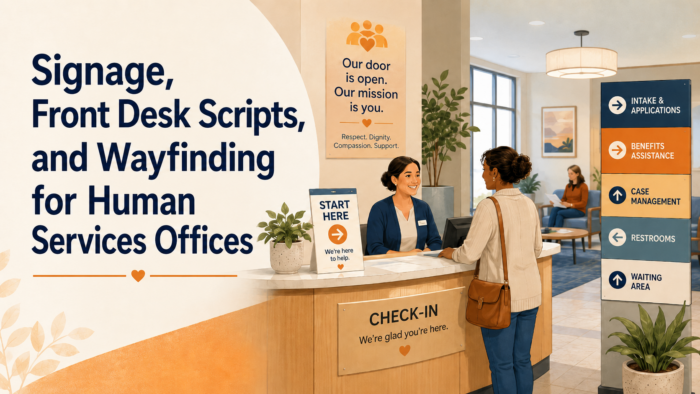
Lobby Communication That Reduces Stress: Signage, Front Desk Scripts, and Wayfinding for Human Services Offices
A human services office lobby is more than a waiting area. It is often the first physical place where residents try to make sense of benefits, documents, notices, deadlines, interviews, case status, eligibility questions, and urgent household needs. A resident may arrive worried about SNAP, Medicaid, cash assistance, child care assistance, housing-related support, EBT issues, a renewal packet, a missing document, or a case closure notice. They may not know which counter to approach, which line to stand in, which form to complete, whether they need an appointment, or whether the agency can resolve their issue that day. The lobby becomes the place where uncertainty is either reduced or intensified.
For human services agencies, county social services departments, public benefits offices, and state benefits agencies, lobby communication should be treated as part of the service system, not as decoration or afterthought. Signage, front desk scripts, check-in language, queue instructions, posted notices, digital screens, security desk guidance, and wayfinding cues all shape how residents experience the agency before they ever speak with a worker. A confusing lobby can increase stress, slow down service, raise the emotional temperature, and place more pressure on frontline staff. A clear lobby can help residents orient themselves, understand what to do next, and feel that the agency is prepared to guide them.
This matters because many residents arrive at human services offices under pressure. They may have taken time off work, arranged transportation, brought children with them, relied on someone else for a ride, gathered documents with difficulty, or come in after failing to resolve an issue by phone or online. Some may have limited English proficiency, disabilities, low literacy, unstable housing, limited technology access, or prior negative experiences with government systems. The lobby has to work for residents who are not calm, not fully informed, and not always sure whether they are in the right place.
Good lobby communication does not require every office to look the same or rely on expensive redesign. It requires the agency to think strategically about the resident’s first few decisions. Where do I go when I walk in? Do I need to check in? What information should I have ready? Where do I wait? What happens after I check in? Where do I go for language assistance? Which issues can be handled today, and which require another step? When those decisions are supported clearly, residents have less need to ask repetitive questions, staff spend less time correcting preventable confusion, and the office environment becomes easier to manage.
Lobby communication also affects trust. Residents judge the agency not only by the final decision on a case, but by how understandable the process feels along the way. If signs conflict, scripts vary by staff member, lines are unclear, or residents are redirected several times without explanation, the agency may seem disorganized even when staff are working hard. If the lobby gives clear guidance, uses respectful language, and helps people understand what is happening, the agency communicates competence before the formal service interaction begins.
The goal is not to make every resident interaction simple. Human services issues are often complex, and some cases will require individual review, follow-up documents, eligibility decisions, hearings, or coordination across programs. The goal is to remove avoidable stress from the physical environment. A well-designed lobby communication system helps residents move through the office with fewer unnecessary barriers, while giving staff a stronger foundation for safe, consistent, and respectful service.
The Lobby Is Where Agency Communication Becomes Physical
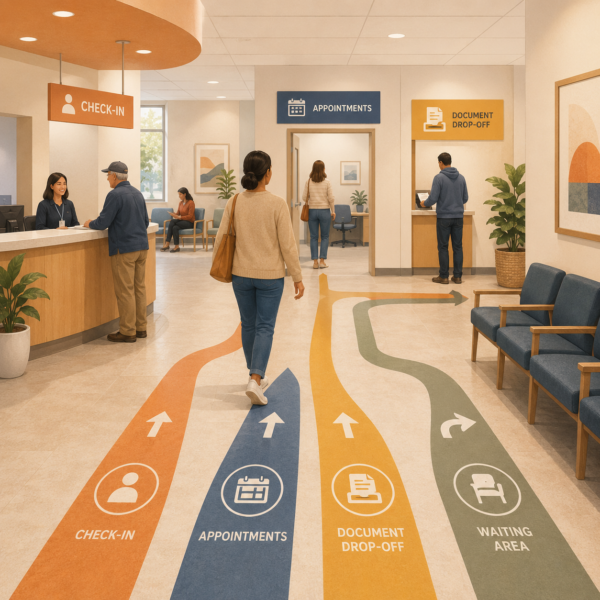 Public benefits communication often focuses on notices, websites, text alerts, portals, call centers, and partner materials. Those channels matter, but the office lobby is where communication becomes spatial. Residents are not only reading information. They are deciding where to stand, where to sit, who to approach, what paperwork to hold, which door to enter, whether they are allowed to ask a question, and how to interpret the behavior of others waiting around them. The physical environment communicates whether the process is organized or confusing before any staff member speaks.
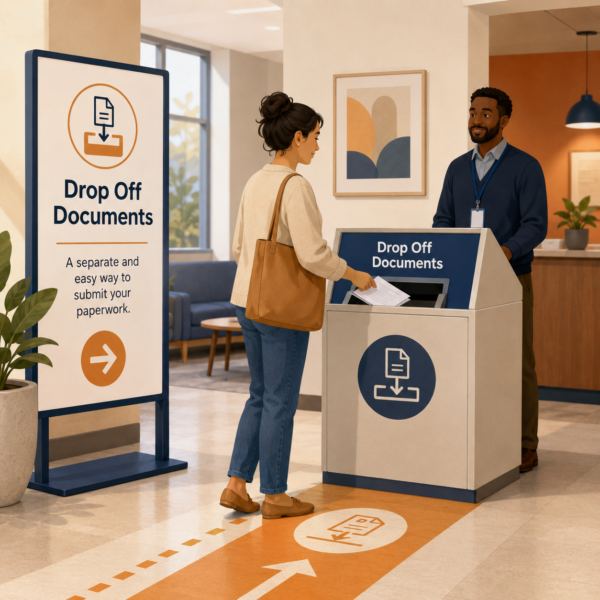
This is why lobby signage and wayfinding should not be treated as facilities details separate from resident communication. A sign that says “check in here” is a service instruction. A sign that distinguishes document drop-off from appointment check-in is a workload management tool. A sign that explains language assistance is an access tool. A sign that directs residents to the correct waiting area is a stress-reduction tool. Each visible cue either helps residents make the next decision or leaves them to interpret the environment on their own.
Human services agencies should think of the lobby as one part of the same communication system that begins before the resident arrives. A resident may have received a notice, checked a website, called a phone line, or been referred by a community partner. The language in the lobby should match those channels as much as possible. If a notice says “send documents,” the lobby should not use only “verification intake.” If the website says “renew benefits,” the check-in desk should not refer only to “redetermination appointments” without explanation. Consistent language helps residents recognize that they are still inside the same process.
Physical Space Can Either Lower or Raise the Emotional Temperature
A confusing lobby can increase stress quickly. Residents may not know whether they are waiting in the correct line, whether they need a number, whether they should speak to security first, whether they are allowed to drop off paperwork, or whether their issue requires an appointment. When people feel unsure, they often ask repeated questions, crowd around desks, interrupt staff, or rely on other residents for guidance. None of this means residents are acting unreasonably. It often means the environment is not communicating clearly enough.
Clear physical communication lowers the emotional temperature by reducing uncertainty. Residents are more likely to wait calmly when they understand where they are in the process, what will happen next, and where to ask for help. Staff are better able to manage difficult conversations when basic orientation has already been handled by the environment. The lobby does not eliminate stress, but it can prevent avoidable confusion from becoming additional tension.
The First Ten Feet Matter
The first few moments after a resident enters the office are critical. Residents should be able to identify the check-in point, the general service path, and any urgent instructions without having to interrupt staff or guess from the movement of other people. If the first visible signs are administrative, outdated, too small, or filled with internal terminology, the resident begins the visit by searching for meaning rather than taking the correct next step.
The first ten feet should answer the most practical arrival questions. Residents need to know whether to check in, where to go for appointments, where to drop off documents, where to request language assistance, and where to wait after they have checked in. This does not require a wall full of signs. It requires careful hierarchy, plain language, and placement at the exact decision point where residents need the information.
More Than Just Applications: Human Services and Public Benefits Communication Strategies for State and Local Agencies
This article is part of our series on strategic communication for Human Services Agencies, Public Benefits Agencies, and Health and Human Services departments. To learn more and to see the parent article, which links to other content just like this, click the button below.
Lobby Stress Often Comes From Unclear Sequence
Many lobby problems are not caused by a lack of information. They are caused by unclear sequences. Residents may see several signs, forms, counters, kiosks, windows, seating areas, or staff stations, but still not know the order in which they are supposed to use them. They may stand in line before checking in, check in before gathering the right document, wait in the wrong area, or ask the front desk about an issue that belongs at a specialized window. The problem is not that residents missed the rules. The problem is that the sequence was not made visible.
Human services offices often handle multiple resident pathways at once. Some people are arriving for scheduled interviews. Others are dropping off documents. Others need help understanding a notice. Others have EBT questions, case status questions, emergency needs, language access needs, or appointment follow-up. If all of those pathways begin in the same physical space without clear guidance, residents may assume every issue belongs in one line or at one counter. That can create bottlenecks and frustration for both residents and staff.
A stronger lobby communication system shows the sequence before residents have to ask. The office can distinguish check-in, document drop-off, appointments, urgent questions, language assistance, and general information using plain-language signs and consistent scripts. The sequence should also be reinforced by staff language. If the sign says “Start here,” the front desk script should match that instruction. If residents are redirected, staff should explain the next step rather than simply pointing to another area. Sequence clarity helps residents feel guided instead of passed around.
“Start Here” Should Mean Something Specific
Many offices use a “Start Here” sign, but the phrase only helps if it leads to a clear action. Residents need to know what happens at that starting point. They may be checking in for an appointment, asking for a queue number, dropping off documents, requesting language assistance, or explaining the reason for their visit. If “Start Here” does not distinguish among those needs, it can simply move confusion to the front of the line.
A stronger starting point gives residents a short, practical orientation. It can explain that all visitors should check in, that document drop-off has a separate box or window, that scheduled appointments should have a notice or ID ready, and that language assistance is available. The starting point should not be overloaded with detail, but it should clearly explain what residents are expected to do first.
Residents Should Know What Happens After Check-In
Check-in is not the end of orientation. After residents check in, they still need to know where to wait, whether they will be called by name or number, whether they should keep documents ready, whether they can leave and return, and what to do if they believe they have been waiting too long. Without this information, residents may approach the desk repeatedly because they do not know whether the process is moving.
Post-check-in communication can reduce tension by setting expectations. A sign, ticket, text notification, verbal script, or lobby screen can explain the next step in simple terms. Residents do not need a full operational explanation. They need enough clarity to understand that their presence has been recorded, what they should do while waiting, and how they will know when it is their turn.
Front Desk Scripts Should Reduce Interpretation for Residents and Staff
Front desk staff often carry the heaviest communication burden in a human services lobby. They greet residents, interpret unclear questions, manage lines, identify urgent issues, redirect people to the correct pathway, respond to frustration, and protect staff workflows. Without consistent scripts, each staff member may explain the same process differently. Residents may then receive different answers depending on who is working, what time they arrive, or how they describe their issue.
A front desk script should not sound robotic or impersonal. Its purpose is to give staff a stable structure for the most common interactions while leaving room for judgment and empathy. The script should help staff identify why the resident is there, explain the next step, use consistent plain language, and avoid unnecessary internal terminology. It should also help staff handle common stress points, such as residents arriving without documents, missing an appointment time, misunderstanding a notice, or needing help with a portal.
Consistent scripts also protect the lobby environment. When staff have clear language, residents are less likely to feel dismissed or redirected without explanation. A script can help staff say, “I can help you get to the right place,” instead of simply telling someone they are in the wrong line. It can help staff explain that dropping off documents is different from speaking with a worker. It can help staff clarify that the office received a document but eligibility staff still need to review it. These small language choices can reduce stress because they make the process feel more understandable and less arbitrary.
Signage Should Answer the Question Residents Are Asking at That Moment
Effective lobby signage is not just about placing information on walls. It is about matching information to the resident’s decision point. A resident entering the building needs a different message than a resident waiting after check-in, dropping off documents, looking for language assistance, or trying to understand whether they need an appointment. If every sign tries to explain everything, the lobby becomes visually crowded and harder to use. If signs are too vague, residents still have to ask staff what the sign means.
Human services offices should design signage around the questions residents are likely to ask as they move through the space. At the entrance, the question is usually where to start. At the front desk, the question is what information to provide. Near a document drop-off area, the question is what can be left there and what happens after submission. In the waiting area, the question is how residents will be called and what they should do while they wait. Near interview rooms or service windows, the question is whether the resident is in the right place for the next step.
This approach makes signage more strategic because it treats signs as part of the resident journey. Each sign should help someone take the next correct action with less staff intervention. The sign should use plain language, be placed where the decision happens, and avoid internal labels that residents may not recognize. The best lobby signage does not simply inform. It guides movement, reduces uncertainty, and supports calmer interactions between residents and staff.
Place Signs Where Decisions Happen
Sign placement matters as much as wording. A sign about document drop-off is less useful if it appears after residents have already waited in the wrong line. A sign about language assistance is less useful if it is posted only at a desk residents are hesitant to approach. A sign about appointments is less useful if residents see it only after they have already checked in incorrectly.
Agencies should identify the physical points where residents are most likely to pause, hesitate, or ask for help. Those are the places where communication should appear. Signage should meet residents before confusion occurs, not after staff have already had to correct it.
Use Resident Words, Not Internal Labels
Lobby signs should use the words residents are most likely to understand. A resident may not know what “verification intake,” “eligibility unit,” “redetermination desk,” or “case maintenance window” means. They are more likely to understand “drop off documents,” “renew benefits,” “check in for an appointment,” “ask about a notice,” or “get help with your case.”
Internal terms can appear when required, but they should be paired with plain-language explanations. The goal is not to remove agency vocabulary entirely. The goal is to keep that vocabulary from becoming a barrier at the exact moment residents are trying to move through the office.
Wayfinding Should Separate Common Pathways Without Fragmenting the Experience
Human services lobbies often serve residents with very different needs at the same time. Some residents need a scheduled interview. Others need to submit documents. Others need to ask about a notice, request language assistance, replace an EBT card, check the status of a case, or find out why benefits changed. When all of these residents are directed through the same unclear pathway, the lobby can become crowded, tense, and inefficient. People wait in the wrong place, staff repeat the same corrections, and residents may feel as though they are being passed around.
Wayfinding should help separate common pathways without making the office feel fragmented. A resident should be able to tell the difference between checking in for an appointment, dropping off paperwork, and asking for general help. At the same time, the office should still feel like one coordinated service environment. The signs, scripts, ticketing systems, lobby screens, and staff directions should reinforce the same structure. If residents are redirected, the reason should be clear and the next step should feel connected to the first one.
This is especially important for residents who arrive with multiple needs. A person may need to drop off documents and ask about a notice. Another may need language assistance and help checking in. Another may have an appointment but also need to update an address. Wayfinding should not assume that every resident fits neatly into one category. It should give the lobby a clear structure while allowing staff to help residents move between pathways when needed.
Document Drop-Off Needs Its Own Clear Path
Document drop-off is one of the most common sources of lobby confusion. Residents may not know whether they can leave documents without speaking to a worker, whether documents need a case number, whether they will receive confirmation, or whether dropping off a document means the case is complete. If the document pathway is unclear, residents may wait unnecessarily or leave paperwork in the wrong place.
A stronger document drop-off system explains what can be submitted, how documents should be labeled, whether copies are preferred, how residents can confirm receipt, and what happens after the agency receives the paperwork. The message should make clear that receiving a document is not always the same as reviewing or accepting it.
Appointment Check-In Should Feel Different From General Questions
Residents with appointments need to know where to check in, what to have ready, and where to wait after check-in. Residents without appointments need to know whether they can still receive help, whether they need to take a number, or whether they should use another channel. If the lobby does not distinguish appointment check-in from general questions, both pathways can slow down.
Agencies can reduce confusion by giving appointment check-in a clear visual and verbal identity. Signs and scripts should help residents understand whether they are in the right place for an appointment, what will happen next, and how to ask for help if they are late, early, missing paperwork, or unsure why they were scheduled.
Front Desk Scripts Should Be Designed for Consistency Under Pressure
Front desk staff often manage the most unpredictable part of the resident experience. They may greet someone who is calm and prepared, then immediately help someone who is angry, confused, frightened, or worried that benefits are about to stop. They may need to answer the same question dozens of times in a day while also monitoring lines, appointments, document drop-off, security concerns, language access needs, and staff availability. In that environment, communication consistency cannot depend only on individual staff style.
A strong front desk script gives staff a reliable structure for common situations. It should help staff quickly identify the resident’s purpose, direct the person to the right next step, and explain what will happen after that step. The script should not be stiff or overly formal. It should sound natural enough for real interactions while still preserving the same core message across staff members and shifts. The goal is to reduce improvisation on the points that most affect resident understanding.
Scripts also help protect staff. When residents are stressed, unclear explanations can escalate frustration. A consistent script gives staff language that is respectful, direct, and process-oriented. It helps them avoid sounding dismissive when redirecting residents, avoid overpromising when a case needs review, and avoid using internal terms that may confuse the person at the counter. Good scripts make the interaction easier for residents and safer for staff.
Scripts Should Explain the Next Step, Not Just the Rule
Residents often become frustrated when they hear only what the office cannot do. “You are in the wrong line,” “You need an appointment,” or “We cannot review that here” may be accurate, but those statements can feel like a dead end. A better script pairs the limitation with the next step.
Front desk language should help residents understand the path forward. For example, staff can explain where the resident should go, what they should bring, how to submit documents, when to expect follow-up, or which channel can resolve the issue. The resident may still be disappointed, but they are less likely to feel abandoned.
Scripts Should Match the Signs Residents Already Saw
Front desk scripts should reinforce the language used in lobby signs. If a sign says “Drop off documents here,” staff should use the same phrase rather than switching to “verification intake.” If a sign says “Check in for appointments,” staff should not refer only to “scheduled eligibility events.” When signs and scripts use the same language, residents receive confirmation that they are following the right path.
This consistency also helps staff manage the lobby more efficiently. Instead of explaining a new concept from scratch, staff can point to a sign, repeat the same phrase, and guide the resident to the next step. The environment and the staff message support each other.
Waiting Area Communication Should Set Expectations Without Overpromising
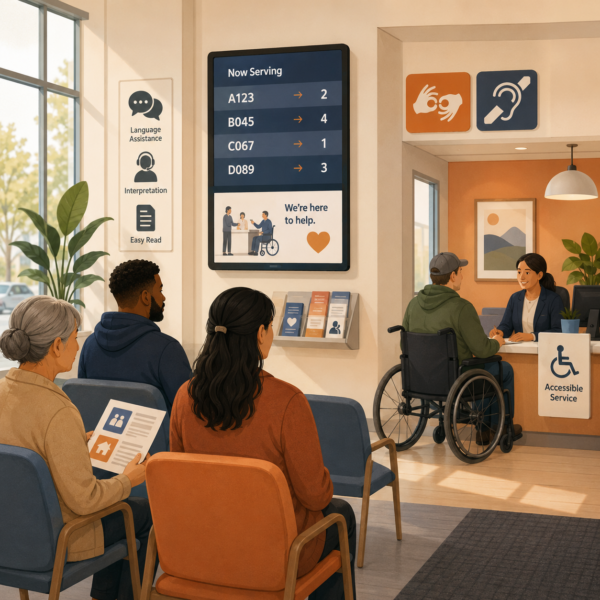 Waiting is one of the most stressful parts of a human services office visit because residents often do not know what is happening behind the scenes. They may not know whether they have been checked in correctly, whether their number has been skipped, whether their issue can be handled that day, whether they need to stay nearby, or how long the process may take. Silence during waiting can create anxiety, especially when residents are managing work schedules, transportation limits, children, medical needs, or urgent benefit concerns.
Waiting area communication should give residents enough information to understand the process without promising more certainty than the office can provide. If wait times vary, the agency should be careful not to post estimates that quickly become inaccurate. Instead, the office can explain how residents will be called, what documents they should keep ready, where to ask if they need language assistance, and what to do if they have been waiting longer than expected. The message should reduce uncertainty while preserving operational flexibility.
This communication can be delivered through signs, lobby screens, ticket language, staff announcements, printed handouts, or text notifications where available. The format matters less than the clarity of the message. Residents should understand that they are in the right place, that the agency has a process for calling them, and that there is a clear way to ask for help if something seems wrong. Waiting area communication should make the time feel managed, not mysterious.
Language Access Should Be Visible Before Residents Have to Ask
Language access should not depend on a resident knowing the right words to request help. In a human services lobby, residents may arrive with notices they do not fully understand, documents they are unsure how to submit, or urgent questions about benefits that affect food, health coverage, cash assistance, child care, or housing stability. If language assistance is mentioned only in small print, buried near a back wall, or available only after someone reaches the front desk, residents may spend the first part of the visit uncertain about whether help is available.
A stronger lobby communication system makes language access visible at the earliest practical point. Entrance signs, check-in areas, ticketing kiosks, lobby screens, and front desk scripts should all make clear that interpretation or language assistance is available. The message should be simple, respectful, and easy to recognize. Residents should not have to disclose sensitive case details before they can ask for communication help. They should be able to identify the pathway for assistance before the service interaction becomes complicated.
This visibility benefits staff as well. When language access is built into the lobby flow, frontline staff are less likely to rely on improvised explanations, family members, or other residents to bridge communication gaps. Staff can follow a defined process, residents can receive more accurate information, and the agency can reduce the risk of misunderstandings that lead to missed steps or avoidable benefit interruptions. Language access is not a separate accommodation layered onto the lobby. It is part of the basic communication environment.
Accessibility Should Shape the Physical and Communication Layout
Accessibility in a human services lobby is not limited to ramps, doors, counters, or seating. Those physical elements matter, but so does the communication design. Residents with disabilities may need signs that are readable from a distance, plain-language instructions, screen-reader-compatible digital check-in tools, visual cues that do not rely only on color, clear audio announcements, seating that supports longer waits, and staff scripts that explain alternatives when a standard process does not work. A lobby can meet certain facility requirements and still be difficult to navigate if the communication system is not accessible.
Human services agencies should review lobby communication from the perspective of residents who may have low vision, hearing loss, mobility limitations, cognitive disabilities, mental health conditions, anxiety, trauma histories, or difficulty processing dense information under stress. A sign with too much text may be technically informative but practically unusable. A ticketing kiosk without clear instructions may create a barrier. A loud or crowded waiting area without clear visual updates may make it difficult for residents to know when they are being called. Accessibility requires attention to how people actually receive and act on information in the space.
Accessible communication also supports residents who do not identify as needing an accommodation. Plain headings, clear pathways, readable signs, predictable scripts, and visible help points make the lobby easier for everyone to use. This is particularly important in public benefits offices, where residents may be under pressure, carrying documents, caring for children, or trying to understand a notice while also navigating the room. Accessibility improves the overall service environment because it lowers the amount of interpretation required from every resident.
Document Drop-Off Communication Should Prevent False Closure
Document drop-off is one of the most common lobby functions, but it is also one of the easiest to misunderstand. A resident may believe that once a document is dropped off, the case is complete. The agency may still need to scan, route, review, accept, or request additional information. If the lobby does not explain this distinction, residents may leave with a sense of closure that does not match the actual case status. Later, when they receive another notice or call asking for more information, they may feel that the agency ignored what they already submitted.
Lobby communication should make the difference between receiving and reviewing documents clear. A document drop-off sign or script can explain that the agency will receive the paperwork, but eligibility staff may still need to review it before the case can move forward. If residents will receive a receipt, confirmation number, stamped copy, or other acknowledgement, the process should be visible. If no immediate review is available, residents should know that before they leave. Clear language helps residents understand what the drop-off does and what it does not guarantee.
This distinction reduces avoidable calls and frustration. Residents are less likely to assume the case is finished when they understand that document submission is one step in the process. Staff are better able to explain follow-up notices when the original drop-off pathway already included that expectation. Community partners can also reinforce the same message when they help residents gather and submit paperwork. A clear document drop-off process protects trust by preventing a common mismatch between resident expectation and agency workflow.
Lobby Screens and Digital Displays Should Be Managed as Communication Tools
Many human services offices use lobby screens, digital displays, ticket boards, or announcement systems to communicate with residents. These tools can be useful, but only when they are managed intentionally. A screen that rotates through too many messages, displays outdated information, uses small text, or mixes urgent instructions with general announcements can become background noise. Residents may stop looking at it, or they may miss the one message that applies to their visit.
Digital displays should be treated as part of the lobby communication hierarchy. Their purpose should be clear. Some screens may show queue information. Others may provide reminders about documents, language assistance, appointment check-in, or where to find help. The content should be short, readable, and relevant to the physical location. A waiting room screen should not carry every agency announcement. It should reinforce the information residents need while they are in that space.
Digital lobby communication also needs active maintenance. Outdated reminders, old program notices, expired deadlines, and obsolete portal instructions can damage credibility. Residents may reasonably assume that information displayed in the lobby is current. Agencies should assign ownership for reviewing screen content and retiring messages that no longer apply. A digital display can strengthen communication only if it is treated as a managed channel, not as a place to store miscellaneous announcements.
Security and Reception Roles Should Be Aligned With the Communication Strategy
In many human services offices, the first person a resident encounters may not be an eligibility worker or front desk specialist. It may be a security officer, greeter, receptionist, kiosk attendant, or contracted staff member. These roles often become informal communication points because residents naturally ask the first visible person where to go. If these staff members do not have clear language, residents may receive incomplete or inconsistent direction before they ever reach the appropriate service point.
Agencies should include these roles in lobby communication planning. Security and reception staff do not need to answer case-specific questions, but they do need clear scripts for basic orientation. They should know how to direct residents to check-in, document drop-off, language assistance, appointment areas, and urgent help pathways. They should also know how to avoid giving eligibility guidance or making promises about case outcomes. This keeps the first interaction helpful without placing staff outside their role.
Alignment is especially important when the lobby is busy or tense. Residents may interpret a quick redirection as dismissal if the reason is not explained. A simple script can help staff say, “Start at the check-in desk so we can route you to the right service,” or “Documents can be dropped off here, but case staff will still need to review them.” Clear role-based language helps protect safety, reduce confusion, and keep the lobby flow consistent.
Lobby Communication Should Reinforce Respectful Service
The words displayed and spoken in a lobby shape the tone of the entire visit. Signs that sound harsh, accusatory, or rule-focused can make residents feel unwelcome before they have an opportunity to explain their situation. Scripts that begin with what the agency cannot do may increase defensiveness. Residents may already feel anxious about their benefits, embarrassed about asking for help, or frustrated by prior attempts to resolve an issue. The lobby should not add unnecessary emotional weight.
Respectful lobby communication does not mean avoiding rules or minimizing expectations. Offices still need safety standards, check-in procedures, document requirements, appointment policies, and boundaries around staff availability. The difference is in how those expectations are communicated. A sign can say what residents should do rather than only what they may not do. A script can explain the next step instead of sounding like a refusal. A waiting area message can acknowledge delays without promising unrealistic timelines.
A respectful communication environment also supports staff. When the lobby uses clear, calm, and consistent language, staff are not left to enforce unclear rules or absorb frustration caused by preventable confusion. Residents are more likely to understand what is expected, and staff are better able to focus on the issue that brought the resident to the office. Respectful communication is not a soft add-on. It is a practical tool for reducing stress and supporting safer, more effective service.
Wayfinding Should Be Tested During Real Lobby Conditions
Lobby communication can look clear during an internal review and still fail during a busy service day. Staff may understand the signs because they already know the building. Supervisors may understand the sequence because they helped design the workflow. Facilities teams may see the layout as logical because they know where each door, window, and desk leads. Residents arrive without that context. They are reading the space while managing stress, time pressure, paperwork, children, transportation concerns, language needs, or uncertainty about their benefits.
This is why wayfinding should be tested under real conditions, not only reviewed on a floor plan. Agencies should observe where residents pause, where they ask repeated questions, where lines form unexpectedly, where people miss signs, where residents go after check-in, and where staff have to correct the same misunderstanding. These observations often reveal that the problem is not resident behavior. The problem is that the environment is asking residents to make decisions without enough visible guidance.
Testing should include different resident pathways. A person coming for a scheduled appointment may need one sequence. A person dropping off documents may need another. A person asking about an EBT issue, language assistance, case status, or a confusing notice may need a different starting point. If the lobby works only for residents who already know the office, the communication system is not doing enough. Strong wayfinding helps first-time visitors, returning residents, people with limited literacy, and residents with multiple needs navigate the space with fewer unnecessary questions.
Lobby Communication Should Reduce Repetitive Questions
Repetitive questions are one of the clearest signs that lobby communication is not carrying enough of the basic orientation work. If residents repeatedly ask where to check in, whether they need a number, where to drop off documents, how they will be called, whether they can speak to a worker, or where to request language assistance, the agency has useful evidence about where signage, scripts, or wayfinding need improvement. These questions should not be treated only as interruptions. They are diagnostic signals.
When the same question is asked throughout the day, the agency should look first at whether the answer is visible, plain, and located at the right decision point. A sign may exist but be too small, too far away, too crowded with other information, or written in internal language. A script may be clear when used by one staff member but not consistently used across shifts. A kiosk may provide instructions, but only after residents have already approached the wrong desk. The goal is to move common answers into the environment so staff are not required to repeat them constantly.
Reducing repetitive questions does not mean eliminating human help. Residents will always need staff support for case-specific issues, urgent circumstances, language access, disabilities, and complex questions. The purpose of clearer lobby communication is to reserve staff attention for the questions that truly require judgment, empathy, and problem solving. When signs and scripts answer basic orientation questions, staff can spend more time helping residents with the substance of their visit.
Lobby Materials Should Match Notices, Websites, and Portal Language
Residents often arrive at a human services office after interacting with another communication channel. They may bring a mailed notice, reference a text alert, show a portal screen on their phone, print a website page, or repeat instructions given by a call center or community partner. If the lobby uses different terminology from those channels, residents may wonder whether they are in the wrong place or whether the instruction they received was incomplete. This is especially common when agency language shifts between plain resident-facing terms and internal program terminology.
Lobby materials should therefore reinforce the same language residents encounter before they arrive. If notices say “send documents,” lobby signs should use “drop off documents” or “send documents here,” not only “verification intake.” If the website says “renew benefits,” appointment check-in should not rely only on “redetermination.” If text alerts tell residents to “check your case status,” lobby guidance should make clear where residents can ask about case status and what information they should have ready. Consistent language helps residents recognize the path they are already following.
This alignment also supports staff and partners. When the same terms appear across notices, websites, portals, scripts, and lobby signs, residents receive confirmation instead of contradiction. Staff can point to a sign and use the same phrase the resident saw in a notice. Community partners can direct residents to the office with greater confidence because the office environment reflects the same guidance. A lobby should not feel like a separate communication universe. It should feel like the physical extension of the agency’s broader communication system.
Frontline Feedback Should Shape Lobby Improvements
Frontline staff often know where lobby communication is failing before leadership sees it in data. They hear the repeated questions, watch residents choose the wrong line, see which signs are ignored, notice where people become frustrated, and understand which scripts calm tension or make it worse. Security staff, receptionists, eligibility workers, call center staff, navigators, interpreters, and supervisors all have practical insight into how residents actually move through the office.
Agencies should create simple ways for frontline staff to share those observations. This does not require a formal study every time a sign needs improvement. Staff can track recurring questions, identify unclear signs, flag confusing handoffs, report where residents tend to gather, and suggest language that residents understand more easily. These observations can be reviewed regularly and used to refine signage, scripts, queue instructions, lobby screens, and document drop-off guidance.
Frontline feedback is especially important because lobby conditions change. A process that worked before a portal update may no longer work when more residents arrive with upload questions. A document drop-off system may need adjustment during renewal periods. A new text alert campaign may increase office visits from residents asking about the same reminder. A task that used to happen at one window may move to another. A lobby communication system should be maintained as resident behavior and agency operations shift.
Lobby Communication Should Support Safety Without Sounding Threatening
Human services offices must maintain safety for residents and staff. Clear expectations about respectful conduct, check-in procedures, prohibited items, security screening, waiting areas, and staff access may be necessary. The way those expectations are communicated matters. Signs that rely heavily on warnings, threats, or enforcement language can make the lobby feel hostile, especially for residents who already feel anxious or unwelcome. Safety communication should be firm, clear, and respectful.
A stronger approach explains expectations in a way that supports order without escalating tension. Rather than filling the lobby with negative commands, agencies can use calm language that describes what residents should do, where they should go, and how staff will help. Safety-related messages should be visible, but they should not dominate the entire communication environment. Residents should see guidance for service, not only rules for behavior.
This balance helps staff as well. When conduct expectations are clearly and respectfully posted, staff have a shared reference point if a situation becomes difficult. When the rest of the lobby communication is also clear, many preventable frustrations are reduced before they escalate. Safety is supported not only by enforcement, but by an environment that reduces confusion, crowding, and uncertainty.
Lobby Communication Should Be Maintained, Not Just Installed
Lobby communication can become outdated quickly. A sign may reference an old portal name, a retired form, a changed check-in process, a previous office layout, or a deadline that no longer applies. A lobby screen may continue displaying a message after the policy has changed. A handout may sit at the front desk long after the website has been updated. Residents often assume that anything posted in the office is current, so outdated lobby communication can damage trust and create real service problems.
Agencies should assign ownership for lobby communication just as they assign ownership for website pages, notices, and scripts. Someone should know who approves signs, who updates lobby screens, who retires outdated handouts, who reviews translated materials, and who checks whether physical directions still match the actual workflow. Without that ownership, signs and materials can accumulate over time until the lobby becomes cluttered with mixed messages.
Maintenance is also about restraint. Not every message belongs in the lobby forever. High-priority instructions should remain visible, while temporary messages should have a review date. The more signs compete for attention, the less effective each one becomes. A maintained lobby communication system keeps the most important guidance clear, current, and easy to follow.
Strategic Communication Support for Human Services and Public Benefits Agencies
 Lobby communication is not simply an office operations issue. It is part of how human services agencies shape access, reduce stress, support staff, and build trust with residents who may already be navigating difficult circumstances. When residents enter a public benefits office, they are often trying to resolve issues tied to food assistance, health coverage, cash assistance, child care support, housing-related needs, EBT concerns, renewal notices, or missing documents. The signs they see, the words they hear at the front desk, the way they are directed through the space, and the expectations set while they wait all influence whether the visit feels manageable or confusing.
Because lobby communication sits at the intersection of physical space, service design, accessibility, language access, staff workflow, security, and resident behavior, many agencies benefit from structured communication support. Internal teams may understand the office layout and service process deeply, but that familiarity can make it harder to see where residents hesitate, misread signs, stand in the wrong line, miss language assistance information, or leave with the wrong expectation about what happens next. A resident-centered review can help identify where the environment is creating avoidable stress and where clearer communication can improve the experience without requiring a full facility redesign.
Stegmeier Consulting Group (SCG) helps human services and public benefits agencies strengthen the communication systems residents encounter before, during, and after an office visit. That support may include lobby communication audits, signage frameworks, front desk scripts, wayfinding recommendations, document drop-off language, waiting area messaging, source-of-truth alignment, staff guidance, partner materials, and communication planning for service model changes. The goal is not to make the lobby feel overly scripted or impersonal. The goal is to create a calmer, clearer, and more consistent environment where residents understand what to do and staff have the language they need to guide people effectively.
This support is especially valuable when agencies are experiencing high lobby volume, resident frustration, inconsistent front desk explanations, unclear document drop-off processes, language access challenges, portal-related questions, or changes in how residents are expected to check in and receive service. Strong lobby communication helps residents orient themselves more quickly, gives staff a more stable service framework, and reduces avoidable confusion before it becomes conflict, delay, or repeat contact.
Future Trends in Human Services Lobby Communication
Human services offices are likely to place greater emphasis on lobby communication as agencies continue to balance digital service delivery with in-person support. Even as more applications, renewals, document uploads, and case status functions move online, physical offices will remain important for residents who need help understanding notices, resolving urgent issues, accessing language assistance, submitting documents, or navigating barriers that cannot be solved through a portal alone. That means the lobby will continue to serve as a critical access point, not just a waiting area.
Another likely trend is closer alignment between digital and physical communication. Residents may arrive at an office after receiving a text alert, using a portal, reading a website page, or being referred by a community partner. Lobby signs and scripts will need to match the language residents have already seen in those channels. If digital communication says “upload documents” and the lobby says “verification intake,” residents may not recognize that they are still following the same process. Agencies that align physical and digital communication will make the full service experience easier to navigate.
Agencies may also rely more on observed resident behavior to improve lobby communication. Repeated questions, wrong-line patterns, document drop-off confusion, language assistance requests, long wait concerns, and staff redirection patterns can all show where the lobby is not communicating clearly enough. These signals can help agencies refine signs, scripts, queue instructions, lobby screens, and staff guidance. The most effective offices will treat lobby communication as something to maintain and improve over time, not as a one-time signage project.
Finally, lobby communication will likely become more closely tied to safety, accessibility, and staff support. Clearer wayfinding, respectful conduct expectations, visible help pathways, and consistent front desk language can reduce preventable tension. This does not eliminate the need for security procedures or difficult conversations, but it can make the environment less confusing and more predictable. For agencies serving residents under stress, that predictability is a meaningful part of service quality.
Conclusion
Human services lobbies should help residents understand what to do, where to go, and what to expect. When signs are unclear, scripts are inconsistent, pathways are poorly marked, or waiting area communication is silent, residents are left to interpret the office on their own. That uncertainty can increase stress, create repetitive questions, slow service, and place more pressure on frontline staff.
A stronger lobby communication system uses signage, wayfinding, front desk scripts, waiting area messages, language access cues, accessibility supports, and staff alignment to guide residents through the physical space. It explains the sequence of service, distinguishes common pathways, sets expectations after check-in, clarifies document drop-off, and reinforces the same language used in notices, websites, portals, and call center scripts. This kind of communication reduces avoidable confusion while preserving room for staff judgment and individualized support.
In the end, a human services lobby should not feel like another barrier residents must overcome. It should function as a clear entry point into the agency’s service system. When agencies design lobby communication with resident stress, staff workflow, and real service pathways in mind, they create offices that are easier to navigate, safer to manage, and more respectful of the people who depend on public benefits and support services.
SCG’s Strategic Approach to Communication Systems
Align your agency’s messaging, processes, and public engagement strategies.
Human services and public benefits agencies need communication systems that work across physical offices, digital tools, notices, call centers, and partner networks. Lobby communication is a critical part of that system because it shapes how residents experience the agency at the moment they arrive for help. Clear signage, consistent scripts, accessible wayfinding, and source-of-truth alignment can reduce stress, support staff, and make the service process more understandable.
SCG helps agencies create communication frameworks that connect resident-facing language with real operational pathways. Whether your agency is improving lobby signage, redesigning check-in communication, strengthening front desk scripts, clarifying document drop-off, aligning office materials with website guidance, or preparing staff for a new service model, SCG can help you build a communication system that supports clarity, access, consistency, and trust. Use the form below to connect with our team and explore how a strategic communication system can help your agency improve lobby communication, reduce resident stress, and strengthen the in-person service experience.