
Text Alerts That Prompt Action: Designing Renewal and Document Reminders for Public Benefits Agencies
Text alerts have become one of the most practical tools public benefits agencies can use to reach residents quickly. A short reminder can prompt someone to renew benefits, upload documents, check a notice, complete an interview, report a change, or act before a deadline passes. For residents managing SNAP, Medicaid, cash assistance, child care assistance, housing-related support, or other public benefits, a well-timed text can be the difference between completing a step on time and losing access for a procedural reason.
But text alerts only work when they are designed around action. A message that says “you have an update” or “log in to your account” may create activity, but it may not produce completion. Residents need to know what the alert is about, whether action is required, which benefit may be affected, what deadline applies, and where to go next. In a public benefits context, a vague text can create anxiety, unnecessary calls, duplicate submissions, or missed deadlines because the resident still has to interpret what the agency wants.
For human services agencies, public benefits agencies, county social services departments, and state benefits offices, text messaging should not be treated as a simple notification tool. It should be part of a larger communication system that connects notices, portals, call center scripts, eligibility workflows, staff guidance, partner materials, and source-of-truth pages. A text alert is short, but it carries high stakes. It must be concise enough to be read quickly and clear enough to guide a resident toward the correct next step.
This is especially important during renewals and document requests. Those moments often involve deadlines, consequences, and several possible points of confusion. A resident may need to complete a renewal form, submit income proof, provide missing verification, check whether a document was received, or respond to a follow-up request. If the text alert does not make the required action visible, the agency may increase awareness without reducing churn.
Strong text alerts do not try to explain the full benefits process in one message. They do something more disciplined. They point residents toward a specific action, use consistent terminology, identify urgency when it matters, and connect to a trusted place where residents can complete the step or verify details. The best text alerts are not miniature notices. They are action prompts that fit into a broader resident journey.
Text Alerts Should Prompt a Specific Action, Not General Attention
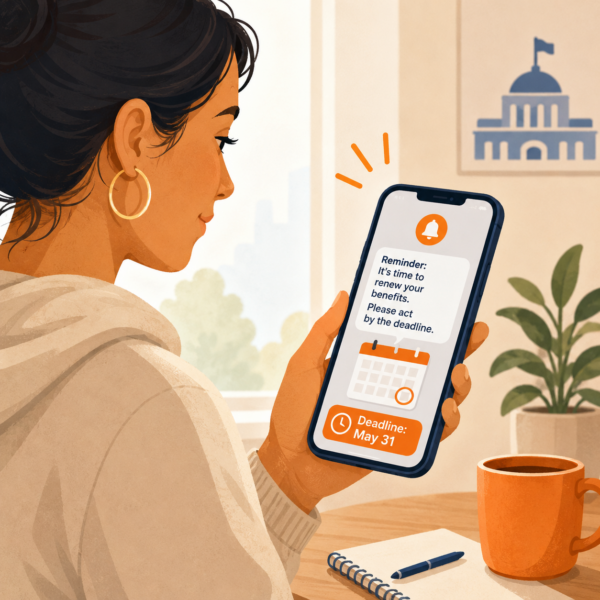 A public benefits text alert should be designed around what the resident needs to do next. Many agencies send short messages that notify residents that something has changed, something is available, or something needs attention. Those messages may be technically accurate, but they can still leave residents unsure how to respond. A message that points to a portal without naming the task may cause the resident to log in and search around without understanding what matters. A message that says documents are due without identifying which documents may lead to calls, wrong uploads, or inaction.
A stronger text alert identifies the action clearly. It should state whether the resident needs to renew benefits, send a document, check a notice, complete an interview, update contact information, or review case status. When possible, it should connect the action to the relevant program or household process. This is especially useful when residents receive multiple benefits, because a reminder connected to SNAP may not resolve a Medicaid renewal, and a child care document request may not satisfy a cash assistance verification need.
The text does not have to include every detail. In fact, it usually should not. The purpose of the alert is to move the resident toward the right task and the right source of truth. A well-designed message gives enough information to prevent confusion, then directs the resident to the appropriate portal, notice, phone number, office, or webpage for the full instruction. The alert should reduce uncertainty, not transfer it to the next channel.
Renewal Reminders Need Clear Timing and Plain Consequences
Renewal reminders carry high stakes because they often relate directly to whether benefits continue. Residents may not recognize a renewal deadline until they receive a mailed notice, portal message, text reminder, or call. A text alert can help bring attention back to the task before the deadline passes, but only if the message makes the timing and consequence clear. A generic reminder that says “renewal due soon” may be better than silence, but it may not be strong enough to prompt action.
A better renewal text explains that the resident needs to complete the renewal by a specific deadline or by the date listed in the official notice. It should make clear that benefits may stop, close, or be delayed if the renewal is not completed. The tone should be serious but not threatening. Residents should understand the importance of the step while also seeing that there is still a path to complete it. The message should lead with action, not penalty.
Renewal reminders should also avoid unexplained technical terms. Words such as redetermination, recertification, eligibility review, or continuation review may be required in some systems or notices, but the text should use resident-facing language wherever possible. If a formal term must appear, the agency should connect it to the plain-language action. A resident should not have to know the agency’s vocabulary to understand that they need to renew benefits.
More Than Just Applications: Human Services and Public Benefits Communication Strategies for State and Local Agencies
This article is part of our series on strategic communication for Human Services Agencies, Public Benefits Agencies, and Health and Human Services departments. To learn more and to see the parent article, which links to other content just like this, click the button below.
Document Reminders Should Identify What Is Missing
Document reminders can reduce churn when they tell residents exactly what is still needed. Too often, text alerts say that documents are missing or verification is incomplete without naming the document, the person it applies to, or the benefit affected. That may prompt the resident to call, but it may not prompt the resident to submit the right information. In a high-volume benefits environment, vague document reminders can increase workload without improving completion.
A stronger document reminder is specific enough to guide action. It might tell the resident that the agency still needs proof of income, a work schedule, identity proof, address information, or another document named in the official notice. When case-specific detail can be included safely and appropriately, the alert should use it. When detail cannot be included because of privacy, system, or message-length limits, the alert should point residents directly to the notice, portal task, or official source where the missing item is listed.
The reminder should also distinguish between sending a document and having that document accepted. Residents may believe that once they upload or mail something, the requirement is complete. If the agency still needs to review the document, the communication system should make that clear through confirmation language and status updates. Text reminders should not create false certainty. They should help residents understand whether the agency is still waiting on them or whether the agency is reviewing what was received.
Text Alerts Must Fit Into a Larger Communication Path
A text alert should not carry the full burden of public benefits communication. It is too short, too context-limited, and too easy to misread when separated from the larger process. Its role is to prompt action and guide residents to the correct next step. That means the message must connect cleanly to the mailed notice, online portal, website, call center script, staff explanation, and partner guidance. If those channels use different terms or provide different instructions, the text may add another layer of confusion.
Agencies should design text alerts as part of a resident journey. A renewal notice may explain the full process. A text reminder may highlight the deadline and direct the resident back to the renewal task. A portal confirmation may explain that the renewal was submitted and is under review. A call center script may mirror the same language when residents ask for help. Each channel has a different job, but the meaning should remain consistent.
This is where message discipline matters. If the mailed notice says “renew your benefits,” the text should not say “complete redetermination” unless the agency has already connected those terms. If the portal says “upload verification,” the text should explain what that means in plain language. If the website provides the most current guidance, the text should point there rather than forcing residents to rely on a fragment of information. Text alerts work best when they are short entries into a clear system, not disconnected reminders sent into an already confusing process.
The First Words Should Tell Residents Why the Alert Matters
Text alerts have very little room to earn attention. Residents may receive them while working, caring for children, riding transit, standing in a store, managing other household needs, or sorting through several messages from different organizations. If the first words are vague, the resident may ignore the alert, assume it is not urgent, or postpone action until the deadline has passed. For public benefits agencies, the beginning of the message should make the purpose clear immediately.
A strong alert opens with the resident action or the case need, not with an internal label. “Renew your benefits,” “Send proof of income,” “Read your notice,” or “Complete your interview” is more useful than a message that begins with a portal name, program acronym, or generic account update. The agency can still include the program or account reference, but the first signal should help residents understand why the message matters to them.
This is especially important because text alerts can feel similar to scams or commercial notifications if they are not written carefully. Residents may be cautious about clicking links or responding to unknown numbers, and agencies should respect that concern. The message should use a recognizable sender, plain language, and a clear connection to an official notice, account, phone number, or website. The alert should not pressure residents to share sensitive information by text. It should guide them toward a trusted official channel.
Lead With the Action, Then Add Context
A text alert should not begin with background information when action is required. Residents need to see the task first, then the reason or context. For example, a renewal reminder should lead with the renewal action before explaining that benefits may stop if the step is not completed. A document reminder should name the missing item before explaining where to submit it.
This sequence is useful because residents often scan text messages quickly. If the first line does not tell them what to do, they may not read far enough to understand the consequence. Leading with action helps the alert function as a prompt, not just a notification.
Avoid Terms That Sound Official but Do Not Guide Behavior
Some public benefits terms are accurate but not especially useful in a short text message. Words such as redetermination, recertification, verification, adverse action, or eligibility review may be part of the formal process, but they may not tell residents what to do. In a text alert, those terms should be translated into practical action whenever possible.
If a formal term must appear because it matches a notice or system label, the alert should connect it to plain language. For example, the message can explain that a redetermination means the resident needs to renew benefits. This small clarification can prevent residents from thinking the text refers to a separate or unfamiliar process.
Timing Matters as Much as Wording
A well-written text alert can still fail if it arrives at the wrong point in the process. If the reminder comes too early, residents may set it aside because the task does not feel immediate. If it comes too late, they may not have enough time to gather documents, find help, complete a portal task, or contact the agency before the deadline. Timing should be designed around the resident’s ability to act, not simply around the agency’s mailing or system schedule.
Renewal and document reminders often require a sequence rather than a single message. An early reminder can make residents aware that action is needed. A closer reminder can highlight the deadline. A final reminder, when appropriate, can reinforce urgency and direct residents to the fastest valid completion path. Each message should serve a different purpose. Repeating the same vague alert several times is less effective than sending a small sequence that becomes more specific as the deadline approaches.
Agencies should also consider the practical time needed to complete the task. A resident who needs proof from an employer, landlord, child care provider, school, bank, or medical provider may need several days to gather it. A resident who needs help from a community partner, interpreter, authorized representative, or local office may need additional time. Text alert timing should account for these access realities. The goal is not only to remind residents that something is due. It is to give them a realistic chance to complete it.
Text Alerts Should Distinguish Between Action Required and No Action Needed
Residents should not have to guess whether a text message requires them to do something. Public benefits agencies often send reminders, confirmations, status notices, appointment alerts, and general updates through similar channels. If the alert does not clearly distinguish action required from no action needed, residents may either ignore an urgent task or call the agency unnecessarily to confirm what the text means.
When action is required, the message should say so plainly and identify the task. When no action is needed, the message should also say that plainly. A confirmation that the agency received a document should not sound like a new request. A status update that says the agency is reviewing a renewal should not make the resident think another submission is required. Clear distinction reduces anxiety and prevents avoidable contacts.
This clarity also supports staff and partner communication. If residents call after receiving a text, the call center should be able to reinforce the same message. If a resident shows the text to a community partner, the partner should be able to tell whether the resident needs to act or wait. The more clearly the alert separates action from information, the less interpretation work falls on everyone else in the system.
Links Should Point Residents to the Exact Next Step
A text alert that includes a link should not send residents to a broad homepage if the resident needs to complete a specific task. A homepage may be useful for general navigation, but it can become a barrier when someone is trying to renew benefits, upload documents, or check a case-specific notice. The link should take residents as close as possible to the correct action, official portal, source-of-truth page, or instruction path.
This does not mean every text must include a link. In some cases, security concerns, state policy, or agency practice may make it better to direct residents to an official website they already know, an online account, a phone number, or the notice they received by mail. When links are used, they should be consistent with the agency’s official digital guidance and should avoid looking suspicious or unfamiliar. Residents should be able to verify that the destination is legitimate.
A strong link strategy also includes fallback instructions. Some residents will not click links in text messages because they are worried about scams. Others may not have enough data, may not remember account credentials, or may need help using the portal. The message should make the official path clear and point residents to other valid ways to complete the task when those options exist. A text alert should move residents toward completion without making one channel feel like the only possible route unless it truly is.
Reminder Language Should Match the Notice, Portal, and Staff Script
Text alerts become more effective when they use the same language residents have already seen in notices, portals, and other agency communication. A resident who receives a mailed notice saying “renew your benefits” should not receive a text that says “complete your redetermination” unless the agency has clearly explained that those terms mean the same thing. A resident who is asked to “send proof of income” should not be sent to a portal screen that only refers to “verification upload” without a plain-language bridge. Small terminology differences can create real uncertainty when benefits are at stake.
Consistency matters because residents often move across several channels before completing a task. They may read a notice, receive a text, log into a portal, call the agency, and ask a community partner for help during the same renewal or document process. If each channel uses different language, the resident may believe there are several separate requirements instead of one required action. That confusion can lead to duplicate submissions, missed deadlines, unnecessary calls, or inaction.
Public benefits agencies should treat text alerts as part of a shared message framework. The same action terms should appear across the mailed notice, portal task, reminder text, call center script, lobby guidance, and partner materials whenever possible. If a formal system label must appear, the text should connect it to the resident-facing action. This makes the reminder feel like a continuation of the same process rather than a new and unfamiliar instruction.
Renewal Texts Should Help Residents Understand What Is Still Unfinished
A renewal reminder should do more than announce that a renewal exists. It should help residents understand whether the renewal has not been started, has been started but not submitted, has been submitted but still needs documents, or is under review by the agency. These are different situations, and each one requires different communication. A resident who has already submitted a renewal should not receive a message that sounds as if nothing has been received. A resident who still needs to send proof should not receive only a general reminder that the renewal is due.
This distinction is important because residents may reasonably assume that any agency reminder means something is wrong. If the text is too vague, they may call to confirm status, upload documents again, or start a new application because they are not sure what remains unfinished. A more useful renewal text identifies the status as clearly as possible. It can say that the renewal has not been received, that documents are still needed, that the agency is reviewing the renewal, or that no further action is needed right now.
When agencies cannot include case-specific detail in a text because of privacy, technical, or message-length limits, the reminder should still point residents to the specific place where they can verify what remains. That may be the official notice, online account, call center, local office, or source-of-truth page. The text should not leave residents with only a vague sense of urgency. It should direct them to the next reliable source of detail so they can complete the renewal without guessing.
Document Reminders Should Reduce Wrong Submissions and Duplicate Uploads
 Document reminders can either reduce confusion or create more work depending on how they are written. A message that says “documents are missing” may alert the resident, but it does not necessarily help them send the correct information. Residents may respond by uploading whatever document seems closest, mailing the same item they already sent, or calling the agency for clarification. In a high-volume benefits environment, vague document reminders can increase activity without increasing successful completion.
A stronger document reminder identifies the missing item in plain language when the agency can safely do so. It can tell the resident that proof of income, proof of address, a work schedule, identity information, or another specific item is still needed. It can also direct residents to the official notice or account for the full list. When a document applies to a particular benefit or household member, the broader communication system should make that clear. The text itself may be short, but it should not detach the reminder from the specific task.
Document reminders should also account for the difference between received and accepted. Residents may believe that uploading a document means the requirement is complete, while the agency may still need to review the document for readability, completeness, and relevance. Text alerts and confirmation messages should avoid creating false certainty. A good reminder system tells residents when the agency is still waiting on them, when the agency has received something and is reviewing it, and when a new or corrected document is needed.
Text Alerts Should Avoid Making Residents Solve the Security Puzzle
Residents are increasingly cautious about text messages that ask them to click links, log into accounts, or respond quickly. That caution is reasonable. Public benefits agencies should design text alerts in a way that prompts action without teaching residents to trust suspicious messages. A benefits reminder should never ask residents to send sensitive information directly by text, and it should avoid language that feels like pressure from an unknown source.
A stronger approach helps residents recognize official communication and verify the path. The alert should use a consistent sender identity when possible, avoid unfamiliar links when agency policy requires caution, and direct residents to official channels they can independently confirm. If a link is used, it should point to an official destination and be consistent with the agency’s broader digital guidance. Residents should be encouraged to use known agency websites, official accounts, or listed phone numbers rather than replying with personal information.
This security discipline supports both resident protection and agency trust. If residents cannot tell the difference between a legitimate alert and a scam, they may ignore important reminders or follow unsafe instructions. Agencies should therefore write text alerts that are clear, restrained, and verifiable. The goal is to prompt timely action while reinforcing safe habits for interacting with digital benefits communication.
Message Sequences Should Build Toward Completion, Not Just Repeat the Same Alert
A text reminder strategy should be more than sending the same message several times. Residents may need different information at different points in the renewal or document process. An early alert can make them aware that action is needed. A mid-cycle alert can clarify what remains unfinished. A near-deadline alert can emphasize urgency and direct them to the fastest valid completion path. A post-submission alert can confirm receipt or explain what happens next. Each message should serve a distinct purpose.
Repeating the same vague reminder may increase frustration without improving outcomes. Residents may wonder why the agency keeps texting without explaining what is actually needed. Some may assume the agency has not received their submission, even if the reminder was automated. Others may stop paying attention because every message sounds the same. A well-designed sequence reduces this problem by matching the message to the resident’s stage in the process.
The sequence should also stop or change when the resident acts. If someone completes a renewal, the next message should not sound as if the renewal is still missing. If a document is received but under review, the message should explain that distinction. If no action is needed, the resident should not continue receiving alerts that imply urgency. Text messaging builds trust when it feels responsive to the resident’s actual status, not merely automated around the agency’s calendar.
Text Messaging Requires Strong Consent, Privacy, and Security Discipline
Text alerts can be powerful because they reach residents quickly, but that same speed creates responsibility. Public benefits agencies should be careful about what information is included in a text, how residents are enrolled, how residents can opt out, how phone numbers are updated, and how messages are written so they do not expose sensitive benefit information. A renewal reminder or document alert may seem routine to the agency, but for a resident sharing a phone, changing numbers often, or living in an unstable household situation, even a short message can carry privacy implications.
Agencies should design text alerts with the assumption that the phone may not always be private, the number may not always be current, and the resident may not always recognize the sender. That means messages should be specific enough to prompt action but careful enough to avoid unnecessary disclosure. A text can say that action is needed on a benefits case without listing excessive personal details. It can tell residents to check an official notice or account without asking them to send private information by text. It can direct residents to trusted agency channels without making the text itself the place where sensitive information is exchanged.
Security discipline also protects the credibility of the agency’s communication. Residents are often warned not to trust suspicious links, unexpected messages, or requests for personal information. Agencies should not undermine that guidance by sending alerts that look or feel like scams. Text alerts should use consistent sender practices where possible, plain and restrained language, recognizable agency references, and official verification pathways. The message should prompt action while reinforcing safe behavior.
Language Access and Accessibility Should Be Built Into the Alert Strategy
Text alerts should be designed for residents with different languages, literacy levels, disabilities, technology access, and comfort with digital tools. A short message may appear simple, but it can still be difficult to understand if it uses program jargon, unexplained acronyms, vague deadlines, or links that are hard to verify. Residents who rely on translated notices, interpreters, assistive technology, shared phones, or community support may need text reminders that connect clearly to other accessible channels.
Language access should not be treated as an afterthought. If an agency sends renewal and document reminders in English only while mailed notices or portal content are available in multiple languages, residents may receive an incomplete communication experience. The agency should consider how residents select language preferences, how text messages align with translated notices, and how alerts direct residents to language assistance. The goal is not to overload a text with every translation detail. The goal is to make sure the text does not become a weak link in an otherwise accessible communication system.
Accessibility also depends on message structure. Texts should use direct wording, avoid unnecessary abbreviations, and make the action easy to identify. Residents should not have to interpret a dense sentence on a small screen to understand that they need to renew, send a document, or check a notice. When possible, agencies should test messages with staff, partners, and residents who understand the practical barriers people face. A message that reads clearly in an internal review may still fail when received by someone under pressure, using a small device, or navigating the process in a second language.
Staff and Community Partners Need the Same Alert Logic
Text reminders often generate follow-up questions. A resident may receive a message and call the agency, visit a local office, show the text to a food bank, ask a legal aid organization for help, or bring the alert to a school, clinic, library, housing provider, or community-based organization. If staff and partners do not understand the alert logic, they may have difficulty explaining whether the resident needs to act, what the deadline means, where the missing document is listed, or how the alert connects to an official notice.
Agencies should prepare staff and partners before major text campaigns go out. They should know what messages are being sent, who is receiving them, what action each alert is intended to prompt, and where residents should be directed for case-specific information. This preparation does not need to be overly complicated. A simple alert guide can show the message language, the resident action, the official source of truth, and the appropriate response when residents ask for help. That kind of alignment reduces confusion and prevents staff from having to interpret the reminder in real time.
Partner alignment is especially important because many residents trust community organizations and may turn to them before contacting the agency. Partners do not need access to private case information in order to help residents understand the general meaning of a reminder. They do need clear boundaries, shareable language, and referral instructions. When partners can explain that a text is prompting the resident to check an official notice, upload a listed document, or contact the agency through a verified channel, they become part of a safer and more consistent communication system.
Agencies Should Measure Whether Text Alerts Are Producing Completion
A text alert strategy should be evaluated by whether it helps residents complete the intended task, not simply by whether messages were delivered. Delivery rates, open behavior, click activity, call volume, renewal completion, document submission, wrong-document rates, duplicate uploads, opt-out rates, and procedural closures can all provide useful signals. If texts are prompting residents to act but not helping them complete the correct action, the agency may be generating activity without reducing churn.
Measurement should connect the text message to the larger resident journey. If a renewal reminder increases portal visits but many residents abandon the renewal before submission, the problem may be in the portal instructions or preparation language. If a document reminder increases uploads but many documents are unusable, the reminder may need clearer guidance about acceptable proof or where to find the full request. If call volume spikes after a text campaign, the alert may be too vague or may not point residents to the right source of truth.
Agencies should use these signals to refine message timing, wording, sequencing, and channel alignment. A text alert program should not remain static after launch. Renewal cycles, document requests, resident behavior, portal workflows, and staff capacity can all change. The strongest agencies treat text reminders as part of continuous communication improvement. They learn where residents are getting stuck and adjust the alert system accordingly.
Text Alerts Should Be Governed as Part of the Agency’s Communication System
Text messaging can become fragmented when different units send alerts for different programs without a shared strategy. One team may send renewal reminders, another may send document alerts, another may send interview notices, another may promote portal use, and another may send general public information. If each message uses different language, timing, sender identification, link practices, or tone, residents may experience the system as inconsistent. This is especially risky for households receiving multiple benefits.
A stronger approach treats text messaging as part of agencywide communication governance. Agencies should define when texts are appropriate, what types of messages require review, how plain-language standards apply, how links are used, how opt-out language is handled, how translated messages are managed, how staff are notified, and how messages connect to notices and source-of-truth pages. Governance does not need to slow down every message. It creates the discipline needed to communicate quickly without creating avoidable confusion.
This is particularly important for high-consequence reminders. Renewal and document messages can affect whether residents maintain benefits. They should not be written as isolated operational alerts. They should be aligned with the notice, the portal, the call center, the website, and partner guidance. When text messaging is governed as part of the broader communication system, agencies can use it as a precise tool for prompting action rather than a loose channel that adds more noise.
Strategic Communication Support for Human Services and Public Benefits Agencies
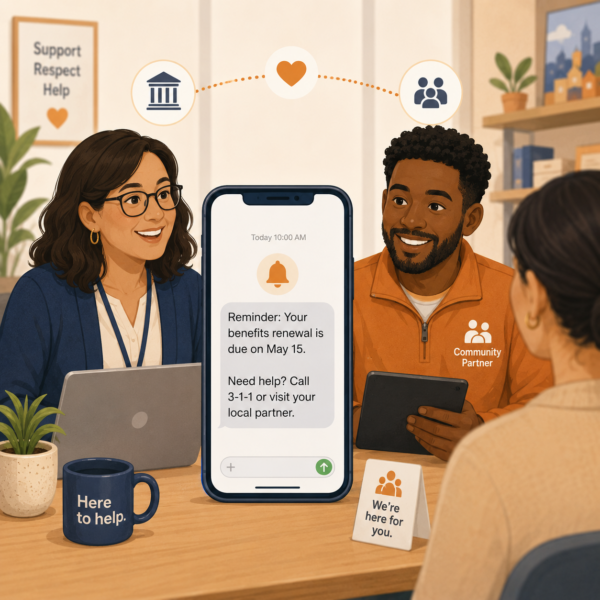 Text alerts are not simply operational reminders. They are high-consequence communication tools that can affect whether residents renew benefits, submit required documents, respond before a deadline, and maintain access to essential support. For human services agencies, public benefits agencies, county social services departments, and state benefits offices, text messaging can reduce churn and improve completion, but only when the alerts are written as part of a broader communication system. A short message can prompt action, but it cannot compensate for confusing notices, inconsistent portal language, unclear document requests, or staff scripts that do not match the public guidance.
Because renewal and document reminders touch so many parts of the resident journey, many agencies benefit from structured communication support. Internal teams may understand eligibility rules, system triggers, message timing, and case-processing requirements, but that familiarity can make it harder to see where residents may become confused. A resident may not know whether a text means action is required, whether the agency has already received a document, whether the alert applies to SNAP, Medicaid, cash assistance, or child care assistance, or whether they should use the portal, call center, mail, office, or another pathway to complete the step.
Stegmeier Consulting Group (SCG) helps human services and public benefits agencies design communication systems that make text alerts more actionable, consistent, and resident-centered. That support may include reminder message frameworks, renewal communication sequencing, document reminder language, source-of-truth page development, staff and partner scripts, plain-language notice alignment, portal language review, and guidance for connecting text alerts to the larger resident journey. The goal is not to send more reminders for the sake of activity. The goal is to send clearer reminders that help residents complete the right action through the right channel at the right time.
This type of support is especially valuable when agencies are trying to reduce procedural benefit loss, improve renewal completion, lower call volume, reduce duplicate submissions, or strengthen trust in digital communication. Well-designed text alerts help residents understand what matters now, staff explain reminders consistently, partners reinforce accurate guidance, and agencies use messaging as a focused tool for completion rather than a general notification channel.
Future Trends in Public Benefits Text Alerts
Human services agencies are likely to place greater emphasis on text alerts as residents continue to rely on mobile communication for reminders, updates, and quick access to agency information. Text messaging will remain useful because it can reach residents faster than mailed communication and can draw attention to time-sensitive benefit actions. But agencies will increasingly need to move beyond basic reminders and design text alerts that are specific, secure, accessible, and connected to the full communication path.
Another likely trend is more personalized reminder logic. Instead of sending the same general message to every resident, agencies will benefit from alerts that reflect where the person is in the process. A resident who has not started a renewal needs a different message from someone whose renewal was submitted but still needs documents. A resident whose document was received but remains under review needs a different message from someone who has not submitted anything. More precise reminder logic can reduce unnecessary calls and duplicate action because residents receive guidance that better matches their actual status.
Agencies may also strengthen the connection between text alerts and digital benefits tools. Texts will increasingly point residents to portals, document upload tools, online notices, and case status screens. That makes language alignment essential. If the text says one thing and the portal labels the task differently, residents may lose confidence or abandon the process. Stronger text strategies will require shared terminology, clearer confirmation messages, and source-of-truth pages that explain what residents should expect after they act.
Finally, text messaging will likely become more closely tied to communication governance. As agencies send more alerts across programs, they will need clear standards for consent, privacy, sender identity, link practices, language access, opt-out handling, staff awareness, partner guidance, and measurement. Text alerts can be powerful, but they should not become a disconnected stream of reminders. They should be governed as part of the agency’s larger communication infrastructure.
Conclusion
Text alerts can help public benefits agencies reduce churn when they are designed to prompt clear and timely action. A strong reminder tells residents what task matters, why it matters, when it must be completed, and where to go for the full instruction. It does not rely on vague account updates, unexplained portal references, or technical benefit language that residents may not recognize under pressure.
Renewal and document reminders are most effective when they fit into a larger communication system. The text should match the notice, portal, website, call center script, staff guidance, and partner materials. It should distinguish action required from no action needed, identify missing documents when possible, respect privacy, support language access, and direct residents to official channels without creating security concerns. Clear reminders reduce interpretation work for residents and reduce avoidable workload for agencies.
In the end, text messaging is valuable because it can reach residents at the moment when action is still possible. Its strength depends on precision, timing, consistency, and trust. When public benefits agencies design text alerts as part of a disciplined communication system, reminders become more than notifications. They become practical tools for helping residents maintain benefits, complete required steps, and navigate agency processes with greater confidence.
SCG’s Strategic Approach to Communication Systems
Align your agency’s messaging, processes, and public engagement strategies.
Human services and public benefits agencies need communication systems that help residents understand deadlines, documents, renewal steps, and case actions without relying on confusing or disconnected reminders. Text alerts can support that work, but they need to be aligned with notices, portals, call center scripts, partner materials, and source-of-truth guidance so residents receive one clear message across every channel.
SCG helps agencies create communication frameworks that turn reminders into effective action prompts. Whether your agency is improving renewal texts, document reminders, portal notifications, staff scripts, partner guidance, or message sequencing across programs, SCG can help you build a communication system that supports clarity, completion, access, and trust. Use the form below to connect with our team and explore how a strategic communication system can help your agency design text alerts that prompt action, reduce avoidable churn, and strengthen the resident experience.