
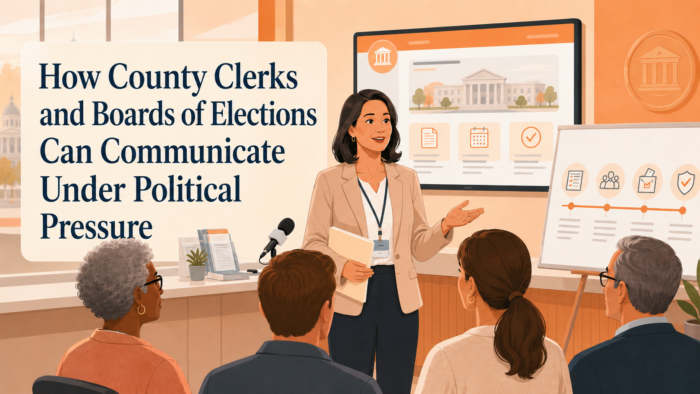
The Nonpartisan Line: How County Clerks and Boards of Elections Can Communicate Under Political Pressure
Political pressure rarely arrives as one dramatic moment. More often, it builds through repeated demands for faster answers, public accusations before facts are confirmed, pressure from campaigns or elected officials to frame a process in partisan terms, and growing scrutiny from voters who want reassurance that the office is being fair to everyone. In that environment, county clerks and boards of elections do not just need accurate procedures. They need a communication approach that helps them stay visibly neutral, credible, and steady while attention intensifies.
That challenge is larger than media relations alone. Election officials are widely recognized by federal and state election organizations as the primary and most trusted official sources of election information, and public confidence is more vulnerable when voters do not understand how election processes work or where to find accurate information. Joint guidance from the U.S. Election Assistance Commission and CISA says that a lack of public understanding can undermine confidence, and NASS’s #TrustedInfo2026 initiative specifically promotes state and local election officials as the trusted sources of election information.
Political pressure also has a personal dimension. The Election Assistance Commission has published guidance noting that many election officials face abusive messages and even violent threats, and that documenting and reporting threats is critically important. That reality changes the communication environment. The office is not only explaining rules and procedures. It is doing so while managing public emotion, institutional risk, and, in some cases, personal safety concerns for staff and leadership.
This article provides an evergreen communication framework for county clerks, boards of elections, and other election offices that need to communicate under political pressure without sounding political themselves. It focuses on how to establish a clearly nonpartisan voice, how to respond when public demands intensify, how to keep procedural language from sounding evasive, and how to build internal discipline so the office speaks with one calm and credible message.
The Nonpartisan Line Has to Be Built Before the Pressure Peaks
 Election offices often talk about nonpartisanship as a value, but under pressure it has to function more like an operating system. It cannot depend on the mood of the moment or on the communication instincts of one spokesperson. If an office waits until a dispute, rumor, recount, delayed result, equipment issue, or high-profile allegation to decide how it will sound, it is already at a disadvantage. The public will hear uncertainty, inconsistency, or defensiveness long before it hears neutrality.
That is why the nonpartisan line should be built in advance. The office needs a stable public voice that is recognizably procedural, fact-based, and institution-centered before controversy ever rises. Joint EAC and CISA guidance encourages election officials to prepare communication plans, define key messages, identify audiences, build teams with clear responsibilities, and prepare incident-response communications so voters know where to access accurate information. In practice, that means the office should not be inventing its tone during conflict. It should already know how it explains deadlines, tabulation, observation rules, ballot processing, audits, canvassing, certification, and disruptions in a way that sounds steady rather than political.
A strong nonpartisan communication posture also helps the office resist pressure to personalize institutional decisions. Under stress, outside actors often try to turn procedural actions into motives. A lawful deadline becomes an attempt to help one side. A refusal to speculate becomes avoidance. A careful answer becomes evidence that something is being hidden. The office cannot control those interpretations completely, but it can reduce their persuasive force by using language that is consistently tied to procedure, timing, law, and institutional role rather than emotion or rhetorical combat.
This matters because public trust is shaped by repetition. Voters decide whether an office sounds neutral not from one statement, but from the cumulative pattern of what they hear over time. If the office consistently explains what it is doing, why that step exists, what comes next, and where official information will be updated, then even critics have less room to claim the office is improvising politically. Neutrality becomes visible through message discipline.
The office should also remember that nonpartisan communication is not the same as passive communication. A neutral office does not need to sound vague, timid, or reluctant. In fact, the opposite is usually more effective. A calm office that states the process clearly, names the relevant timeline, explains the legal or procedural basis for the action, and repeats where official information will appear often sounds more credible than an office trying too hard to avoid every definitive sentence. Neutrality is not softness. It is disciplined clarity without partisan framing.
Another advantage of advance preparation is that it protects staff alignment. Political pressure often exposes differences in internal communication style. One person wants to respond aggressively. Another wants to say very little. Another wants to over-explain every procedural detail. If the office has already developed standard public language and talking points around recurring pressure points, it is much easier to keep the message consistent across leadership, communications staff, call center staff, frontline workers, and board members. EAC communication resources for new election officials explicitly emphasize considering audience needs and using planning materials to support voter communications, which reinforces the value of building this discipline before problems emerge.
Most importantly, a prebuilt nonpartisan voice helps the office avoid the trap of sounding like it is entering the political contest it is trying to administer. Once the office begins answering partisan energy with partisan energy, it loses one of its greatest institutional advantages. The stronger position is to remain unmistakably administrative, transparent, and process-oriented even when others are trying to force the conversation into partisan terms.
Beyond the Ballot: Election Office Communication Strategies for County Clerks, Secretaries of State, and Boards of Election
This article is part of our series on strategic communication for Election Offices, Election Administration Agencies, and Boards of Elections. To learn more and to see the parent article, which links to other content just like this, click the button below.
Define Communication Under Pressure as Clarity, Consistency, and Role Discipline
Election offices communicate more effectively under political pressure when they define the job narrowly and clearly. The job is not to win the argument of the day. The job is not to answer every accusation with equal intensity. The job is to explain what the office is doing, why that action or timing exists, what the public should expect next, and where official information can be verified. When the office treats communication this way, it becomes much easier to stay nonpartisan without sounding detached.
Official election communication guidance supports this approach. The EAC and CISA public communications guide emphasizes identifying the message to share with voters, developing short, simple, and clear talking points, preparing teams for incident response, and ensuring voters know where to access accurate information. NASS’s #TrustedInfo initiative likewise centers the idea that voters should be driven directly to election officials’ websites, social media pages, and official materials for timely and credible information.
Clarity matters because pressure environments reward simplification. If the office uses language that is too technical, too cautious, or too abstract, other voices will fill the gap with simpler explanations that may be partisan, misleading, or false. The answer is not to become political in return. The answer is to become more understandable. The office should translate the administrative process into plain public meaning without sacrificing accuracy.
Consistency matters because political pressure often causes message drift. One interview is more forceful than the last. One spokesperson emphasizes legal procedure while another emphasizes fairness. One statement sounds calm while the next sounds defensive. Even small variations can create the impression that the office is changing its story. A stable message structure reduces that risk. The office should sound like one institution, not like several individuals responding from their own instincts.
Role discipline matters because not every question deserves the same kind of answer. Some questions call for a procedural explanation. Some call for a timeline. Some call for a referral to a formal process, record, or meeting. Some call for a brief statement and then no further elaboration until facts are confirmed. Under pressure, offices get into trouble when they answer from the wrong role. A county clerk or board member should not sound like a candidate, a pundit, or a litigator. The office should sound like the administrator of a public process.
Keep the Office in the Administrative Role at All Times
One of the clearest ways to preserve nonpartisanship is to stay anchored in the office’s actual function. The office administers election procedures, maintains records, communicates timelines, and provides official updates. It does not validate partisan narratives, speculate about motives, or join campaign-style framing. This sounds obvious, but it becomes difficult when pressure is intense and the public conversation is emotional.
A practical way to maintain that line is to speak in the language of procedure, timing, documentation, and official process. Instead of reacting to accusations at their emotional level, the office can explain what step is underway, what standard applies, when the next update will occur, and where the public record or official information can be found. The EAC and CISA guidance specifically recommends developing short, clear talking points about priority topics and practicing them for clarity with people unfamiliar with elections. That is a useful discipline because it helps the office sound comprehensible without sounding political.
This does not make the office weak. It makes the office legible. Under pressure, the most credible institutions are often the ones that refuse to drift from their lane.
Build Messages Around Process, Not Around Personalities
Political pressure often comes wrapped in names, offices, campaigns, and personalities. Communication becomes much more volatile when the election office mirrors that framing. A stronger approach is to keep returning to the process itself. What happened? What is the procedure? What is the timeline? What documentation exists. What comes next? Where can the public verify the official information?
This process-centered approach also helps the office communicate fairly to multiple audiences at once. Voters, reporters, candidates, observers, and community organizations may all be listening for different reasons, but they can all understand a process explanation if it is clear enough. Official election communication guidance emphasizes preparing for key dates, identifying partners who can help amplify or validate messaging, and ensuring that public information remains accurate and accessible during periods of stress or incident response.
When the office builds its public language around the process rather than around the conflict, it becomes harder for outside pressure to redefine the office’s role. That is one of the most practical ways county clerks and boards of elections can protect the nonpartisan line in public view.
Respond to Public Accusations Without Letting the Office Become Part of the Fight
Political pressure often becomes most dangerous for an election office when an accusation demands an emotional response. A campaign, commentator, activist, or elected official may frame an administrative step as partisan, secretive, incompetent, or unfair. If the office answers in the same emotional register, it risks looking like another combatant rather than the administrator of a public process. The stronger approach is to answer accusations by returning to procedure, record, timeline, and official role. Federal election communication guidance emphasizes that officials should communicate clearly, prepare short talking points, and direct the public to accurate official information rather than allowing confusion to spread unchecked.
This does not mean the office should be passive. A nonpartisan response can still be firm. The key is that the office should answer the substance of the public concern without adopting the framing of the accuser. If the accusation is that ballots are being handled improperly, the office should explain the relevant handling procedure, where that process is documented, what stage is currently underway, and when the next official update will occur. If the accusation is about delay, the office should explain the timeline and the required steps still in progress. The office should not sound like it is debating motives. It should sound like it is explaining an administrative process that already has a defined structure. This kind of disciplined messaging is consistent with EAC and CISA guidance encouraging election officials to prepare incident-response communications and clear public explanations for election processes and security topics.
Another practical rule is to avoid answering the loudest version of an accusation when a narrower procedural explanation is what the public actually needs. In pressure environments, accusations often come wrapped in rhetoric designed to provoke a reaction. The office does not need to repeat that language in order to answer the issue. It can restate the topic in neutral terms, explain the procedure, and point to the official record or update location. That helps the office preserve clarity without amplifying a political performance. The Election Assistance Commission’s communication materials stress plain language, audience awareness, and making official websites the clear source of accurate election information, which supports this calmer, procedural posture.
A useful internal test is whether the response helps an ordinary voter understand what is happening. If the answer mostly sounds like rebuttal theater, it is unlikely to strengthen trust. If it explains what step is occurring, why it exists, and what the public should expect next, it is much more likely to work. That distinction matters because most of the office’s audience is not looking for combat. They are looking for orientation.
Answer the Question the Public Needs Resolved
Under political pressure, the accusation being shouted is not always the public question that actually needs to be answered. A public claim may sound like fraud, cover-up, or favoritism, but the public may really be asking something simpler. What is happening right now. Is this normal. What process governs this step. When will there be another update. Election offices communicate more effectively when they identify and answer that underlying question instead of getting trapped in the accusation’s language. Guidance from EAC and CISA specifically recommends developing simple, clear talking points that explain election processes in ways voters can understand and verify.
This approach also protects neutrality because it keeps the office focused on explanation rather than confrontation. It does not ignore the accusation. It translates it into the procedural information the public actually needs. That translation is often the most valuable thing the office can provide during a high-pressure moment.
Use Records, Timelines, and Process Descriptions as Anchors
The most reliable nonpartisan communication anchors are records, timelines, and process descriptions. These help the office avoid speculative language and keep the message tied to verifiable facts. When possible, the office should explain what official record exists, what timeline governs the current step, and what process determines the next action. That posture is aligned with broader election communication guidance encouraging offices to prepare official sources, identify key process explanations in advance, and provide voters with accurate information through trusted channels.
Anchoring to records and timelines also helps the office sound steadier under pressure. A response built around what the office is doing under established procedure is harder to pull into partisan argument than a response built around mood, rebuttal, or rhetorical intensity. It keeps the office in its actual lane.
Use Transparency to Build Trust, Not to Feed Political Theater
 Transparency is essential for election offices under pressure, but not every demand for more information is really a demand for public understanding. Some demands are designed to force the office into a cycle of endless reaction, partial disclosure without context, or premature comment before facts are confirmed. The office therefore needs a disciplined approach to transparency. It should be open, but not chaotic. It should explain the process, make official information visible, and clarify what can be said now, what will be updated later, and where the public record will appear. That approach fits with official election guidance that emphasizes timely, accurate, and clear public information while also preparing for incident response and operational disruptions in a structured way.
A strong transparency posture starts with predictable information practices. If the office uses clear update times, stable public pages, written explanations of common procedures, and visible documentation for key public steps, it becomes easier to answer pressure with openness rather than improvisation. That openness is different from letting every external actor dictate the office’s cadence. The office should share what is verified, explain what is still being reviewed, and avoid creating the impression that it will chase every speculative demand as though it were an official process requirement. NASS’s current #TrustedInfo2026 effort reinforces the idea that state and local election officials should serve as the trusted public source for election information, which works best when the office maintains a clear and orderly source of truth.
Transparency also works better when it is proactive. If the office knows that a process, delay, review step, or board action is likely to attract scrutiny, it should explain that process before the pressure peaks. Election communication resources from EAC and CISA encourage pre-election and pre-incident preparation for exactly this reason. Public understanding is easier to build before a controversy becomes a test of institutional credibility.
At the same time, transparency should not be confused with overexposure. An office can damage its own credibility by speaking too early, speculating beyond confirmed facts, or releasing fragments of information without enough context for the public to interpret them correctly. Under pressure, the office should be explicit about what is known, what is still being confirmed, and when more information will be available. That kind of disciplined transparency is usually more credible than trying to look maximally open in every direction at once.
Political pressure can also intensify personal risk for election officials and staff. The EAC’s election official security resources note that threats and intimidating statements toward election officials are an ongoing reality and stress the importance of documentation, reporting, and relationships with law enforcement. That means communication planning under pressure should account not only for public clarity, but also for staff safety and escalation routes when hostile attention becomes threatening rather than merely critical.
Align Board Members, Staff, Website, and Media Responses Around One Institutional Voice
Political pressure becomes much harder to manage when the office sounds different depending on who is speaking. A county clerk may sound procedural, a board member may sound reactive, a media response may sound more defensive than the website, and frontline staff may improvise under pressure. To the public, those differences do not look like ordinary variation. They look like instability. That is why county clerks and boards of elections need one institutional voice that can be repeated across public meetings, interviews, written statements, FAQs, social posts, and staff responses. Guidance from the U.S. Election Assistance Commission and CISA explicitly recommends building communication plans in advance, identifying team roles and audiences, and preparing clear talking points so voters know where to find accurate information.
The strongest starting point is a shared language set for recurring pressure points. The office should not leave terms like unofficial results, canvassing, certification, chain of custody, observer access, ballot review, machine testing, or audit to individual interpretation in the moment. Each of these topics should have a preferred public explanation in plain language so that the board chair, clerk, public information lead, hotline staff, and website all reinforce the same meaning. The EAC’s communication resources for new election officials specifically encourage offices to consider audience needs and use planning materials and communication resources to support voter-facing explanations.
This alignment also depends on deciding where the official record lives. Under pressure, the website should function as the office’s source of truth. Statements to the press, public comments at meetings, and replies to community questions should reinforce what appears there rather than creating competing versions of the office’s position. That approach fits with the EAC and CISA guidance stressing that election officials should ensure voters know where to access accurate information and that official websites should serve as trusted locations for that information. NASS’s #TrustedInfo2026 effort reinforces the same principle by directing voters to election officials and official election sources for reliable information.
A practical way to support that discipline is to organize every major public pressure point around a simple internal structure. What is happening? Why is this step occurring? What rule, process, or timeline governs it. What should the public expect next? Where can the public verify official information? When everyone in the office works from that same structure, the message becomes easier to repeat accurately and much harder to pull into partisan framing. The election infrastructure incident response communications guide from CISA similarly stresses that communication during incidents affecting election operations or security is essential to confidence in the election process.
Give Board Members and Senior Staff the Same Public Message Architecture
Boards of elections face a special challenge because public meetings often create unscripted moments under visible political tension. One board member may want to explain in detail, another may want to rebut criticism directly, and another may want to defer entirely. Without a common message architecture, these differences can make the board sound divided even when the underlying process is straightforward. The office should therefore prepare board members and senior staff with the same public logic, the same preferred terminology, and the same source-of-truth references before contentious meetings or decision points. EAC communication planning materials emphasize preparing teams and defining communication responsibilities ahead of time rather than improvising during a live incident or controversy.
This does not mean every speaker must sound identical. It means every speaker should reinforce the same institutional meaning. One person may be more concise and another may be more explanatory, but both should return to the same procedural facts, the same timeline, and the same official information source. When that discipline holds, the office appears coordinated and nonpartisan even under visible strain. When it does not, the public starts reading tone shifts as evidence of political division or uncertainty. Official election communication resources consistently place value on coordinated, clear, and audience-aware messaging for exactly this reason.
Let the Website Carry the Detail So Spokespeople Can Stay Clear and Steady
Spokespeople often get pulled into trouble when they try to deliver every procedural detail verbally in a tense moment. The better model is to let the website carry the full explanation while public statements carry the clearest summary. A spokesperson can explain the current step, the governing timeline, and where the public can read the fuller official information. This keeps the spoken message calm and understandable while preserving transparency. It also reduces the chance that a long live explanation will be clipped, reframed, or quoted out of context. EAC and CISA guidance encourages election officials to direct the public to official channels and prepare written materials in advance for topics that are likely to generate confusion or misinformation.
When the website is carrying the detail, it should also be updated with discipline. Time-stamped updates, clear headings, and stable pages for recurring topics help the office maintain a visible pattern of transparency without sounding reactive. This matters because prolonged scrutiny often creates a demand for both speed and clarity, and written source-of-truth content is one of the most effective ways to provide both. NASS’s #TrustedInfo2026 initiative and related resources similarly emphasize election officials as the trusted source for election information and direct voters to official election websites and materials.
Keep Tone Disciplined When Scrutiny Lasts for Days or Weeks
Short bursts of pressure are difficult, but prolonged scrutiny is where many election offices begin to lose tone discipline. Repetition creates fatigue. Staff get asked the same accusatory question in slightly different forms. Public comments become more heated. Reporters seek sharper angles. Community frustration rises because the process is still ongoing. In that environment, the office can start sounding irritated, thin-skinned, or overly legalistic even when the underlying process remains sound. That is why tone discipline has to be treated as a sustained operational practice, not as a one-time communications choice. EAC and CISA guidance both emphasize preparing teams for prolonged incident response communication and ensuring public information remains clear, accurate, and consistent while operations continue.
A disciplined tone under pressure is usually calm, specific, and repetitive in the right ways. It does not sound sarcastic. It does not sound personally wounded. It does not sound eager to win the exchange. Instead, it keeps returning to the process, the timeline, the official record, and the next expected update. That kind of repetition is not a weakness. It is one of the clearest signals that the office is grounded in procedure rather than pulled by politics. The EAC’s communication resources for election officials emphasize clarity, audience focus, and prepared materials, all of which support this steadier approach under stress.
It is also important to distinguish between criticism and threat. Not every hostile message changes the office’s public posture, but threats to election officials and staff must be taken seriously. The Election Assistance Commission has published resources noting that election officials continue to face violent threats and intimidating statements and that it is critically important to document and report every threat, while related federal resources summarize available support for responding to threats against election personnel. That means communication planning under prolonged scrutiny should include escalation routes, documentation practices, and coordination with security or law enforcement when the environment moves beyond criticism into intimidation.
Tone discipline also depends on pacing. The office should not feel compelled to answer every provocation at the speed of social media. In many cases, the stronger response is to update the official source, brief staff and board members, and then repeat the same clear explanation in public rather than engaging every version of the conflict individually. This is consistent with the broader election communications guidance that urges officials to prepare official channels, define communication roles, and make sure voters know where accurate information will be posted during periods of disruption or confusion.
Finally, offices should remember that sustained nonpartisan tone is itself a public demonstration of institutional strength. When a clerk or board of elections sounds measured after days of pressure, the public sees that the office is not being governed by whichever voice is loudest at the moment. That visibility matters. Trust is built not only by what the office says once, but by whether it can keep saying the same clear, factual, process-centered message as long as the scrutiny lasts. NASS’s #TrustedInfo2026 campaign and EAC communication resources both reinforce the idea that election officials serve the public best when they remain recognizable, reliable, and clearly official as information pressures intensify.
Promoting Long-Term Election and Voter Confidence Through Clear Nonpartisan Communication
Clear nonpartisan communication does more than help an office get through one difficult news cycle. It builds a durable public expectation that county clerks and boards of elections will explain what is happening in procedural, factual, and even-tempered terms, even when outside pressure is intense. That matters because national election organizations continue to position state and local election officials as the most trusted official sources for election information, and CISA and the U.S. Election Assistance Commission have emphasized that weak public understanding can undermine confidence in election processes.
This kind of discipline reduces misinformation pressure over time. When the office consistently explains deadlines, observation rules, result reporting, canvassing, certification, and other recurring pressure points in the same plain public language, it becomes harder for outside actors to redefine routine procedures as suspicious events. The stronger the office’s source-of-truth materials and message repetition, the less room there is for rumor, speculation, and partisan framing to fill the gap.
Operationally, stronger nonpartisan communication also lowers internal strain. Offices that prepare clear message structures, defined response roles, and stable public explanations are better positioned to handle media requests, public complaints, and repeated misinformation claims without forcing each staff member to improvise. EAC and CISA guidance specifically recommends identifying team roles, planning for incident response communications, and making sure voters know where official information will appear.
There is also a staff protection benefit. Election officials continue to face threats and intimidation, and the EAC’s security resources stress the importance of documenting and reporting threats and maintaining relationships with law enforcement. A calmer, more structured communication system does not remove that risk, but it helps offices distinguish between ordinary criticism, organized public pressure, and situations that require formal security escalation.
Over time, this work helps the office protect one of its most valuable institutional assets: recognizability as the official, nonpartisan place where the public can verify what is true. NASS’s #TrustedInfo2026 initiative and the Can I Vote project both reinforce the principle that voters should be directed back to election officials and official election websites for reliable information. When county clerks and boards of elections communicate in a way that is consistently procedural and verifiable, they make that trust easier to sustain across election cycles.
Strategic Communication Support for County Clerks, Boards of Elections, and Voter-Facing Agencies
 County clerks and boards of elections often know exactly what procedure governs a disputed issue, but that does not always mean the public-facing explanation is ready for a high-pressure environment. A statement can be legally accurate and still sound evasive. A timeline can be correct and still feel confusing. A board meeting can be procedurally sound and still create public uncertainty if members and staff are not working from the same message architecture.
That is why agencies often choose to partner with an external resource like Stegmeier Consulting Group (SCG) to strengthen communication systems. Stegmeier Consulting Group supports election offices, boards of elections, clerks, and other voter-facing public organizations by helping them build practical communication frameworks for source-of-truth pages, high-pressure public statements, board meeting messaging, media talking points, FAQ structures, staff scripts, and response workflows that stay nonpartisan under scrutiny. These kinds of planning and coordination practices align closely with official election communication guidance that encourages prepared talking points, defined roles, official web resources, and incident-response communication planning.
SCG can also help offices identify where political pressure is most likely to distort public understanding, simplify procedural explanations without sacrificing accuracy, and connect websites, board communications, press responses, and frontline staff language so the office sounds like one institution rather than several competing voices. Those practices help reduce confusion, lower rumor pressure, and strengthen public confidence that the office is administering the process rather than participating in the political fight around it.
Conclusion
County clerks and boards of elections protect the nonpartisan line most effectively when they communicate as institutions rather than as participants in the political conflict around them. Federal election communication guidance emphasizes advance planning, clear talking points, defined communication roles, and official channels that voters can rely on for accurate information, while NASS continues to promote state and local election officials as the trusted sources of election information through #TrustedInfo2026.
That means the office’s job under pressure is not to match accusation with accusation. It is to explain the process, name the timeline, point to the official record, and repeat where verified information will appear next. When that message stays steady across board members, staff, websites, media responses, and public meetings, the office is far less likely to look reactive, divided, or political. Guidance from the EAC and CISA also stresses that communication during incidents affecting election operations or security is essential to maintaining confidence in the integrity of the election process.
The goal is not simply to survive a difficult news cycle. The goal is to build a recognizable public pattern of fairness, steadiness, and procedural clarity that voters can trust across election cycles. Offices that do this well reduce misinformation pressure, lower avoidable operational strain, and make it easier for the public to distinguish election administration from the politics surrounding it.
SCG’s Strategic Approach to Communication Systems
Align your agency’s messaging, processes, and public engagement strategies
Election offices build confidence when every public touchpoint reinforces the same procedural explanation, the same timeline logic, and the same source of truth. Stegmeier Consulting Group (SCG) helps county clerks, boards of elections, and other voter-facing public organizations create coordinated communication systems by developing source-of-truth content, high-pressure response frameworks, public meeting messaging, media talking points, FAQ structures, and staff scripts that remain nonpartisan under scrutiny.
SCG also supports governance and operational coordination so websites, board communications, press responses, hotline language, and frontline staff messaging work together as one coherent public information system. Use the form below to connect with our team and explore how a strategic communication framework can elevate your agency’s impact.