
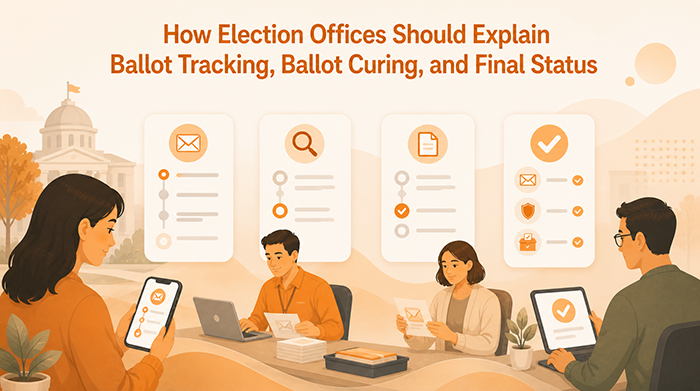
What Happens to My Ballot: How Election Offices Should Explain Ballot Tracking, Ballot Curing, and Final Status
Ballot tracking has become one of the most visible trust points in modern election administration. Voters increasingly expect to know when a ballot was mailed, when it was received, whether it was accepted for counting, and what happens if there is a problem that requires action. That expectation is reasonable, but it also creates a communication challenge for election offices. A ballot status system may be technically accurate and still fail the public if the language is vague, the status labels are hard to interpret, or the next step is unclear.
Confusion usually does not begin with fraud claims or broad public controversy. It often begins with ordinary uncertainty. A voter sees that the ballot is “received” but not yet “accepted.” Another sees a notice about a signature issue and does not understand whether the ballot can still count. Another checks too early, sees no update, and assumes something went wrong. In each case, the problem is not simply the ballot process itself. The problem is that the communication system did not explain the process in terms the voter could understand and act on confidently.
Election offices therefore need to treat ballot tracking communication as more than a technical tool or a legal notice requirement. It is a public-facing confidence system. It helps voters understand where their ballot stands, what the office is doing, what the voter may need to do next, and when a status change is likely to occur. When that communication is clear, it reduces preventable calls, lowers anxiety, and strengthens trust in the process. When it is unclear, it creates unnecessary suspicion around normal administrative steps.
This article provides an evergreen framework for how election offices should explain ballot tracking, ballot curing, and final ballot status. It focuses on message clarity, status definitions, next-step guidance, timing expectations, channel coordination, and practical ways to help voters understand the life cycle of their ballot from issuance through final disposition.
Why Ballot Status Messaging Breaks Down
 Ballot status messaging breaks down because election offices often communicate from the perspective of the process rather than from the perspective of the voter. Internal teams understand that ballots move through multiple administrative stages. They understand that receipt, verification, curing, acceptance, and counting are not always simultaneous. Voters, however, usually experience the process through a very small set of status labels shown on a website, in a text alert, or in an email. If those labels are too technical or too compressed, the voter fills the gap with assumptions.
One common failure point is the use of status terms without enough plain-language explanation. A label such as “received” may be perfectly accurate, but many voters read it as “counted.” A label such as “pending review” may sound alarming even when it reflects a routine step. A label such as “challenged” or “deficient” may be legally precise but emotionally confusing if it does not immediately explain whether the voter can still correct the issue. In these moments, the label alone is not enough. The voter needs the meaning, the likely timing, and the next action if action is required.
Another common failure point is that the process is not linear from the voter’s point of view. A voter may track a ballot at different moments and see different statuses that appear inconsistent even when they are not. For example, a ballot may be marked mailed, then received, then under review, then accepted. Without explanation, the voter may interpret those transitions as delay or risk. The office may see a routine workflow. The voter may see a problem. That gap is where confusion grows.
Timing makes the problem worse. Ballot systems update at different intervals, and some voters expect real-time visibility that the office cannot provide. If the office does not explain expected update windows, voters may assume that a missing change means the ballot was lost or mishandled. In reality, the ballot may simply be moving through a standard verification queue or waiting for the next system refresh. A status page that lacks timing context often creates anxiety even when the underlying process is working exactly as designed.
Messaging also breaks down when the office separates ballot tracking from ballot curing communication. To an election office, these may be separate operational processes. To the voter, they are part of the same story. A voter whose ballot needs correction does not think in terms of departmental workflows. That voter wants to know whether the ballot can still count, what caused the issue, how to fix it, and how long the voter has to act. If the tracking page says one thing and the cure notice says another, trust declines quickly.
A final weakness appears when communication focuses too heavily on compliance language and not enough on usable guidance. Legal accuracy matters, but public understanding matters too. A perfectly compliant notice can still fail as a voter communication if it does not explain the practical meaning of the status in straightforward terms. Election offices need both. They need legally sound language and plain-language interpretation working together.
Voters Interpret Status Labels Emotionally as Well as Logically
Ballot status communication is often treated as a neutral information problem, but voters do not experience it that way. A ballot represents effort, time, and civic responsibility. For some people it also represents planning around work, caregiving, mobility, or transportation. When a status appears unclear or negative, the voter does not interpret it only as data. The voter often interprets it as a sign that something may go wrong with the vote itself.
This is especially true when the vocabulary sounds procedural rather than human. A phrase like “cure required” or “pending adjudication” may make sense inside an office workflow, but to a voter it can sound final, punitive, or opaque. That reaction is not irrational. It is a predictable response to unclear language in a high-stakes setting. Election offices should anticipate that emotional reading and build explanations that reduce unnecessary alarm without minimizing the seriousness of real action deadlines.
That does not mean every status must be softened or stripped of formality. It means each status should be paired with a short explanation that answers the practical question in the voter’s mind. Is my ballot safe? Do I need to do something? Can this still be fixed? When will I know more? Those are the questions that determine whether the communication supports confidence or increases fear.
Normal Process Delays Often Look Like Problems to the Public
Many ballot status concerns come from ordinary timing differences, not actual ballot issues. A voter may return a ballot and expect immediate confirmation. Another may see that the ballot was received but not yet accepted and assume there is a defect. Another may check a tracking portal multiple times in one day and treat the lack of change as evidence that the ballot is stalled. In each case, the communication challenge is not just the status itself. It is the missing explanation of when updates typically occur and what each stage means.
Election offices can reduce a large share of this confusion by normalizing standard timing. If the office explains that ballot receipt may appear before verification, that final acceptance may not show instantly, and that some update windows depend on system refresh timing, voters are less likely to interpret ordinary workflow as abnormal. This does not eliminate every concern, but it dramatically improves the ability of the public to read status information correctly.
Timing explanations are particularly important close to major deadlines. As Election Day approaches, voters become more alert to risk and more likely to interpret silence as danger. Offices that communicate expected timing clearly help prevent a surge of avoidable calls, duplicate inquiries, and rumors about ballots that are actually moving through normal processing.
Beyond the Ballot: Election Office Communication Strategies for County Clerks, Secretaries of State, and Boards of Election
This article is part of our series on strategic communication for Election Offices, Election Administration Agencies, and Boards of Elections. To learn more and to see the parent article, which links to other content just like this, click the button below.
Define Ballot Tracking Communication as Progress Guidance and Next-Step Guidance
Election offices should define ballot tracking communication in two clear ways. First, it should function as progress guidance. Second, it should function as next-step guidance. Progress guidance helps voters understand where the ballot is in the overall process. Next-step guidance helps them understand whether they need to do anything further. When those two functions are separated clearly and explained consistently, ballot status becomes much easier for the public to interpret.
Progress guidance should explain the ballot life cycle in a way that is simple enough to follow without losing accuracy. Voters need to understand that a ballot may be issued, mailed or made available, returned, received, reviewed, and then accepted or flagged for correction depending on applicable rules and processes. That explanation should appear not just in a help center or FAQ, but alongside the status experience itself. A tracking portal is far more useful when voters can see both the current label and the broader meaning of where that label fits in the process.
Next-step guidance is equally important because status labels alone do not tell voters whether action is required. A voter seeing “received” usually needs reassurance that the ballot is in the office’s hands and that the next steps are administrative. A voter seeing a cure-related status needs specific instructions, a deadline, and a clear explanation of how to submit the correction. A voter seeing a final accepted status needs confirmation that no further action is required. Each of these outcomes should be explicit rather than implied.
This approach helps offices write more useful status language. Instead of relying on a short term that voters must decode, the office can pair each status with a short plain-language explanation. For example, a ballot marked received can also say that the ballot arrived and is awaiting any required review. A ballot marked accepted can say that the ballot has been accepted for counting and that no further action is needed. A ballot needing cure can say exactly what issue was identified, whether the ballot can still count, and how the voter can resolve it. These explanations reduce guesswork and create a more transparent experience.
Progress guidance and next-step guidance also help election offices coordinate their channels more effectively. The website, tracking portal, text alerts, cure notices, email messages, and call center scripts can all align around the same simple public logic. Where is the ballot in the process? Does the voter need to act? When should the voter expect another update? That structure keeps communication consistent across the full voter experience and reduces the chance that one channel will sound more alarming or more final than another.
Standardize Status Language So Voters Can Understand the Ballot Life Cycle
A ballot tracking system is only as useful as the language it uses. If the status labels are inconsistent, overly technical, or too compressed to carry real meaning, voters will interpret them incorrectly. Election offices should therefore treat status language as a public communication system, not just a data label system. The goal is not to create more statuses than necessary. The goal is to create a small, stable set of statuses that reflect the voter-facing life cycle of the ballot in plain language.
This matters because most voters are not trying to master election administration terminology. They are trying to answer a few practical concerns. Did the office send my ballot? Did the office receive my ballot? Do I need to fix anything? Is my ballot accepted? A strong status framework helps voters answer those concerns quickly without oversimplifying the underlying process. It also reduces the chance that one voter-facing channel will use language that sounds more positive or more negative than another.
Election offices should avoid treating internal workflow labels as if they are automatically suitable for public display. A term that works well inside the office may create needless confusion outside it. Internal teams may need precise processing categories, but the public-facing system should emphasize clarity, consistency, and actionability. When offices separate internal coding from voter-facing communication, they gain much more control over how the ballot journey is understood.
A well-designed public status framework also creates more stability across election cycles. Voters who use ballot tracking more than once should not have to relearn the meaning of familiar milestones. Staff training becomes easier when the office relies on the same public terms each cycle. Call center guidance, text alerts, website explanations, and cure notices also stay better aligned when they are built around one stable vocabulary.
One of the most useful ways to build that vocabulary is to organize ballot status language around a small set of recognizable stages. Those stages do not need to capture every internal administrative step. They need to communicate what the voter most needs to know at each point. A practical public-facing set might include stages such as ballot issued, ballot sent or available, ballot received, ballot under review if applicable, ballot needs action, and ballot accepted. The exact terms may vary by jurisdiction, but the structure should remain simple enough that a voter can understand the life cycle without reading legal text each time.
Each Status Should Carry Meaning, Timing, and Action
A status label should never stand alone when a short explanation would prevent confusion. Each voter-facing status should be paired with a brief description that explains what the status means, whether the voter needs to act, and when the next update is likely to occur if that is known. This transforms a raw label into usable guidance.
For example, a ballot marked as received should not force the voter to guess whether the ballot is done moving through the system. A brief explanation can clarify that the office has received the ballot and that any required review is underway or pending. A ballot marked as accepted should not simply appear as a coded endpoint. It should clearly tell the voter that the ballot has been accepted and that no further action is needed.
This structure is especially important for intermediate stages. A voter who sees under review may worry unless the office explains that review is a normal step before final status is posted. A voter who sees a needs action label should immediately see what kind of issue exists, whether the ballot can still be counted, how to fix the problem, and what deadline applies. The more direct the explanation, the less likely the voter is to assume the worst.
Timing language should also be realistic. Election offices should not imply instant updates if the system operates in batches or if review steps take time. A short note that status updates may take time to appear, especially during high-volume periods, can prevent ordinary administrative timing from being mistaken for ballot failure.
Avoid Labels That Sound Final When the Ballot Can Still Be Fixed
Some ballot statuses create unnecessary alarm because they sound more final than they actually are. Terms like rejected, deficient, challenged, or invalid may reflect real legal categories, but in many cases the voter still has an opportunity to cure the issue. If the first thing the voter sees sounds definitive, the office may accidentally discourage the very action needed to resolve the problem.
Election offices should be careful about how they present cure-related statuses publicly. If a ballot can still be corrected, the status should say so clearly and immediately. The communication should not bury that fact in fine print or secondary content. The voter needs to understand that the ballot is not yet in final accepted status, but it is also not beyond resolution if the voter acts within the required time frame.
This does not mean offices should hide seriousness or soften legal meaning to the point of confusion. It means the public-facing communication should reflect the real voter decision. If the ballot needs action and can still be corrected, that is the most important truth to present first. More formal terminology can appear in the notice itself where appropriate, but the voter should never have to infer whether the ballot still has a path forward.
Explain Ballot Curing as a Voter Action Process, Not as an Administrative Exception
Ballot curing is one of the most important communication moments in the ballot life cycle because it is the point at which the voter may still be able to protect the ballot from failing to reach final accepted status. Yet it is also one of the most misunderstood parts of election administration. Many voters do not know what curing means, do not know that some ballot issues can be corrected, or do not realize that a cure notice requires prompt action. If election offices explain curing poorly, the result is not just confusion. It can be a lost opportunity.
Offices should present ballot curing as a clear voter action process. The core message should be straightforward. The office identified a correctable issue. The ballot may still count if the voter follows the required steps by the deadline. The office should then explain the specific issue in plain language, provide the cure method, state the deadline clearly, and explain how the voter can confirm when the cure was received and processed. This structure helps the voter move from worry to action.
A cure communication should never rely on jargon alone. Many voters will not understand terms like signature discrepancy, affidavit deficiency, or envelope issue without explanation. The office should translate the issue into practical language while retaining legal accuracy. It should also avoid overloading the voter with long blocks of process detail before presenting the action required. The most important thing is helping the voter understand what to do next.
The curing process should also be explained consistently across channels. If the tracking portal says one thing, the email notice says another, and the hotline script uses different timing language, voters will not know what to trust. The office should align the portal, notices, website FAQ, text alerts if used, and staff scripts around the same public explanation of what curing means and how it works. Consistency is especially important because voters receiving a cure notice are more likely to be anxious and more likely to contact the office directly.
Election offices should also make clear that curing is time-sensitive but manageable. Alarm without guidance is counterproductive. Voters need to understand that the issue matters, but they also need to feel that the office has given them a practical path to resolution. A message that is too passive may not prompt action. A message that is too harsh may discourage it. The best approach is calm urgency supported by precise instructions.
Finally, offices should connect curing to final status rather than treating it as a separate side process. Voters want to know what happens after they submit the correction. They need to understand that the office will review the cure, update the ballot status when appropriate, and show a final result once the issue is resolved or the deadline has passed. That continuity matters because it helps the voter see curing as part of one understandable ballot journey rather than as a confusing detour.
Explain Final Ballot Status Clearly and Honestly
 Final ballot status is the point at which the voter most wants certainty. After the ballot has been mailed, returned, received, and possibly reviewed or cured, the voter wants a clear answer about where things stand. This is where many election offices miss an important communication opportunity. They may assume that a final status label speaks for itself, when in reality the voter may still be unsure what that label means, whether it reflects a completed process, and whether any further action is possible or necessary.
Election offices should therefore define final ballot status in direct, unambiguous public language. If a ballot has reached an accepted final status, the office should say so clearly and pair that status with a brief explanation that no further action is required from the voter. The explanation should not force the voter to infer the result from a coded term or from an internal processing label. A voter should be able to look at the final status and understand immediately that the ballot successfully reached the required endpoint in the process.
This may sound simple, but it becomes complicated when offices try to make one status do too much work. For example, some systems use labels that are technically correct but too vague for the public. A term like completed may leave room for doubt because it does not explicitly say whether the ballot was accepted. A term like processed may describe a workflow milestone but may not tell the voter whether the ballot has reached final accepted status. When the language is too general, voters may continue checking the portal, calling the office, or assuming that another hidden step remains.
Clear final status communication should also distinguish between a ballot that has been accepted and a ballot that has merely moved out of an earlier stage. Offices should not rely on voters to understand the difference between receipt, review, and final acceptance. If the ballot is accepted, that should be the headline meaning. If the ballot is not accepted and still has a remedy available, that should be equally clear. If the ballot is in a final non-accepted status and no further voter action is possible under applicable rules, the office should communicate that outcome carefully, respectfully, and plainly.
Honesty matters here. Some ballots do end in a final status that the voter did not want. Election offices should not hide that fact behind euphemism or vague wording. At the same time, the office should never communicate a negative final outcome in a way that sounds abrupt, unexplained, or detached. If the ballot did not reach accepted status, the voter should see a short explanation of why, whether the issue was correctable, whether the cure deadline passed, and whether there are any additional resources the office can provide to help the voter understand the outcome. Even when the result cannot be changed, the quality of the explanation still affects trust.
Final status communication should also anticipate a common source of public confusion. Many voters think in terms of whether the ballot was counted, while many election systems think in terms of whether the ballot was accepted. Offices should be careful about how they bridge that difference. In some jurisdictions, the legally and operationally appropriate public language is that the ballot was accepted for counting or accepted and will be included according to the jurisdiction’s procedures. That formulation is often more accurate and more understandable than a bare status label with no explanation. It tells voters what they need to know without suggesting that public-facing portals display every later internal counting step in real time.
Another important element is continuity after curing. If a voter submits a cure response, that voter needs to understand what happens next. The office should explain that once the correction is received, it will be reviewed, and the ballot status will then move to a final outcome when that review is complete. Without that explanation, a voter may think the cure submission itself should instantly change the status to accepted. If the system does not update immediately, the voter may assume the correction failed or was not received. A brief explanation of the expected review sequence can prevent that misunderstanding.
Election offices should also think carefully about how they describe the difference between a final accepted status and a final unresolved status. The language should be plain enough for the public but stable enough for staff training, FAQ content, and notice templates. A well-structured final status framework often works best when it uses a small number of public-facing outcomes that are easy to interpret. Those outcomes should answer the voter’s practical question first, then provide supporting detail. In effect, the final status should close the story, not open a new round of guesswork.
A strong public-facing final status framework usually helps answer three questions immediately:
-
What is the final outcome of my ballot?
-
Do I need to do anything else?
-
Where can I get help if I still have questions?
Those questions matter because finality is not only a legal or administrative concept. It is also a confidence concept. The voter wants to know that the process has reached a clear and trustworthy conclusion. If the office communicates that conclusion well, many other communication burdens decrease. Repeat status checks decline. Anxiety falls. Staff spend less time explaining the same endpoint over and over.
Final status communication should also be coordinated across every channel that discusses ballot tracking. The status portal, text alerts, email notices, cure-related updates, FAQs, and call center scripts should all use the same public logic. If one channel says accepted, another says processed, and another says completed, voters will inevitably interpret those differences as meaningful even when they are not. Alignment is especially important at the endpoint because any inconsistency at the end of the process can retroactively undermine trust in everything that came before it.
This is also where tone matters. Final status communication should feel calm, direct, and respectful. A ballot that has been accepted should not be described in stiff bureaucratic language when a clear, reassuring sentence would do. A ballot that ended unsuccessfully should not be described in abrupt terms that make the office sound indifferent. The tone should reflect that the office understands the importance of the voter’s effort and the seriousness of the result.
Finally, election offices should remember that final status is often the point at which voters decide whether they trust ballot tracking at all. If the final outcome is easy to understand and clearly connected to the earlier stages, voters are more likely to view the entire system as transparent and credible. If the final outcome feels vague, delayed, or disconnected from earlier messages, they are more likely to suspect that the system is incomplete or unreliable. In other words, final status communication is not just the end of a process. It is a defining moment in the public’s understanding of how the office handles ballots.
Coordinate Tracking Portals, Alerts, FAQs, and Staff Scripts as One Voter Guidance System
Voters do not experience ballot communication through a single channel. They move between the tracking portal, text alerts, emails, cure notices, FAQs, call centers, and conversations with election staff. A voter may first see a text saying the ballot was received, then open the tracking portal for more detail, then read the FAQ to understand what received means, and finally call the office if the status does not change as quickly as expected. Those channels must therefore function as one voter guidance system. If they use different terms, different timing language, or different explanations of what happens next, the office creates avoidable doubt.
Coordination begins with message alignment. The public-facing status names should be the same across the portal, alerts, FAQs, and staff scripts. The explanation of what each status means should also remain consistent. A voter should not read that a ballot is under review in one place, pending in another, and in process in another unless those distinctions are genuinely necessary and clearly explained. Most of the time, that kind of variation does not add clarity. It adds uncertainty.
Text and email alerts should not try to carry the entire explanation. Their job is to notify the voter of a meaningful change and direct the voter to the appropriate official source for more detail. A short alert can work very well when it uses a stable status label and links back to a portal or page that explains the current step in plain language. The problem begins when alerts are written as isolated messages that sound more urgent or more final than the portal itself. That is why alert language should be built from the same public status framework rather than written separately each time.
FAQs play a different but equally important role. They provide the context that helps voters interpret statuses over time. A good FAQ does not simply define terms in abstract language. It answers the questions voters are most likely to ask when they encounter each stage. What does received mean. Why has my ballot not been accepted yet? What happens after I submit a cure? What does final accepted status mean? These questions should be answered in plain language that reflects the actual portal experience rather than in general process language alone.
Staff scripts are essential because any public communication system eventually reaches a human conversation. Call center staff, election workers, and other frontline personnel need to use the same status vocabulary and the same timing explanations that appear online. If a voter hears one explanation from the portal and another from the office, the second explanation often overrides the first, not because it is more accurate, but because it is personal. That means staff language has to be especially disciplined. Human conversations should reinforce clarity, not introduce a second interpretation of the system.
This coordination also improves office efficiency. When the portal, alerts, FAQs, and staff scripts all answer the same practical questions in the same sequence, the office receives fewer repetitive inquiries and fewer escalations driven by misunderstanding. Staff can spend more time assisting voters with real problems and less time translating inconsistent language created by disconnected channels.
A practical channel coordination model often works best when each channel has a defined purpose:
-
The tracking portal shows the current status and the clearest explanation of what it means.
-
Text and email alerts notify voters of meaningful updates and direct them to more detail.
-
FAQs explain common questions about timing, status progression, curing, and final outcomes.
-
Staff scripts reinforce the same meanings and provide calm, consistent next-step guidance.
Alerts Should Reduce Uncertainty, Not Create It
Ballot alerts are powerful because they bring information directly to the voter, but that power creates risk if the wording is not precise. A short message can easily sound more alarming than intended if it lacks context. For example, a cure-related alert that says action required without immediately explaining that the ballot may still be corrected can create panic before the voter even opens the portal. Likewise, a notification that a ballot was received may unintentionally sound final if the voter assumes that receipt automatically means acceptance.
Election offices should therefore write alert language with special care. Alerts should use stable public labels, avoid unnecessary jargon, and point voters to the official place where the status is explained in fuller detail. They should also be reserved for updates that matter. If offices send too many alerts or alerts that do not clearly reflect a meaningful change, voters may stop paying attention to the ones that are truly important.
Timing language matters here as well. When the office knows that a status may not update instantly after a ballot is returned or a cure is submitted, that expectation should appear in the broader communication system and, when appropriate, in the alert flow itself. Voters are much less likely to interpret silence as failure when they have been told what update timing normally looks like.
Staff Should Explain Statuses the Same Way the Portal Does
A human explanation can either strengthen trust or erode it. When a voter contacts the office, the staff member’s wording becomes part of the ballot tracking experience. If that explanation uses different language than the portal, the voter may conclude that the system is unclear or that different parts of the office are not aligned.
Staff scripts should therefore mirror the same logic used in the public-facing portal. They should explain where the ballot is in the process, whether the voter needs to do anything, and when another update may appear. They should also prepare staff to answer common emotional questions, not just procedural ones. A voter asking whether the ballot is okay is usually asking for both factual information and reassurance that the process is still working.
Short scenario-based training can help staff maintain consistency without sounding robotic. The goal is not to force identical phrasing in every conversation. It is to ensure that every staff member communicates the same meaning, the same next-step guidance, and the same realistic timing expectations.
Promoting Long-Term Election and Voter Confidence Through Clear Ballot Status Communication
Clear ballot status communication does more than answer individual voter questions. It helps build a longer-term pattern of trust in how election offices manage one of the most sensitive parts of the voting process. When voters can follow the life cycle of a ballot in plain language, interpret status changes correctly, and understand what to do if a problem arises, the office reduces the gap between internal process and public perception. That gap is where much avoidable suspicion begins.
Operationally, better communication also reduces preventable pressure on election staff. Offices receive fewer repetitive calls when status labels are understandable, fewer escalations when cure instructions are direct, and fewer anxiety-driven inquiries when timing expectations are explained clearly. This matters during high-volume periods, when even a modest reduction in confusion can improve responsiveness across the entire office.
Equity improves as well. Voters with less time, fewer resources, limited mobility, or less familiarity with election processes are often hit hardest by unclear ballot communication. A system that relies on inference, technical language, or hidden timing assumptions favors those who already understand how to navigate bureaucracy. A system that explains the process clearly, shows the next step plainly, and uses consistent language across channels is more usable for everyone.
In the long run, ballot tracking becomes more than a convenience feature. It becomes a visible signal of whether the office communicates with transparency, discipline, and respect for the voter’s effort. Offices that explain tracking, curing, and final status clearly are not simply reducing confusion in the moment. They are strengthening confidence in the integrity and professionalism of election administration over time.
Strategic Communication Support for Election Offices and Voter-Facing Agencies
 Election offices often have the operational processes needed to support ballot tracking and curing, but they may struggle to turn those processes into a public communication system that voters can understand easily and use confidently. When status labels are unclear, cure messages sound overly technical, and alerts do not align with the tracking portal, normal administrative steps can start to look like unexplained problems. A coordinated communication framework reduces that risk by making sure each voter touchpoint reinforces the same status meanings, the same timing logic, and the same next-step guidance.
That is why agencies often choose to partner with an external resource like Stegmeier Consulting Group (SCG) to strengthen communication systems. SCG supports election offices, boards of elections, clerks, and voter-facing public organizations by helping them build practical communication frameworks for ballot status portals, cure notices, FAQs, alert language, staff scripts, and public-facing guidance. That includes voter-centered message architecture, plain-language status explanations, channel alignment, timing expectation language, and governance approaches that help offices communicate complex ballot processes more clearly and consistently.
SCG can also help offices identify where confusion is most likely to occur in the voter journey, develop clearer final status explanations, and create communication tools that reduce anxiety without sacrificing legal accuracy. These practices help protect voter confidence, reduce misinformation, and improve the overall ballot tracking experience.
Conclusion
Election offices strengthen public confidence when they explain ballot tracking as a clear, understandable journey rather than as a series of technical labels. Voters need to know where the ballot is in the process, what each status means, whether any action is required, and when they should expect another update. When offices provide that guidance consistently, ballot tracking becomes a confidence tool rather than a source of unnecessary uncertainty.
Clear communication matters at every stage. Standardized status language helps voters interpret normal progression correctly. Plain-language curing explanations help voters act quickly when a correctable issue exists. Honest final status communication closes the process with clarity and respect. Coordinated portals, alerts, FAQs, and staff scripts ensure that voters hear the same meaning no matter where they engage with the office.
The goal is not simply to report status changes. The goal is to help voters understand what is happening to their ballot and what, if anything, they need to do next. Offices that communicate with that level of discipline reduce anxiety, lower avoidable staff burden, and make the ballot process easier to trust from start to finish.
SCG’s Strategic Approach to Communication Systems
Align your agency’s messaging, processes, and public engagement strategies
Election offices build confidence when every voter touchpoint reinforces the same status meanings, the same timing expectations, and the same next-step guidance. SCG helps voter-facing organizations create coordinated communication systems by developing plain-language ballot status frameworks, cure communication approaches, final status explanations, FAQ architecture, alert language, and staff scripts that remain aligned throughout the voter journey.
SCG also supports governance and operational coordination so portals, notices, FAQs, alerts, and frontline explanations work together as one coherent public information system. Use the form below to connect with our team and explore how a strategic communication framework can elevate your agency’s impact.