
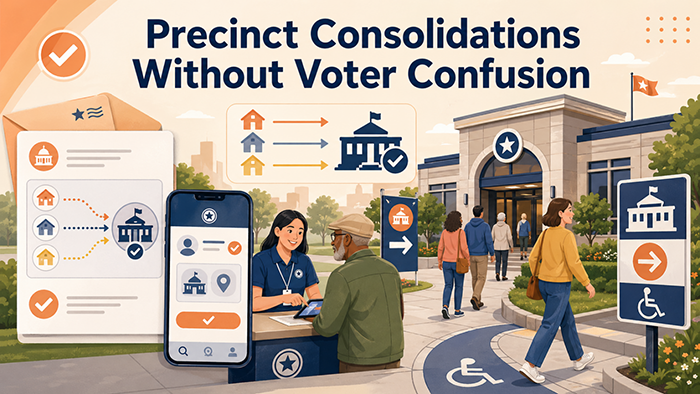
Precinct Consolidations Without Voter Confusion: How Election Offices Can Message Polling Place Changes Clearly
Precinct consolidations can be operationally necessary, but they also create one of the fastest paths to voter confusion when communication is not tightly coordinated. A voter may have gone to the same location for years, rely on a habitual route, or assume that a familiar building will remain unchanged from one election to the next. When multiple precincts are combined into fewer sites, even a well-planned operational change can feel disruptive if voters do not receive clear, consistent, and practical guidance.
Confusion rarely comes from the consolidation itself. It usually comes from fragmented messaging. A mailed notice may use one site description, a website may list another, a social post may shorten the location name differently, and on-site signs may point to an entrance that was never mentioned in earlier communication. Voters then arrive uncertain, staff spend valuable time redirecting basic traffic, and the office faces avoidable frustration that can damage trust in the process.
Precinct consolidation communication is therefore both a public information challenge and a field operations challenge. Voters need to know whether they are affected, where they should go, what to expect on arrival, and how to verify that the information is current. They also need to experience the same message across every official touchpoint. When that happens, consolidations feel manageable. When it does not, even a small change can appear larger and more chaotic than it really is.
This article provides an evergreen framework for election offices that need to message precinct consolidations clearly. It focuses on message structure, label consistency, source-of-truth practices, channel coordination, wayfinding, staff scripts, and partner alignment so polling place changes can be communicated without avoidable voter confusion.
Why Precinct Consolidation Messaging Breaks Down
 Precinct consolidation messaging breaks down because the voter experience moves across too many channels and too many decision points. Voters may encounter a postcard, a voter lookup tool, a text or email alert, a social media reminder, a news story, a community organization post, and finally a sign in a parking lot or at a building entrance. If even one of those touchpoints uses a different language or arrives out of sequence, confusion begins to build.
Messaging also breaks down when election offices assume that a correct notice is enough. A consolidation is not just a piece of information. It is a change in behavior. Voters need to stop relying on habit, confirm that they are affected, travel to a different site or a different entrance, and trust that the change is legitimate. That requires communication that is repetitive in the right ways, coordinated across channels, and centered on the next action the voter should take.
Timing creates another common failure point. If a website is updated but mail has already gone out, voters may treat the printed information as final. If a text alert goes out before hotline staff or poll workers are briefed, the public may react before the field is ready to respond. If the office posts a change without clear time stamps, older versions can continue circulating through neighborhood groups and family chats long after the official guidance changed.
Finally, consolidation messaging breaks down when it explains the administrative reason before telling voters what to do. Voters do not need a long narrative first. They need a simple answer about where to go, which voters are affected, what entrance to use, and how to confirm their information before they leave home.
Voters Experience One Election System, Not Many Internal Functions
Voters do not distinguish between election operations, communications, GIS staff, poll worker coordinators, facility contacts, and community partners. They experience one election system. If the website, mailed notice, signage, and staff scripts do not line up, voters do not see separate internal functions. They see one system that appears uncertain.
That reality makes coordination essential. Even when different teams own different tasks, the voter-facing meaning has to stay aligned. A consolidation notice, a voter lookup result, and an arrival sign all need to tell the same story in the same terms. Otherwise, the office creates extra friction for voters who are simply trying to complete a basic civic task.
Coordination also protects field capacity. When messages align, hotline staff, poll workers, and site greeters spend less time correcting preventable confusion and more time helping voters with actual needs such as accessibility support, language access, ballot questions, or check-in issues.
Confusion Compounds at the Worst Possible Moments
Voter confusion tends to concentrate at high-pressure moments. It appears the night before voting, early in the morning before work, during lunch breaks, after school pickup, and near the close of polls. These are the exact moments when many voters have the least flexibility and the lowest tolerance for mixed signals.
A consolidation can therefore create more than inconvenience if communication is weak. Wrong-site arrivals, parking congestion, entrance bottlenecks, and long redirection lines can all develop from information gaps that seemed minor in advance. In practice, those gaps can suppress confidence and discourage participation among voters who already face time, mobility, transportation, or language barriers.
Election offices should view confusion as a communication outcome, not just a voter mistake. When a large number of people arrive at the wrong place or hesitate at the right place, the message system has failed to support the behavior the office needed.
Beyond the Ballot: Election Office Communication Strategies for County Clerks, Secretaries of State, and Boards of Election
This article is part of our series on strategic communication for Election Offices, Election Administration Agencies, and Boards of Elections. To learn more and to see the parent article, which links to other content just like this, click the button below.
Define Precinct Consolidation Communication as Decision Support and Arrival Support
Precinct consolidation communication should function as decision support. It should tell voters only what they need in order to determine whether they are affected and where they should go. It should also function as arrival support, helping them move from the street or parking lot to the correct entrance, line, and check-in flow once they reach the site.
Decision support requires specificity. Which precincts or voter groups are consolidated. Which prior polling places are no longer in use for this election. Which site is now serving those voters. Whether the change applies to Election Day, early voting, or both. Vague announcements cause voters to assume that the change affects everyone or, just as often, that it affects no one.
Arrival support requires practical detail. If the new consolidated site has a different parking pattern, mention it. If the entrance is on the side of the building rather than the front, say so clearly. If voters needing accessible access should use a separate route, provide that information in plain language. These details matter because the final stage of confidence is built when voters can match what they read in advance to what they see when they arrive.
Both decision support and arrival support depend on consistency. The same site name, address, entrance description, and help instructions should appear in every official place where the voter looks. When those elements remain stable, the office reduces anxiety and helps the public trust that the consolidation is organized rather than improvised.
Build a Shared Message Spine for Every Consolidation-Related Channel
Coordination begins with a shared message spine. The spine is the structure that keeps meaning consistent across the website, voter lookup tool, mailers, text alerts, email notices, social posts, news talking points, hotline scripts, and on-site signs. Without a spine, each channel writes its own version, and voters receive slightly different versions of the same change.
A practical message spine for precinct consolidations should stay simple and repeatable. It should identify the affected voters, state what changed, provide the new voting location, describe any arrival instructions, and direct people to the official source of truth. The first line should carry the voter action because that is the portion most likely to be read quickly, screenshotted, or repeated by a third party.
A useful structure includes:
-
Who is affected
-
What changed
-
Where to vote now
-
What to expect on arrival
-
Where to verify current information
This structure works across almost every channel. A text alert can use a shortened version that points voters to the lookup tool. A postcard can present the same sequence in plain language. A social post can carry the action-first line and direct people to the official page. Hotline and poll worker scripts can mirror the same order so the public hears the same explanation regardless of where they ask.
The point of the spine is not to make every message identical in length. It is to make every message identical in meaning. When the same structure appears again and again, voters learn what to look for and can process changes more quickly.
Use One Label Set for Sites, Entrances, Parking, and Affected Voters
Label consistency is one of the fastest ways to reduce confusion during a consolidation. If a site is called Lincoln Middle School in one channel, Lincoln Gym in another, and Lincoln Community Entrance in a third, voters may assume the information conflicts even if all three references point to the same location. That hesitation can be enough to send someone to the wrong driveway, the wrong door, or the wrong line.
Election offices should define one official label set and use it everywhere. That includes the polling place name, the address format, the entrance description, the parking reference, and the voter group description. If the site is officially listed as Lincoln Middle School, then every notice should use that name first and clarify the entrance second. If the entrance is Door B, that same wording should appear in the website guidance, text reminders, poll worker briefing, and sign system.
Stable labels also make translation, accessibility support, and third-party amplification easier. Community organizations, interpreters, local media, and hotline staff can all repeat the same terms. That reduces drift and gives voters a better chance of matching what they heard to what they see on site.
Lead With the Voter Action, Not the Administrative Explanation
Consolidation notices often begin with background language about districting, staffing, facilities, turnout history, or resource allocation. That information may matter, but it should not appear before the instruction the voter actually needs. The message should first say where the voter should go and who is affected.
Action-first language reduces stress because it gives the voter an immediate next step. Once that step is clear, the office can provide limited context about the reason for the consolidation. That sequence matters because voters process communication differently when they are preparing to vote than when they are reading a general policy update.
This approach also travels better through the community. When a short message is forwarded from one person to another, the key action remains visible. That makes it less likely that administrative detail will crowd out the operational guidance voters need most.
Make the Source of Truth Clear, Public, and Easy to Confirm
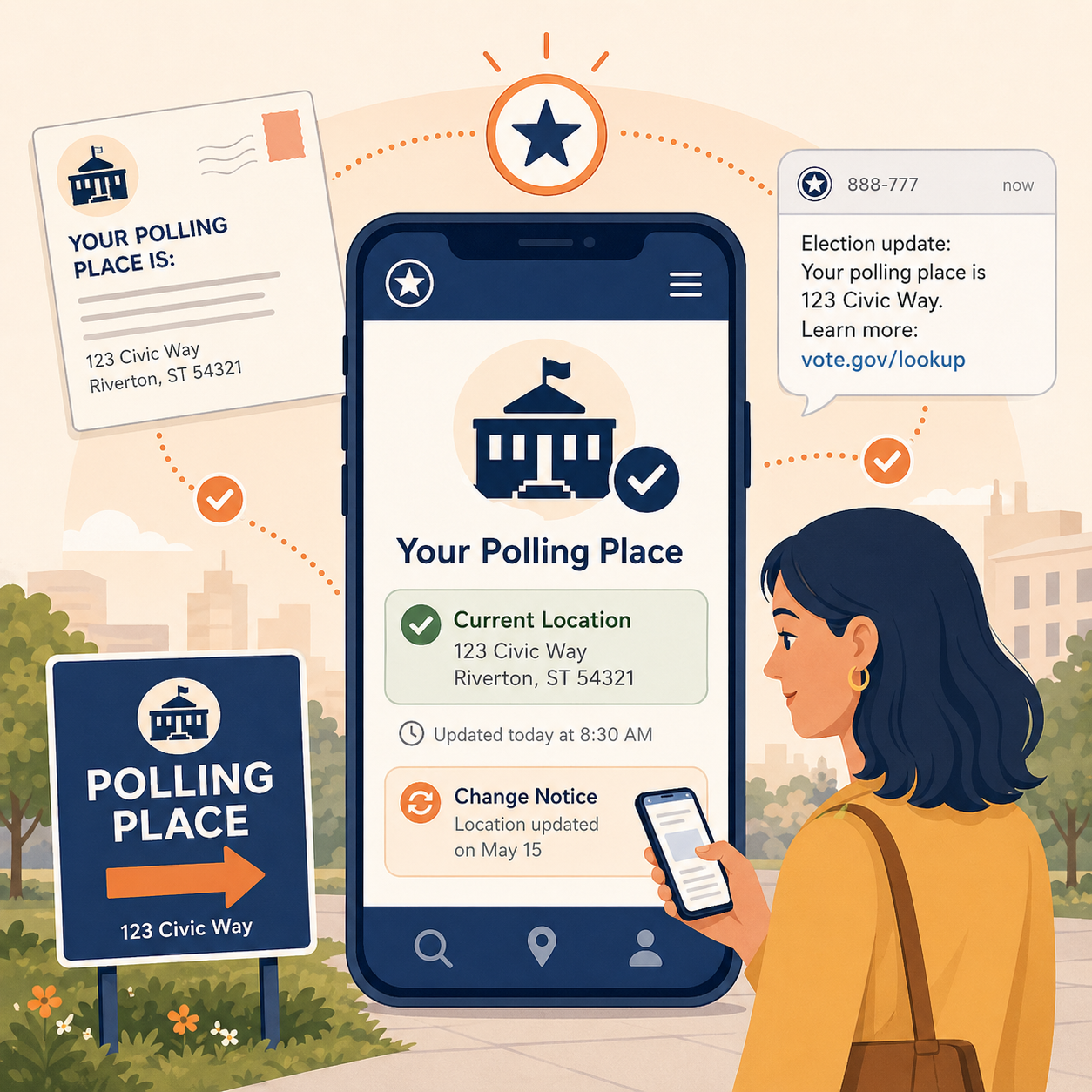 During a precinct consolidation, voters will compare information from multiple places. Some will rely on printed mail. Others will search online, visit social media, call the office, or ask a trusted community group. The election office cannot control every source in circulation, but it can establish a clear source of truth and train every official channel to point back to it.
A source of truth should be easy to scan, mobile-friendly, and clearly time-stamped. It should say which voters are affected, where they should vote now, what entrance or parking guidance applies, and how to get help if they need language support or an accessible route. It should also allow voters to verify their own information rather than rely only on general notices.
Every office-controlled channel should reinforce that source. A postcard can tell voters where to verify their site. A text alert can link directly to the lookup tool or update page. A social post can provide the short action line and refer voters back to the official page. Hotline staff and community partners should know exactly which page or tool to reference.
A strong source-of-truth experience should answer a short list of voter decisions quickly:
-
Am I affected by this consolidation
-
Where do I vote now
-
What should I look for when I arrive
-
How do I confirm my voter-specific information
-
Where do I get help if I need assistance
Use Time Stamps and Short Change Notes to Prevent Conflicting Versions
Old information can remain believable long after it is outdated, especially when it comes from a printed notice, a community repost, or a screenshot that appears official. A time stamp helps voters determine whether what they are seeing is current. A short change note helps them understand what changed without having to read every version from the beginning.
If the consolidation affects only certain precincts, say that clearly. If the site stayed the same but the entrance changed, say that clearly. If the office corrected an earlier location label or parking note, state that plainly. These change cues reduce suspicion because they show that the office is managing the update transparently rather than silently replacing information.
Time stamps and change notes also help staff stay aligned. When hotline workers, poll workers, and communications staff all know which version is current, they are far less likely to contradict an older notice still being referenced by the public.
Keep the Official Information Focused on the Voter Decision
A source-of-truth page should not become a long narrative explanation of the consolidation process. Voters need a fast answer about where to go and what to expect. If the page is overloaded with procedural detail, the key instruction becomes harder to find.
A better approach is to keep the top section focused on the voter decision and the arrival path. More context can appear below for voters who want it, but the first screen should answer the immediate need. That makes the experience more usable for mobile users, first-time voters, older voters, busy caregivers, and anyone confirming information under time pressure.
Coordinate Mail, Website Updates, Alerts, Social Posts, and Signage as One Voter Guidance System
Voters do not experience election communication as separate channels. They move through those channels in sequence. A person may read a mailed notice at the kitchen table, verify the location online the night before, see a reminder text on the morning of voting, and follow signs once they reach the site. Those channels therefore need to operate as one voter guidance system. If one says the right thing and another says it differently, the office creates doubt at the exact moment it needs confidence.
Coordination begins by assigning each channel a clear role. Mail creates awareness and establishes that a change is real. The website and voter lookup tool provide verification. Text and email alerts reinforce urgency and direct people to confirm. Social posts amplify the message and correct rumor. On-site signs and greeters then complete the experience by confirming what the voter already saw. When those roles are clear, the office avoids redundancy that adds noise and instead builds a layered communication path that supports the voter from home to arrival.
Signage deserves special attention because it resolves the last stage of uncertainty. A voter can follow every correct step in advance and still lose confidence in the parking lot if the signs feel inconsistent, improvised, or incomplete. The sign system should therefore reinforce the exact same names, entrance terms, and directions that appear in digital and printed materials.
Finally, these channels must be updated together. A website correction without corresponding sign replacement creates contradictions on the ground. A social post without hotline preparation creates avoidable pressure on staff. A mail notice that uses one label set while the lookup tool uses another weakens trust before the voter even leaves home.
Place Guidance Before Decision Points and Use Confirmation Cues
Voters make choices at predictable moments. They decide whether they are affected, when to leave home, which driveway to enter, where to park, which entrance to approach, and which line to join. Guidance should appear before those decisions, not after a voter has already committed to the wrong path.
Decision-point placement works best when paired with confirmation cues. After a voter turns into the correct lot or approaches the correct side of the building, a second cue should confirm that they are in the right place. This reduces hesitation, backtracking, and line disruption. It also helps keep traffic moving because fewer people stop to reconsider whether they took the wrong route.
Confirmation cues are especially valuable at consolidated sites serving multiple precincts. Voters arriving at a larger location may be uncertain whether they are in the correct place or whether the site is simply crowded. Reassurance at the right moments can reduce stress and lower the burden on greeters and poll workers.
Make Temporary Signage Look Official and Part of the System
Temporary signs often fail because they look disconnected from the official election system. A sheet of paper taped to a door or a handwritten arrow may contain correct information, but it can still undermine trust because it appears provisional or unofficial. In election settings, appearance matters because voters use visual cues to judge whether guidance is reliable.
Temporary signs should therefore use the same naming conventions, tone, and basic visual hierarchy as the rest of the office’s communication. The site name should match the notice. The entrance label should match the website. The redirection should be clear and uncluttered. Signs should be placed where drivers and pedestrians can both benefit from them, and outdated signs should be removed promptly so they do not remain in circulation as false guidance.
Accessibility should be built into the sign plan as well. Signs should be readable from a reasonable distance, placed where they are visible without requiring guesswork, and designed to support voters who may already be under time or mobility stress.
Align Poll Workers, Hotline Staff, Community Partners, and Local Officials
During a consolidation, staff become one of the most important communication channels. Voters will ask whether they are in the right place, where to enter, whether the change applies to them, and what to do if they expected to vote somewhere else. If staff language does not match public messaging, the office will lose credibility quickly even if the website and mail were correct.
This is why internal alignment matters as much as external messaging. Poll workers, site greeters, hotline staff, and any facility personnel assisting on voting day should receive the same message spine, the same location labels, and the same escalation paths. They do not need a long narrative. They need short, confident, action-oriented language that matches what the public already saw.
Community partners and local officials also matter. Neighborhood groups, libraries, municipal offices, advocacy organizations, and elected officials often share voting information with good intentions. During a consolidation, these groups should not be left to paraphrase the change on their own. The office should give them copy-ready language that protects accuracy and keeps location terms consistent.
Decision rights should be clear as well. Election operations should own site and routing decisions. Communications should own message structure and public deployment. Poll worker leadership should own field execution and issue escalation. When those responsibilities are defined, updates move more cleanly from the office to the field.
Provide Copy-Ready Blocks for Partners and Frontline Use
Partners and frontline staff often do not have time to draft custom language, and they should not have to. Copy-ready blocks reduce drift because the office can provide language that already matches the lookup tool, signage, and official notices. That helps community organizations and local officials amplify the right information without unintentionally changing key details.
These blocks should stay short and action-first. They should name the affected voters, the new site, and the official place to verify current information. Where appropriate, they should also mention arrival details such as the correct entrance or parking note. A version date should appear on any packet that may be reused so partners know whether they are sharing the current language.
A practical support packet can include:
-
A short public notice for email, text, or social sharing
-
A hotline script for common voter questions
-
A site greeter script for redirecting confused voters
-
A brief partner note for community organizations and municipal offices
Train Staff Scripts for Calm, High-Trust Interactions
Many voters arrive with limited time and high stakes. A polling place change that seems minor from an administrative standpoint can feel far more significant to a voter who arranged childcare, coordinated a ride, took time off work, or is already uncertain about the process. Staff scripts should therefore do more than provide directions. They should help stabilize confidence.
A strong script mirrors the same message spine used in public communication. It confirms whether the voter is affected, states where the voter should go, gives the next clear action, and directs the voter to the official confirmation source if needed. It should also include respectful language for frustrated voters and a clear escalation route for people who need accessibility support, language assistance, or help resolving uncertainty about their polling place.
Practice matters. Short scenario drills before voting begins can improve consistency and reduce improvisation. Staff do not need an elaborate training exercise. Even a few brief role-play examples can help them internalize the correct site names, entrance labels, and redirection language so they sound confident when the public begins to ask for help.
Promoting Long-Term Election and Voter Engagement Outcomes Through Communication
Clear precinct consolidation communication improves more than one election day. It helps build a longer-term pattern of trust between the election office and the public. When voters see that polling place changes are explained clearly, verified easily, and supported consistently on site, they learn that the system can be trusted even when it changes. That confidence matters because election administration often depends on the public’s willingness to act on official guidance quickly and without unnecessary skepticism.
Operational performance improves as well. Fewer wrong-site arrivals, fewer parking and entrance bottlenecks, and fewer repetitive hotline calls all allow staff to focus on real support rather than preventable correction. Poll workers can assist voters more effectively, lines are easier to manage, and field conditions become more stable because the communication system is doing its job.
Equity improves when consolidation messages include accessible routes, arrival details, and language support pathways. Voters with less flexibility are disproportionately affected by unclear directions. That includes older voters, voters with disabilities, voters relying on rides, first-time voters, and people with limited English proficiency. When the office communicates clearly before and during arrival, it reduces the risk that confusion becomes disenfranchisement in practice.
A disciplined consolidation communication system also lowers rumor risk over time. When the public consistently sees time-stamped updates, stable location labels, and coordinated signs and scripts, misinformation has less room to grow. The office becomes the place people trust first, rather than the place they check only after hearing something elsewhere.
Strategic Communication Support for Election Offices and Voter-Facing Agencies
 Election offices often have strong operational knowledge of precinct consolidation plans but struggle to keep public communication aligned across mail, websites, alerts, social posts, partner outreach, and field execution. When site labels drift, update timing varies, and arrival guidance remains vague, voter confusion can quickly become a logistical and credibility problem. A coordinated communication system reduces that risk by making sure every public touchpoint reinforces the same action, the same location details, and the same verification path.
That is why agencies often choose to partner with an external resource like Stegmeier Consulting Group (SCG) to strengthen communication systems. SCG supports election offices, boards of elections, clerks, and voter-facing public organizations by building practical communication frameworks that connect voter notices, website updates, lookup tools, signage systems, hotline language, partner outreach, and poll worker scripts. That includes message spine development, stable label systems for sites and entrances, copy-ready communication blocks, update templates, and governance workflows that keep digital and on-site guidance aligned.
SCG can also help offices design mobile-friendly source-of-truth pages, strengthen channel coordination before voting begins, and create staff scripts that reduce escalations during high-pressure voter interactions. These practices help protect public trust, reduce misinformation, and improve the voter experience during both planned consolidations and last-minute site changes.
Conclusion
Precinct consolidations can be communicated clearly when election offices treat communication as part of the voting system rather than as a separate notice function. A shared message spine, stable location labels, and a clear source of truth allow mail, websites, lookup tools, alerts, social posts, signage, and staff scripts to tell one coherent story. Decision-point guidance and confirmation cues reduce hesitation on arrival, while copy-ready partner language helps keep public amplification accurate.
Credibility is preserved through predictable update discipline, time stamps, short change notes, and visible alignment between digital guidance and the physical site. Internal coordination matters just as much as public communication because poll workers, hotline staff, site greeters, and community partners all shape how voters interpret the change. When these practices are embedded, voter confusion decreases, field pressure eases, and the consolidation feels more orderly and more trustworthy.
The goal is not only to announce that a polling place changed. The goal is to help voters act correctly and confidently from the moment they hear about the consolidation to the moment they enter the correct line. Election offices that communicate with that level of discipline protect both operational performance and public confidence.
SCG’s Strategic Approach to Communication Systems
Align your agency’s messaging, processes, and public engagement strategies
Election offices build confidence when every channel reinforces the same action, the same location labels, and the same source of truth. SCG helps voter-facing organizations create coordinated communication systems by developing message spines, stable polling place and entrance label sets, time-stamped update templates, voter-friendly source-of-truth content, and practical field guidance that stays aligned from home to arrival.
SCG also supports governance and operational coordination so updates stay synchronized across notices, lookup tools, alerts, websites, partner communications, signage, hotline scripts, and poll worker language, even when changes happen close to voting. Use the form below to connect with our team and explore how a strategic communication framework can elevate your agency’s impact.