
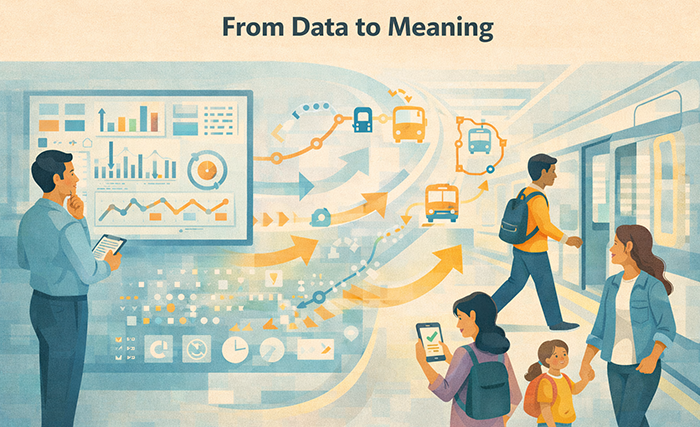
From Data to Meaning: Turning Transit Performance Metrics Into Rider Trust
Transit agencies collect a large amount of performance data. On-time performance, headway adherence, missed trips, crowding, elevator uptime, customer service response time, and project delivery milestones can all be measured. The problem is that measurement alone does not create trust. Riders can hear that performance is improving and still feel that daily travel is unpredictable, especially when their own trips do not match the story.
Trust grows when riders can connect the data to lived experience. They need to understand what a metric means for their commute, their transfer, their late-night trip, or their ability to plan childcare pickup. They also need to see that the agency is being transparent about what is improving, what is not improving yet, and what the agency is doing next. When metrics are published without that meaning, riders interpret reporting as public relations rather than accountability.
Turning data into meaning is a communication strategy. It requires a stable set of rider-relevant measures, plain-language definitions, consistent reporting rhythms, and a clear explanation of how actions drive outcomes. It also requires equity awareness, because system averages can hide the lived experience of riders who face the highest burden from delays, missed trips, and inaccessible stations. This article provides an evergreen framework for using performance metrics to build credibility, reduce cynicism, and strengthen rider trust over time.
Why Performance Metrics Do Not Automatically Create Trust
 Many performance dashboards are written for internal management rather than for riders. They use technical terms, complex charts, and large tables that are hard to interpret quickly. Riders then see data as something the agency uses for itself, not as information designed to help the public understand service quality. When riders cannot interpret what they are seeing, the reporting does not increase trust, even if the numbers are positive.
Trust also breaks when agencies rely on system-wide averages. A system average can improve while a specific corridor continues to feel unreliable. Riders who experience long gaps or repeated missed transfers will judge credibility based on those trips, not based on a regional average. If the public narrative says performance is improving and riders do not feel it, riders often assume the agency is hiding the real story.
Timing also matters. Riders are sensitive to inconsistency in the reporting cycle. If the agency publishes a dashboard irregularly or changes the measures frequently, riders struggle to track progress. Inconsistent reporting can look like the agency is moving the goalposts, even when the intent is simply to refine metrics.
Finally, trust declines when metrics are presented without actions and accountability. Riders do not only want to know what the numbers are. They want to know what the agency is doing about the numbers. A dashboard that reports performance without linking it to specific operational changes, staffing actions, infrastructure work, or reliability initiatives feels incomplete. Over time, riders learn to ignore it.
From Detours to Understanding: Effective Communication Strategies for Transportation Agencies to Improve Safety and Drive Behavioral Change
This article is part of our series on strategic communication for Transportation Agencies, Transit Authorities, and Public Works departments. To learn more and to see the parent article, which links to other content just like this, click the button below.
What Riders Need From Performance Communication
Riders need clarity, relevance, and consistency. Clarity means plain-language definitions and simple visual logic that helps people interpret results quickly. Relevance means measures that map to lived experience, such as missed trips, long gaps, transfer reliability, crowding by time of day, and elevator uptime at key stations. Consistency means the same measures and the same framing over time, so riders can recognize progress and understand what “better” looks like.
Riders also need context that respects their experience. A credible performance update acknowledges that conditions vary by corridor, time of day, and type of trip. It identifies where improvements are strongest and where challenges remain. It also sets realistic expectations about stabilization periods, seasonal variation, construction impacts, and the difference between short-term disruptions and long-term reliability work.
Performance communication also works best when it is decision-supportive. It should help riders know where to find reliable information, how to interpret service changes, and what to expect during improvement initiatives. It can also help riders understand the agency’s priorities and tradeoffs, especially when improvements are phased. When riders see a clear connection between priorities, actions, and metrics, trust grows even if the system is not yet where it needs to be.
Equity-focused performance communication is part of this. Riders who have the least flexibility pay the highest cost when service is unreliable. Performance reporting should therefore include measures that reflect worst-case outcomes, such as long gaps, missed trips, and accessibility outages, not only average conditions. Reporting that centers these high-burden experiences signals that the agency is measuring what matters most to riders who depend on the system daily.
Build a Metrics Communication Spine That Makes Results Interpretable
Performance reporting builds trust when it follows a consistent communication spine. Riders should not have to relearn how to read the agency’s story each month. A stable structure makes reporting easier to understand and easier to compare over time.
A practical spine begins with the rider meaning statement. It summarizes what riders should notice in daily travel. The next element is the metric definition in plain language, including what the agency measures and why it matters. The third element is the trend, stated clearly as improving, stable, or worsening over a defined period. The fourth element is the location and time context, clarifying where the result is strongest and where it is weaker. The fifth element is the action link, describing what the agency did or is doing to drive the change. The final element is the next step, stating what will be monitored next and when the public will receive the next update.
This spine turns numbers into a coherent narrative without exaggeration. It also reduces suspicion because it shows that reporting is tied to action and accountability. Riders can see not only what is happening, but also what the agency is doing and what to expect next.
The spine should be consistent across metrics. If the agency uses this structure for reliability, crowding, accessibility, and customer response, riders learn how to interpret each update quickly. Consistency also supports staff and partners who need to share the information in public settings.
A spine also supports multilingual and accessibility needs. When the structure is predictable and plain, translation is more accurate and assistive technologies can present information more effectively.
Lead With “What This Means for Riders” Before Showing the Chart
Most riders do not start with charts. They start with questions about their trips. Reporting should begin with a short statement that explains what the metric means in lived experience. This shifts the tone from technical reporting to practical communication.
A rider meaning statement can describe what riders should notice, such as fewer long gaps, fewer canceled trips, more consistent arrival spacing, or improved elevator reliability. It should be specific and grounded in daily travel. It should avoid sweeping claims that riders may not feel across every corridor.
Leading with meaning also reduces misinterpretation. A chart might show improvement, but riders may not understand the baseline or the context. A meaning statement sets interpretation before the visual detail appears.
This approach also supports trust because it signals that the agency is measuring service for riders, not only for internal reporting.
Tie Each Metric to a Specific Operational Lever
Metrics build credibility when they are connected to what the agency is doing. Riders want to know what changed in operations, staffing, maintenance, scheduling, or infrastructure that produced the result. Without this link, metrics can feel abstract and disconnected from reality.
Operational levers should be described in plain language. For example, schedule adjustments to match real travel time, headway management practices to reduce bunching, targeted bus lane enforcement, operator staffing improvements, or maintenance changes that reduce elevator downtime. The agency does not need to share every internal detail. It needs to show a clear cause-and-effect relationship.
Linking metrics to levers also reduces cynicism about reporting. Riders are more likely to trust a dashboard when it is paired with visible, concrete actions.
This approach also supports internal alignment. Teams can see how their work is represented publicly, and staff can communicate more consistently about what the agency is doing to improve service.
Choose Rider-Relevant Measures and Avoid Overloading the Public
Trust does not grow from publishing every available metric. It grows from publishing the right metrics in a consistent way. An overloaded dashboard can feel like a data dump and can cause riders to disengage. A smaller set of high-value measures creates clarity.
Rider-relevant measures often include long gaps, missed trips, arrival spacing, transfer reliability, crowding by time window, accessibility uptime for elevators and ramps, and response times for service issues. These measures map to lived experience. They also capture the failure modes that create the most frustration.
Agencies should also include measures that reflect stability, not only averages. For example, a corridor’s average on-time performance might improve while variability remains high. Measures that capture variability, such as the share of trips with a gap above a defined threshold, often matter more to riders than a small change in averages.
Measure selection should also reflect equity. Riders who depend on transit most are harmed most by long gaps and missed trips. Including worst-case measures signals that the agency is measuring what matters to the most impacted riders.
Finally, measure selection should remain stable. Frequent changes in measures undermine trust because riders cannot track progress. Agencies can improve measures over time, but changes should be explained clearly and applied consistently.
Use Corridor-Level Reporting to Match Lived Experience
System-wide numbers can hide local reality. Corridor-level reporting helps riders connect performance to their trips. It also helps community partners and local leaders understand where improvements are strongest and where more work is needed.
Corridor reporting should be designed carefully. It should use a consistent set of corridors and a consistent set of measures so trends are comparable. It should also be presented in a way that does not overwhelm. A limited set of key corridors, updated consistently, often works better than a map of every route.
Corridor reporting also supports transparency. Riders are less likely to assume the agency is hiding poor performance when reporting includes areas that are struggling.
This approach also improves decision support. If a corridor is underperforming, the agency can explain what actions are being taken there, rather than relying on a general system narrative.
Include Measures That Reflect Reliability and Accessibility Together
Many riders experience performance as a trip chain, not as a single vehicle arrival. A trip chain includes station access, platform movement, vehicle arrival, boarding, and transfers. If accessibility fails at the station level, the trip fails even if the vehicle is on time.
Including accessibility measures, such as elevator uptime, in the same performance narrative signals that the agency values usability for the full community. It also helps riders understand whether station access is improving over time.
Combining reliability and accessibility measures also improves accountability. It prevents agencies from focusing only on vehicle movement while neglecting the barriers that keep riders from using service.
This approach also supports equity. Riders with disabilities are disproportionately affected by station access failures. Including these measures in core reporting signals that the agency is measuring what matters.
Make Metrics Understandable With Plain Language and Clear Visual Logic
Performance communication fails when the public has to interpret charts without guidance. Clear visual logic reduces interpretation burden and helps riders understand trends quickly. Visual design is part of communication strategy because it shapes what riders notice first and what they believe is changing.
A practical approach uses consistent definitions, consistent time windows, and consistent baselines. If the agency reports monthly performance, it should use the same monthly cycle each time. If it uses rolling averages, it should explain that clearly and use the same method consistently. Consistency reduces suspicion and makes progress easier to see.
Plain language is essential. Terms like “headway adherence” and “run time variability” can be translated into rider language such as “more evenly spaced arrivals” and “less unpredictable travel time.” Riders can understand technical ideas, but they need the meaning in practical terms.
Visuals should prioritize trends and thresholds. Riders care about whether conditions are improving and whether service meets a reasonable reliability threshold. Showing trend lines and the share of trips that exceed a long-gap threshold can be more meaningful than presenting a single average.
Visuals should also be scannable. Too many charts, too many axes, and too many categories can overwhelm. A smaller set of visuals tied to the rider meaning statements is more effective than a comprehensive data dump.
Use Simple Thresholds That Reflect Real Rider Experience
Threshold-based reporting can make metrics more intuitive. For example, instead of only reporting average headways, an agency can report the share of riders who experienced a gap longer than a defined threshold in a given corridor during key time windows. This maps directly to frustration and planning uncertainty.
Thresholds should be chosen carefully and explained clearly. They should reflect rider experience, not only internal targets. They should also remain stable over time so riders can track improvement. If a threshold changes, the agency should explain why and how it affects trend comparisons.
Threshold reporting also supports equity. Riders who face the highest burden from long gaps are often those with the least flexibility. Measuring the worst outcomes signals that the agency is focusing on the harm that matters most.
Thresholds can also support accountability. When thresholds are public and stable, the agency can show progress toward reducing the most severe failures, not only improving averages.
Threshold-based measures also help staff communicate. Staff can explain improvements in practical terms, which reduces skepticism and improves credibility in public conversations.
Explain Variability and Stability, Not Only Averages
Averages can be misleading. A corridor can have a good average while still producing severe long gaps and bunching. Riders remember the extremes because those are the moments that disrupt life and create mistrust.
Explaining variability can be done in simple terms. Agencies can describe whether arrivals are becoming more consistent and whether the largest gaps are shrinking. They can also describe whether missed trips are decreasing and whether transfers are more dependable.
Stability is often a better trust builder than speed. Riders can plan around a consistent pattern more easily than around a faster but unpredictable one. Reporting should therefore emphasize stability and reliability improvements, not only average travel time changes.
Variability reporting should be consistent and not overly technical. It can use simple visuals such as distributions or a long-gap share measure that communicates variability without requiring advanced statistical literacy.
This approach also reduces cynicism. Riders are less likely to interpret reporting as selective when the agency acknowledges variability and addresses it directly.
Use Transparent Context That Prevents Metrics From Feeling Like Spin
 Riders distrust metrics when they suspect cherry-picking. Transparent context reduces that suspicion and strengthens credibility. Context means explaining what changed in the operating environment and how that affects results.
Context can include seasonal variation, major construction impacts, staffing constraints, service design changes, and unusual events. The key is to explain context without using it as an excuse. Riders respond better when context is paired with actions and next steps.
Context also includes acknowledging uneven performance. An agency can be transparent about corridors that improved and corridors that did not. It can also explain what is being prioritized next. This honesty often builds more trust than a broad claim that everything is improving.
Context should also include time framing. Some improvements, such as infrastructure changes and fleet upgrades, take time. Others, such as schedule adjustments and headway management practices, can produce faster changes. Explaining timelines helps riders set realistic expectations and reduces disappointment.
Finally, context should include how the agency is listening. If rider complaints and reports informed a specific improvement, the agency can say so. This signals that rider feedback is part of the performance system, not separate from it.
Acknowledge What Is Not Improving Yet and What Will Be Done Next
Credibility increases when agencies name challenges openly. If a corridor remains unreliable, the agency can say so and explain what actions are being taken. If elevator uptime has not improved as expected, the agency can explain what maintenance changes are planned and how updates will be communicated.
This transparency prevents a common trust failure. Riders often know where performance is weak. If reporting avoids those areas, riders assume the agency is hiding problems. Naming them directly reduces that suspicion.
Naming challenges should be paired with clear next steps and a reporting cadence. Riders should know when the agency will update progress and what measures will be used. Predictability builds confidence.
This approach also supports internal accountability because it links public reporting to operational commitments.
Use “What We Did” and “What We Are Doing Next” to Link Data to Action
Data becomes meaningful when it is connected to actions. A performance update can include a short list of operational actions that influenced the trend and a short list of next actions being implemented.
These actions should be described in plain language and tied to a specific metric. For example, schedule adjustments to reduce late departures, updated dispatch practices to maintain spacing, targeted corridor improvements to reduce delay sources, or staffing changes to reduce canceled trips.
The “what we are doing next” section should also include timing. Riders want to know when they might feel a change. The agency should be realistic and avoid overpromising.
Linking action to data also supports staff and partners. It gives them consistent language to explain improvements and reduces speculation about what the agency is doing behind the scenes.
Use Consistent Reporting Rhythms and Channels That Riders Can Find
Performance reporting builds trust when it is predictable. Riders should know when updates will be published and where to find them. Irregular reporting makes progress harder to track and can create suspicion, even when performance is improving.
A practical approach sets a cadence, such as monthly highlights with quarterly deeper dives. The cadence should remain stable across the year. It should also be communicated clearly so riders understand when to expect new information. Predictability reduces rumor cycles and reduces the perception that updates appear only when the news is positive.
Channel consistency matters as much as cadence. A dashboard can be the primary reference, but riders may discover it through social posts, newsletters, station posters, or announcements. Each channel should route riders to the same source of truth. The dashboard should be mobile-friendly, readable, and structured around rider meaning statements rather than technical categories.
Reporting should also be easy to share. Riders and community partners often share performance information in meetings and local forums. When reporting is structured with clear summaries and stable links, it is more likely to be shared accurately rather than paraphrased incorrectly.
Finally, reporting channels should be integrated with rider feedback routes. A performance page can include a simple way to report recurring problems or to request clarification. When riders can see that feedback is part of the system, reporting feels less like a one-way broadcast and more like accountability.
Build a “Performance Highlights” Layer for Quick Understanding
Not every rider wants to read a full dashboard. A performance highlights layer provides a quick, scannable summary that explains what changed and what it means. It can include the top trends, the corridors where improvements are strongest, and the corridors where challenges remain.
Highlights should use the same message spine as the dashboard. They should begin with rider meaning statements, then cite the key measure, then link to the full detail. This structure preserves transparency while reducing cognitive load.
Highlights should also include time stamps and a consistent reporting window. Riders should be able to tell immediately which period is being reported. Clear time framing reduces confusion and prevents outdated highlights from circulating as if they are current.
A highlights layer also supports internal alignment. Staff can use the same summary language in public conversations, which strengthens consistency and reduces conflicting explanations.
Keep Definitions and Measures Stable So Trends Remain Comparable
Trust depends on comparability. If measures change frequently, riders cannot tell whether performance is improving or whether the agency changed the measurement method. Stability is essential.
Stability does not mean measures can never evolve. It means changes should be rare, explained clearly, and implemented with continuity. For example, if a measure changes, the agency can provide a bridge explanation and maintain a historical comparison where possible.
Definitions should also remain stable. If “missed trip” is defined one way in one report and differently in another, the public cannot track progress. A clear glossary of measures helps maintain stability.
Stable measures also support partners and media. When definitions are consistent, public conversation becomes more accurate and less speculative. This improves trust and reduces misinformation.
Stability also reduces internal workload because teams can update the same templates rather than rebuilding reporting each cycle.
Use Staff and Partner Communication to Reinforce Performance Meaning
Riders often interpret performance reporting through conversations, not through dashboards. Community meetings, rider boards, social media discussions, and frontline interactions shape trust. Performance communication is more effective when staff and partners can explain what the metrics mean in practical terms.
Staff readiness starts with a message pack. It includes the rider meaning statements, plain definitions of key measures, corridor-level highlights, and the actions tied to the trends. Staff can then answer questions consistently and avoid improvising explanations that may conflict with published reports.
Partners also matter. Community organizations, employers, and local leaders often discuss transit performance in their own forums. Providing partner-ready summaries and copy blocks reduces misinterpretation and helps accurate meaning travel through trusted networks.
Staff and partner communication also supports transparency about tradeoffs. If performance improvements require schedule adjustments, stop changes, or construction impacts, staff and partners should have clear language to explain why those choices were made and how they connect to reliability outcomes.
Finally, staff and partner reinforcement should preserve tone. Performance reporting should sound calm and factual, not defensive. A respectful tone signals competence and supports trust even when the report includes areas that are not improving.
Equip Frontline Staff With Simple Explanations and Routing Guidance
Frontline staff often receive questions about delays, reliability, and accessibility. Staff do not need to recite metrics. They need short explanations that connect performance efforts to rider experience.
A simple explanation can describe what the agency is working to improve, such as reducing long gaps and missed trips. It can also direct riders to where performance updates are published and where to report recurring issues. Routing guidance helps riders find verified information and reduces rumor reliance.
Staff should also have a safe way to address frustration. Clear, calm language that acknowledges inconvenience and points to practical options reduces conflict. This tone is consistent with trust-building performance reporting.
Equipping staff also reduces burnout because staff are not forced to improvise under pressure.
Provide Partner Toolkits That Preserve Meaning and Avoid Cherry-Picking
Partners may unintentionally cherry-pick positive numbers when sharing performance updates. Cherry-picking can backfire and reduce trust. A partner toolkit can reduce this by providing a balanced summary that includes both improvements and remaining challenges.
The toolkit should include the rider meaning statements, the key measures, the time window, and the actions being taken. It should also include the stable link to the full dashboard so partners can reference the source of truth.
Providing balanced toolkits supports community trust. Partners can share credible information without feeling like they are acting as spokespeople. It also helps community conversations stay grounded in verified facts rather than speculation.
Partner toolkits also improve consistency across forums, which reduces misinformation and strengthens public understanding over time.
Promoting Long-Term Transportation Outcomes Through Communication
Performance metrics build trust when they are translated into rider meaning, reported consistently, and linked to clear actions. Riders are more likely to believe improvement narratives when they can connect measures to daily experience, such as fewer long gaps, fewer missed trips, more reliable transfers, steadier crowding conditions, and improved accessibility uptime.
Long-term trust improves when agencies use a stable metrics communication spine. Rider meaning statements, plain-language definitions, corridor-level context, and transparent trends help riders interpret results without feeling manipulated. Stable measures and consistent reporting rhythms make progress comparable over time. Time stamps and clear reporting windows reduce confusion and discourage outdated sharing.
Equity outcomes improve when performance reporting includes high-burden failure modes rather than only averages. Measures that reflect long gaps, missed trips, and accessibility outages show that the agency is measuring what matters to riders with the least flexibility and the highest dependence on transit. Corridor-level reporting also helps reveal uneven experiences and supports targeted improvement discussions.
Operational outcomes improve as well. Clear reporting reduces rumor cycles and reduces repetitive questions because riders can verify performance information through a consistent source of truth. When metrics are linked to operational levers, staff and partners can explain improvements more consistently, which reduces conflict and strengthens public cooperation with change.
Finally, data-to-meaning communication supports resilience. Systems will have difficult days. Agencies that communicate performance with transparency, consistent context, and clear next steps can maintain credibility even when improvements are still underway.
Strategic Communication Support for Your Transportation Agency
 Transportation agencies often have robust performance data but struggle to translate it into public trust. Agencies must select rider-relevant measures, explain them in plain language, avoid hiding corridor-level challenges, and connect trends to actions without sounding defensive. Without a shared system, reporting can feel like a data dump or a public relations effort, and riders disengage.
That is why agencies often choose to partner with an external resource like Stegmeier Consulting Group (SCG) to strengthen communication systems. An outside partner can help transportation organizations design data-to-meaning reporting, including metric communication spines, rider meaning statements, corridor-level dashboards, plain-language measure glossaries, consistent reporting rhythms, staff message packs, partner toolkits, and update templates that keep definitions stable.
SCG supports transportation agencies by helping teams translate performance metrics into practical public guidance. That includes developing rider-centered narratives, designing visuals that communicate thresholds and stability, building transparent “what we did and what we are doing next” linkages, and aligning staff and partner communication so the public hears consistent explanations. Over time, these practices reduce cynicism, strengthen trust, and improve public understanding of service improvement efforts.
Conclusion
Turning transit performance data into rider trust requires more than publishing dashboards. Agencies build credibility by leading with rider meaning, using plain-language definitions, choosing a focused set of rider-relevant measures, reporting at the corridor level, explaining variability and stability, and providing transparent context that includes what is not improving yet. Linking metrics to operational actions and next steps makes reporting feel accountable rather than promotional.
A consistent cadence and a clear source of truth help riders track progress and verify information. Staff and partner toolkits extend meaning into real conversations. When performance reporting is designed as decision-support communication, it becomes a practical trust-building system that strengthens long-term engagement and cooperation.
SCG’s Strategic Approach to Communication Systems
Align your agency’s messaging, processes, and public engagement strategies
Agencies that communicate effectively build stronger trust with staff, stakeholders, and the public. Whether you are improving performance communication, strengthening internal workflows, or aligning agency-wide messaging, SCG can help you develop a communication system that supports consistent decision-making and long-term organizational success. Use the form below to connect with our team and explore how a strategic communication framework can elevate your agency’s impact.