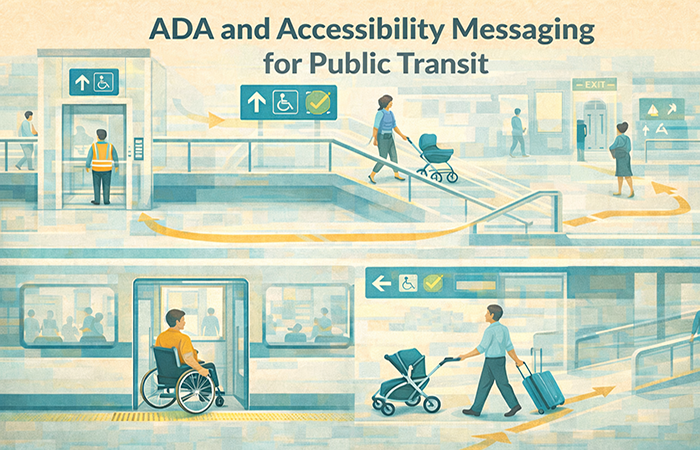
Beyond Compliance: ADA and Accessibility Messaging for Public Transit
Accessibility is not only a compliance requirement. It is a core component of service quality. When public transit is accessible, riders with disabilities can plan trips with confidence, complete transfers reliably, and use stations, stops, and vehicles without unnecessary barriers. When accessibility information is unclear, delayed, or inconsistent, the system becomes difficult to use even if the infrastructure meets technical standards.
Many agencies communicate accessibility in legal terms or only in specialized sections of their websites. Riders often need practical information at decision points. They need to know which entrances are accessible, whether elevators are working, how to request assistance, and what alternatives exist during outages or construction. They also need to receive this information in a tone that preserves dignity and avoids implying that accessibility is an exception or a burden.
Accessibility messaging also affects frontline operations. When riders cannot find reliable guidance, staff are forced to solve problems in the moment, often under pressure. Clear, consistent accessibility communication reduces conflict, reduces travel uncertainty, and improves safety. It also strengthens trust across communities that rely on transit for independence and daily life.
This article provides an evergreen framework for public transit agencies that want ADA and accessibility messaging to go beyond compliance. It focuses on rider-first information design, consistent terminology, update rhythms for outages and construction, staff readiness, and quality controls that make accessibility guidance practical and reliable.
Why Accessibility Messaging Breaks Down in Real Life
 Accessibility messaging often breaks down because it is separated from the main service communication system. An elevator outage might be posted on a specialized page, while service alerts use different wording, and station signage does not match. Riders then have to assemble information from multiple sources while trying to travel. That experience is exhausting and often unsafe.
It also breaks down when accessibility guidance is too vague. Phrases like “use the accessible entrance” are not actionable if riders do not know which entrance that is, how to reach it, and whether it is open. Vague guidance shifts the burden of problem-solving onto riders, which undermines independence and increases stress.
Another breakdown occurs when updates are not timely. Accessibility conditions can change quickly. If an elevator returns to service but the website still lists it as out, riders may avoid the station unnecessarily. If an outage begins and the update arrives late, riders can become stranded. Time stamps, predictable updates, and consistent routing to a source of truth are essential.
Finally, accessibility messaging can break down due to tone. Language that sounds like a warning, a restriction, or an inconvenience can feel stigmatizing. Accessibility communication should be calm, practical, and dignity-first. It should treat accessible pathways and support options as normal parts of service delivery.
From Detours to Understanding: Effective Communication Strategies for Transportation Agencies to Improve Safety and Drive Behavioral Change
This article is part of our series on strategic communication for Transportation Agencies, Transit Authorities, and Public Works departments. To learn more and to see the parent article, which links to other content just like this, click the button below.
Define “Beyond Compliance” as Practical Independence and Predictability
Beyond compliance means that riders can use the system with confidence. It means accessibility information is easy to find, consistent across channels, and updated reliably. It means riders can plan for accessible routes, navigate outages, and understand alternatives without needing to negotiate for help.
Practical independence is supported by clear information design. Riders should be able to answer key questions quickly. Which route is accessible for my trip? Which entrance should I use? What do I do if an elevator is out? Where can I get assistance? What is the accessible alternative during construction? These questions should be answered in plain language and with stable place labels that match signage.
Predictability also requires updated discipline. Accessibility updates should include time stamps and “what changed” lines. They should also provide next update times when conditions are evolving. When riders know when to expect updates, they can plan more effectively and feel less anxious.
Beyond compliance also includes integrating accessibility into everyday messaging. Accessibility should not be hidden. It should appear wherever service impacts are discussed, such as construction phases, detours, station entrance changes, and major service disruptions. Integration reduces unequal information access and signals that the agency is designing for the full community.
Use an Accessibility Message Spine That Makes Guidance Actionable
Accessibility messaging is most effective when it follows a consistent structure that riders can recognize quickly. A stable message spine reduces uncertainty, supports faster comprehension, and makes it easier for staff and partners to share the same meaning across channels.
A practical accessibility spine begins with the impact statement, written in plain language. It states what is unavailable or what has changed, such as an elevator outage, an entrance closure, a platform access constraint, or a temporary route change. The next element is scope, including the specific station, entrance label, platform, or stop affected. The third element is timing, including when the condition began, the time of the last update, and when the next update will be provided if the situation is evolving. The fourth element is the accessible alternative, stated as an executable route with clear directions. The fifth element is the help route, including how to request assistance and where staff support is available. The final element is the verification path, pointing to the current source of truth.
This structure keeps the most critical information visible. It also reduces reliance on vague phrases. Riders need to know exactly what to do, and a spine forces the message to include the actionable steps that support independence.
The spine should also use consistent terminology. Terms such as “accessible entrance,” “elevator,” “lift,” “ramp,” “platform access,” and “assistance” should not shift across updates. Consistent terms reduce confusion and improve translation quality when multilingual support is needed.
Finally, the spine should be designed for short formats, such as alerts and signage, as well as longer formats, such as web pages and rider guides. A consistent spine allows the agency to communicate the same meaning at multiple levels of detail without introducing contradictions.
State the Accessible Alternative as a Route, Not as a Suggestion
Many accessibility messages fail because the alternative is presented as a general instruction. Riders need a concrete route that they can follow. An alternative should name the entrance or station to use, describe how to reach it using visible cues, and clarify what the rider will experience once they arrive.
A route-based alternative should include direction cues such as cross streets, landmarks, or station-side labels. It should also indicate whether the alternative requires additional walking time and whether that route is accessible for common mobility devices. When the alternative is realistic and clearly described, riders are less likely to become stranded or to rely on uncertain assistance.
Route-based guidance also supports staff. When staff use the same route description, riders receive consistent instructions in conversation and on signs. This reduces conflict and reduces the need for staff to improvise explanations.
A route-based approach also improves safety. Riders are less likely to attempt unsafe shortcuts when they can see a clear, official accessible path.
Use Time Stamps and “What Changed” Lines to Protect Trust
Riders who rely on accessibility information are often planning around constraints. Outdated information can cause unnecessary detours, missed appointments, and higher stress. Every accessibility update should include a clear time stamp, and updates should include a short “what changed” line when conditions shift.
A “what changed” line might state that an elevator has returned to service, that the accessible path has moved due to construction, or that a help point has changed location. This makes updates easier to interpret and reduces the spread of outdated screenshots.
Time stamps should also be consistent across channels. If an outage is listed in one place but not another, riders will not know what to trust. Consistent time stamps and consistent routing to a source of truth reduce this problem.
This practice also supports internal alignment. Staff can confirm the most recent update quickly and communicate with confidence.
Integrate Accessibility Into All Service Change Communication
Accessibility messaging should not live only in a separate section of the agency’s communication. It should appear wherever service changes are communicated, including detours, construction phases, station entrance changes, and major disruptions. When accessibility is integrated, riders who rely on accessible pathways receive the same real-time guidance as everyone else.
Integration begins with including an accessibility line in the main service update when accessibility is affected. If an elevator is out, the main disruption alert should include the accessible alternative route and the help route. If a detour changes boarding locations, the detour notice should state whether temporary stops are accessible and what alternatives exist.
Integration also requires consistent labels. Accessibility instructions should use the same entrance names and path labels used in signage and maps. If construction introduces temporary routes, those routes should be named consistently and used across all materials.
Integrated accessibility messaging also supports equity. Riders with disabilities should not have to search harder for decision-critical information. Providing accessibility guidance in the main message reduces unequal burden and increases confidence.
Finally, integration helps reduce operational strain. When accessible alternatives are clear, fewer riders require emergency assistance, and staff can focus on targeted support rather than repeated troubleshooting.
Include Accessibility Checks in Service Change Templates and Review Processes
Templates reduce drift. If service change templates include an accessibility section by default, teams are more likely to include the necessary information in every update. This prevents accessibility from being overlooked during busy periods.
An accessibility check in the review process can be simple. Confirm whether the change affects accessible entrances, elevators, ramps, boarding locations, or transfer paths. If it does, include the accessible alternative route and the help route. If it does not, state that accessible access remains available as usual, using consistent language.
Embedding these checks improves reliability of messaging and reduces last-minute corrections. It also improves trust because riders see accessibility treated as a standard operational consideration.
Templates also support translation. When accessibility fields are consistent, multilingual updates are easier to produce without meaning drift.
Align Digital Updates With On-Site Wayfinding and Staff Guidance
Riders experience accessibility through the physical environment. Digital guidance must match what riders see on site. If an update references an entrance label that is not visible, or if signage directs riders differently, riders lose trust quickly.
Alignment requires coordinated planning. Digital updates should use the same labels as signs. Signs should be placed at decision points. Staff should receive the same route-based instructions that appear in public updates. When all three align, riders can navigate more confidently.
Alignment also reduces conflict. Riders who receive consistent guidance are less likely to feel dismissed or misled when asking for help.
Coordinated alignment is especially important during construction, when temporary routes change and signage can lag. A disciplined update workflow helps keep digital, on-site cues, and staff guidance synchronized.
Build an Accessibility Update System for Outages and Construction
Accessibility information is most critical when conditions change quickly. Elevator outages, entrance closures, temporary ramps, platform access shifts, and construction detours can turn a routine trip into a major barrier. Agencies need an accessibility update system that performs reliably under pressure.
A practical system includes clear thresholds for what triggers an accessibility alert, a consistent message spine, and a predictable update cadence. It also includes one source of truth that is time-stamped and easy to find. The source of truth should include the current status, the route-based accessible alternative, and the help route. Every channel should route riders back to that source so information remains consistent.
An outage and construction system also requires coordination across departments. Maintenance teams know conditions first. Operations teams understand service impacts. Communications teams publish updates. Customer service teams handle rider questions. Without coordination, updates are delayed, inconsistent, or vague. A structured workflow makes roles clear and reduces drift.
The system should also include closure updates. When accessibility is restored, the agency should publish a clear “back in service” update with a time stamp. Closure prevents riders from avoiding a station unnecessarily and reduces the spread of outdated outage information.
Finally, an accessibility update system should be tested. Agencies can run drills for common scenarios, such as an elevator outage during peak hours or an accessible entrance closure due to a construction phase shift. Drills reveal workflow gaps before real riders are affected.
Establish Thresholds for Alerts and a Predictable Update Cadence
Not every minor disruption requires the same level of alerting. Agencies can define thresholds based on rider impact. For example, an outage that removes the only accessible route to a platform should trigger immediate alerts. An outage with a nearby accessible alternative might be handled through the source of truth and on-site messaging, with push alerts reserved for high-impact cases.
A predictable cadence improves trust. Riders benefit when the agency states when the next update will occur. During active repair, a cadence such as every 20 or 30 minutes can reduce anxiety and reduce rumor cycles. If there is no new information, an update can still confirm that repairs are ongoing and restate the accessible route alternative.
Cadence discipline also prevents excessive alerts that create fatigue. Riders need reliable information, not constant noise. A steady rhythm keeps riders informed while preserving attention.
A cadence also supports staff coordination. Teams can align around update points and reduce ad hoc posting that can lead to contradictory messages.
Provide Temporary Accessible Alternatives That Are Realistic and Specific
Alternative routes must be feasible. A message that sends riders to an accessible entrance should include a realistic path to reach it. It should also account for the full trip chain, including transfers and the ability to exit at the destination.
If a station becomes inaccessible, messaging should identify the nearest usable accessible stations and provide guidance on how to connect. If shuttle service or alternate service is provided, messaging should explain how to access it, where it stops, and what to expect.
Alternatives should also be evaluated for safety and practicality. Long distances, steep grades, missing curb cuts, and unsafe crossings can turn a theoretical alternative into a barrier. Agencies can reduce harm by validating alternative routes and adjusting guidance based on real conditions.
Clear alternatives also reduce the burden on staff. When riders can follow a clear route-based alternative, fewer emergency assistance requests occur and fewer riders are stranded.
Equip Staff to Deliver Dignity-First Accessibility Support
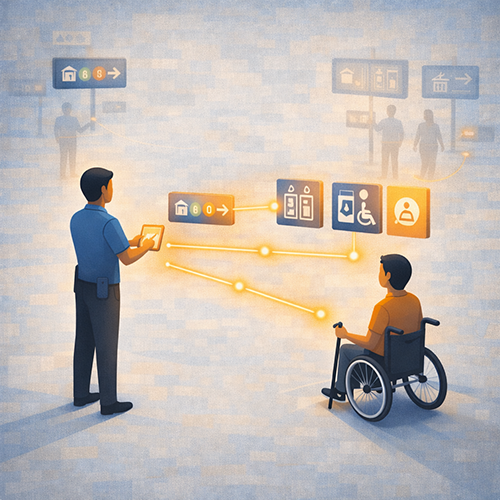 Frontline staff are often the bridge between policy and practice. Riders ask staff for directions, help, and clarification when accessibility conditions change. If staff do not have consistent guidance, riders experience the system as unreliable and may feel dismissed.
Staff readiness begins with scripts that mirror public messaging. Scripts should include the impact statement, the route-based alternative, and the help route. They should also include tone guidance that preserves dignity. Accessibility support should never be framed as an inconvenience. Staff language should communicate that assistance is normal and expected.
Staff readiness also requires rapid internal updates. When accessibility conditions change, staff should receive the latest version quickly, with a clear time stamp and a short “what changed” line. This prevents staff from unintentionally giving outdated directions.
Training should include scenario practice. Staff can rehearse how to guide riders to accessible alternatives during common situations, such as elevator outages, construction route changes, and platform access constraints. Practice improves consistency and reduces stress during real incidents.
Finally, staff should have clear escalation routes. Some riders need specific support that requires coordination, such as arranging assistance at a different station or confirming whether a temporary ramp is usable. Clear escalation prevents riders from being bounced between channels.
Use Tone-Safe Language That Avoids Stigma and Preserves Agency Credibility
Dignity-first language focuses on what is available and what the rider can do next. It avoids phrasing that implies the rider is a problem or that assistance is unusual. It also avoids over-apologizing in a way that can feel dismissive or performative.
Tone-safe language is calm and practical. It acknowledges the barrier and provides the alternative route. It also confirms the help route, including how to request assistance and where staff can support the rider. This structure reduces stress and increases confidence.
Tone-safe language should be consistent across channels. A rider should hear the same calm, respectful phrasing from a staff member that they read in a public update. Consistency reinforces trust.
Tone-safe training also protects staff. When staff have approved language, they can respond confidently without improvising under pressure.
Align Customer Service and Field Teams With the Accessibility Source of Truth
Customer service teams often handle the most urgent accessibility questions. They need immediate access to the most current guidance and the same route-based alternatives used in public messaging. If customer service and field teams reference different information, riders experience inconsistency.
Alignment includes providing the message pack to customer service and field teams, along with clear version cues. It also includes a clear process for escalating complex cases, such as when an alternative route is blocked or when multiple elevators are out at once.
Customer service scripts should also include accessibility-specific troubleshooting. Riders may need help navigating app status information, understanding alternate station options, or locating assistance points. Clear scripts improve response time and reduce frustration.
Aligning teams around the same source of truth reduces misinformation, reduces conflict, and improves rider confidence during disruption.
Make Accessibility Messaging Visible in Routine Communication
Accessibility messaging should not appear only during outages or compliance reporting. Riders build trust when they see accessibility treated as part of everyday service communication. Routine visibility also reduces the learning burden during disruptions because riders already know where to find accessibility information and what language to expect.
Routine visibility includes clear accessibility information on trip planning pages, station pages, and route pages. It also includes consistent cues in apps, signage, and printed rider guides. When accessibility information is integrated into standard content, riders do not have to search through specialized sections to find what they need.
Visibility also includes normalizing the use of accessibility features and services. Messages should communicate that accessible routes and assistance options are standard parts of service. The tone should be practical and respectful, without implying that accessibility needs are unusual.
Routine communication can also include proactive guidance for planned work. If a construction phase will affect accessible entrances or elevator availability, the agency can provide advance notice with route-based alternatives. Early notice reduces last-minute travel failures and supports independence.
Finally, routine visibility supports partner communication. Community organizations that serve riders with disabilities can more easily share accurate guidance when the agency has stable, easy-to-find accessibility information.
Publish Accessible Station and Stop Information in Stable, Mobile-Friendly Pages
Riders often need station-specific accessibility details. Stable station pages should include accessible entrances, elevator locations, platform access details, and assistance points. They should also include a clear way to check current status and a time stamp for the most recent update.
Mobile-friendly design matters. Riders may check this information while traveling. Content should be scannable and structured with clear headings. Maps should be paired with text directions. Critical instructions should not be locked inside images.
Stable pages also support consistency across channels. Alerts and staff scripts can route riders to the same station page for verified details. This reduces the spread of conflicting summaries.
Stable station pages should also include clear labeling aligned with on-site signs. If a station uses entrance labels, the page should use those labels consistently. This improves wayfinding and reduces confusion.
Normalize Accessibility Services and Assistance Options Without Overexplaining
Accessibility messaging should preserve dignity. Riders should be able to find assistance information without feeling singled out. The agency can include assistance options alongside other service information and use neutral language that communicates availability.
Messages should explain how to request assistance and where help points are located. They should also clarify any hours or constraints so riders are not surprised. Clarity reduces frustration and supports independence.
Overexplaining can feel paternalistic. A concise, practical approach is more respectful. It provides the steps and the help route and then allows riders to choose what they need.
Normalization also supports staff. When assistance is framed as standard, staff interactions become smoother and less stigmatizing.
Measure Accessibility Communication Performance and Improve It Over Time
Beyond compliance requires continuous improvement. Agencies can improve accessibility messaging by measuring whether riders can find information, interpret it correctly, and navigate alternatives successfully. Measurement should focus on usability and reliability, not only on whether content exists.
A practical measurement approach includes tracking the timeliness of updates, consistency across channels, and accuracy of accessible alternatives. It can also include monitoring customer service contacts related to accessibility, such as calls about elevator outages, accessible routes, and assistance requests. Spikes can signal that messaging is unclear or that updates are not reaching riders effectively.
Agencies can also use rider feedback loops. Riders with disabilities often provide high-quality, specific feedback about what works and what does not. Agencies can collect feedback through short surveys, partner organizations, and targeted listening sessions. Feedback should be translated into concrete messaging improvements, such as clearer route descriptions or better alignment between digital and on-site labels.
Measurement should also include internal process performance. Agencies can track how quickly maintenance updates reach communications, how consistently templates are used, and whether staff scripts are updated in parallel. Process measures help identify where drift and delays originate.
Finally, agencies can publish progress transparently. Sharing improvements, such as faster outage updates or better station page clarity, builds trust. It also signals that accessibility is treated as service quality, not only as compliance.
Track Timeliness, Accuracy, and Consistency as Core Communication Metrics
Timeliness can be measured by the time between an accessibility change and the public update. Accuracy can be measured by whether the message matches on-site conditions and whether the alternative route is usable. Consistency can be measured by whether channels use the same terms, the same time stamp, and the same route-based guidance.
These measures create a clear improvement target. They also help agencies prioritize fixes that reduce the most harm. For example, improving update speed for outages that remove the only accessible route can have high impact.
Metrics also support internal accountability. When teams can see where delays occur, they can refine workflows and improve coordination.
Tracking these measures over time also supports staff confidence. A reliable system reduces improvisation and reduces rider frustration.
Use Rider Feedback and Partner Input to Improve Messaging Realism
Riders often identify issues that are not visible in internal systems. A route may be technically accessible but practically difficult due to slope, crossings, or signage gaps. Feedback helps agencies refine alternatives and improve clarity.
Partners can also provide insight. Organizations serving riders with disabilities may hear recurring confusion points and can help agencies test new templates and phrasing. Partner input can also help agencies prioritize which languages and formats are most needed.
Feedback should be translated into specific changes. Agencies can update templates, revise station page language, improve signage alignment, and refine help routes. Continuous improvement is more credible when riders can see that feedback produces tangible change.
A visible feedback route also strengthens trust. Riders are more willing to engage when they believe the agency will act on what they share.
Promoting Long-Term Transportation Outcomes Through Communication
Accessibility messaging strengthens transit outcomes when it supports independence, predictability, and safety. Riders rely on clear information to plan accessible routes, navigate outages, and manage construction impacts without avoidable barriers. When accessibility guidance is actionable and consistently updated, riders experience the system as more usable and more trustworthy.
Long-term trust improves when agencies treat accessibility communication as part of the main service communication system. A consistent message spine, time stamps, and “what changed” lines help riders interpret evolving conditions. Stable station pages, consistent place labels, and clear verification paths reduce the spread of outdated information and reduce the burden on riders to confirm what is current.
Equity outcomes improve when accessibility guidance is visible, practical, and dignity-first. Riders with disabilities should not have to search harder for decision-critical information. Integrating accessibility into service updates, detour notices, and construction messaging reduces unequal information access. Clear help routes and calm, respectful language reduce stigma and support fair treatment in daily interactions.
Operational outcomes improve as well. Clear accessibility updates reduce last-minute assistance needs, reduce customer service call surges, and reduce conflict with frontline staff. When staff scripts align with public messaging and the source of truth, staff can provide consistent guidance without improvising. This consistency protects staff capacity and stabilizes rider behavior during disruptions.
Finally, a disciplined accessibility communication system increases readiness. Agencies can communicate faster and more accurately when templates, thresholds, rapid review roles, and governance practices are already in place. This reduces risk of errors and supports continuous improvement over time.
Strategic Communication Support for Your Transit Agency
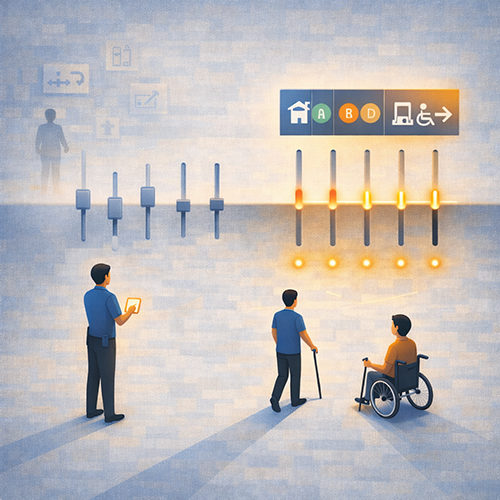 Public transit agencies often meet technical requirements for accessibility while still facing communication gaps that create real barriers. Agencies must keep accessibility information current, align digital and on-site cues, provide clear alternative routes during outages and construction, and equip staff to communicate in a dignity-first way. Without a shared system, messaging drifts, updates lag, and riders experience avoidable uncertainty.
That is why agencies often choose to partner with an external resource like Stegmeier Consulting Group (SCG) to strengthen communication systems. An outside partner can help transit organizations build accessibility messaging capabilities beyond compliance, including message spines, station accessibility page templates, outage and construction update protocols, staff scripts, partner toolkits, rapid review checklists, and governance workflows that keep meaning consistent across channels.
SCG supports transit agencies by helping teams translate accessibility requirements into practical rider guidance that works in real conditions. That includes refining route-based alternatives, aligning labels with on-site wayfinding, strengthening update cadence and version cues, building accessible and translation-ready content, and equipping staff and customer service teams with consistent, respectful scripts. Over time, these practices reduce barriers, strengthen trust, and improve daily usability for riders who depend on accessible transit.
Conclusion
ADA and accessibility messaging goes beyond compliance when it functions as decision support. Transit agencies can improve outcomes by using a consistent accessibility message spine, stating accessible alternatives as clear routes, integrating accessibility into all service change communication, building a reliable update system for outages and construction, equipping staff with dignity-first scripts, maintaining stable station accessibility references, and measuring timeliness, accuracy, and consistency as core communication metrics.
Accessibility is service quality. When riders can find accurate information quickly and act on it confidently, the transit system becomes more usable, more equitable, and more trusted.
SCG’s Strategic Approach to Communication Systems
Align your agency’s messaging, processes, and public engagement strategies
Agencies that communicate effectively build stronger trust with staff, stakeholders, and the public. Whether you are strengthening accessibility messaging, improving internal workflows, or aligning agency-wide communication, SCG can help you develop a communication system that supports consistent decision-making and long-term organizational success. Use the form below to connect with our team and explore how a strategic communication framework can elevate your agency’s impact.