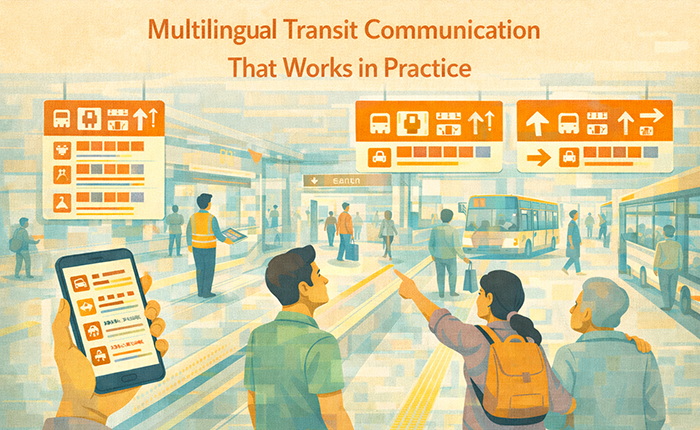
Multilingual Transit Communication That Works in Practice
Transit systems serve communities that speak many languages. Riders navigate schedules, detours, fares, service disruptions, construction phases, and rider rules in real time. When critical information is only available in one language, some riders face higher risk, higher uncertainty, and higher cost. Those riders are more likely to miss the right stop, arrive at a closed entrance, misunderstand a fare change, or lose time during a disruption.
Multilingual communication is not only a translation task. It is a service reliability task. Riders experience language access through speed, consistency, and usability across channels. A translated post that arrives late, uses different terms than signage, or leaves out key action steps can create confusion even when the intent is positive. In practice, multilingual messaging works only when it is built into the communication system from the start.
This article provides an evergreen framework for transit agencies that want multilingual communication to work in daily operations, not only in policy statements. It focuses on practical message structures, translation workflows, channel alignment, staff readiness, and quality controls that keep meaning consistent as conditions change.
Why Multilingual Transit Communication Often Fails
 Multilingual communication often fails because it is treated as an add-on after the main message is finalized. The English version is written quickly, posted, and then sent for translation. By the time translated versions are ready, the situation has changed, or riders have already made decisions based on incomplete information. This delay can turn translation into a symbol of exclusion, even when teams are working hard.
It also fails when language is translated but meaning is not maintained. Transit messages rely on precise scope, timing, and action steps. If a translation shifts the strength of a directive, changes a time window, or uses a different label for a station entrance, riders can receive a different instruction than other riders. Meaning drift is especially common when agencies lack a consistent glossary for fare products, route types, and service change terms.
Multilingual communication also breaks down across channels. A website might include translated pages, but station signage might not. Social posts might be translated, but rider alerts might not. Staff scripts may be English-only. Riders then have to stitch together information from partial sources, which increases stress and increases the chance of errors during disruptions.
Finally, multilingual communication fails when it over-relies on long documents. Dense PDFs and full policy pages may be translated, but riders often need short, actionable guidance on phones and at decision points. When the most visible message is not available in multiple languages, the existence of a translated PDF does not solve the practical problem.
From Detours to Understanding: Effective Communication Strategies for Transportation Agencies to Improve Safety and Drive Behavioral Change
This article is part of our series on strategic communication for Transportation Agencies, Transit Authorities, and Public Works departments. To learn more and to see the parent article, which links to other content just like this, click the button below.
Define “Works in Practice” as Fast, Consistent Decision Support
Multilingual communication works in practice when riders can make correct decisions without extra searching. The message states what is happening, who is affected, what to do next, and where to verify the latest update. It does so with consistent terms across languages and across channels, so the rider experience remains coherent.
Working in practice also means translation is integrated into update rhythms. Riders benefit when agencies publish updates on a predictable cadence and release multilingual versions in parallel for the most critical content. Parallel release reduces rumor cycles and reduces the perception that some riders are receiving second-class information.
Working in practice also means the system is prepared before the disruption or campaign begins. Agencies that maintain translation-ready templates, approved terminology, and staff scripts can move faster without sacrificing clarity. This preparation reduces drift, supports equity, and protects trust during high-pressure moments.
Build a Multilingual Message Spine That Preserves Meaning
Multilingual communication becomes more reliable when every message follows a consistent structure that is easy to translate. A stable message spine reduces ambiguity and helps translators preserve meaning. It also helps riders scan quickly because the same information appears in the same order across languages.
A practical spine begins with the impact statement in plain language. It states what riders will experience, such as delays, suspended service, a detour, a stop closure, a station entrance change, or a fare update. The next element is scope, including affected routes, stations, directions, or corridors. The third element is timing, including start and end windows and the time of the next update. The fourth element is the rider action step, describing what to do now in a way that is executable. The fifth element is the verification path, pointing to the current source of truth. The final element is the help route, such as where to get assistance in person or by phone when needed.
This spine is effective because it separates facts from explanation. It prevents messages from becoming long narratives that are harder to translate accurately. It also ensures that critical information is not buried. When riders receive the impact and action first, they can make decisions even if they do not read the entire message.
A multilingual spine should also include consistent terminology for key words. Agencies can define terms for service types, route categories, fare products, and facility labels and use them consistently across languages. Consistency reduces drift and prevents riders from receiving different interpretations depending on language version.
Finally, the spine should be designed for short formats. Many riders encounter updates through alerts, signage, and social captions. A spine that works in short form reduces the risk that translations are delayed because the original message is too long and complex.
Write Source Messages for Translation, Not for Internal Jargon
Multilingual quality improves when the source message is written in clear, direct language. Jargon-heavy messages create translation risk because technical terms may not have direct equivalents and may be interpreted inconsistently. A source message should use plain phrasing that connects to rider experience.
Translation-ready writing also avoids compound sentences and vague time phrases. Short sentences reduce ambiguity. Specific dates and times reduce confusion. Clear scope descriptions reduce the chance that a translation broadens or narrows the affected area unintentionally.
Translation-ready writing also includes consistent labeling of places. If a station entrance has a label, the label should be used consistently in all public messaging and signage. If labeling is inconsistent, translation will amplify that inconsistency because riders cannot match what they read to what they see.
Writing for translation also helps staff. Staff scripts often reuse source language. If the source message is clear, staff can communicate it more consistently in conversation.
Translation-ready writing is also faster. Clear, structured text is easier to translate and easier to quality-check.
Use “What Changed” Lines to Make Updates Clear Across Languages
Updates are common in transit communication. Service conditions shift, construction phases adjust, and disruptions evolve. Riders become confused when they cannot tell what is new. A short “what changed” line makes updates easier to interpret and reduces the spread of outdated information.
A “what changed” line should be concrete. It can state expanded scope, revised timing, a new boarding location, or restored service. It should be placed near the top of the update. This helps riders decide quickly whether they need to change plans.
This practice is especially important for multilingual communication because delays in translation can cause riders to see older versions. A “what changed” line helps riders identify the newest update and reduces guesswork.
Consistent update labeling also helps partners. Community organizations and institutions can repost updates more accurately when changes are clearly indicated.
A “what changed” line also supports internal coordination. Staff can see what is new and communicate it consistently.
Create a Terminology System That Prevents Drift
Multilingual communication fails quickly when key terms are inconsistent. Drift can occur across languages and within a single language. A fare product name, a service alert label, or a station entrance description might shift depending on who wrote the message. Riders then receive mixed cues and lose confidence in official information.
A terminology system begins with a rider-facing glossary of core terms. It includes fare product names, transfer terms, payment actions, service change terms, station and stop labels, and accessibility terms. Each term should have an approved definition and an approved translation in the most common languages used in the service area. The glossary should be used by communications, customer service, operations, digital teams, and partner organizations.
The glossary should also include terms to avoid. Some internal terms create confusion or translate poorly. A list of avoided terms helps writers choose clearer alternatives and reduces the chance that translators will have to interpret ambiguous jargon.
Terminology systems also need governance. When a term changes, all channels should be updated in a coordinated way. This prevents riders from seeing mixed vocabulary during transition periods.
Finally, terminology systems should be linked to templates. If templates use approved terms, consistent language becomes automatic. This reduces drift and improves translation quality at scale.
Standardize Place Labels and Wayfinding Terms Before Translating
Station entrances, platforms, temporary detour paths, and accessible routes must be named consistently. Riders need to match what they read to what they see. If the physical environment uses one label and the message uses another, translation will not solve the problem. It will deepen it.
Standardizing labels means choosing consistent names for entrances and pathways and using them on signs, maps, and digital assets. It also means ensuring that staff scripts use the same labels. This consistency is especially important during construction phases and service disruptions, when riders rely on short cues.
Wayfinding terms should also be translation-tested. Some directional phrases can be unclear if translated literally. Agencies can improve clarity by using landmarks, cross streets, and simple directional cues that are easier to translate and easier for riders to follow.
Label consistency also reduces staff burden. When riders can find their way more easily, staff receive fewer urgent questions and fewer conflicts.
Consistency also supports equity. Riders with language barriers rely heavily on clear physical cues. Aligning translated messages with physical labels reduces unequal confusion.
Use Translation Memory and Approved Phrases for Common Scenarios
Many transit messages repeat. Delays, detours, stop closures, elevator outages, fare updates, and construction phases appear regularly. Agencies can improve speed and quality by using translation memory and approved phrase libraries for these common scenarios.
Approved phrases reduce variability and reduce the risk that a translator will interpret the same concept differently each time. They also make it easier to publish multilingual updates quickly because the base language is already aligned and reviewed.
A phrase library should include impact statements, action steps, verification cues, and help routes. It should also include tone-safe language that remains calm and practical. Consistent tone across languages builds trust.
Translation memory also supports efficiency. It reduces cost and increases consistency, especially during frequent updates. Over time, the agency builds a reliable library of rider-facing language that can be reused across campaigns and disruptions.
Design Channels and Workflows for Parallel Multilingual Release
Multilingual communication works best when critical information is released in parallel. Parallel release reduces unequal access to time-sensitive guidance and improves trust. Riders who rely on translated content should not consistently receive updates hours later, especially during disruptions, planned detours, and construction phase changes.
Parallel release requires channel planning. Not every channel needs the same level of translation for every message, but the most critical guidance should be available across the channels riders rely on most. Agencies can set clear thresholds. High-impact disruptions, safety advisories, detours affecting major corridors, fare changes, and construction phase shifts should trigger multilingual release protocols. Lower-impact updates can be routed to a status page, with multilingual summaries on a predictable cadence.
Parallel release also requires message discipline. Short, structured messages are easier to translate quickly. When messages are bloated or contain multiple concepts, translation becomes slower and more error-prone. A consistent message spine makes parallel release feasible because it keeps content focused on impact, scope, timing, action, and verification.
Workflow design is also essential. Agencies need a clear internal sequence. Draft the source message using translation-ready language. Route it through a rapid review checklist. Trigger translation using approved terms and phrase libraries. Publish in the primary language and parallel languages. Update the source of truth first, then update secondary channels and staff scripts. This sequencing reduces contradictions and reduces the chance that riders see partial updates.
Parallel release also benefits from predictable cadence. During extended disruptions, riders do not need constant updates in every language if nothing has changed. They do need to know when the next update will occur. Including a next update time and using “what changed” lines reduces the need for frequent posts while keeping riders oriented.
Define What Must Be Multilingual and What Can Be Consolidated
Not every message needs full multilingual replication. Agencies can reduce workload and still protect equity by defining what qualifies as critical. Critical messages are those that materially affect rider decisions and safety. They include service suspensions, major delays, station closures, detours that change boarding locations, major construction phase changes, fare changes, and accessibility disruptions that affect usable paths.
Messages that are informational but not decision-critical can often be consolidated into a status page or dashboard. The agency can still provide multilingual headers and short summaries that direct riders to the current source. This approach reduces noise while preserving access.
Clear thresholds also protect staff. When teams know which messages require multilingual release, they can move faster and avoid debate in the moment. Consistent thresholds reduce unequal treatment because the decision to translate is not ad hoc.
Thresholds should also be reviewed periodically. As ridership demographics and channel usage patterns change, the agency may need to adjust which messages qualify as critical.
Defining thresholds also supports partner communications. Partners can be informed when multilingual assets will be available and where to find them.
Use Templates That Support Fast Translation and Fast Publishing
Templates are the backbone of parallel release. A template library can include structures for disruptions, detours, stop closures, elevator outages, fare updates, construction phases, and rider rule reminders. Each template can include standardized fields for impact, scope, timing, action, verification, and help routes.
Templates should also include approved phrases that are already translated. This allows staff to assemble updates quickly without inventing new language each time. Templates reduce errors and reduce drift across languages.
Templates also support channel adaptation. The same template can feed a push alert, a social caption, a website update, a station sign, and a staff script. When the core language is consistent, the rider experience is more coherent.
Template design should also be mobile-first. Riders often read updates quickly on phones. Short, scannable templates are more useful and translate more reliably.
Equip Staff and Partners to Reinforce Multilingual Messaging
 Multilingual communication is not only what is posted online. It is also what riders hear from staff and partners in real time. Staff and partners are often the most trusted sources during disruptions and at decision points. If staff scripts are English-only or inconsistent with translated messaging, riders experience confusion and unequal access.
Staff readiness starts with providing tone-safe scripts in the most common languages when feasible, and at minimum providing clear routing guidance for language support. Scripts should mirror the same message spine used in public updates. They should state impact, scope, action, timing, and verification in plain terms. They should also include a clear help route for riders who need assistance.
Partner readiness is equally important. Community organizations, employers, schools, and municipal partners often help riders navigate service changes and fare policies. Agencies can provide copy-ready partner blocks in multiple languages, along with a consistent verification link. This reduces rewriting and reduces drift.
Equipping staff and partners also includes training on terminology. If staff use different terms than public materials, riders will assume the information is inconsistent. A shared approved terms list and short training refreshers help maintain consistency.
Finally, agencies should make language support visible. Riders are more likely to seek help when they can see that assistance exists. Visibility can include signage, website cues, and clear directions for accessing interpretation or multilingual support.
Treat Call Centers and Customer Service as Multilingual Decision Points
Customer service channels are often where multilingual access becomes real. Riders call or message when they are confused, stranded, or facing payment issues. If customer service cannot provide consistent multilingual support, the agency loses an opportunity to reduce confusion quickly.
Customer service teams benefit from the same message pack used for public updates. They also benefit from translated scripts for high-frequency scenarios. Even partial script support can improve consistency and reduce call time because staff are not improvising.
Customer service workflows should also include escalation routes. Complex cases may require specialized support. Clear escalation prevents riders from being bounced between channels, which is a common source of frustration.
A consistent approach also reduces operational burden. When riders receive clear help quickly, they are less likely to spread misinformation or to show up at the wrong locations.
Provide Partner Toolkits in Multiple Languages With Copy-Ready Blocks
Partners can extend multilingual reach when they have ready-to-share content. A partner toolkit should include short blocks that can be pasted into newsletters, social posts, and printed notices. It should also include a clear verification path and a time stamp or update cadence cue.
Copy-ready blocks should use the same approved terms and the same message spine as agency content. This preserves meaning and reduces the chance that partners introduce inconsistent wording.
Toolkits should also include guidance on what not to change. Partners may shorten messages. They should avoid changing dates, scope, and action steps. Clear partner guidance reduces drift.
Partner toolkits are also an equity tool. Many riders trust local organizations more than agency channels. When those organizations share accurate multilingual guidance, more riders can make correct decisions in real time.
Quality Control That Prevents Meaning Drift and Risky Errors
Multilingual transit communication must be accurate. Small errors in scope, timing, or boarding location can create real harm. Quality control is not optional, and it does not need to be slow. It needs to be systematic, repeatable, and focused on the highest-risk failure points.
Quality control begins with source-message discipline. The original message should be written in plain language, with short sentences and explicit dates and times. It should avoid ambiguous modifiers and internal jargon that can translate inconsistently. When the source message is clear, translations are more reliable.
Quality control also depends on glossary enforcement. Translators and internal reviewers should use the approved terms list and the phrase library. When a term is translated differently in different assets, riders receive inconsistent instructions. Consistency is a safety and trust issue.
A practical quality control process includes a quick verification checklist for every translated message. The checklist confirms that the impact statement matches, that scope is identical, that timing is identical, that the action step is executable, and that the verification and help routes are correct. It also confirms that place labels match the physical environment.
Quality control should also include periodic back-translation audits for high-risk templates. Back-translation is not needed for every message, but it can be valuable for templates that are used frequently and have complex instructions, such as fare policy changes and construction detours. Audits identify where the approved phrasing should be refined to preserve meaning more consistently.
Finally, quality control should include incident learning. When a translation error occurs, the agency should capture what happened and update the template or glossary to prevent repetition. This turns mistakes into system improvement.
Validate Place Names, Directional Cues, and Accessibility Instructions
Place names and directional cues are common error points. A translation may alter a station entrance label, a cross street reference, or a temporary stop description in a way that makes it harder to follow on the ground. Riders then cannot match the message to signage. This creates immediate confusion, especially during detours and construction phases.
Validation requires aligning translated language with the labels used on signs and maps. If the environment uses “North Entrance,” the message should use that exact label. If a temporary stop is described using cross streets, the translation should preserve those references precisely.
Accessibility instructions are also high risk. If an accessible route is described incorrectly, riders who rely on it may face serious barriers. Translated accessibility guidance should be reviewed with extra care and should include a clear help route when conditions change.
Validation is also supported by field testing. When possible, agencies can test a message by walking the path described and confirming that the cues match what riders will see. Even small field checks can prevent major confusion.
Consistent place and accessibility validation reduces unequal harm because riders with language barriers often rely more on clear physical cues to navigate.
Use Rapid Review Roles and a Clear Approval Path During Disruptions
During disruptions, agencies cannot afford long review loops. They also cannot afford risky errors. A rapid review model assigns clear roles. One person drafts using templates. One person verifies facts and scope. One person confirms that the translation matches the approved terms and preserves meaning. The message is then published through a defined sequence.
Clear roles reduce delays because teams are not debating who approves what. A clear approval path also prevents contradictory updates, since the source of truth is updated first and other channels follow.
Rapid review should be supported by a checklist. The checklist focuses on the high-risk elements, such as timing, scope, and action steps. It also confirms that the “what changed” line is accurate.
A clear approval path also supports staff and partners. When updates are reliable, staff can communicate with confidence and partners can share accurately.
Keep Multilingual Communication Visible and Respectful in Daily Operations
Multilingual communication should not appear only during crises. Riders build trust when they see language access consistently in routine communication, such as service reminders, planned detours, fare guidance, and rider rules. Consistent visibility signals that the agency is committed to serving the full community, not only responding when pressured.
Visibility includes placing multilingual cues at decision points. Riders should see language access options on the website, in apps, at stations, and on major printed materials. They should also see clear instructions for accessing interpretation or multilingual customer service. When language support is visible, riders are more likely to seek help early rather than waiting until a problem becomes urgent.
Respectful multilingual communication also means avoiding paternalistic tone. Translated messages should preserve the same calm, practical voice as the primary language. If translations sound more severe or more vague, riders will experience unequal tone. That tone difference can reduce trust and reduce compliance.
Visibility also includes consistent updates. Riders who rely on multilingual content should receive the same update rhythm and the same version cues. Time stamps and “what changed” lines should appear consistently across languages. This reduces outdated sharing and improves clarity during evolving conditions.
Finally, visibility supports partner confidence. Community organizations are more likely to share agency content when multilingual assets are reliable and routinely available. This strengthens the information ecosystem and reduces rumor spread.
Publish Multilingual Service Basics in Stable Locations Riders Can Find
Riders need stable places to find core information. This includes how to pay, how transfers work, how to access reduced fare programs, how to sign up for alerts, and how to report issues. These basics should be available in multiple languages and should be maintained as living references.
Stable locations reduce the need for repeated explanations. They also reduce the chance that riders rely on unofficial summaries that may be outdated. When the agency provides clear multilingual references, riders and partners can link to them confidently.
Stable multilingual references should also be mobile-friendly and accessible. Clear structure, scannable headings, and plain text improve usability.
Keeping these basics current is part of governance. When a fare policy changes, multilingual basics must be updated in parallel, not later.
Reinforce Language Access Through Staff Scripts and On-Site Cues
On-site cues can make language access real. Signs that indicate availability of assistance, staff scripts that include routing guidance, and visible help points reduce the sense that non-English speakers must navigate alone.
Staff scripts can include a short phrase that directs riders to multilingual support, along with a simple process for connecting to interpretation when available. Scripts should be calm and respectful. They should avoid implying that language assistance is a burden.
On-site cues should also include the same labels used in multilingual messages. When cues and messages match, riders can navigate more confidently.
Reinforcement also includes ensuring that staff know where to find current multilingual updates. During disruptions, staff should have access to the message pack and the source of truth so they can communicate consistently.
Promoting Long-Term Transportation Outcomes Through Communication
Multilingual communication strengthens transit outcomes because it reduces unequal confusion during service changes, disruptions, and capital work. Riders who can access clear guidance in their preferred language are more likely to make correct decisions, avoid missed trips, and navigate detours and construction phases safely. Over time, this improves trust and supports more consistent ridership because information feels reliable and inclusive.
Long-term trust improves when agencies publish multilingual updates in parallel for critical content and maintain consistent terms across channels. A stable message spine, time stamps, and “what changed” lines make evolving situations easier to interpret. Riders become less dependent on informal translation and less likely to rely on rumors because they can verify current guidance through an official source of truth.
Equity outcomes improve when language access is treated as part of daily service quality. Translation-ready templates, approved glossaries, accessible formats, and visible help routes reduce barriers for riders who face higher information constraints. These practices also reduce unequal enforcement and unequal disruption impact because riders receive the same actionable instructions and the same update cadence across languages.
Operational outcomes improve as well. Clear multilingual guidance reduces crowding at the wrong locations, reduces customer service call surges, and reduces conflict with frontline staff. When staff scripts and partner toolkits align with public messaging, riders hear the same guidance in conversation that they see online and on signs. This consistency protects staff capacity and stabilizes rider behavior during high-pressure moments.
Finally, a well-governed multilingual system increases readiness. Agencies can communicate faster during disruptions because templates, phrase libraries, and rapid review roles are already in place. This reduces risk of errors and reduces the lag that often undermines trust.
Strategic Communication Support for Your Transit Agency
 Transit agencies often understand the importance of language access, but building a multilingual system that performs under pressure can be difficult. Agencies must balance speed and accuracy, maintain consistent terminology across many channels, and coordinate staff and partner communication as conditions change. Without a shared system, translated content arrives late, meaning drifts, and riders experience unequal access to decision-critical information.
That is why agencies often choose to partner with an external resource like Stegmeier Consulting Group (SCG) to strengthen communication systems. An outside partner can help transit organizations design multilingual communication workflows that work in practice, including message spines, translation-ready templates, approved term glossaries, phrase libraries, rapid review checklists, staff scripts, partner toolkits, and governance protocols that keep meaning consistent across languages.
SCG supports transit agencies by helping teams translate operational information into clear, actionable public guidance that is consistent and accessible. That includes refining source messages for translation readiness, aligning terminology across web, alerts, signage, and scripts, designing parallel-release workflows for critical updates, and creating quality control practices that prevent meaning drift. Over time, these practices improve clarity, strengthen equity, and increase trust in the agency’s communication during both routine operations and disruptions.
Conclusion
Multilingual transit communication works in practice when it is built as a system. Agencies can improve outcomes by using a consistent message spine, writing source messages for translation, maintaining an approved terminology glossary, using templates and translation memory for common scenarios, defining parallel-release thresholds for critical content, equipping staff and partners with aligned scripts and copy-ready blocks, and applying rapid quality control to protect scope, timing, and action steps.
Language access is service quality. When riders can find clear guidance quickly, verify updates reliably, and receive consistent instructions across channels, the transit system becomes easier to use and more trusted across the full community.
SCG’s Strategic Approach to Communication Systems
Align your agency’s messaging, processes, and public engagement strategies
Agencies that communicate effectively build stronger trust with staff, stakeholders, and the public. Whether you are improving multilingual communication, strengthening internal workflows, or aligning agency-wide messaging, SCG can help you develop a communication system that supports consistent decision-making and long-term organizational success.
Use the form below to connect with our team and explore how a strategic communication framework can elevate your agency’s impact.