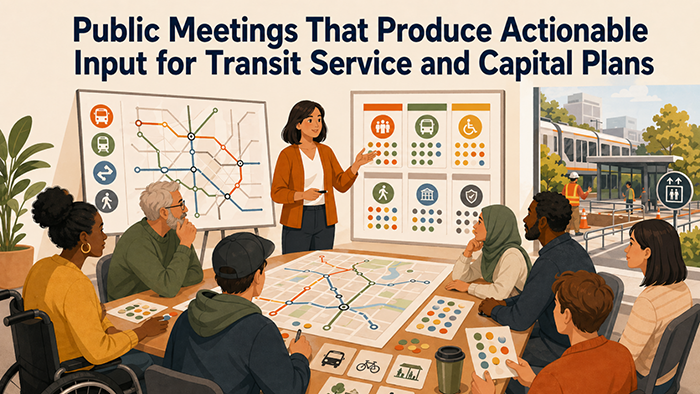
Public Meetings That Produce Actionable Input for Transit Service and Capital Plans
Public meetings are a standard tool for transit agencies, but many meetings do not produce input that can be used to make decisions. Riders and community members may show up, share frustration, and leave feeling unheard. Staff may leave with a long list of comments that are emotionally important but difficult to translate into service or capital plan choices. When meetings feel like venting sessions, trust erodes and the agency loses an opportunity to improve outcomes through informed public participation.
Actionable input is not the same as public approval. It is specific information that helps planners and project teams choose among options, adjust tradeoffs, and prioritize investments. It clarifies what people value most, where risk and hardship concentrate, and what constraints matter in daily travel. Actionable input also helps agencies design service changes and capital projects that are more usable, more equitable, and easier to implement without avoidable backlash.
Producing actionable input requires a communication system. It includes clear meeting purpose, decision-ready questions, accessible pre-read materials, structured facilitation, and a follow-up loop that shows how input was used. Without this structure, meetings generate heat instead of insight. With it, meetings become a reliable channel for improving service plans and capital programs.
This article provides an evergreen framework for transit agencies that want public meetings to produce decision-grade input for service changes and capital plans. It focuses on meeting design, question strategy, equity and accessibility, and post-meeting synthesis that turns public feedback into clear next steps.
Why Public Meetings Often Fail to Produce Actionable Input
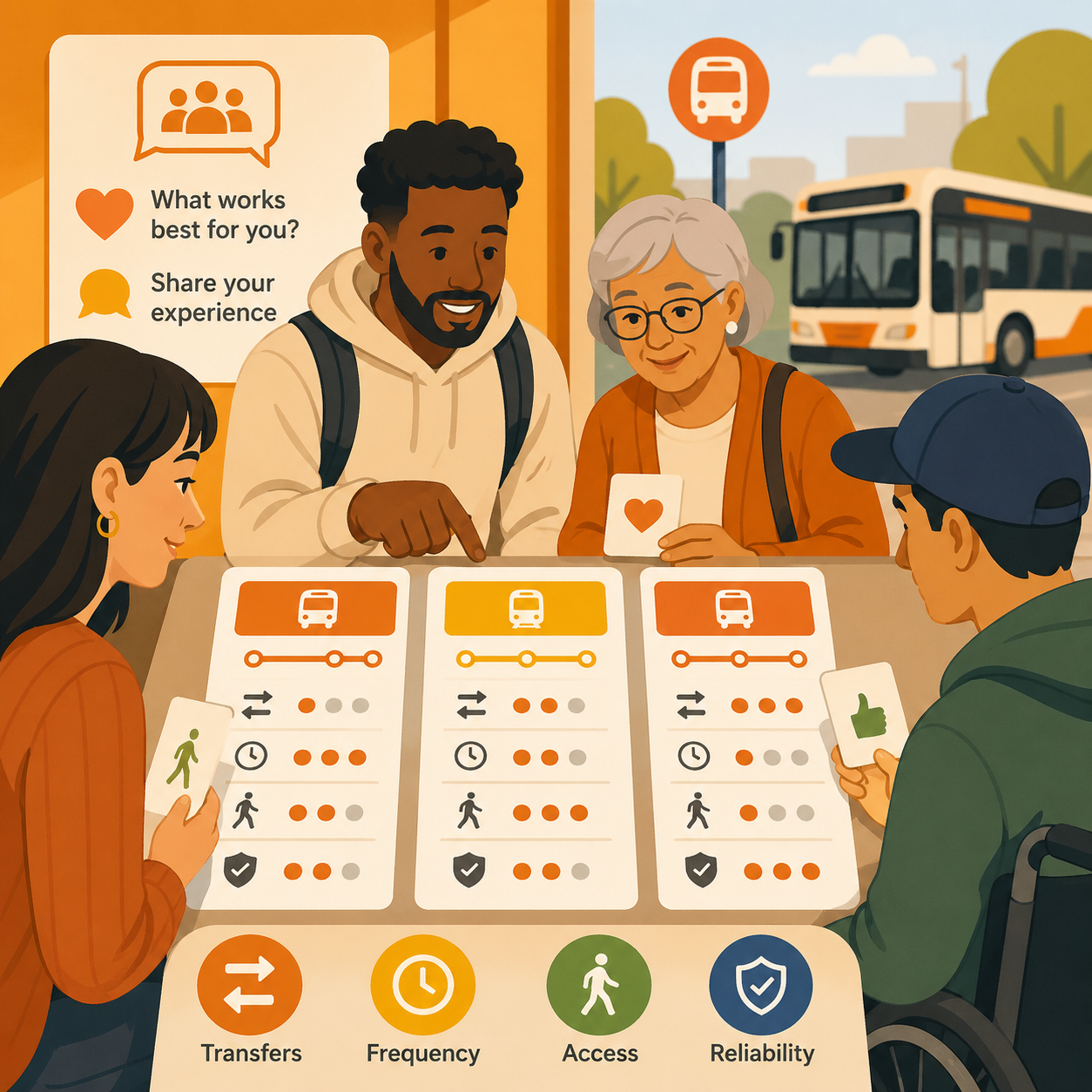 Public meetings often fail when the agency is unclear about what it needs from the public. If the meeting purpose is framed as “share your thoughts,” participants will share everything. Staff then receive feedback that is broad, emotional, and difficult to convert into specific choices. The meeting can still feel meaningful, but it does not reliably improve decision-making.
Meetings also fail when the agency presents too much information without a clear path for input. Long slide decks, technical maps, and jargon-heavy explanations can overwhelm participants. People respond by focusing on personal experiences rather than on the decisions in front of the agency. That experience is valid, but it does not automatically produce the comparisons and priorities that planners need.
Another common failure is asking the public to comment on solutions without showing constraints and tradeoffs. When participants do not understand what is fixed and what is flexible, they often recommend actions that are not feasible, or they assume the agency is ignoring obvious fixes. This drives cynicism and increases conflict.
Meetings also fail when they do not provide multiple ways to participate. A single evening meeting, delivered only in English, with limited accessibility support, will produce skewed input. The agency may then unintentionally design plans around the perspectives of people who have the time and tools to attend. That is not only an equity problem. It is a planning quality problem.
Finally, meetings fail when the follow-up loop is weak. If people never see what was done with their input, they assume the meeting was performative. Over time, participation drops and distrust grows. The agency then loses the very voices it most needs, including frequent riders and communities most affected by service and capital decisions.
From Detours to Understanding: Effective Communication Strategies for Transportation Agencies to Improve Safety and Drive Behavioral Change
This article is part of our series on strategic communication for Transportation Agencies, Transit Authorities, and Public Works departments. To learn more and to see the parent article, which links to other content just like this, click the button below.
Define Actionable Input as Decision Support, Not General Sentiment
Actionable input helps the agency choose. It clarifies priorities and tradeoffs. It identifies pain points with enough specificity to guide changes in service design or capital phasing. It also reveals how different rider groups experience the same corridor, station, or route at different times of day.
For service planning, actionable input often includes specific trip patterns, transfer pain points, reliability thresholds that matter to riders, and the practical consequences of frequency changes. It also includes information about where crowding, long gaps, and missed connections concentrate. For capital planning, actionable input often includes the access and wayfinding issues that shape daily usability, safety concerns tied to station design, elevator and accessibility reliability, and the real barriers created by construction phasing.
Actionable input is also comparative. It helps the agency understand what matters most when everything cannot be fixed at once. Participants can help identify which improvements would produce the biggest quality-of-life gain, which changes would create the most harm, and which tradeoffs feel acceptable if benefits are clear and reliable.
This does not mean meetings should ignore emotion. Emotion often points to where harm is concentrated. The goal is to capture emotion and then translate it into structured, specific decision inputs. When facilitation is designed well, participants can share lived experience and still provide priorities that planners can use.
A decision-support definition also improves public expectations. Participants can understand that the meeting is not a referendum. It is a structured input process that will shape options, priorities, and mitigation strategies. That clarity reduces frustration and increases the chance that people engage with the decisions on the table.
Build Meeting Purpose Around Specific Decisions and Clear Boundaries
Public meetings produce better input when the agency is explicit about what decisions are being shaped. The meeting should not be framed as a general discussion about the transit system. It should be framed around a defined set of choices, such as service frequency priorities, route redesign options, stop changes, station access improvements, capital phasing, or construction mitigation strategies.
A clear purpose statement includes three elements. It states the decision type, the timeline for the decision, and how public input will influence the outcome. It also states boundaries. Boundaries describe what is fixed, such as funding limits, regulatory requirements, fleet constraints, or construction windows. They also describe what is flexible, such as priority corridors, phasing choices, mitigation measures, or communication approaches. When boundaries are clear, participants offer more feasible suggestions and fewer unrealistic demands.
Meetings also benefit from a clear definition of the output. The agency can describe what it will produce after the meeting, such as a summary of priorities, a list of top concerns with mitigation themes, or a refined set of options. When the output is clear, participants can shape their contributions toward what the agency needs.
Purpose clarity also reduces conflict. Many meeting tensions come from misaligned expectations. Some participants assume the meeting is an opportunity to stop a project. Others assume the plan is already decided. A clear purpose statement sets a more honest frame and reduces frustration driven by ambiguity.
Finally, purpose clarity improves equity. People with less time to participate need to know quickly what the meeting is about and what their contribution will influence. Clear purpose statements make it easier to decide whether to attend and how to prepare.
Translate Planning Questions Into Rider-Understandable Decision Prompts
Planning questions often arrive in technical form. Riders and community members can still provide high-quality input, but the questions must be translated into prompts that connect to lived experience.
A rider-understandable prompt is specific and comparative. It asks participants to choose priorities, evaluate tradeoffs, or identify the most critical pain points. It avoids broad questions that invite unlimited scope. It also avoids jargon that participants cannot evaluate reliably.
Prompts can be framed around trip outcomes. For example, which corridor needs more reliable transfers. Which station access barriers create the biggest daily burden. Which service pattern change would reduce the most missed connections. These prompts generate information that planners can use.
Prompts can also be framed around risk and equity. For example, where do late-night safety concerns feel most acute. Which construction phase would create the hardest barrier for riders with mobility devices. These prompts surface actionable mitigation needs.
Clear prompts make meetings more productive because participants spend less time guessing what the agency wants and more time providing comparable, decision-ready feedback.
Make Tradeoffs Explicit So Input Is Grounded and Usable
Transit service and capital planning are always constrained. Agencies cannot increase frequency everywhere, rebuild every station at once, or eliminate every disruption during construction. Participants provide more useful input when tradeoffs are visible.
Tradeoff framing can be simple. For service changes, it can show that improving frequency on one corridor may require reducing coverage elsewhere, or that reliability improvements may require schedule adjustments. For capital plans, it can show that accelerating one station improvement may delay another, or that certain construction windows reduce cost but increase short-term disruption.
Making tradeoffs explicit also builds trust. People are more willing to engage when they see that decisions are not arbitrary and that the agency is being transparent about constraints. Transparency reduces the perception that the agency is hiding options.
Tradeoff framing should also include mitigation opportunities. Participants may accept disruption or change more readily when they can shape mitigation, such as clearer wayfinding, accessible alternatives, or targeted service support during construction phases.
When tradeoffs are named, the meeting produces better input because participants respond to real choices rather than imagined unlimited possibilities.
Prepare Participants With Accessible Pre-Reads and Simple Decision Context
Public meetings produce better input when participants arrive oriented. If the meeting spends most of its time explaining background, the remaining time is often too short for structured discussion. Pre-reads allow the meeting to focus on decisions.
Effective pre-reads are short, visual, and written in plain language. They explain what is changing, why the agency is considering it, what constraints exist, and what questions the agency needs answered. They also explain how input will be used and when the next decisions will occur.
Pre-reads should also be accessible. They should be mobile-friendly, available as plain text, and offered in the languages commonly used in the service area. They should include accessible formats for people using assistive technologies. Accessibility improves both equity and planning quality because it increases participation from riders who face higher barriers.
Pre-reads should also support people who prefer non-digital access. Printed summaries at stations, community locations, and partner organizations can broaden participation. A phone-based option for requesting materials also helps riders who do not rely on email or web access.
Preparation also includes setting the meeting tone. If the agency communicates that it wants specific, decision-support input and will follow up with how the input was used, participants are more likely to engage constructively.
Use Simple Maps and Scenarios Instead of Dense Technical Slides
Participants need to understand what is being discussed, but they do not need every technical detail to provide actionable input. Dense slides and complex maps often overwhelm and reduce participation quality. Simple maps that highlight the affected corridors, key stations, transfer points, and phase boundaries are more useful.
Scenarios also help. Scenario-based materials can describe how a typical trip would change under each option and what tradeoffs each option creates. Scenarios translate planning logic into lived experience, which is what participants can evaluate best.
Scenarios should be grounded in real rider patterns. They can include commute trips, late-night trips, school trips, and trips that involve transfers. When participants see their situation reflected, they are more likely to provide specific feedback.
Using simpler materials also protects meeting time. Less time is spent decoding slides, and more time is spent generating comparable input.
Clarify What the Agency Already Knows and What It Still Needs to Learn
Meetings can become repetitive when participants spend time explaining issues the agency already understands. It is more productive to state what the agency has learned so far and what remains uncertain.
This clarity can be presented as a short list of known themes, such as recurring reliability pain points, station access barriers, or construction phase concerns. Then the agency can state the questions it needs answered, such as which barriers are most severe, which mitigation options would reduce harm most, and which tradeoffs feel most acceptable.
Stating what is known also builds credibility. It shows that the agency has been listening and analyzing data and that the meeting is not starting from zero. It also reduces the perception that the meeting is performative.
Stating what needs to be learned helps participants focus. People are more willing to provide structured input when they understand what will be most useful.
Use Facilitation Formats That Turn Lived Experience Into Comparable Inputs
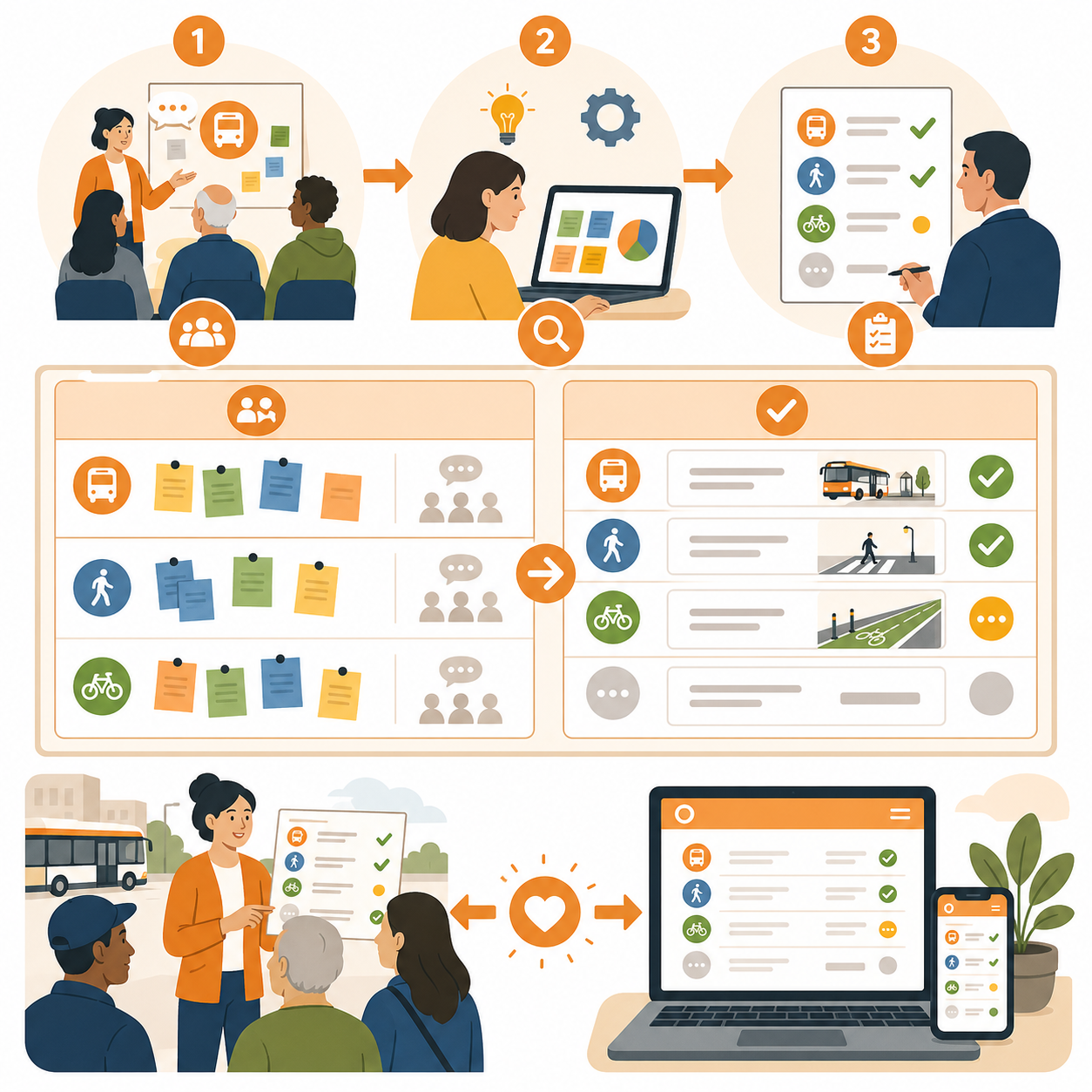 Facilitation determines whether a meeting produces decision-ready information or a long list of unrelated comments. A productive approach captures lived experience, then guides participants to translate that experience into priorities, tradeoffs, and mitigation ideas that can be compared across groups.
Structured formats reduce domination and increase clarity. Small-group discussions with clear prompts often produce more actionable input than open microphone sessions. When participants can talk through scenarios and then report back in a consistent format, staff can synthesize patterns more reliably.
A practical structure begins with a short orientation, then moves quickly into guided input activities. Each activity should end with a clear output, such as a ranked list, a set of priority locations, or a set of preferred mitigation strategies. When outputs are defined, facilitators can keep discussion focused without shutting down valid experiences.
Facilitation should also be designed to reduce re-litigation. Meetings often attract recurring frustrations that are real but outside the decision scope. Facilitators can acknowledge these issues and capture them in a separate channel, while keeping the meeting focused on the current decisions. This preserves dignity while protecting the purpose of the meeting.
Finally, facilitation should create psychological safety. Participants provide better input when they believe the agency is listening and will use the information responsibly. This requires respectful tone, clear ground rules, and a process that treats all participants as credible sources of insight.
Replace Open Mic With Structured Prompts and Time-Boxed Rounds
Open mic formats often produce the least actionable input. They encourage speeches, repetition, and emotional escalation. They also privilege participants who are comfortable speaking publicly and have time to attend. A structured approach produces more balanced participation and more comparable outputs.
Time-boxed rounds can be simple. Each table or small group answers the same prompt for a set period, then shares a summary using a standard format. This creates comparable data across groups. It also makes synthesis easier because staff can identify recurring themes and quantify how often priorities appear.
Structured prompts should be written in plain language and should be specific. Prompts should ask participants to choose among options, identify top pain points, or propose mitigation strategies tied to specific locations or time windows. This produces feedback that can directly inform plan adjustments.
A structured approach also reduces conflict. People feel heard when they have a defined opportunity to contribute, and facilitators can keep discussion focused on decisions rather than on arguments about process.
Use Ranking and Tradeoff Exercises to Convert Feedback Into Priorities
Transit planning involves choices. Meetings should include at least one exercise that forces prioritization. Ranking exercises help participants identify what matters most. They also reveal differences across rider types and neighborhoods, which can inform equity analysis.
Tradeoff exercises can be designed around realistic constraints. For service planning, participants can be asked to choose between frequency improvements in one corridor versus extended coverage in another. For capital planning, participants can be asked to prioritize accessibility improvements, safety upgrades, or station circulation changes, knowing not all can be done at once.
These exercises also reduce vague requests. Participants often want everything improved, which is understandable. Ranking helps clarify what they would choose first and what they would accept later. That information is decision-grade input.
Tradeoff exercises should also include mitigation prompts. If a participant accepts a tradeoff, they can identify what mitigation would make it acceptable, such as clearer wayfinding, improved lighting, or targeted support during construction. This yields practical design and communication improvements.
Design for Equity and Accessibility to Avoid Skewed Participation
Public meetings produce actionable input only if the input reflects the riders most affected by decisions. Traditional meeting formats often exclude people who have the least flexibility. Equity-focused meeting design expands participation pathways and reduces barriers to engagement.
Equity begins with time and location choices. Meetings should be offered at multiple times or through multiple participation options, including in-person, virtual, and asynchronous input. Transit riders may have shift work, caregiving responsibilities, and long travel times. A single evening meeting will not capture full rider experience.
Equity also includes language access. Meetings should offer interpretation for the most common languages in the service area and provide translated materials in advance. Facilitators should also use plain language and avoid jargon so that participants can engage without needing professional planning knowledge.
Accessibility also matters. Venues should be accessible, and virtual options should be compatible with assistive technologies. Materials should be available in accessible formats. Captions should be provided for virtual sessions. These choices expand participation and reduce unequal exclusion.
Equity also includes trust histories. Some communities may not participate because they believe input will not matter. Agencies can address this by working with community partners, using trusted venues, and clearly communicating how input will be used. Transparent follow-up is the strongest trust-builder over time.
Offer Multiple Participation Paths and Use the Same Prompts Across Them
Multiple participation paths are effective only if they capture comparable input. The agency should use the same core prompts across in-person, virtual, and asynchronous formats. This allows staff to synthesize feedback without treating each format as a separate conversation.
Asynchronous input can be collected through short surveys, interactive maps, and structured comment forms that mirror meeting prompts. These tools should be simple, mobile-friendly, and available in multiple languages. They should also include the same tradeoff and ranking questions used in meetings.
Using consistent prompts also reduces bias. It prevents one format from producing only broad sentiment while another produces detailed priorities. Comparable prompts produce comparable data.
Comparable input also improves transparency. The agency can report back on the combined results across formats, which helps participants trust that all voices were included.
Use Trusted Partners to Reach Riders Who Do Not Attend Meetings
Many riders will not attend agency-hosted meetings, especially if they have experienced prior processes as performative or confusing. Trusted partners can help reach these riders through existing networks.
Partners can include community organizations, employers, schools, and local institutions. Agencies can provide partner-hosted listening sessions that use the same structured prompts. This reduces barriers and increases participation quality because the environment feels more familiar.
Partner sessions should still be structured to produce comparable output. Facilitators can be trained to use the same prompts and capture results in a consistent format. This prevents the partner sessions from becoming purely qualitative without decision-ready structure.
Partner engagement also supports trust. Riders are more likely to share specific feedback when they believe it will be used. Working through trusted partners signals respect and increases the likelihood of future participation.
Capture Input in a Way That Makes Synthesis Possible
Meetings do not produce actionable input if the agency cannot translate discussion into usable outputs. Capturing input requires more than taking notes. It requires a structured capture method that aligns with the meeting prompts, preserves key details, and makes results comparable across groups and sessions.
Structured capture begins with standardized templates. Each prompt should have a corresponding capture field. For example, if the prompt asks participants to rank service priorities, the capture template should record ranked choices, the reasons behind them, and any location-specific notes. If the prompt asks for mitigation ideas for a construction phase, the capture template should record mitigation types, priority locations, and who would benefit most.
Capture should also preserve time and place specificity. Service and capital inputs often depend on daypart, direction, and location. A comment like “this transfer is unreliable” becomes actionable when it includes when it fails most often, which routes or platforms are involved, and what riders currently do to cope. Structured capture encourages facilitators to collect this specificity without turning the meeting into an interrogation.
Capture methods should also avoid over-reliance on free-form comments. Free-form narratives can be valuable, but they are harder to synthesize. When the meeting includes ranking and tradeoff exercises, the capture method should preserve those outputs as the core data. Narrative can then be used to explain why priorities emerged, rather than becoming the entire dataset.
Finally, capture should include a separate channel for out-of-scope issues. Participants often raise concerns that are real but not part of the meeting decision scope. Capturing those concerns in a separate category respects participants while keeping the decision dataset clean. It also allows the agency to route those concerns to the right department later.
Use Consistent Coding Categories and Location Tags
Coding categories make synthesis possible. Agencies can define a small set of categories tied to service planning and capital planning, such as reliability, frequency, coverage, transfers, safety, accessibility, wayfinding, station circulation, stop placement, and construction mitigation. When every comment is tagged with one or more categories, patterns become easier to see.
Location tagging is equally important. A service plan comment should be tagged to a route, corridor, transfer point, or time window. A capital plan comment should be tagged to a station, entrance, platform area, or project phase. Tags transform anecdotes into spatially grounded inputs that planners can act on.
Coding should be consistent across formats. If the agency collects input through meetings, online tools, and partner sessions, the same category and location tagging approach should apply. This allows synthesis across channels and reduces the risk of treating different formats as separate conversations.
A consistent coding approach also improves transparency. The agency can report back on themes by category and location, which helps the public see how their input was organized and used.
Preserve Minority Perspectives Without Losing the Priority Signal
Actionable input includes majority themes and minority impacts. A meeting may produce a clear top priority, but smaller groups may surface critical equity issues, such as accessibility barriers, late-night safety risks, or impacts on riders with limited alternatives.
A strong capture approach preserves these minority perspectives explicitly. This can be done by tagging equity-relevant impacts, identifying high-burden rider groups, and noting when a comment reflects a common constraint for a specific community. The goal is not to give equal weight to every comment. The goal is to ensure that high-harm issues are not erased by majority volume.
Minority perspective preservation also improves planning quality. Many service and capital decisions have unintended consequences that show up first among riders with the least flexibility. Capturing these impacts early allows the agency to adjust options and mitigation strategies before implementation.
Preserving minority perspectives also supports trust. Communities that feel consistently overlooked will disengage. When agencies demonstrate that they captured and addressed high-burden impacts, participation becomes more sustainable over time.
Close the Loop With a Follow-Up That Shows How Input Was Used
Public engagement loses value when the follow-up is weak. Participants need to see that their input mattered. Closing the loop is also how agencies build long-term participation. When people see that their priorities influenced choices, they are more likely to participate again and to share engagement opportunities with others.
Closing the loop starts with a timely meeting summary. The summary should highlight the key priorities, the top tradeoffs identified, and the most common mitigation suggestions. It should use plain language and should reference locations and scenarios that participants raised. It should also include a clear description of what the agency will do next, including decision timelines and where updates will be posted.
Follow-up should also include a “what we heard and what we are doing” structure. This structure connects input to agency actions, such as adjusting an option, modifying a phase plan, adding a mitigation measure, or refining the evaluation criteria. Even when the agency cannot implement a suggestion, it should explain why in a calm and transparent way.
Closing the loop should also be consistent across participation formats. People who engaged asynchronously or through partners should receive the same summary and the same opportunity to see results. This improves equity and reduces the perception that only meeting attendees mattered.
Finally, closing the loop should include a way to continue engagement. This can include the next meeting date, a survey link, a project update subscription, or a feedback route. Engagement should feel like a process with visible checkpoints, not a one-time event.
Publish a Clear Summary With Decisions, Not Only Themes
Theme-only summaries are common, but they can feel vague. Participants often want to know what will change because of what they shared. A decision-oriented summary states which options were refined, which priorities were elevated, and which mitigation measures will be included.
Decision summaries should also include dates. If decisions will be made later, the agency should state when and where updates will occur. Predictable timing reduces rumor cycles and helps participants stay engaged.
The summary should also include what was out of scope and how those issues will be routed. This prevents participants from feeling ignored and clarifies why some topics were not addressed in the meeting’s decision process.
Clear summaries also help internal teams. They create alignment across departments and provide a reference point for staff responding to public questions.
Use a Consistent “What We Heard. What We Will Do.” Format
A consistent format helps build trust over time. When the agency uses the same follow-up structure after each engagement, participants learn what to expect and how to interpret outcomes.
The “what we heard” section should list priorities and key concerns in plain language. The “what we will do” section should list concrete actions, such as adjusting service options, refining station design elements, improving wayfinding plans, or changing construction mitigation. It should also include where the agency cannot take action and why, stated plainly.
This format also supports equity. It helps participants see whether high-burden issues were addressed and what mitigation will be used. It also makes it easier for partners to share results with their communities.
Consistency in follow-up is one of the strongest participation incentives. People are more willing to provide specific input when they believe it will be used and reflected back responsibly.
Promoting Long-Term Transportation Outcomes Through Communication
Public meetings improve transit service and capital planning when they produce decision-grade input rather than broad sentiment. Actionable input helps agencies prioritize investments, refine options, and design mitigation that reduces harm during transitions. Over time, this improves both planning quality and public trust, because riders can see a clearer connection between engagement and outcomes.
Long-term participation improves when meetings are consistently designed around clear decisions, structured prompts, and visible boundaries. Riders and community members are more willing to invest time when they understand what the agency needs and how their feedback will be used. Predictable follow-up strengthens this effect. When people see a consistent “what we heard and what we will do” loop, engagement becomes more sustainable.
Equity outcomes improve when agencies expand participation pathways and capture comparable input across formats. Offering multiple meeting times, virtual access, asynchronous options, language access, and accessible materials helps ensure that input reflects the riders most affected by service and capital decisions. Partner-hosted sessions also broaden reach and reduce trust barriers. When engagement is more inclusive, the resulting plans tend to be more workable and less likely to create unintended harm.
Operational outcomes improve as well. Structured meetings reduce conflict and reduce repetitive confusion. Staff can focus on decision prompts rather than on managing open mic escalation. Standard capture templates and coding categories make synthesis faster and more reliable, which improves internal alignment and speeds plan refinement. Clear follow-up reduces rumor cycles and reduces the volume of recurring public questions.
Finally, a repeatable meeting system strengthens agency readiness. Service plans and capital programs often require frequent engagement. When agencies build a reliable approach to meeting design, facilitation, capture, and follow-up, they can engage more effectively without reinventing the process each time.
Strategic Communication Support for Your Transportation Agency
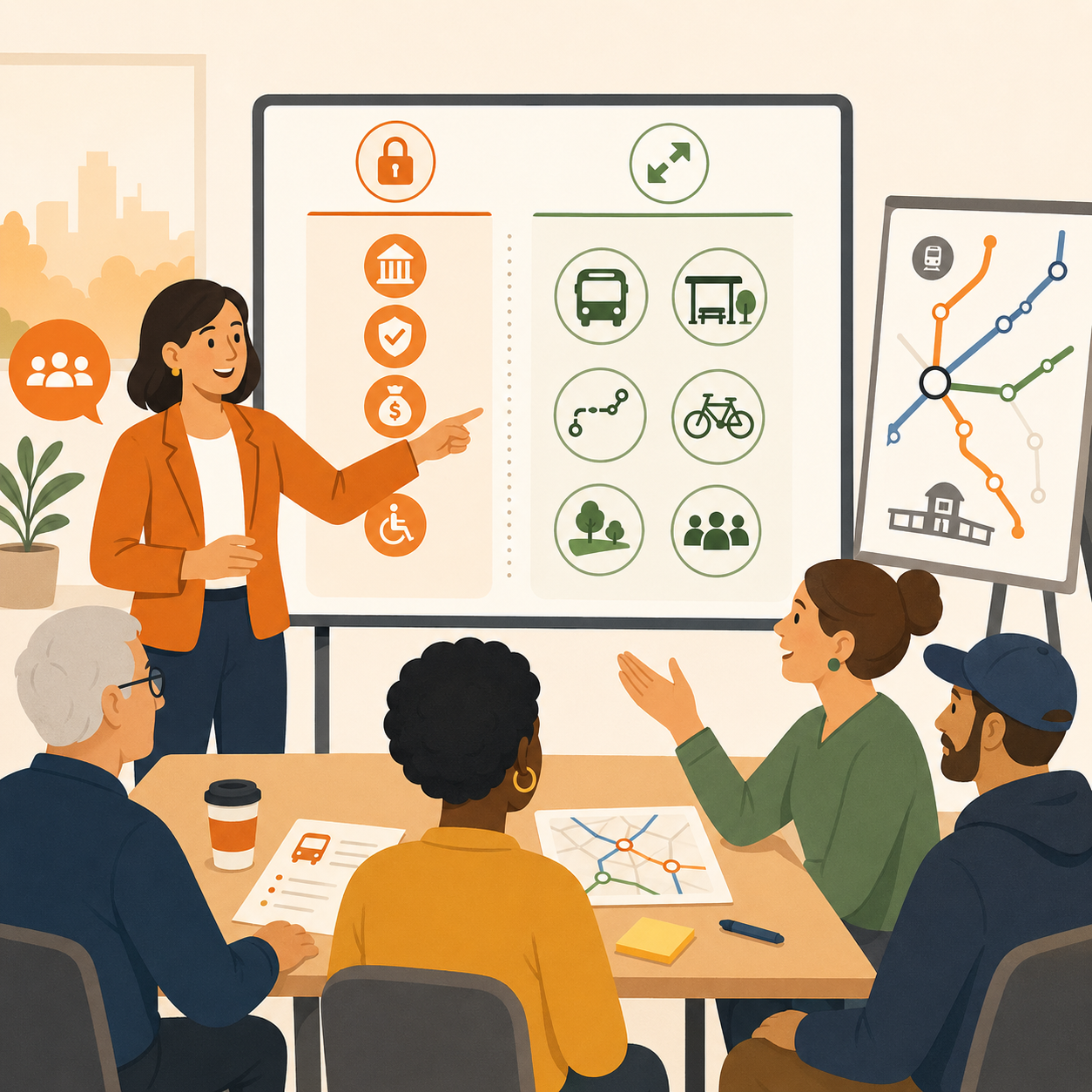 Transit agencies often recognize the value of public engagement, but producing actionable input consistently can be difficult. Agencies must balance transparency with readability, manage strong emotions without losing decision focus, design for equity and accessibility, and transform diverse feedback into clear priorities and next steps. Without a shared system, meetings can become venting sessions that produce limited decision support and weaken trust.
That is why agencies often choose to partner with an external resource like Stegmeier Consulting Group (SCG) to strengthen communication systems. An outside partner can help transit organizations design engagement approaches that produce decision-grade input, including meeting purpose framing, decision-ready prompts, facilitation scripts, capture templates, coding frameworks, partner toolkits, and follow-up communication packages that show how input was used.
SCG supports transportation agencies by helping teams build engagement workflows that are clear, equitable, and repeatable. That includes shaping pre-read materials in plain language, designing structured meeting formats that generate comparable outputs, aligning internal teams around message spines and decision boundaries, and producing post-meeting summaries that translate input into actions and timelines. Over time, these practices improve planning quality, reduce conflict, and strengthen public confidence in both service planning and capital investment decisions.
Conclusion
Public meetings produce actionable input when they are designed as decision support. Transportation agencies can improve outcomes by defining clear meeting purpose and boundaries, translating planning questions into rider-understandable prompts, making tradeoffs explicit, preparing participants with accessible pre-reads, using structured facilitation that converts lived experience into priorities, designing for equity through multiple participation paths, capturing input with consistent templates and location tags, and closing the loop with transparent follow-up that shows how input was used.
When agencies build a repeatable public meeting system, engagement becomes more productive and more trusted. Riders and community members gain clearer pathways to influence service and capital decisions, and agencies gain better information to design plans that work in real life.
SCG’s Strategic Approach to Communication Systems
Align your agency’s messaging, processes, and public engagement strategies
Agencies that communicate effectively build stronger trust with staff, stakeholders, and the public. Whether you are improving public meeting design, strengthening internal workflows, or aligning agency-wide messaging, SCG can help you develop a communication system that supports consistent decision-making and long-term organizational success. Use the form below to connect with our team and explore how a strategic communication framework can elevate your agency’s impact.