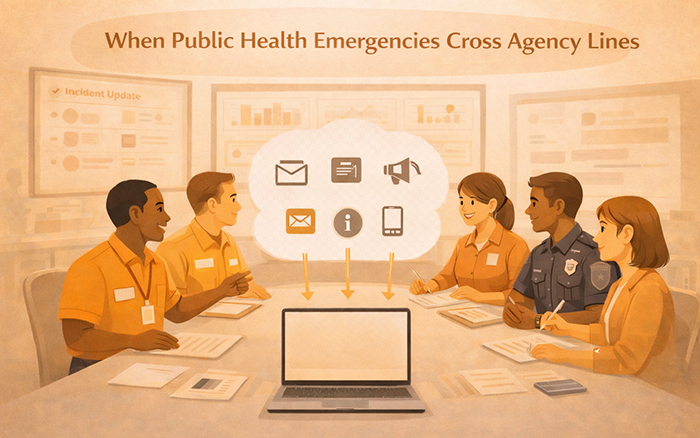
When Public Health Emergencies Cross Agency Lines: Building Coordinated Communication
Public health departments and health agencies rarely respond to emergencies alone. Outbreaks, environmental hazards, mass exposures, and service disruptions often cross agency lines, requiring coordination with emergency management, hospitals, schools, transportation, public works, law enforcement, and community partners. In these moments, residents do not care which entity “owns” the issue. They care whether guidance is clear, consistent, and actionable.
Health authorities and public health organizations also face a high-risk communication reality during multi-agency events. If one agency publishes guidance that differs from another, residents interpret the mismatch as confusion or concealment. If agencies use different definitions, different risk language, or different update rhythms, misinformation fills the gaps. Coordination is not only operational. It is a trust requirement that shapes whether communities comply with protective actions.
Coordinated communication is a system. It includes shared message spines, aligned terminology, clear decision rights, synchronized updates, and partner-ready materials that prevent drift as information spreads. This article provides an evergreen framework for health agencies that need to coordinate communication across multiple entities, while maintaining clarity, equity, and credibility under pressure.
Why Crossing Agency Lines Creates Communication Risk
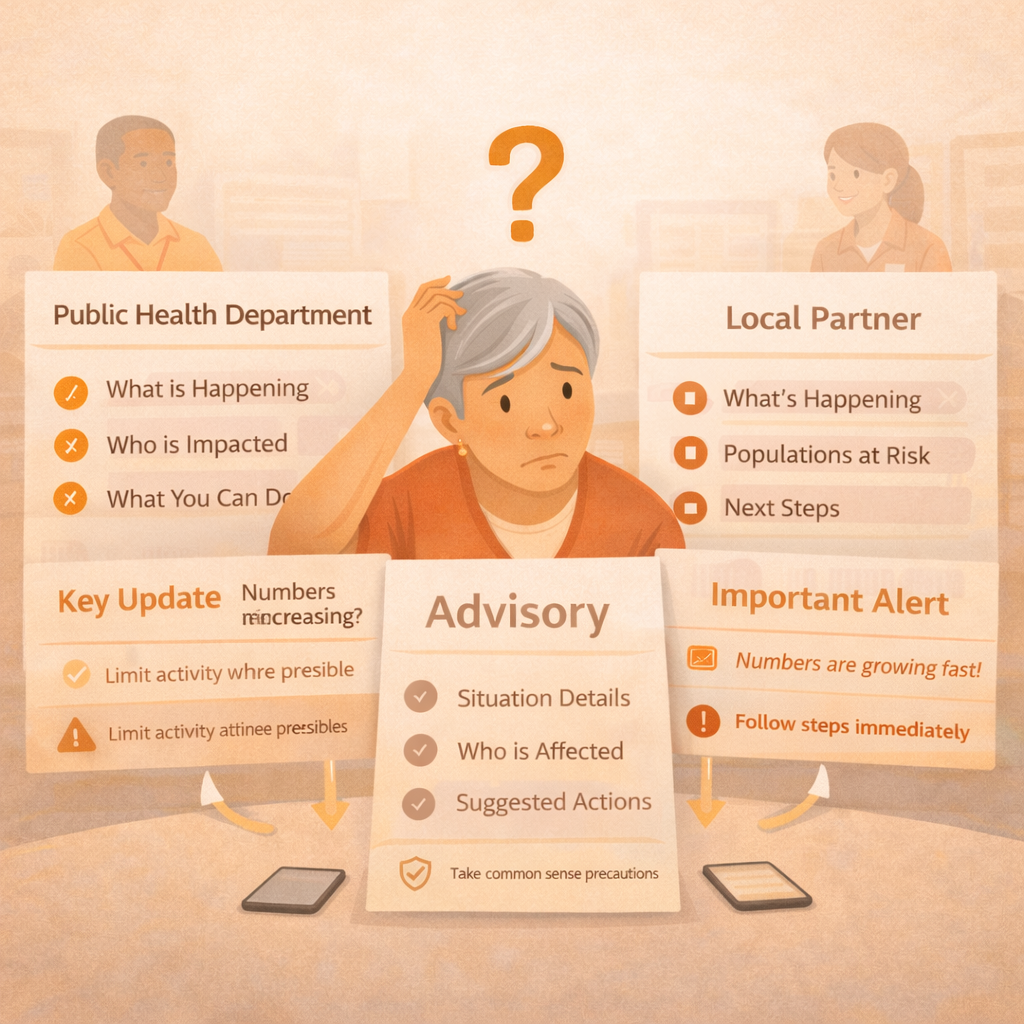 A multi-agency response creates complexity that residents cannot see. Agencies may have different legal authorities, different data sources, different operational constraints, and different public audiences. Even when agencies agree internally, the public experience can still feel inconsistent if external messaging is not aligned tightly.
Public health departments often see communication risk emerge in predictable ways. Agencies may use different labels for the same situation, such as advisory versus warning, or recommendation versus requirement. They may publish updates on different schedules, causing residents to see different numbers or different guidance depending on which channel they check. They may also prioritize different details, with one agency emphasizing technical context and another emphasizing actions, which can make the messages feel contradictory.
Cross-agency communication risk is also amplified by the way information travels. Residents encounter pieces of the response through news headlines, social posts, group chats, workplace messages, and community leaders. Those pieces are often stripped of context. If the pieces do not match, residents assume someone is wrong. That assumption triggers confusion, anger, and decreased compliance, especially when protective actions require effort.
Another risk is that agency coordination is visible through frontline interactions. A resident may call one hotline and receive one answer, then call another and hear different wording. They may receive different instructions from different staff at a clinic, school, or service site. These inconsistencies become personal experiences, and personal experiences carry more weight than official statements.
Coordination also affects equity. Underserved communities often rely on trusted local partners rather than official channels. If partner messaging is inconsistent across agencies, these communities may receive conflicting guidance and have fewer options for verification. Health authorities strengthen equity when coordination includes shared partner toolkits, shared translation pathways, and consistent routing guidance for residents who need help.
Finally, crossing agency lines increases decision complexity. When decisions involve multiple entities, approvals can slow down and updates can lag. Silence creates an opening for misinformation. Public health organizations can reduce this risk by establishing a coordination structure that supports speed with consistency.
From Data to Action: Effective Communication Strategies for Public Health Agencies
This article is part of our series on strategic communication for state and local government Public Health Agencies. To learn more and to see the parent article, which links to other content just like this, click the button below.
The Coordination Basics, A Shared Message Spine and a Single Source of Truth
The most effective coordinated communication starts with two core foundations. The first is a shared message spine. The second is a single source of truth that all agencies reference.
A shared message spine is a short set of sentences that states what is happening, who is affected, what residents should do now, and where to verify current details. When multiple agencies share the same spine, they can publish through different channels and still maintain consistent meaning. This reduces confusion even when agencies must speak to different audiences or emphasize different operational details.
A shared spine also forces alignment on definitions. If a health authority and an emergency management agency use different language for risk level, the public will notice. Agencies can prevent drift by agreeing on the words that should not change across entities, especially for scope, timing, action steps, and requirements. This is particularly important when guidance includes conditions, such as different recommendations for higher-risk groups or different instructions for specific neighborhoods.
A single source of truth is the public-facing place where the most current guidance lives. It can be hosted by one agency, or it can be a joint page that multiple agencies link to. The critical point is that all agencies point to the same location for current details. This reduces the spread of outdated screenshots and reduces the need for residents to compare multiple pages.
The source page should be date-stamped, mobile-friendly, and structured so the key action steps are visible immediately. It should also include a short “what changed” line when updates occur. These features reduce rumor cycles because residents can verify quickly and see that information is being maintained.
Coordinated communication becomes more reliable when both foundations are in place before the emergency peaks. When agencies try to align after contradictory messages have already circulated, they spend more time repairing trust and less time guiding action.
Align Terminology and Risk Language Before You Publish
Multi-agency events often fail at the vocabulary level first. Public health departments and health agencies may use different terms for the same concept, and the public interprets that difference as disagreement. Coordination improves when agencies align on a small set of terms that must remain consistent across all public-facing materials.
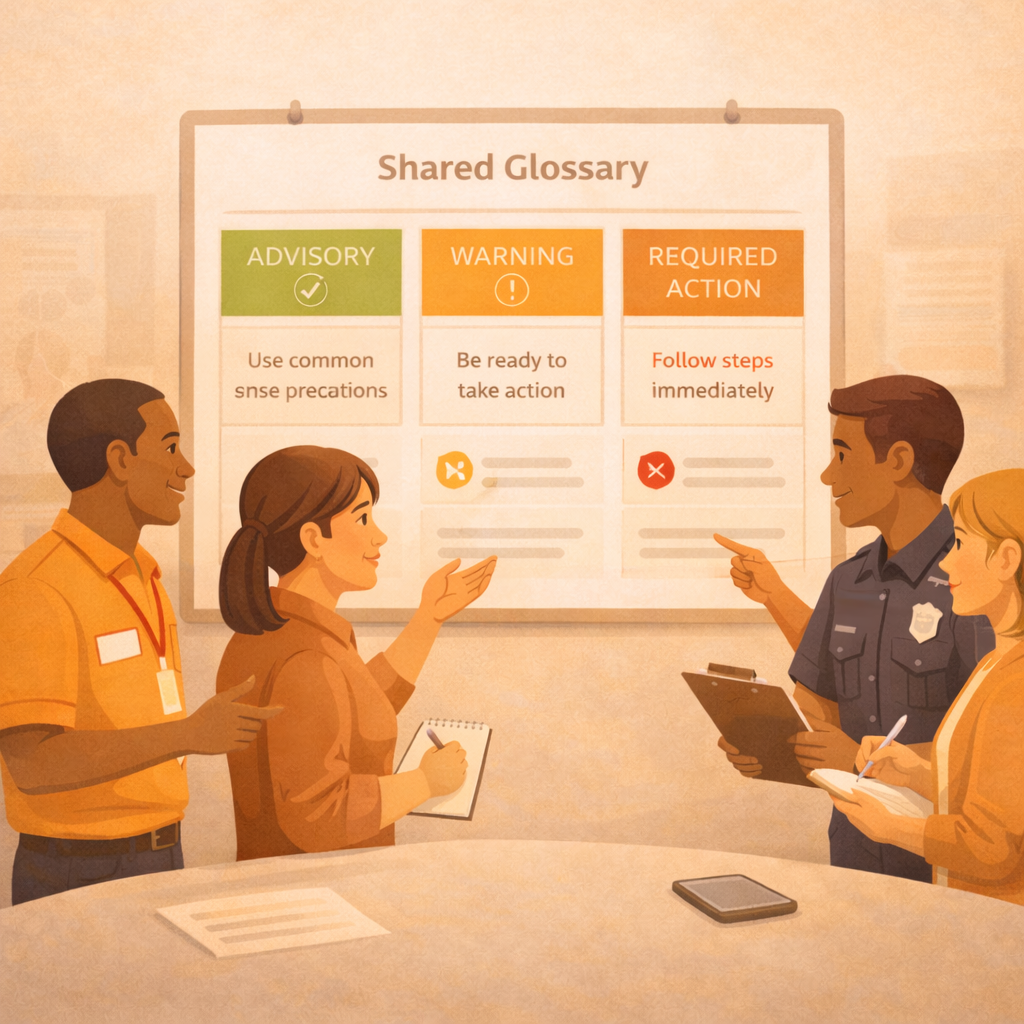
Terminology alignment should include labels that drive behavior, such as advisory versus warning, recommended versus required, exposed versus at risk, and eligible versus not eligible. These words shape how residents interpret urgency and responsibility. Health authorities can reduce confusion by defining these terms in plain language and ensuring the same definitions appear in every major channel, including websites, social posts, press statements, partner toolkits, and staff scripts.
Risk language also needs calibration. One agency may be accustomed to technical phrasing, while another may communicate through emergency operations language. Residents need plain language that communicates seriousness without causing panic. A shared approach to risk language can include consistent labels for the level of action expected, along with a short explanation of what the label means. This helps residents understand whether the message is informational, time-sensitive, or requiring immediate behavior changes.
Alignment also includes geographic and population scope. If an environmental hazard affects specific neighborhoods, the messaging must name those neighborhoods consistently and avoid implied broader risk. If a hazard affects higher-risk groups differently, the messaging must clarify that distinction clearly. When scope language varies across agencies, residents assume either exaggeration or minimization.
A final terminology issue is measurement language. One agency may refer to an indicator using a technical term, while another uses a common-language label. A public health organization can reduce confusion by choosing one primary label for the public message and using it consistently, while still allowing technical descriptions in deeper documentation. This approach supports both transparency and comprehension.
Create a Shared Glossary for the Incident
A shared glossary is one of the simplest ways public health departments and health agencies can prevent cross-agency drift, especially when multiple entities are issuing updates under pressure. The glossary does not need to be long. It needs to be explicit, easy to reference, and written in plain language so staff and partners can use it in conversation without rewriting. The purpose is to make sure the same words mean the same thing everywhere, across web pages, press statements, social posts, hotline scripts, partner toolkits, and frontline conversations.
A useful incident glossary typically includes three types of terms. First are risk and action labels, such as informational update, action recommended, action required, advisory, warning, or order. Each label should include a short definition that clarifies what the public is expected to do and what level of urgency applies. Second are scope and timing terms, such as affected area, exposure window, impacted facility, higher-risk groups, and until further notice. These terms should specify what is included, what is not included, and how residents can tell whether the guidance applies to them. Third are program and incident-specific definitions, such as what counts as eligible, what documentation is required, what a confirmation means, what a testing result category means, or what “available” means when capacity is limited.
The glossary becomes more effective when it is operational, not just descriptive. That means including a short example phrase staff can use verbatim, along with a brief note on what language should not be used because it creates confusion. For instance, if agencies decide to use “recommendation” for voluntary actions, the glossary can explicitly state that “optional” should be avoided if it implies the guidance is unimportant. If “order” is used, the glossary can clarify what enforcement looks like, or clarify that the order carries legal requirements, so residents do not confuse it with general advice.
Because emergencies evolve, the glossary should be treated as a living document with a clear owner and a predictable update process. Health authorities can assign one incident communications lead to manage changes, time-stamp updates, and distribute the newest version to all agencies and partners. If a definition changes, the update should be flagged clearly so staff do not keep using old language. This practice reduces contradictions across agencies and helps frontline teams respond confidently when residents ask clarifying questions.
Maintain Consistent Terms Across Translations
Translation consistency is essential in coordinated incidents because different language communities often rely on different channels and trusted messengers. If key terms shift in translation, residents may receive different interpretations of the same guidance, which undermines both equity and trust. Public health departments can prevent this by treating multilingual terminology as part of the shared glossary, not as a separate task that happens after the English language message is finalized.
A practical approach is to establish approved equivalents for key incident terms and reuse them consistently across every translated asset. This includes risk and action labels, scope and timing language, and program-specific definitions. When possible, the translated equivalents should be reviewed by bilingual staff or trusted community partners to ensure they match local usage and do not carry unintended stigma or ambiguity. This step is especially important for words that can be interpreted differently in different dialects or cultural contexts.
Parallel updates are also critical. If English materials update quickly but translations lag, residents in other language communities may rely on informal translation in social networks, which often introduces errors. Health agencies can reduce this risk by planning translation into the update workflow, using templates that are easier to translate, and publishing multilingual updates on the same schedule as English updates whenever possible. When parallel publishing is not feasible for every detail, agencies can at minimum publish the key takeaway, the action step, and the verification path in multiple languages immediately, then follow with deeper translated detail as soon as it is ready.
Consistent translation also requires stable formatting and stable link paths. Public health organizations can reduce confusion by maintaining a predictable location for translated materials, using the same naming conventions across languages, and ensuring that timestamps and “what changed” notes are visible in each language version. When residents can confirm that their language page is current, they are less likely to rely on screenshots or secondhand summaries, and the coordinated communication system becomes more equitable and more reliable.
Clarify Decision Rights and Approval Pathways to Prevent Delays and Contradictions
Coordination breaks down when agencies do not know who can decide what, or when approvals become unpredictable. Public health departments and health agencies can improve speed and consistency by clarifying decision rights early and by establishing a simple approval pathway that matches the urgency of the event.
Decision rights should define which agency owns the technical guidance, which agency owns operational details, and which agency owns the public-facing narrative. In many cases, a health authority may own clinical or exposure guidance, while emergency management may own sheltering or logistics, and public works may own infrastructure impacts. If these ownership boundaries are not explicit, agencies may publish overlapping messages with conflicting emphasis, and residents will experience the response as disorganized.
Approval pathways should also reflect the difference between facts and decisions. Facts such as location details, hours, and confirmed updates often need quick publication. Decisions that change requirements or trigger new actions may need higher-level approval. Health agencies can reduce delays by creating a tiered approach, where certain update types can be published quickly by designated leads, while higher-impact changes follow a defined escalation path.
Consistency depends on sequencing. Staff and partners should not learn major changes from the public. A coordinated approach includes an internal brief and partner pre-brief before broad public publishing, especially for changes that will generate questions immediately. This reduces improvisation and supports a consistent public experience across hotlines, clinics, schools, and partner sites.
Finally, approval pathways should include a process for resolving disagreements. Agencies may have different risk tolerances and different legal constraints. When disagreements arise, the public message still needs one clear instruction. A pre-defined conflict resolution step, such as escalation to a joint incident leadership group, helps prevent contradictory statements from being published in parallel.
Use a Joint “Message Pack” as the Common Reference
A message pack includes the shared message spine, the agreed terminology, the current action steps, and the top questions and answers. It should be updated as the situation evolves and distributed across agencies so staff are aligned. When agencies reference the same pack, contradictions decrease.
A joint pack is most effective when it is designed for fast reuse. Public health departments and health agencies can include copy-ready blocks for the most common channels, such as web updates, social posts, partner emails, and hotline scripts, so staff are not rewriting under pressure. The pack should also include a short “what changed” section and a clear date and time stamp, which helps agencies, partners, and frontline teams quickly confirm they are working from the current version. When the message pack is structured this way, it becomes a shared operating document that supports consistent public interactions and reduces last-minute improvisation across organizations.
Establish a Synchronization Rule for Updates
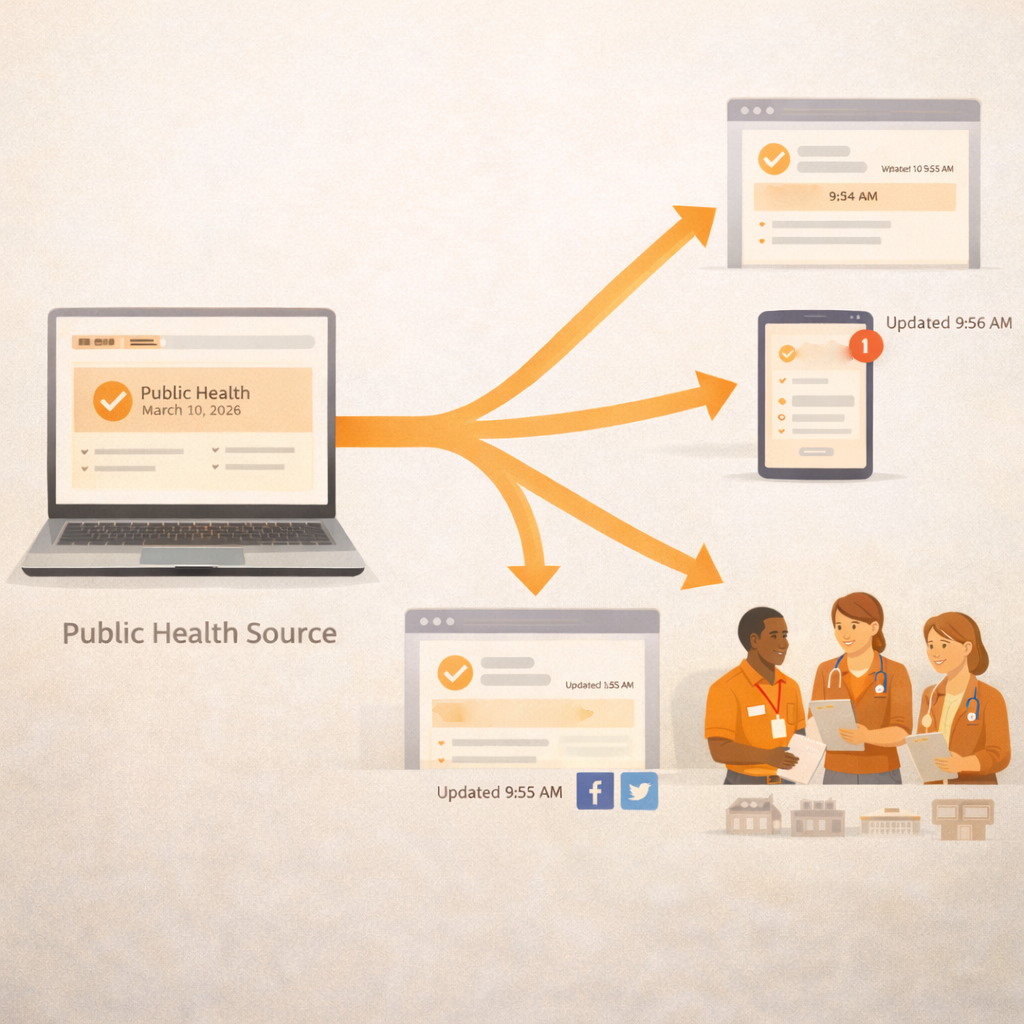
A synchronization rule clarifies how agencies will coordinate timing. For example, the source-of-truth page is updated first, then all agencies publish channel adaptations within a defined window. This prevents residents from seeing conflicting information because different channels lag behind. A clear rule supports speed and reduces confusion.
Synchronization works best when it also defines exceptions and responsibilities. Health authorities can specify which update types must be synchronized every time, such as changes to eligibility, requirements, service locations, and safety actions, and which updates can be published independently, such as minor formatting fixes or internal-only clarifications. Public health departments can also assign one communications lead to trigger the synchronization window and confirm completion across agencies. This small layer of coordination helps prevent partial updates from circulating, protects public trust during fast-moving events, and makes it easier for partners and media to share the same current guidance without reconciling multiple versions.
Coordinated Updates, How to Keep Multiple Channels and Agencies in Sync
 During a multi-agency emergency, residents often check multiple sources to confirm what is true. If they see different numbers, different instructions, or different timestamps, they assume confusion or concealment. Public health departments and health agencies reduce this risk by treating updates as synchronized releases rather than separate announcements.
Synchronized updating begins with a clear sequence. The single source-of-truth page should be updated first, with a visible timestamp and a brief note about what changed. Once the source is current, each participating agency can publish its channel-specific version, using the shared message spine and the same terminology. This approach creates consistency even when agencies speak to different audiences or emphasize different operational details.
Update cadence matters. If one agency posts frequently and another posts rarely, residents may treat the quieter agency as uninformed or disconnected. Health authorities can reduce this perception by agreeing on an updated rhythm and sticking to it, especially during active periods. A predictable rhythm lowers rumor velocity because residents know when to expect new information and do not interpret quiet periods as hidden activity.
Coordination also requires clarity about what constitutes an update. In many events, the facts change slowly, but questions and rumors change quickly. Public health organizations can use short confirmatory updates when needed to reinforce what remains true, restate key actions, and direct residents back to the verification page. These brief updates support stability without creating fatigue.
Channel drift is a common problem. A website post might be updated, but social posts might still show an older instruction. A partner newsletter might repeat yesterday’s eligibility language. A hotline script might lag behind. Health agencies can reduce drift by distributing updated message packs internally and by using a simple checklist that confirms each channel has been refreshed. This is not about perfection. It is about preventing the most visible contradictions that undermine trust.
Coordinated updates also benefit from consistent formatting cues. When residents see the same header structure, the same risk label, and the same link path across agencies, they recognize the message as aligned. This recognition reduces anxiety and reduces the spread of unofficial summaries.
Use a “What Changed” Line and a “What to Do Now” Line Every Time
Residents often return to updates looking for two things. They want to know what changed, and they want to know what to do. A consistent pair of lines provides quick orientation and reduces misinterpretation. This also helps partners and media summarize accurately.
Date-Stamp Visuals and Avoid Screenshots as the Primary Distribution Method
Screenshots travel longer than guidance remains current. Public health departments can reduce confusion by dating visuals and encouraging residents and partners to share links rather than screenshots. When people can verify quickly, outdated content loses power.
Coordinating With Partners, Schools, Clinics, and Community Organizations
Multi-agency emergencies are rarely communicated only through official government channels. Schools, hospitals, clinics, employers, shelters, community-based organizations, and local media often become the primary messengers for many residents. Public health departments strengthen coordinated communication when partner networks receive aligned materials that are easy to share and easy to keep current.
Partner coordination begins with clarity about what partners need. Partners usually need a short explanation of what is happening, a clear instruction for residents, and a reliable verification path. They also need guidance on where to route questions that they cannot answer. Health agencies can support this by providing a partner-facing message pack that includes copy-ready text, a short FAQ, and a link to the source-of-truth page.
Partners also need version control. A flyer posted at a community site may remain visible for weeks. A school email may be forwarded repeatedly. Health authorities can reduce outdated guidance by including dates on partner materials and by establishing a simple update process, such as sending updated copy blocks through a partner distribution list. When partners can refresh content quickly, communities receive more consistent information.
Equity depends on partner coordination. Underserved communities often rely on trusted local organizations and ethnic media. Public health organizations can strengthen equity by ensuring partners receive translated materials in parallel, clear access routes for residents who need assistance, and consistent terminology that prevents different communities from receiving different interpretations.
Partner coordination also benefits from humility and relationship. Partners will share more confidently when they understand the decision logic and when they feel respected as part of the response system. Health agencies can build this confidence by providing brief context, being transparent about constraints, and maintaining predictable communication rhythms.
Provide Routing Language So Partners Know What to Do With Questions
Partners should not be forced into the role of policy interpreter. Health agencies can provide short routing language that directs residents to the correct hotline, clinic, or web page. This reduces partner burden and ensures residents receive accurate answers.
Build a Partner Update Routine That Matches the Incident Rhythm
A routine can be as simple as a daily partner email during active phases and a less frequent update as conditions stabilize. The key is predictability. When partners know when updates arrive, they can coordinate their own messaging and reduce improvisation.
Coordinated Risk Communication Without Alarm, Keeping Tone and Urgency Aligned
When multiple agencies communicate during a public health emergency, tone becomes part of coordination. Residents interpret urgency not only from what is said, but from how it is said. If one agency sounds calm and another sounds alarmed, the public assumes disagreement about severity. Public health departments and health agencies can reduce confusion by aligning on how urgency will be communicated and by linking urgency to clear actions rather than emotional intensity.
A practical way to align tone is to separate urgency from intensity. Urgency is about timing and action. Intensity is about emotional force. Coordinated communication should increase urgency through clarity, not through dramatic language. Health authorities can communicate seriousness by stating what is happening, who is affected, what the public should do now, and what will happen next. This approach supports appropriate action while reducing fear-driven rumor cycles.
Tone alignment also requires shared risk language. Agencies should use the same labels for the level of action expected and the same definitions for what those labels mean. When residents see consistent labels across agencies, they can interpret messages more confidently, even when they are encountering information in fragments. Consistency is especially important for messages that include requirements, advisories, or time-sensitive protective actions.
Coordinated risk communication also benefits from clearly stating scope. Many emergencies do not affect the entire community equally. Environmental hazards may be limited to specific neighborhoods. Exposure events may be tied to a specific setting or time window. A health agency can reduce unnecessary fear by stating scope early and repeating it near the action step. This helps residents quickly determine whether the message applies to them.
A further tone challenge is uncertainty. During multi-agency events, some details may still be under investigation. Residents can handle uncertainty when it is communicated transparently and paired with a stable decision path. Public health organizations can state what is known, what is being investigated, and what residents should do while more information is gathered. This prevents speculation and reduces the chance that agencies appear to contradict themselves later.
Finally, tone alignment should include calm myth correction. Rumors spread quickly during emergencies, especially when multiple agencies are involved. Agencies should respond with consistent, plain-language clarifications that lead with the truth and provide a verification path. When agencies coordinate myth correction, misinformation loses momentum faster because residents encounter the same correction from multiple credible sources.
Align on a Shared “Action Level” Label for Each Update
Residents need quick cues. Agencies can improve clarity by labeling each update as informational, action recommended, or action required, or using equivalent language agreed upon in advance. The label should be paired with a short statement of what residents should do. When the label is consistent, the public responds with more appropriate urgency.
Use Consistent De-Escalation Language for Resident Questions and Concerns
Frontline staff and partners often face anxious or angry questions. Health agencies can support calmer public interactions by using shared, respectful phrasing that acknowledges concern and returns to practical guidance. When de-escalation language is consistent, residents experience the response as coordinated and competent.
Internal Coordination, Staff Messaging That Prevents Public Contradictions
Coordinated public messaging depends on coordinated staff messaging. Residents often interact with multiple agencies through hotlines, clinics, inspections, schools, and community services. If staff across agencies are not aligned, the public will receive conflicting guidance even if the official statements are consistent. Public health departments can reduce this risk by treating staff communication as a joint coordination task.
Internal coordination starts with shared message packs distributed across agencies. These packs should include the message spine, key definitions, scope language, and the top questions staff are hearing. They should also include routing guidance so staff know where to send unusual cases. When staff across agencies rely on the same pack, conversations become more consistent and confusion decreases.
Staff sequencing also matters. Agencies should ensure that frontline staff receive updates before public posts go live, especially for changes that affect eligibility, access routes, or required actions. When staff learn about changes from residents, they must improvise. Improvisation creates contradictions. A short internal pre-brief prevents that and supports calmer interactions.
Internal coordination should also include role clarity. Staff need to know what their agency owns, what another agency owns, and how to refer residents appropriately. This is especially important when agencies have different legal authorities or service roles. Clear referral guidance prevents staff from guessing and prevents residents from being bounced between agencies without answers.
Finally, internal coordination benefits from a mechanism to surface contradictions quickly. Staff and partners often notice inconsistencies first. A shared internal channel for reporting confusion, such as a designated inbox or daily coordination call, allows agencies to correct misalignment quickly and update message packs before contradictions spread.
Create a Cross-Agency “Top Questions” List to Guide Clarifications
A shared list of top questions helps agencies focus on the same friction points. When the list changes, it indicates that messaging may need adjustment or that new rumors are emerging. Using the same list across agencies supports consistent public responses and reduces mixed messaging.
Use One Escalation Path for Conflicting Interpretations
When staff receive questions that expose conflicting interpretations, they need one clear escalation route. A designated incident communications lead or joint leadership group can resolve the discrepancy and issue an updated message pack. This prevents staff from making individual judgment calls that create further drift.
Promoting Long-Term Public Health Outcomes Through Communication
Coordinated communication across agency lines improves long-term public health outcomes because it strengthens trust, reduces confusion, and makes protective actions easier to follow. Public health departments and health agencies often share responsibility for emergencies that involve infrastructure, schools, healthcare delivery, and community services. When agencies speak with one aligned meaning, residents spend less time trying to reconcile conflicting messages and more time taking the steps that protect health.
Long-term outcomes improve when coordination systems are built before the next event. Shared message spines, aligned terminology, clear decision rights, and synchronized update rhythms create a repeatable operating model that can be activated quickly. This reduces the likelihood of contradictory statements, reduces rumor cycles, and improves the consistency of staff interactions across hotlines, clinics, and partner sites. Over time, communities experience public messaging as more dependable, which increases cooperation in both routine programs and urgent events.
Equity outcomes also strengthen when coordination includes partner networks and language access. Underserved communities often rely on trusted local organizations and ethnic media rather than official websites. When agencies provide partners with copy-ready materials, parallel translations, and consistent verification paths, communities receive clearer guidance and fewer conflicting interpretations. This is especially important when protective actions require access to services, because residents with higher barriers need the most reliable instructions.
Coordinated communication also reduces operational strain. When residents receive consistent instructions, fewer people call multiple hotlines for confirmation, fewer arrive at service sites unprepared, and fewer conflicts emerge from inconsistent staff explanations. Staff are better able to focus on service delivery, and leadership is better able to monitor what residents are misunderstanding and correct it quickly. This efficiency supports long-term outcomes because it protects capacity during high-demand periods.
Finally, coordination improves institutional learning. Cross-agency “top questions” tracking, shared feedback loops, and consistent after-action review practices allow agencies to refine templates and clarify terms over time. Each event can strengthen the system for the next one, creating a more resilient public health communication infrastructure across the region.
Strategic Communication Support for Your Health Agency
 Multi-agency emergencies place high demands on public health departments and health agencies. Health authorities must align terminology, risk language, and update rhythms across organizations with different roles and constraints, while maintaining clarity for residents who are scanning quickly and sharing information out of context. Without a defined coordination system, messages drift, approvals slow down, and contradictions can emerge even when agencies agree on the underlying facts.
That is why agencies often choose to partner with an external resource like Stegmeier Consulting Group (SCG) to strengthen communication systems. An outside partner can help public health organizations design coordinated communication frameworks that function under real incident pressure, including shared message spines, joint glossary development, synchronized update workflows, partner toolkits, staff message packs, and feedback loop structures that reveal confusion early. This support can also include governance design that clarifies decision rights, escalation paths, and approval tiers so agencies can move quickly without losing consistency.
SCG supports health agencies by helping teams translate complex, cross-agency operations into clear public meaning, while protecting equity through accessible formats and partner distribution. Over time, these practices improve trust, reduce friction, and help coordinated emergency responses lead to better community outcomes.
Conclusion
Public health emergencies that cross agency lines require communication that is coordinated as carefully as operations. Public health departments and health agencies strengthen public understanding when they align terminology and risk language, clarify decision rights, synchronize updates through a single source of truth, equip partners with ready-to-use materials, and support staff with shared message packs and escalation routes. Coordinated tone and predictable update rhythms reduce fear and reduce rumor cycles, while clear action paths improve compliance.
Health authorities and public health organizations can make coordination sustainable by treating it as a system, not as a one-time collaboration. When coordinated communication is repeatable and disciplined, communities receive clearer guidance, trust is easier to maintain, and long-term public health outcomes improve across both emergencies and routine programs.
SCG’s Strategic Approach to Communication Systems
Align your agency’s messaging, processes, and public engagement strategies
Agencies that communicate effectively build stronger trust with staff, stakeholders, and the public. Whether you are improving health communication campaigns, strengthening internal workflows, or aligning agency-wide messaging, SCG can help you develop a communication system that supports consistent decision-making and long-term organizational success. Use the form below to connect with our team and explore how a strategic communication framework can elevate your agency’s impact.