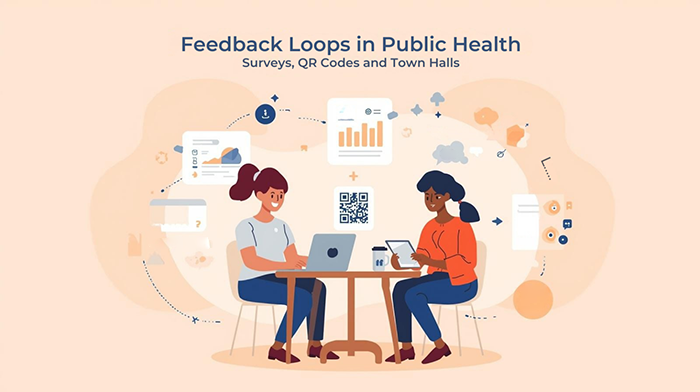
Feedback Loops in Public Health: Surveys, QR Codes, and Town Halls
Public health departments and health agencies are expected to understand community needs in real time, yet many signals arrive late or not at all. Residents may struggle with eligibility rules, appointment steps, or confusing guidance, then disengage without ever telling the organization why. In that environment, feedback loops become a core communication function because they help health authorities detect friction early, correct misunderstandings, and strengthen trust before small issues become public frustrations.
Public health organizations also operate in complex systems where partners, clinics, schools, and community networks shape what residents hear and how they respond. A feedback loop does more than collect opinions. It creates a practical pathway for residents and staff to surface barriers, for departments to interpret patterns, and for the agency to respond with changes that people can see and feel. When feedback loops are designed well, they reduce confusion, improve program participation, and make communication more equitable across different communities.
Feedback loops can take many forms. Surveys can capture trend-level insights and measure satisfaction or clarity. QR codes can enable micro-feedback at the moment of service, including in clinics, mobile events, and public-facing signage. Town halls can surface concerns that require explanation, context, and relationship-building. The strongest approach uses these methods as a connected system, not as isolated outreach moments.
This evergreen guide explains how health agencies can design feedback loops that lead to action. It focuses on practical mechanisms, governance, equity considerations, and closing the loop so residents and partners see what changed.
Why Feedback Loops Are a Communication Capability, Not an Extra Task
 Feedback loops help public health departments translate lived experience into better decisions. Most communication breakdowns are not caused by a lack of information. They are caused by gaps between what the agency intends and what residents actually understand. A flyer may be technically accurate, but still unclear about steps. A social post may be timely, but still misread because the audience lacks context. Feedback reveals those gaps quickly, especially when the feedback is collected at the same moment residents encounter the message or service.
Health agencies also benefit because feedback reduces operational strain. When people are confused, they call, show up unprepared, miss follow-up steps, or rely on partners to interpret guidance. These patterns increase workload at clinics, hotlines, and front desks. A well-designed feedback loop helps an organization detect where people are getting stuck, then adjust messaging, processes, or both. Over time, fewer residents need individualized clarification because the system becomes clearer.
Feedback loops also support credibility. Residents often judge a public health organization not only by outcomes, but by whether it listens and adapts. When an agency invites feedback, responds respectfully, and communicates changes transparently, trust increases. That trust matters during routine programming, such as immunizations, screenings, environmental health notices, and maternal and child health services. It also matters during urgent events, when the community must act quickly and misinformation spreads fast.
Equity is another reason feedback loops matter. Some residents face higher barriers to providing feedback, including language access needs, limited internet access, distrust shaped by past experiences, and time constraints. If feedback is gathered only through channels used by already engaged audiences, decisions may be skewed toward those voices. Public health departments strengthen equity when they design multiple, accessible pathways for feedback, then interpret results with attention to who is represented and who may be missing.
Finally, feedback loops improve staff alignment. Frontline teams often know where confusion exists, but those insights can stay local unless there is a clear mechanism to capture and share them. When health authorities treat feedback as part of communication infrastructure, staff experience fewer contradictions, fewer last-minute adjustments, and more confidence in how to explain programs.
From Data to Action: Effective Communication Strategies for Public Health Agencies
This article is part of our series on strategic communication for state and local government Public Health Agencies. To learn more and to see the parent article, which links to other content just like this, click the button below.
What Makes It a True Feedback Loop, Not Just Feedback Collection
Public health organizations collect feedback frequently, but the collection step alone does not create improvement. A true feedback loop has four connected stages: capture, interpret, act, and communicate back. When any stage is missing, feedback becomes a record of complaints rather than a tool for learning and trust.
Capture means gathering input in ways that match the audience and the moment. Public health departments can capture feedback through surveys sent after services, QR codes on signage, short intercept questions at events, partner check-ins, staff debriefs, and town halls. The best capture methods are simple, accessible, and tied to a specific experience, such as scheduling, waiting, receiving guidance, or completing a program step.
Interpretation means turning raw input into patterns that can guide decisions. Health agencies need a shared way to categorize comments and questions, identify recurring barriers, and distinguish one-off issues from systemic themes. Interpretation is strongest when it includes both quantitative signals, such as response distributions and trend shifts, and qualitative signals, such as recurring phrases, common misunderstandings, and repeated complaints about the same process step.
Act means choosing what will change and who owns the change. Not every issue can be addressed immediately, and not every issue should be solved through communication. Some barriers require operational fixes, such as adding appointment capacity or clarifying documentation rules. Others require messaging fixes, such as defining terms consistently or improving step-by-step guidance. Health authorities benefit when there is a clear decision pathway that routes issues to the right owners, with realistic timelines.
Communicating back means closing the loop so residents and partners understand what changed, what is being worked on, and what remains the same. This is the trust-building step. Public health departments that close the loop reduce cynicism because people see that sharing feedback leads to visible improvement. Even when an agency cannot make a requested change, explaining why and offering alternatives demonstrates respect and competence.
A mature feedback loop also connects internal and external learning. Internal feedback from staff can reveal where public messaging is failing in real interactions, and external feedback can reveal where internal assumptions do not match community reality. Public health organizations improve faster when both sources are treated as signals in the same system.
Surveys That Improve Communication, Designing Questions That Lead to Action
Surveys can be one of the most reliable feedback tools for public health departments when they are designed for decisions, not for volume. Many health agencies collect surveys that produce interesting data but do not clearly indicate what should change. A communication-focused survey should help the organization understand whether residents received the message, understood it, trusted it, and could act on it.
A practical approach is to anchor surveys to a specific experience. Public health organizations get clearer results when they ask about one program step at a time, such as scheduling, check-in, receiving results, understanding eligibility, or following guidance after a visit. When a survey tries to cover everything, responses become less actionable and harder to interpret.
Survey length matters as well. Short surveys tend to perform better and produce cleaner signals. Health authorities can choose a small set of questions that reveal friction quickly. If deeper insight is needed, it is often better to run a short recurring pulse survey and then follow up with targeted interviews or partner check-ins, rather than building one long survey that few residents complete.
Below are survey question types that often produce actionable insights for public health departments and health agencies.
-
Comprehension checks. Ask whether residents understood what the program is, what step to take next, and what the key requirement was.
-
Clarity of steps. Ask whether the process felt straightforward, and where residents got stuck, such as documentation, scheduling, or follow-up.
-
Trust and confidence. Ask whether residents felt confident that the information was accurate and current.
-
Access barriers. Ask whether residents had trouble with hours, transportation, cost concerns, language access, disability access, or digital access.
-
Channel effectiveness. Ask how residents first heard about the service or guidance, and which channel was most helpful.
-
Open-text friction. Include one short open-text prompt that asks what was confusing or what would make the experience easier.
Public health agencies should also plan how the survey will be used. If survey findings are not reviewed regularly, the loop breaks. Health organizations benefit from setting a predictable review cadence, such as weekly during active periods and monthly during routine programming. This cadence should include a clear owner who summarizes themes and routes action items to the right teams.
Equity considerations must be built into survey design. Public health departments should consider language access, low-literacy formats, mobile usability, and alternative non-digital options for residents who cannot or will not complete an online survey. Health authorities can also ensure that survey interpretation includes attention to who responded and who did not, so decisions do not reflect only the most engaged audiences.
Use Plain Language in Surveys to Avoid Measuring Confusion Instead of Experience
Surveys can fail when they use the same jargon residents struggled with in the first place. Public health organizations can improve response quality by writing survey questions in plain language and avoiding acronyms. The survey should measure the resident experience, not the resident’s ability to decode internal terminology.
Plain language also improves comparability across time. When questions are easy to understand, changes in responses are more likely to reflect real shifts in experience. This makes the results more reliable for decision-making and easier to translate into messaging or operational adjustments.
Turn Results Into a Simple Action Summary for Staff and Partners
A survey becomes more valuable when results are translated into a short action summary. Public health departments can share the summary internally and with partners to show what residents are experiencing and what improvements are being made. This supports alignment and demonstrates that feedback is being used, which increases trust and future participation in feedback efforts.
A simple summary can also reduce internal debate about what to do next. When themes are clearly stated, owners can be assigned quickly and follow-up messages can be written with consistent meaning across staff and partner channels.
QR Codes as Micro-Feedback Tools, Capturing Insight at the Moment of Experience
QR codes can strengthen feedback loops because they make it easier for residents to respond in the moment, when the experience is fresh. Public health departments can place QR codes in clinics, mobile units, partner sites, waiting rooms, printed handouts, event signage, and community bulletin boards. When residents scan a code and provide a quick response, the organization receives real-time signals about clarity, access, and service quality.
QR-based feedback works best when it is frictionless. The form should be short, mobile-friendly, and clearly labeled. Residents should understand what the code is for, how long it will take, and what will happen with their input. Health agencies can increase participation by stating that feedback helps improve services and communication, then keeping the form to a small number of questions.
A QR code can also be tailored to the location or context. Public health organizations can use different codes for different sites or programs, which helps identify where confusion is concentrated. A health authority can also use QR codes to capture topic-specific feedback, such as whether a flyer was understandable or whether signage made the next step clear. This makes feedback more actionable because it ties directly to a communication artifact.
QR feedback must be designed with equity in mind. Not every resident can or will use a smartphone. Public health departments can provide alternative options such as a short URL, a paper comment card, or a staff-assisted option. Health agencies can also ensure the QR landing page supports multiple languages and accessibility features, especially for programs serving diverse communities.
QR codes are most powerful when they support rapid iteration. If a health department sees repeated confusion in a particular location, it can adjust signage, update scripts, or revise materials quickly. This reduces repeated friction and demonstrates responsiveness to residents.
Pair QR Codes With a Clear Prompt That Names the Purpose
Residents are more likely to scan when the purpose is obvious. Public health organizations can use a short prompt that explains what the feedback is about, such as clarity of instructions or ease of access. The prompt should be written in plain language and should avoid implying that the resident must have a complaint to respond.
Clear prompts also reduce misinterpretation. When the prompt names the topic, the agency receives more focused feedback and residents feel more confident that their input will be used for a specific improvement.
Use QR Feedback to Improve Specific Communication Assets
A QR code can be tied to a specific handout, poster, or web page. This allows health agencies to learn which assets are confusing and which are working well. When feedback is tied to a specific asset, changes can be made quickly and measured over time. This turns QR feedback into a practical tool for continuous communication improvement.
Asset-specific feedback also supports version control. When the agency updates an item, it can track whether confusion decreases after the change. This makes improvements easier to justify and easier to standardize across programs.
Town Halls That Build Trust, Designing Two-Way Communication Without Losing Control
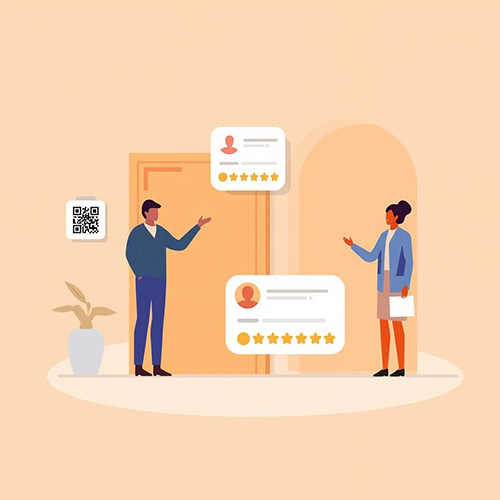 Town halls can be one of the most visible feedback tools for public health departments, but they are often treated as one-time events rather than a structured feedback mechanism. When town halls are designed well, they strengthen trust, clarify misunderstandings, and surface barriers that surveys may miss. When they are designed poorly, they can become unfocused, dominated by a few voices, or framed as a debate rather than a problem-solving conversation.
Public health agencies get better outcomes when town halls have clear intent. The goal is not to answer every question on the spot. The goal is to hear concerns, clarify what is true, explain decision logic in plain language, and capture actionable themes that will lead to follow-up improvements. Residents want to feel heard, and they also want to understand what the health organization can change, what it cannot change, and how decisions are made.
A strong town hall design starts with structure. Health authorities can open with a short explanation of the purpose, a clear message spine, and the verification pathway residents should use for current information. Then the event can move into guided discussion rather than open-ended commentary. Guided discussion makes it easier to collect useful feedback and makes it easier to maintain a calm tone.
Town halls also work better when questions are captured in multiple ways. Some residents will speak out loud. Others will not. Public health organizations can collect questions through chat, text submission, partner collection in advance, and short post-event forms. This improves equity because it allows participation from residents who are less comfortable speaking publicly or who have language barriers.
Timing and audience targeting also matter. A single general town hall can be useful, but topic-specific sessions often produce more actionable feedback. Health departments can host focused sessions for caregivers, older adults, school communities, or residents in specific neighborhoods, especially when a program or risk affects those groups more directly. When the audience is more specific, questions are more consistent, and follow-up actions are clearer.
Town halls should not stand alone. They should connect to surveys, QR feedback, and partner input. A health agency can use town halls to explore deeper context behind survey results, then confirm priorities through a follow-up pulse survey. This creates a connected loop that strengthens both trust and actionability.
Set Ground Rules That Protect Respect and Keep the Conversation Productive
Public health departments can keep town halls useful by establishing clear expectations. Ground rules should encourage respectful participation, reduce personal attacks, and clarify that questions will be documented even if they cannot all be answered live. This protects staff and participants, and it keeps the event focused on solutions.
Clear ground rules also protect the agency’s ability to gather usable themes. When the tone remains constructive, the organization can interpret patterns more accurately and follow up with changes that address the real barriers behind the concern.
Use a “What We Heard” Summary as the Bridge to Action
A town hall becomes a real feedback mechanism when the agency produces a short summary of themes. Health authorities can share “what we heard” and “what we are doing next” in a follow-up message. This helps residents see that participation mattered and reduces cynicism about engagement events.
A summary also creates a practical handoff to internal teams. When themes are documented clearly, owners can be assigned, timelines can be set, and the agency can close the loop with specific improvements residents can recognize.
Closing the Loop, Turning Feedback Into Visible Changes Residents Can Recognize
The most common failure point in feedback efforts is the closing step. Public health organizations collect feedback, interpret it internally, and then make changes quietly. Residents do not see the connection, so they assume nothing happened. Closing the loop is the step that turns feedback into trust.
Closing the loop does not require long reporting. It requires clear, visible signals. Health agencies can share brief updates that explain what changed, why it changed, and how residents will experience the improvement. These updates can be shared through the same channels used to request feedback, such as clinic signage, partner newsletters, web pages, and social posts.
Closing the loop also supports internal alignment. When staff see that feedback led to changes, they are more likely to encourage residents to provide input and more likely to adopt the updated language or process. This reduces drift and reinforces the value of the feedback loop as an operational capability.
To close the loop effectively, public health departments benefit from choosing a small number of changes to highlight. If an agency tries to publish every improvement, the message becomes noisy. If it highlights nothing, trust erodes. A focused approach demonstrates progress and builds confidence without creating overload.
Below are examples of changes that are often meaningful and visible in public health settings.
-
Clearer eligibility language. Update a web page, flyer, or script so residents can understand quickly whether a service applies to them.
-
Simplified steps. Reduce the number of steps required for scheduling or follow-up, or clarify the order of steps.
-
Improved access routes. Add a phone option, a walk-in pathway, or clearer hours and location information.
-
Better translations. Publish translated materials in parallel and clarify where to find them.
-
Updated signage. Revise clinic signage to make next steps obvious and reduce confusion at check-in.
-
More consistent partner materials. Provide copy-ready updates that reduce meaning drift across networks.
Health agencies should also communicate when a requested change is not possible. Residents may ask for expanded hours or service changes that are outside agency control. A public health organization can still build trust by explaining constraints plainly, naming what the agency is doing to mitigate barriers, and offering alternatives.
Use “You Said, We Did” Updates Without Sounding Promotional
A simple “you said, we did” format can work well, but it should remain respectful and practical. Public health departments can keep the focus on the improvement and the resident benefit rather than taking credit. This tone helps residents feel respected and increases willingness to engage in future feedback.
A practical tone also reduces skepticism. When updates are framed as service improvements rather than promotional messaging, residents are more likely to believe that the agency is listening and acting in good faith.
Make the Change Easy to Notice at the Point of Use
Changes should be visible where residents experience the friction. If the issue was confusing signage, the fix should be on the sign. If the issue was unclear steps, the fix should appear at the top of the web page and in the script staff use. When residents encounter the improvement directly, the feedback loop feels real.
Visibility also helps partners and staff reinforce the improvement. When the change is easy to point to, the agency can rebuild confidence faster and encourage more residents to share feedback in the future.
Governance and Ownership, Who Receives Feedback and Who Makes It Actionable
Feedback loops in public health succeed when ownership is clear. Without defined roles, feedback accumulates in inboxes, spreadsheets, and meeting notes, then stalls because no one knows what happens next. Public health departments and health agencies can prevent this by establishing a simple governance structure that routes feedback to the right place quickly and makes decisions visible inside the organization.
A practical governance model separates three responsibilities. Someone must own intake, someone must own interpretation, and someone must own action. Intake includes monitoring survey results, QR submissions, and town hall questions. Interpretation includes summarizing patterns and identifying what is a communication issue versus an operational issue. Action includes assigning fixes, setting a timeline, and confirming when a change is ready to publish or implement. Health authorities do not need a large committee for this. They need a small, dependable workflow that repeats.
Governance also helps protect consistency across programs. Public health organizations often run multiple initiatives at the same time, and feedback can point to competing priorities. A consistent routing approach helps leaders compare friction across programs and decide what matters most based on impact, urgency, equity, and feasibility. When that prioritization happens in a predictable way, staff confidence improves and external messaging becomes steadier.
Another governance requirement is clarity about what feedback can change. Some feedback is best addressed through messaging, such as unclear steps or confusing eligibility language. Other feedback requires service adjustments, such as hours, capacity, or referral routes. Public health departments can reduce frustration by labeling feedback internally by category and by ensuring that operational owners receive issues that communication teams cannot solve alone. This prevents a cycle where communications staff keep rewriting language while the underlying barrier remains.
Create a Simple Triage Path for Fast Decisions
A triage path helps departments decide what to handle immediately and what to schedule. High-impact issues include recurring misunderstandings that cause missed appointments, repeated eligibility errors, or confusion that increases conflict at sites. These should move quickly to the owner who can fix them. Lower-impact issues can be queued for regular review. Health agencies can keep triage efficient by using a small set of categories, then applying the same rules each week.
A triage path also helps protect attention. When staff know which signals trigger fast action, the organization is less likely to react to one-off issues while missing recurring barriers that affect large numbers of residents.
Build Privacy, Anonymity, and Data Handling Into the Process
Feedback collection often involves sensitive experiences, especially in public health programs connected to behavioral health, reproductive health, sexual health, or immigration-related concerns. Health authorities can protect trust by defining what is anonymous, what is optional, and what will never be used for enforcement or punitive decisions. Public health organizations also benefit from clear internal practices for storing feedback, limiting access, and avoiding unnecessary collection of identifiable information. When privacy practices are clear, residents are more likely to participate honestly, and staff are more likely to treat feedback as a trusted signal.
Privacy clarity is also part of equity. Residents who have experienced harm or stigma may not share feedback unless they believe it is safe. Clear privacy language and disciplined data handling help create that safety.
Measurement That Improves the System, Not Just a Report
Feedback loops become stronger when health agencies measure whether changes are reducing friction. Measurement does not need to be complex. It needs to be tied to decisions and to resident experience. Public health departments can track a small set of indicators that show whether clarity and access are improving, then use those signals to refine templates, scripts, and service pathways.
One useful approach is to connect feedback themes to observable outcomes. If residents report confusion about steps, the agency can monitor whether repeat calls decrease after a script update. If residents report unclear eligibility language, the agency can track whether fewer residents arrive unprepared or whether partner questions decline after a flyer revision. Health authorities gain value when feedback is not only collected, but also linked to operational strain and resident follow-through.
Public health organizations can also treat feedback as an early-warning system. A small shift in questions can signal that something changed in the environment, such as a new rumor, a partner misunderstanding, or a process variation at one site. When the agency detects that shift early, it can correct meaning before confusion spreads widely.
Measurement also supports learning across seasons and programs. Over time, health agencies can identify which message structures reduce misunderstanding, which access routes residents prefer, and which channels drive the highest follow-through for different communities. This creates a reusable communication infrastructure that improves with repetition.
Use Leading Indicators That Reflect Clarity and Access
Leading indicators help departments see improvement before outcomes fully change. For example, fewer repeat questions, fewer eligibility misunderstandings, and fewer “I did not know” comments can indicate that messaging and signage are working better. Health agencies can review these indicators on a predictable scale and use them to decide whether a change needs refinement or whether it is stable enough to standardize.
Leading indicators also make continuous improvement easier to manage. When the organization tracks the same signals each cycle, staff can see progress and identify where additional adjustments are needed.
Combine Resident Feedback With Staff and Partner Signals
Resident feedback tells the organization what people experience. Staff and partner signals often reveal why the experience is happening. Public health departments strengthen their loop when they compare resident input with what frontline teams and community partners are hearing. When these signals align, decisions become easier. When they diverge, it usually indicates that the message is landing differently in different settings, which is often an equity issue that deserves targeted adjustment.
Combining signals also reduces blind spots. When resident input is limited in one community, partner and staff signals can reveal barriers that may not show up in survey data, especially when trust is uneven.
Promoting Long-Term Public Health Outcomes Through Communication
Feedback loops improve long-term public health outcomes because they turn daily resident experience into system learning. Public health departments and health agencies do not need to guess where confusion exists or why participation drops. They can measure it, interpret it, and fix it. Over time, this reduces repeated misunderstandings, improves program follow-through, and strengthens trust in guidance that residents may rely on across multiple seasons and life stages.
Long-term outcomes improve when feedback loops become routine. When surveys, QR micro-feedback, and town halls are connected and reviewed on a predictable cadence, health authorities can detect friction early and prevent it from becoming normalized. A small fix to eligibility wording, a clearer scheduling instruction, or a better sign at a clinic can prevent hundreds of preventable errors. These small improvements also protect staff capacity and reduce frustration in frontline interactions.
Feedback loops also support equity. Underserved communities often face higher barriers to access and higher exposure to misinformation or informal interpretations. Public health organizations strengthen equity when they collect feedback through multiple channels, ensure language access, and use partners to gather insights from residents who may not attend formal meetings or complete long surveys. When feedback reveals that a process assumes ideal conditions, health agencies can adjust access routes and messaging so more residents can participate.
Long-term trust is strengthened when the loop is closed. Residents are more likely to engage in future outreach when they see that feedback leads to visible improvements. The same is true for partners. When community organizations see that their input leads to better materials, clearer referral routes, and faster corrections, they become stronger amplifiers of accurate guidance, which improves outcomes across the broader community network.
Finally, feedback loops create a culture of continuous improvement inside the organization. Public health departments that treat feedback as operational data become more resilient. They can adapt to changing conditions without constant reinvention, because they have a system for learning what is working and what needs adjustment. Over time, this supports stronger communication performance during both routine programs and urgent events.
Strategic Communication Support for Your Health Agency
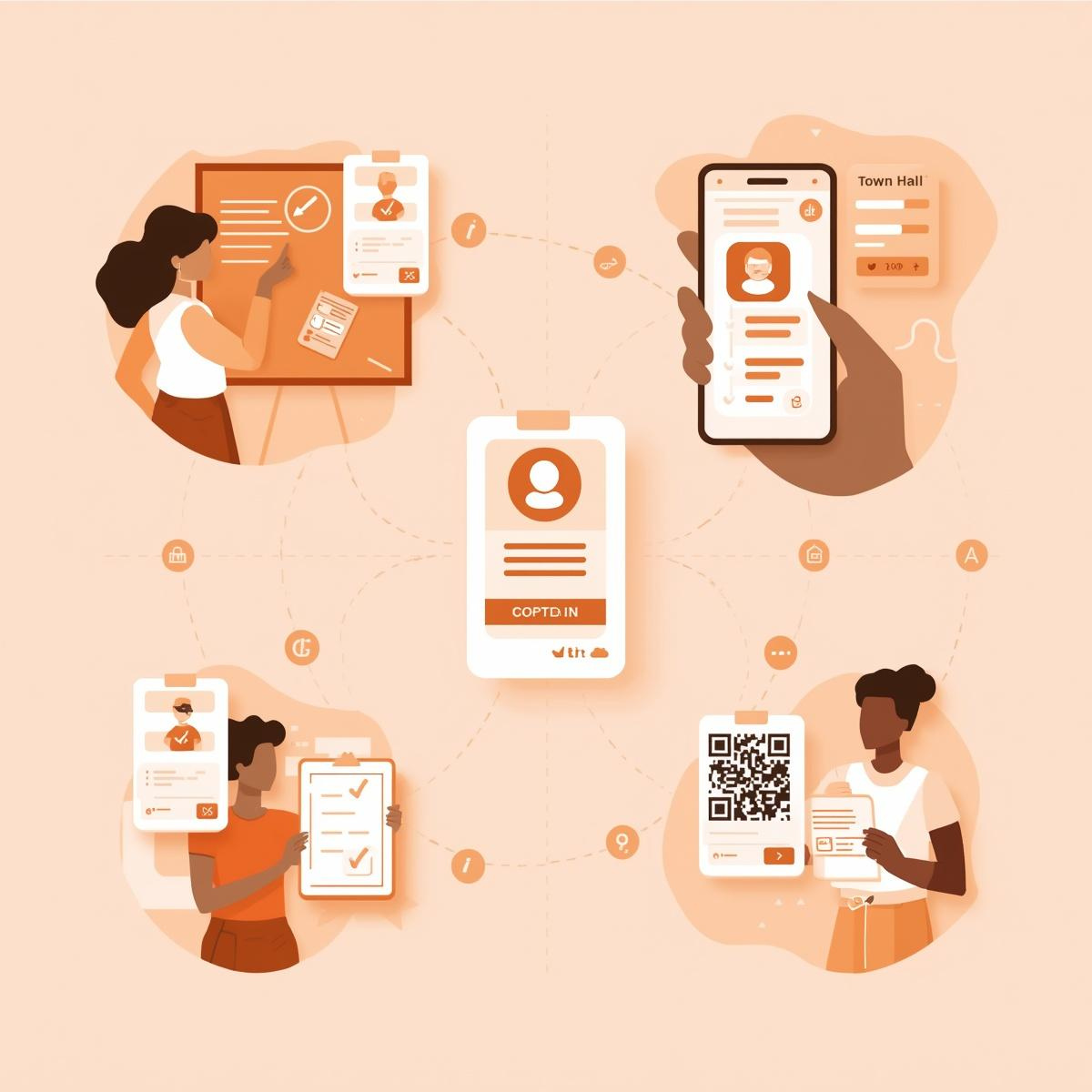 Public health departments and health agencies often want stronger feedback loops, but execution can be challenging. Surveys can be inconsistent, QR tools can be deployed without a plan for interpretation, and town halls can generate themes that are hard to route into action. Health authorities also need governance, privacy practices, equity design, and clear closing-the-loop messages so feedback efforts build trust rather than frustration.
That is why agencies often choose to partner with an external resource like Stegmeier Consulting Group (SCG) to strengthen communication systems. An outside partner can help public health organizations design feedback loops as a connected system, including survey strategy, QR micro-feedback design, town hall structures, partner input pathways, governance workflows, and closing-the-loop communications that are calm and practical. This support can also include building templates, dashboards, and routing practices that make feedback review consistent and make action ownership clear.
SCG supports health agencies by helping teams translate feedback into changes residents can recognize. That often includes improving message clarity, simplifying steps, strengthening access routes, aligning staff scripts, and creating partner-ready materials that reduce drift. Over time, these practices help health departments build stronger trust, reduce operational friction, and improve participation across programs and communities.
Conclusion
Feedback loops are one of the most effective ways public health departments and health agencies can improve communication clarity and program performance. Surveys provide trend insight when questions are designed for action. QR codes capture micro-feedback at the moment of experience. Town halls surface concerns that require context, explanation, and relationship-building. When these tools are connected through governance, interpretation, action, and visible loop closing, they become a communication capability that strengthens trust.
Health authorities and public health organizations improve outcomes when they treat feedback as a system. That system reduces confusion, supports equity, and strengthens resident confidence in guidance and services. Over time, feedback loops help departments build communication infrastructure that learns, adapts, and performs better each cycle.
SCG’s Strategic Approach to Communication Systems
Align your agency’s messaging, processes, and public engagement strategies
Agencies that communicate effectively build stronger trust with staff, stakeholders, and the public. Whether you are improving health communication campaigns, strengthening internal workflows, or aligning agency-wide messaging, SCG can help you develop a communication system that supports consistent decision-making and long-term organizational success. Use the form below to connect with our team and explore how a strategic communication framework can elevate your agency’s impact.