Explaining the “Why” Behind Preventive Health Measures
Public health departments and health agencies are often expected to promote preventive behaviors that do not feel urgent to the people who need them most. Vaccination reminders, screening schedules, safer sex guidance, food safety practices, fall prevention, smoke alarm use, and mosquito bite reduction can all be evidence-based and still get ignored if residents do not understand the reason behind the request. When people cannot quickly answer “why does this matter for me,” the message becomes background noise.
Health authorities and public health organizations also have to communicate prevention in a trust environment that is more fragile than it used to be. Many residents have experienced changing guidance, confusing headlines, and conflicting opinions online. In that context, a preventive message that focuses only on what to do can sound like an order. A preventive message that explains why can sound like respect, and respect is often what earns attention.
Explaining the why does not mean dumping scientific detail on the public. It means translating the purpose of a preventive measure into clear, relatable reasoning that makes sense in daily life. A county or regional health department can stay accurate while still sounding human, and it can acknowledge uncertainty while still giving residents a stable decision path.
Prevention is also cumulative. Many protective actions feel small, but their value compounds across households, schools, workplaces, clinics, and community spaces. When health agencies consistently explain why preventive measures matter, residents are more likely to follow through over time, and partners are more likely to reinforce the message rather than unintentionally undermining it.
Why Prevention Messages Fail Without a Clear “Why”
 A preventive health measure is usually asking someone to act today to avoid a problem later. That time gap is the core challenge. If the benefit feels distant, abstract, or unlikely, people default to convenience. If the measure feels inconvenient, they delay, and delay becomes non-action.
Public health departments often respond by increasing volume. More posts, more flyers, more reminders, more slogans. Volume helps only when the underlying message is already clear and compelling. When the message is unclear, volume mostly increases fatigue. Residents start tuning out. Frontline staff start dreading questions. Partners hesitate to share because they anticipate pushback.
A clear why changes the equation because it reframes prevention as a decision with an understandable payoff. The payoff can be personal, such as avoiding a dangerous complication or preventing lost wages from illness. It can be relational, such as protecting a grandparent or a newborn. It can be community-focused, such as keeping clinics from being overwhelmed or reducing the spread of a seasonal illness in schools.
Health agencies also benefit operationally when the why is clear. A clearer why reduces repetitive questions, lowers rumor-driven call spikes, and shortens the time between awareness and action. That is not just a communications win. It is a capacity win.
Another reason prevention messages fail is that the public often interprets them through identity and values, not only through facts. If a message sounds like it is written for “other people,” residents may disengage even if it applies directly to them. When the why is built around local realities and everyday constraints, it becomes easier for people to see themselves in the message.
Prevention also competes with competing priorities. A resident who is caring for family, managing multiple jobs, or navigating unstable housing may see prevention as a luxury. Public health organizations can make prevention feel more realistic by explaining the why in a way that acknowledges constraints, offers options, and respects the tradeoffs people are making.
From Data to Action: Effective Communication Strategies for Public Health Agencies
This article is part of our series on strategic communication for state and local government Public Health Agencies. To learn more and to see the parent article, which links to other content just like this, click the button below.
What People Are Really Asking When They Ask “Why”
When residents push back on preventive guidance, they are often not asking for a research citation. They are asking for meaning. They want to know what the measure changes, how it protects them, and whether it is worth the effort.
In practice, the public tends to ask a small set of why-questions repeatedly across topics. Public health departments can anticipate these questions and build answers into messaging, rather than waiting to respond in comments or call queues.
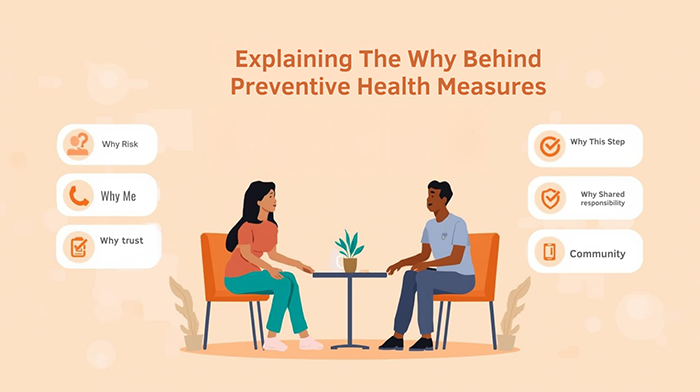
Why now. Many preventive measures are time-sensitive, even when the hazard is not obvious. Timing can depend on seasonal patterns, exposure trends, clinic capacity, school calendars, travel periods, or environmental conditions. If timing is not explained, residents assume it is arbitrary. Health agencies can reduce skepticism by making timing feel logical and local.
Why me. People want to know whether the measure applies to them specifically, and if so, what makes them a priority. Risk is not uniform. Age, chronic conditions, pregnancy, occupation, living situation, and caregiving responsibilities can change the risk-benefit balance. Health authorities can avoid overgeneralizing by clearly stating who benefits most, while still explaining why the measure is broadly helpful.
Why this step. Preventive guidance can feel like a pile of rules unless the steps connect to an understandable mechanism. Residents do not need a textbook explanation, but they do need a simple logic chain. This action reduces this risk. This risk leads to this outcome. This outcome matters because it affects your health, your family, or your ability to work.
Why should I trust this. Trust is shaped by tone, transparency, consistency, and the presence of credible messengers. Public health organizations strengthen trust when they explain what they know, what they are monitoring, and how they will update guidance. People are more willing to accept a preventive measure when they believe the agency is being straightforward rather than persuasive.
Why is this my responsibility. Some preventive measures require collective participation to work well, which can create resentment if the message sounds moralizing. A health agency can reduce that resentment by describing collective prevention as mutual protection, and by emphasizing that the agency is also doing its part through services, resources, and infrastructure.
When public health departments treat these why-questions as the core of message design, prevention messaging becomes more resilient. It also becomes easier to translate across channels because the reasoning is clear, not implied.
The Psychology of Prevention and How to Communicate With It
Preventive health behavior is shaped by how people perceive risk, effort, and social norms. Residents often underestimate risks that are unfamiliar, long-term, or probabilistic. They often overestimate risks that are vivid, immediate, or emotionally charged. Prevention can struggle because it is often about reducing probability, and probability is hard to feel.
A health authority can make prevention feel more tangible by describing consequences in everyday terms, while avoiding fear-based messaging that backfires. The goal is to help residents see the risk as real enough to matter, but manageable enough to act on. Messages that are too calm can feel dismissive. Messages that are too alarming can cause avoidance.
Effort is another driver. People are more likely to act when the steps are clear, the path is simple, and the support is visible. If the preventive measure requires appointments, paperwork, costs, transportation, or time off work, the public will weigh those burdens against benefits that may not feel immediate. Public health organizations can improve follow-through by offering multiple access paths and explaining how to reduce friction.
Social norms also matter. If people believe that “nobody else is doing it,” they are less likely to participate. If they believe the behavior is common and socially supported, adoption rises. Health agencies can reinforce positive norms by highlighting participation, partner alignment, and community stories that feel authentic rather than promotional.
Trust is a fourth driver. Prevention requires accepting guidance before a problem happens. That is inherently harder than responding to a visible crisis. Public health departments build trust through predictable communication patterns, clear explanations, and consistent terminology. They also build trust by using messengers who are credible in specific communities, including clinicians, school nurses, community health workers, faith leaders, and local organizations.
Finally, people respond better to prevention when they feel autonomy. Messages that acknowledge choice, explain tradeoffs, and offer realistic options often outperform messages that sound like commands. Health agencies can keep guidance firm while still respecting autonomy by explaining the why and offering practical paths rather than only instructions.
These psychological realities are not a reason to simplify science to the point of distortion. They are a reason to translate science into human decision-making language. A public health organization that communicates with the psychology of prevention in mind will see fewer misunderstandings and more sustained behavior change.
The Building Blocks of a Clear “Why” That Drives Action
When health agencies explain the why effectively, their messages tend to follow a consistent pattern that residents can understand quickly. This pattern works across prevention topics, from immunization and screening to injury prevention and environmental health. It also helps public health departments stay aligned when multiple teams create content, because the message structure is predictable and easier to replicate across programs and channels.
A clear why usually starts with a purpose statement that connects the preventive step to an outcome people care about, such as avoiding a severe complication, preventing a long recovery, protecting infants or older adults, or reducing disruptions to work and school. The purpose statement does not need to be long. It needs to be specific enough that a resident can immediately see what the action is meant to prevent or protect.
From there, the message becomes stronger when it includes a simple mechanism in plain language, not a technical explanation. Residents do not need a clinical lecture. They need a short logic chain that makes the step feel reasonable, such as explaining that a measure reduces exposure, catches problems early, lowers the chance of severe illness, or prevents a hazard from escalating. When the mechanism is stated plainly, the request feels less like a rule and more like a practical decision.
Health authorities also improve follow-through when the why is matched to the right audience cues. A prevention measure often helps everyone, but it may matter more for certain groups based on age, chronic conditions, pregnancy, workplace exposure, living situation, or caregiving roles. When a public health organization clearly signals who benefits most and why, residents can self-identify faster, and they are less likely to assume the guidance is generic or meant for someone else.
Timing is another building block that is often missing. Many residents accept the concept of prevention but question urgency. A clear why briefly explains why now, using a simple trigger such as seasonality, local trends, exposure patterns, travel periods, or clinic capacity. When timing is explained, the message feels grounded rather than arbitrary, and residents are more likely to act before the problem becomes visible.
A clear why also needs a realistic action pathway, because understanding alone does not produce behavior. Public health departments increase follow-through when they make the next step obvious and practical, including options for people who face barriers such as transportation, cost, language access, disability access, or limited time. Even a short sentence that points to multiple access routes can reduce drop-off and prevent frustration.
Trust is the final essential building block. Residents want to know where the guidance comes from and how stable it is likely to be. A brief trust anchor can explain the source, what is known, what is being monitored, and how updates will be communicated. This is especially important for preventive measures that involve probability and uncertainty, because clarity about confidence and change triggers helps people feel respected rather than persuaded.
When public health organizations use these building blocks consistently, the why becomes easier to communicate across channels and easier for partners to share accurately. The message feels purposeful, the logic is visible, and the next step is clear, which is exactly what prevention messaging needs to drive action.
Translating Data Into Meaning Without Overwhelming People
Preventive health measures are often supported by statistics, studies, and trend data. Those details matter, but raw numbers rarely persuade on their own. Residents need interpretation. They need to understand what the data changes for them, and what decision the data supports.
Public health departments can translate data into meaning by connecting it to concrete outcomes. For example, instead of leading with incidence rates, a health agency can explain what a rise in cases means for wait times at urgent care, for school absences, or for vulnerable family members. Instead of focusing on relative risk reduction alone, a health authority can explain what “lower risk” looks like in daily life, such as fewer severe complications or fewer disruptions.
Data also becomes more understandable when it is contextualized locally. A public health organization can explain whether trends are rising, stable, or declining in a community, and what indicators are being watched. When residents see local relevance, they are less likely to dismiss prevention as generic advice.
Another helpful technique is to use decision-guiding numbers. Rather than presenting many metrics, a health agency can choose one or two numbers that directly support the choice being asked. Then it can explain what those numbers mean in plain language. This approach reduces cognitive load and improves recall.
Public health organizations should also anticipate that some audiences will want the deeper data. The best approach is layering. Provide the plain-language meaning upfront, then offer a path to the detailed dashboard, report, or technical guidance for residents, clinicians, and partners who want it. Layering respects different needs without making the main message unreadable.
Finally, data translation should avoid false precision. Residents often interpret precise numbers as certainty. Prevention often involves uncertainty and probability, so health authorities should communicate confidence appropriately. Clear language about what is known, what is still being studied, and what the agency is monitoring can strengthen trust, especially when guidance evolves.
Explaining the Why When People Are Tired, Skeptical, or Overloaded
 Many residents are not rejecting prevention because they oppose health. They are tired, busy, and overwhelmed by competing demands. They may also be skeptical because they have seen guidance change or because they have heard conflicting claims from different sources. In this environment, the why needs to be both clear and calm.
A public health department can support tired audiences by reducing the effort required to understand the message. That means leading with the point, keeping sentences short, and making the next step obvious. It also means acknowledging that the step may feel inconvenient, then explaining why it is still worth it. A single sentence that recognizes the burden can reduce defensiveness, as long as it is followed immediately by a practical path forward.
Skepticism is often fueled by perceived inconsistency. Health agencies can reduce that perception by explaining what changed and why. When prevention guidance evolves, the agency can describe the update as a response to new evidence, changing local conditions, or improved access to tools. The explanation should be brief and direct. Long defenses can sound like persuasion.
Public health organizations also need to avoid common traps when addressing skepticism. One trap is repeating misinformation in detail, which can unintentionally amplify it. Another is sounding dismissive, which can harden resistance. A more effective approach is to state the correct information plainly, then provide a clear verification path through the agency’s site, hotline, or trusted healthcare partners.
It also helps to connect prevention to goals people already care about. For many residents, prevention is compelling when it protects routine life, such as keeping kids in school, keeping caregivers healthy, avoiding missed work, and reducing medical bills. These outcomes are not less serious than clinical outcomes. They are the real-world consequences that shape whether people act.
Finally, public health departments should consider how prevention feels for people who have previously been let down by systems. Trust can be shaped by accessibility, language access, respectful tone, and visible support. When a health authority offers realistic options and clearly explains how to get help, the why becomes more credible.
Channel-Ready Ways to Explain the Why Across Prevention Topics
Preventive health measures often need to be explained in multiple places, including clinic signage, social media, partner newsletters, school channels, community events, and direct outreach. Health agencies can keep the why consistent by using a small set of repeatable why frames that match common prevention situations. The goal is not to sound scripted. The goal is to make sure the reasoning stays stable as the message moves across formats, messengers, and levels of detail.
Below are practical why frames that public health departments can reuse across topics. Each frame can be written as a single sentence, then paired with one clear next step and one clear access path.
-
Personal protection. Explain that the preventive step lowers the chance of a serious outcome, even if a person feels fine today. Use it for vaccination, screening, and early testing. Follow immediately with how to schedule or where to walk in.
-
Early action. Emphasize that acting early makes the process simpler, faster, and more effective. Use it for time-limited screening windows, post-exposure steps, and early treatment eligibility.
-
Protecting others. Connect the action to protecting people at higher risk, including infants, older adults, and immunocompromised community members. Keep the tone practical, not moralizing, and name the settings where protection matters most.
-
Keeping services available. Explain prevention as a way to reduce avoidable strain on clinics so care is available for those who need it. Ground it in local impacts like shorter wait times and more available appointments.
-
Community stability. Highlight that prevention reduces disruption like missed school days and lost wages. This frame often performs well for partner channels like schools and employers.
-
Timing and local conditions. Answer why now by pointing to a clear local trigger, such as seasonality, rising local trends, or a time-limited clinic opportunity. Add a brief note about what the agency is monitoring.
-
Practical support. Pair the why with a visible access pathway and options for common barriers, such as transportation, scheduling, language access, disability access, and cost. Make the help route obvious.
These frames become truly channel-ready when they are kept short and paired with one clear action step and one clear route to follow-through. On Instagram, the frame can appear as the first line of the caption with a link path to the source page. On a flyer, it can appear as a headline plus a short sentence near the top, paired with a phone number and QR code. In a partner toolkit, it can appear as copy-ready text that partners can paste without rewriting.
Coordinating Internally and With Partners So the Why Stays Consistent
Even the clearest reason can get diluted if different parts of an organization explain it differently. Public health departments often have multiple programs communicating simultaneously, and each program may use its own terms, tone, and examples. Partners then add their own adaptations. Over time, residents hear multiple versions of the same guidance and assume disagreement.
Health agencies can reduce this drift by aligning on a shared message spine for major prevention initiatives. The spine should include the core why in plain language, the key audience cues, the essential action step, and the primary access pathway. Once that spine is agreed, teams can adapt it by channel, but they should not change the meaning.
A health authority also benefits from building a small library of approved why language that can be reused across programs. This is especially useful for recurring preventive measures, such as seasonal respiratory illness prevention, heat safety, and vector control. When the language is stable, updates become easier, and partners share with more confidence.
Partner alignment matters because many residents trust local messengers more than institutions. Schools, clinics, community organizations, and employers can reinforce prevention messages, but they need tools that are ready to use. If partners have to rewrite content, they may unintentionally alter the why. Public health organizations can prevent that by providing short, copy-ready blurbs with clear audience cues, plus a link to the department’s source page for details.
Internal coordination also benefits from clear review roles. Someone should own accuracy, someone should own plain language, and someone should own accessibility and language access. These roles can be lightweight, but they need to exist. Without them, teams either publish inconsistently or slow down under the weight of informal approvals.
Finally, consistency improves when health agencies communicate changes predictably. If guidance evolves, the department can explain what changed, why it changed, and what residents should do now. Predictability reduces rumor cycles and helps prevention messages feel stable even in changing conditions.
Promoting Long-Term Public Health Outcomes Through Communication
Explaining the why behind preventive health measures is a long-term investment in community decision-making. When residents understand the purpose of preventive actions, they are more likely to repeat them, to encourage others, and to recognize when guidance applies to them. Over time, this creates a culture where prevention feels normal rather than exceptional.
Public health departments support long-term outcomes when they consistently link prevention to practical benefits and clear next steps. Residents who understand why screening matters are more likely to follow schedules. Residents who understand why vaccination helps are more likely to maintain protection over time. Residents who understand why safer behaviors reduce risk are more likely to adopt habits that compound into healthier outcomes.
Health agencies also improve outcomes when they reduce barriers to follow-through. The why is not sufficient if the access pathway is difficult. Clear explanations paired with realistic options, such as multiple appointment routes, low-cost alternatives, language access, and partner support, help residents turn understanding into action.
Long-term outcomes are strengthened by trust, and trust is strengthened by transparency. When health authorities explain what they know, what they are monitoring, and how they will update guidance, residents experience the organization as credible and stable. That stability matters because prevention is ongoing, not a one-time event.
Prevention messaging becomes more durable when it is treated as infrastructure. Templates, message spines, partner toolkits, and consistent terminology reduce the chance that the why changes with staff turnover or shifting channel trends. Public health organizations that build this infrastructure can sustain clear prevention messaging across seasons, programs, and emerging issues.
Strategic Communication Support for Your Health Agency
 Health agencies often have strong prevention programs and strong evidence, but they still face a familiar gap between what is recommended and what residents actually do. Public health departments also have to communicate prevention through multiple channels, coordinate with partners, and respond to questions quickly. Without a system, explaining the why can become inconsistent across teams, and inconsistency is one of the fastest ways to weaken trust and reduce follow-through.
That is why agencies often choose to partner with an external resource like Stegmeier Consulting Group (SCG) to strengthen communication systems. An outside partner can help a public health organization translate prevention science into clear, repeatable messaging frameworks that staff can apply across programs without constant reinvention. This support is most useful when internal teams are moving fast, managing multiple priorities, and trying to keep communication consistent across web, print, social, and partner channels.
SCG supports public health organizations by helping them develop message spines that carry the why in plain language, align terminology across teams, and create templates that reduce rework. This can include practical guidance for translating data into everyday meaning, building audience cues that help residents self-identify quickly, and designing access pathways that acknowledge real constraints. SCG also helps health authorities strengthen partner alignment by providing ready-to-use content that preserves the why without forcing partners to rewrite, which reduces drift and improves consistency across the community.
A communication system approach makes prevention messaging more sustainable. Residents experience fewer contradictions, and staff spend less time correcting misunderstandings. Over time, health agencies can explain preventive measures with clarity that supports immediate action and long-term public health outcomes.
Conclusion
Preventive health measures work best when residents understand the purpose behind the request. When health agencies explain the why clearly, prevention feels practical and grounded, not arbitrary. Follow-through improves when public health departments and health authorities anticipate the questions people are already asking, including why now, why this applies to me, why this step matters, and what makes the guidance credible.
Clear why messaging also reduces confusion across channels and partner networks. When public health organizations use consistent building blocks, translate data into everyday meaning, and provide realistic pathways for action, residents are more likely to take the next step. Over time, consistent communication becomes part of prevention infrastructure, strengthening healthier behaviors, sustaining trust, and supporting long-term public health outcomes.
SCG’s Strategic Approach to Communication Systems
Align your agency’s messaging, processes, and public engagement strategies
Agencies that communicate effectively build stronger trust with staff, stakeholders, and the public. Whether you are improving health communication campaigns, strengthening internal workflows, or aligning agency-wide messaging, SCG can help you develop a communication system that supports consistent decision-making and long-term organizational success.
Use the form below to connect with our team and explore how a strategic communication framework can elevate your agency’s impact.