Plain Language in Public Health: Why It Matters More Than Ever
Public health departments are being asked to communicate in a world where attention is scarce, information spreads faster than verification, and residents often encounter health information in fragments. A single screenshot, a forwarded text, or a headline can shape what people believe and how they behave. In that environment, plain language is not a stylistic preference. It is a practical public service that helps health agencies reduce confusion, support informed choices, and protect trust when conditions shift.
Health authorities and public health organizations also face a harder reality. Many messages require the public to act quickly, interpret risk, and navigate systems that may already feel complicated. When writing is dense, overly technical, or inconsistent across channels, people do not just feel frustrated. They delay action, misunderstand eligibility, miss deadlines, or decide the guidance is not meant for them.
Plain language does not mean oversimplifying science. It means translating essential meaning into words and structures people can understand on the first read, even when they are stressed, distracted, or reading on a phone. It also means designing messages so the most important information is easy to find, easy to follow, and hard to misinterpret.
A practical plain language approach helps health agencies improve clarity without losing accuracy. It strengthens message structure, supports equity by reducing barriers to understanding, and creates faster review workflows that keep meaning consistent across web, social, print, and partner communications during both routine programs and high-pressure events.
What Plain Language Really Means in Public Health
 Plain language is often mistaken for shorter writing or a friendlier tone. Those are sometimes outcomes, but the core idea is more specific. Plain language means the audience can find what they need, understand what it means, and use it to take the right next step.
For public health departments, that definition matters because the audience is rarely uniform. A single message may be read by a clinician, a caregiver, a small business owner, a student, and a resident who speaks English as a second language. A message that works for one group can fail for another if it relies on shared assumptions or specialized vocabulary.
In practice, plain language in a health authority looks like a set of repeatable habits. Start by naming what is happening in concrete terms. Move quickly to what the reader should do. Clarify who the message applies to and what changes if conditions shift. Then provide the simplest path to more detail for people who need it.
The plain in plain language is also about cognitive load. Public health organizations regularly communicate during moments when people are anxious, busy, or skeptical. Anxiety reduces comprehension. Complexity raises the chance of errors. When a message is structured clearly, residents have a better chance of following it correctly, and staff have fewer follow-up calls to manage.
Plain language also supports internal alignment. When an agency develops consistent definitions, consistent labels, and consistent phrasing for common concepts, staff across programs are less likely to produce contradictory messages. That consistency becomes especially important when the organization relies on partners to share information across different neighborhoods and platforms.
From Data to Action: Effective Communication Strategies for Public Health Agencies
This article is part of our series on strategic communication for state and local government Public Health Agencies. To learn more and to see the parent article, which links to other content just like this, click the button below.
Why Plain Language Has Become a Higher-Stakes Requirement
Plain language has always been valuable, but several trends have raised the stakes for health agencies.
First, public expectations have changed. People compare public messaging to the clarity they get from consumer services, apps, and customer support. When a public health department publishes instructions that feel harder than they should be, residents assume the system is indifferent or disorganized, even if the program itself is strong.
Second, the information environment is noisier. Residents encounter health information alongside rumors, opinion content, and advertising. When official messages are hard to parse, the loudest explanation often wins. That is one reason clarity is a trust strategy. It reduces the space where misinformation can thrive.
Third, public health work is increasingly cross-system. Health authorities often coordinate with schools, employers, hospitals, emergency management, social services, and community-based organizations. Each partner may use different terminology and a different tone. Plain language gives public health organizations a shared baseline that partners can adopt without constant interpretation.
Fourth, the need for speed is real. In routine programs, slow communication is inefficient. In emergencies, it can be dangerous. Plain language helps departments publish faster because the message structure is simpler, the vocabulary is more consistent, and the review process has fewer debates about meaning.
Finally, equity demands clarity. Health agencies serve communities with different literacy levels, language access needs, internet access, and historical experiences with institutions. Dense writing often harms the same populations that public health programs are trying to support. Clarity is not the only equity lever, but it is one of the most actionable ones.
This does not mean every message must be short. Some topics require nuance and detail. The goal is to layer information so that the essential meaning is immediate, while deeper content remains available for those who need it.
Plain Language as an Equity Tool, Not Just a Writing Style
When a public health organization improves clarity, the benefits are not evenly distributed. They often concentrate among residents who face the greatest barriers to navigating systems. That is why plain language is closely linked to equitable access.
Consider what happens when a program announcement is filled with acronyms, eligibility caveats, and indirect instructions. People who have time, stable internet, and experience with government processes might still figure it out. People juggling multiple jobs, caregiving, transportation challenges, or limited English proficiency are more likely to abandon the attempt. The end result is not just confusion. It is unequal participation.
For public health departments, plain language becomes an equity practice when it consistently answers a few core questions that residents silently ask. What is this program or alert about. Does it apply to me. What should I do next. Where do I go for help if I cannot complete the standard way.
Health agencies can also treat plain language as an accessibility strategy. Plain language improves comprehension for people with cognitive disabilities, people who are stressed, and people reading quickly. It also improves translation quality because simpler sentence structure reduces ambiguity.
Equity-focused clarity is also about removing institutional assumptions. Many messages assume people know how appointments work, how referrals work, what documentation is required, or how long a process takes. Health authorities can reduce drop-off by stating those process expectations explicitly in everyday language.
Plain language also helps preserve dignity. When messaging is written in a way that implies blame, laziness, or irresponsibility, it can discourage engagement. A public health organization can be direct without being judgmental by focusing on practical steps, realistic options, and respect for constraints.
The Most Common Clarity Breakdowns in Public Health Messaging
Even skilled teams fall into predictable patterns that reduce clarity. Naming those patterns helps health agencies spot them early and prevent them from becoming habits.
One common breakdown is leading with context instead of action. Public health departments often start with background, rationale, or institutional framing. Residents typically want the opposite. They want the point first, then the explanation.
Another breakdown is the policy voice, where sentences become long, abstract, and full of qualifiers. Qualifiers are sometimes necessary, but when too many appear in one sentence, readers lose the thread. The message may be technically accurate, but functionally unusable.
A third breakdown is inconsistent terminology across channels. A web page may say one thing, a flyer may use different labels, and a social post may shorten the meaning in a way that changes it. People notice these mismatches quickly, and the mismatch becomes the story.
A fourth breakdown is burying eligibility rules in paragraphs rather than making them easy to scan. People often misinterpret eligibility because they skim. This is not a reader failure. It is a design problem.
A fifth breakdown is assuming a single pathway for action. Many residents cannot take the default path. They may not have transportation, they may not have documentation readily available, or they may not be able to call during business hours. Health authorities can reduce frustration by offering at least one alternative path, even if it is simply a call-back option, a walk-in window, or a partner resource.
These breakdowns are solvable when an agency commits to a consistent structure and an internal review checklist that prioritizes the audience experience, not only technical completeness.
The Anatomy of a Plain Language Message
 Plain language starts before the first sentence. It starts with deciding what a resident needs to know first, what they need to do next, and what details can come later. Public health departments often have strong content but weaker sequencing, which is why messages can feel thorough while still failing to produce action.
A reliable structure that works for health agencies across topics is to lead with the bottom line, then add context in layers. That means the opening should answer the most urgent question in plain terms, then immediately clarify who the message applies to. After that, the message should make the next step obvious. Only then should it expand into background, definitions, or supporting evidence.
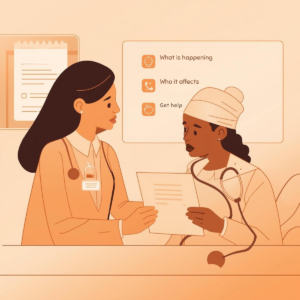
In practice, a plain language message from a health authority usually benefits from five elements that appear in the same order across channels. First, a clear statement of what is happening. Second, who it affects. Third, what people should do. Fourth, why it matters in practical terms. Fifth, where to get help or more information.
Even when the content is complex, this structure keeps the reader oriented. It also prevents the scroll fatigue problem where residents stop reading before they reach the action step.
A key choice for public health organizations is how to present nuance. Nuance is not the enemy. Hidden nuance is. Many messages bury critical qualifiers inside long sentences, which makes the qualifier easy to miss. A clearer approach is to state the core action plainly, then add a short sentence that names the conditions that change the advice.
Another part of the anatomy is visual hierarchy. Readers scan for signals. Health agencies can make the message easier to navigate by using short headings that mirror how people think. Who this is for, what to do now, and when to call for help are more usable than headings that sound like internal program labels. This is especially important when public health departments coordinate with partners, because partners often republish content in different formats, and clear headings help meaning survive that reshaping.
Plain language is also strengthened by concrete nouns and active verbs. Instead of writing utilize, write use. Instead of individuals experiencing symptoms, write people with symptoms. Instead of seek additional information, write visit this page or call this number. These changes do not reduce accuracy. They reduce friction.
Finally, public health organizations benefit from making the next step easy to complete. If the action requires eligibility checks, documentation, or timing constraints, say so plainly. If the action has two paths, such as online and phone, describe both options in everyday language. When a message assumes a single path, it often excludes residents who need a different one, and the message becomes less equitable even if the program itself is well-designed.
A Plain Language Checklist Public Health Teams Can Use Before Publishing
A checklist helps health agencies turn good intentions into consistent output, especially when multiple staff publish across web, social, email, and partner toolkits. This is also where clarity becomes operational. The checklist creates a shared definition of ready, so teams spend less time debating style and more time improving comprehension.
Audience and scope checks
-
Does the first screen clearly say what is happening in plain language.
-
Does the message clearly state who it applies to, including any groups or settings that are exceptions.
-
If guidance differs by risk level, does the message separate standard guidance from targeted advice.
Action and usability checks
-
Can a resident identify the next step within 10 seconds of reading.
-
Are action steps written as concrete verbs that a person can do today.
-
Does the message include an alternative path for people who cannot use the default option.
-
If the process requires documents, appointments, or time windows, is that stated plainly.
Language and readability checks
-
Are acronyms either removed or defined on first use, then used consistently.
-
Are sentences short enough to understand on a first read, especially on mobile.
-
Are technical terms replaced with everyday words where possible, without changing meaning.
-
Does the message avoid institutional tone that sounds distant, punitive, or overly legal.
Consistency and channel checks
-
Do the web version, social version, and partner version use the same labels and core wording.
-
Does the message include a clear update date and, if relevant, a short note on what changed.
Equity and access checks
-
Is the message available in the languages most used in the community, or is translation planned and clearly signposted.
-
Does the message avoid assumptions about internet access, transportation, work schedules, or healthcare access.
-
If the message points to resources, are those resources realistic, accessible, and clearly described.
When public health departments use a checklist like this consistently, clarity becomes the default. Over time, staff also start drafting with the checklist in mind, which makes reviews faster and reduces last-minute rewrites.
Plain Language in High-Risk, High-Emotion Moments
Public health organizations often communicate when people are worried, angry, exhausted, or grieving. Those emotions change how residents process information. Even highly literate readers can miss key details when they are stressed, and they may interpret tone as a signal of intent.
In high-emotion situations, plain language is not only about comprehension. It is also about stability. A calm structure, direct wording, and a clear next step help people feel oriented. That reduces panic behavior and increases the likelihood that residents will follow guidance correctly.
Health agencies can improve clarity in these moments by adopting a few consistent communication choices. One is to lead with what people can do, not only what they should avoid. Another is to minimize conditional phrasing in the first lines. If there are exceptions, name them after the core instruction is clear, rather than embedding multiple qualifiers in the first sentence.
A common mistake in urgent messages is trying to address every possible scenario at once. When a public health department piles on multiple instructions, readers often retain none of them. A more effective approach is to prioritize the top one or two actions, then point readers to a page that includes the fuller set of details.
Tone also matters. Residents read tone as a cue for whether the agency is confident, whether it respects them, and whether it is trustworthy. Plain language works best when it is direct but not harsh. It acknowledges uncertainty without sounding evasive. It also recognizes constraints without implying blame.
Plain language also helps in rumor-heavy environments. When misinformation spreads, agencies sometimes respond with long corrections and dense evidence. Those responses often get ignored. A clearer approach is to state the truth plainly, name what is incorrect without repeating it extensively, and give residents a simple way to verify information through official channels.
Making Technical and Clinical Information Understandable Without Distorting It
A core fear in public health organizations is that plain language will water down science. In practice, the opposite often happens. Plain language forces writers to identify the essential meaning and remove unnecessary complexity. That process can make accuracy more visible.
The key is to separate precision from jargon. Precision is necessary. Jargon is optional. Many technical terms can be replaced with everyday words that preserve the concept, especially when paired with a short explanation.
Health agencies can translate technical concepts by focusing on what the concept changes for the reader. Instead of emphasizing an epidemiological term, the message can explain what that term means for risk, timing, or action. That makes the information usable, which is the point of public communication.
Another effective practice for public health departments is to use concrete comparisons carefully. When done well, comparisons help residents grasp scale. When done poorly, they can be misleading or feel dismissive. The best comparisons are grounded in everyday experience, avoid overpromising, and clearly state their limits.
Health authorities can also use the define once, then repeat approach. If a term must be used, define it in one short sentence the first time, then use it consistently. Avoid introducing multiple terms that overlap, because that increases cognitive load and invites misinterpretation.
It also helps to avoid stacking multiple numeric concepts in a single paragraph. Numbers matter in public health, but residents often struggle to interpret them, especially when they are presented without context. A clearer approach is to highlight one key number, explain what it means for the reader, and then provide a link or expandable section for people who want the full data.
When public health organizations communicate clinical guidance, they also need to clarify what is general and what requires individual medical advice. Plain language helps here because it allows the agency to be specific about scope. It can state the standard guidance for most people, then direct individuals with specific conditions to consult their provider. That reduces confusion and helps prevent people from interpreting general guidance as personalized medical direction.
Promoting Long-Term Public Health Outcomes Through Communication
Plain language is not only for emergencies. It is one of the most reliable ways public health departments can support long-term outcomes, because long-term outcomes depend on steady, repeated understanding. Programs that require ongoing behavior change, such as vaccination schedules, chronic disease prevention, nutrition support, maternal health care coordination, and environmental health protections, succeed when residents can understand and act without repeatedly asking for interpretation.
Over time, plain language strengthens outcomes by reducing drop-off between awareness and follow-through. Residents are more likely to complete a screening, show up for an appointment, or adopt a prevention behavior when they do not have to decode the message first. That saves effort for the public and reduces administrative burden for health agencies.
Plain language also protects trust in the long run. When health authorities communicate in a consistent, understandable way, residents experience the organization as predictable and respectful. Even when guidance changes, people are more willing to accept updates if they understand what changed and why. This matters because many public health interventions require repeated engagement across months or years.
Plain language also improves internal efficiency in public health organizations. When messages are clear, staff spend less time answering the same questions, less time correcting misinterpretations, and less time rewriting materials that partners could not use. Those efficiency gains create capacity for program delivery, partner coordination, and community engagement that can move outcomes.
Finally, plain language supports equity in long-term outcomes. When information is clear and action steps are realistic, more residents can access services and participate in prevention behaviors. This reduces the chance that programs unintentionally benefit only those who already have the resources to navigate complex systems.
Sustaining this benefit requires a system approach. Health agencies need consistent templates, a review checklist that centers the audience, and feedback loops that identify where people get stuck. Over time, plain language becomes a culture within the organization rather than a special effort only applied to high-profile campaigns.
Strategic Communication Support for Your Health Agency
 Health agencies are expected to communicate across complex topics, multiple channels, and diverse audiences while operating with limited time and staff capacity. Even strong public health departments can struggle to maintain consistent clarity when multiple programs publish content, partners reuse messaging in different formats, and updates need to move quickly. In those conditions, plain language efforts can become uneven. One program writes clearly while another slips into policy voice. One channel stays accurate while another shortens wording in a way that changes meaning. Over time, residents experience that inconsistency as confusion, and staff experience it as rework.
That is why agencies often choose to partner with an external resource like Stegmeier Consulting Group (SCG) to strengthen communication systems. An outside partner can help a public health organization define plain language as an operational standard, then build the tools and workflows that make that standard sustainable. The purpose is not to rewrite everything. The purpose is to create a repeatable system that helps teams publish faster, maintain consistent meaning across channels, and reduce avoidable misunderstandings that drive call volume and frustration.
SCG supports public health organizations by helping them design a plain language framework that fits their reality. This often begins with aligning on a shared message structure, agreed-upon terminology, and a small set of language rules that protect clarity across programs and channels. From there, the work typically includes developing templates for common message types, such as alerts, program announcements, FAQs, web pages, and partner toolkits. Health authorities also benefit from lightweight governance practices that clarify who drafts, who reviews for plain language and accessibility, who approves content, and how updates are logged. When those workflow elements are defined, clarity becomes less dependent on individual writers and more dependent on a stable process.
A strong plain language system also includes practical internal capability building. Many public health departments have skilled staff who simply need shared conventions and a quick review discipline to produce consistently clear content. Training, coaching, and short drafting exercises can help teams practice translating complex concepts into everyday language without losing accuracy, while also building confidence in how to communicate uncertainty, shifting evidence, and risk variability. For health agencies working with clinics, schools, or community-based partners, the system can also include partner-ready language that preserves meaning even when others repost or adapt content.
When plain language is treated as a system, the benefits show up quickly. Residents understand what to do and where to go. Partners share information more accurately. Staff spend less time answering repetitive questions and correcting misinterpretations. Most importantly, public health organizations improve follow-through on programs and protective actions, which is where communication becomes a direct contributor to outcomes.
Conclusion
Plain language matters more than ever because the public encounters health information in fragments, under stress, and in a noisy environment where unclear messages get replaced by louder ones. When public health departments communicate in plain language, they make it easier for residents to understand risk, recognize what applies to them, and take the right next step. Plain language also protects trust by making updates feel predictable, not arbitrary, and by reducing the space where misinformation can fill gaps.
For health agencies and health authorities, plain language is not a one-time editing effort. It is a sustainable practice built on message structure, consistent terminology, usable action steps, equity-minded design, and a review process that centers the audience experience. When public health organizations adopt those practices across programs and channels, they reduce confusion, increase follow-through, and strengthen long-term public health outcomes.
SCG’s Strategic Approach to Communication Systems
Align your agency’s messaging, processes, and public engagement strategies
Agencies that communicate effectively build stronger trust with staff, stakeholders, and the public. Whether you are improving health communication campaigns, strengthening internal workflows, or aligning agency-wide messaging, SCG can help you develop a communication system that supports consistent decision-making and long-term organizational success. Use the form below to connect with our team and explore how a strategic communication framework can elevate your agency’s impact.