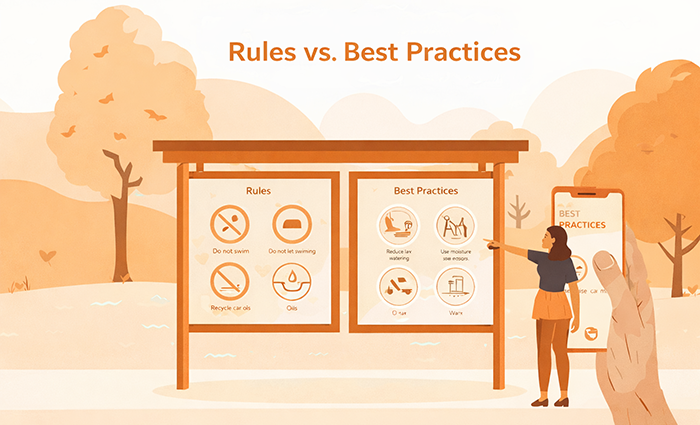
Rules vs. Best Practices: Communicating Water Use Guidance Clearly
People encounter water use guidance in many forms, yet the distinction between what is required and what is encouraged is not always obvious. Some messages outline strict requirements intended to protect shared supplies, prevent waste, or meet drought stage and regulatory expectations. Others suggest behaviors that support long term conservation but are not enforceable rules. Water Conservation Districts rely on this balance, but customers often interpret both categories as the same unless communication makes the difference unmistakable. When that clarity is missing, even well intentioned customers may feel uncertain, restricted, or unsure how to respond.
Understanding water use guidance often requires more context than many customers bring with them. People arrive with different priorities and constraints. Some are focused on keeping landscapes healthy, others on managing household routines, and many on keeping costs predictable. A requirement that limits outdoor irrigation may feel frustrating to someone trying to protect trees or comply with HOA expectations. A best practice recommendation may be overlooked by someone who does not realize how small actions add up across a neighborhood or service area. If districts do not clearly articulate why a behavior is required or merely encouraged, customers fill in the gaps with assumptions that can lead to inconsistent compliance, unnecessary demand, or dissatisfaction.
Clarity in communication helps customers feel informed and respected rather than corrected. Explaining the purpose behind each type of guidance also supports better decision making. When customers understand why a requirement exists or why a best practice matters, they are more likely to adjust their actions voluntarily. This strengthens cooperation, nurtures trust, and supports a shared sense of stewardship. Districts that communicate with precision, empathy, and accessibility create conditions where water guidance feels purposeful and where people are more likely to act responsibly.
Why Differentiating Rules and Best Practices Matters
 For many customers, rules and best practices blend together unless the district clearly specifies what is required and what is encouraged. Water Conservation Districts often receive questions about whether guidance is mandatory or simply recommended, especially during drought stages, seasonal watering windows, or program rollouts tied to rebates and incentives. District communications also need to clarify which requirements stem from local ordinances, wholesale provider conditions, or emergency declarations, and which recommendations reflect smart habits that reduce waste. Clarity in these distinctions influences both compliance and public perception.
Customers interpret rules as enforceable requirements. They expect consequences if rules are broken and often assume that requirements exist for serious supply, infrastructure, or community reliability reasons. Best practices, however, are often interpreted as flexible, optional, or based on personal judgment. When districts fail to explain why a best practice matters, customers may disregard it entirely. Yet many best practices, such as fixing leaks quickly, adjusting irrigation cycles, and using efficient fixtures, meaningfully reduce demand even if they are not codified into law. Understanding these differences empowers customers to act responsibly even when enforcement is not visible.
Clear differentiation also strengthens communication credibility. Customers appreciate transparent messaging that explains how decisions are made and why certain actions are required while others are strongly encouraged. When districts articulate the reasoning behind both categories and communicate them consistently across mailers, websites, social updates, and customer service scripts, the system feels thoughtful rather than arbitrary. This transparency reduces resistance, builds trust, and supports long term cooperation across diverse customer groups. Ultimately, the more clearly districts explain water guidance categories, the more consistently people adopt behaviors that protect shared water resources.
From Scarcity to Sustainability: Effective Communication Strategies for Water Conservation Agencies
This article is part of our series on strategic communication for Water conservation agencies. To learn more and to see the parent article, which links to other content just like this, click the button below.
How Customers Interpret Required vs. Recommended Guidance
People rely heavily on quick cues when interpreting water use guidance. If a notice appears formal, highly visible, or emphasized with strong visual design, customers assume it communicates enforceable requirements. If a message uses softer language, appears in a smaller format, or is presented as a tip, they may interpret it as optional. Water Conservation Districts see this confusion across bill inserts, mailed notices, websites, social posts, and public signage. Customers may treat recommended habits as strict rules, or dismiss important recommendations as casual suggestions, unless the district makes the distinction unmistakable. When that clarity is missing, even well intentioned customers may feel uncertain, restricted, or unsure how to respond.
Customers also compare guidance to past experiences. If they encountered stricter watering schedules or drought rules in a neighboring jurisdiction, they may assume similar requirements apply everywhere. Conversely, if they previously lived in areas with lenient policies or abundant supply, they may treat recommendations as optional even when the district is seeking strong participation. This variability places a heavy burden on communication clarity. Without explicit explanations, customers rely on assumptions that may not align with district intent.
Emotional state also shapes interpretation. Customers under financial strain may react negatively to messages that feel punitive. Customers trying to protect landscapes during heat may resist requirements if they seem to threaten plants or contradict familiar routines. When districts explain the purpose behind each type of guidance, people experience less friction. They see requirements as protective rather than arbitrary and view best practices as meaningful contributions rather than unnecessary suggestions. Clear communication of intent helps customers interpret guidance accurately and respond cooperatively.
Why Rules Require Direct, Plain Language
Requirements must communicate with absolute clarity to protect shared supply, maintain system reliability, and meet drought stage or regulatory expectations. Water Conservation Districts rely on direct, plain language to establish boundaries around watering schedules, prohibited uses, emergency restrictions, and program compliance requirements. Clear, unambiguous wording is also essential when rules connect to enforcement, customer notifications, or coordinated actions with retail water providers and local governments.
Plain language eliminates ambiguity about what customers must do. Words such as “required,” “prohibited,” “must,” or “do not” are necessary when consequences extend beyond individual inconvenience and affect community supply or fairness across customer groups. The public expects requirements to be written in straightforward terms that reflect seriousness and urgency. When districts soften rule language too much in an effort to be polite, the message can lose clarity and undermine both compliance and conservation outcomes.
Clear language does not require a harsh tone. Districts can pair direct requirements with concise explanations to maintain trust and encourage cooperation. For example, a notice might state, “Do not irrigate between 10 a.m. and 6 p.m. High heat causes rapid evaporation and reduces effectiveness.” This approach preserves the authority of the requirement while helping customers understand why compliance matters. By combining clarity with context, districts support both enforcement and public understanding.
How Best Practices Build Stewardship Even Without Enforcement
Best practices give customers a way to participate in conservation voluntarily, and when communicated effectively, they build long term stewardship. Water Conservation Districts use best practices to encourage efficient irrigation habits, leak awareness, climate appropriate landscaping, and thoughtful daily routines that reduce waste. Districts may also share recommendations that support program success, such as preparing for an irrigation audit, choosing eligible equipment, or maintaining upgrades after installation. These messages invite cooperation rather than mandate it.
Customers respond positively to best practices when they understand that small habits add up to meaningful outcomes. A suggestion such as “Check for running toilets and fix leaks within 48 hours” helps people see themselves as contributors to system reliability and drought resilience. Best practices feel less restrictive than requirements, so customers adopt them more willingly. When customers consistently follow recommendations, they help reduce peak demand, prevent avoidable losses, and support fairer outcomes across the community even when enforcement is not present.
Best practices also create opportunities for positive engagement. Districts can share tips through workshops, demonstration landscapes, school programs, community events, social media, and customer service interactions. When customers feel invited rather than reprimanded, they are more open to learning and participation. Over time, voluntary behaviors often become community norms, making conservation efforts more resilient and widespread.
Communicating the Purpose Behind Rules and Best Practices
Customers accept guidance more readily when they understand why it exists. Water Conservation Districts often find that conflict decreases when messages explain supply conditions, drought stage triggers, fairness considerations, or system constraints in plain terms. When districts communicate the “why,” requirements and best practices gain legitimacy. People are more likely to cooperate when they understand the purpose behind expectations and how those expectations connect to shared outcomes.
Purpose driven communication also helps prevent misinterpretation. Without context, customers may assume restrictions are arbitrary or primarily revenue driven. A requirement limiting irrigation days can feel unreasonable until customers understand peak demand, storage limitations, or coordinated regional conditions. A best practice recommending smart controller settings may feel optional until customers learn how quickly small adjustments reduce demand across a service area. Communicating purpose shifts thinking from “I am being restricted” to “I understand the reason behind this expectation,” which supports long term cooperation.
Districts can communicate purpose through concise statements on mailers, websites, bill messaging, SMS or email alerts, public meeting materials, and customer service scripts. The tone should remain informative rather than scolding. When customers feel respected and included in the reasoning, they align more readily with district goals. This mutual understanding transforms rule adherence from compliance into collaboration. The more effectively districts articulate purpose, the more consistently customers support and internalize conservation guidance.
Designing Signage That Clearly Differentiates Rules and Best Practices
 Signage remains one of the most visible and influential ways to communicate water use expectations, especially when paired with mailers and digital updates. Water Conservation Districts rely on clear sign design at district offices, demonstration landscapes, community event booths, partner locations, and public-facing facilities to reinforce watering requirements and recommended habits. Districts also benefit from signage that helps customers quickly understand program steps, drought stage impacts, and best practice guidance without overwhelming them with technical detail. Clear visual and verbal design strengthens understanding and reduces confusion about what is required versus encouraged.
Establishing a Visual Hierarchy That Customers Can Interpret Quickly
People interpret signage in seconds, which means districts must design a visual hierarchy that distinguishes mandatory requirements from recommended best practices. Water Conservation Districts often use bold headers, distinct labels such as “Required” versus “Recommended,” and consistent icon sets to signal what is enforceable. Districts benefit from standardized templates so customers quickly learn how to interpret drought stage updates, watering schedules, rebate instructions, or use limitations. Consistency across signs reduces confusion and builds recognition over time.
A strong visual hierarchy reduces cognitive load. When customers can immediately tell which information requires compliance and which encourages stewardship, they make better decisions under pressure. Visual consistency also reinforces learning through repetition. Even if a customer does not read every word, the hierarchy helps them understand the relative importance of each message.
Districts must ensure that visual hierarchy supports accessibility. Color contrast, text size, and symbol clarity all influence readability for people with varying abilities. When visual hierarchy aligns with accessibility best practices, signage becomes more inclusive and more effective. This strengthens understanding and supports higher compliance with both requirements and best practices.
Using Tone and Wording to Prevent Misinterpretation
Tone is a powerful component of sign design. Requirements need direct, plain language, while best practices benefit from a friendly, collaborative tone. A district sign might use “Do not water on non scheduled days” for requirements, contrasted with “Consider watering early to reduce evaporation” for best practices. Clear tone reduces ambiguity. Customers should never wonder whether a directive is optional or mandatory. When wording signals the correct level of urgency, districts prevent confusion and reduce the risk of unintentional noncompliance.
Tone also supports trust. When messages feel respectful rather than authoritarian, customers are more likely to view the district as a partner in stewardship rather than an enforcer. Supportive language is especially important when messaging touches household stressors such as costs, landscape loss, or changing routines. Districts can be firm and still be empathetic.
Tone should remain consistent across channels. The tone on a website, bill insert, email alert, or customer service script should match what customers see on signs. Inconsistency can undermine credibility because people may assume the district is unsure about the seriousness of the message. When tone is aligned, customers experience a unified communication system that reinforces clarity.
Preventing Sign Overload and Message Fatigue
Too many signs can lead people to ignore information entirely. Districts can unintentionally create clutter at public counters, event booths, demonstration areas, or partner sites when program updates change frequently. Long lists of details can overwhelm customers who are trying to understand a few key actions. When too many competing messages appear in the same space, mandatory requirements can become lost among best practice reminders.
Customers process information selectively. If required actions are buried, customers may miss critical steps or misread what is enforceable. Simplifying layouts, reducing redundancy, and using clear labels helps prevent fatigue and keeps attention focused on the most important guidance. This is particularly important during drought stages when customers are already receiving more communication than usual.
Districts can reduce overload by grouping related messages, removing outdated information, and using layered communication strategies. For example, a lobby poster can provide high level requirements, while a QR code or handout offers detailed program steps or FAQs. This approach respects cognitive capacity and preserves attention for critical water guidance.
Why Tone Matters in Water Use Communication
Tone influences how customers interpret expectations and whether they feel respected, supported, or discouraged. Water Conservation Districts must balance authority and approachability when communicating watering schedules, drought restrictions, and program requirements. A calm, empathetic tone can encourage participation, while clear, confident language helps customers make decisions during changing conditions. A community oriented tone frames water guidance as shared responsibility rather than top down instruction.
Tone shapes compliance more powerfully than many districts expect. A stern message may deter some customers but provoke resistance in others, particularly when people feel stressed about costs, heat impacts, or landscape loss. An overly soft tone can minimize the seriousness of a requirement. The most effective communication uses plain, respectful language that conveys urgency without creating defensiveness. When customers feel addressed as partners rather than problems, they are more receptive to both requirements and best practices.
Tone also influences the emotional climate of public interactions. A welcoming tone helps reduce tension during peak demand periods, emergency restrictions, or rapid drought stage changes. When districts maintain consistent tone across digital channels, printed materials, signage, and staff conversations, customers experience coherence that reinforces trust. Thoughtful tone is not just stylistic. It is a functional part of communication strategy that influences whether people cooperate willingly or resist guidance.
Helping Customers Understand the Consequences of Noncompliance
People are more likely to follow requirements when they understand the consequences of ignoring them. Water Conservation Districts often communicate community level consequences such as reduced supply reliability, higher peak demand that stresses systems, and increased risk of mandatory restrictions for everyone. Districts may also explain operational impacts, including higher treatment and pumping demands, limitations on storage, and reduced flexibility during emergencies. Clear consequences help customers understand that requirements protect more than individual preferences.
Consequences should be explained clearly and concisely without relying on fear based messaging. Customers respond better to communication that highlights shared responsibility and explains why prevention matters. For example, a notice may explain that watering during peak heat leads to significant evaporation and undermines conservation goals. Another may describe how persistent leaks increase demand and raise costs across the system. When consequences are tied to visible or relatable outcomes, customers internalize the seriousness of decisions more effectively.
Districts can highlight both immediate and long term consequences. Immediate consequences such as warnings, fines, or loss of program eligibility communicate urgency. Long term consequences help customers understand how collective behavior affects reliability across seasons. By framing consequences within a broader conservation narrative, districts reinforce the importance of following requirements and encourage customers to adopt best practices consistently.
How Digital Communication Supports Rule Clarity
Digital communication shapes customer expectations long before they change behavior, which makes it essential for explaining the difference between requirements and best practices. Water Conservation Districts use mobile friendly websites, email or SMS alerts, social channels, and online program portals to communicate drought stages, watering schedules, rebate requirements, and timely updates. Digital channels also help districts clarify what is enforceable and what is recommended, especially when conditions shift quickly.
Digital tools strengthen clarity by allowing districts to categorize information in ways that a single sign or mailer cannot. Messages can be grouped into required actions and recommended behaviors, with supporting context and links to FAQs, program details, or simple how-to steps. Customers who want quick guidance can absorb essentials, while those who prefer detail can explore more fully. This layered approach supports diverse audiences with different levels of familiarity with water management and conservation programs. Digital communication also enables translation, accessibility formatting, and audio alternatives that support inclusive engagement.
Digital channels should align with printed and in-person messaging to avoid confusion. If a watering schedule online differs from a mailed notice or a staff explanation, customers may question accuracy and legitimacy. When digital and offline communication reinforce each other, customers trust both sources more readily. Districts that maintain synchronized messaging reduce conflict, increase compliance, and strengthen adoption of both requirements and best practices.
Training Staff to Communicate Water Use Expectations Effectively
Staff and volunteers play a critical role in helping customers interpret requirements and best practices. Water Conservation Districts rely on customer service teams, program coordinators, field staff, and community educators who answer questions about watering schedules, rebates, audits, and drought stage changes. Staff are the human bridge between district intent and customer understanding. When staff can explain what is required, what is recommended, and why it matters, customers make better decisions and feel more supported.
Effective training ensures that staff communicate expectations consistently and confidently. Staff should understand not only the rules and best practices, but also the reasons behind them, including supply conditions, equity considerations, and program goals. When staff can explain these factors in a calm, knowledgeable tone, customers respond more positively and conversations are less likely to escalate. Clear talking points, shared language, and easy-to-reference guidance support these efforts across phones, email, counter service, and community events.
Training should also prepare staff to recognize common misunderstandings. Some customers may treat best practices as irrelevant, while others may assume recommendations are enforceable requirements. Staff who can identify these patterns can clarify expectations early and reduce frustration. Empowered staff create more consistent customer experiences and reinforce a communication culture rooted in clarity, transparency, and empathy. Districts that invest in training strengthen compliance and support long term stewardship.
Avoiding Mixed Messages Across Communication Channels
One of the most common sources of customer confusion is inconsistency across communication channels. Water Conservation Districts may publish one message online, distribute a mailer with different timing, or have staff explain requirements in slightly different terms. Program requirements can also drift if older web pages remain live after updates. When customers perceive mixed messages, they are less likely to trust any of the information provided.
Consistency is the foundation of communication credibility. Customers expect that requirements will remain stable or that districts will clearly announce updates. Best practices should also follow a familiar format so people can recognize them quickly. When different tools share a unified structure, customers learn to interpret guidance more intuitively. This reduces cognitive load and helps prevent situations where a customer unintentionally violates a requirement due to outdated or conflicting information. To maintain consistency, districts need internal workflows that coordinate message creation, review, approval, and publication across platforms.
Avoiding mixed messages also supports positive relationships. Confusion often leads to frustration, and frustration can escalate into complaints or noncompliance. When customers see that the district communicates clearly and consistently, even during drought stage changes or emergency conditions, trust grows. Consistency signals competence and care. By aligning messages across every channel, districts strengthen communication effectiveness and community cooperation.
Understanding Customer Motivations to Tailor Water Use Messages
Water use behavior is shaped by individual motivations, and communication becomes clearer when districts consider these motivations carefully. Water Conservation Districts engage with customers who have different priorities, such as keeping landscapes alive, managing household routines, meeting business needs, or reducing bills. Some customers are highly conservation minded and want detailed guidance. Others want simple instructions they can apply quickly. Tailoring communication to these motivations makes water guidance more relatable and easier to follow.
Some customers seek efficiency and prefer direct, minimal explanations. Others want context and appreciate learning how supply, weather, and demand connect. For some, water use choices are emotional because they connect to home pride, cultural practices, or stress about heat and plant loss. Districts that tailor message structure and depth can reduce resistance and increase voluntary participation. When customers feel a message speaks to their reality, they absorb it more readily.
Tailoring also supports inclusivity. Customers differ in housing type, language, financial flexibility, and comfort with technical terms. Districts can increase clarity by offering multiple pathways to understanding, such as visuals, plain language versions, step-by-step checklists, and staff support. Tailored communication improves accessibility and helps create a respectful experience for all customers. When people feel seen and understood, they become more open to supporting conservation goals.
Aligning Rules and Best Practices With Seasonal Communication Needs
Water use expectations often shift with the seasons, requiring districts to adjust requirements and best practices accordingly. Water Conservation Districts may tighten watering schedules during summer demand peaks, update drought stage requirements, or shift best practice recommendations based on temperature, wind, or local supply conditions. Seasonal shifts influence how districts frame both required and recommended behaviors, and they shape what customers perceive as reasonable and achievable.
Clear seasonal communication helps customers understand why guidance changes and what actions are needed. A watering window that changes in summer can appear arbitrary unless the district explains heat-driven evaporation and peak demand pressures. A best practice encouraging controller adjustments is more likely to be adopted when customers understand how weather and soil conditions affect watering needs. Seasonal context reduces confusion and prevents customers from interpreting changing expectations as inconsistency.
Seasonal communication also helps districts protect supply during vulnerable periods. By explaining why certain requirements apply during specific conditions, districts give customers the tools to build adaptive habits. This fosters deeper understanding and long term stewardship. When customers learn how seasonal demand and weather patterns influence system strain, they become more thoughtful participants in conservation.
Building Customer Confidence Through Transparent Communication
Transparent communication strengthens trust and helps customers feel confident in water use decisions. Water Conservation Districts often see frustration when customers encounter unexpected restrictions, unclear watering schedules, or shifting drought stage guidance. Transparency reduces uncertainty by giving people the information they need before confusion escalates, including what changed, when it changed, and how to comply.
Customers respond well when districts describe both the “what” and the “why.” A clear message stating that restrictions were updated, followed by a brief explanation tied to supply, demand, or regional conditions, supports understanding. Transparency also includes communicating what the district is doing behind the scenes, such as monitoring demand, coordinating with providers, updating stage triggers, or expanding customer support. When people see decisions are informed and intentional, they are more patient and more cooperative.
Digital tools, printed materials, and staff conversations all shape transparency. Districts that align information across these channels create a unified communication ecosystem that supports confidence. Transparent communication will not eliminate all confusion, but it reduces conflict and helps customers interpret requirements and best practices correctly. In doing so, districts reinforce a culture of cooperation that strengthens conservation outcomes.
Pairing Enforcement With Education to Support Better Outcomes
Enforcement may be necessary to protect shared water resources, but it becomes more effective when paired with education. Water Conservation Districts may enforce watering schedules, prohibited uses, emergency restrictions, or program compliance rules to maintain fairness and system reliability. While enforcement addresses immediate risks, education builds long term participation and reduces repeated violations.
Customers respond differently when they understand the reasoning behind enforcement actions. A warning that simply states a rule exists may trigger defensiveness, while a message that explains how peak demand strains supply or how evaporation undermines conservation goals is more likely to encourage cooperation. Education can transform enforcement moments into learning opportunities. This reduces future conflict and helps customers make better decisions in subsequent weeks and seasons.
Enforcement paired with education also helps maintain credibility. When districts show that requirements are consistent and grounded in real conditions, customers are more likely to view enforcement as fair and necessary. This reinforces the legitimacy of both requirements and best practices. Over time, the combination of enforcement and education strengthens stewardship and reduces the need for corrective interventions.
Recognizing When Best Practices Need to Transition Into Rules
Some best practices eventually become requirements as conditions change. Water Conservation Districts may begin with voluntary guidance, such as recommending shorter irrigation runtimes or encouraging quick leak repairs, then formalize expectations when participation is insufficient or drought conditions intensify. Districts may also shift program rules when demand patterns indicate that stronger measures are necessary to protect supply reliability and equitable access.
Transitioning from best practice to requirement requires careful communication. Districts should explain why the shift is necessary, what conditions changed, and how the new requirement will be applied. When customers understand that the decision is based on measurable need, they are more likely to support the transition. Clear messaging helps ensure the change is not perceived as sudden or punitive. Instead, it is understood as a reasonable response to evolving realities.
How In-Person Education Enhances Water Use Understanding
In-person education gives customers practical context that strengthens understanding of requirements and best practices. Water Conservation Districts often use workshops, demonstration gardens, irrigation audit walkthroughs, rebate events, school programs, and community presentations to explain why guidance exists and how to apply it. Without context, a requirement or recommendation can feel inconvenient. With context, it feels purposeful and achievable.
Education strengthens understanding by connecting guidance to real outcomes. When customers learn how evaporation works, how soil conditions affect irrigation needs, or how leaks add up across a service area, their choices change. They see that small actions have broader impacts. Education elevates communication from instruction to shared learning, which encourages more thoughtful decision making.
Interactive elements strengthen retention. QR codes linking to short videos, step-by-step checklists, and simple calculators help customers connect personally to the information. The more customers understand the story behind a requirement or best practice, the more willingly they participate. In-person education creates a bridge between what customers hear and what they need to do, reinforcing both requirements and recommended habits.
Incorporating Community Voices Into Water Use Messaging
Community perspectives help districts build communication that resonates more widely and more authentically. Water Conservation Districts can gather input from residents, businesses, property managers, community organizations, and culturally specific groups that experience water guidance differently. Feedback from customers with diverse housing situations, languages, and landscape expectations helps districts improve clarity and fairness. These perspectives add credibility to public messaging and help districts anticipate concerns before they become complaints.
Incorporating community voices communicates that water stewardship is shared responsibility rather than a top down directive. Districts can share short testimonials, highlight local success stories, and recognize community-led conservation efforts. When customers see their community reflected in communication, they are more likely to internalize guidance and participate consistently. These approaches help people understand that conservation is a community value, not only a district priority.
Engaging community voices also strengthens trust. When districts listen and reflect what customers need, support grows. This collaborative approach helps districts respond to cultural differences, accessibility needs, language barriers, and varied familiarity with water programs. Incorporating community voices results in more inclusive and more effective communication systems that help customers connect with and support conservation goals.
Strategic Communication Support for Your Water Conservation District
 Clear communication around water use guidance requires more than well written notices or updated web pages. It depends on systems that help staff and leadership communicate consistently across channels while supporting public understanding of both requirements and best practices. Water Conservation Districts often recognize that internal processes were not designed for frequent drought stage updates, rapid shifts in supply conditions, or ongoing program messaging tied to rebates and incentives. Districts also need coordinated tools that translate technical realities into plain language that customers can act on quickly.
Districts often choose to partner with an external resource like Stegmeier Consulting Group (SCG) because communicating water guidance requires a strategic, unified approach rather than reactive messaging. SCG helps districts create communication systems that connect the “why” behind expectations with the daily customer experience. By improving message alignment, workflow clarity, and customer readiness, SCG supports districts in strengthening both compliance and trust. This approach helps ensure that requirements are understood, best practices are adopted, and conservation goals become more achievable across diverse customer groups.
SCG’s methodology emphasizes internal alignment before external communication. When staff understand expectations clearly and feel confident explaining them, customer interactions become more constructive and consistent. SCG works with districts to develop messaging frameworks that connect digital channels, printed materials, and staff guidance into one coherent system. This reduces conflicting messages that undermine credibility and supports communication resilience during seasonal demand peaks, drought stage shifts, or emergency restrictions.
SCG also assists districts in crafting messaging that balances authority and accessibility. Water guidance often carries emotional weight for customers who feel strongly about home routines, landscapes, or perceived fairness. By integrating empathy, clarity, and purpose driven explanations into communication systems, SCG helps districts deliver messages that resonate. This approach strengthens customer cooperation and reduces tension in moments of conflict. Over time, districts gain tools to communicate more confidently and more consistently, regardless of changing conditions.
Conclusion
Distinguishing between requirements and best practices is one of the most important communication challenges for Water Conservation Districts. Customers arrive with different levels of water knowledge, expectations, and stressors. Without clear communication, they may misunderstand what is required, question why certain behaviors matter, or disregard guidance that protects shared supply. When districts explain the purpose behind both requirements and best practices, customers see the logic behind each expectation. Communication becomes collaborative rather than corrective, creating a more supportive and engaged community.
Successful communication relies on a balance of clarity, empathy, consistency, and accessibility. Requirements need direct, unambiguous language that communicates urgency and responsibility. Best practices benefit from supportive tone and purposeful explanations that help customers understand how small actions contribute to long term reliability and resilience. Digital tools, printed materials, staff conversations, and community education all play complementary roles in reinforcing the distinction between required actions and recommended habits. When these channels align, customers respond with greater trust, attentiveness, and voluntary participation.
By investing in communication systems that strengthen understanding and promote stewardship, districts build stronger relationships with the public and protect water resources more effectively. Customers become partners rather than bystanders in conservation. Clear, purposeful messaging ensures that requirements and best practices function not as barriers, but as pathways to shared responsibility, community resilience, and long term water reliability.
SCG’s Strategic Approach to Communication Systems
Align your agency’s messaging, processes, and public engagement strategies
Agencies that communicate effectively build stronger trust with staff, stakeholders, and the public. Whether you are implementing QR code systems, improving internal communication workflows, or strengthening agency-wide alignment, SCG can help you develop a communication system that supports consistent decision-making and long-term organizational success. Use the form below to connect with our team and explore how a strategic communication framework can elevate your agency’s impact.