The Research Triangle: How Wake County, North Carolina Branded a Region for Talent and Business Growth
 The Research Triangle of North Carolina, anchored by Raleigh, Durham, and Chapel Hill, has earned a reputation as one of the most vibrant and fast-growing regions in the United States. With a population exceeding two million, three world-class research universities (Duke University, the University of North Carolina at Chapel Hill, and North Carolina State University), and the renowned Research Triangle Park (RTP), the area stands at the intersection of innovation, research, and entrepreneurship.
While the Triangle has long attracted businesses in life sciences, technology, and advanced manufacturing, by the early 2010s it faced a new challenge: companies moving into the region needed a steady stream of highly skilled workers. Competing regions like Austin, Denver, and Boston were not only marketing their business ecosystems but also aggressively branding themselves as lifestyle destinations for young professionals and families.
In response, Wake County Economic Development (WCED), in partnership with the Raleigh Chamber of Commerce and regional stakeholders, launched Work in the Triangle—a brand dedicated to talent attraction and retention. Unlike traditional economic development campaigns that focused primarily on tax incentives, land availability, or industry clusters, Work in the Triangle put people at the center of its story. It sought to show prospective residents that the Triangle was not only a place to work, but also a place to live, belong, and thrive.
This case study explores the evolution, strategy, and impact of Work in the Triangle, highlighting how it blended storytelling, digital platforms, and community engagement to strengthen the region’s global competitiveness.
Communication Strategy
Narrative Framing and Message Development
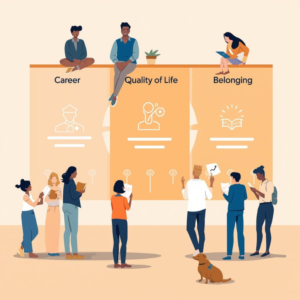
The narrative foundation of Work in the Triangle rested on a holistic value proposition: talent thrives at the intersection of career opportunity, quality of life, and community belonging.
The campaign moved away from the jargon-heavy, industry-only messaging typical of economic development. Instead, it crafted a relatable narrative:
- Career opportunity: The Triangle was presented as a place where cutting-edge jobs in life sciences, tech, and advanced manufacturing were not only available but growing rapidly. The message: you don’t have to be in Silicon Valley or Boston to be at the forefront of your industry.
- Quality of life: Campaign assets highlighted affordable housing, high-performing schools, diverse cultural amenities, and easy access to mountains and beaches within a few hours’ drive. National “best place to live” rankings were integrated into messaging to provide credibility.
- Diversity and inclusivity: The narrative made space for stories of international professionals, entrepreneurs of color, and women in STEM, ensuring the campaign reflected the region’s values.
Why It Worked
This framing shifted the conversation from “why should companies choose us?” to “why should people choose us?” In an era where talent drives site selection, that pivot was critical. By weaving lifestyle with opportunity, Work in the Triangle created a more human, aspirational story. It was not just about buildings and tax rates—it was about building a life.
Growing Places: Communication Strategies for Economic Development and Public Finance Agencies
This article is part of our series on strategic communication for Economic Development organizations, including state and local economic development agencies, regional partnerships, and business attraction initiatives. To learn more and to see the parent article, which links to other content just like this, click the button below.
Multi-Channel Communication Execution
The execution of Work in the Triangle was both broad and layered, ensuring that messages reached diverse audiences through multiple channels.
- Digital Hub (WorkintheTriangle.com): The campaign created a centralized portal where jobseekers could explore thousands of listings, learn about companies, and access relocation resources. Beyond jobs, the site included lifestyle guides, testimonials, and neighborhood spotlights.
- Social Media Activation: Work in the Triangle was one of the first economic development brands to fully embrace social media as a primary channel. Weekly hashtags such as #TriangleTuesdays showcased live job postings, while Instagram highlighted community festivals, breweries, and local entrepreneurs.
- Targeted Advertising: Paid campaigns on LinkedIn, Facebook, and Google Ads targeted professionals in competing metros. Ads were geofenced around airports and transit hubs in cities like New York and San Francisco, ensuring maximum visibility for traveling professionals.
- Earned Media & Storytelling: Local outlets like WRAL TechWire and national publications such as Forbes featured the Triangle’s rise as both a tech and lifestyle hub. WCED leaders and local entrepreneurs were positioned as thought leaders, adding authenticity.
- Trade Shows & National Events: At industry conferences like BIO International and SXSW, Work in the Triangle booths emphasized both business assets and lifestyle, combining data-driven pitches with immersive storytelling through video and VR tours.
- Local Integration: Campaign branding was visible at community events such as startup pitch competitions, cultural festivals, and workforce summits, embedding Work in the Triangle into the region’s identity.
Why It Worked
This multi-channel approach created redundancy and reach. A jobseeker might first encounter Work in the Triangle on LinkedIn, later see a lifestyle ad while traveling, and finally land on the website after hearing about a job opportunity. Each channel reinforced the next, building a cohesive and memorable impression.
Audience Segmentation and Targeting
 Work in the Triangle succeeded in part because it recognized that different audiences had different motivations. Instead of one-size-fits-all messaging, the campaign created tailored strategies for key groups:
- Young Professionals: Ads targeted millennials and Gen Z workers seeking affordable housing and career mobility. Messaging emphasized Raleigh-Durham’s thriving cultural scene, breweries, and arts venues.
- Experienced STEM Professionals: Campaigns aimed at mid-career workers in life sciences and IT highlighted the region’s role in gene therapy, data science, and government contracting.
- International Talent: Messaging emphasized the Triangle’s growing international community and resources for newcomers, appealing to global professionals.
- Local Graduates and Alumni: Partner universities promoted Work in the Triangle to current students and alumni networks, encouraging talent to stay or return after stints elsewhere.
- Employers: Companies were encouraged to co-brand job postings and use Work in the Triangle assets in their own recruitment campaigns.
Why It Worked
By meeting each group where they were—whether focused on affordability, opportunity, or belonging—the campaign avoided the trap of vague generalities. Each audience felt seen and understood, which built credibility and engagement.
Visual Identity and Brand Integration
Work in the Triangle built a strong visual identity designed to signal vibrancy and inclusivity.
- Logo & Tagline: The geometric logo referenced the three corners of the Triangle, while the tagline “Where Talent Thrives” directly reinforced the campaign’s purpose.
- Color Palette: Energetic hues like teal, orange, and cobalt blue conveyed innovation and approachability.
- Imagery: Photography highlighted diverse professionals, vibrant downtown streetscapes, coworking hubs, and natural spaces, presenting a well-rounded lifestyle.
- Consistency: Whether on a billboard, a social feed, or a trade show booth, the brand assets created instant recognition.
Why It Worked
Consistency across touchpoints built trust. For professionals considering relocation, familiarity with a brand signals legitimacy. Employers saw the branding as modern and credible, making them more likely to align their own recruitment campaigns with it.
Community Engagement Tactics
Work in the Triangle prioritized authentic engagement with the community.
- Employer Partnerships: Hundreds of employers—from startups to Fortune 500s like SAS, Lenovo, and Red Hat—listed jobs on the Work in the Triangle portal and co-branded recruitment.
- University Collaborations: Career services offices at Duke, UNC, and NC State integrated the brand into alumni outreach, job fairs, and career portals.
- Storytelling with Locals: Campaign videos and social features profiled local entrepreneurs, artists, and young professionals, creating a chorus of authentic voices.
- Networking Events: “Triangle Talent Jams” brought together jobseekers, recruiters, and entrepreneurs, making the brand tangible through in-person experiences.
- Cultural Partnerships: Local festivals, sports teams, and arts organizations featured Work in the Triangle branding, ensuring the campaign was visible beyond strictly economic spaces.
Why It Worked
This engagement built authenticity. Rather than a top-down government initiative, Work in the Triangle felt like a community-driven identity that belonged to both employers and residents. That credibility resonated strongly with newcomers.
Communication Lessons
1. Talent is the Cornerstone of Competitiveness
 In the past, economic development organizations (EDOs) often emphasized land availability, incentive packages, or low taxes as the primary levers for attracting companies. Work in the Triangle demonstrated a crucial shift: talent is now the driving factor in business attraction and retention. Employers consistently report that access to a skilled, reliable, and diverse workforce outweighs many other considerations when deciding where to locate.
By putting talent front and center, the campaign anticipated and aligned with site selection trends. It acknowledged that even the most attractive business climate will fall flat if employers cannot hire the people they need. This lesson reminds EDOs everywhere that workforce messaging cannot be secondary—it must be the lead story.
2. Lifestyle Narratives Drive Decisions
For knowledge workers—engineers, researchers, designers, and entrepreneurs—career opportunity is only part of the equation. Where they live, how much it costs, what cultural amenities are available, and whether they feel part of a vibrant community all weigh heavily in decision-making.
Work in the Triangle succeeded because it told a whole-life story: it featured affordable housing compared to coastal metros, access to greenways and beaches, and nationally ranked school systems. These messages complemented the career opportunities in life sciences and tech, painting a picture of a balanced life.
The takeaway is that economic development branding must go beyond “work” to encompass “live” and “play.” This holistic framing ensures campaigns resonate emotionally, not just rationally.
3. Digital Must Be Balanced with Human Connection
Work in the Triangle invested heavily in digital—job portals, LinkedIn campaigns, social storytelling—but it also recognized the enduring importance of human connection. Talent Jams, alumni events, and employer partnerships created in-person touchpoints where the brand became tangible.
The balance between digital scalability and face-to-face authenticity was critical. Digital platforms cast a wide net, but personal interactions built trust and closed the loop. Without the in-person element, the campaign risked being dismissed as “just marketing.” With it, Work in the Triangle gained credibility and became embedded in community culture.
The broader lesson: digital-first campaigns must still plan for authentic, offline engagements to anchor their promises in real experiences.
4. Diversity Strengthens the Brand
Modern workers increasingly seek not only opportunity but also environments that reflect inclusivity and equity. Work in the Triangle leaned into the region’s growing diversity by featuring immigrant entrepreneurs, women in STEM, and professionals of color in its storytelling.
This wasn’t tokenistic—it was aligned with reality. The Research Triangle has one of the fastest-growing international populations in the U.S., and highlighting that diversity made the brand feel more authentic. It also broadened appeal to global talent pools and reassured companies that the region could support diverse recruitment.
The communication lesson here is that inclusivity is not just a moral imperative; it is a competitive advantage. Campaigns that avoid or ignore diversity risk alienating key audiences, while those that embrace it strengthen their attractiveness and credibility.
5. Consistency Builds Credibility
From its geometric logo to its tagline (Where Talent Thrives), Work in the Triangle delivered consistent visuals and messages across every channel. Whether a jobseeker encountered the brand on a billboard, a social media post, or a university career portal, the look, tone, and story aligned.
That consistency did more than build recognition; it built trust. In a crowded space where regions compete aggressively for talent, inconsistency can signal disorganization or lack of seriousness. Conversely, Work in the Triangle’s coherence made it appear professional, credible, and enduring.
The lesson is clear: EDOs must treat branding with the same rigor as major consumer companies. Every campaign element should align with a unified brand architecture so that repetition strengthens recall and believability.
6. Alumni Networks are Gold Mines
One of the less obvious but most impactful elements of Work in the Triangle was its focus on alumni. The region’s universities produce tens of thousands of graduates each year, many of whom leave for jobs in Boston, San Francisco, or New York. By targeting alumni with “Come Home to the Triangle” messaging, the campaign tapped into an emotionally resonant audience: people who already had roots in the region.
This strategy proved especially effective for mid-career professionals considering relocation for family or lifestyle reasons. Alumni often bring back not only themselves but also expanded networks, new skills, and capital.
The communication lesson: do not overlook the “boomerang” effect. Alumni are a ready-made audience for attraction campaigns, and messaging that appeals to belonging and nostalgia can be more persuasive than any tax incentive.
7. Authentic Storytelling Outperforms Slogans
Ultimately, the heart of Work in the Triangle was its stories: videos of real professionals, profiles of local entrepreneurs, social features of families who relocated. These stories turned abstract promises into lived reality. They helped audiences imagine themselves in the region because they saw others like them thriving there.
This reflects a broader shift in communication: people trust peers more than institutions. By elevating community voices, WCED avoided the pitfall of sounding like a marketing agency and instead came across as amplifying authentic experiences.
The lesson: authenticity is the new currency of trust. Campaigns must prioritize storytelling that reflects real voices, not just polished taglines.
Conclusion
The Work in the Triangle campaign demonstrates how regions can reposition themselves in the talent economy. By focusing on the human side of economic development (career, lifestyle, and belonging), it succeeded in attracting not only companies but also the people those companies need to thrive.
Its lessons are widely applicable: build a brand rooted in real assets, tell authentic stories, integrate across digital and physical channels, and most importantly, treat talent as your primary customer. For Wake County and the broader Triangle, this approach has helped ensure that the region continues to be one of the most competitive, livable, and innovative hubs in the United States.
Ready to Elevate Your Agency’s Public Communication?
We understand the unique challenges state and local government agencies face—from complex issues to diverse community needs. Our comprehensive approach can help you transform the way you connect with constituents, improve transparency, and highlight the valuable work your agency does every day.
Interested in learning more? Reach out to us today for a consultation. We’d love to discuss how our services can support your goals and help you build lasting trust with the communities you serve.