
Accessibility in Park Communications: Ensuring Every Visitor Feels Included
Accessibility is not only a legal requirement. It is a communication philosophy that ensures every visitor, regardless of ability, background, age, or familiarity with the outdoors, can participate confidently and safely. Across parks and recreation agencies, wildlife agencies, outdoor recreation departments, and park districts, accessibility expectations have expanded. Many visitors now look for multimodal communication options, inclusive signage, and information systems that reduce uncertainty. Agencies that adapt to these expectations build environments where visitors feel recognized, informed, and welcomed.
Parks and recreation spaces are designed to serve diverse communities. Families arrive with strollers, mobility devices, or visual limitations. Older adults may need clear surface descriptions or wayfinding cues at predictable intervals. Visitors with sensory sensitivities may require quieter zones or visual alternatives to audio announcements. Wildlife agencies also serve visitors who rely on detailed habitat descriptions, closed captioning for digital education, or simplified alerts that make safety information easier to absorb.
The purpose of accessible communication is not only functional. It is emotional. Communication that feels inclusive increases confidence, reduces frustration, and encourages deeper connection to nature. Visitors who feel supported return more often. They engage more fully with programming and develop stronger stewardship behaviors. Agencies that communicate inclusively show that accessibility is not a special feature. It is a fundamental part of visitor experience management.
This article explores how agencies can design and sustain accessible communication systems that work across platforms, seasons, and user groups. It focuses on practical strategies that help organizations shift from compliance thinking to hospitality thinking so every visitor experiences the environment without barriers.
Refining What Accessibility Means in Outdoor Settings
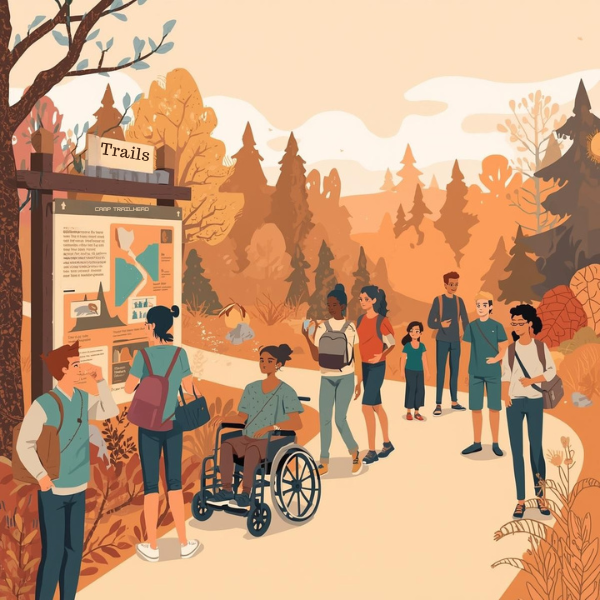 Accessibility in outdoor environments differs from accessibility in urban or built environments. Trails shift with weather. Surfaces change from gravel to packed dirt to sand. Wildlife patterns alter the landscape. Lighting varies significantly across the day. Outdoor recreation departments must therefore interpret accessibility as an adaptive, seasonally informed practice rather than a static checklist.
Agencies often assume accessibility refers only to physical accommodations. In reality, communication accessibility includes cognitive clarity, sensory comfort, and emotional reassurance. A trail may be technically accessible but still feel unreachable if visitors cannot understand the signage, the website lacks descriptive information, or maps do not reflect real world conditions. Accessibility requires both accurate information and approachable information.
Families rely on accessible communication to help children manage expectations. Older adults depend on it to avoid uncertainty that could lead to anxiety or risk. Visitors with disabilities depend on it to assess whether the environment supports their independence. Wildlife agencies also recognize that neurodiverse visitors may interpret sound, light, or movement differently, making communication predictability essential.
Accessible communication is not intended to simplify the experience. It is intended to clarify it. When communication systems fail, visitors work harder to interpret the environment and compensate for missing information. When communication systems succeed, visitors feel aligned with the landscape rather than at odds with it.
From Trails to Tweets: Effective Communication Strategies for Parks, Recreation, Outdoors, and Wildlife Agencies
This article is part of our series on strategic communication for Parks, Recreation, Outdoors, and Wildlife agencies. To learn more and to see the parent article, which links to other content just like this, click the button below.
Why Accessibility Matters for Visitor Trust
Trust develops when visitors believe an agency anticipates their needs and communicates in ways that support them. This trust is essential for safety messaging, rule interpretation, and stewardship campaigns. When visitors trust the information system, they respond more constructively to guidance about wildlife behavior, seasonal closures, or risk conditions.
Visitors form first impressions long before they read a trail sign. Their experience begins on the agency’s website or mobile tools where accessibility gaps often appear. If text is dense, contrast is poor, or descriptions are vague, visitors may assume the on site experience will also be confusing. Agencies that invest in accessible digital communication set the tone for an inclusive on site experience.
Trust also develops when visitors feel communication is spoken to them, not around them. For example, multilingual visitors may lose confidence if interpretive materials exist only in English. Visitors with limited outdoor experience may feel unwelcome if messaging assumes a high level of technical knowledge. Individuals using mobility devices may feel discouraged if trail descriptions do not accurately reflect incline, width, or stability.
Parks and recreation agencies that communicate clearly and compassionately build credibility. Wildlife agencies that use accessible language when describing habitat restrictions or seasonal closures create stronger compliance. Park districts that anticipate sensory needs in signage placement help visitors feel emotionally safe. In all cases, accessible communication signals an agency’s commitment to inclusion.
Barriers Visitors Commonly Experience When Communication Is Not Accessible
Many accessibility challenges are not obvious. They often arise when communication assumes knowledge, ability, or familiarity that visitors do not have. These challenges affect visitors across all demographics, including families, older adults, newcomers to outdoor recreation, and people with disabilities.
Common barriers include:
- Unclear trail descriptions that fail to explain slope, surfacing, or seasonal variation in conditions.
- Small or low contrast signage that is difficult for visitors with visual differences to read.
- Overreliance on text without complementary icons or simplified explanations.
- Audio only announcements that do not support visitors with hearing loss or sensory sensitivities.
- Digital information that lacks alt text or structured navigation, making it inaccessible for screen reader users.
- Maps that do not reflect real conditions, leaving visitors uncertain about what is accurate or outdated.
- Inconsistent terminology, especially when multiple agency divisions produce public materials.
- High cognitive load created by complex instructions or crowded message boards.
These barriers limit participation not because visitors lack interest but because communication systems unintentionally increase effort, uncertainty, or risk. Outdoor recreation departments respond most effectively when they identify patterns in visitor confusion and redesign communication systems to be more intuitive and inclusive.
When agencies address accessibility barriers proactively, they expand the population that can safely and comfortably use outdoor spaces. This strengthens stewardship, increases participation in programs, and demonstrates a commitment to public service.
Understanding Accessibility as a Visitor Experience Strategy
Accessibility is often framed as a compliance activity. Yet agencies benefit when they view it as a visitor engagement strategy that enhances clarity, reduces operational strain, and strengthens public satisfaction. When communication is accessible, staff spend less time answering repetitive questions. Visitors make more informed decisions. Risk decreases. Complaints decline. Engagement rises.
Parks and recreation agencies that embrace accessibility view communication as an anticipatory service. Wildlife agencies often do the same when designing safety campaigns that must reach diverse audiences. Park districts enhance program participation by ensuring registration materials are readable, bilingual, and simple to interpret. Outdoor recreation departments improve trail experiences by offering multiple formats of guidance rather than a single mode.
Accessible communication creates a supportive environment where visitors feel empowered. When people feel empowered, they behave more confidently and comply more readily with rules. They explore more areas of the park, engage with programming, and build stronger emotional connections to the landscape. Accessibility therefore becomes a catalyst for both operational efficiency and community impact.
Designing Accessible Signage That Supports Diverse Visitors
Signage functions as a silent guide. When it is accessible, visitors move through outdoor environments with confidence. When it is not, even simple routes feel complicated. Parks and recreation agencies, wildlife agencies, outdoor recreation departments, and park districts must design signage that serves visitors with a wide range of visual, cognitive, linguistic, and mobility needs.
Accessible signage is not purely informational. It shapes emotion, expectations, and comfort levels. It also plays a significant role in safety and stewardship. Visitors who cannot interpret signs quickly may miss important trail cues or misunderstand wildlife advisories. Families who cannot find restrooms or water stations easily experience unnecessary stress. Older adults may interpret poor signage as a sign that an agency does not fully consider their needs.
Effective accessible signage relies on clarity, consistency, and thoughtful placement.
Clear Visual Hierarchy
Visitors should be able to understand signs at a glance. A clear visual hierarchy uses predictable organization so the eye naturally lands on what matters first. This benefits visitors with visual processing differences, as well as families navigating movement with children who often cannot stop for long periods.
A strong hierarchy includes:
- Concise headings that communicate the purpose of the sign.
- Readable body text that avoids densely packed sentences.
- Iconography that reinforces meaning without requiring interpretation.
- Whitespace that reduces visual clutter.
Wildlife agencies benefit from predictable hierarchy when sharing hazard information. For example, a large icon of a bear or moose positioned above clear guidance helps visitors process safety expectations more quickly.
Older adults appreciate hierarchy because it reduces cognitive load. They can determine instantly whether a sign relates to navigation, safety, or general information.
Readable Typography and Contrast
Typography affects how well visitors understand information, particularly in outdoor settings where lighting shifts throughout the day. Agencies should choose fonts that are simple, high contrast, and legible from a distance. Overly decorative fonts or condensed lettering can hinder readability.
Parks and recreation agencies often adopt font standards that ensure consistency across all facilities. Outdoor recreation departments sometimes test signage under different light conditions, including bright midday sun, heavy shade, early morning glow, and artificial lighting.
Color contrast is equally important. High contrast combinations, such as dark text on a light background or light text on a dark background, support visitors with low vision. Wildlife agencies working in forested areas often avoid green-on-brown palettes because they blend into the environment.
Consistency across the system matters more than individual sign styling. When visitors recognize the typography system, they interpret new information more quickly.
Placement That Supports Accessibility
Even the clearest sign fails if it cannot be seen. Placement affects accessibility more than many agencies realize. Park districts frequently assess sign height, angle, and proximity to travel paths to ensure visitors can read signs without strain.
Key considerations include:
- Height: Signs should be readable for wheelchair users, children, and adults without requiring physical repositioning.
- Angle: Tilting information panels slightly upward supports readability for mobility device users and reduces glare.
- Proximity: Signs placed too far from decision points lose their usefulness. Signs placed too close to trail junctions may overwhelm visitors.
Outdoor recreation departments benefit from thinking about how visitors physically move through spaces. Families travel differently than solo hikers. Mobility device users take alternate routes around obstacles. Older adults often pause more frequently. Signage placement must anticipate these patterns.
Wildlife agencies also consider ecological constraints. Signs must not obstruct habitat or introduce visual noise that disrupts scenic value. Accessibility solutions must therefore balance environmental and visitor needs.
Designing Accessible Trail Maps and Wayfinding Systems
Trail maps are communication tools. They shape how visitors orient themselves, understand distances, estimate effort, and make safety decisions. When trail maps are accessible, visitors feel capable and confident. When they are not, visitors feel lost even before leaving the trailhead.
Parks and recreation agencies, outdoor recreation departments, and wildlife agencies increasingly treat maps as part of the visitor experience rather than static reference material.
Descriptive Information That Supports Decision Making
Traditional maps emphasize terrain, distance markers, and trail shapes. Accessible maps add context that supports planning for visitors of varying abilities. This includes surface type, slope rating, rest points, shade availability, and water access.
Visitors with mobility limitations depend on accurate slope descriptions. Families appreciate notes about stroller friendly sections. Older adults rely on clear explanations of uneven surfaces or steep grades. Neurodiverse visitors benefit from predictable, structured descriptions that reduce surprise.
Agencies can also note seasonal variations. Winter conditions often alter trail difficulty. Summer heat can transform easy loops into strenuous outings. Wildlife agencies may adjust accessibility information when habitat restrictions temporarily close or reroute trails.
Accessible maps help visitors determine if a route matches their ability before they begin.
Simplified Layouts for Cognitive Accessibility
Complex maps overwhelm visitors who struggle with spatial processing or who are unfamiliar with outdoor recreation. Simplified layouts, which highlight only key paths and landmarks, provide clearer guidance than detailed topographic models.
Outdoor recreation departments often publish two map versions. One version includes full detail for experienced users. Another version uses simplified lines, high contrast landmarks, and clear icons for entry level users. Families, new visitors, and older adults frequently prefer the simplified version.
Maps should avoid unnecessary decoration or overly intricate legend systems. Reducing cognitive load helps all visitors navigate more efficiently.
Multiple Formats for Inclusion
Accessible wayfinding extends beyond printed maps. Agencies should offer maps in multiple formats to meet diverse needs.
- Digital versions that support screen readers.
- Large format boards at trailheads.
- Tactile maps for visitors with visual impairments.
- Simplified pocket maps for families and older adults.
Wildlife agencies sometimes integrate QR codes that link to audio trail descriptions or interpretive storytelling. Park districts may offer bilingual or multilingual versions, especially in regions with culturally diverse populations.
When visitors can choose the format that best supports their abilities, navigation becomes inclusive rather than intimidating.
Improving Digital Accessibility Across Websites and Mobile Tools
Digital accessibility is often the first point of inclusion. Visitors plan trips using websites, apps, and online maps. If digital content is inaccessible, visitors may feel discouraged before setting foot on the property.
Parks and recreation agencies, outdoor recreation departments, and wildlife agencies must treat digital accessibility with the same seriousness as physical accessibility.
Structuring Content for Screen Readers
Many visitors rely on screen readers. Agencies can improve access by using descriptive headings, accurate HTML structure, alt text for images, and clear link descriptions.
Visitors who use assistive devices must be able to navigate information without confusion. Proper coding ensures that information reads in a logical order and that users do not get lost in repeated or unlabeled elements.
Agencies also benefit from offering transcripts for videos and audio clips. This supports visitors with hearing differences and helps multilingual visitors absorb information at their own pace.
Mobile Friendly Layouts
Most visitors expect to access information from their phones. Summer visitors look up heat alerts and crowd updates. Winter visitors check trail conditions. Wildlife agencies rely on mobile platforms to deliver real time safety messages or wildlife advisories.
Accessible mobile layouts prioritize:
- Text that scales without distortion
- Buttons large enough for easy tapping
- Menus that do not collapse into overly complicated structures
- High contrast modes for bright outdoor light
Mobile accessibility intersects with equity. Some visitors rely solely on smartphones for information access. Designing with mobile first principles ensures that communication remains inclusive across communities.
Avoiding Overload and Reducing User Friction
Digital clutter prevents visitors from finding the information they need. Agencies often unintentionally overload their websites with dense paragraphs, stacked alerts, or endless menu layers. Visitors with cognitive processing differences experience frustration, and families quickly abandon navigation if information requires too much effort to interpret.
Outdoor recreation departments benefit from periodic content audits. Removing redundancies, simplifying descriptions, and grouping related information improves overall experience. Park districts often use intuitive icons and progressive disclosure techniques so visitors see broad categories first and deeper details only when needed.
Digital accessibility means not only offering multiple formats but ensuring those formats are approachable and usable.
Enhancing Audio, Visual, and Sensory Accessibility Across Outdoor Spaces
 Outdoor environments stimulate multiple senses at once, which can enrich a visitor’s experience while also creating challenges for those who process sensory information differently. Parks and recreation agencies, wildlife agencies, outdoor recreation departments, and park districts must recognize these dynamics when designing accessible communication systems. Accessibility in this context means helping every visitor interpret information comfortably, regardless of hearing ability, vision differences, or sensory sensitivity.
Sensory accessibility succeeds when agencies consider how information is delivered and how environmental factors shape visitor interpretation. It is not an add on feature but a foundational part of welcoming diverse communities.
Improving Audio Clarity and Providing Alternatives
Audio announcements remain useful for sharing safety alerts, program updates, or time sensitive information, yet sound alone cannot reach all visitors. People with hearing differences may miss critical cues. Visitors with auditory sensitivities may avoid areas where announcements feel overstimulating. Families with young children often navigate noisy environments where audio cues become difficult to discern.
Accessible audio communication begins with clarity. Spoken information should be delivered at a steady pace so visitors have time to process what they hear. Messages should avoid unnecessary technical language and focus on essential meaning. Wildlife agencies that rely on audio for seasonal wildlife advisories often discover that simplifying phrasing improves comprehension across all groups.
Every audio message should also exist in a visual format. A text panel near the announcement area, a quick digital push notification, or a captioned video can ensure the message reaches a broader audience. These redundancies support visitors who cannot hear well, visitors who prefer reading over listening, and multilingual visitors who process written language more effectively.
Older adults often appreciate visual reinforcement when ambient noise makes audio difficult to interpret. Parents appreciate text alternatives when juggling children who may not hear an announcement or may not understand its importance. When agencies provide multiple pathways to the same message, accessibility becomes an integrated system rather than a single accommodation.
Strengthening Visual Communication for Visitors With Low Vision
Visual accessibility extends far beyond increasing font size. Visitors with low vision benefit from thoughtful choices in color contrast, icon consistency, spacing, and layout. Outdoor environments introduce additional challenges such as glare, shadows, and rapidly shifting light conditions, which means visual communication must work in imperfect conditions rather than ideal ones.
Strong contrast between text and background remains the most important visual accessibility feature. Text that blends into the landscape, whether due to low contrast or environmental camouflage, increases effort for visitors and reduces confidence. Outdoor recreation departments often test signage in different lighting to ensure readability in early morning shade, bright afternoon sun, and cloudy conditions. Wildlife agencies operating in snowy regions also avoid pale palettes that vanish against winter landscapes.
Predictable typography helps visitors recognize information quickly. When all signs across a system use the same font family, weight, and spacing, visitors spend less time deciphering style variations and more time interpreting meaning. Families moving quickly toward restrooms, program areas, or trailheads benefit from typography that communicates instantly. Older adults often feel more secure when signage does not require squinting or interpretation.
Visual accessibility allows visitors to understand the landscape as the agency intends rather than through a series of guesses.
Supporting Visitors With Sensory Sensitivities
Visitors who experience sensory sensitivities often face challenges related to noise levels, crowd density, strong smells, unexpected movement, or visually busy environments. Agencies can reduce these stressors by designing communication that prepares visitors in advance and offers clear alternatives during the visit.
Some agencies identify quieter, low stimulation areas that provide a calming environment for individuals who need breaks from sensory intensity. These zones may be labeled on maps or described in digital materials so visitors can plan their route accordingly. Wildlife agencies sometimes use these areas to create quiet observation points for species viewing, which benefits both sensory sensitive visitors and the broader public.
Communication can help set expectations before visitors enter potentially stimulating environments. Notices that describe crowd levels during peak hours, potential wildlife sounds, or the presence of event related noise help visitors choose the experience that best matches their comfort level. For neurodiverse visitors and families with sensory sensitive children, predictability is one of the strongest supports an agency can offer.
Written alternatives to verbal instructions also help reduce sensory strain. Some visitors simply prefer the ability to read at their own pace. When agencies provide written maps, step by step guidance, or posted versions of verbal directions, they allow visitors to engage on their own terms.
Sensory accessibility shows visitors that their comfort and emotional wellbeing are considered parts of the outdoor experience.
Predictability Through Consistent Communication Patterns
Predictability is a cornerstone of accessible communication. Visitors feel more confident when they understand how an agency structures information, where to find guidance, and how messages are typically delivered. Predictability supports neurodiverse visitors, first time visitors, multilingual families, and older adults who may rely heavily on routine or clarity when navigating unfamiliar terrain.
Consistent iconography across signage, maps, brochures, and digital tools helps visitors recognize meaning quickly. When symbols repeat across different points in the environment, interpretation becomes intuitive. Consistent phrasing for safety alerts also reduces confusion. Visitors remember patterns more easily than isolated messages, which helps reinforce important behaviors.
Wayfinding markers that appear at predictable intervals reduce anxiety for visitors who worry about getting lost. Trail difficulty indicators that follow a consistent color system prevent misinterpretation. Wildlife agencies benefit from predictable visual language when communicating closures due to migration or sensitive habitat periods since visitors quickly learn how to interpret recurring color cues or shapes.
Predictability reduces cognitive load across all visitor groups. When communication feels stable and familiar, visitors focus more on the experience and less on deciphering information systems.
Creating Inclusive Interpretive Materials
Interpretive materials help visitors understand landscapes, wildlife, cultural history, and stewardship values. When these materials are accessible, they broaden participation and deepen visitor engagement. When they are not, entire groups feel disconnected from the educational mission of the site.
Interpretive design must support varied abilities, learning styles, ages, and cultural backgrounds. Agencies should treat interpretive communication as both an educational strategy and an inclusion strategy.
Writing Interpretive Content in Clear, Engaging Language
Interpretive panels often become overly scientific or text heavy. While depth is important, accessibility requires clarity. Writing should follow straightforward sentence structures and avoid jargon that creates unnecessary barriers. Messages should introduce ideas in logical sequences so visitors understand both context and relevance.
Agencies can increase clarity by grounding interpretive content in relatable concepts. Wildlife agencies often use storytelling approaches to explain habitat changes, migration patterns, or ecological relationships. Visitors engage more deeply when they can imagine the processes described rather than translate scientific terminology.
Families appreciate interpretive content that incorporates curiosity prompts, short reflections, or child friendly insights. Older adults benefit from content that avoids visual density or technical complexity. Neurodiverse visitors often prefer material that follows predictable rhythm and structure, using clear transitions and minimal distractions.
Clear interpretive writing does not simplify meaning. It expands access to meaning.
Offering Interpretive Materials in Multiple Formats
Interpretive systems reach more visitors when they allow for choice. Some visitors prefer reading. Others prefer listening. Some learn best through visuals or tactile experiences. Offering multiple formats ensures visitors can access information in a way that matches their abilities and preferences.
Large print versions of interpretive materials help visitors with low vision. Audio descriptions paired with displays provide support for visitors who cannot rely solely on sight. Videos with captions support visitors with hearing differences as well as multilingual audiences. QR codes can link to expanded digital stories or simplified summaries. Tactile features such as raised outlines or textured maps support visitors who benefit from hands on interpretation.
Outdoor recreation departments often incorporate multilingual elements, especially in diverse communities. Park districts sometimes create sensory friendly versions of interpretive content that avoid flashy animations or loud auditory components.
Interpretive flexibility honors the idea that learning styles differ and that outdoor spaces should accommodate those differences.
Reducing Cognitive Load in Interpretive Displays
Interpretive displays can overwhelm visitors when they present too much text, too many visuals, or too many concepts simultaneously. Reducing cognitive load makes interpretive content more accessible for visitors with attention differences, visitors unfamiliar with the subject matter, families with young children, and older adults who prefer slower processing.
Agencies can reduce cognitive load by breaking content into smaller segments, separating themes with clear subheadings, and removing extraneous details that distract from core messages. Visuals should guide the visitor rather than compete for attention, and layouts should follow predictable visual flow so visitors understand what they are meant to read first.
Outdoor recreation departments often test displays by observing where visitors pause, how long they stay, and which parts of the board they skip. These observations help refine design choices that promote clarity and reduce overload.
When cognitive load is minimized, interpretive materials become enjoyable rather than mentally demanding. Visitors retain more information and feel more connected to the content.
Designing Inclusive Safety Communication Systems
Safety communication lies at the intersection of clarity, trust, and accessibility. It must reach visitors who move at different speeds, interpret information differently, speak different languages, or have limited experience with outdoor environments. Parks and recreation agencies, wildlife agencies, outdoor recreation departments, and park districts must ensure safety messages remain understandable to every visitor regardless of ability.
Inclusive safety communication requires predictable structure, accessible language, and presentation formats that do not overwhelm. When visitors feel confident that they understand the information, they make better decisions and respond more constructively to guidance.
Creating Clear and Approachable Safety Messages
Visitors interpret safety messages through their own personal filters. Some arrive with high outdoor literacy and respond quickly to warnings. Others arrive with less experience and hesitate when the message feels technical or unclear. Accessible safety communication removes ambiguity by focusing on simplicity and directness.
Instead of posting dense paragraphs that explain risk factors, agencies benefit from highlighting what visitors must do, why it matters, and when it applies. Wildlife agencies often lead in this area when communicating about animal behavior or habitat sensitivity. Their most effective messages pair simple instruction with a brief explanation of purpose, which helps visitors accept the guidance rather than pushing back against it.
Older adults appreciate safety messaging that avoids urgency language unless it is necessary. Families appreciate messages that clarify rules for children without placing blame or assuming prior knowledge. Visitors with cognitive differences rely on steady, consistent phrasing that does not shift unexpectedly.
Accessible safety communication recognizes that not all visitors interpret risk the same way. It ensures that the intended meaning is unmistakable.
Supporting Visitors With Varying Levels of Outdoor Experience
Some visitors arrive with decades of outdoor experience. Others arrive with little or no knowledge of trail etiquette, wildlife behavior, or seasonal hazards. Communication must support both ends of the spectrum without patronizing experienced users or overwhelming new ones.
Agencies can bridge this gap by presenting layered information. A simple version of the safety message should appear prominently for everyone. Additional context can appear nearby or through QR codes for visitors who want deeper detail. Park districts often adopt this approach when explaining water safety at beaches or lakes where the audience spans a wide range of familiarity.
Outdoor recreation departments also use layered communication when describing seasonal hazards such as ice, heat, or flooding. A concise message sits at the surface. Visitors who need more information can access extended explanations, hazard maps, or step by step guidance.
Layering ensures accessibility by letting each visitor choose the level of detail that supports their comfort and decision making.
Using Multiple Modalities to Increase Comprehension
Safety communication becomes more inclusive when agencies deliver information in formats that support different sensory and cognitive needs. Written signs provide stability. Audio or spoken messages offer immediacy. Visual cues create quick interpretation. Digital tools provide depth.
Wildlife agencies regularly combine modalities when communicating about active wildlife zones or seasonal closures. They may place a sign at the trailhead, send a push notification through a mobile platform, and provide a map update simultaneously. When information appears in more than one format, visitors are less likely to miss it.
Families often rely on multimodal cues because children may not read signs thoroughly. Visual symbols or simple illustrations help them understand what behavior is expected. Older adults often prefer written or printed reinforcement when environmental noise or auditory limitations make spoken communication less effective.
Multimodal communication anticipates visitor diversity and reduces the likelihood that any group feels excluded.
Ensuring Safety Information Reaches Visitors With Disabilities
Many visitors with disabilities require information delivered in specific formats. Visitors with visual impairments may rely on tactile cues or audio descriptions. Visitors with hearing impairments may depend on captioned videos or written announcements. Visitors with cognitive disabilities may need simplified instructions or predictably structured safety reminders.
Parks and recreation agencies that consider these needs during message design benefit from greater compliance and visitor satisfaction. For example, a safety alert written in plain language supports visitors who process text more slowly. An interpretive panel that includes a tactile element supports those who absorb information through touch. A QR code linked to a captioned video supports visitors who cannot hear spoken instructions.
Outdoor recreation departments may also publish safety summaries in multilingual formats to ensure wider access. This strengthens equity by acknowledging that language can be a barrier just as much as physical design.
Accessibility is not achieved through a single modification. It requires agencies to consider multiple perspectives and design content that can be understood by all.
Anticipating Emotional Response in Safety Communication
Safety messages do more than relay facts. They shape emotional response. When messages feel overly harsh or alarming, visitors may experience anxiety or defensiveness. When messages feel vague, they may underestimate real dangers. Accessibility requires messaging that acknowledges visitor emotion and guides behavior without fear or confusion.
Calm, direct phrasing reduces unnecessary stress. Instead of saying that a trail is extremely dangerous, agencies can clarify that conditions require specific preparation or that certain user groups should consider alternate routes. Wildlife agencies communicating about bear activity often emphasize preparedness rather than alarm, which helps visitors remain attentive without becoming overwhelmed.
Families respond well to messages that provide reassurance by explaining how to stay safe rather than only listing risks. Older adults appreciate messages that validate their desire for stability and predictability. Neurodiverse visitors benefit from predictable emotional tone that does not fluctuate suddenly from casual to urgent without explanation.
When agencies treat emotional response as part of accessibility, safety communication becomes more respectful, more helpful, and more likely to influence behavior positively.
Creating Accessible Emergency Communication Systems
Emergency communication is one of the most challenging aspects of accessibility. Emergencies unfold quickly, and information must be delivered rapidly across diverse visitor groups with varying abilities. Parks and recreation agencies, wildlife agencies, outdoor recreation departments, and park districts must prepare systems that can reach everyone, even those who may not detect audio alarms, read text quickly, or interpret complex instructions.
Accessible emergency communication reduces the chances of panic and increases the likelihood of orderly, safe response.
Designing Messages Visitors Can Interpret Under Stress
Emergencies impair cognitive processing. Visitors may struggle to read long sentences, interpret metaphors, or follow complex directions. Accessible emergency communication uses direct instructions, clear sequencing, and neutral tone.
Visitors interpret short, action based sentences more effectively during stress. They also rely on consistency. Agencies that use the same phrasing across drills, signs, and alerts create familiarity that reduces confusion during real emergencies. Wildlife agencies working in wildfire prone regions often rely on repeated, recognizable templates so visitors know immediately what to do when they receive an alert.
Families, older adults, and visitors with cognitive disabilities benefit especially from straightforward steps. Predictability supports calm decision making even in unfamiliar environments.
Preparing Multiple Redundant Channels
Emergency messages must travel quickly and reliably. Agencies should assume that some visitors will not hear alarms, some will not see text alerts, and others may be offline. Redundancy ensures that at least one channel reaches each person.
Digital alerts can support rapid dissemination, but physical signage and staffed communication remain essential. Outdoor recreation departments that operate in areas with spotty connectivity often rely on a combination of temporary signage, ranger presence, and radio communication to reach isolated visitors.
Redundancy also benefits multilingual communities. When agencies publish emergency templates in multiple languages, visitors understand that the system acknowledges their needs and seeks their safety.
Supporting Visitors Who Need Additional Processing Time
During emergencies, some visitors need more time to interpret information. This includes individuals with cognitive disabilities, non native speakers, families with young children, and older adults. Agencies can support these groups by offering calm, repeated messages instead of rapid, overwhelming streams of information.
Staff training becomes critical. Parks and recreation agencies often prepare seasonal workers to communicate emergency steps patiently, using simple phrases and gestures. Wildlife agencies operating remote areas sometimes train volunteers to escort visitors who need hands-on guidance during evacuations or shelter in place procedures.
When agencies provide patient, steady support, emergency communication remains inclusive even under intense pressure.
Strategic Communication Support for Your Parks and Recreation Agency
 Accessible communication systems do not emerge by accident. They require structure, alignment, and long term planning that supports every visitor, regardless of ability. Stegmeier Consulting Group (SCG) partners with organizations that want to strengthen their communication infrastructure so it becomes more predictable, more inclusive, and more supportive of diverse audiences. People at parks and recreation agencies, wildlife agencies, outdoor recreation departments, and park districts often choose to work with an external resource like SCG when they recognize the need for consistent messaging frameworks that can adapt across seasons and operational demands.
SCG’s approach centers on systems thinking. Accessibility improves when agencies adopt communication processes that scale across maps, signage, digital platforms, staff briefings, and emergency protocols. Instead of addressing accessibility one element at a time, SCG helps organizations align the entire communication ecosystem so that visitors experience clarity at every stage of their journey.
This partnership does not replace the work already happening within agencies. It enhances it. SCG supports teams as they refine internal workflows, establish message standards, introduce visitor friendly language patterns, and evaluate barriers that prevent certain groups from feeling included. SCG’s focus on long term sustainability ensures agencies can maintain accessibility and clarity even as staff change, conditions shift, or visitor expectations evolve.
When agencies strengthen their communication systems, they expand access. They reduce confusion. They create environments where visitors of all abilities feel capable, welcome, and supported. SCG works alongside agencies to build the structures that make this possible.
Conclusion
Accessibility is a commitment to every visitor’s experience. It is a promise that the outdoors belongs to everyone, regardless of ability, familiarity, or comfort level. Parks and recreation agencies, wildlife agencies, outdoor recreation departments, and park districts have the opportunity to design communication systems that honor this promise by anticipating diverse needs and reducing unnecessary barriers.
Accessible communication improves safety, enhances visitor satisfaction, and reinforces public trust. When visitors understand signage, maps, programs, and safety messages without strain, they move through the environment with confidence. Families feel supported. Older adults feel respected. Visitors with disabilities feel included. Newcomers to outdoor recreation feel encouraged to return.
Accessibility also strengthens stewardship. Visitors who feel welcomed and capable are more likely to follow rules, respect wildlife, participate in programs, and support conservation initiatives. Communication that is predictable, inclusive, and compassionate transforms outdoor spaces into communities built around shared responsibility.
The path to accessibility is ongoing. It requires reflection, adaptation, and consistent message design. Agencies that approach accessibility as a strategic investment rather than a compliance task create environments that reflect their mission and deepen their impact on the public they serve.
SCG’s Strategic Approach to Communication Systems
Align your agency’s messaging, processes, and public engagement strategies
Agencies that communicate effectively build stronger trust with staff, stakeholders, and the public. Whether you are implementing QR code systems, improving internal communication workflows, or strengthening agency wide alignment, SCG can help you develop a communication system that supports consistent decision making and long term organizational success. Use the form below to connect with our team and explore how a strategic communication framework can elevate your agency’s impact.